

Published
 Why Australians are moving overseas for a lower cost of livingEveryday living costs in the main overseas destinations, compared with the same costs in Australia.
 Are more Australian citizens leaving than arriving?Departures and returns of Australian citizens year by year, and how the two flows compare.
Section 01 · The total
How many Australians live overseas?
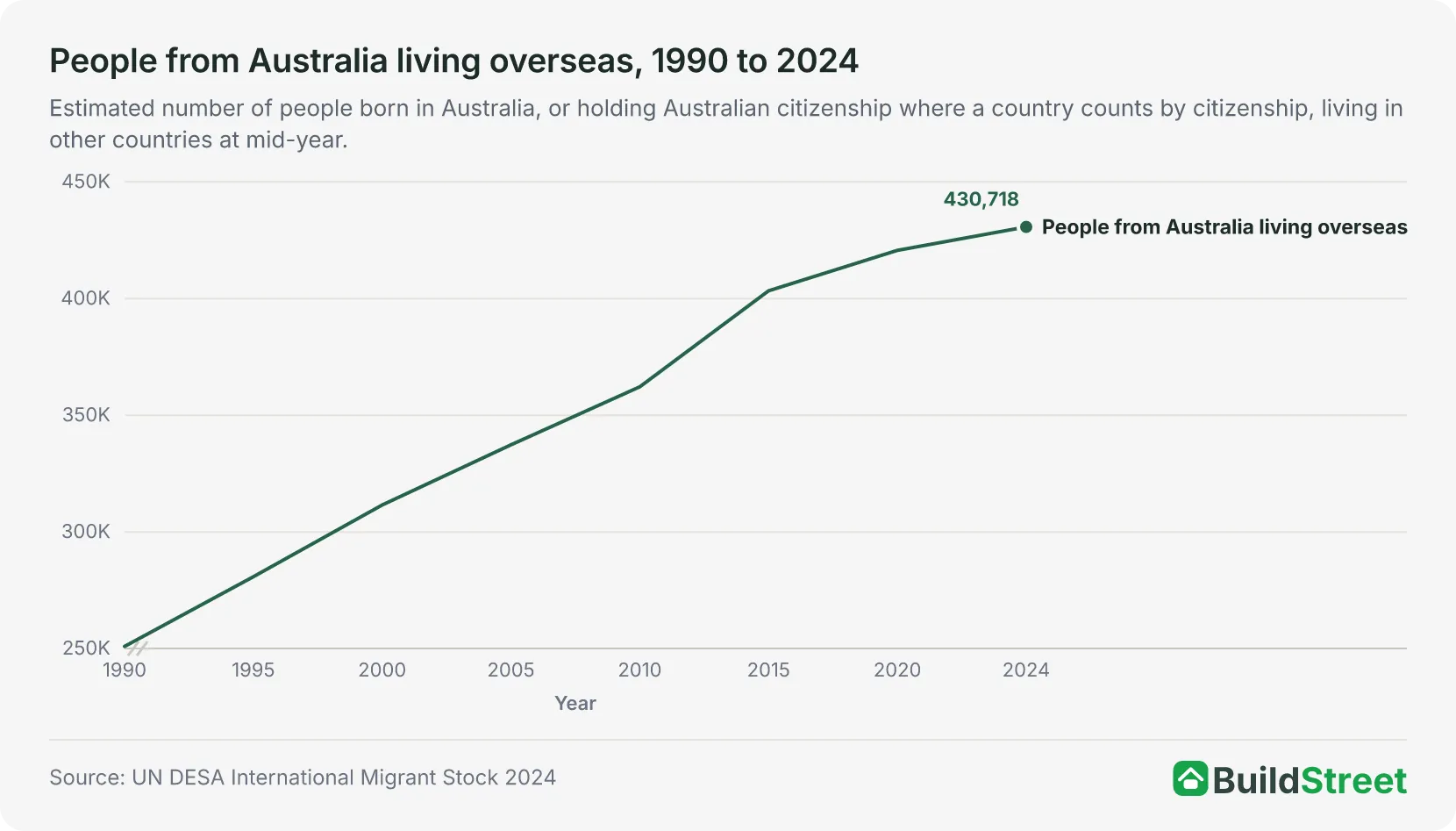
An estimated 430,718 people born in Australia or, in some countries, holding Australian citizenship lived in other countries in mid-2024, according to the United Nations Department of Economic and Social Affairs (UN DESA) International Migrant Stock 20241.
The estimate increased from 250,909 in 1990 to 430,718 in 2024, a rise of 71.7 per cent1. Between 2020 and 2024, the number increased by 10,046 people, or 2.4 per cent, from 420,672 in 2020.
Europe accounted for 216,768 people from Australia in mid-2024, equivalent to 50.3 per cent, while New Zealand and other Pacific countries accounted for 102,569, or 23.8 per cent1. Asia accounted for 71,275, or 16.5 per cent, and Northern America for 26,957, or 6.3 per cent.
Sixteen countries, including China, Japan, Papua New Guinea, India, Indonesia and the Philippines, count Australian citizens rather than people born in Australia. Together, these countries accounted for 43,061 of the 430,718 people in the estimate1. In Asia, 32,600 of the 71,275 were counted as Australian citizens rather than by birthplace.
The estimate covers only the countries that report Australia as a separate country of origin. Australian-born residents of the United States, Spain, Thailand and Vietnam are not included separately in these figures, so the Northern America figure is almost entirely Canada, at 26,777 people1.
Yearly departures of people leaving Australia are covered in Australia: emigration statistics 2024-25.
Section 02 · UK, NZ and US
How many Australians live in New Zealand, the UK and the US?
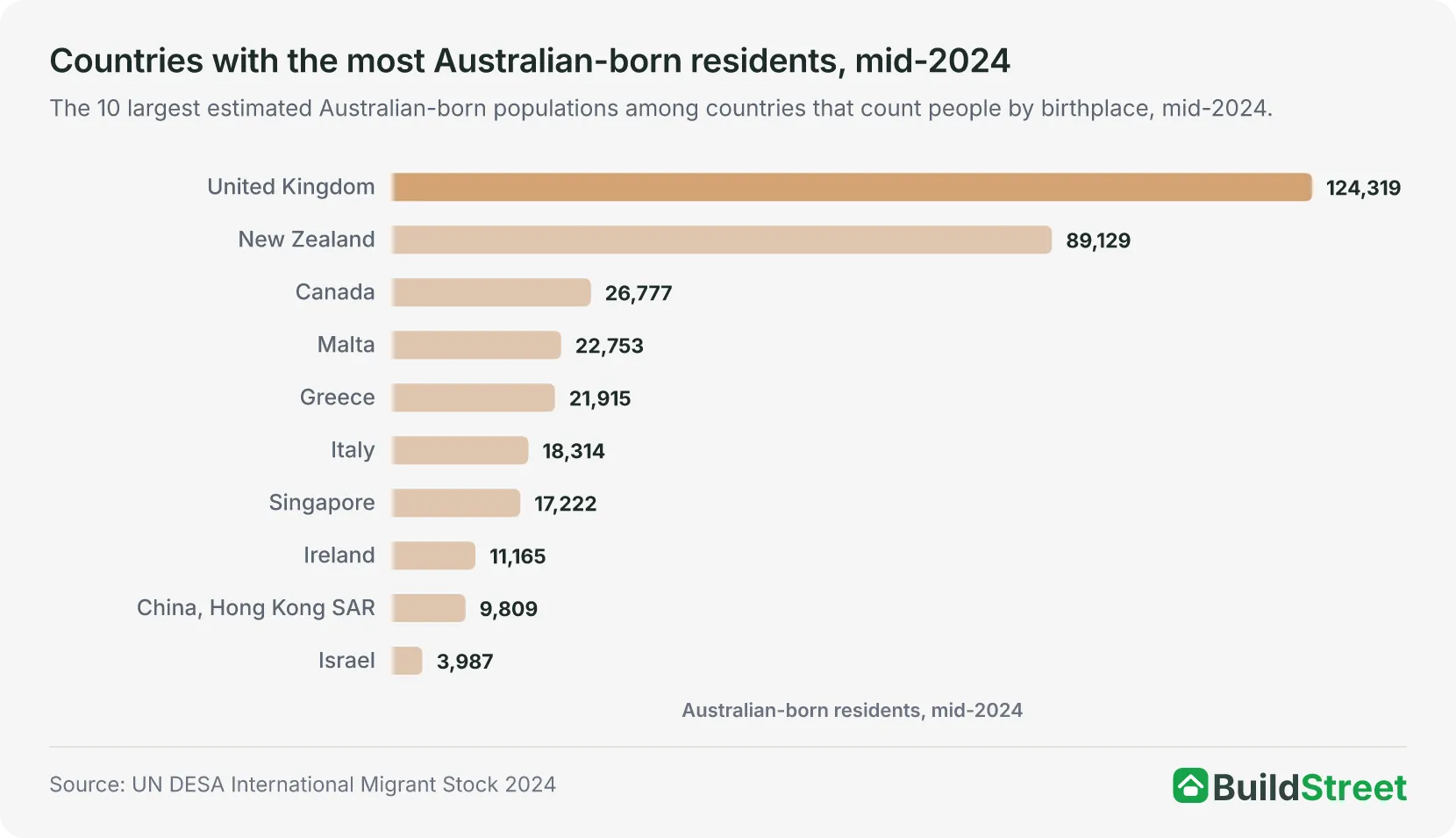
The United Kingdom had the largest Australian-born population among countries that report Australia as a separate country of origin, at 124,319 people in mid-20241. New Zealand recorded the second-largest, at 89,129 people.
The two countries accounted for 49.6 per cent of the 430,718 people from Australia living overseas included in the UN DESA estimate1.
The Australian-born population of the United Kingdom decreased from 125,672 in 2015 to 124,319 in 2024, while the Australian-born population of New Zealand increased from 68,984 to 89,1291.
UN DESA does not report Australia as a separate country of origin for the United States. The US Census Bureau estimated 112,037 Australian-born residents in 2024, with a margin of error of about 7,058 at a 90 per cent confidence level3.
The US estimate was lower than the estimate for the United Kingdom but higher than New Zealand's. Both differences were larger than the survey's margin of error3.
New Zealand's 2023 Census counted 86,322 residents of New Zealand born in Australia, an increase of 14.0 per cent from 75,696 in 20184. The Office for National Statistics (ONS) counted 112,971 Australian-born residents of England and Wales in its 2021 Census, excluding Scotland and Northern Ireland5.
| Australian-born residents of the United Kingdom, New Zealand and the United States, by source | ||||
|---|---|---|---|---|
| Country | UN DESA estimate, mid-2024 | Destination-country count | Year of count | Destination-country source |
| United Kingdom | 124,319 | 112,971 (England and Wales) | 2021 | ONS Census 2021 |
| New Zealand | 89,129 | 86,3224 | 2023 | Stats NZ 2023 Census |
| United States | Not reported | 112,037 (±7,058) | 2024 | US Census Bureau American Community Survey |
Source · UN DESA International Migrant Stock 2024, Table 1; ONS Census 2021, TS012; Stats NZ 2023 Census; US Census Bureau ACS 2024 1-year, B05006.
Section 03 · Fastest growth
Which countries have the fastest-growing Australian populations?
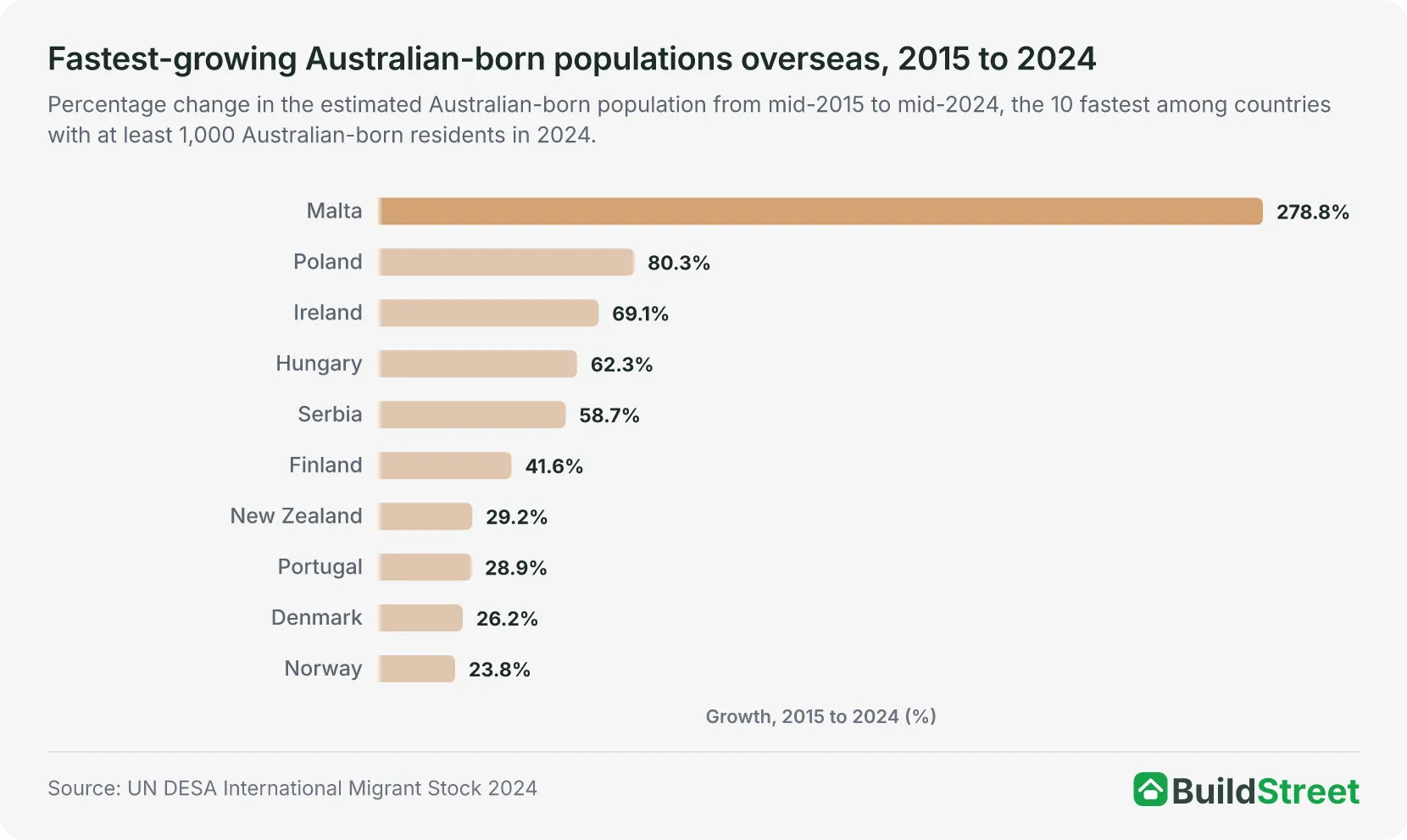
Malta recorded the fastest growth in its Australian-born population among countries with at least 1,000 Australian-born residents, at 278.8 per cent from 2015 to 20241. The Australian-born population of Malta increased from 6,006 in 2015 to 22,753 in 2024.
Poland recorded the second-fastest growth, at 80.3 per cent, from 1,153 to 2,079 people1. Ireland recorded the third-fastest, at 69.1 per cent, from 6,602 to 11,165.
New Zealand recorded the largest increase in Australian-born residents among countries that report Australia as a separate country of origin, at 20,145 people from 2015 to 20241. Malta recorded the second-largest increase, at 16,747 people.
Canada recorded the largest decrease in Australian-born residents among countries that count people by birthplace, from 30,029 in 2015 to 26,777 in 20241.
Japan's estimate of Australian citizens rose from 9,902 in 2010 to 34,359 in 2015 and was 11,962 in 20241.
UN DESA fully reassessed its estimates for 60 countries and areas in 2024. For the remaining countries and areas, the 2024 estimates extrapolate figures from its 2020 edition6.
Section 04 · Southeast Asia
How many Australians live in Southeast Asia?
Malaysia had an estimated 2,432 Australian-born residents in mid-20241. Indonesia had 1,940 Australian citizens and the Philippines had 1,489, counted by citizenship rather than birthplace.
UN DESA does not report Australia as a separate country of origin for Thailand or Vietnam1.
UN DESA's estimate for Malaysia remained at 2,432 or 2,433 people between 2000 and 2024, while its estimate for the Philippines was 1,489 in both 2020 and 20241.
Singapore recorded the largest Australian-born population among Southeast Asian countries that count people by birthplace, at 17,222 people in mid-20241. The Australian-born population of Singapore increased by 22.5 per cent from 14,060 in 2015.
| Australian-born residents or Australian citizens in Southeast Asia, 2015 and 2024 | |||
|---|---|---|---|
| Country | Measure | 2015 | 2024 |
| Singapore | Born in Australia | 14,060 | 17,222 |
| Malaysia | Born in Australia | 2,432 | 2,432 |
| Indonesia | Australian citizens | 2,563 | 1,940 |
| Philippines | Australian citizens | 2,407 | 1,489 |
| Thailand | Not reported | Not reported | Not reported |
| Vietnam | Not reported | Not reported | Not reported |
Source · UN DESA International Migrant Stock 2024, Table 1.
Visa rules, living costs and resident numbers for retirees in Thailand, Malaysia, Vietnam, the Philippines and Indonesia are covered in Australians retiring in Southeast Asia.
Section 05 · Europe
How many Australians live in Greece, Spain, Portugal and Poland?
Greece had an estimated 21,915 Australian-born residents in mid-2024, according to UN DESA, compared with 2,079 in Poland and 1,549 in Portugal1.
From 2015 to 2024, the Australian-born population increased by 80.3 per cent in Poland, 28.9 per cent in Portugal and 8.6 per cent in Greece1.
UN DESA does not report Australia as a separate origin for Spain. Spain's National Statistics Institute (INE) counted 7,210 people born in Australia in its population register at 1 January 2022, including 3,789 Spanish citizens7.
The Spanish count is from 1 January 2022, two and a half years before the UN DESA estimates for Greece, Poland and Portugal.
| Australian-born residents of Greece, Poland, Portugal and Spain, latest counts | |||
|---|---|---|---|
| Country | Australian-born residents | Reference date | Source |
| Greece | 21,915 | Mid-2024 | UN DESA |
| Poland | 2,079 | Mid-2024 | UN DESA |
| Portugal | 1,549 | Mid-2024 | UN DESA |
| Spain | 7,2107 | 1 January 2022 | INE municipal register |
Source · UN DESA International Migrant Stock 2024, Table 1; INE Estadística del Padrón Continuo, 1 January 2022.
Living costs and housing in the four countries are covered in Europe on an Australian budget.
Section 06 · Housing costs
How much does housing cost in countries where Australians live?
Australia's average residential dwelling price was $1,100,400 in the June quarter 2026, according to the Australian Bureau of Statistics (ABS)8. The preliminary estimate fell from $1,108,600 in the March quarter 2026 to $1,100,400 in the June quarter 2026.
The average house price in the United Kingdom was £273,000, or about A$518,000, in July 2026, according to a provisional Office for National Statistics (ONS) estimate converted using the Reserve Bank of Australia (RBA) exchange rate from 30 September 20269.
The median sales price of new houses sold in the United States was US$393,700, or about A$564,000, in August 2026, according to the US Census Bureau10.
New Zealand's median weekly rent for new tenancies was NZ$595, or about A$482 a week, in August 2026, according to the Ministry of Business, Innovation and Employment (MBIE)11. MBIE notes that recent rental figures are provisional because of changes to its rental bond system.
Malaysia's average house price was RM506,317, or about A$178,000, in the June quarter 2026, according to preliminary National Property Information Centre (NAPIC) data12.
Official national average house prices were not available for Thailand, Vietnam, Indonesia or the Philippines.
In Portugal, the median bank valuation of housing was €2,254 per square metre, or about A$3,665, in August 2026, according to Statistics Portugal13.
The average valuation of housing in Spain was €2,355 per square metre, or about A$3,829, in the June quarter 2026, according to the Ministry of Housing and Urban Agenda14.
Poland and Greece publish national house price indexes, which measure price changes rather than average property prices. Statistics Poland reported residential prices 6.3 per cent higher in the June quarter 2026 than a year earlier15. The National Bank of Poland's average sale price for existing flats in Warsaw was 16,723 złoty per square metre in the second quarter of 2026, which the bank measures from March to May16.
The Bank of Greece's index of apartment prices was 5.5 per cent higher in the June quarter 2026 than a year earlier17.
| Latest official housing cost figures, Australia and overseas destinations, 2026 | ||||
|---|---|---|---|---|
| Country | Measure | Period | Local currency | A$ equivalent |
| Australia | Mean price of residential dwellings | June quarter 2026 | $1,100,4008 | $1,100,400 |
| United Kingdom | Average house price | July 2026 | £273,0009 | $518,000 |
| United States | Median sales price, new houses | August 2026 | US$393,70010 | $564,000 |
| New Zealand | Median weekly rent, new bonds | August 2026 | NZ$595 | $482 |
| Malaysia | Average house price | June quarter 2026 | RM506,31712 | $178,000 |
| Portugal | Median bank appraisal per m² | August 2026 | €2,254 | $3,665 |
| Spain | Average appraised value per m² | June quarter 2026 | €2,355 | $3,829 |
| Poland (Warsaw) | Average transaction price per m², existing flats | March to May 2026 | 16,723 zł | Not converted |
Source · ABS; ONS; US Census Bureau; MBIE; NAPIC; INE Portugal; Ministerio de Vivienda y Agenda Urbana; National Bank of Poland; RBA F11.
Household spending across Australia is covered in Cost of living in Australia: what households spent in 2025.
Section 07
Frequently asked questions
How many people born in Australia live in other countries?
An estimated 430,718 people born in Australia, or holding Australian citizenship in some countries, lived in other countries in mid-2024, according to UN DESA. The estimate leaves out countries that do not report Australia as a separate country of origin, including the United States, where the US Census Bureau estimated 112,037 Australian-born residents in 2024.
Which country has the most Australian-born residents?
The United Kingdom had the largest Australian-born population among countries that report Australia as a separate country of origin, at 124,319 people in mid-2024, according to UN DESA. New Zealand had 89,129, and a separate US Census Bureau survey estimated 112,037 Australian-born residents in the United States in 2024.
Where is the number of Australian-born residents growing fastest?
Malta recorded the fastest growth among countries with at least 1,000 Australian-born residents, at 278.8 per cent from 2015 to 2024, according to UN DESA. Poland and Ireland followed, at 80.3 per cent and 69.1 per cent respectively.
How many Australians live in Thailand?
UN DESA does not report Australia as a separate country of origin for Thailand, so it publishes no estimate of people from Australia living there. Thailand is one of several countries, along with Vietnam, Spain and the United States, where Australian-born residents are counted among migrants from other origins.
Does the Australian government count Australians living overseas?
A 2005 Senate committee inquiry found no regular official count of Australian citizens living overseas, and the Australian Census does not count Australian residents or citizens who are overseas on census night. The inquiry cited a Department of Foreign Affairs and Trade estimate of 858,886 Australian citizens living in other countries on a long-term or permanent basis at 31 December 20012.
How much does a house cost in the UK compared with Australia?
The average UK house price was £273,000 in July 2026, about A$518,000 at the Reserve Bank of Australia exchange rate from 30 September 2026, according to the Office for National Statistics. Australia's mean price of residential dwellings was $1,100,400 in the June quarter 2026, although the two measures are calculated differently.
References
- UN DESA Population Division — International Migrant Stock 2024: Destination and origin (Table 1) · un.org ↑ b c d e f g h i j k l m n o p q r s t
- Senate Legal and Constitutional References Committee — They still call Australia home: Inquiry into Australian expatriates (2005), chapter 3 · aph.gov.au ↑ b
- US Census Bureau — American Community Survey 2024 1-year estimates, table B05006 (Place of birth for the foreign-born population) · data.census.gov ↑ b
- Stats NZ — Census results reflect Aotearoa New Zealand's diversity (2023 Census, usually resident population by birthplace) · stats.govt.nz ↑ b
- ONS — Census 2021, TS012 Country of birth (detailed) · ons.gov.uk ↑
- United Nations, International Migrant Stock 2024 · un.org ↑
- INE Spain — Estadística del Padrón Continuo, población por país de nacimiento, 1 January 2022 · servicios.ine.es ↑ b
- ABS Total Value of Dwellings, June quarter 2026 (Cat. 6432.0) · Australian Bureau of Statistics ↑ b
- ONS — Private rent and house prices, UK: September 2026 · ons.gov.uk ↑ b
- US Census Bureau and HUD — Monthly New Residential Sales, August 2026 (CB26-155) · census.gov ↑ b
- MBIE Tenancy Services — Rental bond data, February 1993 to August 2026 · tenancy.govt.nz ↑
- NAPIC — Malaysian House Price Index report, Q1 to Q2 2026p · napic.jpph.gov.my ↑ b
- Statistics Portugal — Bank appraisals on housing, August 2026 · ine.pt ↑
- Ministerio de Vivienda y Agenda Urbana — Valor tasado medio de vivienda libre (Tabla 1) · apps.fomento.gob.es ↑
- Statistics Poland (GUS) — Wskaźniki cen lokali mieszkalnych w 2 kwartale 2026 r. · stat.gov.pl ↑
- National Bank of Poland — Ceny mieszkań (housing prices database) · static.nbp.pl ↑
- Bank of Greece — Index of apartment prices by age (Table II.6) · bankofgreece.gr ↑
- Reserve Bank of Australia, Exchange Rates: Statistical Table F11 (monthly) · Reserve Bank of Australia
