

Published 30 July 2026
Home warranty insurance requirements vary substantially across Australia. Cover becomes compulsory above $3,300 of building work in Queensland and at or above $25,000 in the Northern Territory. Between those two figures sit five more schemes, each with its own name, threshold, cover limit and claim trigger. There is no national home warranty insurance scheme in Australia, and no single answer to what the cover includes.
Seven of Australia's eight states and territories operated a scheme when the article was reviewed. Victoria's replacement scheme, Home Warranty, commenced on 1 July 2026. Tasmania passed enabling legislation in 2023, but the provisions commence by proclamation, and no proclamation was verified at the time of writing.
 What does it cost to build a house in Australia? (2026)Building a new house in Australia costs $474,939 on average for the structure alone, based on the latest ABS completion data. Add land, and the national total sits around $847,000 at the median, climb…
 Home insurance costs by state in Australia: where premiums are highestHome insurance premiums in Australia vary by location, with homeowners in some regions paying more than double the national average. Using official Australian Competition and Consumer Commission (ACCC…
Section 01 · Definition
What home warranty insurance is and why it exists
Home warranty insurance is a statutory protection attached to eligible residential building work. It responds when a builder cannot or will not finish the job or fix defective work, and it is required by state or territory law rather than chosen by the homeowner.
The term is an umbrella expression rather than the official name in most jurisdictions, and the underlying legal models differ.
By jurisdiction
- NSW
Home Building Compensation
- Vic
Home Warranty
- Qld
Qld Home Warranty Scheme
- WA
Home indemnity insurance
- SA
Building indemnity insurance
- ACT
Residential building work insurance
- NT
Fidelity fund certificate
By naming type
- Insurance (3)
· WA: Home indemnity insurance
· SA: Building indemnity insurance
· ACT: Residential building work insurance
- Warranty (2)
· Vic: Home Warranty
· Qld: Home Warranty Scheme
- Fidelity fund (1)
· NT: Fidelity fund certificate
- Compensation (1)
· NSW: Home Building Compensation
What it's not
- Not home and contents insurance
Different product
- Not a builder's own guarantee
Separate protection
- Does not remove builder liability
Obligations remain
- Not always insurance in form
NT and ACT use fidelity funds
- Not available in every jurisdiction
Tasmania has none
Two design differences matter more than the naming. The first is whether a scheme is last resort or first resort. A last-resort scheme responds only after a terminal builder event, such as insolvency, death or disappearance. A first-resort scheme can respond to incomplete or defective work while the builder is still trading.
The second is that the protection sits behind the builder, not in place of the builder. In every jurisdiction reviewed, the contractor's own contractual and statutory obligations remain primary.
Section 02 · Jurisdictional differences
Home warranty insurance rules by state and territory
Home warranty insurance rules vary substantially between Australia's states and territories. A lower mandatory threshold does not necessarily provide a higher level of cover.
Queensland sets the lowest threshold of any scheme, and also has one of the lowest cover amounts. The Northern Territory sets the highest threshold, yet caps its $200,000 cover at 20% of the contract price.
The type of scheme matters more than the dollar figure. New South Wales is a last-resort scheme, so nothing is paid while the builder is still trading and solvent. Queensland is a first-resort scheme, allowing cover to respond in a broader range of circumstances. This means New South Wales's $340,000 and Queensland's $200,000 are not a fair comparison.
Published cover figures range from $200,000 to $400,000, but they measure different things:
- A statutory minimum a policy must provide
- A total ceiling on all assistance
- An aggregate covering both completion and defects
- A default amount per category of loss
- A current insurer-set policy limit
Ranking these figures by size alone would compare a minimum with a ceiling, or a single amount with a combined total.
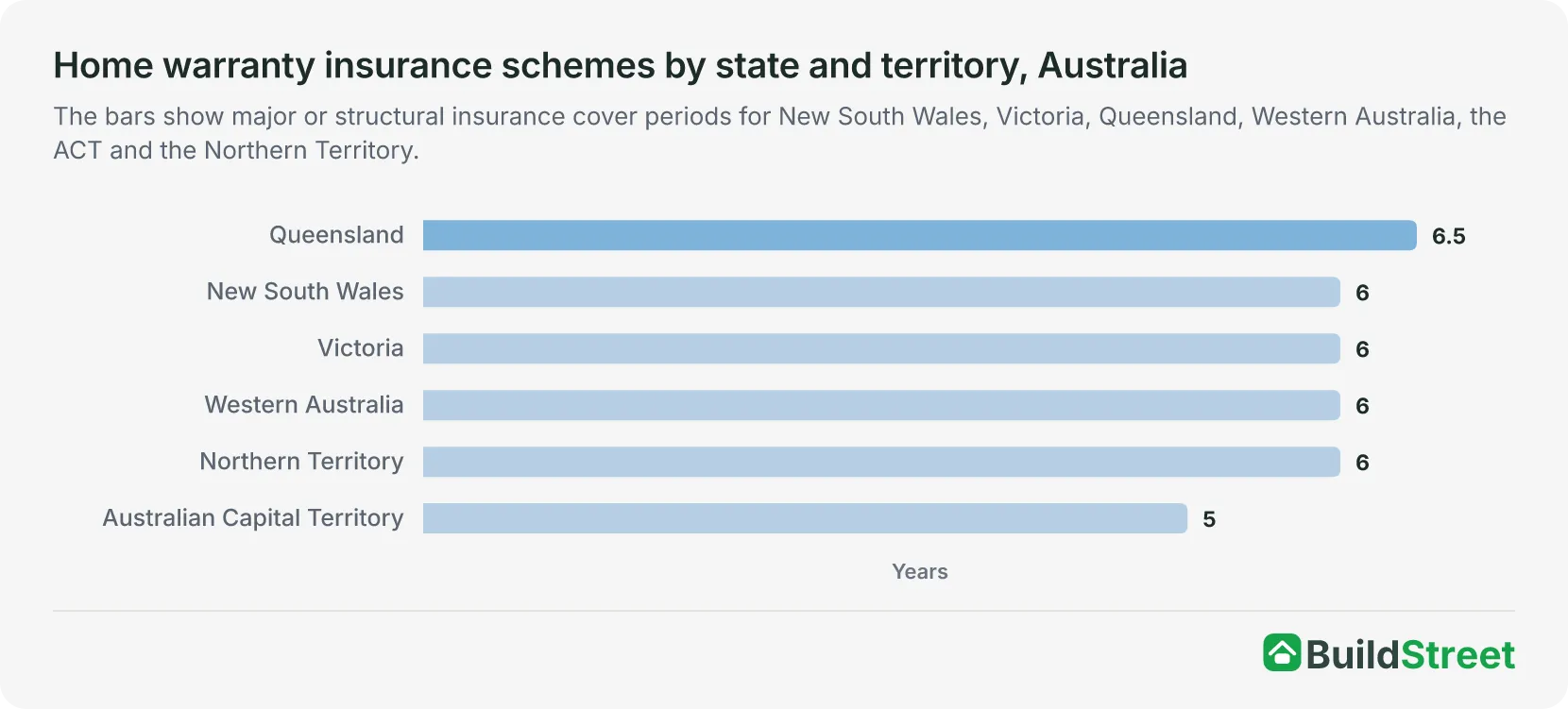
Cover periods for major or structural defects are similar across states, running from 5 years to 6 years and 6 months. Periods for other defects vary more: 6 months in Queensland against 2 years in New South Wales and Victoria, a fourfold difference.
Western Australia and the ACT use one insurance period for all defects. South Australia instead ties its defect cover to its five-year statutory warranty period.
Six of the seven cover figures come from a government or regulator. The Northern Territory's does not: its $200,000 figure is published by Fidelity Fund NT, an industry-run trust, not the government, and it is capped at 20% of the contract price. For example, the 20% cap would limit cover on a $400,000 contract to $80,000, despite the published figure of up to $200,000.
Seven schemes operating, with thresholds from $3,300 to $25,000. Four schemes are last resort, while New South Wales is predominantly last resort. Queensland is first resort, and Victoria's scheme responds where a builder is unable or unwilling to act. Tasmania legislated for a replacement scheme in 2023, but it had not commenced when the article was reviewed.
| Home warranty insurance schemes compared by state and territory, Australia | |||||
|---|---|---|---|---|---|
| Jurisdiction | Threshold | Model | Headline cover | Defect cover period | Claim deadline |
| New South Wales | $20,000 | Predominantly last resort | $340,000 | 6 yrs | Not stated in sources reviewed |
| Victoria | $20,000 | Broader than a traditional last-resort scheme | $400,000 | 6 yrs | Claim-specific deadlines |
| Queensland | $3,300 | First resort | $200,000 | 6 yrs 6 mths | 7 mths for non-structural |
| Western Australia | $20,000 | Last resort | $200,000 | 6 yrs | Not stated in sources reviewed |
| South Australia | $20,000 | Last resort | $250,000 | Not stated separately | Not separately stated in sources reviewed |
| Australian Capital Territory | $12,000 | Last resort | $200,000 | 5 yrs | 180 days |
| Northern Territory | $25,000 | Last resort | $200,000 | 6 yrs | 90 days from awareness |
| Tasmania | n.a. | Not in force | n.a. | n.a. | n.a. |
Source · as cited in the references.
Section 03 · When it is required
When is home warranty insurance mandatory?
Home warranty insurance becomes mandatory when residential building work meets the value and eligibility rules set by the relevant state or territory scheme.
Queensland's threshold of $3,300 captures work that would fall well below the requirement in every other jurisdiction, including many single-trade renovations.
South Australia's threshold rose from $12,000 to $20,000 on 10 November 2025. The Northern Territory's rose from $12,000 to $25,000 for certificates issued after 30 March 2026.
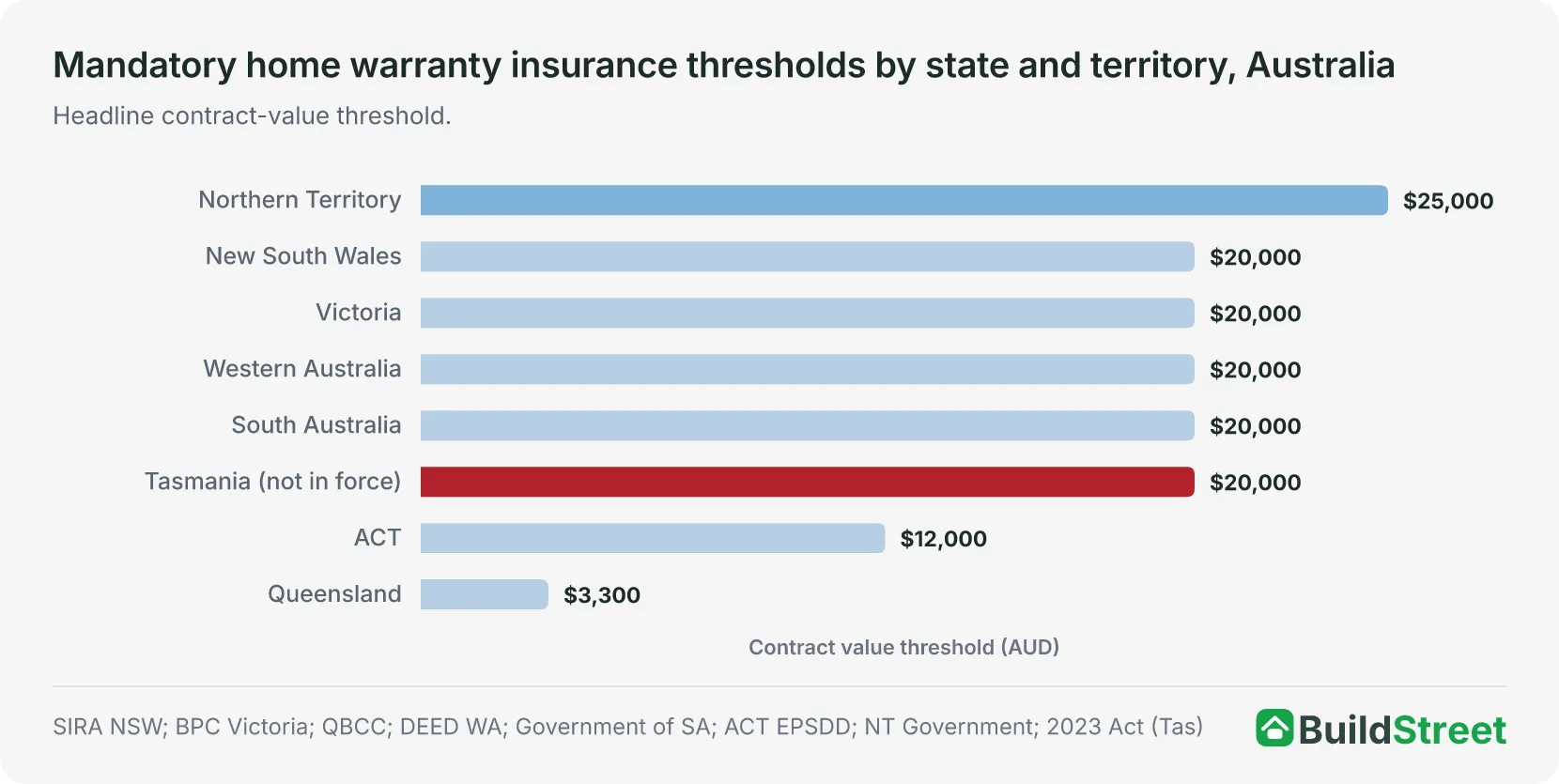
Passing the contract-value threshold does not automatically make cover compulsory.
Each scheme also defines which work is covered and which categories are exempt, and those tests can remove a project that sits well above the dollar figure.
New South Wales publishes 11 exemption categories, including:
- Build-to-rent schemes
- Certain registered charities and recognised housing providers
- Council developers
- Public sector agencies
- Retirement villages
- Kit-home suppliers who do not assemble
- New buildings with a rise of more than three storeys containing multiple home units
South Australia excludes prescribed categories under the Building Work Contractors Regulations 2011: work solely for demolition, construction of a multi-storey residential building, and work for the South Australian Housing Trust.
The scheme administrator states that the multi-storey exclusion applies to residential buildings of more than three storeys containing two or more separate dwellings.
Short-term holiday accommodation and subcontracts to a head contractor also fall outside the requirement.
The ACT scheme is generally limited to houses and apartment buildings of no more than three storeys.
Section 04 · Scope of cover
What the insurance covers and excludes
Across the operating schemes, cover falls into three broad categories: non-completion of the work, defective work, and in some jurisdictions, a lost deposit. Several schemes add consequential costs such as alternative accommodation.
Exclusions are more consistent across the operating schemes. Wear and tear, maintenance, minor cosmetic differences, and work performed outside the contract or the cover period are commonly excluded.
Commonly covered
- Non-completion
All schemes
- Defective work
All schemes
- Lost deposits
NSW, Vic, Qld, WA, ACT
- Accommodation costs
NSW, Vic, Qld; limits vary
- Site security
Victoria
Common exclusions
- Wear and tear
Excluded
- Maintenance
Excluded
- Minor cosmetic differences
Excluded
- Work outside the contract
Excluded
- Work after the cover period
Excluded
Victoria's sublimits
- Total per home
$400,000
- Incomplete work
30% of price
- Accommodation, removal, storage
$12,000
- Site security
$5,000
- Set by
Regs 17, 21–23
Victoria's limits are set directly by the Building (Statutory Insurance Scheme) Regulations 2026 rather than only described in guidance.
Regulation 21 caps total assistance at $400,000 for all losses relating to a home. Within that, regulation 17 limits assistance for completing incomplete work to 30% of the contract price, regulation 23 caps accommodation, removal and storage costs at $12,000, and regulation 22 caps site security at $5,000.
Western Australia publishes three separate consumer figures: a $200,000 aggregate limit, deposit protection up to $40,000, and an excess the insurer is permitted to charge of $500.
South Australia describes its cover differently again. The scheme administrator states that building indemnity insurance contributes to the costs of completing a project above the original contract price, and that the owner still pays the remainder of the contract price to the replacement builder.
Section 05 · Scheme activity data
Queensland home warranty insurance claims, premiums and policies
The Queensland Building and Construction Commission's (QBCC) annual report provides the only government source publishing a five-year home warranty scheme-activity series. New South Wales publishes a Home Building Compensation data portal, but it is structured differently from the QBCC series.
The data covers Queensland only. No government body publishes a harmonised national dataset of home warranty premiums, policies and claims, so these figures describe one jurisdiction's experience rather than an Australian picture.
In 2024–25, the Queensland Home Warranty Scheme issued 164,050 policies covering $21.5 billion of notified work, collected $198.3 million in premiums, received 1,964 claims and approved $60.7 million in claims.
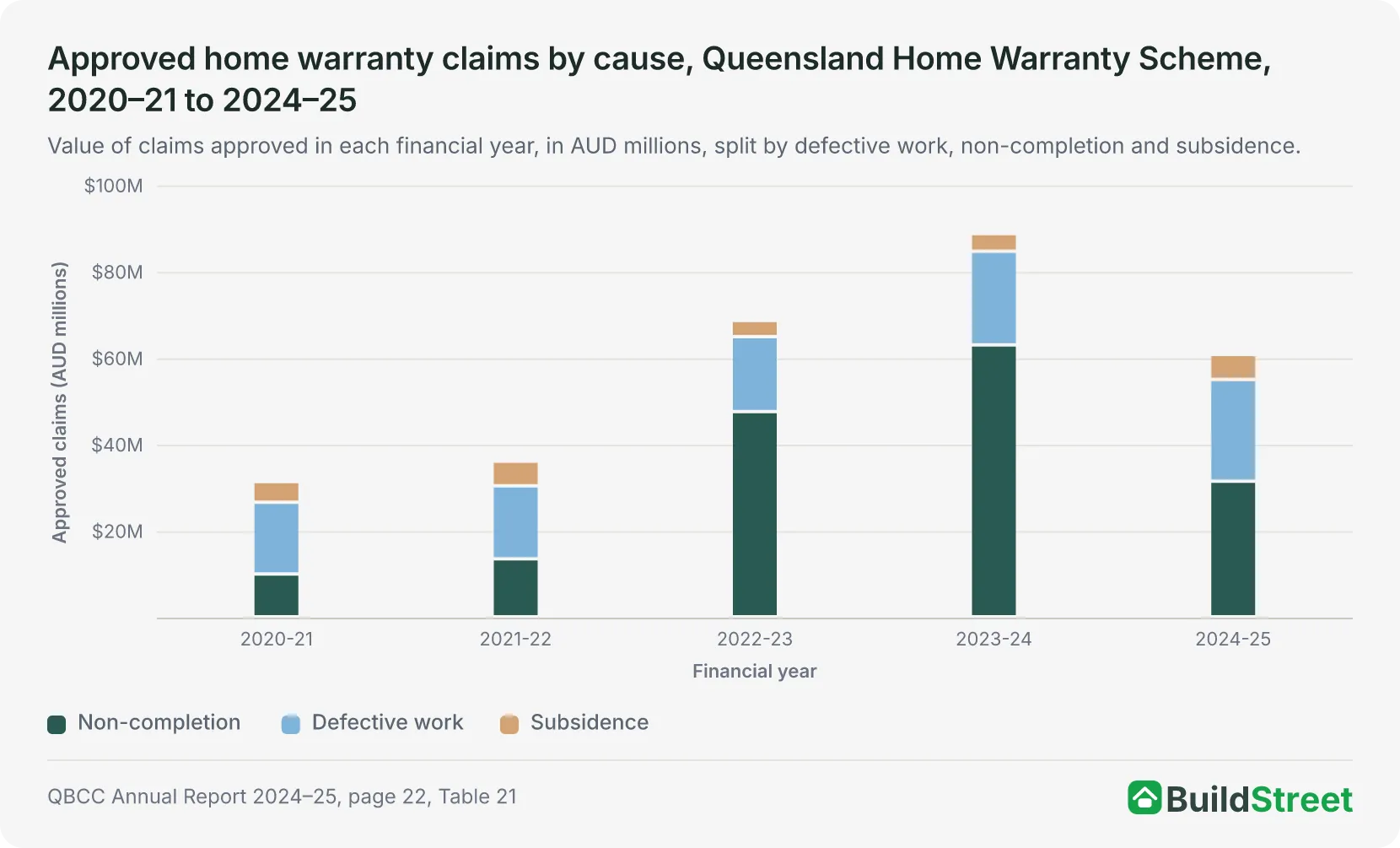
The composition of those approved claims shifted over five years. Approved non-completion claims rose from $9.9 million in 2020–21 to $62.9 million in 2023–24, then fell to $31.4 million in 2024–25, a decrease of 50.1% in one year, calculated from the published annual figures.
Approved defective-work claims followed a different path, rising steadily across the whole period from $16.6 million to $23.5 million, an increase of 41.6% in nominal terms. The scheme data records the amounts approved; it does not identify why the pattern changed.
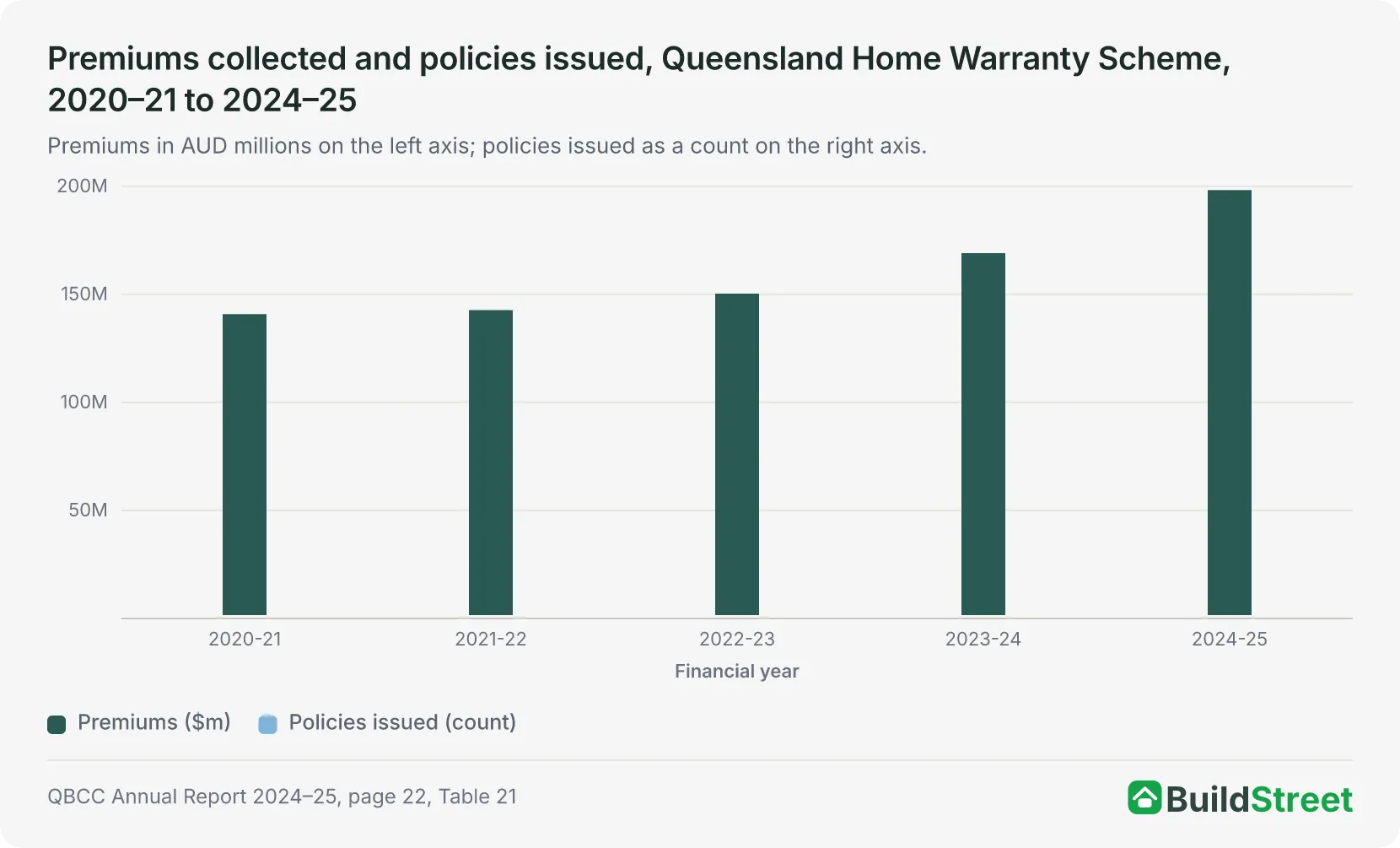
Premiums and policy numbers moved differently again. Policies issued fell 2.6% between 2020–21 and 2024–25, from 168,468 to 164,050, while premiums rose 40.7%. Both figures are calculated from the published annual totals.
Dividing premiums by policies gives an average premium per policy of $1,209 in 2024–25, up from $836 in 2020–21. That average spans everything from a renovation just over $3,300 to a large new build, so it describes the scheme's overall revenue per policy rather than a price any individual would be quoted.
Subsidence was the smallest approved-claim category over the period, ranging from $3.8 million to $5.8 million.
| Queensland Home Warranty Scheme activity, 2020–21 to 2024–25 | |||||
|---|---|---|---|---|---|
| Measure | 2020–21 | 2021–22 | 2022–23 | 2023–24 | 2024–25 |
| Notified work value ($b) | 16.8 | 15.9 | 16.1 | 18.3 | 21.5 |
| Policies issued (no.) | 168,468 | 150,171 | 150,164 | 150,825 | 164,050 |
| Renovations (%) | 76.6 | 79.7 | 82.4 | 80.7 | 79.4 |
| New construction (%) | 23.4 | 20.3 | 17.6 | 19.3 | 20.6 |
| Premiums ($m) | 140.9 | 142.7 | 150.3 | 169.1 | 198.3 |
| Claims received (no.) | 1,537 | 1,856 | 2,745 | 2,299 | 1,964 |
| Claims approved ($m) | 31.3 | 35.1 | 68.6 | 88.7 | 60.7 |
| Of which, defective work ($m) | 16.6 | 16.9 | 17.3 | 21.7 | 23.5 |
| Of which, non-completion ($m) | 9.9 | 13.4 | 47.5 | 62.9 | 31.4 |
| Of which, subsidence ($m) | 4.8 | 5.7 | 3.8 | 4.1 | 5.8 |
| Recovered paid-out costs ($m) | 3.2 | 2.3 | 4.8 | 3.9 | 4.3 |
Source · QBCC Annual Report 2024–25, page 22, Table 21.
Definitions:
- Policies issued counts policies written in the financial year, not policies in force.
- Claims received counts claims lodged in the year. Claims approved is the dollar value approved in the year, not necessarily cash paid in that year. The two do not refer to the same set of claims.
- Recovered paid-out costs are amounts recovered from responsible contractors and may relate to amounts paid in earlier years.
- Monetary figures are nominal.
Claims received per 1,000 policies issued fell from 18.3 in 2022–23 to 12.0 in 2024–25, calculated by dividing claims received by policies issued in each year.
Claims lodged in a year relate to work insured across several earlier years, so that ratio is indicative of scheme workload rather than a defect rate for any cohort of homes.
Section 06 · Insurance versus warranties
How home warranty insurance differs from builder warranties
The builder remains responsible for completing the work and fixing defects. Home warranty insurance is a separate protection that responds when the builder cannot be pursued, or, under some first-resort schemes, will not act.
Three distinct types of protection can operate at the same time, and are often confused.
1. Contractual promises
- Source
The contract
- Owed by
The builder
- Varies by job
Yes
- Includes
Defects liability period
2. Statutory warranties
- Source
Legislation
- Owed by
The builder
- Varies by job
No
- Can be contracted out
No
3. Home warranty insurance
- Source
Statutory scheme
- Paid by
Insurer or fund
- Terms and limits
Vary by scheme and project
- Responds when
Trigger is met
Statutory warranties are not optional guarantees offered by the builder. In South Australia, section 32 of the Building Work Contractors Act 1995 implies six warranties into every domestic building work contract.
These warranties cover proper workmanship to accepted trade standards, good and proper materials, compliance with statutory requirements, reasonable diligence, fitness for human habitation, and fitness for a purpose made known by the owner.
Section 42 of the same Act provides that any purported exclusion, limitation, modification or waiver of a right or warranty implied by the Act is void. A builder cannot contract out of these obligations.
Home warranty insurance sits behind those warranties rather than replacing them. Section 35 describes a complying policy as one that insures a person entitled to the benefit of a statutory warranty against the risk of being unable to enforce or recover under that warranty because of the contractor's insolvency, death or disappearance.
Section 07 · Cost and timing
Who pays for home warranty insurance and when it is arranged
In every operating scheme, the builder or contractor is the party required to obtain or remit the cover. The homeowner is the beneficiary, rather than the party that purchases the policy directly.
Who ultimately bears the cost is a separate question, and official sources do not resolve it uniformly. Several regulators state that the premium may be reflected in the contract price, which means the homeowner can fund it indirectly even where the builder formally pays.
| Who arranges home warranty insurance, the deadline, and who bears the cost | |||
|---|---|---|---|
| Jurisdiction | Who obtains or remits | When it must be in place | Who bears the cost |
| New South Wales | Principal contractor | Before requesting or accepting any payment, including a deposit, or starting work | Contractor buys it; cost may be included in the contract price |
| Victoria | Registered builder | Before the earlier of 10 business days after the contract is signed and the eligible work starting | Builder formally pays; premium may be reflected in the contract price |
| Queensland | Licensed contractor remits to QBCC | Before work starts or within 10 business days after signing, whichever is earlier | Contractor pays the standard premium; homeowner pays only for optional cover up to $300,000 |
| Western Australia | Builder | Before receiving payment or starting work | Builder pays; usually built into the contract price |
| South Australia | Building contractor | Before work, with the certificate supplied to the owner and lodged with the relevant authority | Contractor arranges and pays; pricing treatment depends on the contract |
| Australian Capital Territory | Builder | Before giving the commencement notice or starting work | Builder obtains it; pricing treatment is contractual |
| Northern Territory | Builder obtains the fidelity fund certificate | Before applying for the building permit, taking payment or starting work | Builder formally obtains it; the government page sets no rule on economic incidence |
Source · SIRA NSW; BPC Victoria; QBCC; DEED Western Australia; Government of South Australia and Advisory Notice Building 03/25; ACT EPSDD; Northern Territory Government.
South Australia links the timing requirements to the approval process rather than to the contract. Under Advisory Notice Building 03/25, insurance certificates must be provided to the relevant authority with the building consent application when a contract is already in place.
Building work must not commence before all certificates for that work have been lodged.
Owner-builders in South Australia must obtain a certificate from each contractor doing work valued at $20,000 or more that forms part of a development approval. Insurance is not required for work owner-builders carry out themselves.
Section 08 · Claim triggers
How home warranty insurance claims are triggered
Four of the seven operating schemes are last resort, and New South Wales is classified as predominantly last resort. A claim generally requires a terminal event affecting the builder, such as death, disappearance, insolvency, or, in some jurisdictions, the cancellation or suspension of the builder's registration or licence.
Queensland is a first-resort scheme, while Victoria's scheme, which commenced on 1 July 2026, also responds more broadly. These schemes do not rely only on the terminal builder events used by traditional last-resort schemes.
Last-resort triggers
- New South Wales
Death, disappearance, insolvency or licence suspension
- Western Australia
Death, disappearance, insolvency or cessation
- South Australia
Death, disappearance or insolvency
- Australian Capital Territory
Insolvency, death or disappearance
- Northern Territory
Bankruptcy, death, disappearance or deregistration
Broader triggers
- Queensland
Contractor failure or default
- Queensland, other eligible events
Fire, storm, theft or vandalism
- Victoria
Builder unable or unwilling to complete or rectify the work
- Victoria, usual first step
Written complaint notice to the builder
- Victoria, exceptions
Serious contract events
New South Wales adds a trigger the other last-resort schemes do not share: suspension of the contractor's licence for failing to comply with a tribunal or court order to pay compensation to the homeowner.
Queensland's scheme extends beyond contractor conduct. Eligible events can include fire, storm, vandalism or theft affecting incomplete work. Defective-work claims can also include subsidence, which the Queensland Building and Construction Commission reports as a separate category of approved claim.
Victoria's scheme responds where the builder is unable or unwilling to complete or rectify. Most defect claims begin with a written complaint notice to the builder. That step is not required where a serious contract event has occurred, which includes death, disappearance, insolvency, cancellation of registration or valid termination for default.
Section 09 · Cover periods and warranties
How insurance fits alongside defects liability periods and statutory warranties
There is no national defects liability period. It is usually set by the building contract, varies between projects and is separate from statutory warranties and home warranty insurance cover periods.
Western Australia sets a statutory floor. Section 11 of the Home Building Contracts Act 1991 makes it a term of every contract that the builder is liable to make good defects notified in writing within 4 months of practical completion.
Section 11(1a) allows a contract to provide a longer period.
In Western Australia, home indemnity insurance runs during construction and for 6 years after practical completion, much longer than the 4-month minimum defects liability period. The end of a defects liability period does not automatically end statutory warranty rights or insurance cover.
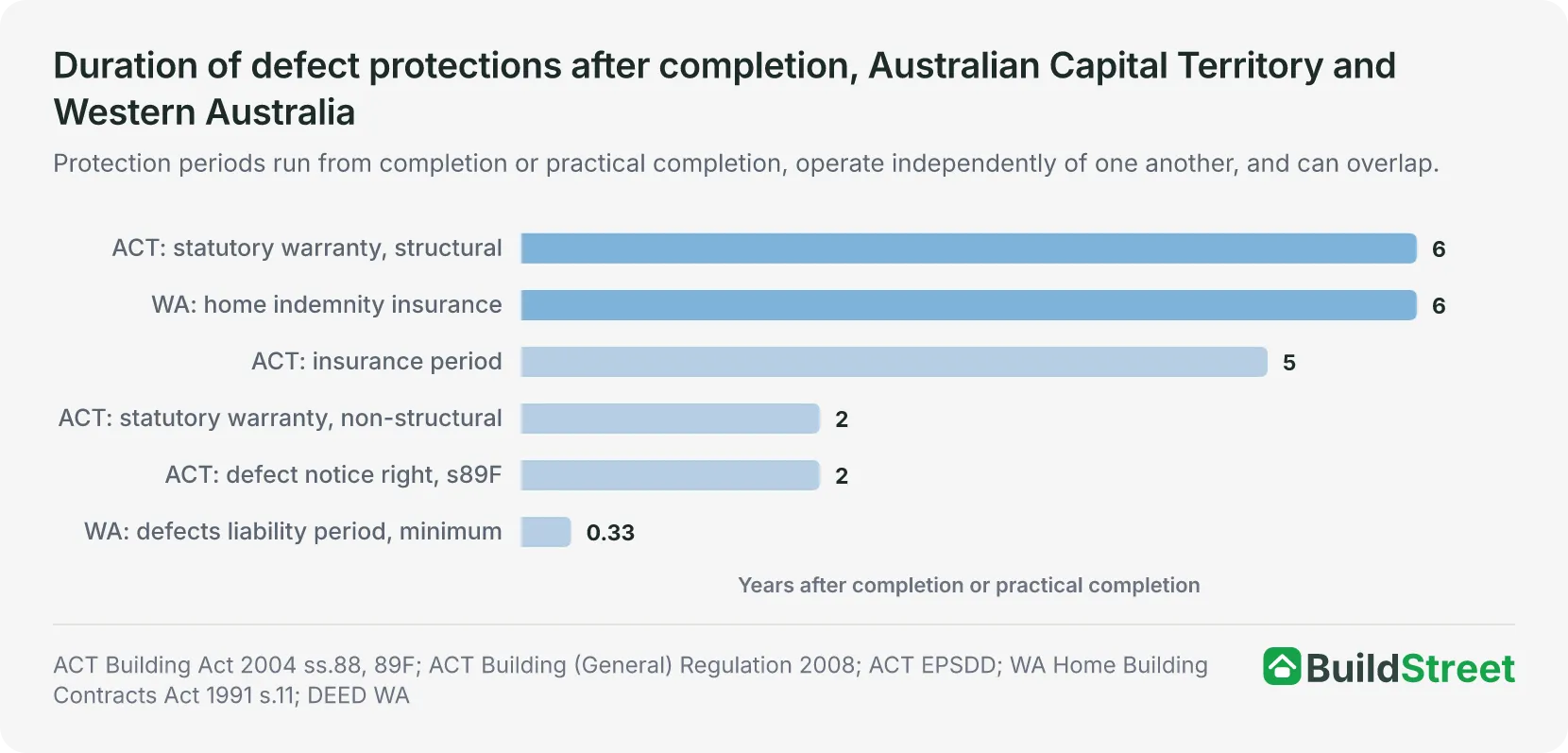
Statutory warranty periods and insurance cover periods differ in most jurisdictions, and either period can be longer than the other.
In the ACT, the insurance period of 5 years is shorter than the 6-year structural warranty. A statutory warranty can therefore remain in force after the insurance period has ended.
In South Australia, the limitation is on the warranty itself. Section 32(5) of the Building Work Contractors Act 1995 requires proceedings for breach of a statutory warranty to be commenced within 5 years after completion of the work, and section 32(6) provides that this period may not be extended.
In Tasmania, section 32(1) of the Residential Building Work Contracts and Dispute Resolution Act 2016 gives owners 6 years from practical completion to commence proceedings for breach of a statutory warranty.
Part 6 implies warranties covering materials, workmanship, legal compliance, plans, fitness for occupation and diligence. Tasmania did not have an operating home warranty insurance scheme when the article was reviewed, so no insurance scheme stood behind these statutory warranties.
In Queensland, structural cover generally runs 6 years 6 months from the cover commencement day, with an additional 6 months in some delayed-completion cases, while non-structural cover runs 6 months after the work is substantially complete, with claims required within 7 months.
| Insurance cover periods, statutory warranty periods and claim deadlines | |||
|---|---|---|---|
| Jurisdiction | Insurance cover period | Statutory warranty or limitation period | Claim notification deadline |
| New South Wales | 6 yrs major defects, 2 yrs other | Statutory warranties supported by the scheme | Not separately stated in sources reviewed |
| Victoria | 6 yrs major defects, 2 yrs other | Builder obligations continue in parallel | Claim-specific deadlines apply |
| Queensland | 6 yrs 6 mths structural, 6 mths non-structural | Contractual and statutory obligations continue | 7 mths for non-structural defects |
| Western Australia | Construction plus 6 yrs from practical completion | Defects liability period, minimum 4 mths, s11 | Not separately stated in sources reviewed |
| South Australia | Up to 5 years for eligible defects | Proceedings within 5 yrs, s32(5), not extendable | Not separately stated in sources reviewed |
| Australian Capital Territory | 5 yrs | 6 yrs structural, 2 yrs non-structural | 180 days |
| Northern Territory | 6 yrs structural, 1 yr non-structural | Sits alongside the statutory dispute system | 90 days from awareness |
Source · as cited in the references.
References
- SIRA – Insurance obligations for residential building works · sira.nsw.gov.au
- State Insurance Regulatory Authority (NSW): Home building compensation for homeowners · sira.nsw.gov.au
- State Insurance Regulatory Authority (NSW): Exemptions from the Home Building Compensation Scheme · sira.nsw.gov.au
- Building and Plumbing Commission (Victoria): Home Warranty · bpc.vic.gov.au
- Building and Plumbing Commission (Victoria): Time limits and amounts for Home Warranty · bpc.vic.gov.au
- Building and Plumbing Commission (Victoria): Home Warranty premium and Notice of Cover · bpc.vic.gov.au
- Building and Plumbing Commission (Victoria): What Home Warranty may cover · bpc.vic.gov.au
- Building and Plumbing Commission (Victoria): Make a Home Warranty claim · bpc.vic.gov.au
- Building (Statutory Insurance Scheme) Regulations 2026 (Vic), S.R. No. 42/2026 · legislation.vic.gov.au
- Queensland Building and Construction Commission: Queensland Home Warranty Scheme factsheet · qbcc.qld.gov.au
- Queensland Building and Construction Commission: Annual Report 2024-25 · qbcc.qld.gov.au
- Department of Local Government, Industry Regulation and Safety (WA): Home indemnity insurance factsheet · wa.gov.au
- Home Building Contracts Act 1991 (WA), s.11 · classic.austlii.edu.au
- Government of South Australia: Building indemnity insurance · sa.gov.au
- South Australian Government Financing Authority – Building Indemnity Insurance · safa.sa.gov.au
- Department for Housing and Urban Development (SA): Advisory Notice Building 03/25 - Building Indemnity Insurance · plan.sa.gov.au
- Building Work Contractors Act 1995 (SA), authorised version 15 Jan 2026 · legislation.sa.gov.au
- ACT Planning – Residential building work insurance · planning.act.gov.au
- ACT Environment, Planning and Sustainable Development Directorate: Statutory warranties · planning.act.gov.au
- Building Act 2004 (ACT), ss.88, 89F · legislation.act.gov.au
- Building (General) Regulation 2008 (ACT), Part 4 · legislation.act.gov.au
- Northern Territory Government – Fidelity fund certificate · nt.gov.au
- Fidelity Fund NT: For Homeowners · fidelityfundnt.com.au
- Premier of Tasmania: Home Warranty Insurance for Tasmanians a step closer · premier.tas.gov.au
- Residential Building Work Contracts and Dispute Resolution Act 2016 (Tas) · legislation.tas.gov.au
- Residential Building (Home Warranty Insurance Amendments) Act 2023 (Tas), s.2 · legislation.tas.gov.au
- Consumer, Building and Occupational Services Tasmania – Financial Assistance Package for consumers affected by construction company failures · cbos.tas.gov.au
