


Published
 Immigration to AustraliaCitizen departures are one part of overseas migration. The immigration article covers arrivals, departures and net overseas migration across every visa group.
 Migration and housing demand across the capitalsThe capitals article compares overseas migration with housing demand in each of Australia's capital cities.
Section 01 · The headline count
How many Australian citizens left Australia in 2024-25?
Australian citizen departures fell to 81,510 people in 2024-25, down from 85,820 in 2023-24, according to the Australian Bureau of Statistics (ABS) Overseas Migration data1. This was a decrease of 4,310 people, or 5.0 per cent.
The ABS rounds the 2024-25 count to 82,0002.
The 2024-25 estimates are preliminary and subject to revision. The next Overseas Migration release is due on 18 December 20262.
Section 02 · The trend
Have Australian citizen departures risen or fallen since before the COVID-19 pandemic?
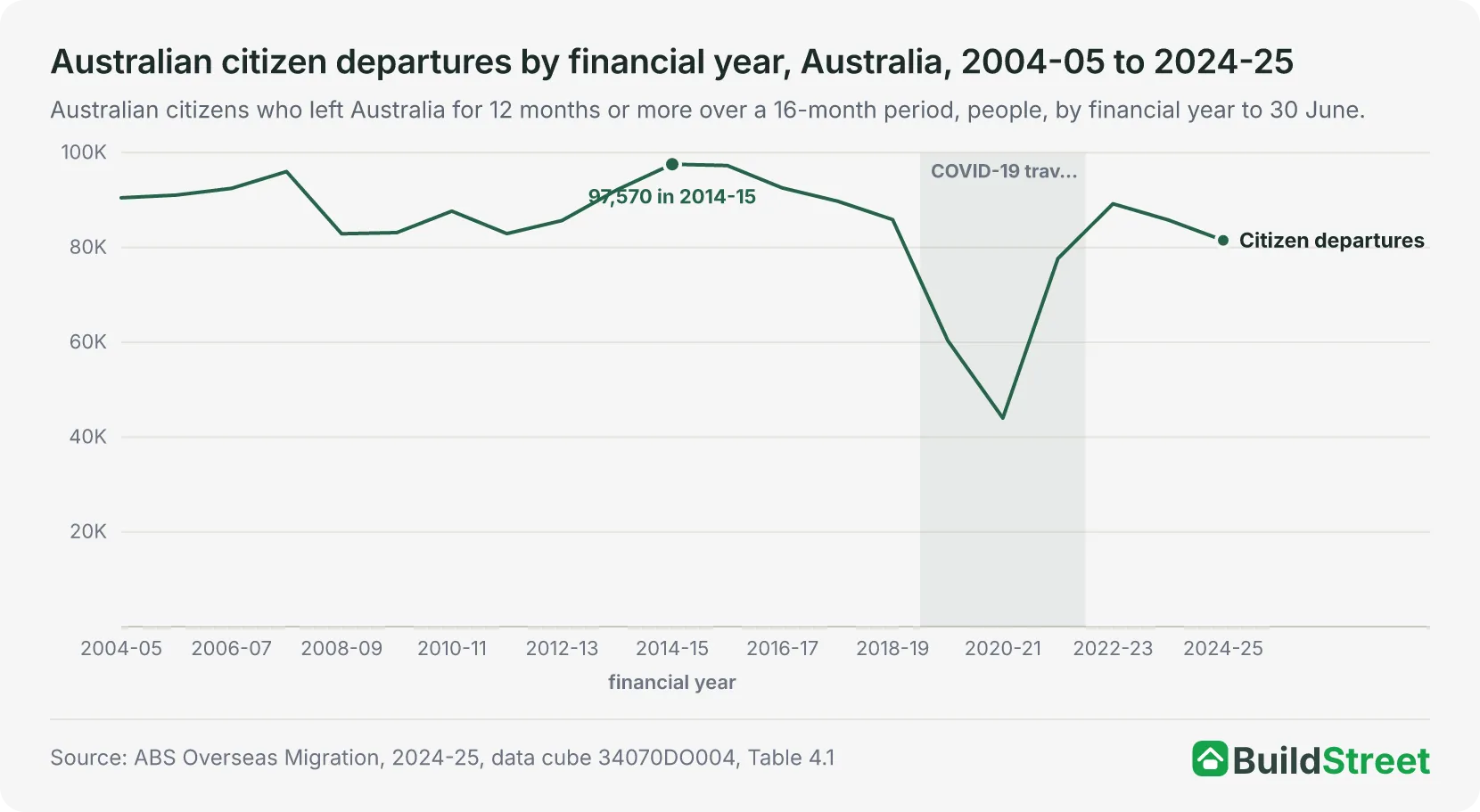
Australian citizen departures were lower in 2024-25 than in any financial year from 2004-05 to 2018-19, at 81,510 people1. Departures have also fallen for two consecutive years, from 89,220 in 2022-23 to 85,820 in 2023-24 and 81,510 in 2024-25.
Over the five years from 2014-15 to 2018-19, citizen departures averaged 92,616 a year, compared with 81,510 in 2024-25, a decrease of 12.0 per cent1. The ABS rounds that pre-pandemic average to 93,0002.
Australian citizen departures fell in every year from 2015-16 to 2018-19, from 97,570 in 2014-15 to 85,890 in 2018-191.
Departures then dropped sharply during the COVID-19 pandemic, falling to 60,390 in 2019-20 and 44,010 in 2020-211. They subsequently rose to 77,670 in 2021-22 and 89,220 in 2022-23. COVID-19 travel restrictions applied from March 2020 until borders reopened to most travellers on 21 February 20222.
Section 03 · Net citizen migration
What is net Australian citizen migration each year?
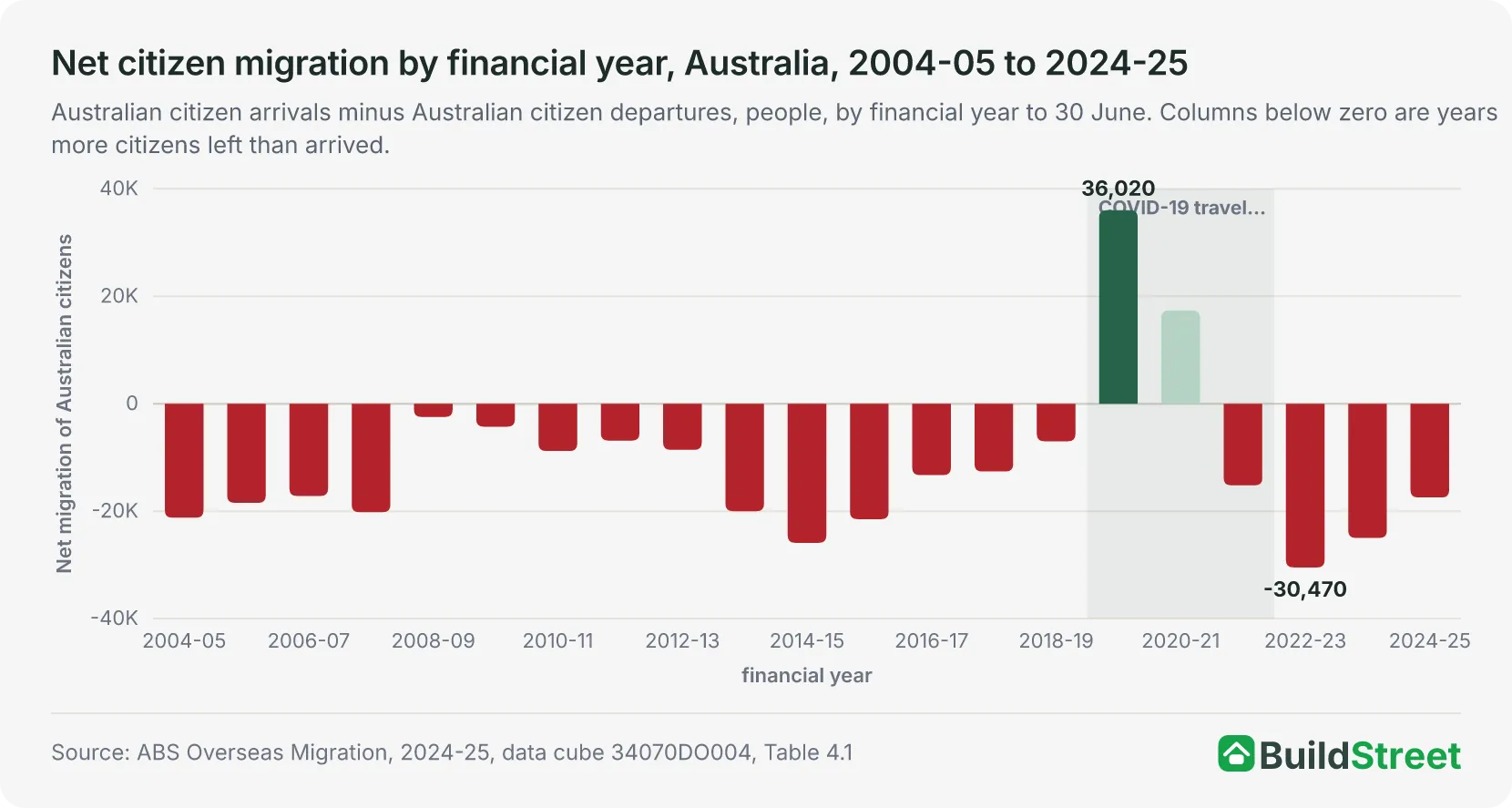
Australia recorded a net citizen migration loss of 17,450 people in 2024-25, with 64,060 Australian citizens arriving to live in the country and 81,510 departing1.
A citizen arrival is an Australian citizen who had been living overseas and stayed in Australia for 12 months or more over the 16 months after arriving3.
Net citizen migration recorded its largest loss of any year from 2004-05 to 2024-25 in 2022-23, at 30,470 people1. The net citizen migration loss then narrowed to 24,980 in 2023-24 and 17,450 in 2024-25. Citizen arrivals rose from 58,750 in 2022-23 to 64,060 in 2024-25.
Citizen arrivals exceeded departures in only two years: 2019-20 and 2020-211. These years recorded net gains of 36,020 and 17,360 people respectively. Australian citizen arrivals recorded their highest annual count from 2004-05 to 2024-25 in 2019-20, at 96,410.
Adding up the annual estimates from 2004-05 to 2024-25, citizen departures exceeded citizen arrivals by 242,980 people in total1.
| Australian citizen arrivals, departures and net citizen migration, Australia, 2004-05 to 2024-25 | |||
|---|---|---|---|
| Financial year | Citizen arrivals | Citizen departures | Net citizen migration |
| 2004-05 | 69,260 | 90,480 | -21,220 |
| 2005-06 | 72,610 | 91,060 | -18,450 |
| 2006-07 | 75,300 | 92,470 | -17,170 |
| 2007-08 | 75,830 | 96,020 | -20,190 |
| 2008-09 | 80,440 | 82,900 | -2,460 |
| 2009-10 | 78,870 | 83,140 | -4,270 |
| 2010-11 | 78,870 | 87,670 | -8,800 |
| 2011-12 | 76,070 | 82,930 | -6,860 |
| 2012-13 | 77,100 | 85,690 | -8,590 |
| 2013-14 | 72,180 | 92,180 | -20,000 |
| 2014-15 | 71,680 | 97,570 | -25,890 |
| 2015-16 | 75,800 | 97,290 | -21,490 |
| 2016-17 | 79,280 | 92,560 | -13,280 |
| 2017-18 | 77,160 | 89,770 | -12,610 |
| 2018-19 | 78,900 | 85,890 | -6,990 |
| 2019-20 | 96,410 | 60,390 | +36,020 |
| 2020-21 | 61,370 | 44,010 | +17,360 |
| 2021-22 | 62,480 | 77,670 | -15,190 |
| 2022-23 | 58,750 | 89,220 | -30,470 |
| 2023-24 | 60,840 | 85,820 | -24,980 |
| 2024-25 | 64,060 | 81,510 | -17,450 |
Source · ABS Overseas Migration, 2024-25, data cube 34070DO004, Table 4.1.
Section 04 · Age
What is the average age of people leaving Australia to live overseas?
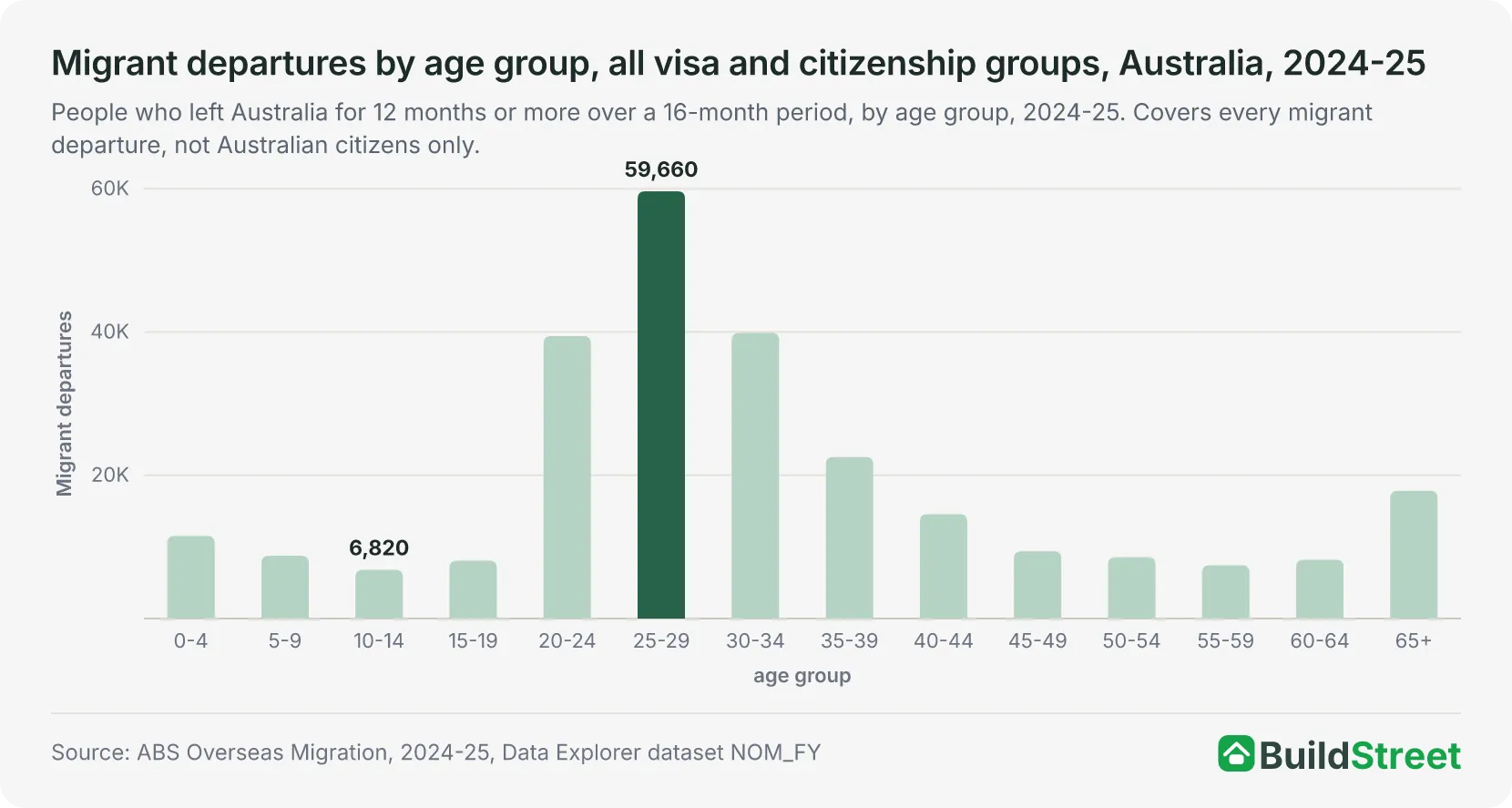
The median age of people leaving Australia to live overseas was 29.6 years in 2024-25, up from 28.5 years in 2018-192. These figures cover all migrant departures, including Australian citizens, New Zealand citizens and temporary visa holders, because the ABS does not publish a separate age breakdown for Australian citizens4.
People aged 25 to 29 recorded the largest number of migrant departures of any five-year age group in 2024-25, at 59,6604. People aged 20 to 34 accounted for 138,990 departures, or 52.9 per cent of all 262,800 migrant departures.
Departures among people aged 65 and over totalled 17,840 in 2024-25, compared with 14,230 in 2018-194.
The median age of migrant departures ranged from 28.3 years in the Australian Capital Territory to 32.1 years in the Northern Territory in 2024-252.
Section 05 · States and territories
Which states and territories have the most Australian citizen departures?
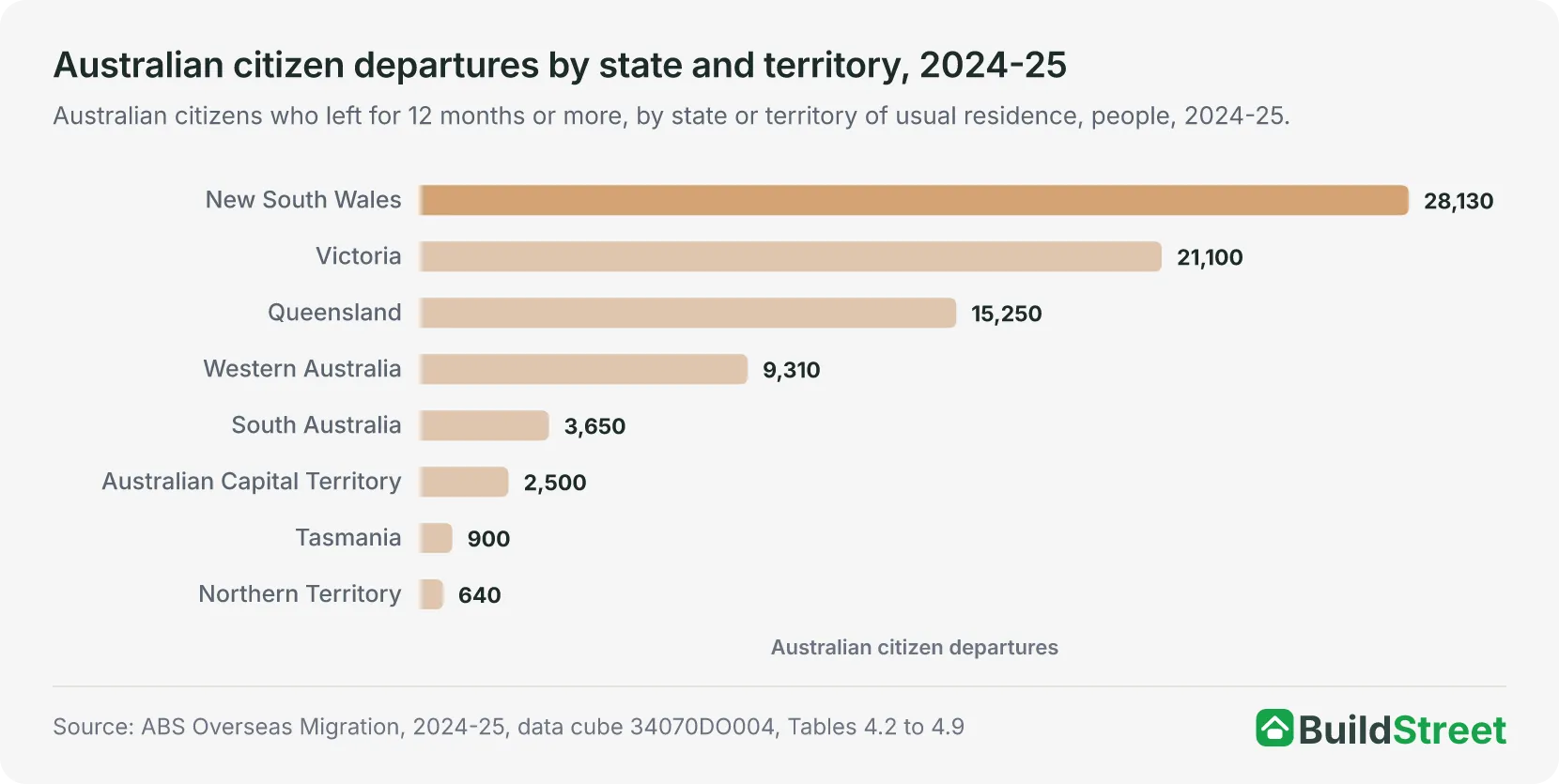
New South Wales recorded the largest number of Australian citizen departures of any state or territory in 2024-25, at 28,130 people, followed by Victoria at 21,100 and Queensland at 15,2501. New South Wales accounted for 34.5 per cent of citizen departures, compared with 31.1 per cent of Australia's population at 30 June 20255.
New South Wales also recorded the largest net loss of citizens of any state or territory, at 6,050 people, as 22,080 citizens arrived and 28,130 left1. Every state and territory recorded a net loss of citizens in 2024-25.
When measured against each state or territory's total population, which includes residents who are not citizens, the Australian Capital Territory recorded the highest rate of citizen departures of any state or territory in 2024-25, at 5.2 per 1,000 residents, while Tasmania recorded the lowest, at 1.6 per 1,0005. The national rate was 3.0 Australian citizen departures per 1,000 residents.
Citizen departures in 2024-25 were below the 2014-15 to 2018-19 annual average in every state and territory, ranging from 4.1 per cent lower in Tasmania to 30.4 per cent lower in the Northern Territory1.
Tasmania and the Northern Territory had the smallest citizen departure counts in 2024-25, at 900 and 640 people respectively1. The ABS cautions that smaller preliminary values may be revised by a larger percentage.
| Australian citizen departures, arrivals and net citizen migration by state and territory, 2024-25 | |||||
|---|---|---|---|---|---|
| State or territory | Citizen departures | Citizen arrivals | Net citizen migration | Departures per 1,000 residents | Average departures a year, 2014-15 to 2018-19 |
| New South Wales | 28,130 | 22,080 | -6,050 | 3.3 | 32,688 |
| Victoria | 21,100 | 16,350 | -4,750 | 3.0 | 22,604 |
| Queensland | 15,250 | 12,520 | -2,730 | 2.7 | 17,652 |
| Western Australia | 9,310 | 7,100 | -2,210 | 3.1 | 10,918 |
| South Australia | 3,650 | 2,870 | -780 | 1.9 | 4,156 |
| Australian Capital Territory | 2,500 | 2,020 | -480 | 5.2 | 2,726 |
| Tasmania | 900 | 700 | -200 | 1.6 | 938 |
| Northern Territory | 640 | 390 | -250 | 2.4 | 920 |
| Australia | 81,510 | 64,060 | -17,450 | 3.0 | 92,616 |
Source · ABS Overseas Migration, 2024-25, data cube 34070DO004, Tables 4.1 to 4.9; ABS National, state and territory population, March 2026, Table 4.
Section 06 · The definition
How are Australian citizens counted as migrant departures?
The ABS counts an Australian citizen as a migrant departure when a person who usually lives in Australia spends at least 12 months overseas within a 16-month period after leaving3. This is known as the 12/16 month rule. The same rule applies to every traveller, regardless of their citizenship or visa.
The 12 months do not have to be continuous. A person who leaves Australia, returns for a short visit and then leaves again may still be counted as a migrant departure. The person is then removed from Australia's estimated resident population from the date they originally left3.
Because the rule requires 16 months of travel records, the ABS initially estimates migration using the travel patterns of similar travellers from the previous year. These figures are updated when the full records become available3.
The ABS reported that using net permanent and long-term movements from border-crossing data in place of net overseas migration would have overstated migration by 179,570 people, or 60 per cent, in the year to December 20256.
Border-crossing data records arrivals and departures rather than the number of people migrating. A person can therefore be counted in these figures without moving to or from Australia permanently6.
In the ABS's example, an Australian citizen who has lived in the United Kingdom for two years and returns for a two-week wedding may be recorded as a long-term arrival in border-crossing data, even though they have not moved back to Australia6.
| How net overseas migration and overseas arrivals and departures count travellers | ||
|---|---|---|
| Feature | Net overseas migration | Overseas arrivals and departures |
| What it counts | People who change their country of usual residence | Border crossings, so one person can be counted several times |
| Duration test | 12 months or more in or out of Australia over a 16-month period | The duration of the current trip, intended or recorded at the border |
| Australian citizen visiting from overseas for two weeks | Not a migrant arrival | Can be a permanent and long-term arrival if the traveller declares Australian residence |
| Purpose | The official measure of migration and an input to population estimates | Travel and tourism trends and short-term movements |
Source · ABS, Use Net Overseas Migration statistics to understand overseas migration, not Overseas Arrivals and Departures, 18 June 2026.
Section 07 · The comparison
How do Australian citizen departures compare with total overseas migration?
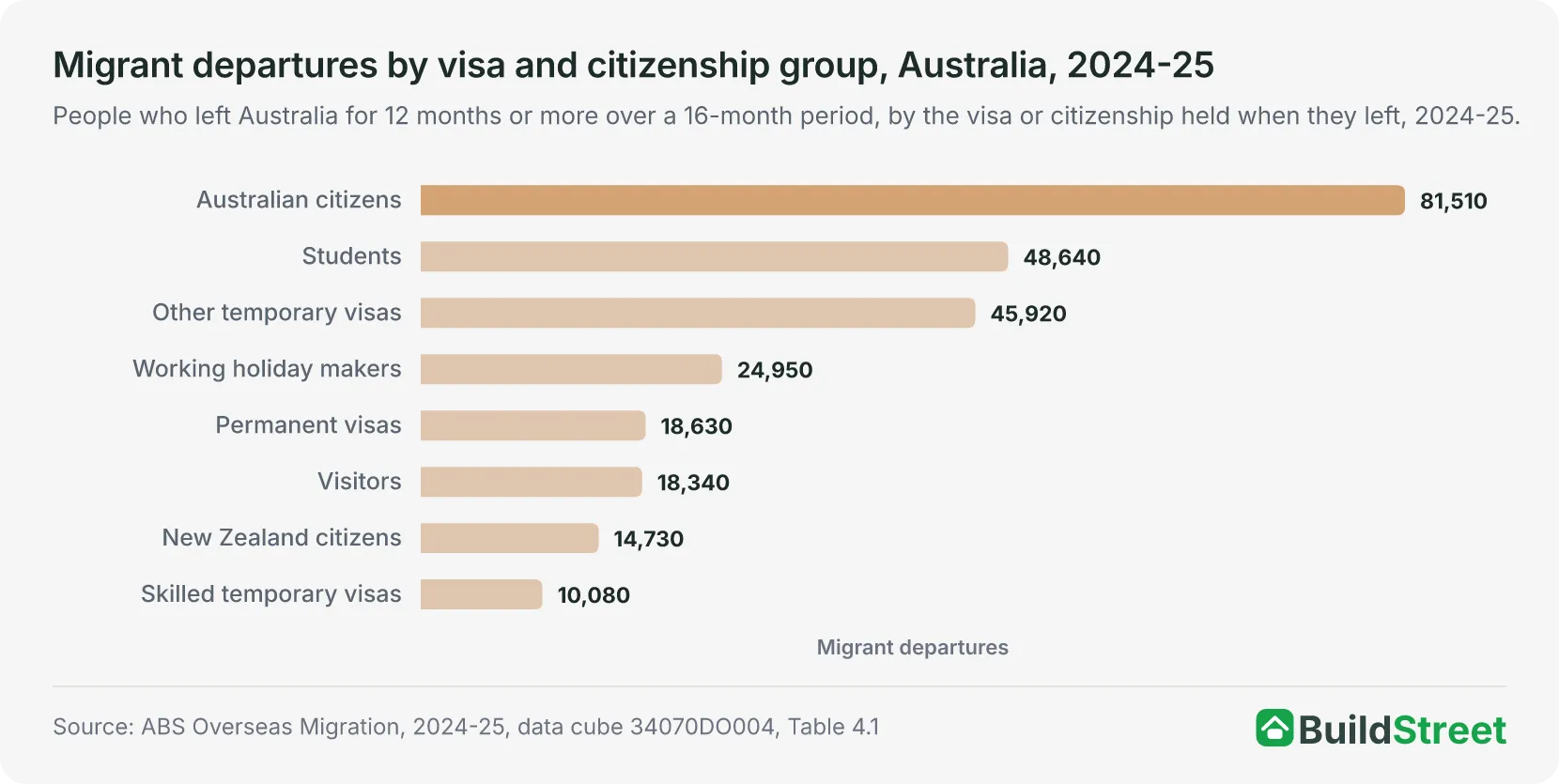
Australian citizens accounted for 31.0 per cent of the 262,800 migrant departures in 2024-251. They also had the highest number of departures of any single citizenship or visa group, ahead of student visa holders at 48,640. The five temporary visa groups together accounted for 147,930 departures.
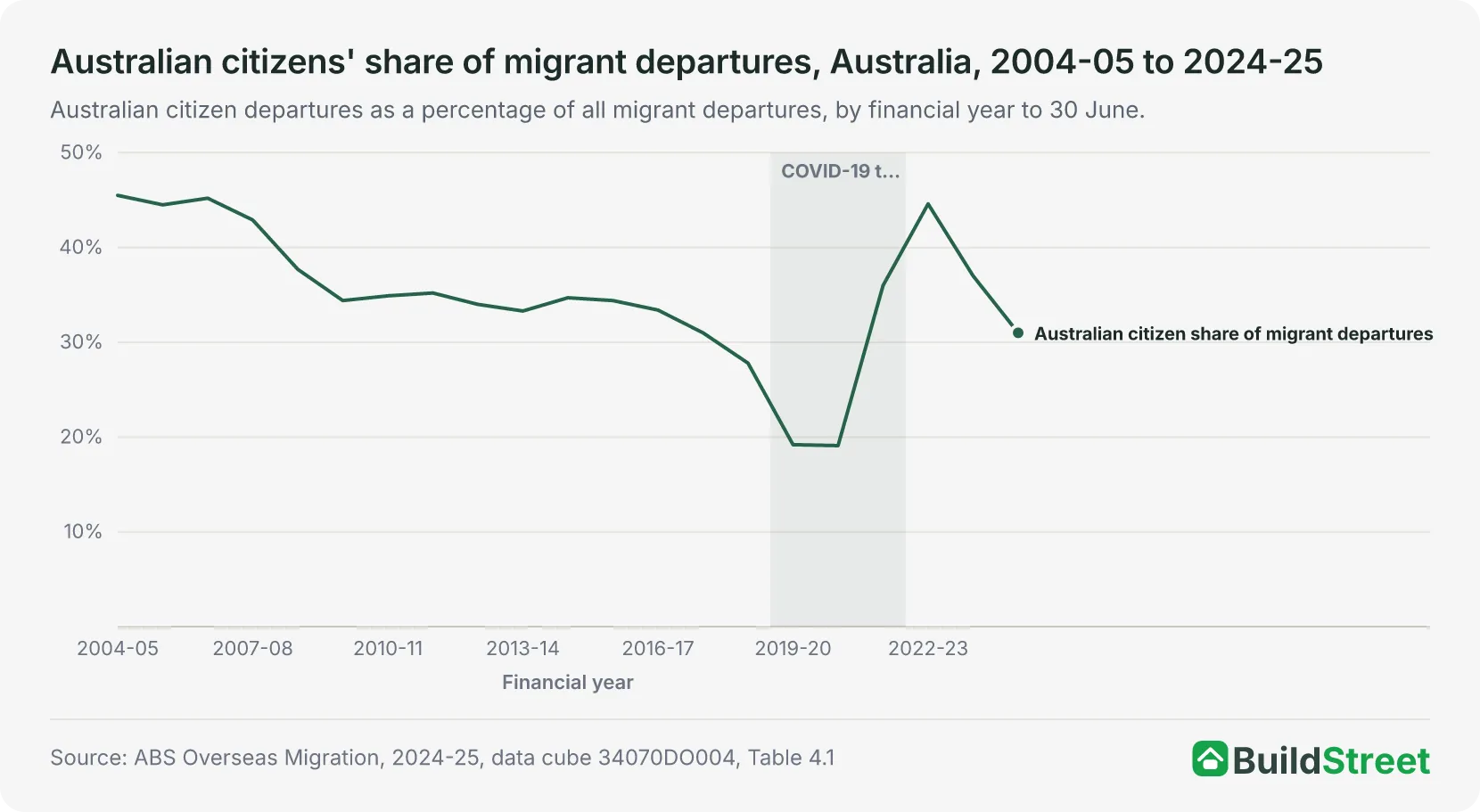
The share of migrant departures involving Australian citizens fell from 45.5 per cent in 2004-05 to 31.0 per cent in 2024-25, a decline of 14.5 percentage points1. Over the same period, temporary visa departures rose from 59,520 to 147,930, while citizen departures fell from 90,480 to 81,510.
Net overseas migration added 305,570 people to Australia's population in 2024-25, with 568,370 migrant arrivals and 262,800 migrant departures2. Excluding Australian citizens, net overseas migration was a gain of 323,020 people1.
The Immigration to Australia article covers arrivals, departures and net overseas migration across every visa group.
Section 08
Frequently asked questions
How many Australian citizens emigrate from Australia each year?
Australian citizen departures totalled 81,510 people in 2024-251, counting citizens who left Australia for 12 months or more over a 16-month period. Citizen departures averaged 92,616 a year over the five years from 2014-15 to 2018-19.
Is emigration from Australia at a record high?
No. Australian citizen departures fell to 81,510 in 2024-25, the lowest annual count from 2004-05 to 2024-25, excluding the three years affected by COVID-19 travel restrictions1. The highest annual count from 2004-05 to 2024-25 was 97,570 in 2014-15.
How many Australian citizens arrive to live in Australia each year?
Australian citizen arrivals totalled 64,060 in 2024-251, counting citizens who stayed in Australia for 12 months or more over the 16 months after arriving. With 81,510 citizen departures, net citizen migration was a loss of 17,450 people.
Why do Australian citizens leave Australia?
No official survey records why Australian citizens move overseas, and the ABS publishes no reason for departure in its overseas migration data. The figures measure how many citizens left and where they lived, but not their reason for leaving.
What is the 12/16 month rule?
The 12/16 month rule is used by the ABS to count overseas migration. A person who usually lives in Australia is counted as a migrant departure if they spend at least 12 months overseas within 16 months of leaving3. The 12 months do not have to be continuous.
References
- ABS Overseas migrant arrivals and departures, by visa and citizenship groups, by state/territory, 2004-05 to 2024-25 (data cube 34070DO004) · Australian Bureau of Statistics ↑ b c d e f g h i j k l m n o p q r s t u v w x
- ABS Overseas Migration, 2024-25 · Australian Bureau of Statistics ↑ b c d e f g h
- ABS Overseas Migration methodology, 2024-25 · Australian Bureau of Statistics ↑ b c d e f
- ABS Net overseas migration: arrivals, departures and net, state/territory, age and sex, financial years, 2004-05 onwards (Data Explorer dataset NOM_FY) · data.api.abs.gov.au ↑ b c
- ABS National, state and territory population, March 2026: Table 4 — Estimated resident population, states and territories · Australian Bureau of Statistics ↑ b c d e
- ABS article: Use Net Overseas Migration statistics to understand overseas migration, not Overseas Arrivals and Departures · Australian Bureau of Statistics ↑ b c
