


Published
 Immigration to AustraliaAustralian citizens made up 11.3 per cent of migrant arrivals in 2024-25. The immigration article covers overseas migration as a whole, by visa and country of birth.
 Leaving Australia by age: how old are people who move overseas?The median age of people leaving Australia increased from 28 years in 2018-19 to 30 years in 2024-25, according to the ABS Overseas Migration data. 2018-19 was the last full year before COVID-19 trave…
Section 01 · The latest year
How many Australians left and arrived in Australia in 2024-25?
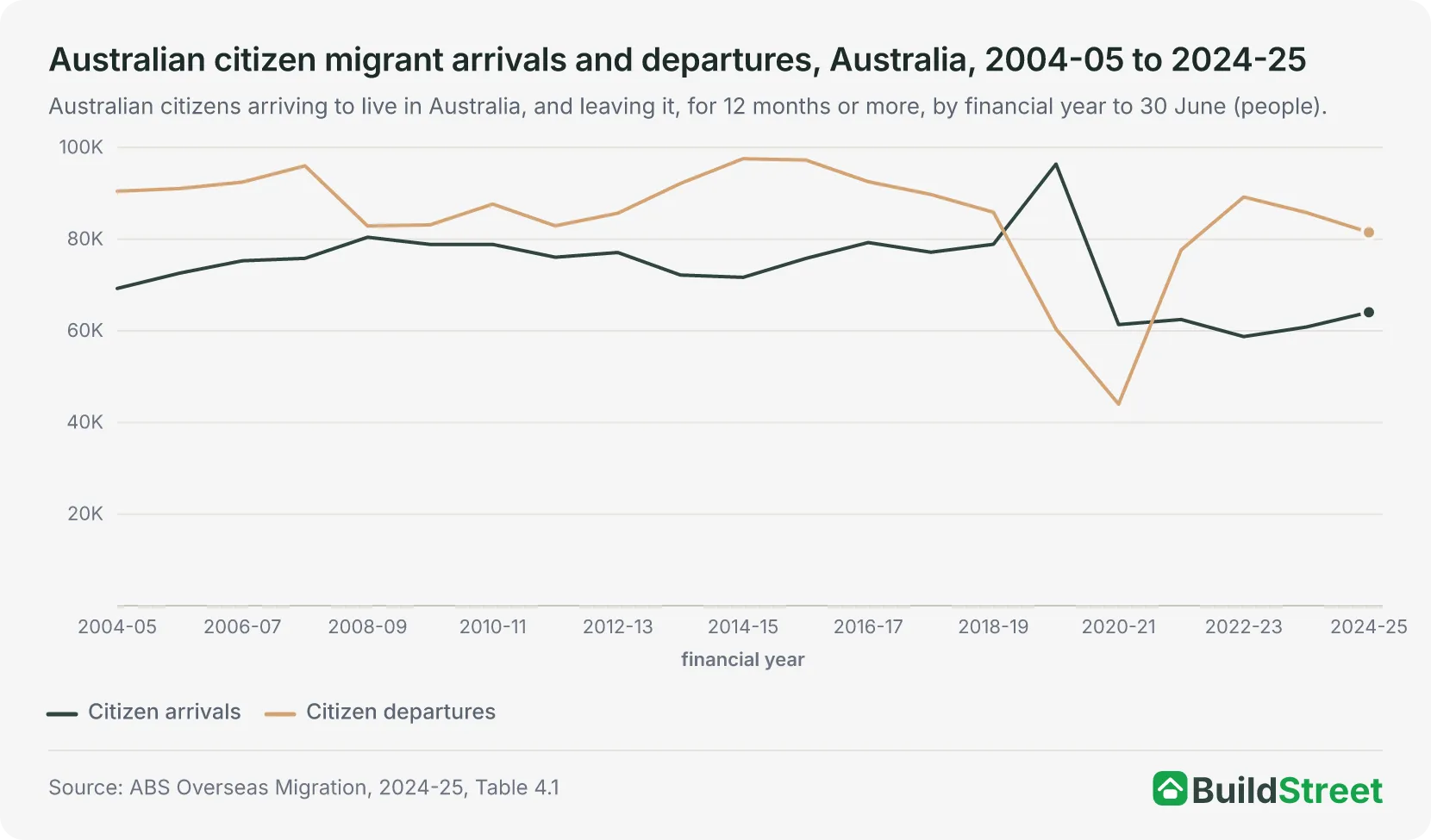
More Australian citizens left Australia than arrived in 2024-25, resulting in a net migration loss of 17,450 people1. Citizen departures fell from 85,820 in 2023-24 to 81,510 in 2024-25, while citizen arrivals increased from 60,840 to 64,060.
Citizen departures and citizen arrivals in 2024-25 were both lower than their averages for the five years before the COVID-19 pandemic, when the ABS recorded averages of 93,000 departures and 77,000 arrivals a year2.
The 2024-25 estimates are preliminary and subject to revision. The next Overseas Migration data, covering 2025-26, is scheduled for publication on 18 December 20262.
| Australian citizen migration, Australia, 2018-19, 2023-24 and 2024-25 | |||
|---|---|---|---|
| Measure | 2018-19 | 2023-24 | 2024-25 |
| Citizen arrivals | 78,9001 | 60,840 | 64,060 |
| Citizen departures | 85,8901 | 85,820 | 81,510 |
| Net migration of Australian citizens | -6,990 | -24,980 | -17,450 |
| Citizens' share of all migrant arrivals (%) | 14.3 | 9.2 | 11.3 |
| Citizens' share of all migrant departures (%) | 27.8 | 37.0 | 31.0 |
Source · ABS Overseas Migration, 2024-25, Table 4.1
Section 02 · The trend
Have more Australians left than returned since 2004-05?
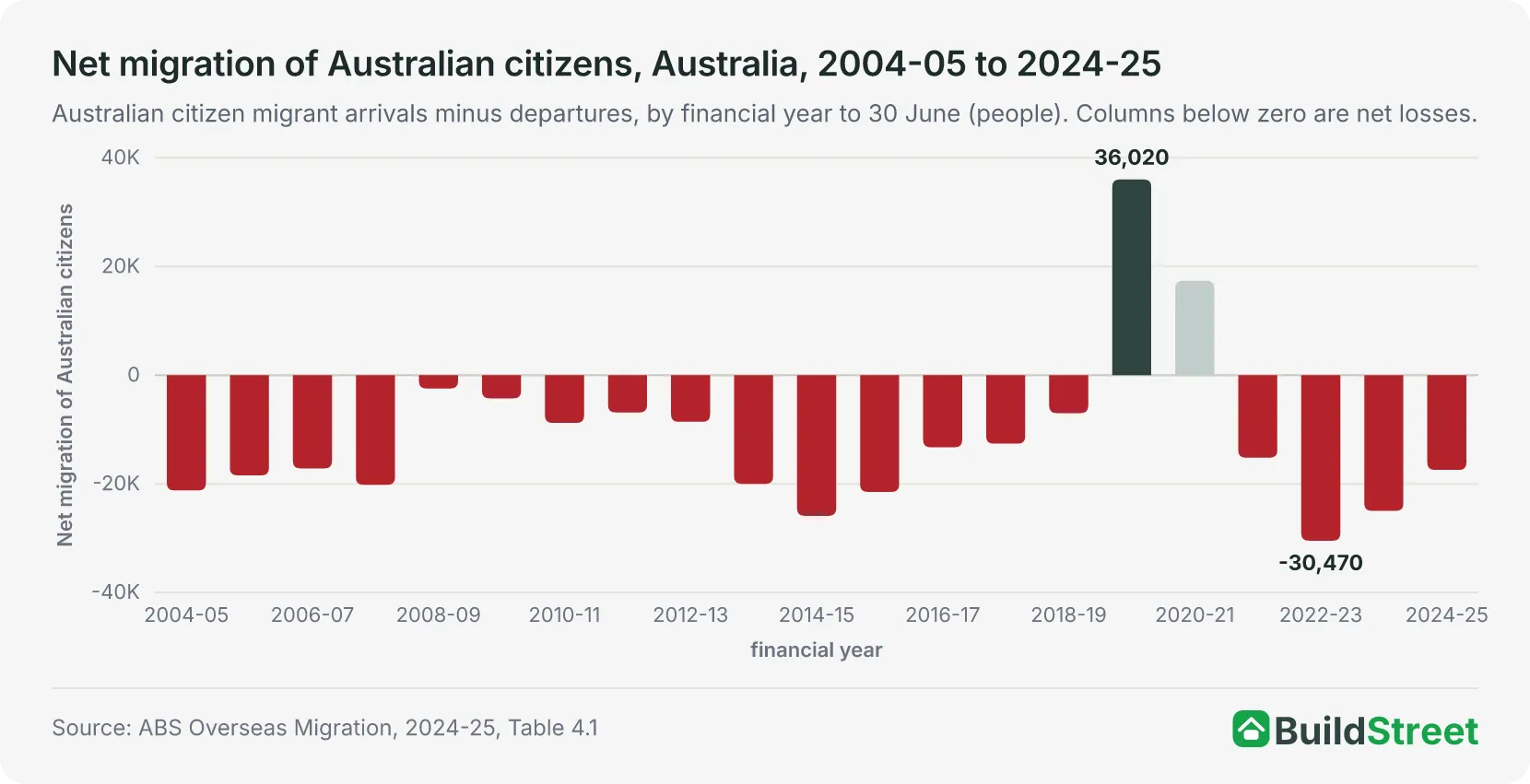
Australian citizen departures were higher than citizen arrivals in every year from 2004-05 to 2024-25 except 2019-20 and 2020-21, resulting in a combined net migration loss of 242,980 people over the period1.
From 2015-16 to 2024-25, the combined net migration loss of Australian citizens was 89,080 people1.
From 2004-05 to 2018-19, citizen departures ranged from 82,900 in 2008-09 to 97,570 in 2014-15, while citizen arrivals ranged from 69,260 in 2004-05 to 80,440 in 2008-091.
Between 2004-05 and 2018-19, the largest annual net migration loss was 25,890 people in 2014-15, while the smallest was 2,460 people in 2008-091.
The net migration loss of Australian citizens narrowed for a second consecutive year in 2024-25, from 30,470 in 2022-23 to 24,980 in 2023-24 and 17,450 in 2024-251.
Section 03 · The pandemic years
What happened to Australian citizen migration during the COVID-19 pandemic?
Australian citizens recorded net migration gains in 2019-20 and 2020-21, the only years from 2004-05 to 2024-25 in which citizen arrivals were higher than citizen departures1.
COVID-19 travel restrictions began in March 2020, were eased from 1 November 2021 and ended for most travellers on 21 February 20222.
The 2019-20 financial year recorded the highest number of Australian citizen arrivals of any year from 2004-05 to 2024-25, at 96,410, while citizen departures fell to 60,3901. The ABS attributes the rise in Australian-born migrant arrivals from September 2019 to March 2020 largely to expatriates who came for short visits before the COVID-19 outbreak but stayed long enough to be counted as migrants2.
Citizen departures fell from 60,390 in 2019-20 to 44,010 in 2020-21, the lowest number in any year from 2004-05 to 2024-25, while citizen arrivals fell to 61,3701. Australian citizens recorded a net migration gain of 17,360 people in 2020-21.
Citizen departures increased to 77,670 in 2021-22 and 89,220 in 2022-23, while citizen arrivals fell to 58,750 in 2022-23, the lowest number recorded between 2004-05 and 2024-251. The 2022-23 financial year recorded the largest net migration loss of Australian citizens over the same period, at 30,470 people.
| Australian citizen migration and net overseas migration, Australia, 2018-19 to 2022-23 | ||||
|---|---|---|---|---|
| Financial year | Citizen arrivals | Citizen departures | Net migration of citizens | Net overseas migration |
| 2018-19 | 78,900 | 85,890 | -6,990 | 241,340 |
| 2019-20 | 96,410 | 60,390 | 36,020 | 192,690 |
| 2020-21 | 61,370 | 44,010 | 17,360 | -84,930 |
| 2021-22 | 62,4801 | 77,670 | -15,190 | 207,910 |
| 2022-23 | 58,750 | 89,220 | -30,470 | 538,340 |
Source · ABS Overseas Migration, 2024-25, Table 4.1
Section 04 · States and territories
Which states and territories do returning Australians move to?
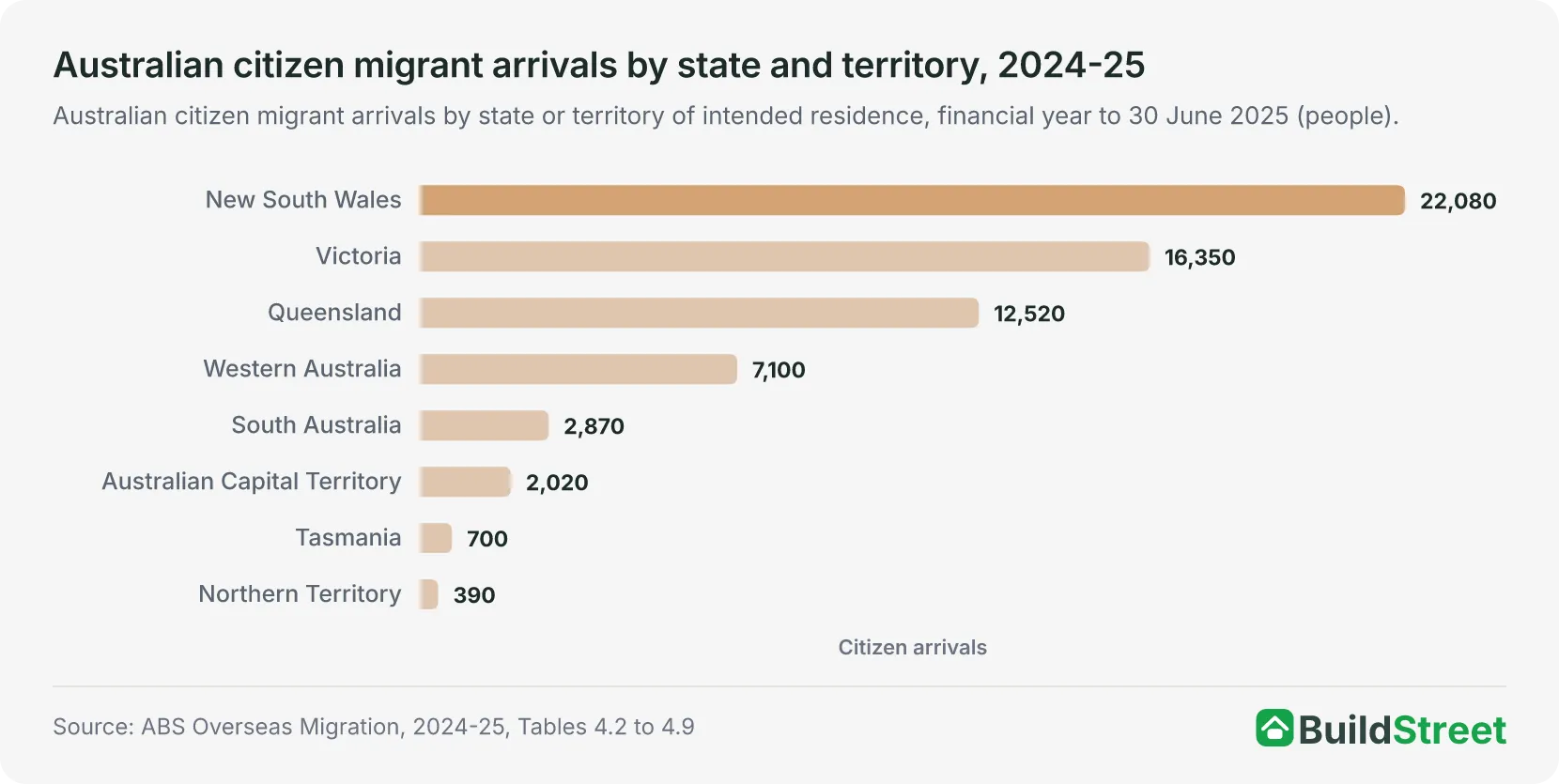
New South Wales recorded the largest number of Australian citizen arrivals of any state or territory in 2024-25, at 22,080 people, accounting for 34.5 per cent of the national total of 64,0601.
Victoria and Queensland recorded 16,350 and 12,520 citizen arrivals respectively, while the Northern Territory recorded the smallest number, at 390 people1. New South Wales accounted for 31.1 per cent of Australia's population at 30 June 20254.
When measured against the population size, the Australian Capital Territory recorded the highest rate of citizen arrivals among the states and territories, at 41.7 per 10,000 residents, compared with 23.2 for Australia as a whole4. Tasmania recorded the lowest rate, at 12.2 arrivals per 10,000 residents.
Every state and territory recorded a net migration loss of Australian citizens in 2024-251. New South Wales recorded the largest net migration loss of Australian citizens of any state or territory, at 6,050 people, followed by Victoria, at 4,750, and Queensland, at 2,730.
In 2020-21, when Australian citizens recorded a national net gain of 17,360, New South Wales recorded a net gain of 15,470, while Victoria, the Australian Capital Territory and the Northern Territory recorded net losses of 1,960, 280 and 70 respectively1.
| Australian citizen migration by state and territory, 2024-25 | |||||
|---|---|---|---|---|---|
| State or territory | Citizen arrivals | Citizen departures | Net migration | Share of citizen arrivals (%) | Arrivals per 10,000 residents |
| New South Wales | 22,080 | 28,1301 | -6,050 | 34.5 | 25.7 |
| Victoria | 16,350 | 21,1001 | -4,750 | 25.5 | 23.1 |
| Queensland | 12,520 | 15,2501 | -2,730 | 19.5 | 22.1 |
| Western Australia | 7,100 | 9,3101 | -2,210 | 11.1 | 23.3 |
| South Australia | 2,870 | 3,6501 | -780 | 4.5 | 15.1 |
| Australian Capital Territory | 2,020 | 2,500 | -480 | 3.2 | 41.7 |
| Tasmania | 700 | 900 | -200 | 1.1 | 12.2 |
| Northern Territory | 390 | 640 | -250 | 0.6 | 14.7 |
| Australia | 64,060 | 81,510 | -17,450 | 100.0 | 23.2 |
Source · ABS Overseas Migration, 2024-25, Tables 4.1 to 4.9; ABS National, state and territory population, June 2025
Overseas migration and housing demand in each capital city are compared in the article on migration and housing demand across the capitals.
Section 05 · Population growth
How does Australians moving overseas affect population growth?
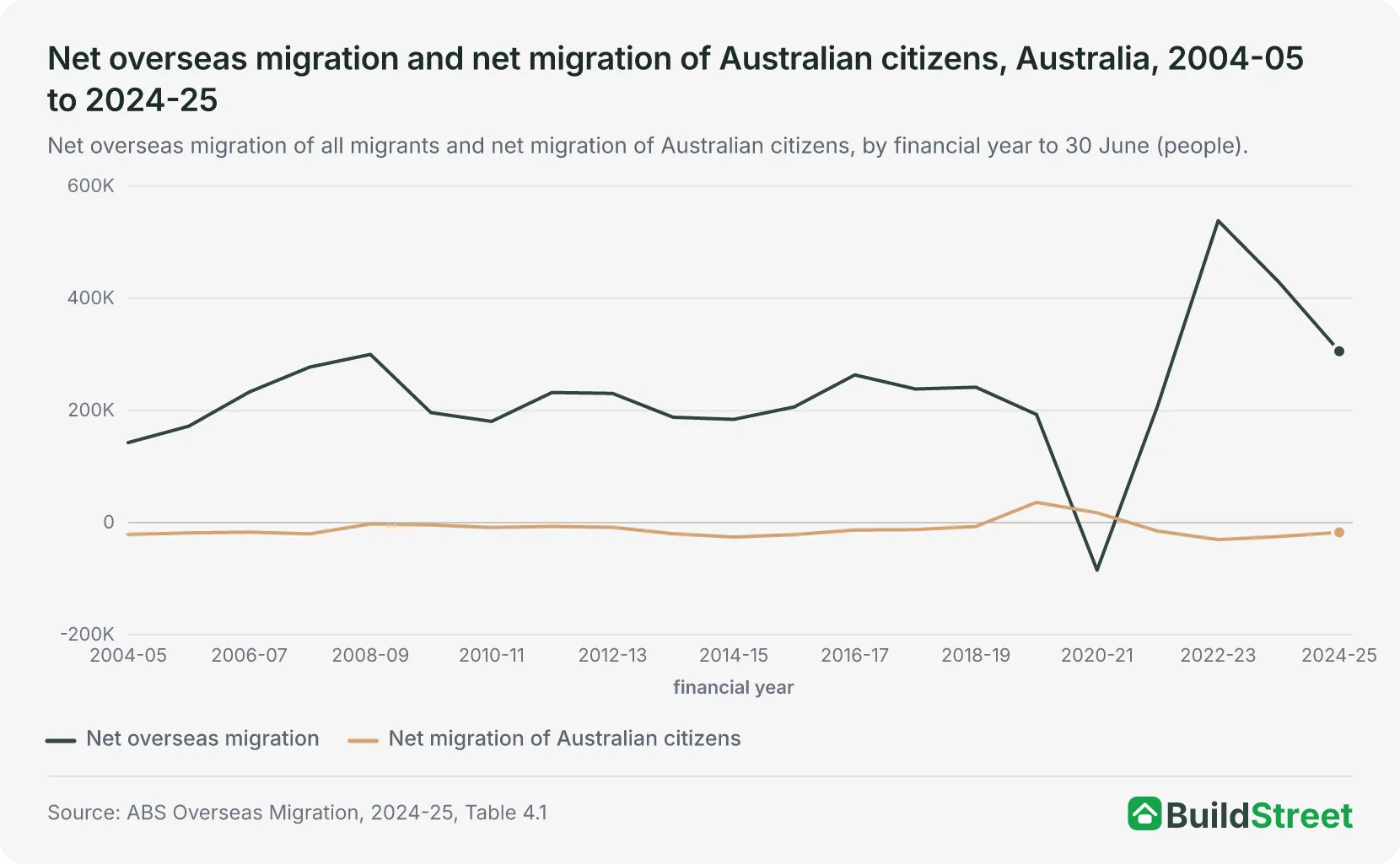
Net overseas migration added 305,570 people to Australia's population in 2024-25, despite a net migration loss of 17,450 Australian citizens1. Net overseas migration of people who were not Australian citizens was a gain of 323,020 people over the year.
Australia's population grew by 420,100 people, or 1.5 per cent, over 2024-25, to 27,614,411 at 30 June 2025, according to the ABS National, state and territory population data4. Natural increase (births minus deaths) added 114,600 people. The net migration loss of Australian citizens was equivalent to 4.2 per cent of Australia's population increase in 2024-25.
The Australian citizen share of overseas migrant arrivals fell from 20.3 per cent in 2004-05 to 11.3 per cent in 2024-25, while their share of departures fell from 45.5 per cent to 31.0 per cent1.
In 2020-21, the only financial year from 2004-05 to 2024-25 when more migrants left Australia than arrived, net overseas migration was a loss of 84,930 people, while net migration of Australian citizens was a gain of 17,3601.
Overseas migration as a whole, by visa and country of birth, is covered in the article on immigration to Australia.
Section 06
Frequently asked questions
Are more Australian citizens leaving Australia than arriving?
Yes. More Australian citizens left Australia than arrived in 2024-25, resulting in a net migration loss of 17,450 people1. Citizen departures were higher than citizen arrivals in every financial year from 2004-05 to 2024-25 except 2019-20 and 2020-21.
Which state or territory do the most Australian citizen arrivals intend to live in?
New South Wales was the intended state of residence for the largest number of Australian citizen arrivals in 2024-25, at 22,080 people, accounting for 34.5 per cent1. The Australian Capital Territory recorded the highest rate among the states and territories, at 41.7 citizen arrivals per 10,000 residents4.
References
- ABS Overseas migrant arrivals and departures, by visa and citizenship groups, by state/territory, 2004-05 to 2024-25 (data cube 34070DO004) · Australian Bureau of Statistics ↑ b c d e f g h i j k l m n o p q r s t u v w x y z a2 b2 c2 d2 e2
- ABS Overseas Migration, 2024-25 · Australian Bureau of Statistics ↑ b c d
- ABS Overseas Migration methodology, 2024-25 · Australian Bureau of Statistics ↑ b c d
- ABS National, State and Territory Population, June 2025 · Australian Bureau of Statistics ↑ b c d e
- Overseas Arrivals and Departures, Australia, July 2026 (time series tables 1, 7 and 8) · Australian Bureau of Statistics ↑
