
Published 23 June 2026
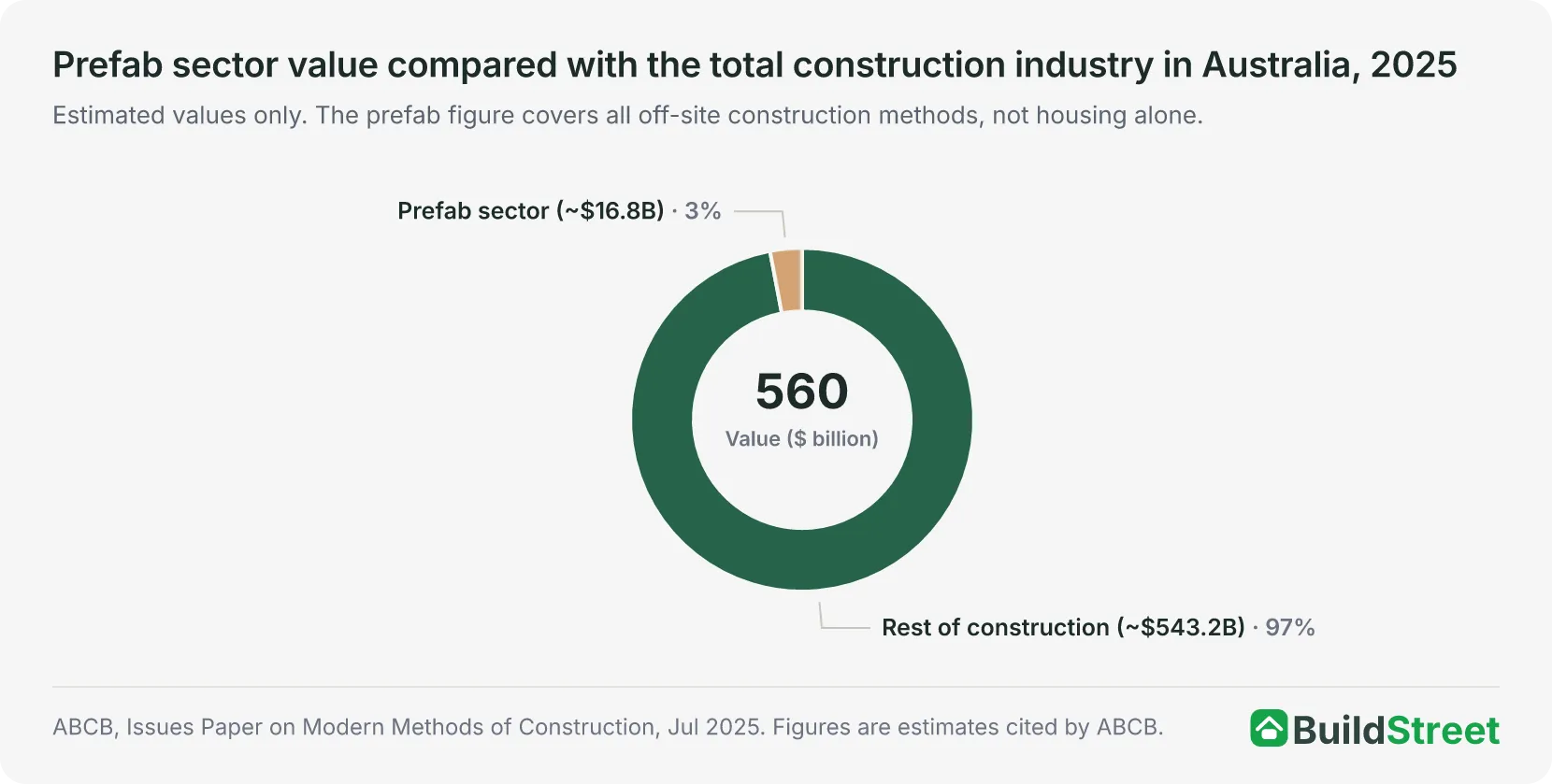
Prefab and modular construction has received increased policy attention in Australia, with governments funding programmes intended to support faster housing delivery. The prefabricated construction sector is estimated at approximately $16.8 billion, equivalent to about 3% of a $560 billion construction industry. The figure covers all prefabricated construction, not prefab housing alone.
For comparison, Japan's prefab sector made up 11.75% of new dwellings built in 2024. Federal and state governments across Queensland, NSW, Victoria, WA, South Australia and Tasmania have active prefab, modular or off-site construction programmes, supported by a $54 million federal commitment in the 2025–26 Budget.
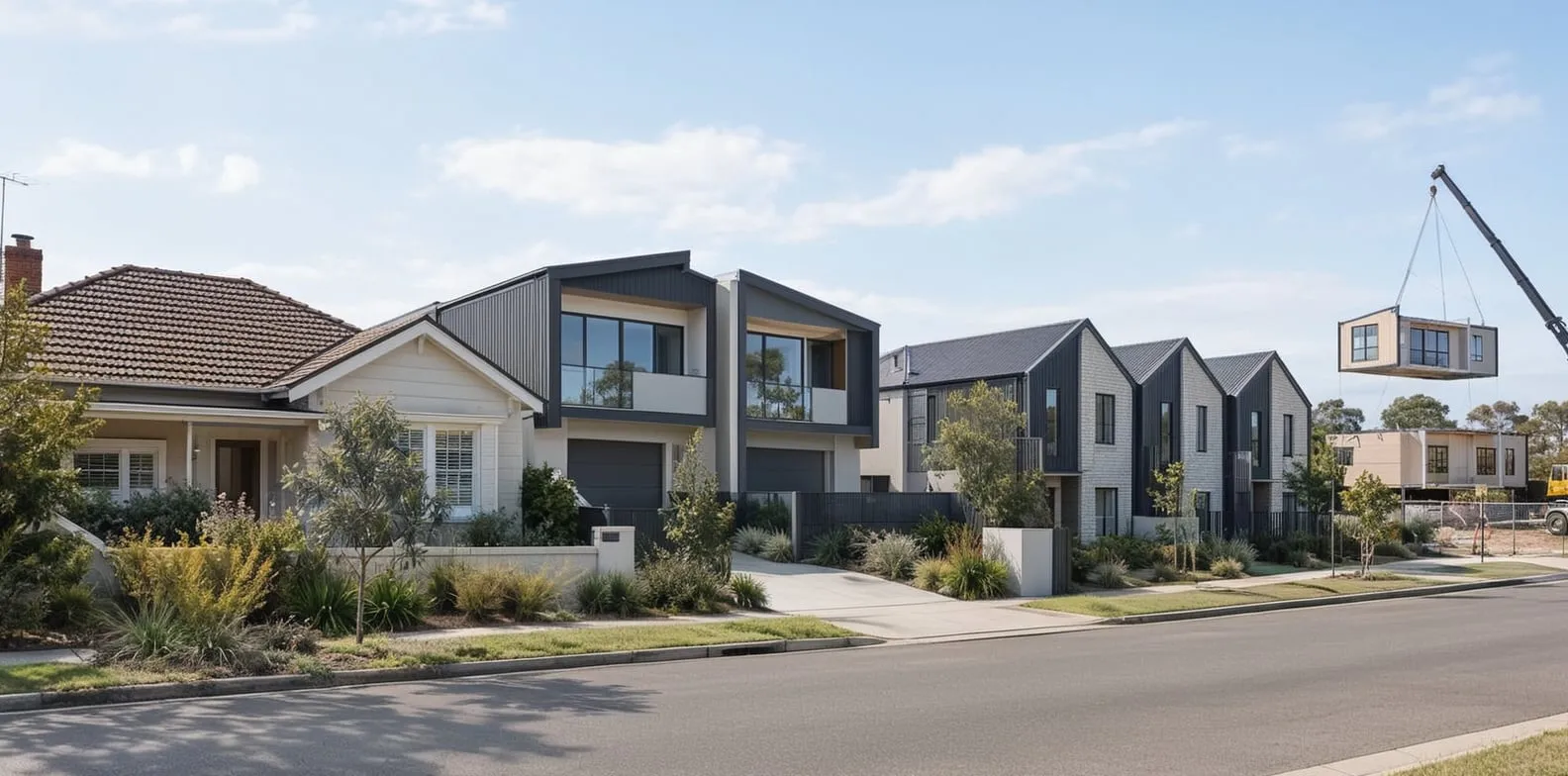 Emerging home types in Australia: modular, prefab, duplexes and the changing dwelling mixDetached houses still make up most of Australia's homes, but their share has slipped over two decades. In 2021, 72.3% of occupied private dwellings were separate houses, down from 75.3% in 2001.
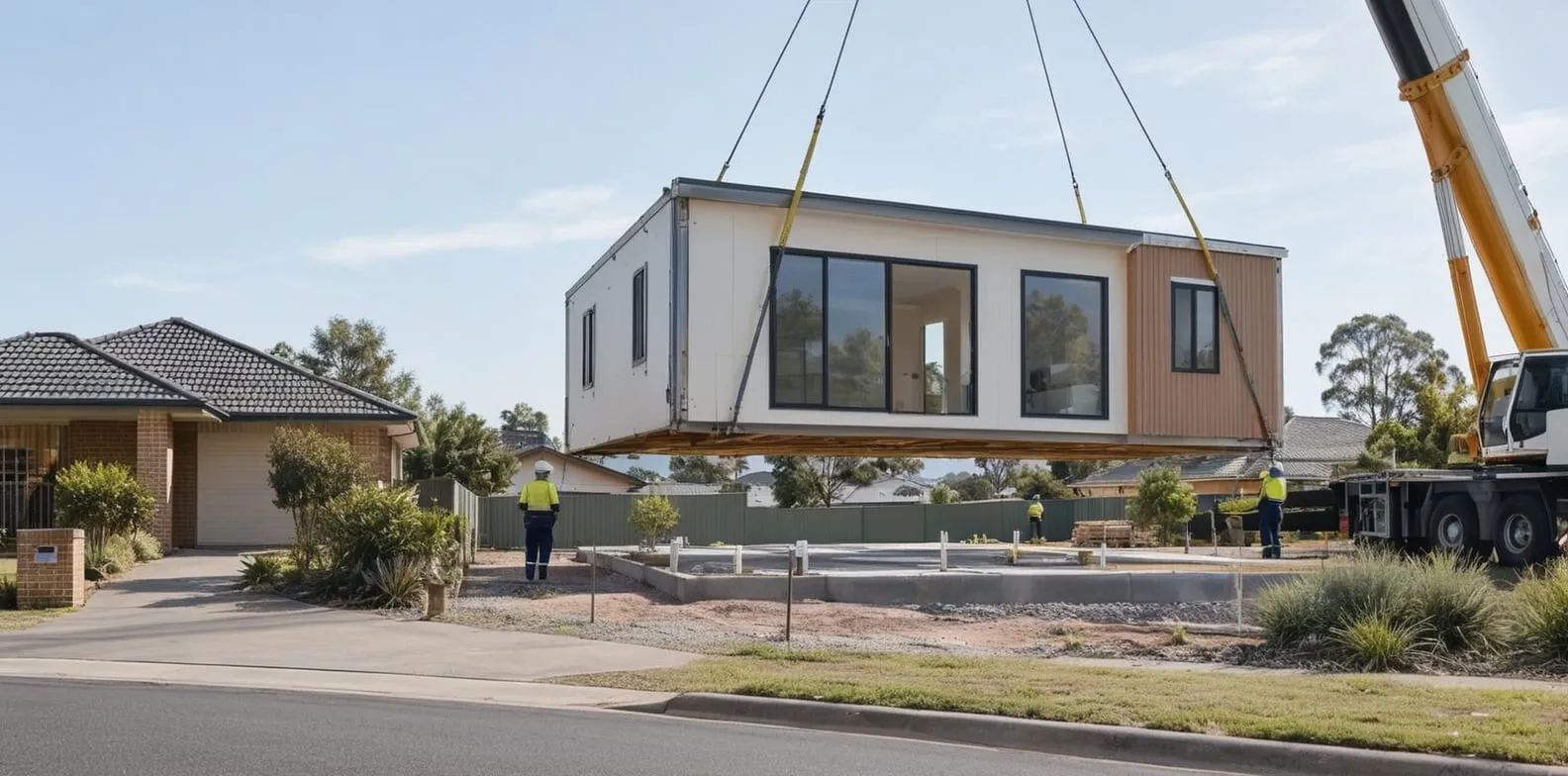 Australian modular housing statistics 2026: build times, costs and government programmesSix Australian state governments have announced, funded or delivered modular, prefabricated or other off-site construction housing programmes to deliver social, regional and key-worker housing faster.…
Section 01 · Definitions
What is prefab construction in Australia?
Prefab construction accounts for less than 5% of total construction in Australia, according to an industry estimate. The term covers a broad range of building methods, from wall panels to fully assembled modular homes.
Prefab, or prefabricated construction, refers to building components made off-site and assembled at their final location. Modular construction is a subset of prefab construction. It refers to fully volumetric rooms or dwellings built in a factory and transported to site for installation. All modular homes are prefabricated, but not all prefabricated homes are modular.
Prefabricated construction is an umbrella term covering modular, panelised and other off-site manufacturing methods. The ABS classifies a "kit house" (category 112) as a house made predominantly from prefabricated components, with modular homes listed as an example. Government documents often use modern methods of construction (MMC) as a broader term.
The distinction matters because each method has different transport, factory, site-work and installation requirements. These differences can affect programme design, delivery timelines and reported costs.
| Type | What it is | Examples |
|---|---|---|
| Prefab (umbrella) | Any building element made off-site and assembled at its final location. Covers both 2D and 3D systems. | Wall panels, roof cassettes, floor systems, bathroom pods, complete modules |
| Panelised (2D) | Flat sections, such as walls, floors and roof panels, made off-site and assembled on a traditional foundation. | Structural insulated panels (SIPs), prefab timber frames |
| Modular (3D) | Fully volumetric units, such as rooms or dwellings, built in a factory and installed on site. | QBuild MMC homes, WA social housing modules, NSW pilot homes |
| Kit home (ABS cat. 112) | ABS classification for a separate house made predominantly from prefabricated components. Modular homes are explicitly included. | Factory-cut timber kits, pre-engineered steel-frame homes |
Source · ABCB, Issues Paper on Modern Methods of Construction, Jul 2025; ABS Building Approvals (Cat. 8731.0), dwelling type definitions; prefabAUS, "What is Prefab?" (industry body definitions).
Section 02
How big is Australia's prefab and off-site construction sector?
Government prefab and modular housing commitments in Australia
Published named commitments include the Commonwealth's $54 million prefab and modular allocation, WA's $97 million, made up of Housing Innovation Fund grants and a separate advanced manufacturing facilities investment, Victoria's $30.38 million and NSW's $10 million. Queensland, South Australia and Tasmania amounts are not publicly quantified.
These commitments cover different programme types and should not be treated as a like-for-like funding total. The table below lists confirmed government programmes and named commitments. Some cost figures remain commercial-in-confidence or unquantified.
| Jurisdiction | Program | Commitment | Notes |
|---|---|---|---|
| Commonwealth | Prefab and modular housing (2025–26 Budget) | $54M | $49.3M to states and territories; balance to ABCB for regulatory reform and certification. Only the $54M total is confirmed across all sources. Source: ABCB Issues Paper, Jul 2025; Minister for Industry media release |
| Western Australia | Housing Innovation Fund and MMC factory investment | ~$97M | $49M Housing Innovation Fund grants to 15 local manufacturers (May 2026) plus a separate $48M for two advanced manufacturing facilities (Neerabup and Kwinana). Source: WA Government, May 2026 |
| Queensland | QBuild Modern Methods of Construction | Part of state housing budget | Up to 600 modular homes via industry suppliers (MMC 600); separately, QBuild RAACs at Cairns and Eagle Farm completed 44 homes since 2023. Source: Qld Government, Jun 2024; Qld Parliament QON 441, 2025 |
| New South Wales | Modular Housing Trial (within $224M Essential Housing Package) | $10M | 8 demonstration homes (3 Wollongong, 5 Lake Macquarie). Source: NSW Government, Jul 2024 |
| Victoria | Modular homes programme (Homes Victoria) | $30.38M | 114 modular homes; plus 25 further with Haven Home Safe (Jan 2024). Source: Premier of Victoria, May 2022; Premier of Victoria, Jan 2024 |
| South Australia | SA Housing Trust off-site panelled homes tender | Not disclosed | 120 homes over approximately 4 years; tender issued Jun 2025. Source: SA Housing Trust, Jun 2025 |
| Tasmania | ModHomes and Modular Housing Finance Guarantee | Ongoing | Around 200 modular social homes over four years; finance guarantee announced Jun 2026. Source: ABCB Issues Paper, Jul 2025 (citing Built Off-site); Premier's announcement, Jun 2026 |
Section 03
How much does a prefab home cost in Australia?
Only official cost data available
$209k–$442k
per home
Queensland's QBuild MMC programme is the only official prefab home cost source identified in the sources reviewed. That range is a government procurement estimate for social housing, not a retail price. No national average sale price for prefab homes has been published in Australia.
Official · Qld Parliament, QON 756, 2024
Every official cost figure identified in the sources reviewed relates to a government social housing programme, not the private market. Costs reflect social housing specifications, government procurement arrangements, transport to regional or remote sites, site works and the scale of individual contracts.
QBUILD MMC · QUEENSLAND · 2024
$209,000–$442,000
- Estimated cost range per home under the QBuild MMC programme. Costs vary by supplier, transport distance, site location and site works. Specific project costings are commercial-in-confidence. The Queensland Government noted that “an average cost for all modular homes built across regional Queensland cannot be provided.”
- Source: Qld Parliament, Question on Notice No. 756, 2024. Official estimate · social housing procurement
WALKERVALE MODULAR HOMES · QUEENSLAND · 2024
$663,154 per home
- Two homes at Walkervale had a total disclosed cost of $1,326,308, which equals $663,154 per home. This is above the QBuild programme range of $209,000 to $442,000 and reflects site-specific conditions for this project only. It is not representative of typical prefab home costs.
- Source: Qld Parliament, Question on Notice No. 756, 2024. Official figure · single project, 2 homes
NATIONAL RETAIL AVERAGE
No official data published
- No Australian government agency has published a prefab-specific price series or national average. For context, ABS figures for 2024–25 put the average construction cost at $474,939 for a new house, $435,089 for a townhouse and $567,947 for an apartment. These cover all construction methods and are not prefab-specific.
- Source: ABS Building Activity, 2024–25; ABCB 2025. Data gap · to be updated when published
Victoria's programme ($30.38 million for 114 homes) works out to roughly $266,500 per home by dividing the total budget. That is derived arithmetic, not a stated per-home cost, so it is not used as a headline figure.
What affects prefab home costs in Australia?
The official programme disclosures point to several factors that drive cost variation:
- Transport distance: moving large modules to regional or remote sites adds logistics cost
- Site works: preparation, foundations and service connections are costs separate from the factory build
- Specifications: government social housing programmes use standard specifications that differ from a privately commissioned home
- Certification: inspection requirements vary by jurisdiction and can affect both timeline and cost
Scale is a separate factor. Early-stage government factory programmes can face higher per-unit costs when production volumes are low. Several federal and state measures identified in the sources reviewed relate to manufacturing capacity, regulation or programme delivery rather than direct retail price support for individual prefab homes.
Section 04
How does prefab adoption in Australia compare internationally?
- Australia · share of total construction
- <5%
- Industry estimate; covers all construction types, not housing alone
- Japan · share of new dwellings (2024)
- 11.75%
- Official; measures prefab share of new dwelling completions
- Singapore · DfMA by gross floor area
- 44%
- 2021 indicator; not housing-specific and not directly comparable
| Prefab and offsite construction adoption indicators in Australia, Japan and Singapore | ||||
|---|---|---|---|---|
| Country | Indicator | Reported figure | Status | Notes |
| Australia | Share of total construction | <5% | Estimated · Productivity Commission, Feb 2025; no dwelling-specific measure | Covers all Australian construction, not housing specifically. No official residential prefab adoption rate exists. |
| Japan | Share of new dwellings (2024) | 11.75% | Official · Statistics of Japan, via ABCB 2025 | Measures prefab as a share of new dwelling completions, which is the metric Australia does not yet publish. Some other Australian official sources cite different Japan benchmarks (12–16% and 28%) due to differences in definition and measurement year; the 11.75% figure is the one used in the ABCB issues paper. |
| Singapore | DfMA by gross floor area (2021) | 44% | Official · Singapore BCA, 2021; 70% target by 2025 (unconfirmed) | Measures Design for Manufacture and Assembly (DfMA) adoption by gross floor area across the whole building sector. Singapore increased from 31% in 2019 to 44% in 2021. The 2025 target of 70% has not been confirmed as achieved in the sources reviewed. Confirmed DfMA trajectory: 31% (2019, official) → 44% (2021, official) → 70% (2025 target). |
Source · Australia: Productivity Commission, Feb 2025. Japan: Statistics of Japan, via ABCB Issues Paper, Jul 2025. Singapore: Ministry of National Development, Singapore, 2022 statement citing 2021 DfMA adoption by gross floor area. The 2025 Singapore figure is a target, not a confirmed outcome.
Japan's figure is the closest comparator for Australia because it uses the same metric Australia does not yet publish: prefab's share of new dwelling completions. Singapore's DfMA rate is not directly comparable, because it measures gross floor area across all building types, not housing specifically, and reflects a broader industry mandate that goes beyond residential construction.
Japan and Singapore use different policy and reporting frameworks from Australia, so their figures should be treated as context rather than direct benchmarks. Australia does not publish an equivalent residential prefab adoption series, which limits direct comparison with Japan's dwelling-completion data and Singapore's DfMA gross-floor-area measure.
Section 05 · Barriers
What is slowing prefab adoption in Australia?
Official reports identify four barriers to greater prefab uptake in Australia: regulatory frameworks designed for on-site construction, financing models that do not suit factory workflows, demand and industry factors including consumer preferences and skills gaps, and scale constraints that keep per-unit costs high at current production volumes. Lack of demand is identified as probably the largest barrier.
Two reports published in 2025 give the most detailed official picture of what is holding back prefab adoption. Both identify the same four barriers, listing regulatory and certification frameworks as a structural constraint for off-site construction methods.
Regulatory barriers
Building certification and inspection processes were designed for on-site construction. Prefab does not map cleanly onto stage-inspection requirements, and planning rules in some jurisdictions favour traditional home designs. Standard approval processes assume construction proceeds in visible stages on site, whereas a modular home may arrive largely complete from a factory. A voluntary national manufacturer certification scheme was funded in 2024. Policy response: ABCB regulatory and certification reform, funded within the $54M 2025–26 Budget allocation, and work on nationally consistent MMC definitions.
Source: ABCB, Issues Paper on MMC, Jul 2025; Productivity Commission, Feb 2025
Finance barriers
Traditional construction loans disburse funds by on-site progress stages. Factory-built homes require large upfront capital before anything appears on site, which does not suit standard lending models. Standard construction loans are structured around on-site inspections at slab, frame, lockup, fixing and completion stages. A modular factory requires capital well before a slab is poured. Policy response: Tasmania's finance guarantee (Jun 2026); federal government commitment to work with banks and investors on prefab financing.
Source: Productivity Commission, Feb 2025; Tasmania Premier's announcement, Jun 2026
Demand and industry barriers
Consumer preference for custom-designed homes and limited familiarity with prefab methods can reduce demand. Some trades have concerns about reduced on-site labour requirements.
Lack of demand has been described as "probably the largest barrier to greater uptake of prefabricated construction." Skills gaps also exist: the workforce required for modular factory production differs from that for on-site construction. No official demand-side survey data was identified in the sources reviewed.
Source: Productivity Commission, Feb 2025; Homes Tasmania programme documentation
Scale barriers
Prefab tends to become more cost-competitive at volume. Early government programmes operating at low throughput can produce homes that are more expensive per unit than higher-volume production. The Productivity Commission notes that scale is needed for cost-effectiveness, but that realised savings have proved difficult to achieve, and prefab can be similar to or more expensive than on-site construction. Policy response: WA's $49M to 15 local manufacturers (May 2026) and $48M for advanced manufacturing facilities.
Source: Productivity Commission, Feb 2025; WA Government, May 2026
Section 06 · Government programs
How are governments using prefab and modular housing in Australia?
The six state programmes active as at mid-2026 are all government-funded. Most delivery programmes target social, affordable or public housing, while other measures support finance, regulation or manufacturing capacity rather than building homes directly. Some programmes refer to regional delivery, social housing supply, faster construction methods, finance, regulation or manufacturing capacity.
There is no comparable official data on prefab uptake in the private residential market.
Queensland · Largest stated modular housing target
QBuild Modern Methods of Construction
- Target: Up to 600 modular homes under the MMC 600 programme, delivered through industry suppliers (not QBuild RAACs); progress against this target was not quantified in the sources reviewed
- QBuild RAAC production (to May 2025): 44 modular homes completed since 2023 — Cairns 18, Eagle Farm (Brisbane) 26. RAAC output is separate from the MMC 600 programme
- Purpose: Social housing and key-worker accommodation in regional Queensland
Source: Qld Government, Jun 2024 (600 target); Qld Parliament, QON 441, 2025 (RAAC completions)
Western Australia
Housing Innovation Fund and advanced manufacturing facilities
- HIF grants: $49M to 15 local housing manufacturers (May 2026)
- Facilities investment: $48M for two advanced manufacturing facilities (Neerabup and Kwinana); ~$97M in named measures combined
- Purpose: Expand manufacturing capacity for prefabrication and modern construction methods
Source: WA Government, May 2026; Housing Innovation Fund announcement, Nov 2025
Tasmania
ModHomes and Modular Housing Finance Guarantee
- Target: Around 200 modular social homes over four years
- Launched: 2022
- Finance guarantee: Announced Jun 2026 to unlock construction-phase lending
Source: ABCB Issues Paper, Jul 2025 (citing Built Off-site); Premier's announcement, Jun 2026
New South Wales
Modular Housing Trial & Expansion
- Initial commitment: $10M within $224M Essential Housing Package (Jul 2024)
- Original scope: 8 demonstration homes (3 Wollongong, 5 Lake Macquarie)
- July 2025 update: 90 modular homes announced; first 3 Wollongong homes online, 10 total expected by end-2025, 80 additional planned
Source: NSW Government media release, Jul 2024; NSW Government, Jul 2025
Victoria
Homes Victoria modular programme
- Funding: $30.38M for 114 modular homes
- Plus: 25 modular social homes with Haven Home Safe (Jan 2024)
- Purpose: Social housing
Source: Premier of Victoria, modular homes announcement, May 2022; regional homes announcement, Jan 2024
South Australia
SA Housing Trust off-site panelled homes
- Target: 120 off-site panelled homes over approximately 4 years
- Announced: Jun 2025
Source: SA Housing Trust, Jun 2025
Prefab and modular housing policy timeline, 2022 to 2026
2022
Tasmania launches ModHomes
Target of around 200 modular social homes over four years.
Source: ABCB Issues Paper on MMC, Jul 2025
June 2024
Queensland announces up to 600 modular homes
The MMC 600 programme targets modular homes delivered through industry suppliers.
Source: Queensland Government, Jun 2024
July 2024 / July 2025
NSW launches modular housing trial and expansion
The initial $10M trial covered 8 homes, followed by a 2025 update announcing 90 modular homes.
Source: NSW Government, Jul 2024; NSW Government, Jul 2025
February 2025
Productivity Commission identifies MMC barriers
The report identified regulatory, finance, demand and scale barriers to prefab adoption.
Source: Productivity Commission, Feb 2025
June 2025
SA Housing Trust issues tender for 120 off-site panelled homes
The tender covers off-site or modular homes to be built over approximately four years.
Source: SA Housing Trust, Jun 2025
2025–26 Budget
Commonwealth allocates $54M for prefab and modular housing
Funding supports state and territory programmes, regulatory reform and certification work.
Source: ABCB Issues Paper on MMC, Jul 2025; Minister for Industry media release
May 2026
WA awards $49M to 15 local housing manufacturers
The grants sit alongside a separate $48M advanced manufacturing facilities investment.
Source: WA Government, May 2026
June 2026
Tasmania announces Modular Housing Finance Guarantee
The guarantee is designed to support construction-phase lending for modular housing projects.
Source: Premier of Tasmania, Jun 2026
References
- Australian Building Codes Board, Issues Paper on Modern Methods of Construction (MMC Certification Scheme), July 2025 · consultation.abcb.gov.au
- Productivity Commission — Housing construction productivity: Can we fix it? · pc.gov.au
- ABS Building Approvals, Australia (latest release, Cat. 8731.0) · Australian Bureau of Statistics
- ABS, Building Activity, Australia (latest release, Cat. 8752.0) · Australian Bureau of Statistics
- Queensland Parliament, Question on Notice No. 756, 2024 · documents.parliament.qld.gov.au
- Queensland Parliament, Question on Notice No. 441, 2025 · documents.parliament.qld.gov.au
- Homes for Queenslanders: Budget delivers plan, 600 modular homes · statements.qld.gov.au
- QBuild — Modern methods of construction program · housing.qld.gov.au
- NSW Government, Modular homes to deliver more social housing, sooner, July 2024 · nsw.gov.au
- Homes NSW — First tenants call public modular housing home · nsw.gov.au
- Modern methods of construction for social housing · nsw.gov.au
- Premier of Victoria — Modular Homes Housing People Across Victoria · premier.vic.gov.au
- Premier of Victoria — Delivering More Homes For Regional Victorians · premier.vic.gov.au
- WA Government, Advanced manufacturing facilities to boost housing supply, May 2026 · wa.gov.au
- WA Government, Housing Innovation Fund boost for manufacturing, home supply, November 2025 · wa.gov.au
- WA Government — Cook Government delivering $49 million for local housing manufacturers · wa.gov.au
- WA Government, Housing Innovation Fund grant recipients · wa.gov.au
- SA Housing Trust — Trust homes built with pre-constructed wall panels · housing.sa.gov.au
- Department for Housing and Urban Development SA — Prefab housing project launched ahead of industry roundtable · dhud.sa.gov.au
- Premier of Tasmania — Tasmania unlocks faster, cheaper housing with modular finance guarantee · premier.tas.gov.au
- CEDA, Tasmania State of the State 2026 · ceda.com.au
- Building and Construction Authority, Singapore, Built Environment Industry Transformation Map · www1.bca.gov.sg
- Building and Construction Authority / BCA Academy, DfMA target source · mic.cic.hk
- Ministry of National Development, Singapore, Speech by Minister Desmond Lee at the Topping Out Ceremony of Avenue South Residence, 2022 · Ministry of National Development, Singapore
- Statistics of Japan, New dwelling completions by construction type, 2024 · e-stat.go.jp
- prefabAUS, What is Prefab? · prefabaus.org.au
