

Published 10 July 2026 · Updated 18 Sept 2026
Section 01 · The basics
What is an easement on a property?
An easement is a legal right over part of a lot, held by someone other than the owner and registered on the title, for a stated purpose. Cardinia Shire Council's definition: an area of land or part of a lot registered on your property title that gives Council, or another service authority, access to your property1.
The land stays with the owner. Ausgrid states, for electricity easements, that ownership of the land remains with the property2. The easement holder instead gains specified rights over that part of the land, and a registered easement generally continues to apply when the property changes ownership.
Many easements on newly subdivided blocks are created as part of the subdivision process. The plan of subdivision is the surveyed plan registered with the state's land registry that creates the new lots. In NSW that plan is called a deposited plan, and the easements, restrictions and covenants it creates are listed in a section 88B instrument: a schedule lodged with the plan under the Conveyancing Act 1919 that brings those rights into existence when the plan is registered3. NSW Land Registry Services describes the search product in the same terms: instrument 88B shows "any easements or restrictions on a title"4.
Section 02 · The types
Common types of easements and who holds them
Common easements include those for access, drainage, sewerage and the supply of water, gas or electricity. Queensland Government guidance lists common easement purposes: easements including access, drainage, sewerage, and the supply of water or gas5. The easement holder varies by type and determines which registered terms or published policies apply to work affecting the easement. The table below shows four common easement types and examples of the relevant holder's published policy.
| Common easement types, holders and building restrictions | ||
|---|---|---|
| Easement type | Who usually holds it | Typical restriction (named policy) |
| Drainage / stormwater | Local council | Council consent to build over; Cardinia Shire (VIC) refuses dwellings and habitable buildings, allows fences and paths with conditions |
| Sewerage / water supply | Water authority (Sydney Water, Urban Utilities, VIC water corporations) | Authority approval before building or excavating near assets; Sydney Water (NSW) does not allow building over pressure pipes |
| Electricity | Distributor (e.g. Ausgrid in NSW) | Houses, sheds, garages and "other large structures" not allowed; written approval required before any work |
| Access / right of carriageway | A neighbouring lot it serves | Terms set by the registered instrument; the holder is the owner of the benefited lot |
Source · Cardinia Shire Council build-over page (as archived 16 April 2026); Sydney Water technical guidelines (October 2025); Ausgrid electricity easements page; Queensland Government easements guidance. Retrieved 10 July 2026.
Section 03 · The envelope
How easements affect a block's buildable area
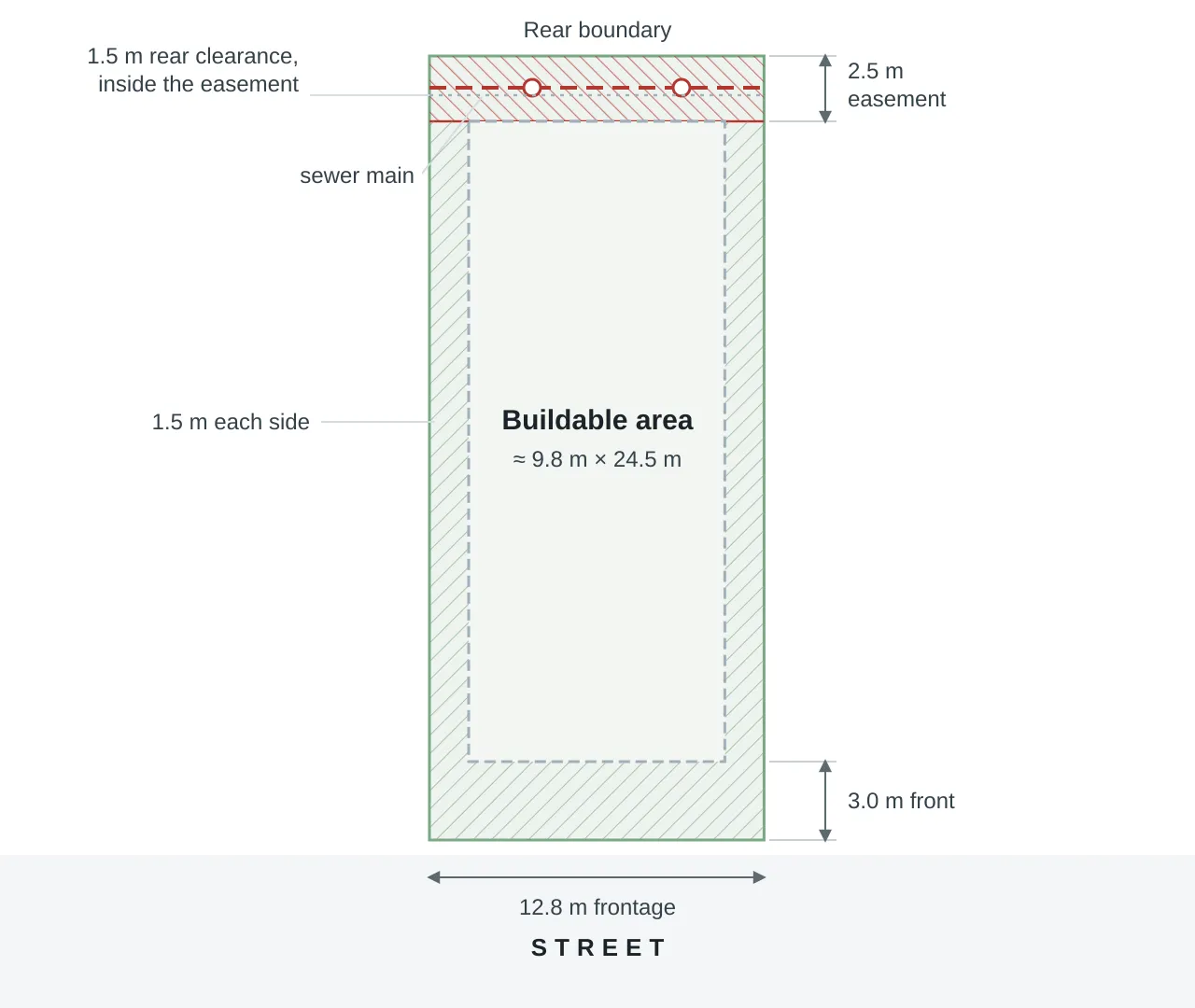
An easement can reduce the part of a block available for building, separately from any setback requirements. A setback can scale with wall height or flex with a council's discretion; a registered easement does neither. Where the easement is wider than the setback on the same boundary, the easement may set a more restrictive building line. A structure the setback rules would otherwise allow then needs the holder's consent, or a redesign.
Worked example: The illustrative lot below is 12.8 m × 30 m (384 m²) with a 2.5 m drainage-and-sewerage easement along the rear boundary; easement widths vary between plans. Queensland's rear clearance for a low wall is 1.5 m under QDC MP 1.1 Table A2(a)6, so on this lot the easement, not the siting code, creates the more restrictive building line: the rear building line sits 2.5 m in, 1.0 m beyond the 1.5 m clearance (derived).
Buildable area on an example Queensland lot with a 2.5 m rear drainage easement
Section 04 · The title
How to find the easements on a block
Easements are recorded in the title and registered plan, with the exact documents varying by state. A NSW title search shows any mortgages, caveats, deeds or easements on the property4; the details including the easement's location, purpose and benefiting party, may be recorded on the plan and, in NSW, the section 88B instrument described above. Public map layers are not a substitute for the registered documents: the metadata for Victoria's statewide easement layer states that only a subset of easements have been captured7.
On a specific block, the documents are checked in this order:
- Order a title search. It lists the registered interests over the lot, including easements.
- Order the registered plan. NSW: the deposited plan plus the s 88B instrument; VIC: the Copy of Plan; QLD: the survey plan image. The plan and associated instruments can provide details not shown on the title, including an easement's width, location, purpose and benefiting party.
- Read the easement's terms. The registered instrument sets the rights attached to the easement and any conditions affecting its use.
- A Before You Dig Australia (BYDA) enquiry can separately show nearby underground or overhead services. It locates services in the ground, not registered easements.
| Easement search documents and costs by state | |||
|---|---|---|---|
| State | What to order | Where | Cost |
| NSW | Title search, then the deposited plan + s 88B instrument | NSW LRS authorised information brokers (LRS doesn't sell one-off searches directly) | $19.49-$98.00 title search; $19.90-$78.00 plan or dealing (registered document) image |
| VIC | Register Search Statement (copy of title) + Copy of Plan: the plan shows "any existing easements over the property" | LANDATA (landata.online), within 5 min by email | Paid; fees published by Land Use Victoria, shown at order |
| QLD | Current title search + image of survey plan | Titles Queensland online search | $25.71 title; $27.56 plan image |
| All states | Plans of underground services near the work site (assets, not the registered easement) | Before You Dig Australia (byda.com.au) | Free |
Source · NSW range is NSW LRS's published one-off broker/reseller price list (updated 1 April 2026); 8 of the 13 listed brokers charge between $21.10 and $44.00 for a title search (derived from that list). QLD prices as listed on the Titles Queensland searches page, 10 July 2026; statutory fees, no GST. Retrieved 10 July 2026.
Section 05 · Consent to build
Building over easements in NSW, Victoria and Queensland
NSW, Victoria and Queensland all have approval or consent requirements for some building work over or near easements and service infrastructure, but the mechanism differs by state and asset holder.
| State | Who consents | The mechanism | A number to know |
|---|---|---|---|
| NSW | Sydney Water, for its pipes and easements | Approval before building or digging near assets | Structures considered over reticulation sewers ≤300 mm only |
| VIC | The service authority the easement is vested in | Report and consent under reg 130, Building Regulations 2018 | $338.70 application fee (Cardinia Shire, 2026-27) |
| QLD | Every registered easement holder | Consent required before approval under s 65, Building Act 1975 | 20 business days for a referral agency to assess |
Source · Summary of the instruments and policies detailed below; the named fee and pipe limits are examples from the cited documents, not statewide schedules.
NSW: Sydney Water approval for building near assets
Sydney Water's rule is that approval may be required before building or digging near its assets. This includes work affecting pipes, drains, meters and easements8.
Its technical guidelines set different requirements according to the type and size of the asset. Certain structures can be considered under the standard provisions for reticulation sewers with diameters of 300 mm or smaller.9 Larger wastewater assets can require referral or specialised assessment.
Some assets have additional restrictions. Building over pressure pipes, sewer connection points and maintenance structures, as well as certain easements, assets in poor condition and asbestos-cement pipes, is not permitted under the technical guidelines.9
Victoria: report and consent under reg 130
Regulation 130(1) of the Building Regulations 2018 requires the report and consent of the relevant service authority for a building permit application involving construction over an easement vested in that authority.10 The service authority that holds the easement must give its report and consent as part of the building permit application.
The regulation's notes add the water layer. Section 148 of the Water Act 1989 prohibits building a structure or placing fill, without the water corporation's consent, over land where an easement exists in favour of a water supply authority or for water supply, sewerage or drainage purposes10. Council report-and-consent fees are set council by council. Cardinia Shire, the Victorian example used through this article, charges $338.70 (2026-27) per application, not refunded if the application is not approved1.
Queensland: every holder's consent under s 65
Under section 65 of the Building Act 1975, if land is subject to a registered easement, the assessment manager, which may be a council or private certifier assessing the building application, cannot approve the application unless each registered easement holder has consented to the building work11.
Work over or near sewers, water mains and stormwater drains is assessed against QDC MP 1.412. A proposal outside MP 1.4's acceptable solutions goes to the service provider as a referral agency, whose assessment forms part of the building application. The referral agency has 20 business days to assess the application13. Urban Utilities' acceptable solutions apply to Class 1 and 10 buildings or structures, including houses and non-habitable structures such as sheds and carports, within three metres of a gravity sewer less than 300 mm in diameter14.
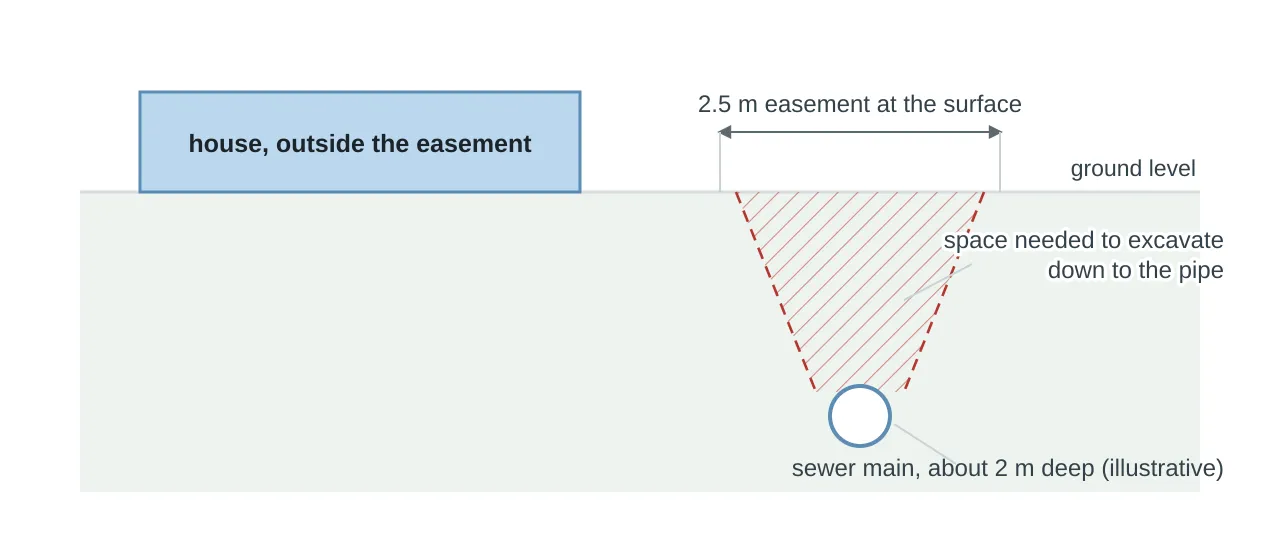
Maintenance access above a sewer main inside a drainage-and-sewerage easement
Section 06 · building limits
What can be built over an easement?
What can be built over an easement depends on the easement holder and the terms that apply to it. Across the three authorities reviewed here, Cardinia Shire in Victoria, and Sydney Water and Ausgrid in NSW, published policies generally distinguish between landscaping, lighter or removable structures, and permanent buildings. The requirements are specific to each authority and should not be treated as national rules.
| What different authorities allow over or near easements | ||
|---|---|---|
| Proposal | Likely answer | Named policy |
| Grass, turf, mulch | No application needed | Cardinia Shire (VIC), build-over-easement rules |
| Fencing (incl. pool fencing), concrete paths, eaves, cut-and-fill | Likely approved, with conditions | Cardinia Shire |
| Concreting a driveway near water assets | Approval required first | Sydney Water, building over or next to assets |
| Garden shed, pergola, deck, water tank, detached steel-frame garage | Likely approved subject to a s 173 agreement on the title | Cardinia Shire |
| Lightweight structures over a reticulation sewer ≤300 mm | Considered, but they cannot be permanently enclosed | Sydney Water technical guidelines (October 2025) |
| Dwelling or habitable building, pool, spa, sauna, permanent brick garage | Refused | Cardinia Shire |
| Anything over pressure pipes or sewers >750 mm | Not allowed | Sydney Water technical guidelines (October 2025) |
| Houses, sheds, garages on an electricity easement | Not allowed; written approval needed before any work | Ausgrid, electricity easements |
Source · Cardinia's lists apply to easements and land within 1 m of a council stormwater drainage asset; a s 173 agreement is an agreement with the council recorded on the title that binds future owners. Cardinia page as archived 16 April 2026; other policies retrieved 10 July 2026.
Section 07
Frequently asked questions
What is an easement in simple terms?
A right, registered on the land's title, for someone else to use part of a block for a stated purpose: commonly drainage, sewerage, water, electricity or access. The land stays with the owner, but the holder can enter and use that strip, and building over it generally needs their consent.
How do I find out if my block has an easement?
A title search and registered plan show the registered easements affecting a block. In NSW, this can include a title search plus a section 88B instrument via an NSW LRS-authorised broker; one-off title searches run from $19.49-$98.00 on NSW LRS's broker price list (updated 1 April 2026). In Victoria, the relevant documents include a Register Search Statement and Copy of Plan via LANDATA. In Queensland, a title search costs $25.71 and a survey plan image costs $27.56 via Titles Queensland, as listed on 10 July 2026.
Can I build a shed or garage over an easement?
Sometimes, with consent. Cardinia Shire (VIC) lists garden sheds and detached steel-frame garages as structures that may be approved over a drainage easement, subject to a section 173 agreement recorded on the title. Permanent brick or weatherboard garages and sheds are listed as not likely to be approved. If the easement belongs to a water authority, that authority's requirements also apply.
Can I put a fence, garden or driveway on an easement?
Requirements vary by easement holder and structure. Cardinia Shire needs no application for grass, turf or mulch, and lists fencing and concrete paths as likely to be approved with conditions. Near water assets, separate approval requirements can apply. Sydney Water, for example, requires approval for some work involving driveways near its pipes.
Does Before You Dig Australia show easements?
No. BYDA is free and provides asset owners' plans showing underground or overhead infrastructure near a work site, but it shows where pipes and cables physically sit, not registered property rights. An easement can exist with no pipe in the ground yet, and a pipe can exist with no easement. Registered easement details are found in the relevant title, plan and associated instruments.
Who owns the land under an easement?
The property owner does. The easement does not transfer ownership of the land to the easement holder. Instead, the holder gains specified rights to use the affected part of the property for the easement's stated purpose. A registered easement generally continues to apply when the property changes ownership.
Check your own block
BuildStreet's lot report includes an easement-layer check where public data exists (for example, sewer-proximity flags from council layers) and reports "unknown: check your title" where it doesn't, because many easements appear only on the registered plan or title and in no public web layer. Type your address, see what the public record shows, and what it can't.
References
- Cardinia Shire Council: Apply to build over an easement · cardinia.vic.gov.au ↑ b
- Ausgrid: Electricity easements · ausgrid.com.au ↑
- Conveyancing Act 1919 (NSW), section 88B · legislation.nsw.gov.au ↑
- NSW Land Registry Services: How to find a record · nswlrs.com.au ↑ b
- Queensland Government: Easements · qld.gov.au ↑
- Queensland Development Code MP 1.1 — design and siting standard for single detached housing on lots under 450 m² · hpw.qld.gov.au ↑
- Vicmap Property: Easement Line (dataset metadata) · discover.data.vic.gov.au ↑
- Sydney Water: Building over or next to assets · sydneywater.com.au ↑
- Sydney Water: Building over and adjacent to pipe assets — technical guidelines (October 2025) · sydneywater.com.au ↑ b
- Building Regulations 2018 (VIC) · legislation.vic.gov.au ↑ b
- Building Act 1975 (Qld), section 65 (authorised reprint current as at 1 February 2026) · legislation.qld.gov.au ↑
- Queensland Development Code MP 1.4: Building over or near relevant infrastructure (version 1.2) · housing.qld.gov.au ↑
- Business Queensland: Build over infrastructure (QDC MP 1.4) · business.qld.gov.au ↑
- Urban Utilities: Lodgement of Form 32 submissions fact sheet (D/19/164612) · urbanutilities.com.au ↑ b
- Before You Dig Australia: free national referral service · byda.com.au
- Titles Queensland: Searches · titlesqld.com.au
- LANDATA (Vic): Copy of Plan and Copy of Title · landata.online
