
Published 24 June 2026 · Updated 21 Sept 2026
Building a new home is cheaper than buying an established one in four of Australia's eight capital cities. However, the comparison is more complex than the headline result suggests, because the outcome depends heavily on location, distance from the city centre and buyer eligibility for government assistance.
Since 2020, the Australian property market has changed significantly. Construction costs have jumped more than 40%1, the median lot size now sits at 416 m²2, a level it has held broadly stable since 2021, and house prices in most capital cities have climbed sharply. As a result, the question of whether it is cheaper to build or buy an existing home no longer has a single national answer. It depends on the state or territory, access to suitable land, distance from established urban centres and whether the buyer qualifies for grants or stamp duty concessions.
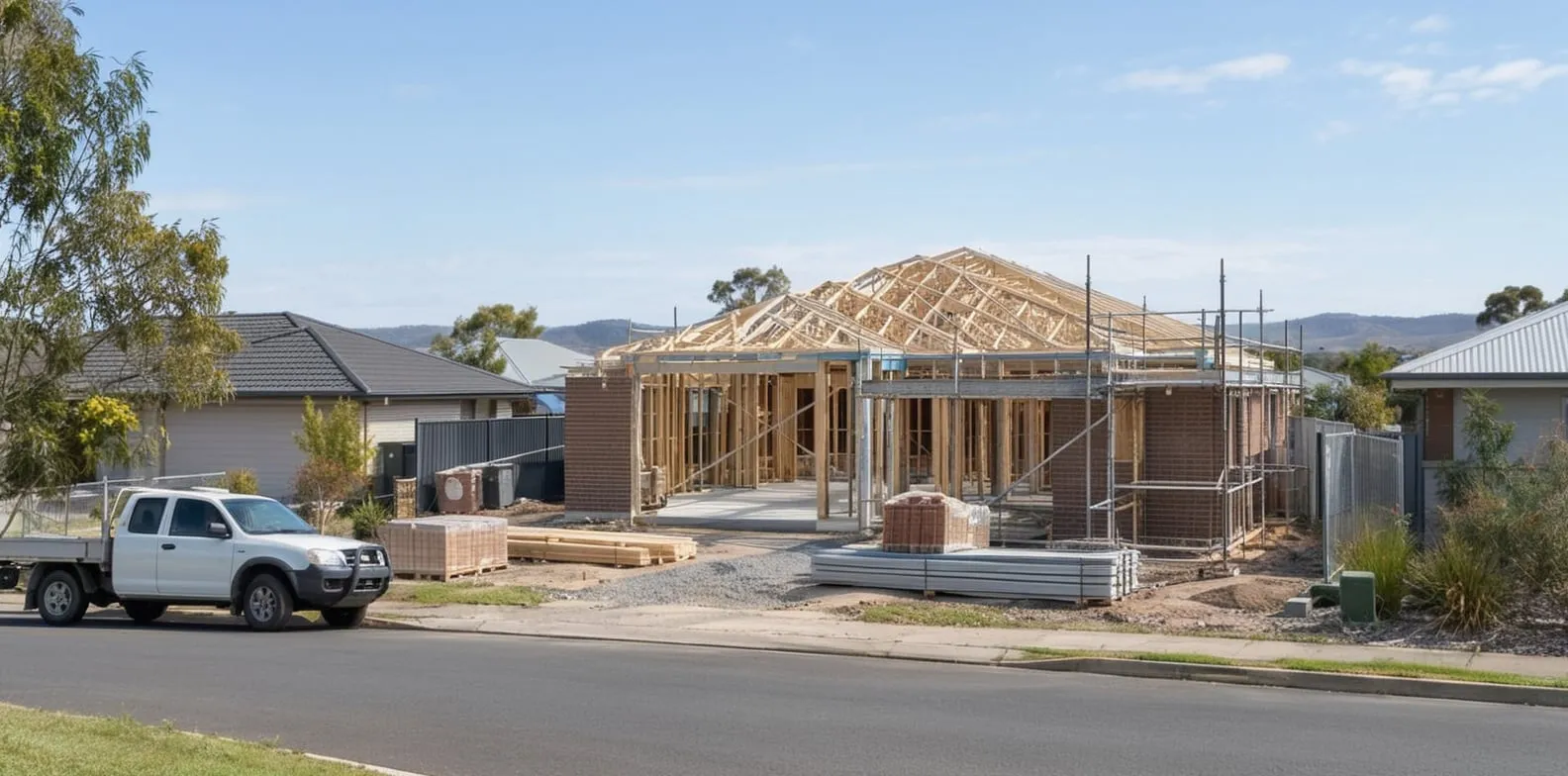 How long does it take to build a house in Australia?The average time from approval to handover is now about 11.5 months for a house, 14.8 months for a townhouse and almost 33 months for an apartment in Australia. While homes still take much longer to b…
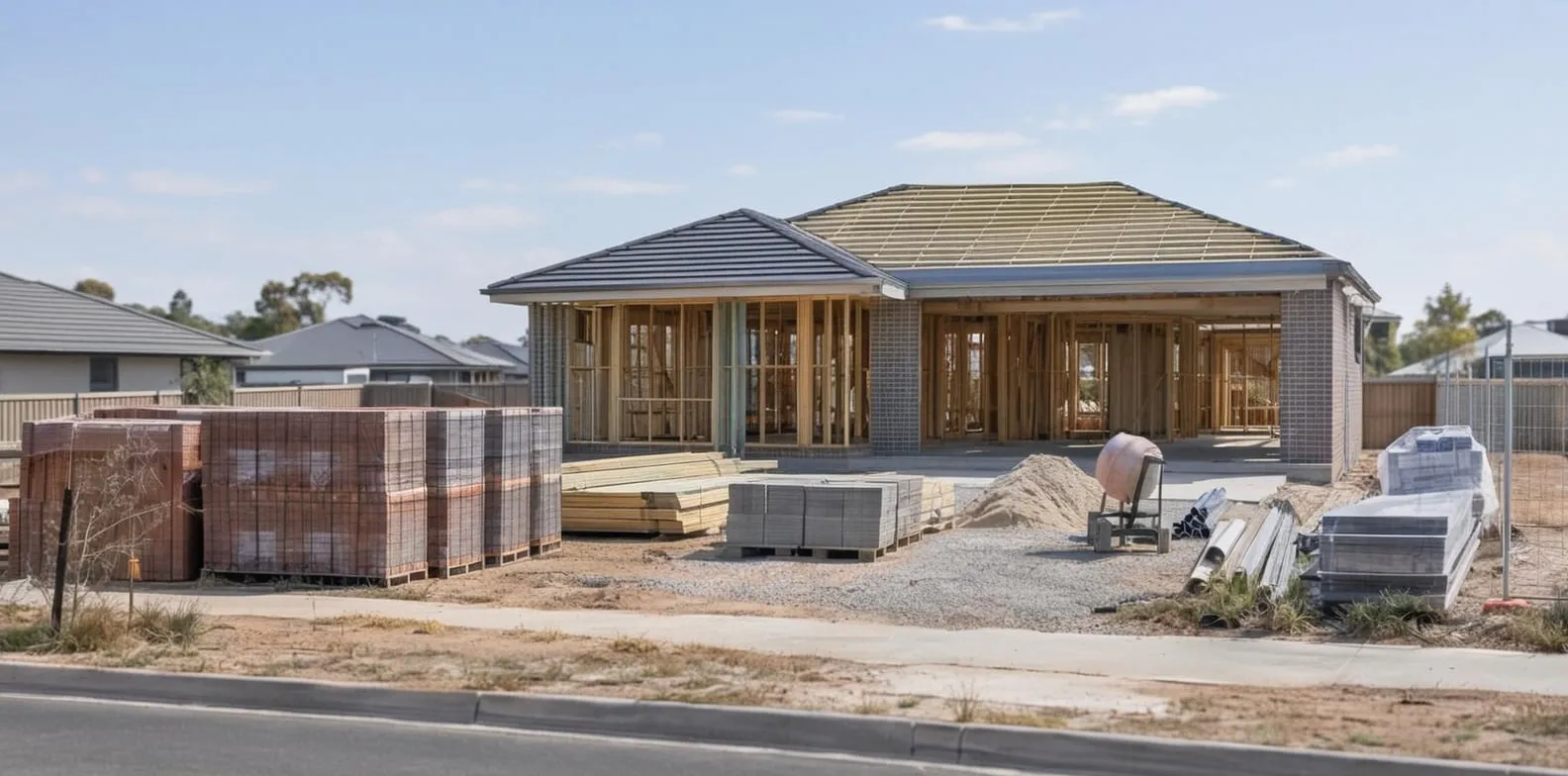 What does it cost to build a house in Australia? (2026)Building a new house in Australia costs $474,939 on average for the structure alone, based on the latest ABS completion data. Add land, and the national total sits around $847,000 at the median, climb…
Section 01 · The Two Pathways
Building vs buying a house: how the two pathways compare
The two pathways differ significantly in how they work. Buying an existing home is relatively straightforward with one contract and one settlement date. Building is far more involved: two separate contracts, a construction loan that releases funds in stages, council approvals and a build process that can easily run past 14 months.
Land & Build Pathway · Avg. 14-20+ months from start to keys
- Dual finance approval
Secure a land mortgage and a separate construction loan. Funds disburse progressively at each build milestone.
Progressive drawdowns
- Land contract & stamp duty
Purchase a vacant block. Stamp duty is calculated on the unimproved land value only, which delivers the biggest tax saving.
Major tax saving
- Pre-construction phase
Engage a builder or architect. Commission a soil test, site survey, and geotechnical report.
Hidden variable cost
- Council approval
Submit plans for a DA, CDC or Building Permit. Must meet the NCC 2022 7-star energy rating. The ABCB's 2023 update estimates the energy-efficiency and livable housing changes together added about $6,008 to the average cost of a Queensland house3.
- Build contract & construction
Five stages: Base → Frame → Lock-up → Fixing → Practical Completion. Detached houses average around 9.2 months; townhouses around 11.7 months.
Holding cost risk
- Occupancy permit & handover
Final inspection, certificate issued, final loan drawdown. New home with full builder's warranty.
Full structural warranty
Established Home Pathway · Avg. 30-90 days from exchange to keys
- Finance pre-approval
A single standard mortgage based on verified income and deposit. Far simpler than a construction loan.
Simpler financing
- Due diligence
Independent building & pest inspection to catch defects, termite damage, or subsidence. A conveyancer runs title searches.
- Contract & exchange
Auction: unconditional on the hammer fall. Private treaty: cooling-off period applies. A 10% deposit is paid on exchange.
Cooling-off protection
- Stamp duty on full value
Ad valorem duty is charged on the total improved value, including both the land and the dwelling, making it the biggest cost disadvantage compared with building.
Largest single tax hit
- Settlement (30-90 days)
Mortgage funds disbursed. Title transfer registered. Immediate possession granted.
- Move in immediately
Established location, existing school catchments, mature infrastructure. Zero holding cost gap.
Immediate occupation
Section 02 · National trends
Building vs buying in Australia: national cost trends from 2015 to 2025
From 2015 to 2025, the cost gap between building and buying shifted in unpredictable ways. The advantage of building has held nationally, but the pandemic years threw construction economics into disarray, and the effects are still being felt.
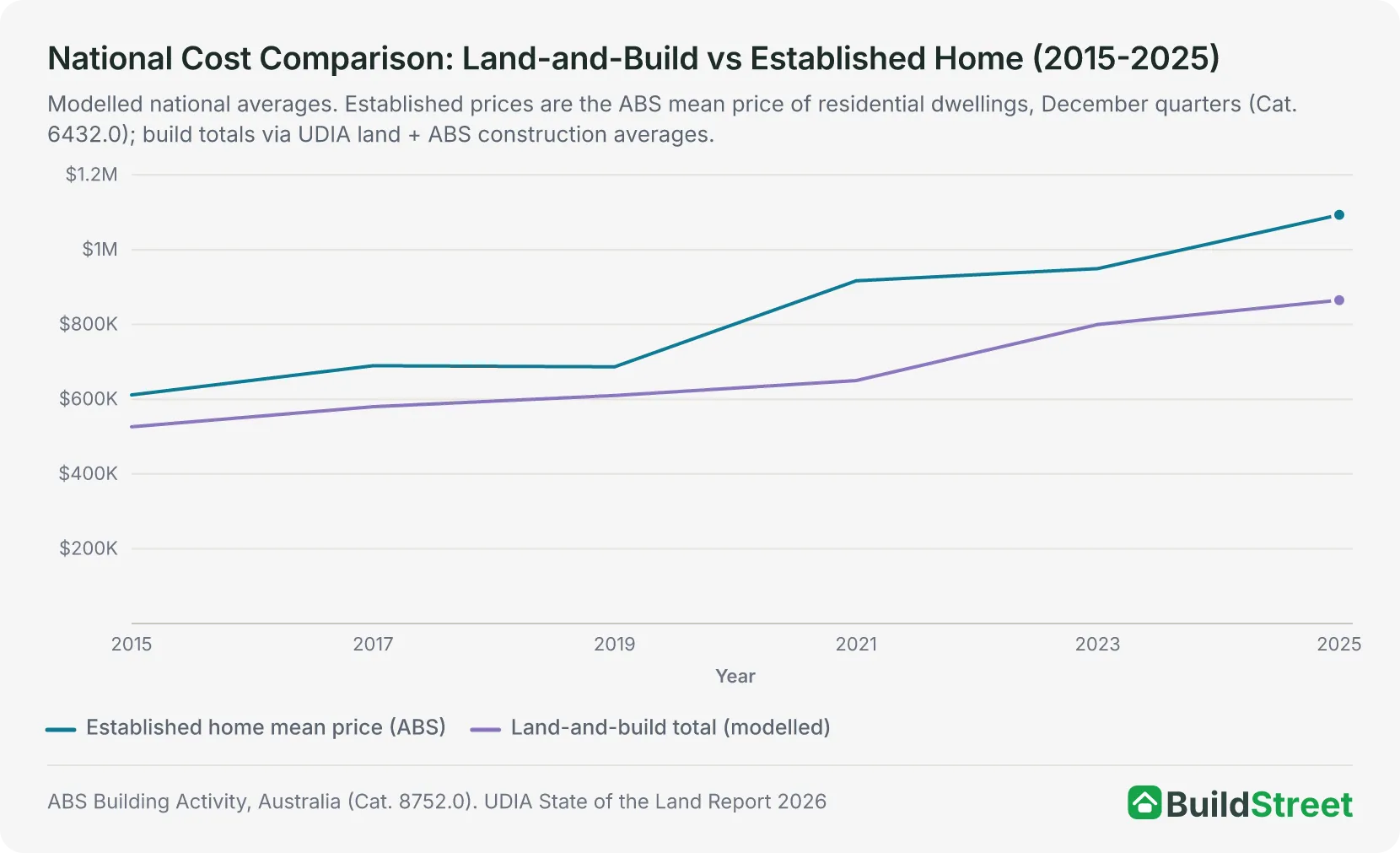
In dollar terms, the gap between buying established and building has widened from $85,300 in 2015 to $228,253 in 2025. But that increase is mostly a story about established home prices rising sharply, not building becoming cheaper.
Section 03 · Capital city results
Is it cheaper to build or buy in each Australian capital city?
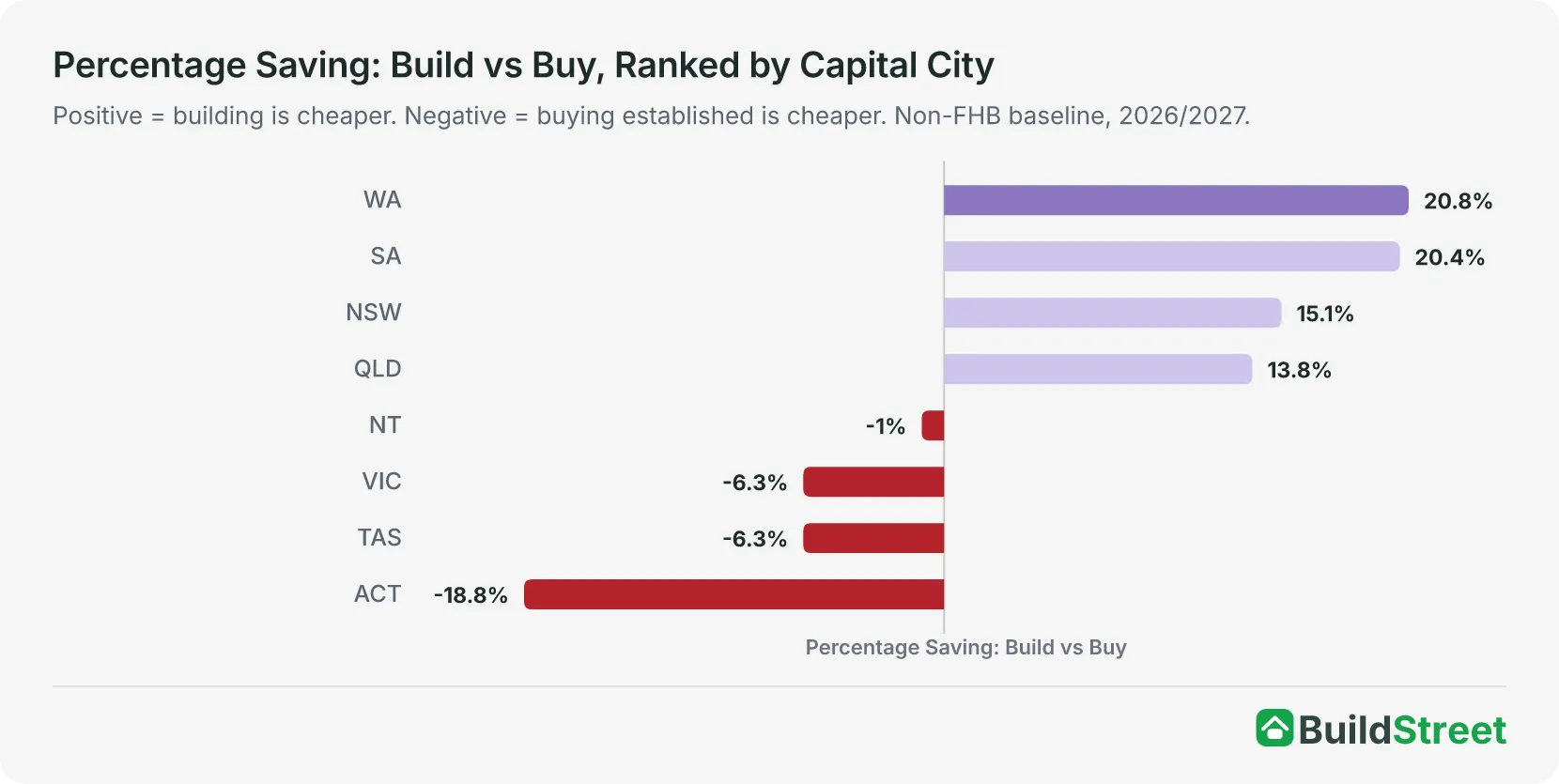
National averages hide a lot. In four of Australia's eight capital-city comparisons, building comes out cheaper, while in four, buying established is cheaper. Where building wins, the modelled margin ranges from about $166,000 in Brisbane to about $234,000 in Sydney. Where buying wins, the gap can be much narrower, including about $8,000 in Darwin.
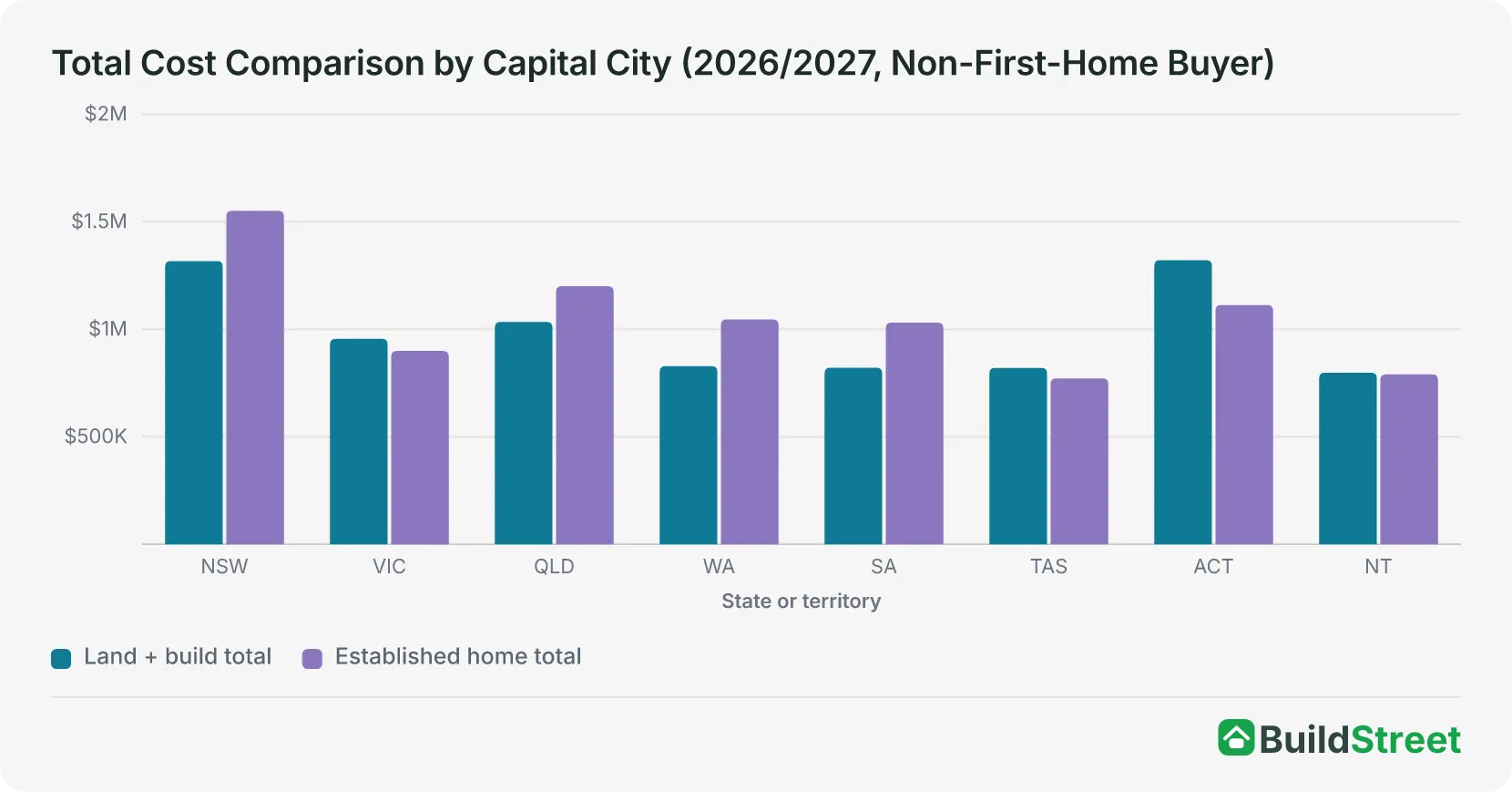
Capital city results: building vs buying
Building wins by $233,513 (15.1%), Sydney
Sydney's median established price of $1.5M creates a vast gap versus outer-fringe greenfield construction. NSW also levies the Housing and Productivity Contribution (HPC) on new builds in Greater Sydney; the $13,001 used here reflects the current indexed per-dwelling-lot rate as at 1 July 20264.
| Land + Build Component | Cost | Established Home Component | Cost |
|---|---|---|---|
| Total | $1,317,200 | Total | $1,550,713 |
| Land (Sydney median) | $695,000 | Purchase price (median) | $1,485,000 |
| Stamp duty on land | $25,462 | Stamp duty on full value | $62,962 |
| Construction (ABS avg, year to March 2026) | $573,386 | B&P inspection | $600 |
| Infrastructure levy (HPC) | $13,001 | Conveyancing + fees | $2,151 |
| Surveys, DA, conveyancing | $10,351 | Stamp duty saving vs build | -$37,500 |
Source · Construction: ABS Building Activity, Australia, March 2026 (8752.0), Tables 39 and 41, average value of a completed new private-sector house, year to March 2026.
Sydney shows the biggest modelled dollar gap nationally, but the trade-off is also significant. The land priced at $695,0002 is typically found in outer areas such as Marsden Park, Leppington or Box Hill, more than 50 km from the CBD. This means the modelled saving reflects not only lower upfront costs, but also differences in commute distance, school catchments and access to established infrastructure.
Section 04 · How government policy reshapes the numbers
How stamp duty and first-home buyer grants affect building vs buying
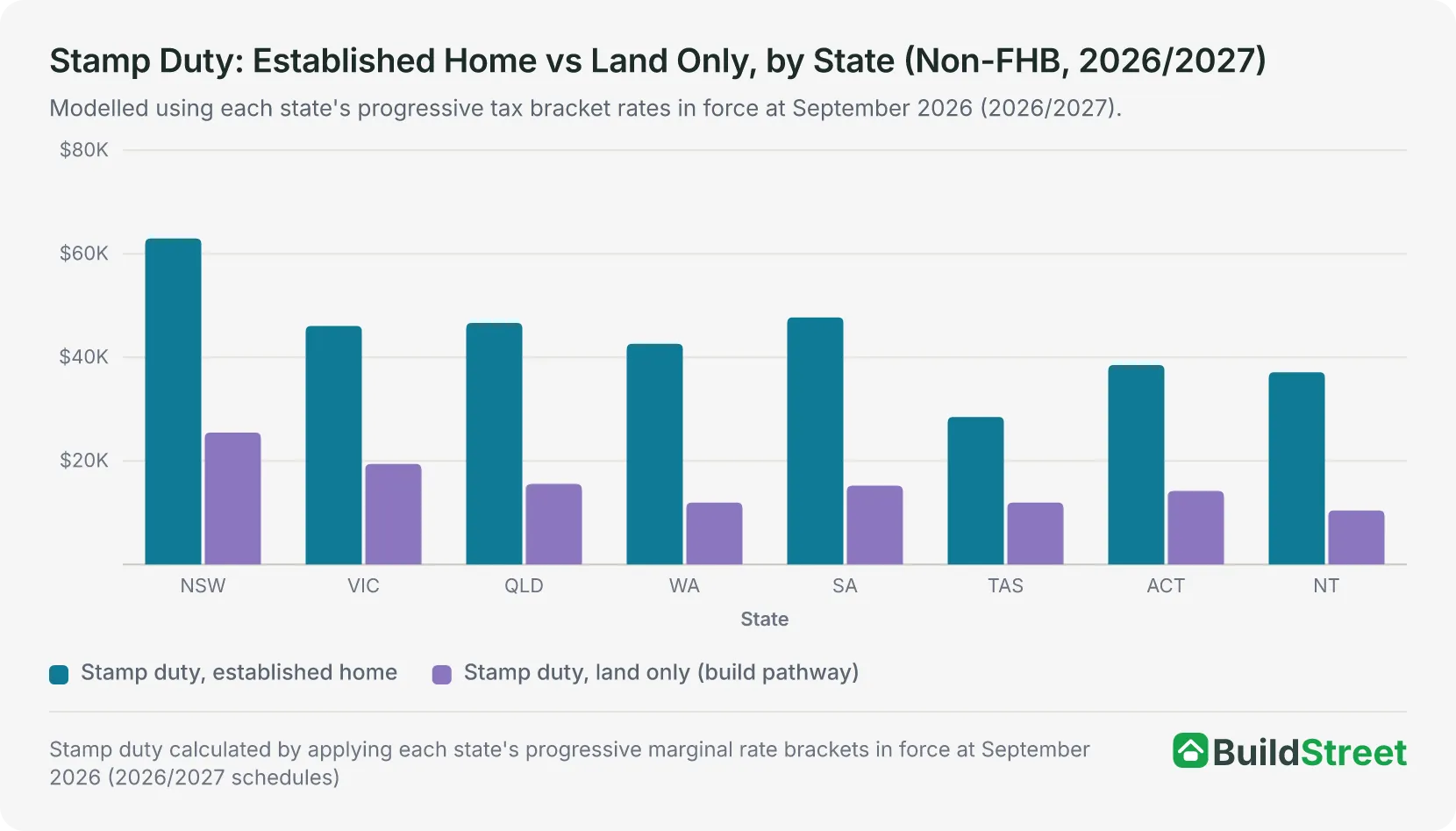
The cost tables above are based on a standard buyer, with no grants or exemptions included. For first-home buyers (FHBs), the comparison can change considerably. When vacant land is purchased, and a new home is built separately, stamp duty is charged on the land value only, not the completed home. In NSW, that means $25,462 in stamp duty on the land compared with $62,962 on the established home5. In Victoria, the equivalent comparison is $19,393 versus $46,070.
| First-home buyer grants and exemptions by state | |||
|---|---|---|---|
| State | Cash Grant | Stamp Duty Relief | Est. Net FHB Benefit |
| QLD | $30,000 (contracts signed on or after 20 Nov 2023; no end date announced) | From 1 May 2025: no transfer duty on wholly residential vacant land for eligible first-home buyers, with no land-value cap | approx. $43,000+ |
| SA | $15,000 Ongoing | Stamp duty abolished for eligible FHBs on new builds & vacant land | approx. $26,500+ |
| NSW | $10,000 | Full exemption on new builds under $800K; concession to $1M | approx. $34,800 |
| VIC | $10,000 | Full exemption on new builds up to $600K; concession to $750K | approx. $26,350 |
| WA | $10,000 | From 21 Mar 2025: no duty on vacant land up to $350K, concession to $450K (build pathway) | approx. $20,150 |
| TAS | $20,000 from 1 Jul 2026 (was $30,000 to 30 Jun 2026) | First Home Owner Grant for eligible buyers building or buying a new home; the $20,000 comprises a $10,000 base grant plus a $10,000 additional amount, subject to eligibility and the passage of legislation | approx. $20,000+ |
| ACT | None | Home Buyer Concession Scheme (income-tested); since 1 Jul 2026, ACT first-home buyers pay no stamp duty | Varies |
| NT | $50,000 New builds only | HomeGrown Territory grant for eligible FHBs building or buying a new home; no stated price cap | approx. $60,000+ |
Source · Methodology: Grant amounts reflect each state's official program as of September 2026. Net FHB benefit combines the cash grant with modelled stamp duty savings. Estimates only, subject to individual eligibility.
Section 05 · Five structural forces
Five factors that explain the build-versus-buy gap
Five key factors help explain why the cost gap between building and buying varies so much across Australia. These factors affect each state and territory differently, which is why the national average can be misleading.
Stamp duty arbitrage
Duty is levied on the unimproved land value only in a build scenario. In high-duty states like NSW, this saves buyers about $37,500 compared with buying established.
Location premium mismatch
Established medians capture inner suburbs with 40 years of infrastructure. Greenfield medians reflect outer-fringe estates 30-50 km from the CBD. The build discount is partly a distance discount.
Construction inflation
Timber, steel and concrete costs surged post-2020. Master Builders Australia, citing ABS multifactor productivity data, reports that building and construction productivity is now 21.5% lower than just over a decade ago6. A detached build now averages around 9.2 months, with townhouses closer to 11.7 months7.
Freight & logistics penalties
Tasmania and the NT import many materials across Bass Strait or long interstate supply chains. This freight premium can invert the usual equation, making buying established cheaper in both jurisdictions.
NCC 2022 compliance costs
All new homes must achieve a 7-star energy rating. The Australian Building Codes Board's 2023 update estimates the NCC 2022 energy-efficiency and livable housing changes together added about $6,008 to the average cost of a Queensland house, up from its original estimate of $4,5843. Established homes are entirely exempt.
Section 06 · Decision guide
When building or buying may be more suitable
Cost is important, but it is rarely the only factor. The more suitable pathway also depends on location flexibility, tolerance for construction delays and the buyer's broader property goals.
First-home buyers
First-home buyers who are grant-eligible and flexible on location may find building more favourable under the modelled costs. Stamp duty exemptions, cash grants, including up to $30,000 in Queensland8, and lower land prices can improve the financial case for building, although this pathway usually requires a longer 14–20 month timeframe.
Build recommended
Upgrader families
For upgrader families, school catchments, established infrastructure and location are often major considerations. Construction delays, holding costs and the disruption of a long build period may make buying an established home more practical in preferred suburbs.
Buy established
Property investors
For property investors, the result depends on the investment goal. Established inner-ring homes may offer stronger access to existing rental markets and established locations, while new builds may provide depreciation benefits. The better option depends on the investor's yield, tax and capital-growth assumptions.
Depends on goal
References
- ABS Building Activity, Australia, December 2025 — Average Cost of New Dwellings (data cube) · Australian Bureau of Statistics ↑
- Urban Development Institute of Australia, State of the Land 2026, released March 2026 · udia.com.au ↑ b
- Australian Building Codes Board, NCC 2022 7-star energy efficiency compliance cost estimate (Dept of Industry, Science and Resources disclosure log) · industry.gov.au ↑ b
- NSW Department of Planning, Housing and Infrastructure, Housing and Productivity Contribution rates for Greater Sydney (indexed 1 July 2026) · planning.nsw.gov.au ↑
- Revenue NSW — Calculate Transfer Duty · revenue.nsw.gov.au ↑
- Master Builders Australia, Latest construction productivity decline is a call to action, 6 February 2026 · masterbuilders.com.au ↑
- ABS Building Activity, Australia — Average dwelling completion times (jun-2025) · Australian Bureau of Statistics ↑
- Queensland Government, First Home Owner Grant, 2026 · qld.gov.au ↑
- ABS, Building Activity, Australia (latest release, Cat. 8752.0) · Australian Bureau of Statistics
- State Revenue Offices (NSW, VIC, QLD, WA, SA, TAS, ACT, NT) — stamp duty rates, FHOG eligibility and first home buyer concessions · revenue.nsw.gov.au
- REIWA, Perth Residential Market Data, March Quarter 2026 — median house sale price, settled sales sourced from Landgate · reiwa.com.au
- Brisbane City Council, Brisbane Infrastructure Charges Resolution (No. 15) 2026 · brisbane.qld.gov.au
- ABS Total Value of Dwellings, June Quarter 2026 — Table 1. Total value of dwellings, all series · Australian Bureau of Statistics
