

Published
Section 01 · The count
How many Australians live in Southeast Asia?
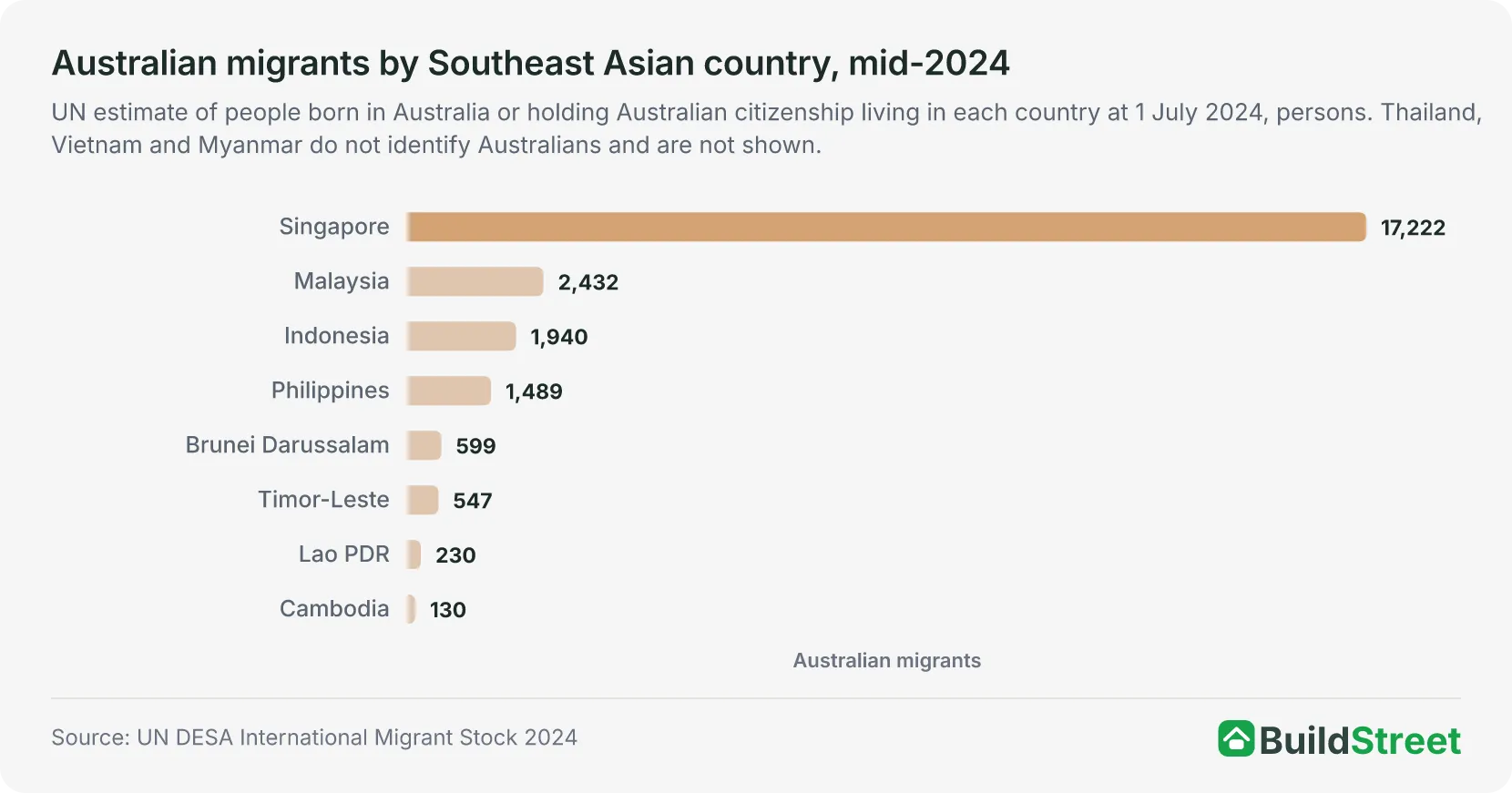
Eight Southeast Asian countries had an estimated 24,589 migrants from Australia in July 2024, according to the United Nations Department of Economic and Social Affairs (UN DESA)1. Singapore accounted for 17,222 of them, or 70 per cent, followed by Malaysia with 2,432, Indonesia with 1,940 and the Philippines with 1,489.
The migration figures include people of all ages and do not show how many Australians have retired in Southeast Asia.
The UN counts migrants based on their country of birth, or their citizenship if birth information is unavailable2. In Singapore and Malaysia, the count is of people born in Australia. In Indonesia and the Philippines, it is of Australian citizens1.
Thailand, Vietnam and Myanmar do not report separate figures for Australians living in their countries, so the UN has no estimate for Australians in those three countries1.
The estimated number of migrants from Australia in the eight countries increased from 14,839 in 1990 to 24,589 in 20241. Over the same period, the number in Indonesia fell from 6,047 to 1,940, while the number in Singapore increased from 4,549 to 17,222.
| Australian migrants in Southeast Asia by country, 1990 to 2024 | ||||||||
|---|---|---|---|---|---|---|---|---|
| Country | 1990 | 1995 | 2000 | 2005 | 2010 | 2015 | 2020 | 2024 |
| Singapore | 4,549 | 6,072 | 7,767 | 8,236 | 11,305 | 14,060 | 15,131 | 17,222 |
| Malaysia | 2,426 | 2,429 | 2,432 | 2,432 | 2,433 | 2,432 | 2,432 | 2,432 |
| Indonesia | 6,047 | 6,776 | 7,625 | 4,660 | 4,168 | 2,563 | 1,466 | 1,940 |
| Philippines | 1,058 | 1,646 | 2,234 | 2,822 | 3,357 | 2,407 | 1,489 | 1,489 |
| Brunei Darussalam | 262 | 372 | 482 | 493 | 504 | 515 | 559 | 599 |
| Timor-Leste | 425 | 451 | 482 | 522 | 543 | 562 | 553 | 547 |
| Lao PDR | 18 | 18 | 17 | 16 | 110 | 205 | 218 | 230 |
| Cambodia | 54 | 142 | 229 | 179 | 129 | 116 | 123 | 130 |
| Eight countries | 14,839 | 17,906 | 21,268 | 19,360 | 22,549 | 22,860 | 21,971 | 24,589 |
Source · UN DESA, International Migrant Stock 2024, Table 1.
In June 2013, 1,183 Australian Age Pension recipients lived in Thailand, Malaysia, Vietnam, the Philippines and Indonesia, according to the Department of Social Services (DSS)3.
The Philippines had 500 recipients, followed by Thailand with 436, Indonesia with 99, Vietnam with 96 and Malaysia with 523.
The five countries accounted for 1.5 per cent of the 76,865 Age Pension recipients paid outside Australia in June 20133. The DSS has not published a count by country since 2013.
| Australian payment recipients living in five Southeast Asian countries, June 2013 | |||
|---|---|---|---|
| Country of residence | Age Pension | Disability Support Pension | All payments |
| Philippines | 500 | 59 | 562 |
| Thailand | 436 | 39 | 475 |
| Indonesia | 99 | 16 | 115 |
| Vietnam | 96 | 5 | 101 |
| Malaysia | 52 | 4 | 56 |
| Five countries | 1,183 | 123 | 1,309 |
| All countries | 76,865 | 7,086 | 85,263 |
Source · DSS, Income support customers: a statistical overview 2013, Table 80.
Section 02 · Thailand
How many Australians live in Thailand and what does housing cost there?
Thailand's 2010 census, the most recent to provide figures by nationality, recorded 4,830 Australian nationals in Bangkok, 2,314 in Chon Buri province4 and 1,336 in Phuket province5, according to the National Statistical Office (NSO)6. Men accounted for 3,180 of the Australian nationals counted in Bangkok and 1,118 of those in Phuket56.
The NSO no longer publishes these nationality tables, but archived copies of its whole-kingdom report record 11,298 Australian nationals across Thailand in 2010, including 1,477 in the southern region7. Preliminary 2025 census results, published in July 2026, do not include figures by nationality8.
Thailand's Board of Investment had approved 4,561 Long-Term Resident visas for wealthy pensioners by 5 October 2026, out of 12,010 approvals across all categories since September 20229. No figure for Australians is published, and the United States, Japan and the United Kingdom had the largest numbers of approvals.
| Australian nationals in Thailand by area, 1 September 2010 | |||
|---|---|---|---|
| Area | Persons | Male | Female |
| Bangkok | 4,830 | 3,180 | 1,650 |
| Central region, excluding Bangkok | 3,529 | 2,914 | 614 |
| of which Chon Buri province | 2,314 | 1,863 | 451 |
| Southern region | 1,477 | 1,213 | 264 |
| of which Phuket province | 1,336 | 1,118 | 218 |
| Northeast region | 857 | 745 | 113 |
| North region | 605 | 453 | 152 |
| Thailand (whole kingdom) | 11,298 | 8,505 | 2,793 |
Source · National Statistical Office Thailand, 2010 Population and Housing Census, Table 5 (archived copies).
The Bank of Thailand's condominium price index for Bangkok and vicinities was 204.4 in August 2026, about twice its 2011 average10. The nationwide index for all residential property was 179.5, and the nationwide index for detached houses with land was 163.7.
Thai households spent an average of 4,736 baht a month on housing, furnishings and household equipment in 2024, while households in Greater Bangkok spent 7,024 baht, according to the NSO Household Socio-Economic Survey11.
At the Reserve Bank of Australia (RBA) exchange rate of 23.41 baht per Australian dollar on 30 September 2026, those amounts are equivalent to about A$202 and A$300 respectively12.
The spending figures include furnishings and household equipment as well as rent and other housing costs. The NSO does not publish a separate figure for average rent paid.
| Residential property price indexes in Thailand, August 2026 | ||
|---|---|---|
| Property type | Nationwide | Bangkok and vicinities |
| All residential property | 179.5 | 173.5 |
| Single-detached house, including land | 163.7 | 143.2 |
| Townhouse, including land | 185.2 | 177.9 |
| Condominium | n/a | 204.4 |
Source · Bank of Thailand, EC_EI_008_S4 Residential Property Price Index.
What housing can foreigners own in Thailand?
Foreigners can own condominium units in Thailand, but total foreign ownership cannot exceed 49 per cent of the floor area of all units in a condominium, measured when the condominium is registered under the Condominium Act13. The Land Code states that a foreigner may acquire land only where a treaty allows it14.
The Land Code allows a foreigner who invests at least 40 million baht, or about A$1.7 million, to acquire up to one rai of land for a residence, with ministerial permission14. One rai is 1,600 square metres.
Section 03 · Malaysia
How many Australians live in Malaysia and what does housing cost there?
Malaysia had an estimated 2,432 people born in Australia in July 2024, according to UN DESA1. The UN estimated between 2,426 and 2,433 people born in Australia living in Malaysia at each recorded date from 1990 to 2024.
Malaysia had an estimated 3.37 million residents who were not Malaysian citizens in 2026, according to the Department of Statistics Malaysia (DOSM), which does not publish these figures by country of citizenship16.
Malaysia's Ministry of Tourism, Arts and Culture approved 97 Australians under the Malaysia My Second Home (MM2H) programme in 2012, making Australia the seventh-largest source country of the 3,227 people approved that year17. Australia was not among the 10 largest source countries for the 21,059 approvals between 2002 and March 2013. The ministry has not published approvals by country for a later period.
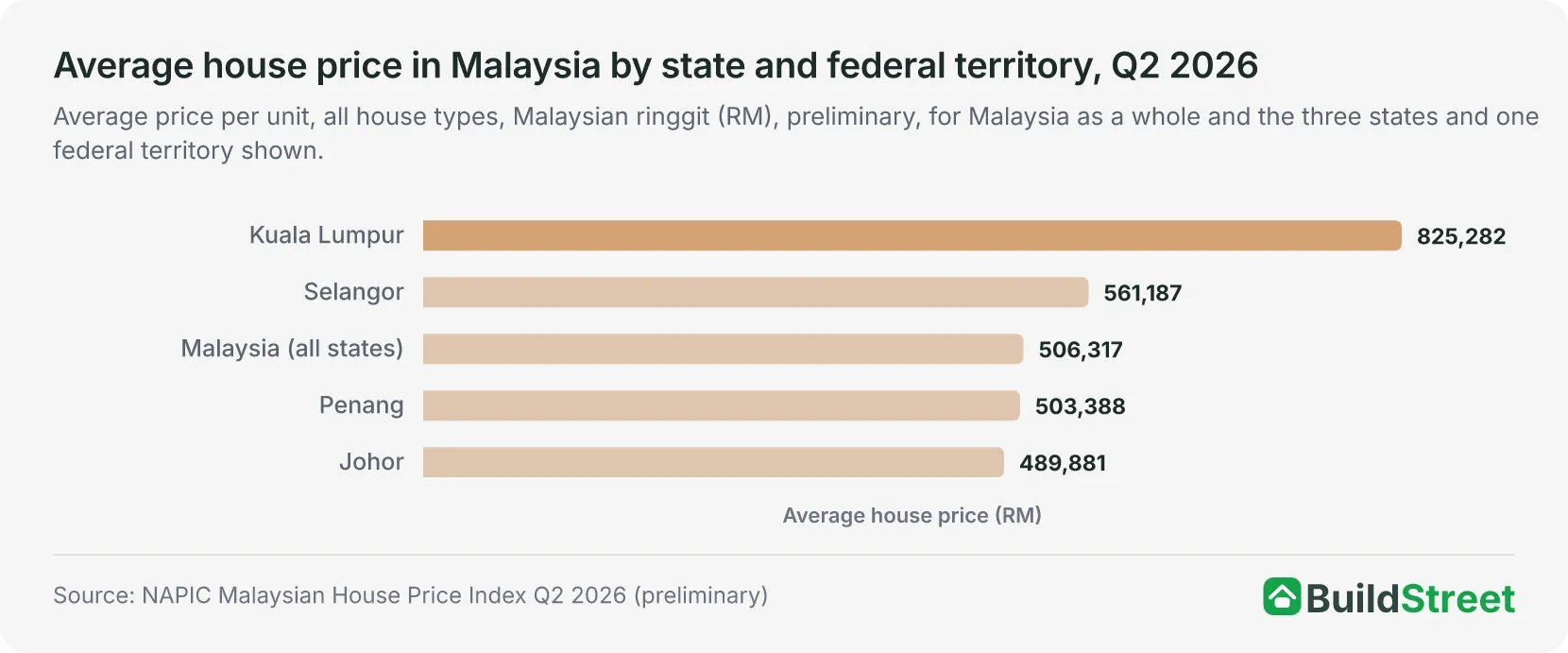
Malaysia's average house price was RM506,317 in the second quarter of 2026, a preliminary figure, according to the National Property Information Centre (NAPIC)18. The national house price index increased 0.9 per cent from the second quarter of 2025. At the RBA exchange rate of 2.8477 ringgit per Australian dollar on 30 September 2026, the average price is equivalent to about A$177,80012.
Kuala Lumpur recorded the highest average house price of any Malaysian state or federal territory, at RM825,28218. Among Kuala Lumpur, Selangor, Penang and Johor, Johor recorded the largest annual increase in its house price index to the second quarter of 2026, at 3.6 per cent.
Malaysian households spent an average of RM1,307 a month on housing, water, electricity, gas and other fuels in 2024, accounting for 23.5 per cent of their total household spending, according to the DOSM Household Expenditure Survey19. That amount is equivalent to about A$459 at the RBA rate on 30 September 2026.
| Average house price in Malaysia by state and federal territory, Q2 2025 and Q2 2026 | |||
|---|---|---|---|
| Area | Q2 2025 (RM) | Q2 2026 (RM) | Annual change (%) |
| Kuala Lumpur | 803,500 | 825,282 | +2.7 |
| Selangor | 567,435 | 561,187 | -1.1 |
| Malaysia (all states) | 501,722 | 506,317 | +0.9 |
| Penang | 502,403 | 503,388 | +0.2 |
| Johor | 472,724 | 489,881 | +3.6 |
Source · NAPIC, Malaysian House Price Index Q1 to Q2 2026 (preliminary), Table I.
What is the minimum home price for foreign buyers in Malaysia?
Malaysia's Ministry of Economy sets a minimum property value of RM1 million per unit for most homes purchased by foreign buyers, and each state authority is responsible for approving purchases20. Malaysia's average house price in the second quarter of 2026 was about half that minimum.
Johor applies the same RM1 million minimum to homes bought by foreign buyers, both new homes bought from developers and existing homes sold again21. Homes bought under the MM2H programme are exempt from the Ministry of Economy approval process20.
Section 04 · Philippines, Vietnam, Indonesia
How many Australians live in the Philippines, Vietnam and Indonesia and what does housing cost there?
The Philippines' 2020 census counted 1,460 Australian citizens in May 2020, making Australian citizens the seventh-largest group among the 78,396 foreign citizens counted, according to the Philippine Statistics Authority (PSA)22. The census counted a further 2,733 Filipinos who also held Australian citizenship.
Central Visayas had the largest number of Australian citizens of any Philippine region in 2020, at 327, followed by Central Luzon with 239 and the National Capital Region with 22722.
UN DESA estimated 1,489 Australian citizens in the Philippines at 1 July 20241.
In Vietnam, the 2019 census counted 3,553 foreigners of all nationalities in April 2019, but did not provide figures for individual nationalities23. The UN does not estimate the number of Australians in Vietnam either, so no official count of Australians living in Vietnam is available from these sources.
In Indonesia, the UN estimated that the number of Australian citizens there fell from 6,047 in 1990 to 1,940 in 20241. Statistics Indonesia and the Directorate General of Immigration do not publish counts of foreign residents by nationality, so the UN estimate is the only figure for Indonesia.
Residential property prices in the Philippines increased 0.4 per cent in the year to the second quarter of 2026, according to Bangko Sentral ng Pilipinas24. Prices of new homes in Indonesia increased 0.69 per cent over the same period, according to Bank Indonesia25.
What housing can foreigners own in the Philippines, Vietnam and Indonesia?
In the Philippines, the Condominium Act restricts foreign ownership depending on how a condominium's shared areas are owned. Where the shared areas are owned jointly, units can be transferred only to Filipino citizens or companies that are at least 60 per cent Filipino-owned26.
Where a condominium corporation owns the shared areas, a unit can be transferred to a foreigner only if the total foreign ownership of the corporation remains within Philippine legal limits26.
Under Vietnam's Housing Law 2023, foreign individuals who are permitted to enter the country can own apartments, but foreign ownership is limited to 30 per cent of the apartments in a building27. A foreign individual can own a home for up to 50 years from the date the ownership certificate is issued, and this period can be extended once by up to 50 years.
Indonesia allows a foreigner holding an immigration permit to own a landed house on a right of use, known as hak pakai, or an apartment unit, priced at or above a minimum set for each province28.
In Bali, the minimum is Rp5 billion for a house and Rp2 billion for an apartment unit, or about A$401,600 and A$160,600 respectively at the RBA rate of 12,450 rupiah per Australian dollar on 30 September 202629.
| Foreign ownership of homes in Vietnam, the Philippines and Indonesia, 2026 | |||
|---|---|---|---|
| Country | What a foreign individual can own | Limit | Latest annual house price change |
| Vietnam | Apartments and houses in projects open to foreign ownership | Foreigners together own no more than 30% of the apartments in a building, each for up to 50 years, extendable once | Not published as an index |
| Philippines | Condominium units | Units go to Filipino citizens or corporations at least 60% Filipino-owned, or to foreigners where the condominium corporation's foreign interest stays within legal limits | +0.4% (Q2 2026) |
| Indonesia | A landed house on a right of use, or an apartment unit | Minimum price of Rp5 billion for a house and Rp2 billion for an apartment in Bali, and Rp5 billion and Rp3 billion in Jakarta | +0.69% (Q2 2026, new homes) |
Source · Viet Nam Housing Law 2023; Philippines Condominium Act; Indonesia Government Regulation 18 of 2021 and Ministerial Decision 1241 of 2022; Bangko Sentral ng Pilipinas; Bank Indonesia.
Section 05 · Living costs
How does the cost of living in Southeast Asia compare with Australia?
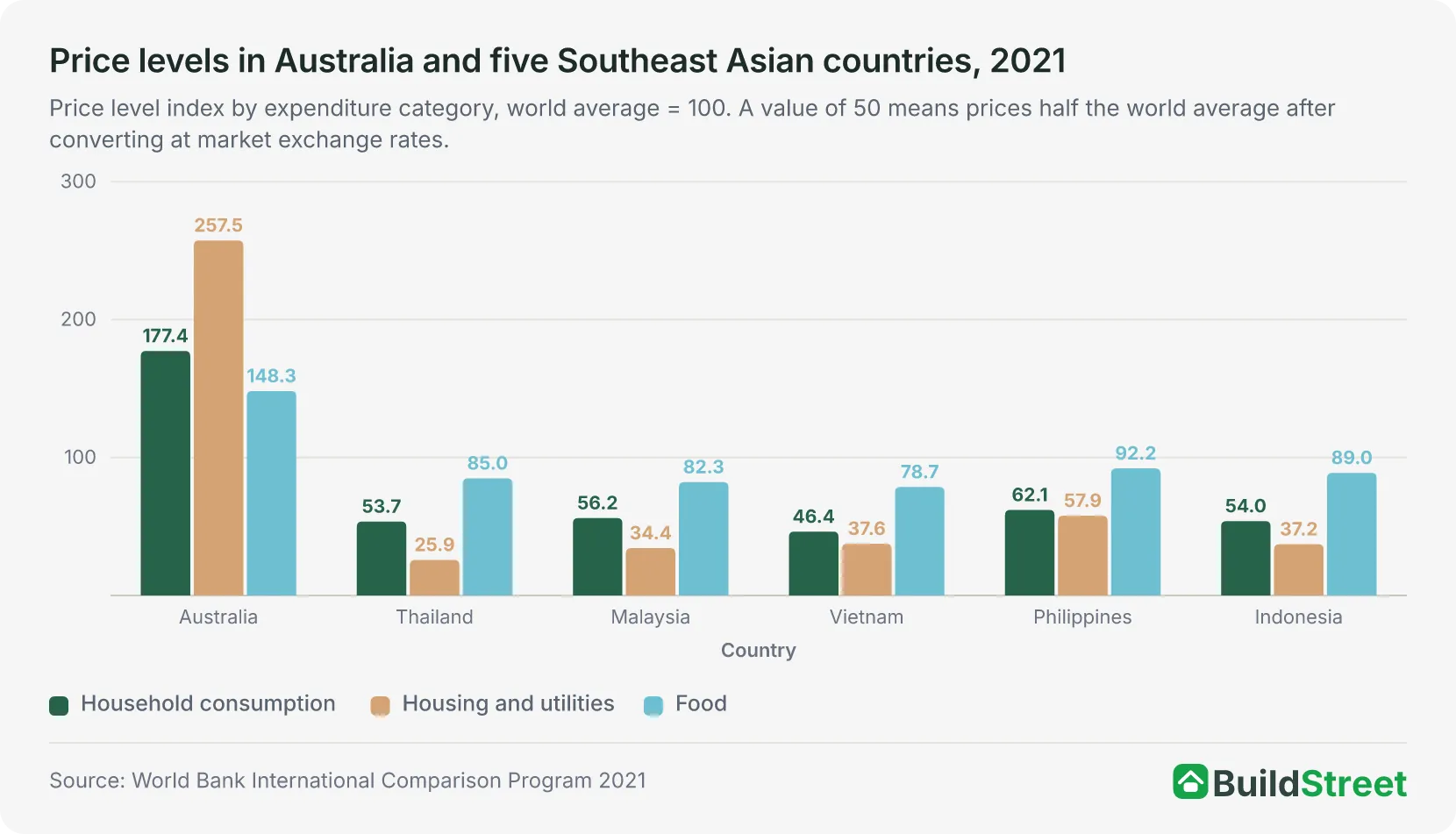
The cost of household goods and services in Thailand, Malaysia, Vietnam, the Philippines and Indonesia was estimated at between 26 and 35 per cent of Australia's price levels in 2021, according to the World Bank International Comparison Program (ICP)30.
Vietnam recorded the lowest household consumption price level among the five countries, at 46.4, compared with a world average of 10030. The Philippines recorded the highest, at 62.1, compared with 177.4 for Australia.
Among the spending categories compared, housing and utilities had the lowest price level relative to Australia's in all five countries. Thailand's price level for housing, water, electricity, gas and other fuels was 25.9, about one-tenth of Australia's price level of 257.530. The Philippines recorded the highest of the five, at 57.9.
Food price levels in the five countries were between 53 and 62 per cent of Australia's in 202130.
The World Bank describes these indexes as estimates rather than official national figures30. They compare 2021 prices using exchange rates from the same year.
| Price level indexes by expenditure category, 2021 | |||||
|---|---|---|---|---|---|
| Country | GDP | Household consumption | Housing and utilities | Food | Health |
| Australia | 168.6 | 177.4 | 257.5 | 148.3 | 194.0 |
| Thailand | 55.2 | 53.7 | 25.9 | 85.0 | 39.9 |
| Malaysia | 57.9 | 56.2 | 34.4 | 82.3 | 43.8 |
| Vietnam | 48.7 | 46.4 | 37.6 | 78.7 | 29.8 |
| Philippines | 62.3 | 62.1 | 57.9 | 92.2 | 49.5 |
| Indonesia | 53.3 | 54.0 | 37.2 | 89.0 | 42.6 |
Source · World Bank, International Comparison Program 2021.
The Australian dollar bought 23.41 Thai baht on 30 September 2026, compared with 21.35 a year earlier, an increase of 9.6 per cent, according to the RBA12.
Among the five currencies, the largest increase was against the Philippine peso, from 38.48 to 43.66 pesos per Australian dollar, or 13.5 per cent12.
| Australian dollar exchange rates, 30 September 2025 and 30 September 2026 | |||
|---|---|---|---|
| Currency | 30 September 2025 | 30 September 2026 | Change (%) |
| US dollar | 0.6602 | 0.6977 | +5.7 |
| Thai baht | 21.35 | 23.41 | +9.6 |
| Malaysian ringgit | 2.7834 | 2.8477 | +2.3 |
| Indonesian rupiah | 11,022 | 12,450 | +13.0 |
| Vietnamese dong | 17,445 | 18,119 | +3.9 |
| Philippine peso | 38.48 | 43.66 | +13.5 |
Source · Reserve Bank of Australia, Table F11.
Price levels in other overseas destinations are compared in cost of living overseas compared with Australia.
Section 06 · Visas
What retirement visas are available in Southeast Asia?
Thailand, Malaysia, the Philippines and Indonesia each offer a visa route for retirees. Minimum ages range from 25 for the Malaysia My Second Home (MM2H) Silver, Gold and Platinum passes to 55 for Indonesia's E33E visa3132. Vietnam has no dedicated retirement visa, although its e-visa allows stays of up to 90 days33.
Thailand's retirement visa is for people aged 50 or over with a monthly income of at least 65,000 baht or a bank balance of at least 800,000 baht34. The visa is valid for three months for a single entry.
Thailand's Long-Term Resident visa for wealthy pensioners, also available from age 50, requires income not from employment of at least US$80,000 a year, or US$40,000 a year combined with a US$250,000 investment in Thailand35. It allows stays of up to 10 years.
Malaysia's MM2H programme requires a fixed deposit of US$150,000, US$500,000 or US$1 million for its Silver, Gold and Platinum passes respectively, which are valid for 5, 15 and 20 years31. Participants must also buy a home worth at least RM600,000, RM1 million or RM2 million respectively, and cannot sell it for 10 years. Participants under 50 must spend at least 90 days a year in Malaysia.
The Philippines' Special Resident Retiree's Visa (SRRV) Classic is available to people aged 40 or over and allows them to stay indefinitely36. A pensioner aged 50 or over with a pension paid for life of at least US$800 a month, or US$1,000 with dependants, must deposit US$15,000. A non-pensioner aged 50 or over must deposit US$30,000.
Indonesia's five-year E33E visa for people aged 55 or over requires a deposit of US$50,000 in a state-owned bank and a monthly income of at least US$3,00032. Indonesia's one-year E33F retirement visa requires the same monthly income and a sponsor.
| Retirement visa routes in five Southeast Asian countries | ||||
|---|---|---|---|---|
| Country | Visa or programme | Minimum age | Main financial requirement | Length of stay |
| Thailand | Retirement visa (e-Visa) | 50 | 65,000 baht a month income, or a balance of 800,000 baht | Three-month visa, single entry |
| Thailand | Long-Term Resident visa, wealthy pensioner | 50 | US$80,000 a year passive income, or US$40,000 plus a US$250,000 investment in Thailand | 10 years (five plus five) |
| Malaysia | MM2H Silver, Gold, Platinum | 25 | Fixed deposit of US$150,000, US$500,000 or US$1 million, plus a home of at least RM600,000, RM1 million or RM2 million | 5, 15 or 20 years, renewable |
| Vietnam | E-visa (no retirement visa) | None | Visa fee of US$25 single entry or US$50 multiple entry | Up to 90 days |
| Philippines | Special Resident Retiree's Visa, Classic | 40 | Deposit of US$15,000 (pensioner) or US$30,000 (non-pensioner) from age 50, and US$25,000 or US$50,000 from 40 to 49. A pensioner needs at least US$800 a month (single) | Indefinite, multiple entry |
| Indonesia | E33E second-home visa for older people | 55 | US$50,000 in a state-owned bank and income of at least US$3,000 a month | Five years, up to 10 in total |
| Indonesia | E33F retirement visa | Not stated | Income of at least US$3,000 a month, with a sponsor | One year, extendable |
Source · Thailand e-Visa; Thailand Board of Investment; Malaysia My Second Home; Philippine Retirement Authority; Directorate General of Immigration, Indonesia; Viet Nam National Electronic Visa system.
Using the Reserve Bank of Australia's exchange rates on 30 September 2026, the maximum basic Age Pension for a single person living outside Australia, at A$29,520.40 a year37, is equivalent to about 57,600 baht or US$1,720 a month12.
This is below Thailand's 65,000-baht monthly income requirement34 and Indonesia's US$3,000 monthly income requirement32, but above the US$800 monthly pension requirement for a single pensioner under the Philippines' SRRV Classic programme36.
Section 07 · Social security
Does Australia have a social security agreement with any Southeast Asian country?
Australia has social security agreements with 32 countries, but none are in Southeast Asia38. The three Asian countries with agreements are India, Japan and the Republic of Korea.
An agreement with Uruguay, signed in August 2025, is being implemented, and agreements with Bosnia and Herzegovina, Brazil, Lithuania, Mongolia and Sweden are still being negotiated38. None of these countries is in Southeast Asia.
Social security agreements allow people to claim a pension from either country and combine periods of Australian residence with time spent contributing to the other country's social security system to meet eligibility requirements38.
Without an agreement, a person must be living in Australia, physically present in the country and an Australian resident when claiming the Age Pension39. The claimant generally needs at least 10 years of Australian residence, including five consecutive years.
Can the Age Pension be paid while living in Southeast Asia?
Once granted, the Age Pension can be paid indefinitely while a person lives overseas, including in Southeast Asia40.
For a person who moves overseas permanently, the Energy Supplement, the Pension Supplement and the Pensioner Concession Card stop from the date of departure41.
After 26 weeks outside Australia, the pension amount depends on the years of Australian residence between age 16 and Age Pension age41. A person with 35 years or more keeps the full rate in most cases, and a person with 10 years receives 10/35ths of the usual rate.
The maximum basic Age Pension rate for a single person living outside Australia is A$29,520.40 a year from 20 September 202637. It is paid every four weeks in local currency or US dollars, depending on the country.
Medicare does not cover medical treatment in another country, and Australia's reciprocal health care agreements cover 11 countries, none of them in Southeast Asia42.
Section 08
Frequently asked questions
Is there an official count of Australians living in Thailand?
The most recent official count is from the 2010 census, which recorded 11,298 Australian nationals in Thailand, including 4,830 in Bangkok, 2,314 in Chon Buri and 1,336 in Phuket. Preliminary 2025 census results do not include figures by nationality, and the UN migrant estimates do not identify Australians in Thailand.
Can an Australian buy property in Thailand?
Foreigners can own condominium units in Thailand, as long as total foreign ownership does not exceed 49 per cent of the floor area of all units. Foreigners generally cannot own land, except under a treaty or with an investment of at least 40 million baht and ministerial permission for up to one rai (1,600 square metres).
Can Australians get the Age Pension while living in Thailand or the Philippines?
The Age Pension can generally keep being paid while a person lives in Thailand or the Philippines, but because Australia has no social security agreement with either country, it must be claimed while living in Australia, generally after at least 10 years of Australian residence. After 26 weeks overseas, the rate depends on the years of Australian residence between age 16 and Age Pension age, with 35 years needed for the full rate in most cases.
What is the minimum age for Malaysia My Second Home (MM2H)?
Applicants for the Malaysia My Second Home (MM2H) Silver, Gold and Platinum passes must be aged 25 or over, while applicants in the Special Economic Zone category must be at least 21. The Silver pass requires a fixed deposit of US$150,000 and the purchase of a home worth at least RM600,000.
Is the cost of living lower in Southeast Asia than in Australia?
Household consumption price levels in Thailand, Malaysia, Vietnam, the Philippines and Indonesia were estimated at between 26 and 35 per cent of Australia's in 2021, according to the World Bank International Comparison Program. The gap was largest for housing and utilities, where Thailand's price level was about one-tenth of Australia's.
References
- UN DESA Population Division — International Migrant Stock 2024: Destination and origin (Table 1) · un.org ↑ b c d e f g
- UN DESA, International Migrant Stock 2024: Key facts and figures (advance unedited version) · un.org ↑
- DSS Income support customers: a statistical overview 2013 (Statistical Paper No. 12) · data.gov.au ↑ b c
- National Statistical Office Thailand, The 2010 Population and Housing Census, Chon Buri provincial report · web.archive.org ↑
- National Statistical Office Thailand, The 2010 Population and Housing Census, Phuket provincial report · web.archive.org ↑ b
- National Statistical Office Thailand, The 2010 Population and Housing Census, provincial and regional reports · web.archive.org ↑ b
- National Statistical Office Thailand, The 2010 Population and Housing Census, Whole Kingdom report (Table 5, population by nationality) · web.archive.org ↑
- National Statistical Office Thailand, Preliminary Report: The 2025 Population and Housing Census · nso.go.th ↑
- Thailand Board of Investment, Press Release No. 175/2569: Thailand's LTR Visa Hits 12,000 Approvals in Four Years · boi.go.th ↑
- Bank of Thailand, EC_EI_008_S4 Residential Property Price Index · app.bot.or.th ↑
- National Statistical Office Thailand, Statistical Yearbook Thailand 2025, Table 8.4 · nso.go.th ↑
- Reserve Bank of Australia, F11 Exchange rates, monthly, January 2010 to September 2026 · Reserve Bank of Australia ↑ b c d e
- Department of Lands, Condominium Act B.E. 2522 and related Ministerial Regulations · dol.go.th ↑
- Department of Lands, Land Code B.E. 2497 · dol.go.th ↑ b
- Department of Lands, land registration manual: lease registration · dol.go.th ↑
- Department of Statistics Malaysia, OpenDOSM Population Table: Malaysia · open.dosm.gov.my ↑
- Ministry of Tourism, Arts and Culture Malaysia, MM2H programme performance from 2002 to March 2013 · motac.gov.my ↑
- NAPIC — Malaysian House Price Index report, Q1 to Q2 2026p · napic.jpph.gov.my ↑ b
- DOSM, Household Expenditure Survey Report 2024 (Malaysia and States) · dosm.gov.my ↑
- Ministry of Economy Malaysia, Garis Panduan Perolehan Hartanah (Guideline on the Acquisition of Properties) · ekonomi.gov.my ↑ b
- Pejabat Tanah dan Galian Johor, Perolehan Hartanah Oleh Kepentingan Asing · ptj.johor.gov.my ↑
- Philippine Statistics Authority, Foreign Citizens in the Country (2020 Census of Population and Housing) · psa.gov.ph ↑ b
- General Statistics Office of Viet Nam, Completed Results of the 2019 Viet Nam Population and Housing Census · nso.gov.vn ↑
- Bangko Sentral ng Pilipinas, Residential Property Price Index Report, 2nd Quarter 2026 · bsp.gov.ph ↑
- Bank Indonesia, Residential Property Price Survey, Quarter II 2026 (press release No. 28/152/DKom) · bi.go.id ↑
- Republic Act No. 4726 (The Condominium Act), Philippines · elibrary.judiciary.gov.ph ↑ b
- Viet Nam Housing Law No. 27/2023/QH15 · datafiles.chinhphu.vn ↑
- Government Regulation (PP) No. 18 of 2021, Indonesia · peraturan.bpk.go.id ↑
- Ministry of Agrarian Affairs and Spatial Planning, Ministerial Decision No. 1241/SK-HK.02/IX/2022 · jdih.atrbpn.go.id ↑
- World Bank, International Comparison Program data · worldbank.org ↑ b c d e
- Malaysia My Second Home, Guidelines · mm2h.gov.my ↑ b
- Directorate General of Immigration, Indonesia: E33E and E33F retirement visas · imigrasi.go.id ↑ b c
- Immigration Department of Viet Nam, Viet Nam National Electronic Visa system · evisa.gov.vn ↑
- Thai e-Visa (Ministry of Foreign Affairs of Thailand), Retirement · thaievisa.go.th ↑ b
- Thailand Board of Investment, Long-Term Resident (LTR) Visa: Wealthy Pensioners · ltr.boi.go.th ↑
- Philippine Retirement Authority, Special Resident Retiree's Visa (SRRV) · pra.gov.ph ↑ b
- Services Australia, Payment schedule and rates for people outside Australia: Age Pension · servicesaustralia.gov.au ↑ b
- Department of Social Services, International social security agreements · dss.gov.au ↑ b c
- Services Australia, Residence rules for Age Pension · servicesaustralia.gov.au ↑
- Services Australia, Travel outside Australia rules for Age Pension · servicesaustralia.gov.au ↑
- Services Australia, When you leave Australia if you get Age Pension · servicesaustralia.gov.au ↑ b
- Services Australia, Health care planning when going overseas · servicesaustralia.gov.au ↑
