

Published 13 July 2026
Australia's National Construction Code lifted the minimum energy rating for new houses from six stars to seven under NCC 2022, the first increase in more than a decade. States and territories then rolled out the change on their own timelines, from New South Wales in October 2023 through to Western Australia in May 2025, while Tasmania deferred the 7-star provisions and the Northern Territory adopted a lower, 5-star minimum instead.
The rule has divided parts of the building industry. The Housing Industry Association says it added real cost to new homes at a difficult time. Federal and state government modelling, along with climate advocacy modelling, says the long-term savings can outweigh the added cost over the life of a home. The disagreement is not just about the figures. It is also about whether affordability is measured upfront, during construction, or over decades of lower energy use.
 What energy efficiency rules apply to new homes in Australia in 2026?A wider look at the National Construction Code's 7-star minimum, how it varies by climate zone, which states have adopted it, and what's exempt or transitional.
 Solar and battery uptake in new Australian homesHow many new homes are built with solar and battery storage as standard, how attach rates differ by state, and how these requirements sit alongside the NCC's energy efficiency rules.
Section 01 · The rule change
What changed under Australia's 7-star energy standard?
New houses must now reach a minimum 7-star rating under the Nationwide House Energy Rating Scheme (NatHERS), up from 6 stars, the first increase to the minimum standard in more than a decade. New apartment buildings must average 7 stars across all units, with no single apartment allowed below 6 stars. Both changes took effect under NCC 2022, then rolled out state by state from late 2023.
Houses now need a Whole of Home score of at least 60 out of 100; apartments need at least 50. This added a new layer of assessment, covering:
- Hot water systems
- Heating and cooling
- Lighting
- Onsite energy generation, such as solar panels and battery storage
The standard moved beyond the building shell to assess the home as a broader energy system. New South Wales is the exception: it uses its own BASIX scheme instead of a NatHERS Whole of Home assessment, aiming for similar energy-efficiency outcomes through a different pathway.
NatHERS is the main pathway used to meet residential energy-efficiency requirements, accounting for more than 90% of building approvals over the long term. That scale is why the change affected a large share of new-home construction at once. The timing added to the impact: the previous 6-star minimum had stood since 2010, making this the first update to residential energy efficiency requirements in more than a decade. NatHERS itself is older still, having been adopted nationally in 2003 and 2004.
2010 to 2022
- Minimum rating (houses)
6 stars
- Minimum rating (apartments)
6 stars
- Whole of Home assessment
Not required
- Scope
Building shell
NCC 2022 onward
- Minimum rating (houses)
7 stars
- Minimum rating (apartments)
7 stars avg, none below 6
- Whole of Home assessment
60/100 houses, 50/100 apts
- Scope
Shell + hot water, HVAC, lighting, solar, battery
Source · NSW uses BASIX instead of a NatHERS Whole of Home assessment. Source: Australian Government NatHERS and NCC guidance; NatHERS FAQs.
Section 02 · Builder cost case
What builders have said about 7-star costs
The Housing Industry Association, known as HIA, puts the added cost at about $20,000 for a typical new house in Victoria from 1 May 2024. Its estimate combines the new 7-star energy-efficiency minimum with better accessibility requirements, rather than isolating the cost of the 7-star change alone.
HIA's broader position is that government modelling underestimates the real cost of moving from 6 stars to 7. It also points to broader ABS data showing building costs were already climbing sharply, arguing that a code change landing on top of that inflation added pressure to an industry already under strain.
The builder-side case is not a fixed dollar amount added to every house. It combines redesign effort, compliance risk, timing and a difficult broader cost environment into a single upfront-affordability argument, but it does not provide a clean national estimate for the isolated cost of moving from 6 stars to 7 stars.
Section 03 · Efficiency case
What governments and climate groups have said about 7-star savings
For an average house, government modelling puts the capital cost at $2,199 against $2,761 in energy bill savings and $261 in other benefits such as comfort, health and resilience, a net benefit of $822 and a benefit-cost ratio of 1.37. Apartments follow a similar shape: $579 in capital costs against $670 in savings and $74 in other benefits, a net benefit of $166 and a ratio of 1.29. On this modelling, the standard produces a positive net benefit in every jurisdiction except one: apartments in Queensland, where the net outcome is negative.
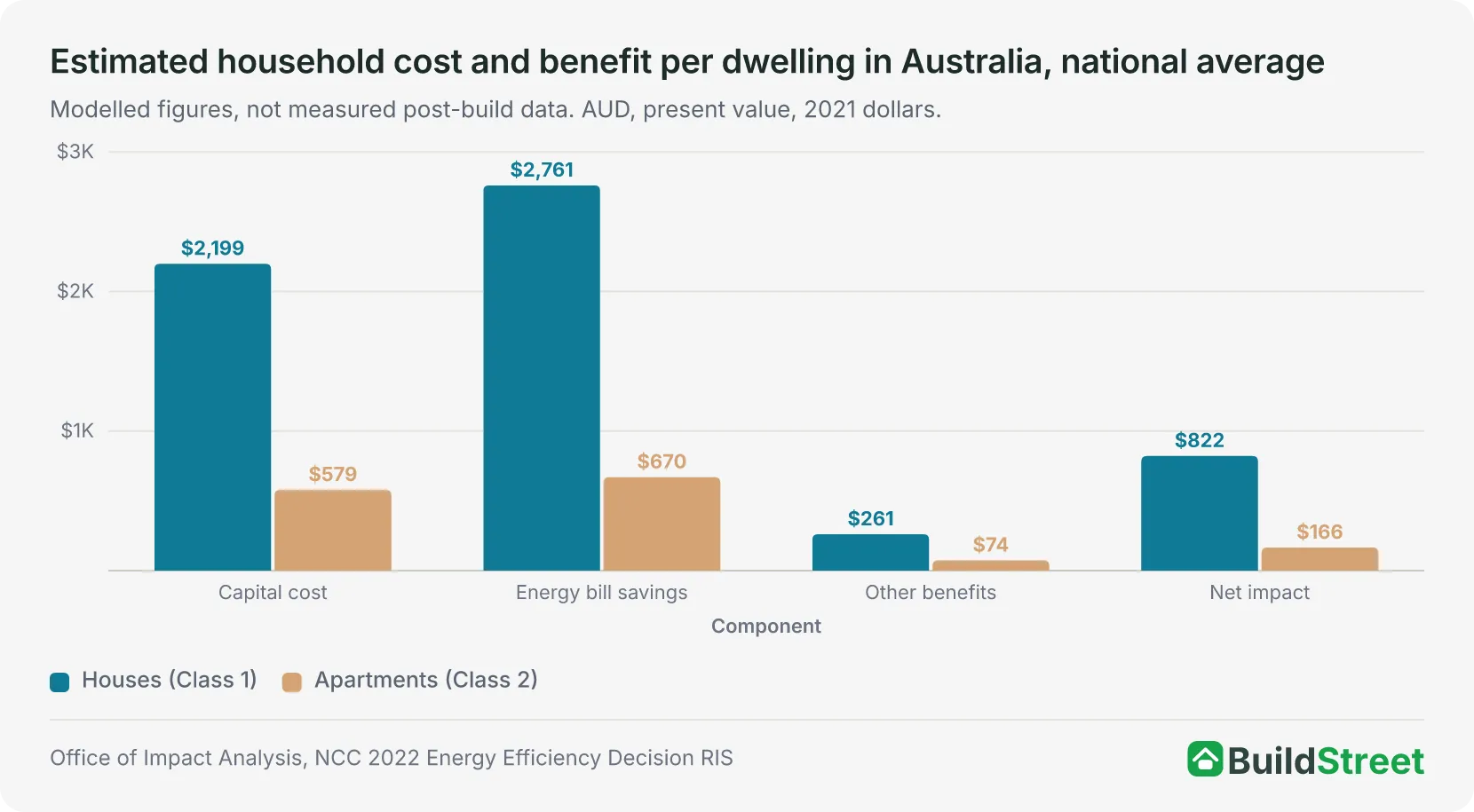
First-year savings are much smaller: $229 for houses and $208 for apartments in 2022, well below the long-run averages above. Stretched over a 30-year asset life instead, updated modelling puts the annual saving at $183 for houses and just $40 for apartments. These smaller figures are still official, and they support the same broad conclusion: running costs fall, just gradually.
NSW's higher BASIX standard is estimated to save an average of $1,070 a year in energy bills, leaving households $678 a year better off once mortgage repayments on the extra cost, at 5.94% p.a., are factored in. Queensland's standard is modelled to save $185 a year in electricity for new homes, provide a $506 million net benefit to the state, reduce emissions by 4.63 million tonnes, and provide a $2,696 net benefit per detached dwelling over its lifetime. Both are state government estimates, not measured post-build outcomes.
An all-electric 7-star home is estimated to save an average of $450 a year on heating and cooling compared with a 6-star home, at an average additional cost of $2,306 and a payback period of 5.9 years. These figures come from Climate Council modelling, which is advocacy modelling rather than government modelling or measured post-build data.
Two research gaps exist:
- CSIRO maintains the data infrastructure behind the ratings system, including NatHERS history and the Australian Housing Data portal, but has not published its own per-home cost premium for 7-star.
- No nationally comparable consumer-group dataset specific to the 7-star rule could be found.
The efficiency case here rests on official modelling, state government figures and Climate Council's advocacy modelling.
Government modelling, an industry estimate and advocacy modelling are different kinds of evidence, so they should not be treated as directly equivalent.
| Source | Claim | Type | Caveat |
|---|---|---|---|
| Office of Impact Analysis | Net benefit in all jurisdictions except Qld apartments | Government modelling | Pre-implementation, not measured |
| NSW Government | $1,070/yr saving; $678/yr better off after mortgage | Government modelling | Assumes 5.94% p.a. mortgage rate |
| QLD Government | $185/yr saving; $2,696 net benefit per dwelling over life | Government modelling | State-specific modelling |
| HIA | About $20,000 added to a typical Victorian house | Industry body | Bundles 7-star with accessibility changes |
| Climate Council | $450/yr saving; $2,306 extra cost; 5.9-year payback | Advocacy body | Own modelling, not government data |
Source · OIA NCC 2022 Decision RIS; NSW Planning (BASIX); Queensland Government (Housing); HIA submissions, 2021 and 2023; Climate Council, "Tents to Castles," 2022.
Section 04 · State rollout
Which states adopted, delayed or changed the 7-star standard?
New South Wales and the Northern Territory moved first, from 1 October 2023. NSW did so through its existing BASIX scheme rather than a straight NatHERS Whole of Home pathway. The Northern Territory set its own minimum of 5 stars from that date, rather than adopting the national 7-star standard. The ACT followed on 15 January 2024, and Victoria and Queensland both started on 1 May 2024. Queensland introduced the changes through Queensland Development Code 4.1.
South Australia adopted the standard later, from 1 October 2024, and paired the change with a commitment to ten years of regulatory certainty. Western Australia was the last mover, with its residential energy-efficiency provisions taking effect from 1 May 2025 after transitional arrangements ended. Tasmania deferred the 7-star provisions and kept its NCC 2019 energy-efficiency requirements in place.
Where governments have explained their reasoning, the language is mostly about certainty, transition and staging. South Australia's ten-year commitment and Queensland's staged approach both show attempts to manage the changeover. For Western Australia and Tasmania, the clearest official material focuses on the transition date or deferral, rather than a detailed public rationale for the delay.
1 Oct 2023
New South Wales
Adopted via BASIX, lifting standards from an average of 5.5 to 6 stars up to 7. Transitional recognition applied to existing BASIX certificates.
1 Oct 2023
Northern Territory
Set a 5-star minimum under its own variation to Part H6, two stars below the national 7-star standard.
15 Jan 2024
ACT
One of the earliest full adopters of the NCC 2022 energy and liveability provisions.
1 May 2024
Victoria
7-star and Whole of Home made mandatory. HIA's clearest public cost estimate is tied to this exact date.
1 May 2024
Queensland
Commenced under QDC 4.1 through an explicitly staged implementation approach.
1 Oct 2024
LateSouth Australia
Started later than the national deferred date, paired with a commitment to ten years of regulatory certainty.
1 May 2025
DelayedWestern Australia
Transitional arrangements ended, one of the clearest delayed implementations nationally.
Deferred
Not adoptedTasmania
Kept NCC 2019 requirements in place, deferring 7-star to the next code cycle. The strongest example of non-uniform adoption.
| Jurisdiction | Start date | Pathway | Status |
|---|---|---|---|
| New South Wales | 1 Oct 2023 | BASIX | Adopted |
| Northern Territory | 1 Oct 2023 | 5-star minimum (Part H6 variation) | Adopted, lower standard (5-star) |
| ACT | 15 Jan 2024 | NCC 2022 | Adopted |
| Victoria | 1 May 2024 | NCC 2022 | Adopted |
| Queensland | 1 May 2024 | QDC 4.1 | Adopted, phased |
| South Australia | 1 Oct 2024 | NCC 2022 | Adopted, late |
| Western Australia | 1 May 2025 | NCC 2022 / Amendment 1 | Adopted, delayed |
| Tasmania | Deferred | NCC 2019 remains | Deferred |
Source · NSW Planning, ACT Planning, Victorian Government, Queensland Housing, South Australian Government, Western Australian Building Bulletin, Tasmanian Government and Northern Territory Government implementation notices.
Section 05 · Cost data
How did building costs change during the 7-star rollout?
Average build costs rose by as much as 42.6% over two years in the fastest-moving jurisdiction, and by as little as 9.4% in the slowest, across the period spanning the standard's rollout.
However, this ABS series does not isolate the cost of the 7-star standard. It shows broader movements in average construction costs for private sector houses, excluding land.
New South Wales and the ACT, the two earliest adopters, recorded the largest first-year jumps. NSW's average build cost rose from $432,039 to $520,907 in 2023-24, the year that captured its 1 October 2023 start date, a rise of 20.6%. Growth then slowed to 8.6% in 2024-25. The ACT followed a similar shape: a 24.6% jump in 2023-24, the largest of any jurisdiction, easing to 14.4% in 2024-25, still the highest ongoing rate in the country.
Victoria and Queensland started on the identical date, 1 May 2024, and moved in opposite directions. Queensland's average cost jumped 15.6% in 2023-24, largely before its own standard had applied for most of that financial year, then rose just 1.8% in 2024-25, the year that actually captured the new rule. Victoria did the reverse: a modest 5.2% rise in 2023-24, followed by a 12.0% jump in 2024-25, the year its standard took full effect. Two states starting on the same day produced almost opposite cost patterns. That alone weighs against any simple, one-direction story about the standard driving costs.
South Australia and Western Australia show the same disconnect. SA's largest increase, 19.6%, landed in 2023-24, a full year before its October 2024 start date, then eased to 4.9% once the standard applied. WA's rises of 13.5% and 6.9% both occurred entirely before its own rule began on 1 May 2025.
Tasmania is the clearest comparison case, because it never adopted 7-star at all. Its average build cost still rose 9.9% in 2023-24 and a further 2.2% in 2024-25. Measured cumulatively across both years, Tasmania's build costs rose 12.3%, more than the Northern Territory's 9.4% over the same period. Neither jurisdiction adopted the national 7-star minimum: the NT set its own 5-star minimum from October 2023, while Tasmania kept the earlier 6-star NCC 2019 requirement. The two jurisdictions with the smallest two-year cost increases in the country are therefore also the two that did not adopt the 7-star standard, though the broader cost pressures discussed above make it difficult to attribute this pattern to the standard itself.
Across all eight jurisdictions, the size and timing of the largest increases line up with each state's 7-star start date in some cases, but not in others. The data shows that broader cost pressure was moving through the sector during the rollout. It does not prove how much of the increase, if any, came from the 7-star standard itself.
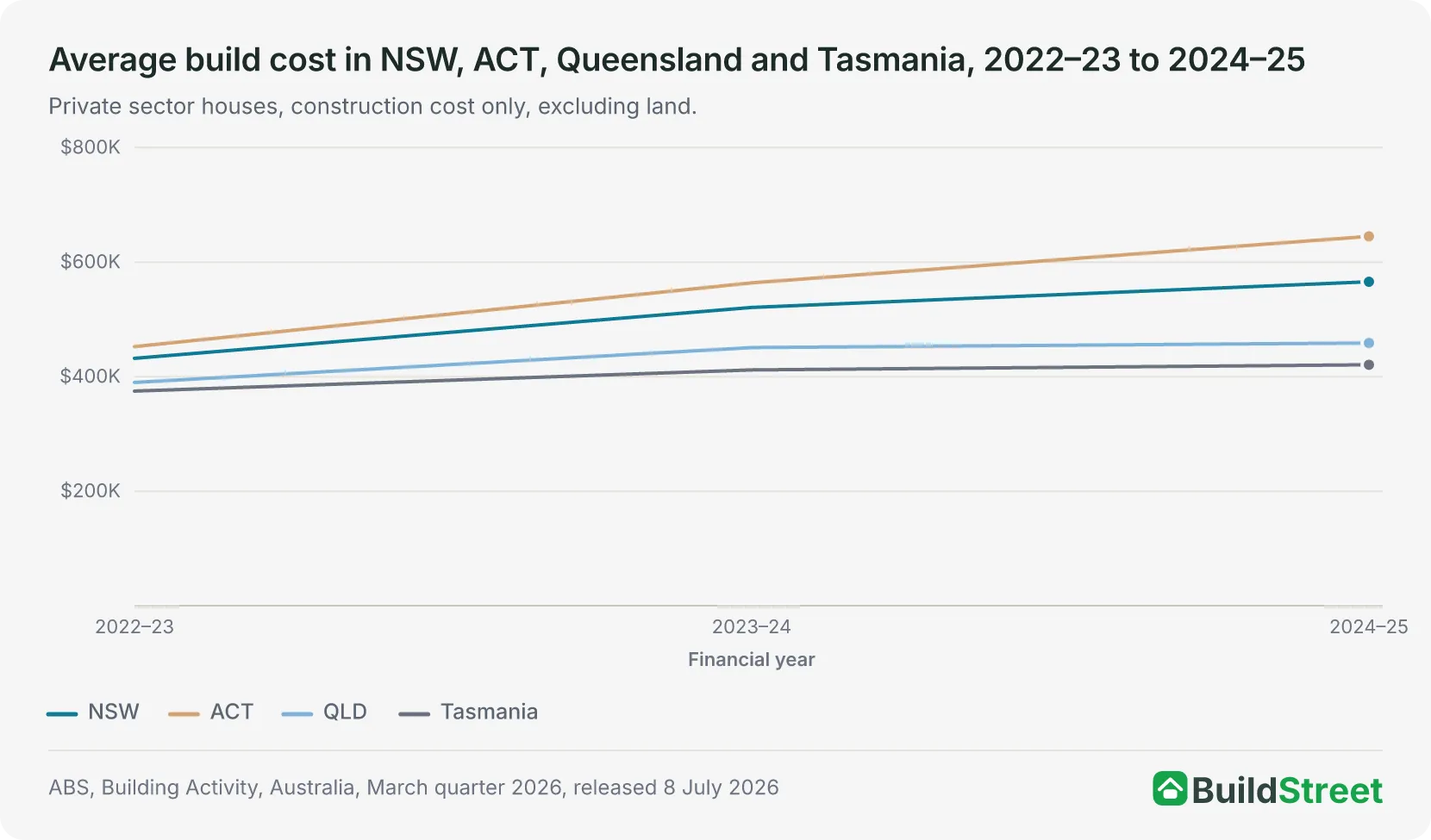
| State | 2022–23 | 2023–24 | 2024–25 | 2-yr change | 7-star start |
|---|---|---|---|---|---|
| ACT | $452,472 | $563,824 +24.6% | $645,052 +14.4% | +42.6% | 15 Jan 2024 |
| NSW | $432,039 | $520,907 +20.6% | $565,749 +8.6% | +30.9% | 1 Oct 2023 |
| SA | $310,737 | $371,627 +19.6% | $389,949 +4.9% | +25.5% | 1 Oct 2024 |
| WA | $335,550 | $380,874 +13.5% | $407,114 +6.9% | +21.3% | 1 May 2025 |
| National | $394,579 | $443,333 +12.4% | $474,939 +7.1% | +20.4% | Staggered |
| VIC | $412,090 | $433,431 +5.2% | $485,292 +12.0% | +17.8% | 1 May 2024 |
| QLD | $389,911 | $450,807 +15.6% | $458,868 +1.8% | +17.7% | 1 May 2024 |
| Tasmania | $374,822 | $411,797 +9.9% | $420,756 +2.2% | +12.3% | Deferred, NCC 2019 retained |
| NT | $434,325 | $471,006 +8.4% | $475,310 +0.9% | +9.4% | 5-star NT variation |
Source · ABS: Building Activity, Australia, March quarter 2026, released 8 July 2026.
Total dwelling approvals fell 26.4% between the 2020-21 pandemic-era peak and 2023-24, and commencements fell 25.6% over the same period. Those figures show that the 7-star standard landed in a sector that was already contracting. They should not be read as evidence that the standard caused the fall in approvals or commencements. Approvals in 2023-24 were 8.9% above where they stood in 2011-12.
Cost pressure also predates the 7-star rollout. The average cost of building a house had already risen 59.5% between 2004-05 and 2018-19, while average floor area shrank slightly over the same period. The 7-star standard arrived on top of a longer-running cost trend.
Section 06 · Affordability tradeoffs
Why the 7-star debate depends on how affordability is measured
A $20,000 upfront estimate and a 1.37 benefit-cost ratio are both figures used in the debate, but they measure different things over different timeframes. The upfront estimate focuses on construction costs, while the benefit-cost ratio includes modelled long-term energy savings and other benefits.
For builders, affordability is often measured at contract signing and during construction. This view focuses on redesign work, compliance risk, assessor fees and higher upfront costs landing in a market that was already under pressure.
For supporters of the standard, affordability is measured over the life of the home. The official, state government and advocacy modelling covered above all make a similar case: a home that costs more to build upfront can cost less to run over time.
The upfront view
Measured at contract signing. Focuses on redesign effort, compliance risk, assessor fees and a cost increase landing while the broader building sector is already under pressure.
The lifetime view
Measured over decades of ownership. Focuses on lower energy bills, improved comfort, and a benefit-cost ratio that official modelling shows as positive in almost every case.
Both views draw on documented figures, but they are not measuring the same thing. That is why the disagreement is less about a single number and more about whether affordability is assessed upfront or over the life of the home.
Section 07 · What's next
What happens next for Australia's home energy ratings?
A national Trajectory for Low Energy Buildings Implementation Plan for 2026-2027 was approved on 16 December 2025, confirming that government work on building energy performance is continuing beyond the original NCC 2022 changes.
On 1 July 2026, the Australian Government launched the new Home Energy Rating brand and website. This included the rollout of Stage 2 for existing home ratings, extending the rating framework beyond new homes.
At a jurisdiction level, the next code cycle is already underway. In the ACT, projects with a development application or works approval application formally lodged before 1 November 2026 may continue to seek building approval under NCC 2022 or NCC 2025 until that application expires. Projects with building approval after 1 May 2027 must comply with NCC 2025 and the ACT 2025 Appendix, subject to that exception.
2022
NCC 2022 sets the standard
7-star and Whole of Home requirements set nationally, ahead of staggered state adoption.
Dec 2025
Trajectory plan approved
2026-2027 implementation plan for low-energy buildings approved nationally.
Jul 2026
Home Energy Rating launched
New Home Energy Rating brand and website launched, alongside Stage 2 for existing home ratings.
May 2027
ACT NCC 2025 transition date
Projects with building approval after this date must comply with NCC 2025 and the ACT 2025 Appendix, subject to transition exceptions.
Source · Source: DCCEEW, Trajectory for Low Energy Buildings; Australian Government, Home Energy Rating; ACT Planning, National Construction Code guidance.
References
- Australian Government: National Construction Code updates mean energy efficiency ratings expansion for new residences · energy.gov.au
- DCCEEW: Trajectory for Low Energy Buildings, Implementation Plan 2026-2027 · dcceew.gov.au
- NatHERS: Frequently asked questions on NCC 2022 residential requirements · nathers.gov.au
- Office of Impact Analysis: National Construction Code 2022 Residential Energy Efficiency, Decision RIS · oia.pmc.gov.au
- Housing Industry Association – Residential building energy-efficiency proposal: Consultation RIS submission, November 2021 · hia.com.au
- NSW Planning — BASIX sustainability standards for residential development · planning.nsw.gov.au
- Housing Industry Association: HIA submission into the Victorian Rental and Housing Market · hia.com.au
- Queensland Government: Residential energy efficiency standards (Modern Homes) · housing.qld.gov.au
- Queensland Government: Modern Homes transitional arrangements · housing.qld.gov.au
- Climate Council: Tents to Castles, Building energy efficient, cost-saving Aussie homes · climatecouncil.org.au
- CSIRO: Supporting increased residential energy efficiency throughout Australia, impact case study · csiro.au
- ABS Characteristics of New Residential Dwellings, 15-Year Summary · Australian Bureau of Statistics
- ABS, Building Activity, Australia (latest release, Cat. 8752.0) · Australian Bureau of Statistics
- ABS Producer Price Indexes, Australia (Cat. 6427.0) — latest release · Australian Bureau of Statistics
- ABS: Home building through the pandemic · Australian Bureau of Statistics
- Home Energy Rating launched today · energy.gov.au
- ACT Planning — National Construction Code, NCC 2025 transition guidance · planning.act.gov.au
