

Published 25 Aug 2026
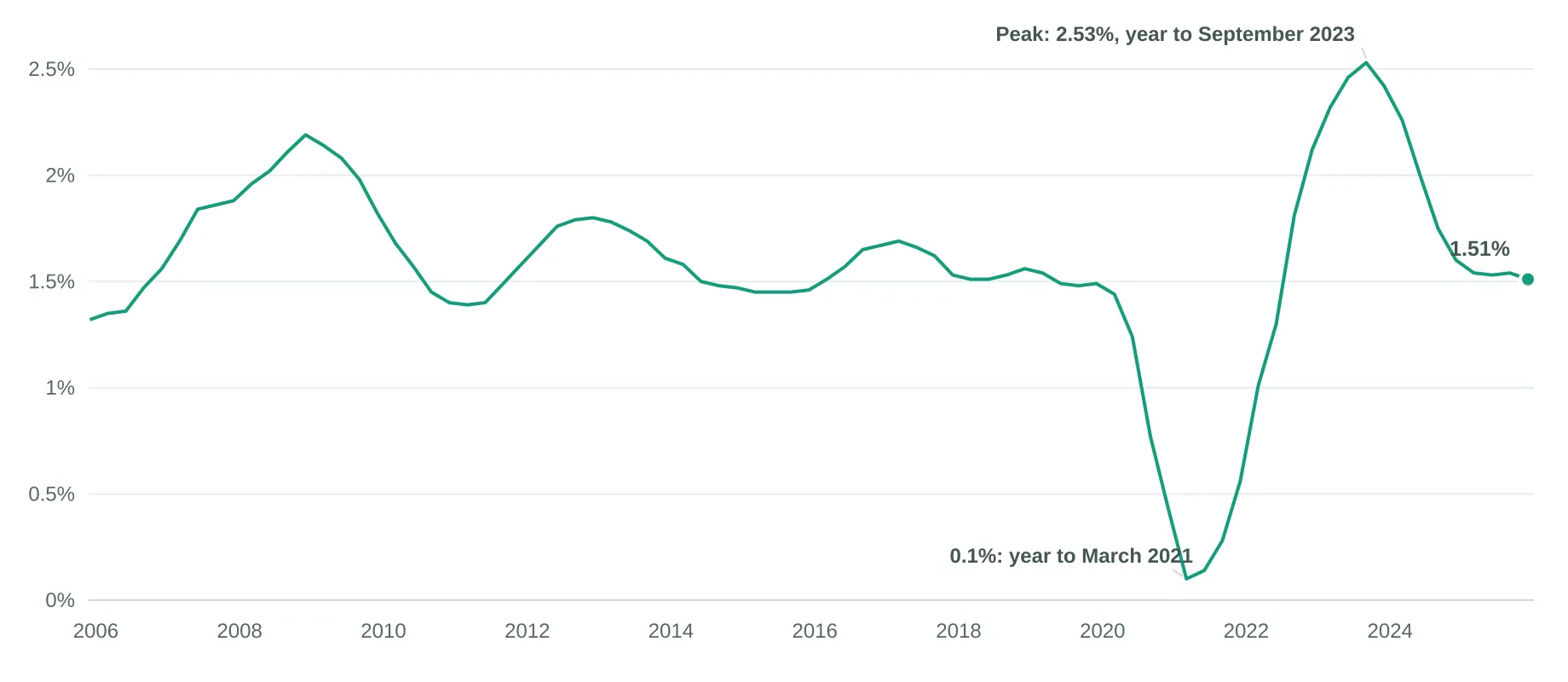 Where the population stands todayThis page looks forward. The main population article covers the present: how many people live in Australia now, how fast the total is growing, and the births, deaths and migration behind it.
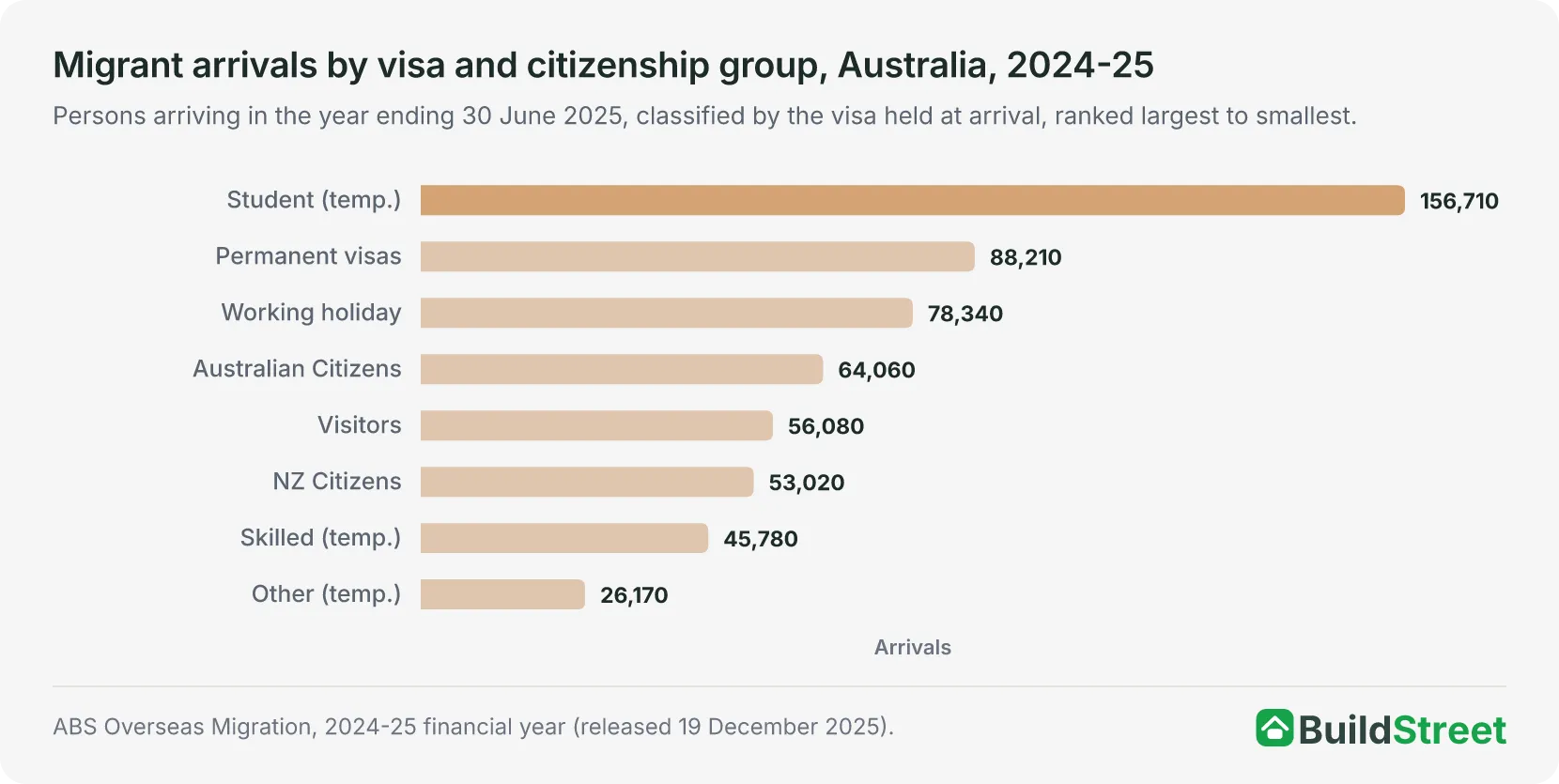 The largest projection inputOverseas migration is the largest component of projected growth in the central scenario and the assumption that varies most between the ABS series. The companion article covers arrivals, departures, visa groups and how net overseas migration is trending.
Section 01 · The 30 million question
When is Australia projected to reach 30 million people?
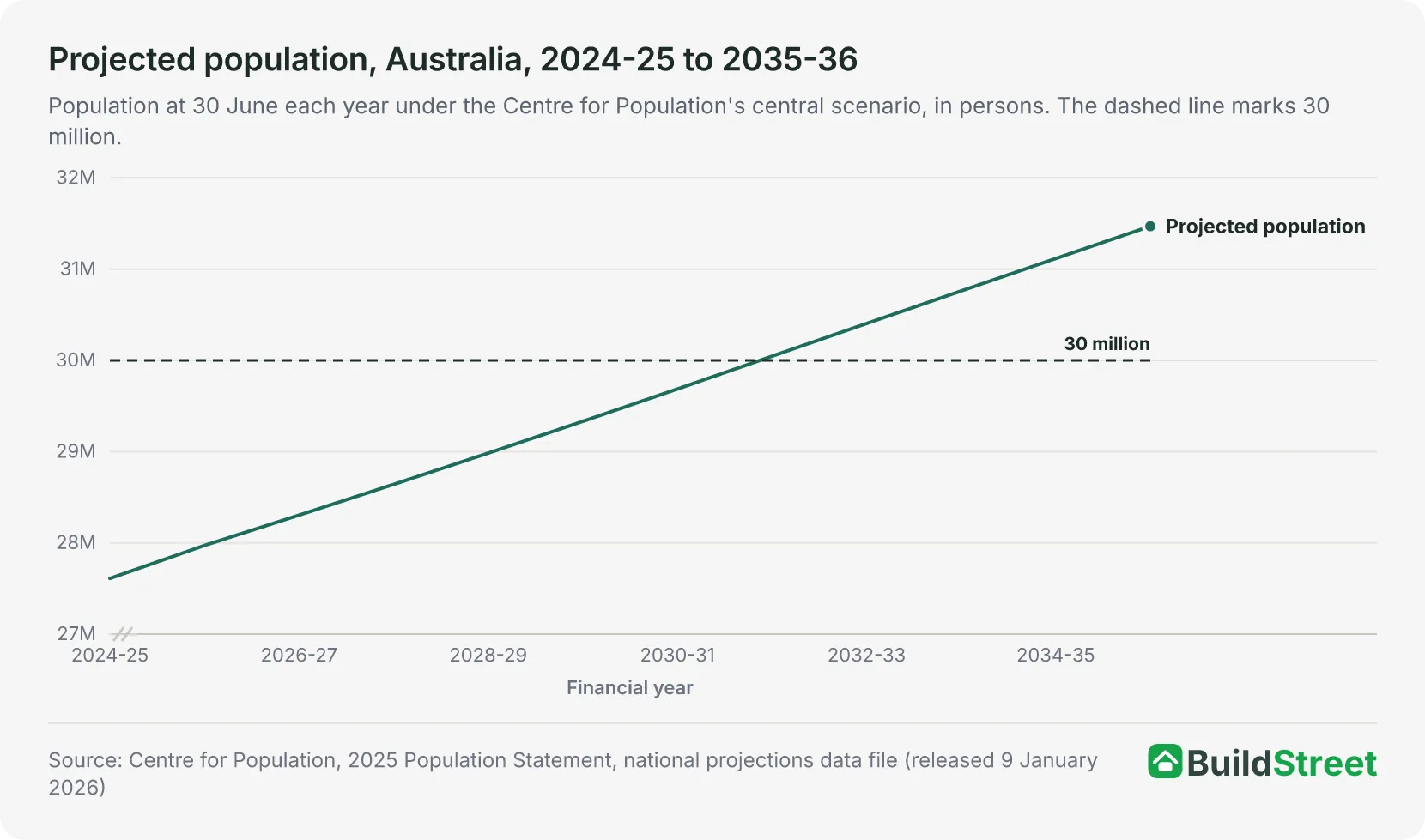
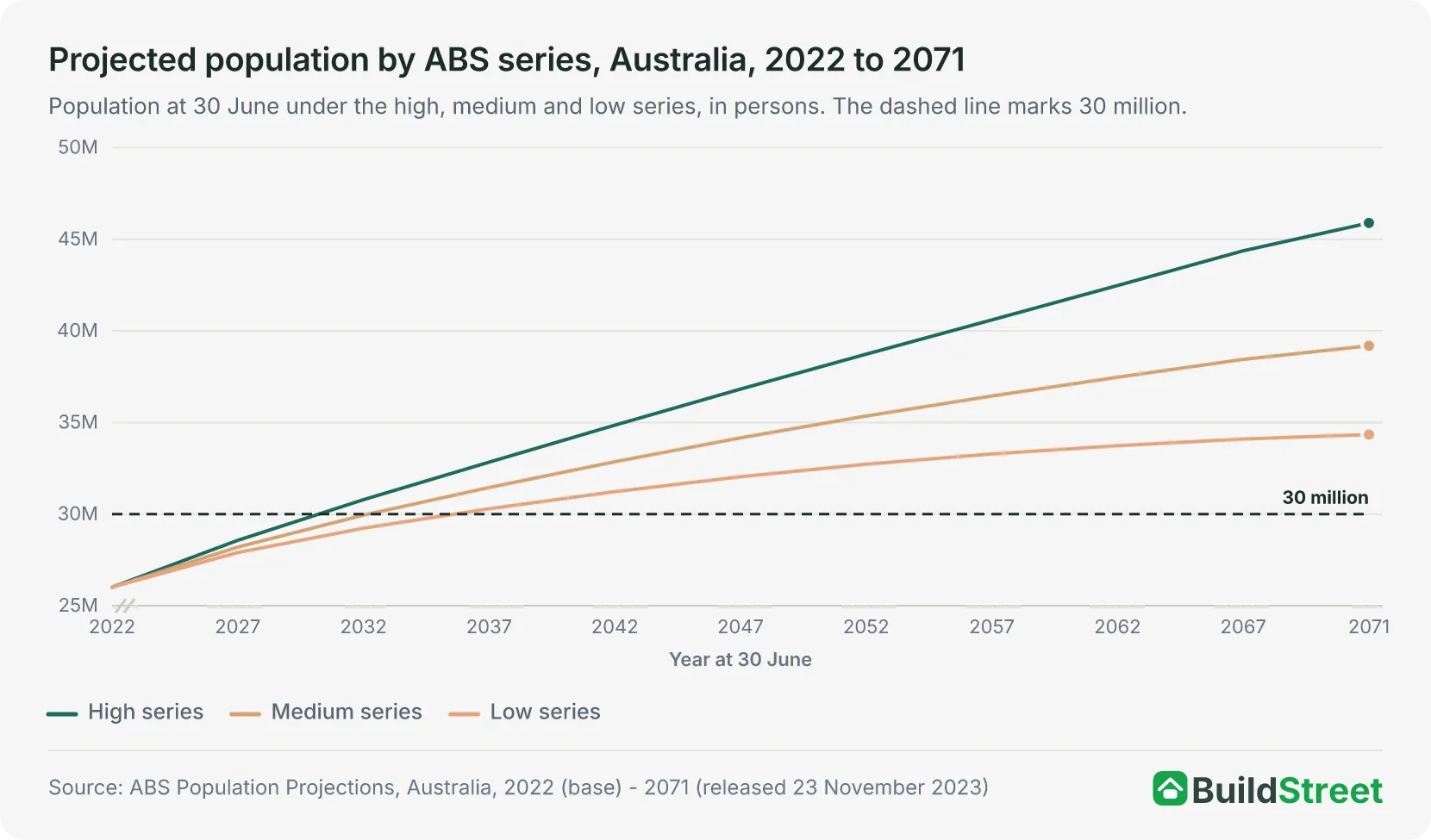
Australia is projected to pass 30 million people during the 2031-32 financial year under the Centre for Population's central scenario. The ABS projection series place the crossing between 30 June 2031 in the high series and 30 June 2036 in the low series.
The Centre for Population projects the crossing during the 2031-32 financial year. Its central scenario has the population at 29,686,200 at 30 June 2031 and 30,045,900 at 30 June 2032, placing the crossing during the 2031-32 year1.
The ABS series bracket that date. The high series first exceeds 30 million at 30 June 2031, with 30,373,698 people. The medium series reaches 30,255,082 at 30 June 2033, while the low series reaches 30,091,582 at 30 June 20362. The medium series comes close a year earlier, ending 30 June 2032 at 29,944,139 people, about 56,000 below 30 million.
Australia's population was 27,801,023 at 31 December 2025, an increase of 412,500 people, or 1.5 per cent, over the year3.
Where the population stands today, and what is driving its growth, is covered in the Australian population statistics article.
Projected year Australia passes 30 million
2031-32
Centre for Population central scenario, 2025 Population Statement. The ABS series place the crossing between 30 June 2031 and 30 June 2036.
Section 02 · The central path
How fast is Australia's population projected to grow to 2035-36?
Growth is projected to slow before the population passes 30 million. The Centre for Population's central scenario has the population growing by 1.5 per cent in 2024-25 and 1.3 per cent in 2025-26, based on changes in its year-end population series. The slowdown largely reflects falling net overseas migration and fertility rates4.
The central scenario adds between 332,400 and 359,700 people in each year from 2026-27 to 2035-36, based on year-to-year changes in the published population figures. It reaches 31,470,400 at 30 June 2036, which the Statement rounds to 31.5 million1.
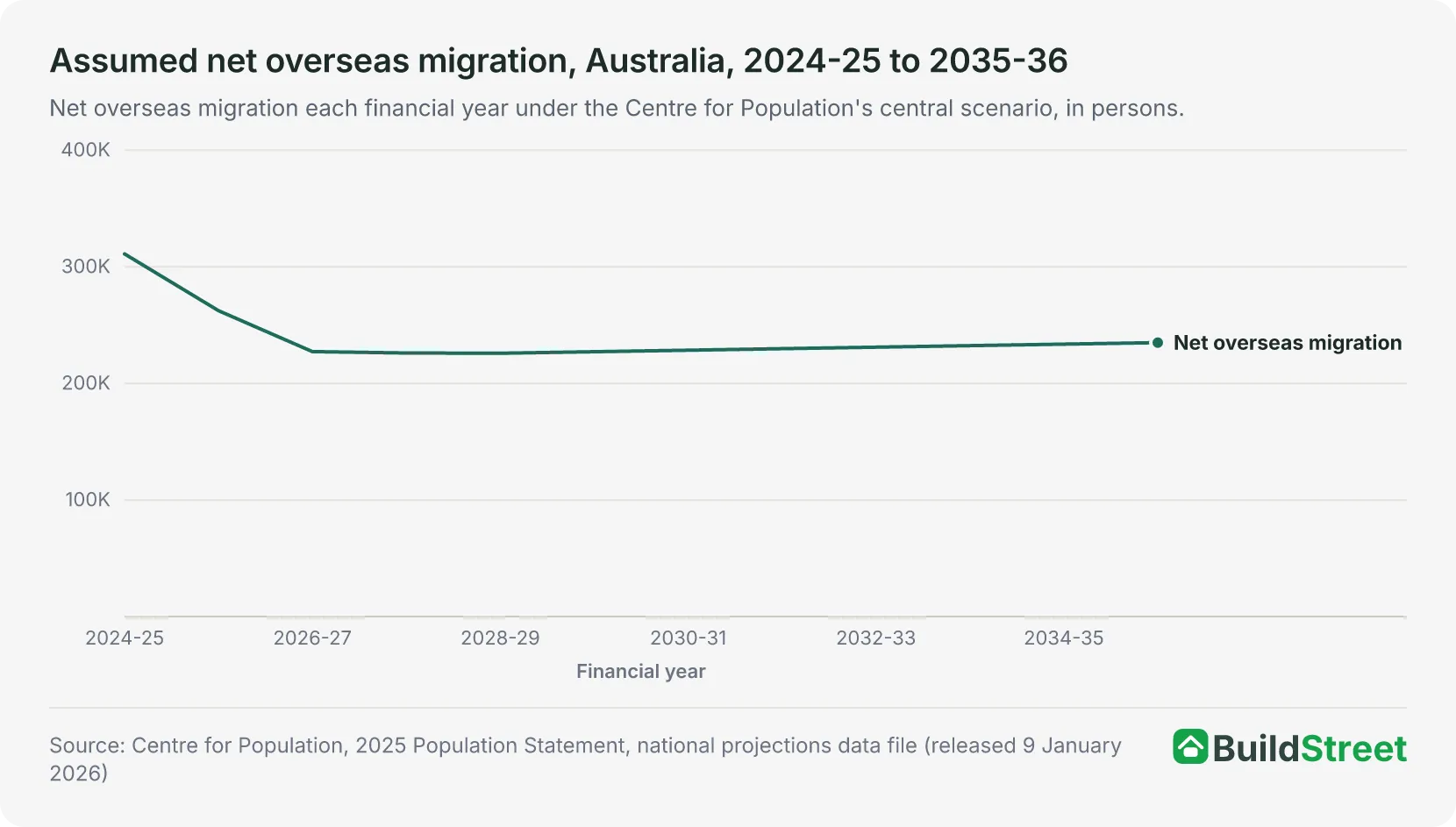
Natural increase and migration both contribute to the projected growth. In 2025-26 the central scenario has natural increase of 99,200, from births of 285,500 and deaths of 186,400, alongside net overseas migration of 262,400. Natural increase then rises from 105,200 in 2026-27 to a peak of 129,900 in 2031-32 before declining to 119,000 in 2035-36, while net overseas migration is projected to reach 235,000 in that year1.
| Projected population and growth components, Australia, 2024-25 to 2035-36 | |||
|---|---|---|---|
| Financial year | Population at 30 June | Net overseas migration | Natural increase |
| 2024-25 | 27,610,300 | 311,100 | 105,400 |
| 2025-26 | 27,972,000 | 262,400 | 99,200 |
| 2026-27 | 28,304,400 | 227,300 | 105,200 |
| 2027-28 | 28,641,100 | 226,100 | 110,600 |
| 2028-29 | 28,983,900 | 225,900 | 116,800 |
| 2029-30 | 29,332,200 | 227,200 | 121,100 |
| 2030-31 | 29,686,200 | 228,500 | 125,500 |
| 2031-32 | 30,045,900 | 229,800 | 129,900 |
| 2032-33 | 30,404,200 | 231,100 | 127,200 |
| 2033-34 | 30,761,000 | 232,400 | 124,400 |
| 2034-35 | 31,116,400 | 233,700 | 121,700 |
| 2035-36 | 31,470,400 | 235,000 | 119,000 |
| 2065-66 extension | 41,002,700 | 235,000 | 69,300 |
Source · Centre for Population, 2025 Population Statement, national projections data file.
Section 03 · The assumptions
What do the population projections assume about births, deaths and migration?
The ABS medium series assumes fertility of 1.6 babies per woman, net overseas migration reaching 225,000 people a year by 2031-32, and life expectancy continuing to rise. The high and low series use different fertility and migration assumptions, while the medium and low series use the same life expectancy assumptions.2
Projections are built by carrying assumptions forward. The ABS starts from a base population, here 30 June 2022, and applies assumed levels of births, deaths and migration year by year to produce each following year's population. Its assumptions can be combined into 54 sets of projections, from which the high, medium and low series were selected for analysis2.
Net overseas migration ranges from 175,000 people a year in the low series to 275,000 in the high series, with the medium series at 225,000. Each assumption is phased in by 2031-32. The ABS compares these with a recent observed average of 103,300 people a year across the calendar years 2020 to 20222.
Observed migration since 2022 is covered in the immigration trends article.
The Centre for Population's near-term assumptions differ. Its Statement forecasts net overseas migration of 262,400 in 2025-26, falling to 227,300 in 2026-27 and then increasing to 235,000 a year by 2035-36, and it expects the total fertility rate to fall to a record low of 1.42 babies per woman in 2025-261. The fertility recovery after that is a modelling assumption, not a forecast. The central scenario has the rate returning to 1.62 by 2031-32 and holding there through 2065-66.
| ABS projection assumptions by series, Australia, 2022-base projections | |||||
|---|---|---|---|---|---|
| Assumption | Recent average | Low | Medium | High | Phased in by |
| Fertility babies per woman | 1.64 | 1.45 | 1.60 | 1.75 | 2026-27 |
| Net overseas migration people a year | 103,300 | 175,000 | 225,000 | 275,000 | 2031-32 |
| Male life expectancy years at birth | 81.2 | 83.9 | 83.9 | 88.4 | 2070-71 |
| Female life expectancy years at birth | 85.3 | 86.8 | 86.8 | 91.1 | 2070-71 |
Source · ABS Population Projections, Australia, 2022 (base) - 2071, assumptions.
Section 04 · States and territories
Which states and territories are projected to grow fastest?
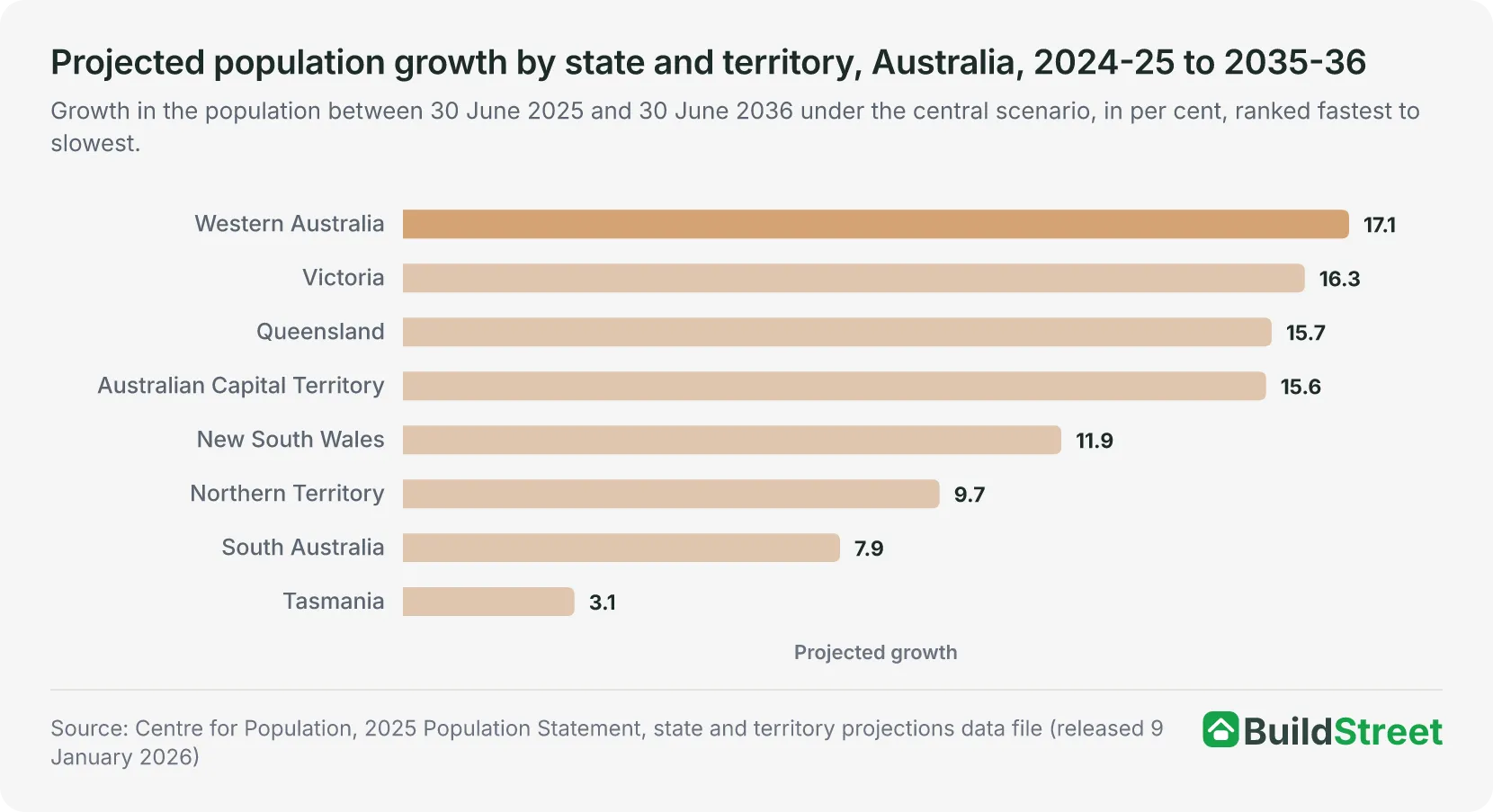
Western Australia has the highest projected growth rate. Its population increases from 3,042,200 at 30 June 2025 to 3,562,400 at 30 June 2036 in the central scenario, an increase of 520,200 people or 17.1 per cent5. The Statement describes Western Australia as expected to be Australia's fastest growing state or territory in the coming years, and Tasmania as remaining the slowest growing4.
Victoria and New South Wales are projected to add more people than Western Australia. Victoria adds 1,151,700 people, the largest increase of any state or territory, to reach 8,221,700. New South Wales adds 1,027,300 people to reach 9,625,400, the largest projected population of any state or territory. Their growth rates are 16.3 per cent and 11.9 per cent, respectively5. Queensland grows 15.7 per cent to 6,558,000 and the Australian Capital Territory 15.6 per cent to 560,800.
Capital cities are projected to grow nearly twice as fast as rest-of-state areas.4 The ABS projections also have 68 per cent of Australia's population living in capital cities by 2032, up from 67 per cent at 30 June 20222. The ABS also projects Melbourne to surpass Sydney between 2032 and 2046 and to reach between 6.5 million and 9.9 million people by 2071.
What that concentration means for dwelling demand is covered in the population growth versus housing supply article.
| Projected population by state and territory, Australia, 2024-25 and 2035-36 | ||||
|---|---|---|---|---|
| State or territory | 30 June 2025 | 30 June 2036 | Growth | Growth % |
| Western Australia | 3,042,200 | 3,562,400 | +520,200 | 17.1 |
| Victoria | 7,070,000 | 8,221,700 | +1,151,700 | 16.3 |
| Queensland | 5,667,500 | 6,558,000 | +890,500 | 15.7 |
| Australian Capital Territory | 485,000 | 560,800 | +75,800 | 15.6 |
| New South Wales | 8,598,100 | 9,625,400 | +1,027,300 | 11.9 |
| Northern Territory | 264,300 | 290,000 | +25,700 | 9.7 |
| South Australia | 1,902,200 | 2,053,100 | +150,900 | 7.9 |
| Tasmania | 576,100 | 594,100 | +18,000 | 3.1 |
Source · Centre for Population, 2025 Population Statement, state and territory projections data file.
Section 05 · Ageing
How much older will Australia's population become?
The median age, 38.5 years in 2022, is projected to increase to between 43.8 and 47.6 years by 2071, and the share of people aged 65 and over is projected to rise from 17 per cent to between 25 and 27 per cent2.
The share of people aged 85 and over rises the most in proportional terms, more than doubling from 2.1 per cent of the population in 2022 to between 5.2 and 6.4 per cent in 2071. The share of children aged 0 to 14 is projected to decline from 18 per cent to between 13 and 16 per cent. The working-age share, covering people aged 15 to 64, is projected to fall from 65 per cent to between 59 and 60 per cent2.
Assumed life expectancy also increases. The Centre for Population's central scenario has male life expectancy at birth increasing from 81.9 years in 2024-25 to 86.1 years in 2065-66, and female life expectancy from 85.8 to 89.5 years. Over the same period, annual natural increase, the difference between births and deaths, is projected to decline from 105,400 to 69,3001.
| Projected age profile, Australia, 2022 and 2071 | ||
|---|---|---|
| Measure | 2022 | 2071 projected range |
| Median age years | 38.5 | 43.8 to 47.6 |
| Children aged 0-14 share | 18% | 13% to 16% |
| Working age 15-64 share | 65% | 59% to 60% |
| Aged 65 and over share | 17% | 25% to 27% |
| Aged 85 and over share | 2.1% | 5.2% to 6.4% |
Source · ABS Population Projections, Australia, 2022 (base) - 2071, key statistics and age structure.
Section 06 · The long run
How big could Australia's population be by 2071?
The projected range spans about 11.5 million people by 2071, derived by subtracting the low series from the high. The ABS projects Australia's population to grow from 26.0 million at 30 June 2022 to between 34.3 and 45.9 million people by 2071, with the medium series at 39.2 million. The gap between the series widens over time as their different assumptions accumulate2. Growth slows in every series. The ABS states the ten-year average annual growth rate to 2022, 1.4 per cent, is projected to decline to between 0.2 and 0.9 per cent.
Later milestones also differ between the series. The high series passes 35 million at 30 June 2043, 40 million at 30 June 2056 and 45 million at 30 June 2069. The medium series passes 35 million at 30 June 2051 and reaches 39,185,129 at the end of the horizon. The low series does not reach 35 million by 2071, ending at 34,343,0152. The Centre for Population's extended central scenario sits between the ABS medium and high paths, with 41,002,700 people at the end of 2065-661.
The zero net overseas migration assumption shows how the projected population changes without net migration from overseas. Under that assumption, Australia's population peaks at 26,911,719 people at 30 June 2036 and declines to 23,932,547 by 2071, never reaching 30 million2.
| Projected year each population milestone is first passed, Australia, by ABS series | |||
|---|---|---|---|
| Milestone | High series | Medium series | Low series |
| 30 million | 30 June 2031 | 30 June 2033 | 30 June 2036 |
| 35 million | 30 June 2043 | 30 June 2051 | Not reached by 2071 |
| 40 million | 30 June 2056 | Not reached by 2071 | Not reached by 2071 |
| 45 million | 30 June 2069 | Not reached by 2071 | Not reached by 2071 |
Source · ABS Population Projections, Australia, 2022 (base) - 2071.
Section 07
Australia at 30 million: quick answers
When will Australia's population reach 30 million?
Australia's population is projected to pass 30 million during the 2031-32 financial year under the Centre for Population's central scenario. The ABS projection series place the crossing between 30 June 2031 in the high series and 30 June 2036 in the low series, with the medium series crossing at 30 June 2033.
What is Australia's population in 2026?
The latest official estimate puts Australia's population at 27,801,023 as at 31 December 2025, an increase of 412,500 people, or 1.5 per cent, over the year. The Australian Bureau of Statistics is scheduled to publish its next quarterly estimate, for March 2026, on 17 September 2026.
How big will Australia's population be by 2050?
The ABS projects between about 32.5 million and 38.0 million people as at 30 June 2050, depending on the series. The high series projects 37,973,865 people at that date, the medium series 34,890,378 and the low series 32,466,996.
Will Australia's population reach 40 million?
Only the ABS high series reaches 40 million within its projection horizon, first passing the milestone on 30 June 2056. The medium series reaches 39.2 million at the end of the projection horizon in 2071 and the low series at 34.3 million. The Centre for Population's extended central scenario reaches 41.0 million by 30 June 2066.
What would happen to Australia's population without overseas migration?
Under the ABS zero net overseas migration assumption, Australia's population would peak at 26,911,719 on 30 June 2036 and decline to 23,932,547 by 30 June 2071, never reaching 30 million. The ABS publishes this series to show how population outcomes change under a zero net overseas migration assumption. It is an analytical assumption, not a forecast.
Are population projections forecasts?
No. The ABS states that its projections are not predictions or forecasts. They illustrate what would happen to the population if the assumed levels of births, deaths and migration occurred. The Centre for Population also updates its projections through the annual Population Statement.
References
- Centre for Population, National Population Projections data file, 2024-25 to 2035-36 · population.gov.au ↑ b c d e f
- ABS, Population Projections, Australia, 2022 (base) to 2071 · Australian Bureau of Statistics ↑ b c d e f g h i j
- ABS, National, state and territory population, December 2025 · Australian Bureau of Statistics ↑
- Centre for Population, 2025 Population Statement · population.gov.au ↑ b c
- Centre for Population, State and Territory Projections data file, 2024-25 to 2035-36 · population.gov.au ↑ b
