


Published
 Cost of living overseas compared with AustraliaThe full comparison of living costs in Australia and the destinations people move to, from groceries and power to rent.
 Australians leaving Australia: emigration statisticsHow many Australian citizens leave each year, how the count has changed since 2004-05, and how the ABS measures a departure.
Section 01 · Australians abroad
How many Australians live in Poland, Portugal, Greece and Spain?
Greece had the largest estimated population born in Australia among Poland, Portugal and Greece, at 21,915 people at mid-2024, according to United Nations Department of Economic and Social Affairs (UN DESA) estimates1. Poland had an estimated 2,079 people born in Australia, compared with an estimated 1,549 in Portugal. The UN does not publish a separate estimate of the number of Australian-born people living in Spain.
Greece's estimated population born in Australia accounted for 5.1 per cent of the estimated 430,718 people born in Australia who lived outside Australia at mid-20241.
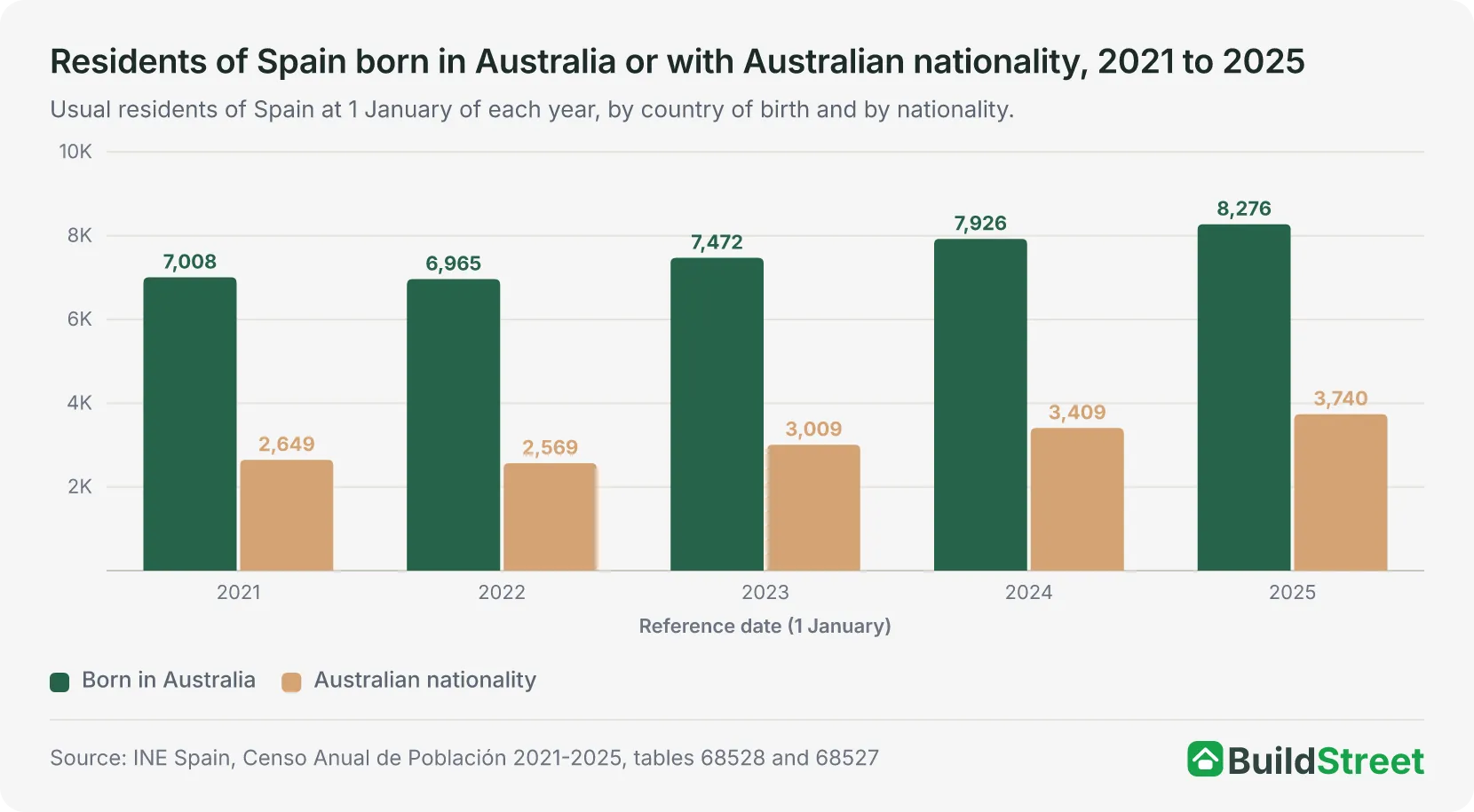
Spain had 8,276 residents born in Australia at 1 January 2025, an increase of 1,268 people, or 18.1 per cent, from 7,008 at 1 January 2021, according to the National Statistics Institute of Spain (INE)2. The number of residents with Australian nationality increased from 2,649 to 3,740 over the same period3.
Poland's 2021 census recorded 1,859 residents born in Australia at 31 March 20214.
Greece's 2021 census recorded 1,377 residents with Australian citizenship5. Portugal's Agency for Integration, Migration and Asylum (AIMA) recorded 1,138 Australian nationals in its resident foreign population at 31 December 20256.
| People born in Australia or holding Australian citizenship in Poland, Portugal, Greece and Spain, 2021 to 2025 | ||||
|---|---|---|---|---|
| Country | Measure | People | Reference date | Source |
| Greece | Born in Australia, UN estimate | 21,915 | Mid-2024 | UN DESA |
| Spain | Born in Australia | 8,276 | 1 January 2025 | INE (Spain) |
| Poland | Born in Australia, UN estimate | 2,079 | Mid-2024 | UN DESA |
| Poland | Born in Australia, census | 1,859 | 31 March 2021 | GUS |
| Portugal | Born in Australia, UN estimate | 1,549 | Mid-2024 | UN DESA |
| Spain | Australian nationality | 3,740 | 1 January 2025 | INE (Spain) |
| Greece | Australian citizenship, census | 1,377 | 22 October 2021 | ELSTAT |
| Portugal | Australian nationals, resident foreign population | 1,138 | 31 December 2025 | AIMA |
Source · UN DESA International Migrant Stock 2024; INE (Spain) Censo Anual de Población; GUS NSP 2021; ELSTAT 2021 Population Census; AIMA Relatório de Migrações e Asilo 2025.
Section 02 · Poland
How much does an apartment cost per square metre in Poland?
Apartments in Poland sold for an average of 8,970 złoty per square metre in 2024, with a median of 8,257 złoty, according to Statistics Poland (GUS)7. In Warsaw, the average price was 15,850 złoty per square metre, compared with 13,738 złoty in Kraków.
Apartment prices in Poland were 6.3 per cent higher in the June quarter 2026 than a year earlier, with increases of 6.5 per cent for new apartments and 6.1 per cent for existing apartments8.
Resale apartments in Warsaw had an average sale price of 16,723 złoty per square metre in the June quarter of 2026, according to a survey by Poland's central bank, Narodowy Bank Polski (NBP), covering March to May9. That is about A$6,220 at the September 2026 average exchange rate. New apartments in Warsaw averaged 16,783 złoty per square metre, or about A$6,24010.
Housing rents in Poland rose 3.6 per cent in the year to August 2026, according to Eurostat's measure of consumer price changes11. No official average rent figure for Poland was available.
| Average and median price per m² of apartments sold, Poland, Warsaw and Kraków, 2024 | ||
|---|---|---|
| Area | Average price per m² (zł) | Median price per m² (zł) |
| Warsaw | 15,850 | 15,402 |
| Kraków | 13,738 | 13,472 |
| Poland | 8,970 | 8,257 |
Source · GUS, Obrót nieruchomościami w 2024 r. and Local Data Bank.
Section 03 · Portugal
What are median house prices and rents in Portugal?
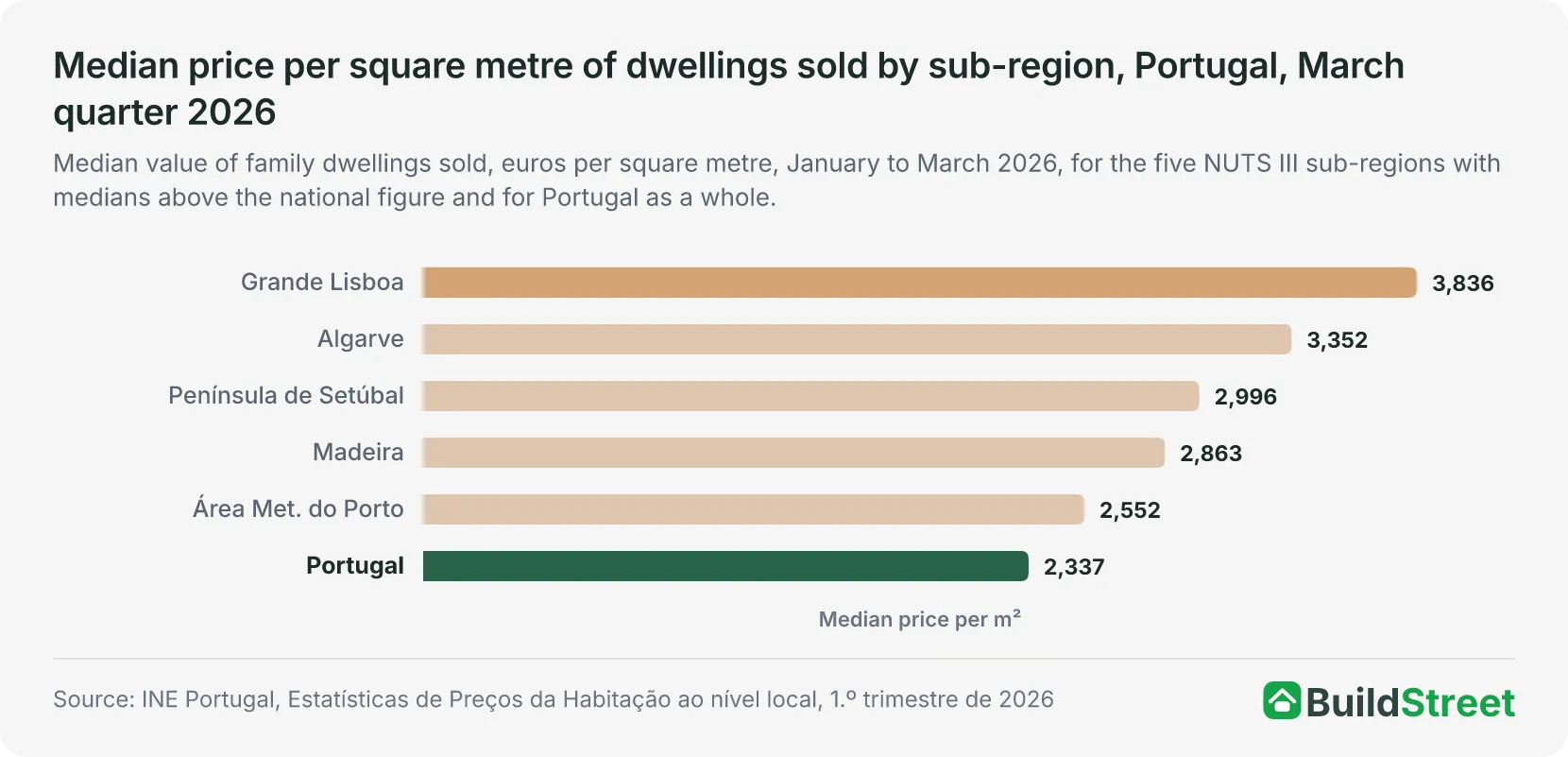
The median price of dwellings sold in Portugal was €2,337 per square metre in the March quarter 2026, an increase of 19.8 per cent from a year earlier, according to Statistics Portugal (INE)12. At the September 2026 average exchange rate, that is about A$3,780 per square metre10.
Grande Lisboa recorded the highest median price among Portugal's sub-regions in the March quarter 2026, at €3,836 per square metre, followed by the Algarve, at €3,35212. Península de Setúbal, Madeira and the Área Metropolitana do Porto made up the rest of the five sub-regions with the highest median prices.
The Lisbon municipality had a median price of €5,292 per square metre, compared with €3,729 in the Porto municipality12. The Lisbon median price was 2.3 times the national median.
Buyers whose tax residence was outside Portugal paid a median of €3,000 per square metre in the March quarter of 2026, compared with €2,313 for buyers who were tax residents in Portugal12.
New lease agreements in Portugal had a median rent of €10.17 per square metre a month in the June quarter 2026, an increase of 10.2 per cent from a year earlier13. That is about A$16.44 per square metre a month at the September 2026 average exchange rate.
Portugal's house price index rose 16.5 per cent in the year to the June quarter of 2026, with prices for existing dwellings rising 18.0 per cent and prices for new dwellings rising 12.3 per cent14.
| Median rent per m² of new lease agreements, Portugal, June quarter 2026 | ||
|---|---|---|
| Area | Median rent per m² a month (€) | Australian-dollar equivalent (A$) |
| Lisbon (municipality) | 17.79 | 28.76 |
| Grande Lisboa | 15.24 | 24.64 |
| Porto (municipality) | 14.66 | 23.70 |
| Algarve | 11.56 | 18.69 |
| Área Metropolitana do Porto | 10.83 | 17.51 |
| Portugal | 10.17 | 16.44 |
Source · INE (Portugal), Estatísticas de Rendas da Habitação ao nível local, 2.º trimestre de 2026.
Section 04 · Greece
How much does housing cost in Greece?
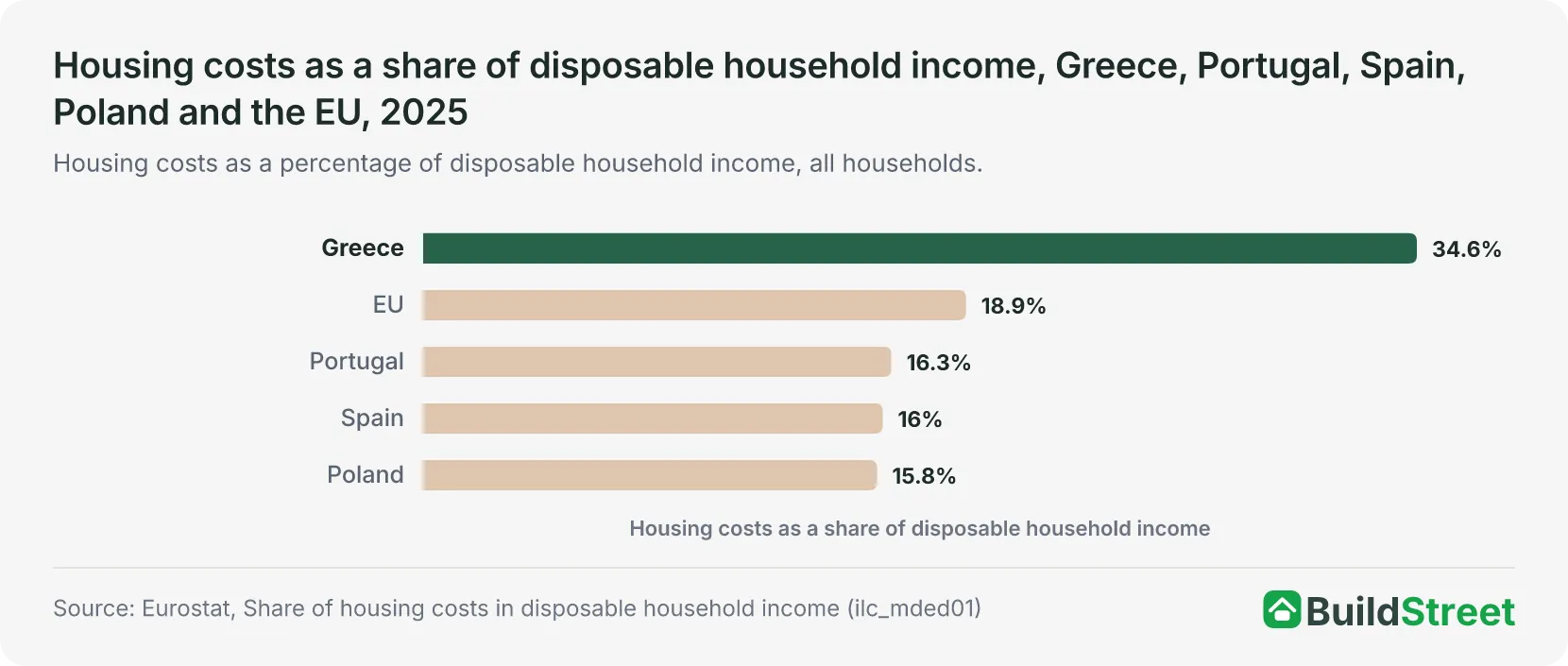
Housing costs accounted for 34.6 per cent of disposable household income in Greece in 2025, compared with 18.9 per cent across the European Union, according to Eurostat's income and living conditions survey15. The share was 16.3 per cent in Portugal, 16.0 per cent in Spain and 15.8 per cent in Poland.
The housing cost overburden rate measures the percentage of people living in households that spend more than 40 per cent of their disposable income on housing.
Greece recorded the highest housing cost overburden rate among the four countries in 2025, at 26.4 per cent of the population, compared with 7.2 per cent in Spain, 6.3 per cent in Portugal and 4.1 per cent in Poland16.
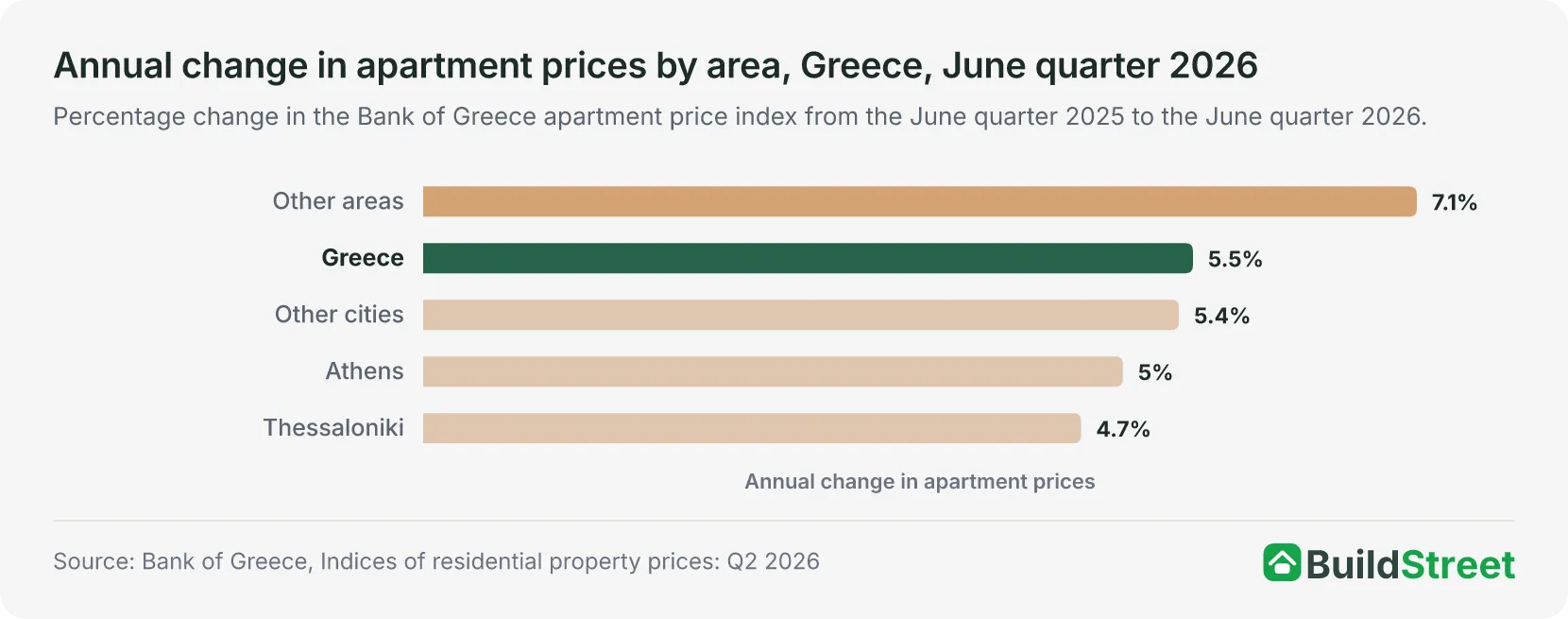
Apartment prices in Greece rose 5.5 per cent in the year to the June quarter of 2026, according to provisional Bank of Greece data17. Apartment prices rose 5.0 per cent in Athens and 4.7 per cent in Thessaloniki over the same period.
Apartment prices in Greece were 14.2 per cent above their 2007 level in the June quarter 2026, with the apartment price index at 114.218. Apartment prices increased by an average of 9.1 per cent in 2024 and 8.3 per cent in 202517.
Rents for dwellings in Greece were 5.9 per cent higher in September 2026 than a year earlier, according to the Hellenic Statistical Authority (ELSTAT) consumer price index19.
Section 05 · Spain
What are house prices and rents in Spain?
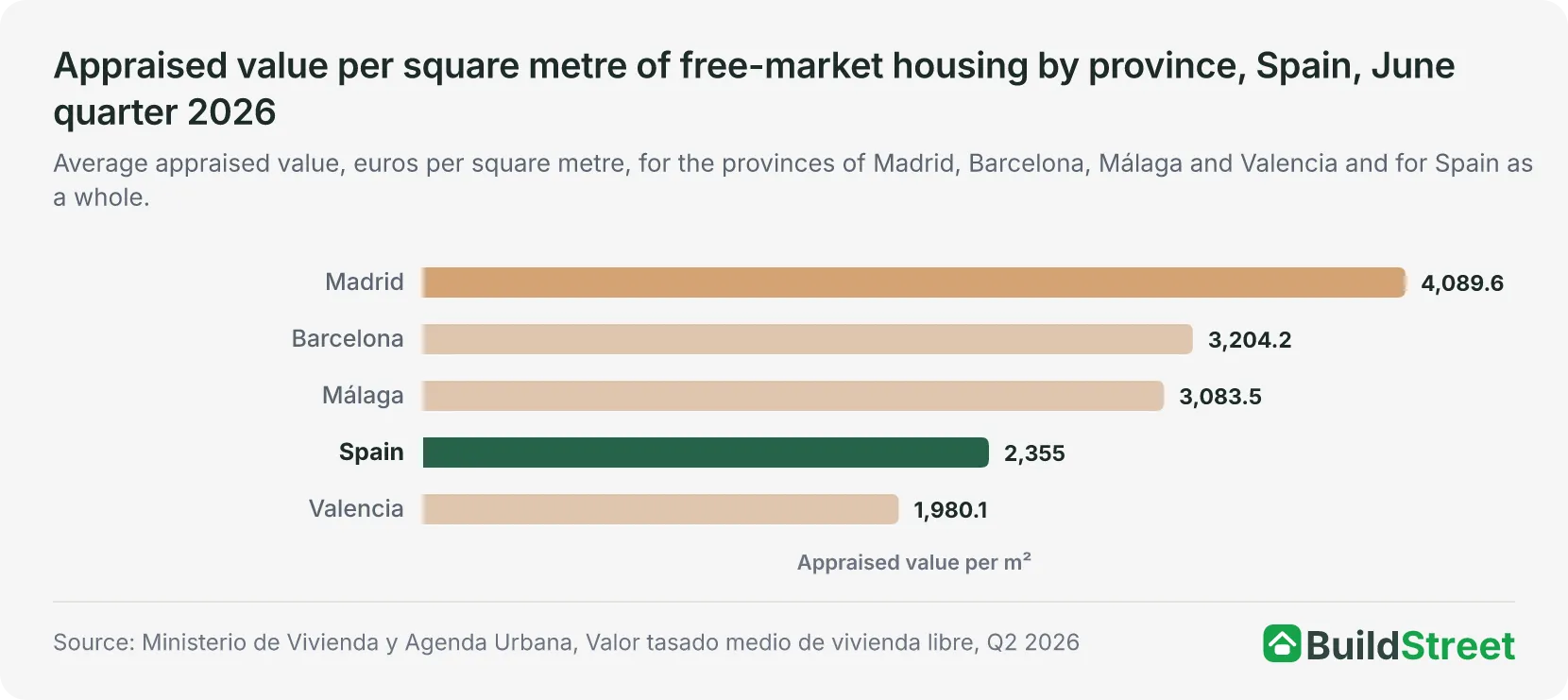
The average appraised value of free-market housing in Spain was €2,355.0 per square metre in the June quarter 2026, an increase of 12.5 per cent from a year earlier, according to Spain's Ministry of Housing and Urban Agenda21. That is about A$3,810 per square metre at the September 2026 average exchange rate.
Madrid province recorded the highest average appraised value among the provinces of Madrid, Barcelona, Málaga and Valencia in the June quarter 2026, at €4,089.6 per square metre, while Valencia province recorded the lowest, at €1,980.121. Valencia province also recorded the fastest annual increase among the four provinces, at 17.6 per cent.
House prices in Spain rose 12.2 per cent in the year to the June quarter 2026, according to the house price index published by the National Statistics Institute of Spain (INE), which tracks sale prices22. Prices of existing dwellings rose 12.9 per cent, compared with 7.4 per cent for new dwellings.
In 2024, the median monthly rent for apartments under existing leases was €900.00 in Barcelona, €868.75 in Madrid, €718.33 in Málaga and €680.83 in Valencia, according to the ministry's national rental database23.
Rents on new contracts in Spain, excluding Navarra and the Basque Country, rose 8.8 per cent in 2024, compared with 2.8 per cent on existing contracts, according to the INE rental price index24.
Housing rents in Spain rose 2.5 per cent in the year to August 2026, according to Eurostat's measure of consumer price changes11.
| Median rent of apartments under existing leases, Madrid, Barcelona, Valencia and Málaga, 2024 | ||
|---|---|---|
| Municipality | Median rent a month (€) | Median rent per m² a month (€) |
| Barcelona | 900.00 | 13.68 |
| Madrid | 868.75 | 13.97 |
| Málaga | 718.33 | 9.55 |
| Valencia | 680.83 | 8.18 |
Source · Ministerio de Vivienda y Agenda Urbana, SERPAVI database 2011-2024.
Section 06 · Living costs
How do living costs in Poland, Portugal, Greece and Spain compare with Australia?
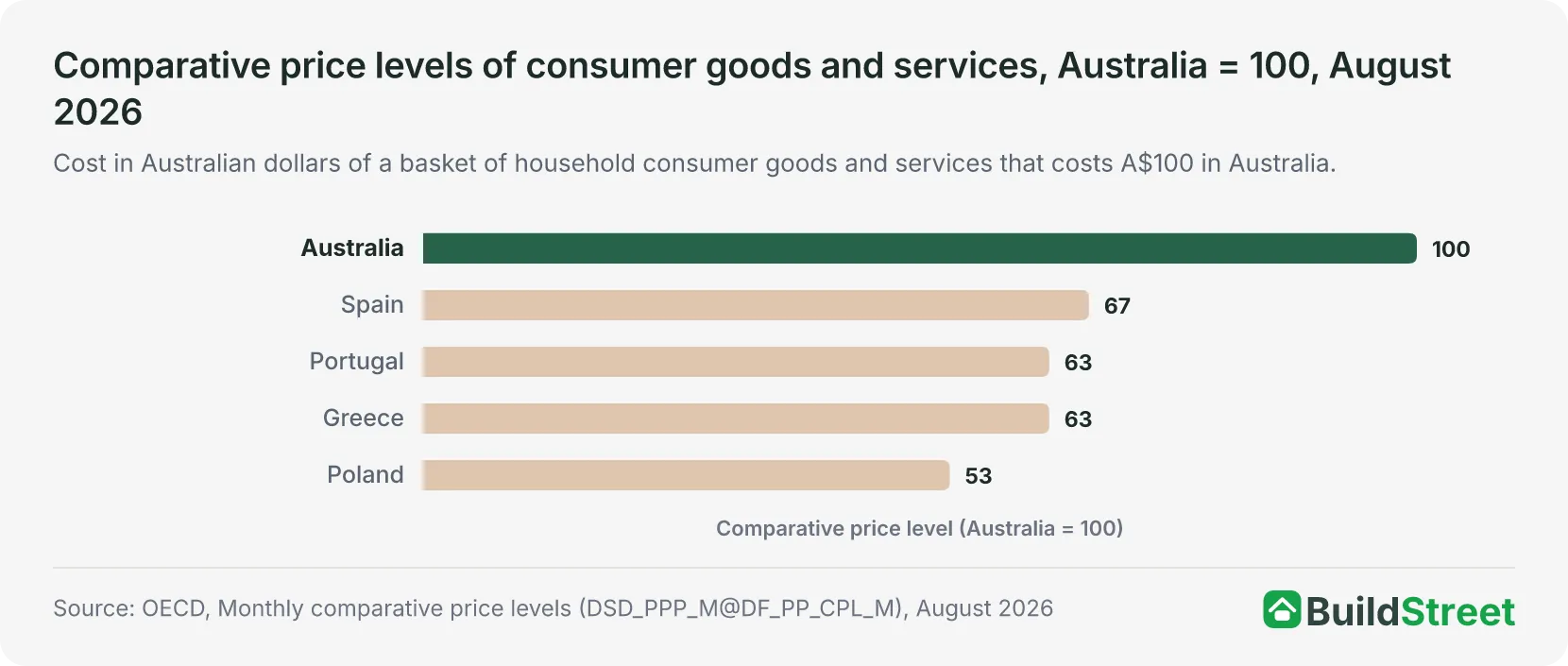
Poland recorded the lowest estimated cost of living among the four countries in August 2026, at A$53 for a basket of household goods and services costing A$100 in Australia, according to estimates from the OECD25. The same basket was estimated to cost A$67 in Spain and A$63 in both Portugal and Greece.
In 2021, Australia's price difference with each of the four countries was larger for housing, water, electricity, gas and other fuels than for food and non-alcoholic beverages, restaurants and hotels, or overall household consumption, according to the World Bank International Comparison Program (ICP)26. Australia's price level for housing and utilities was 257.5, compared with the world average of 100, while the figures were 148.5 in Spain, 116.6 in Portugal, 101.5 in Greece and 55.1 in Poland.
Eurostat's preliminary 2025 figures for housing and utility costs were 52.2 in Poland, 76.6 in Greece, 81.1 in Portugal and 98.1 in Spain, compared with the European Union average of 10027.
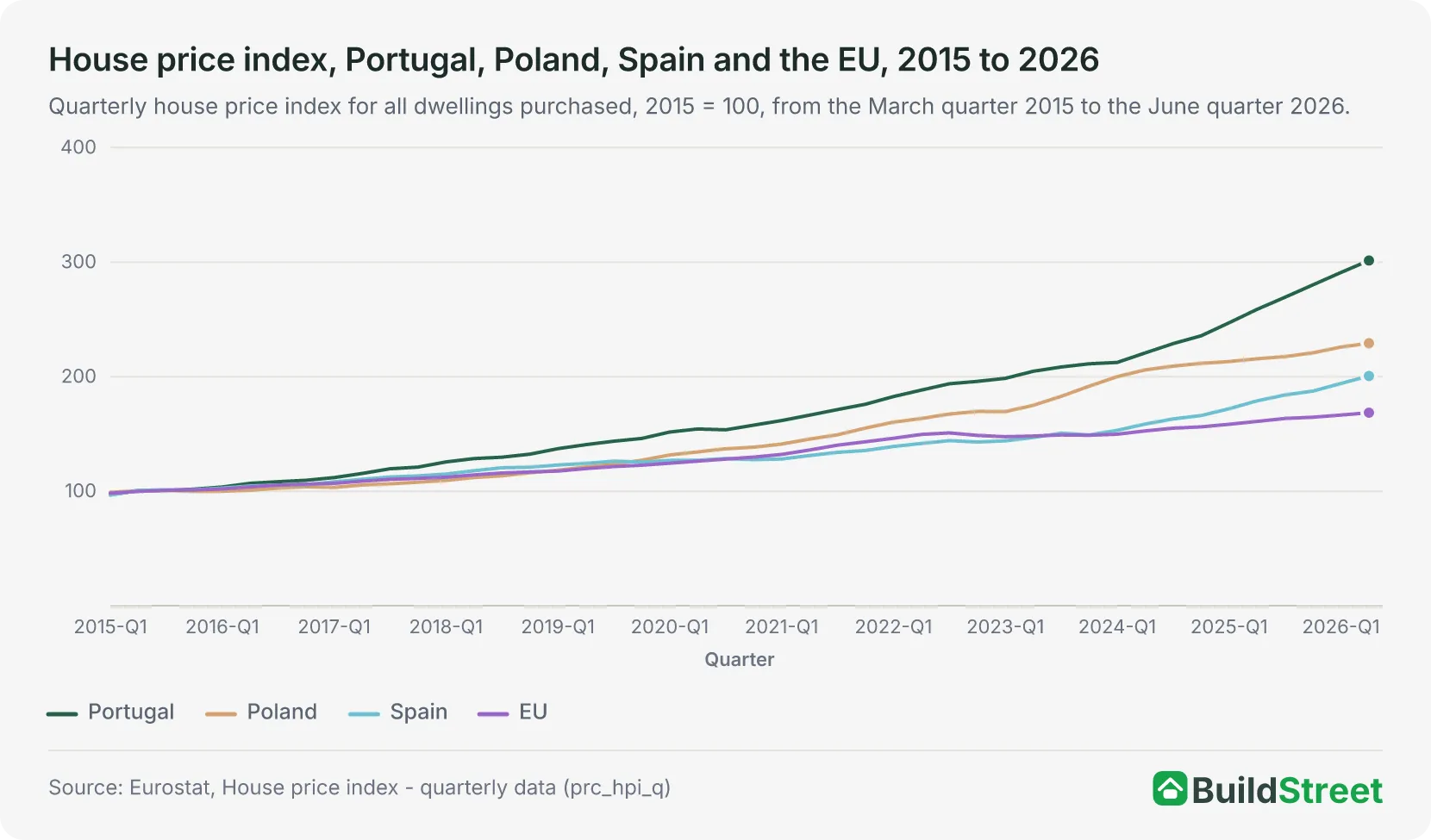
Portugal's house price index was 3.01 times its 2015 level in the June quarter of 2026, compared with 2.29 times in Poland, 2.01 times in Spain and 1.69 times across the European Union28.
Consumer prices in Australia rose 4.0 per cent in the 12 months to August 2026, according to the Australian Bureau of Statistics (ABS)29. Over the same period, consumer prices measured using Eurostat's harmonised index rose 4.6 per cent in Spain, 3.7 per cent in Greece, 3.6 per cent in Portugal and 3.5 per cent in Poland30.
The ABS consumer price index and Eurostat's harmonised index are calculated using different methods, so the inflation rates are not directly comparable.
Household spending in Australia is covered in CheckRate's cost of living in Australia.
| Price level indexes by consumption group, Australia, Spain, Portugal, Greece and Poland, 2021 (World = 100) | ||||
|---|---|---|---|---|
| Country | Actual individual consumption | Housing, water, electricity, gas and other fuels | Food and non-alcoholic beverages | Restaurants and hotels |
| Australia | 177.4 | 257.5 | 148.3 | 187.5 |
| Spain | 117.3 | 148.5 | 114.5 | 111.1 |
| Portugal | 104.8 | 116.6 | 118.6 | 93.9 |
| Greece | 101.6 | 101.5 | 124.6 | 116.7 |
| Poland | 67.7 | 55.1 | 84.7 | 98.0 |
Source · World Bank, International Comparison Program 2021.
Section 07 · Social security
Does Australia have a social security agreement with Poland, Portugal, Greece and Spain?
Australia has a social security agreement with all four countries, according to the Department of Social Services (DSS)31. The current agreement with Portugal took effect on 1 October 200232, Spain on 1 January 200333, Greece on 1 October 200834 and Poland on 1 October 201035.
The agreements allow people to claim eligible pensions from one country while living in the other and to combine periods of Australian residence with periods of social security contributions in the other country to meet minimum eligibility requirements31.
The agreements with Spain and Portugal cover the Age Pension, the Disability Support Pension for people who are severely disabled, Carer Payment in limited cases, Parenting Payment (single) for widowed people, Double Orphan Pension and additional child amounts3637. The agreements with Greece and Poland cover the Age Pension only3839.
Age Pension eligibility requires at least 10 years of Australian residence, including at least five consecutive years40. Under each of the four agreements, Australian residence and periods of social security coverage in the other country can count towards the 10-year residence requirement, according to the DSS Social Security Guide41. A person claiming from outside Australia needs at least 12 months of residence in Australia during their working life, including six continuous months42.
The Age Pension can generally be paid outside Australia for any length of time, but after 26 weeks overseas the rate may be reduced based on how long the person lived in Australia during their working life, measured against a maximum of 35 years43. The maximum basic Age Pension rate for a single person living outside Australia has been A$29,520.40 a year since 20 September 202644.
The agreements with Portugal, Greece and Poland also prevent employees temporarily working in another country from having to contribute to both countries' superannuation systems. According to the DSS, these employees generally remain covered by their home country's system31. The Australian Taxation Office (ATO) lists these three agreements, but not Spain's, among those covering superannuation45.
How the Age Pension works for people who move overseas is set out in CheckRate's guide to living overseas on the Age Pension.
| Australia's social security agreements with Poland, Portugal, Greece and Spain | |||
|---|---|---|---|
| Country | Current agreement in force from | Australian payments covered | Superannuation double-coverage provision |
| Portugal | 1 October 2002 | Age Pension, Disability Support Pension (severely disabled), Carer Payment (limited), Parenting Payment (single, widowed), Double Orphan Pension, additional child amounts | Yes |
| Spain | 1 January 2003 | Age Pension, Disability Support Pension (severely disabled), Carer Payment (limited), Parenting Payment (single, widowed), Double Orphan Pension, additional child amounts | Not listed by the ATO |
| Greece | 1 October 2008 | Age Pension | Yes |
| Poland | 1 October 2010 | Age Pension | Yes |
Source · DSS, Social Security Guide Part 10; ATO, Bilateral social security agreements.
Section 08 · Residency
What visas do Australians need to live in Poland, Portugal, Greece or Spain?
Australian citizens can stay in Poland, Portugal, Greece and Spain without a visa for up to 90 days in any 180-day period, a limit that applies across the whole Schengen area, according to Smartraveller47. Stays longer than 90 days require a national visa or residence permit from the country concerned.
None of the four countries is on Smartraveller's list of Schengen countries with special visa-waiver agreements that may allow Australian citizens to stay longer than 90 days47.
The European Union's Entry/Exit System, which electronically records when travellers from outside the EU enter and leave, has been fully operational since 10 April 202648. The European Travel Information and Authorisation System (ETIAS), a pre-travel authorisation that will cost €20, is not yet in operation and has no announced start date49.
Each country has different visa and residency requirements for longer stays:
Portugal issues residency visas for retirees, people who receive income without working, and remote workers, according to its Ministry of Foreign Affairs50. A remote worker must show average monthly income over the previous three months of at least four times the minimum monthly wage, or €3,680 in 202651. The minimum income requirement for retirees starts at €920 a month, the minimum wage, for the first adult52.
Spain's non-lucrative residence visa, which does not allow work, requires a monthly income of at least €2,400, equivalent to 400 per cent of the IPREM income indicator, plus €600 for each dependent family member53. Spain's international teleworker visa requires monthly income of 200 per cent of the monthly minimum wage of €1,221, equal to €2,442 in 202654.
Greece grants a three-year residence permit for financially independent people, which does not allow employment, to applicants with income of at least €3,500 a month55. Greece's digital nomad visa has the same monthly income requirement. Both thresholds increase by 20 per cent for a spouse and 15 per cent for each child.
Poland grants temporary residence permits for between three months and three years, but its listed permit categories do not include retirement or income from savings and investments56. Poland's temporary residence category for other circumstances covers specific cases, such as people taking up or continuing studies or vocational training, and requires a stable and regular source of income sufficient to cover living costs.
Australia also has reciprocal Work and Holiday arrangements with all four countries, according to the Department of Home Affairs57. Spain offers 3,400 places a year to Australian citizens aged 18 to 3058, while Portugal grants up to 500 visas a year to Australian citizens aged 18 to 3159.
| Long-stay routes for people not working for a local employer, Portugal, Spain, Greece and Poland, 2026 | ||
|---|---|---|
| Country | Route | Monthly income or means required |
| Portugal | Residency visa for remote work | €3,680, four times the minimum wage, averaged over three months |
| Portugal | Residency visa for retirement or passive income | From €920, the minimum wage, for the first adult |
| Spain | Non-lucrative residence visa | €2,400, 400% of IPREM |
| Spain | International teleworker visa | €2,442, 200% of the minimum wage |
| Greece | Financially independent person permit | €3,500 |
| Greece | Digital nomad visa | €3,500 |
| Poland | Temporary residence, other circumstances (specific cases only) | Stable and regular income sufficient for living costs |
Source · Portugal MNE and Decreto-Lei 139/2025; Consulate-General of Spain in Sydney, SEPE and Real Decreto 126/2026; Greek Joint Ministerial Decision 225679/2024; Polish voivodeship offices.
Section 09
Frequently asked questions
Which of Poland, Portugal, Greece and Spain has the lowest cost of living?
Poland had the lowest comparative price level among the four countries in August 2026, when a basket of goods and services costing A$100 in Australia cost A$53 in Poland, according to Organisation for Economic Co-operation and Development (OECD) estimates. The same basket cost A$63 in Portugal and Greece and A$67 in Spain.
How many Australians live in Greece?
An estimated 21,915 people born in Australia lived in Greece at mid-2024, regardless of their citizenship, according to the United Nations. Greece's 2021 census recorded 1,377 residents with Australian citizenship.
Can the Age Pension be paid to someone living in Portugal or Spain?
The Age Pension can generally be paid to eligible people living in Portugal or Spain for any length of time, but after 26 weeks overseas the rate may be reduced based on how long the person lived in Australia during their working life. Australia's social security agreements with Portugal and Spain also allow periods of social security coverage in those countries to count towards the 10-year Australian residence requirement.
How long can Australian citizens stay in Spain without a visa?
Australian citizens can stay in Spain and the rest of the Schengen area without a visa for up to 90 days in any 180-day period. A longer stay requires a Spanish national visa, such as the non-lucrative residence visa or the international teleworker visa.
References
- UN DESA Population Division — International Migrant Stock 2024: Destination and origin (Table 1) · un.org ↑ b c
- INE (Spain), Censo Anual de Población 2021-2025, table 68528 · ine.es ↑
- INE (Spain), Censo Anual de Población 2021-2025, table 68527 (population by nationality) · ine.es ↑
- GUS, National Population and Housing Census 2021 (NSP 2021), annex tables · stat.gov.pl ↑
- ELSTAT, 2021 Population Census, Table A02 Resident population by sex and citizenship · statistics.gr ↑ b
- AIMA, Relatório de Migrações e Asilo 2025 · aima.gov.pt ↑
- GUS, Obrót nieruchomościami w 2024 r. (Real estate trading in 2024) · stat.gov.pl ↑ b
- GUS, Price indices of residential premises in the second quarter of 2026 · stat.gov.pl ↑
- National Bank of Poland — Ceny mieszkań (housing prices database) · static.nbp.pl ↑ b
- Eurostat, Euro exchange rates, monthly data (ert_bil_eur_m) · ec.europa.eu ↑ b c
- Eurostat, HICP monthly data, annual rate of change (prc_hicp_minr): actual rentals for housing, Spain and Poland · ec.europa.eu ↑ b
- INE (Portugal), Estatísticas de Preços da Habitação ao nível local, 1.º trimestre de 2026 · ine.pt ↑ b c d
- INE (Portugal), Estatísticas de Rendas da Habitação ao nível local, 2.º trimestre de 2026 · ine.pt ↑ b
- INE (Portugal), Índice de Preços da Habitação, 2.º trimestre de 2026 · ine.pt ↑
- Eurostat, Share of housing costs in disposable household income (ilc_mded01) · ec.europa.eu ↑
- Eurostat, Housing cost overburden rate (ilc_lvho07a) · ec.europa.eu ↑
- Bank of Greece, Indices of residential property prices: Q2 2026 · bankofgreece.gr ↑ b c
- Bank of Greece — Index of apartment prices by age (Table II.6) · bankofgreece.gr ↑
- ELSTAT, Consumer Price Index: September 2026 (press release, 9 October 2026) · statistics.gr ↑
- Eurostat, House price index (prc_hpi): reference metadata · ec.europa.eu ↑
- Ministerio de Vivienda y Agenda Urbana — Valor tasado medio de vivienda libre (Tabla 1) · apps.fomento.gob.es ↑ b
- INE (Spain), Índice de Precios de Vivienda (IPV), base 2025, segundo trimestre 2026 · ine.es ↑
- Ministerio de Vivienda y Agenda Urbana (Spain), Sistema Estatal de Referencia del Precio del Alquiler de Vivienda (SERPAVI) · mivau.gob.es ↑
- INE (Spain), Índice de Precios de Vivienda en Alquiler (IPVA), año 2024 · ine.es ↑
- OECD, Monthly comparative price levels (DSD_PPP_M@DF_PP_CPL_M) · sdmx.oecd.org ↑
- World Bank, International Comparison Program (ICP) 2021 database · databank.worldbank.org ↑
- Eurostat, Purchasing power parities and price level indices (prc_ppp_ind_1) · ec.europa.eu ↑
- Eurostat, House price index, quarterly data (prc_hpi_q) · ec.europa.eu ↑
- ABS, Consumer Price Index, Australia, August 2026 · Australian Bureau of Statistics ↑
- Eurostat, Euro indicators: Annual inflation up to 3.2% in the euro area, August 2026 · ec.europa.eu ↑
- Department of Social Services, International social security agreements · dss.gov.au ↑ b c
- Department of Social Services, Social Security Guide 10.10.1.10: Agreement with Portugal, history · guides.dss.gov.au ↑
- Department of Social Services, Social Security Guide 10.6.1.10: Agreement with Spain, history · guides.dss.gov.au ↑
- Department of Social Services, Social Security Guide 10.23.1.10: Agreement with Greece, history · guides.dss.gov.au ↑
- Department of Social Services, Social Security Guide 10.26.1.10: Agreement with Poland, history · guides.dss.gov.au ↑
- Department of Social Services, Social Security Guide 10.10.3.20: Agreement with Portugal, benefits payable · guides.dss.gov.au ↑
- Department of Social Services, Social Security Guide 10.6.3.20: Agreement with Spain, benefits payable · guides.dss.gov.au ↑
- Department of Social Services, Social Security Guide 10.26.3.20: Agreement with Poland, benefits payable · guides.dss.gov.au ↑
- Department of Social Services, Social Security Guide 10.23.3.20: Agreement with Greece, benefits payable · guides.dss.gov.au ↑
- Services Australia, Residence rules for Age Pension · servicesaustralia.gov.au ↑
- Department of Social Services, Social Security Guide 10.1.5.40: Minimum periods for Australian residents · guides.dss.gov.au ↑
- Department of Social Services, Social Security Guide 10.1.5.50: Minimum periods for non-Australian residents · guides.dss.gov.au ↑
- Department of Social Services, Social Security Guide 7.2.2, Proportional portability rate & AWLR · guides.dss.gov.au ↑ b
- Services Australia, Payment schedule and rates for people outside Australia: Age Pension · servicesaustralia.gov.au ↑
- ATO, Bilateral social security agreements · ato.gov.au ↑
- Department of Social Services, Social Security Guide 10.1.9.20: Outside Australia rate for agreement payments · guides.dss.gov.au ↑
- Smartraveller, Visas and entry requirements for Europe and the Schengen area · smartraveller.gov.au ↑ b
- European Commission, Migration and Home Affairs, Entry/Exit System · home-affairs.ec.europa.eu ↑
- ETIAS and EES Implementation Timeline · travel-europe.europa.eu ↑
- Portugal, Ministério dos Negócios Estrangeiros, national visas: types of visa · vistos.mne.gov.pt ↑
- Portugal, Ministério dos Negócios Estrangeiros, Residency visa for remote work (digital nomads): checklist · toquio.embaixadaportugal.mne.gov.pt ↑
- Portugal, Ministério dos Negócios Estrangeiros, national visas: means of subsistence · vistos.mne.gov.pt ↑
- Spain, Consulate-General in Sydney, Non-lucrative residence visa · exteriores.gob.es ↑
- Spain, Consulate-General in Washington, Telework (digital nomad) visa · exteriores.gob.es ↑
- Greece, Joint Ministerial Decision 225679/2024 on sufficient resources · migration.gov.gr ↑
- Poland, Opole Voivodeship Office, Temporary residence permit: other circumstances · cudzoziemcy.opole.uw.gov.pl ↑
- Department of Home Affairs, Reciprocal Work and Holiday arrangements · immi.homeaffairs.gov.au ↑
- Spain, Consulate-General in Sydney, Working Holiday visa · exteriores.gob.es ↑
- Portugal, Ministério dos Negócios Estrangeiros, national visas: youth mobility · vistos.mne.gov.pt ↑
- Smartraveller, Portugal travel advice · smartraveller.gov.au ↑
