

Published 24 July 2026
 Interstate migration in Australia: which states are people moving to?People changed their home state 362,891 times in the 2025 calendar year. That is an average of about 990 moves a day, derived by dividing the annual total by 365. Each interstate move appears as an ar…
 Immigration to Australia: the overseas migration numbers behind population growthAustralia gained 305,570 people from overseas migration in 2024-25, the second consecutive annual fall from the 2022-23 record. The ABS recorded 568,370 migrant arrivals and 262,800 migrant departures…
Section 01 · The headline number
What is Australia’s current population?
Australia's estimated resident population was 27,801,023 at 31 December 2025, the most recent quarter available in the official series1. The count rose by 78,638 people, or 0.3 per cent, in the December quarter alone.
The estimated resident population is not a headcount of citizens. It covers everyone who usually lives in Australia, including temporary visa holders such as international students, and it excludes Australians who usually live overseas. The Australian Bureau of Statistics (ABS) compiles it from the Census, state birth and death registries, and Department of Home Affairs travel records, and publishes an update every quarter, about five and a half months after the reference date. The next release, covering the March quarter 2026, is due on 17 September 20261.
Section 02 · The pace
How much is Australia’s population growing each year?
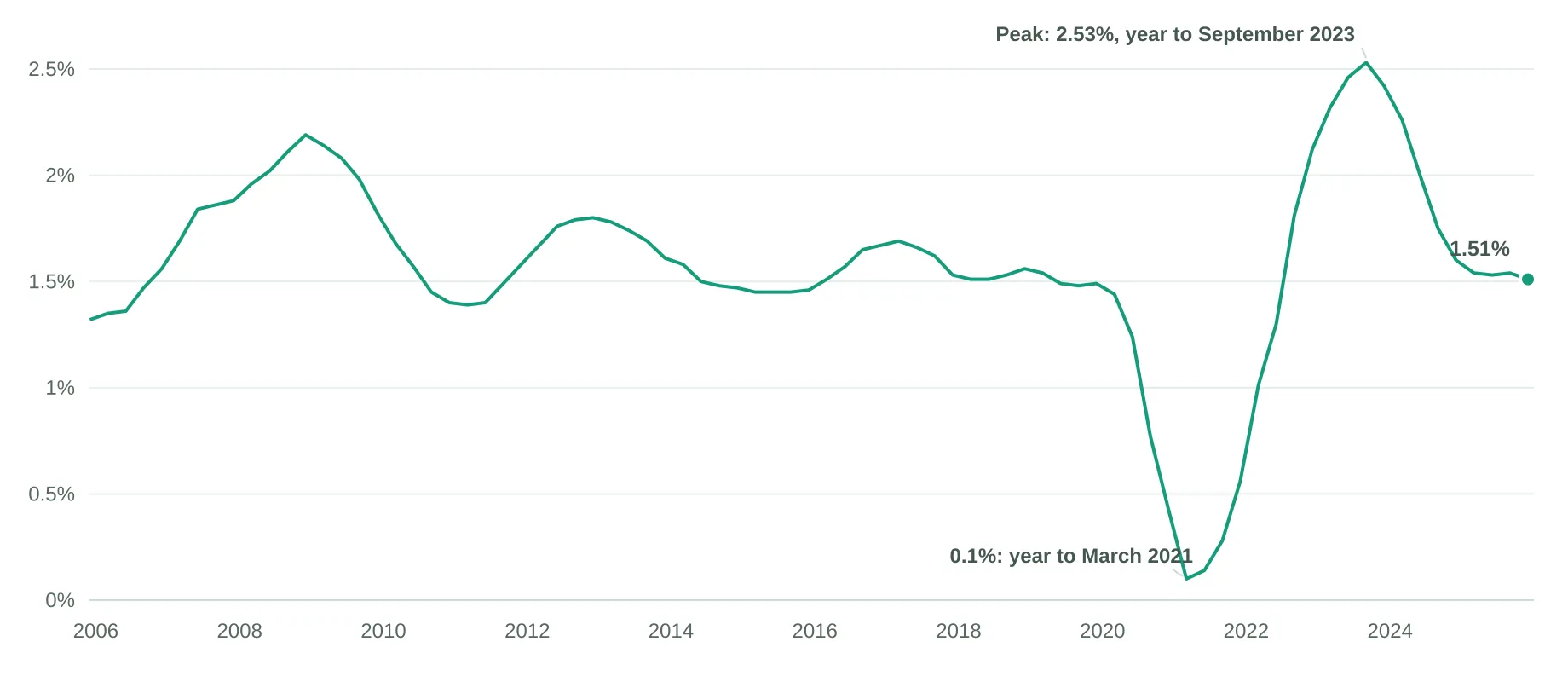
The population grew by 412,500 people, or 1.5 per cent, in the year ending 31 December 20251. That pace was within the range recorded before the pandemic. From late 2005 to late 2019, the annual population growth ranged from 1.32 to 2.19 per cent.
Growth fell to 0.1 per cent in the year to March 20211, when pandemic travel restrictions applied. It then rebounded to a peak of 2.5 per cent in the year to September 2023, the highest rate recorded over the two-decade period. Australia added 661,817 residents, and net overseas migration accounted for 555,798 of them. By the year to December 2025, the rate had eased to 1.5 per cent, roughly where it sat before the pandemic.
Annual population growth rate in Australia, 2005 to 2025
Section 03 · The driverS
What drives Australia's population growth?
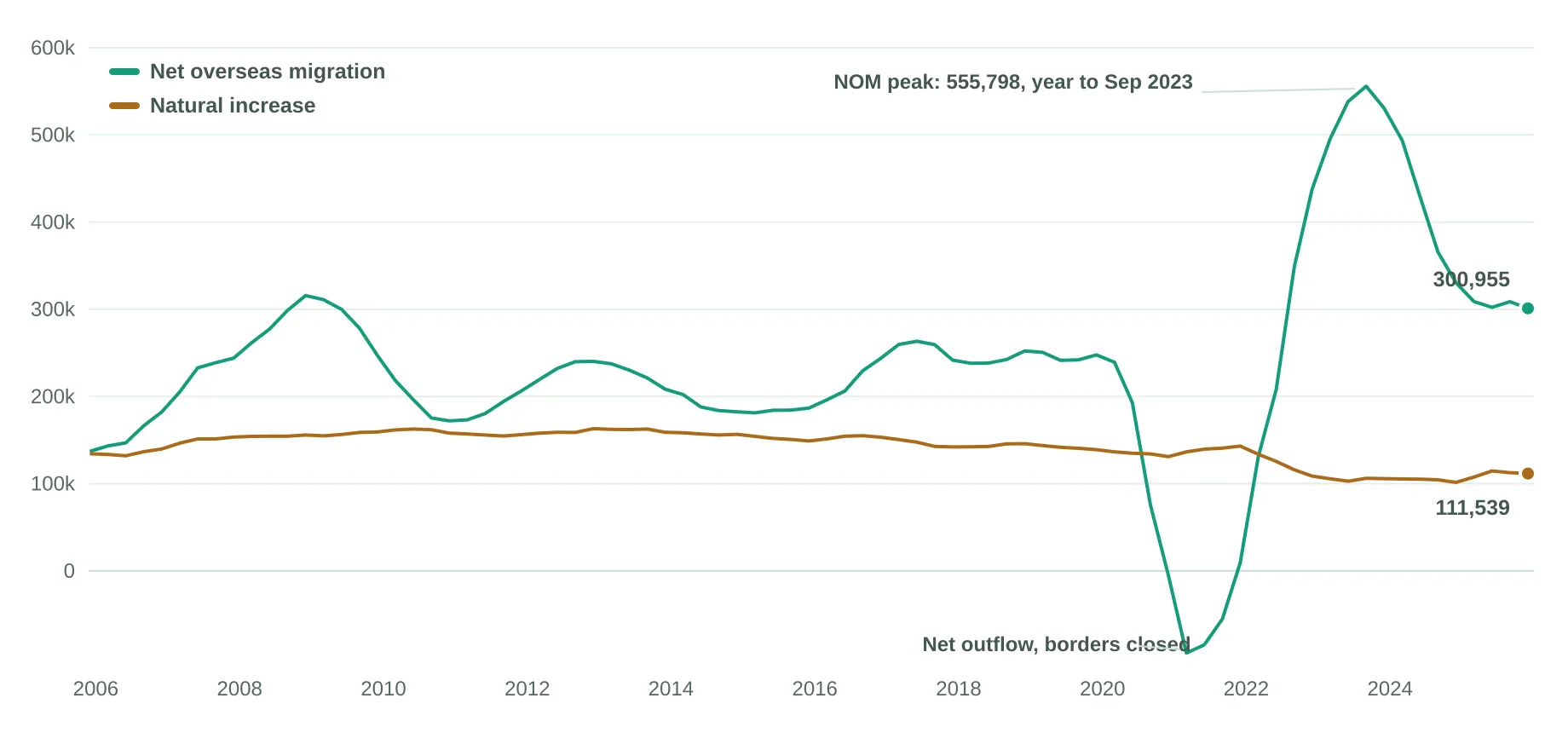
Australia's population growth comes from two main sources: net overseas migration and natural increase. Net overseas migration, the difference between migration arrivals and departures, added 301,000 people in the year to December 20251. Natural increase, the difference between births and deaths, added 111,500.
Of the total population increase of 412,500 people, about 73 per cent came from net overseas migration and 27 per cent from natural increase1. These shares are derived by dividing 301,000 and 111,500 by the total increase.
The two sources of population growth moved in opposite directions compared with the previous year. Net overseas migration fell by 29,500 people, or 8.9 per cent1, continuing its decline from the 2023 peak. Meanwhile, natural increase rose by 10,100, or 10.0 per cent.
Over the year, 563,500 people immigrated to Australia and 262,600 emigrated1. Natural increase comprised about 299,900 births and 188,400 deaths, based on the four-quarter sums of the quarterly series. The ABS rounds the births figure to 300,000.
How those two lines are moving is covered in births, deaths and natural increase in Australia.
Migration has been the larger component in every year of the past two decades except the border-closure years, when it briefly turned negative. In the year to March 2021, net overseas migration was minus 94,326, meaning more people left Australia than arrived1.
Natural increase and net overseas migration in Australia, 2005 to 2025
Section 04 · State by state
Which Australian state or territory is growing the fastest?
Western Australia was Australia's fastest-growing state or territory in the year to December 2025, with its population increasing by 2.2 per cent1.
Every state and territory recorded positive growth1. Tasmania recorded the slowest growth at 0.5 per cent, while New South Wales remained the most populous state, with 8.64 million residents, followed by Victoria at 7.12 million and Queensland at 5.71 million.
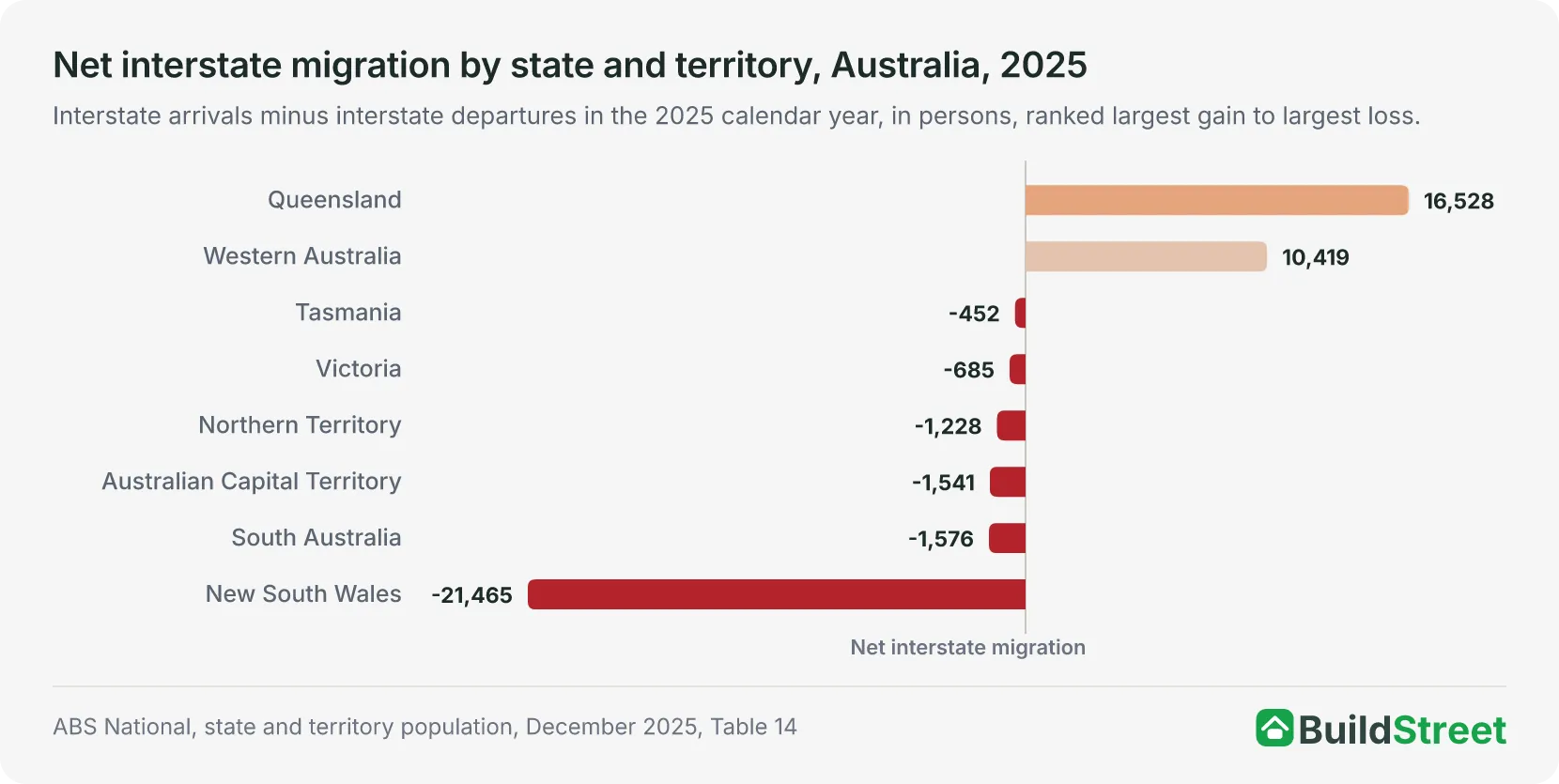
Net overseas migration was the largest contributor to growth in every state and territory1. Interstate migration also contributed to state population changes. Queensland recorded a net interstate migration gain of 16,528 residents, while Western Australia gained 10,419 and New South Wales lost 21,465.
| Australian population and annual growth by state and territory, December 2025 | |||
|---|---|---|---|
| State or territory | Population at 31 Dec 2025 | Change over year | Growth rate |
| New South Wales | 8,641,100 | +104,600 | 1.2% |
| Victoria | 7,121,900 | +117,300 | 1.7% |
| Queensland | 5,712,100 | +92,200 | 1.6% |
| Western Australia | 3,076,500 | +65,500 | 2.2% |
| South Australia | 1,910,600 | +19,700 | 1.0% |
| Tasmania | 579,100 | +2,900 | 0.5% |
| Australian Capital Territory | 487,200 | +6,000 | 1.3% |
| Northern Territory | 267,500 | +4,200 | 1.6% |
| Australia | 27,801,000 | +412,500 | 1.5% |
| Populations rounded to the nearest hundred as published. The Australia total includes Jervis Bay Territory, Christmas Island, the Cocos (Keeling) Islands and Norfolk Island, so state and territory rows do not sum exactly to the national total. | |||
Source · ABS, National, state and territory population, December 2025.
Section 05 · The long run
How has Australia’s population changed since 1981?
The population has grown by 12.9 million people since mid-1981, from 14,923,300 at 30 June 1981 to 27,801,023 at 31 December 2025. This is a derived figure calculated from the difference between the first and last observations in the ABS quarterly population series.1
Quarterly population growth was interrupted in late 2020. Australia’s estimated resident population fell by 15,900 people in the September quarter of 2020 and by a further 2,600 people in the December quarter. These were the only quarter-to-quarter declines recorded between June 1981 and December 2025. Growth resumed with an increase of 22,300 people in the March quarter of 2021. Australia’s population did not record a year-on-year decline at any point between June 1981 and December 20251.
Australia's estimated resident population, 1981 to 2025
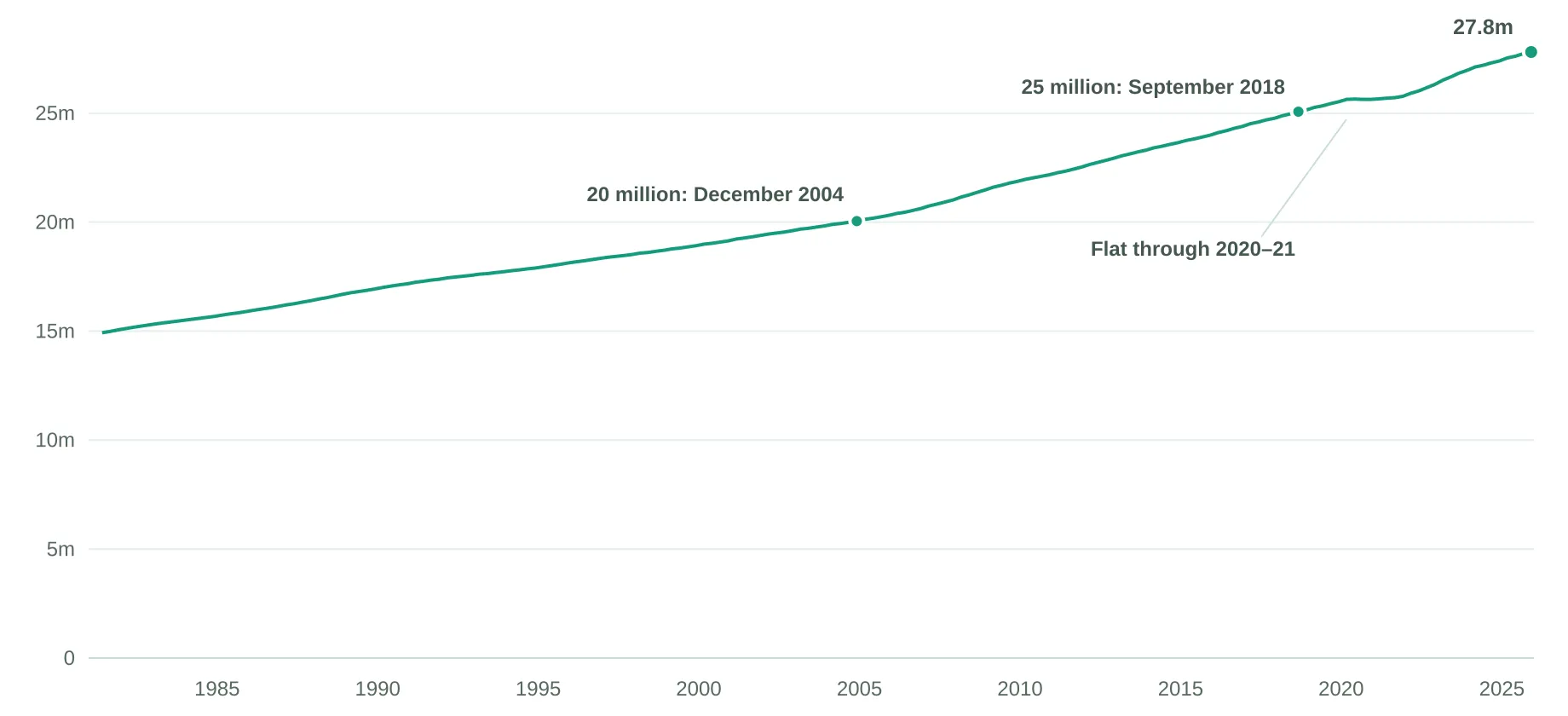
The increase from 26 million to 27 million took seven quarters, from the June quarter of 2022 to the March quarter of 2024. This was the fastest one-million increase in the quarterly series beginning in 1981. By comparison, the increase from 25 million to 26 million took 15 quarters1 and spanned the period of pandemic border restrictions.
| Australia’s population milestones from 20 million to 27 million | ||
|---|---|---|
| Milestone | First quarter above it | Time since previous million |
| 20 million | December quarter 2004 | – |
| 21 million | December quarter 2007 | 12 quarters |
| 22 million | June quarter 2010 | 10 quarters |
| 23 million | March quarter 2013 | 11 quarters |
| 24 million | March quarter 2016 | 12 quarters |
| 25 million | September quarter 2018 | 10 quarters |
| 26 million | June quarter 2022 | 15 quarters |
| 27 million | March quarter 2024 | 7 quarters |
| Derived figures: the first quarter in which the quarterly ERP series exceeds each threshold, and the number of quarters between crossings. | ||
Source · ABS, National, state and territory population, December 2025, Table 1.
Section 06 · Looking ahead
What is Australia’s projected population by 2071?
Australia’s population is projected to range between 34.3 million and 45.9 million by 2071, depending on the assumptions used.2 Over the nearer term, the Centre for Population projects 31.5 million people by 2035–363. This follows an estimated population of 27.8 million at 31 December 2025.
The Centre projects population growth to slow to 1.3 per cent in 2025–26 as net overseas migration and fertility rates decline3. The 2071 figures are Australian Bureau of Statistics projections rather than forecasts. They represent different scenarios based on assumptions about migration, fertility and mortality and may change as those assumptions are updated.
When the country is likely to reach the next round number is covered in when will Australia reach 30 million.
Section 07
Australia's population: quick answers
What is Australia’s latest estimated population?
Australia's estimated resident population was 27,801,023 at 31 December 2025, the most recent figure in the ABS quarterly series, released 18 June 2026.1 The next update, covering the March quarter 2026, is due on 17 September 2026.
How fast is Australia's population growing?
Australia's population grew by 412,500 people, or 1.5 per cent, in the year ending 31 December 2025.1 This was below the recent peak of 2.5 per cent in the year to September 2023.
Is Australia's population growth mostly migration?
Yes. In the year to December 2025, net overseas migration accounted for about 73 per cent of Australia's population growth, adding 301,000 people.1 Natural increase, births minus deaths, added the other 111,500 people, about 27 per cent.
Which Australian state is growing fastest?
Western Australia recorded the fastest growth, at 2.2 per cent in the year ending 31 December 2025.1 Tasmania reported the slowest growth, at 0.5 per cent. New South Wales remains the largest state, with 8.64 million of Australia's 27.8 million people.
When did Australia's population pass 27 million?
Australia's population passed 27 million in the March quarter of 2024. The estimate rose from 26,956,700 at December 2023 to 27,113,500 at March 2024. The increase from 26 million in the June quarter of 2022 to 27 million took about 21 months, the fastest one-million increase in the series beginning in 1981.
When will Australia reach 30 million people?
The Centre for Population's 2025 Population Statement projects that Australia will pass 30 million people during 2031–32. The ABS 2022-based projections put the milestone between 2031 and 2036 depending on the series. These milestone dates are derived from the projection series rather than published as standalone forecasts.
Section 08
