
Published
 Stamp duty revenue is forecast to fall and land tax revenue to riseWhat state and territory budgets expect from transfer duty and land tax revenue to 2029-30, and where the switch from one to the other is already under way.
 How much is stamp duty in each state and territory?The transfer duty scales, typical amounts and concessions that apply to a home purchase in every state and territory.
Section 01 · Two taxes
How do stamp duty and an annual land tax differ?
Stamp duty is a one-off tax paid when buying a property, while an annual land tax is charged every year of ownership on the value of the land alone. In New South Wales, transfer duty on a $1,000,000 home is $39,187 for a contract signed in 2026-27, before any first home buyer exemption or concession1. Transfer duty is calculated on whichever is higher: the purchase price or the property's market value.
The NSW general duty rates increase with the property's value, from $1.25 for every $100 of the first $18,000 to $5.50 for every $100 over $1,290,0001. Revenue NSW adjusts the price thresholds every year in line with changes in the Consumer Price Index, and the rates that apply depend on when the contract is signed.
In this article, an annual land tax means a yearly tax based on land value, such as the NSW First Home Buyer Choice property tax and Australian Capital Territory (ACT) general rates, not the NSW land tax on investment property.
The NSW property tax is calculated on the land value only, excluding the house and any improvements, and is payable for as long as the buyer owns the property2. ACT general rates are also charged every year on land, combining a fixed charge with an amount based on the average land value over the previous five years, excluding buildings and improvements3.
| NSW transfer duty scale, 2026-27 | |
|---|---|
| Dutiable value | Duty payable |
| $0 to $18,000 | $1.25 for every $100 (minimum $20) |
| $18,001 to $38,000 | $225 plus $1.50 for every $100 over $18,000 |
| $38,001 to $103,000 | $525 plus $1.75 for every $100 over $38,000 |
| $103,001 to $387,000 | $1,662 plus $3.50 for every $100 over $103,000 |
| $387,001 to $1,290,000 | $11,602 plus $4.50 for every $100 over $387,0001 |
| Over $1,290,000 | $52,237 plus $5.50 for every $100 over $1,290,000 |
Source · Revenue NSW, How to calculate transfer duty
Earlier duty scales are set out in how stamp duty has changed in Australia.
Section 02 · NSW example
The NSW example: First Home Buyer Choice property tax vs stamp duty
First Home Buyer Choice allowed eligible first home buyers in New South Wales to pay an annual property tax instead of transfer duty from 16 January 2023 until the scheme closed on 30 June 20234.
The option covered a new or existing home valued at $1,500,000 or less, or vacant land valued at $800,000 or less for building a first home4. Buyers who had signed a contract between 11 November 2022 and 15 January 2023 could also opt in and claim a refund of the duty already paid, until 30 June 2023.
For 2022-23 and 2023-24, the tax was $400 plus 0.3 per cent of land value for an owner-occupier and $1,500 plus 1.1 per cent for a property that was not the owner's main residence2. Since 2024-25, Revenue NSW has adjusted the fixed charge and land value rate each year using changes in economic growth per person and land values5. Revenue NSW states that this keeps the average payment rising in line with average incomes.
For 2026-27, the owner-occupied rate is $464.83 plus 0.318 per cent of land value5.
An owner's tax on the same land cannot rise by more than 4 per cent from one year to the next if the property's use does not change, even if its land value rises faster5. Owners who opted in still pay the tax each year, and the first payment for 2026-27 was due on 31 August 20266.
| NSW First Home Buyer Choice property tax rates, 2022-23 to 2026-27 | ||||
|---|---|---|---|---|
| Year | Owner-occupied fixed | Owner-occupied land value rate | Not owner-occupied fixed | Not owner-occupied land value rate |
| 2022-23 | $400.00 | 0.300% | $1,500.00 | 1.100% |
| 2023-24 | $400.00 | 0.300% | $1,500.00 | 1.100% |
| 2024-25 | $437.85 | 0.339% | $1,641.95 | 1.244% |
| 2025-26 | $451.85 | 0.323% | $1,694.45 | 1.187% |
| 2026-27 | $464.835 | 0.318%5 | $1,743.12 | 1.170% |
Source · Revenue NSW, How property tax is calculated
An eligible first home buyer in New South Wales who signs a contract in 2026-27 instead pays no transfer duty on a new or existing home valued at $800,000 or less, and a reduced rate on one valued at less than $1,000,000, under the First Home Buyers Assistance Scheme1.
Section 03 · Break-even years
How many years until stamp duty and an annual land tax cost the same in NSW?
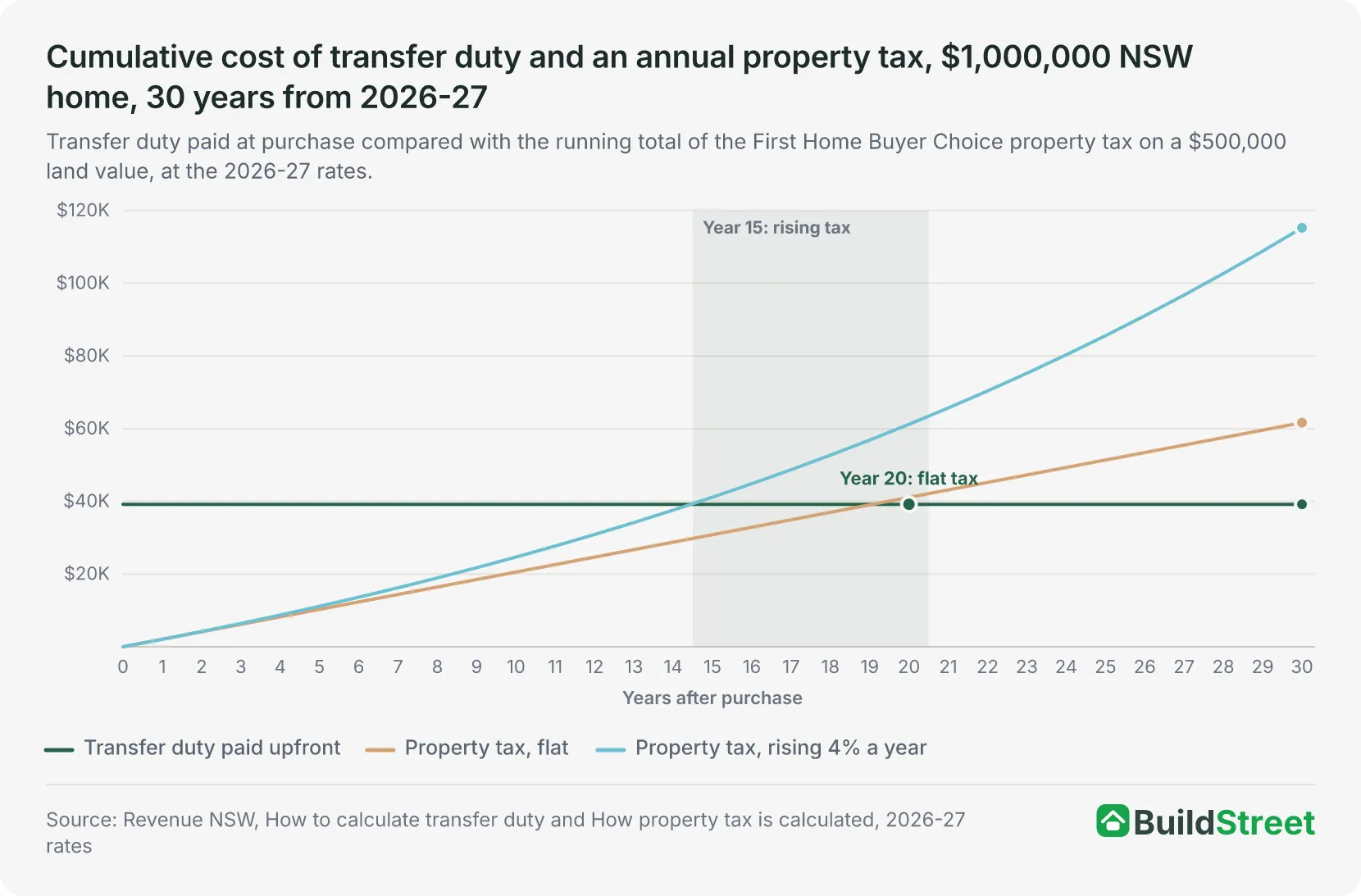
At the 2026-27 NSW rates, the annual property tax on a $1,000,000 home with a $500,000 land value would add up to the $39,187 transfer duty after 20 years if the tax remained unchanged, and after 15 years if it increased by 4 per cent every year.
This is an example based on the 2026-27 transfer duty rates1 and the 2026-27 owner-occupied property tax rate, which gives $2,054.83 in the first year5. The 4 per cent increase is the maximum allowed each year if the property's use does not change. This makes 15 years the earliest the annual tax could equal the duty under these assumptions.
The calculation is based on four assumptions, rather than forecasts:
- The land value is assumed to be half the purchase price, because no official average land share for NSW homes was found.
- If the tax remains unchanged, the land value and the tax rates stay where they are in 2026-27.
- If the tax increases, it rises by 4 per cent every year, the cap on yearly increases.
- Transfer duty is calculated at the general rate, without first home buyer exemption or concession, and the annual property tax uses the owner-occupied rate.
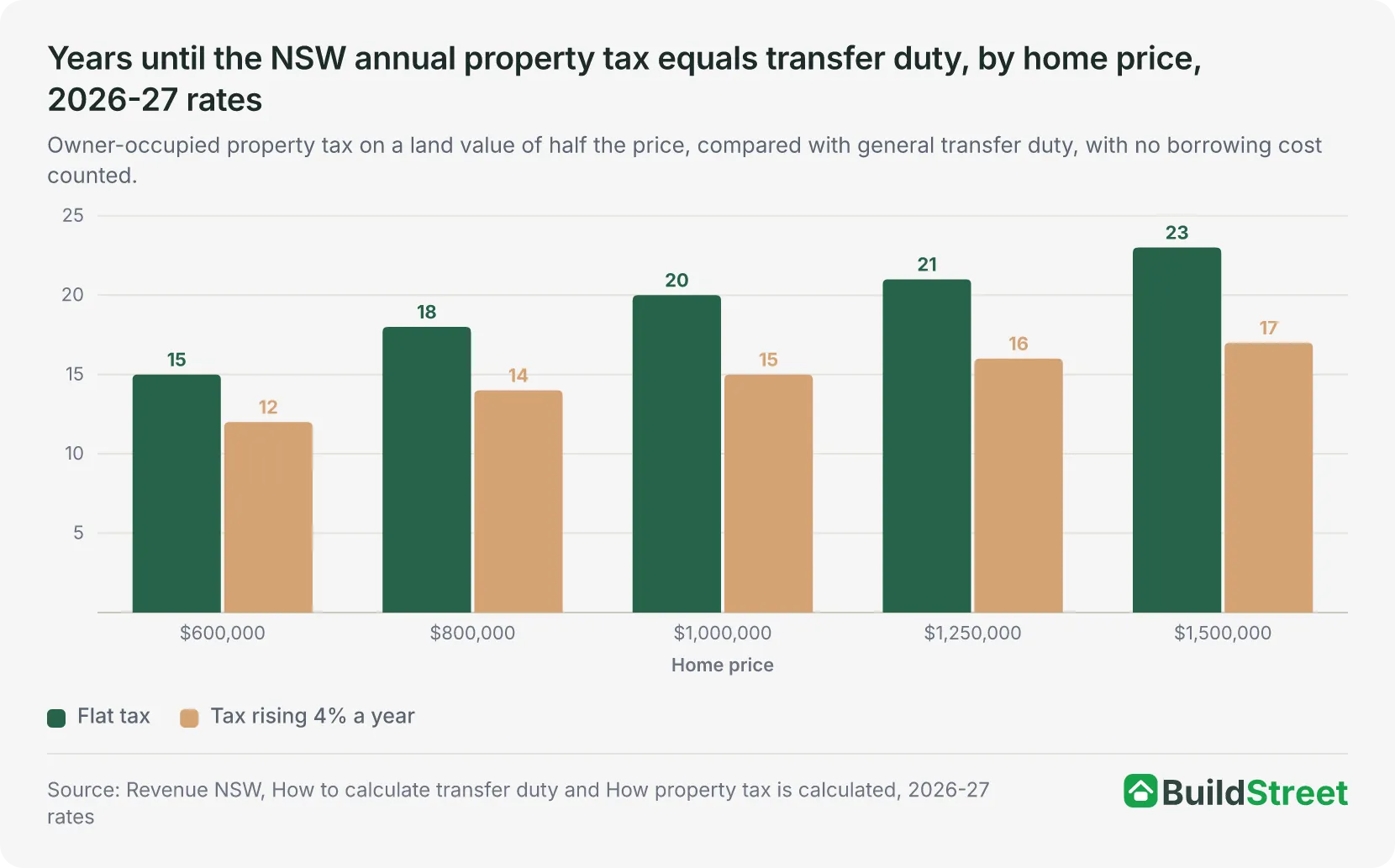
The break-even point occurs later for more expensive homes in these examples, because the duty payable increases with the purchase price, while the property tax is largely based on land value.
With half the price in land value, the annual tax would take 15 years to equal the duty on a $600,000 home and 23 years on a $1,500,000 home, the maximum property value allowed under First Home Buyer Choice5. With the tax rising 4 per cent a year, the same homes would take 12 years and 17 years respectively.
Including borrowing costs changes the comparison. At an interest rate of 6.2 per cent, the rising annual tax would take 26 years rather than 15 years to equal the cost of duty on the $1,000,000 home.
The rate is the Reserve Bank of Australia's average on new owner-occupier variable-rate home loans in August 20267. The calculation accounts for the cost of borrowing the upfront duty and assumes the interest rate stays at 6.2 per cent throughout. This is an illustrative assumption, not a forecast.
A tax that remains unchanged would never equal the duty when borrowing costs are included under this model, because the interest on $39,187 at 6.2 per cent, about $2,430 a year, is more than the $2,054.83 tax.
| Years until the NSW annual property tax equals transfer duty, by home price, 2026-27 rates | |||||||
|---|---|---|---|---|---|---|---|
| Home price | Transfer duty | Land value (50%) | Tax in year 1 | Flat tax | Tax rising 4% a year | Flat tax, 6.2% borrowing cost | Rising tax, 6.2% borrowing cost |
| $600,000 | $21,187 | $300,000 | $1,418.83 | 15 | 12 | 44 | 20 |
| $800,000 | $30,187 | $400,000 | $1,736.83 | 18 | 14 | Never | 24 |
| $1,000,000 | $39,187 | $500,000 | $2,054.83 | 20 | 15 | Never | 26 |
| $1,250,000 | $50,437 | $625,000 | $2,452.33 | 21 | 16 | Never | 29 |
| $1,500,000 | $63,787 | $750,000 | $2,849.83 | 23 | 17 | Never | 33 |
Source · Revenue NSW, How to calculate transfer duty and How property tax is calculated (2026-27 rates); Reserve Bank of Australia, table F6
The proportion of a home's price represented by land value also affects the result. On the $1,000,000 home, a land value of 30 per cent of the price puts the flat-tax break-even at 28 years, compared with 15 years at 70 per cent. With the tax rising 4 per cent a year, the same two cases take 19 years and 12 years respectively.
Section 04 · ACT example
The ACT example: lower stamp duty and higher annual rates
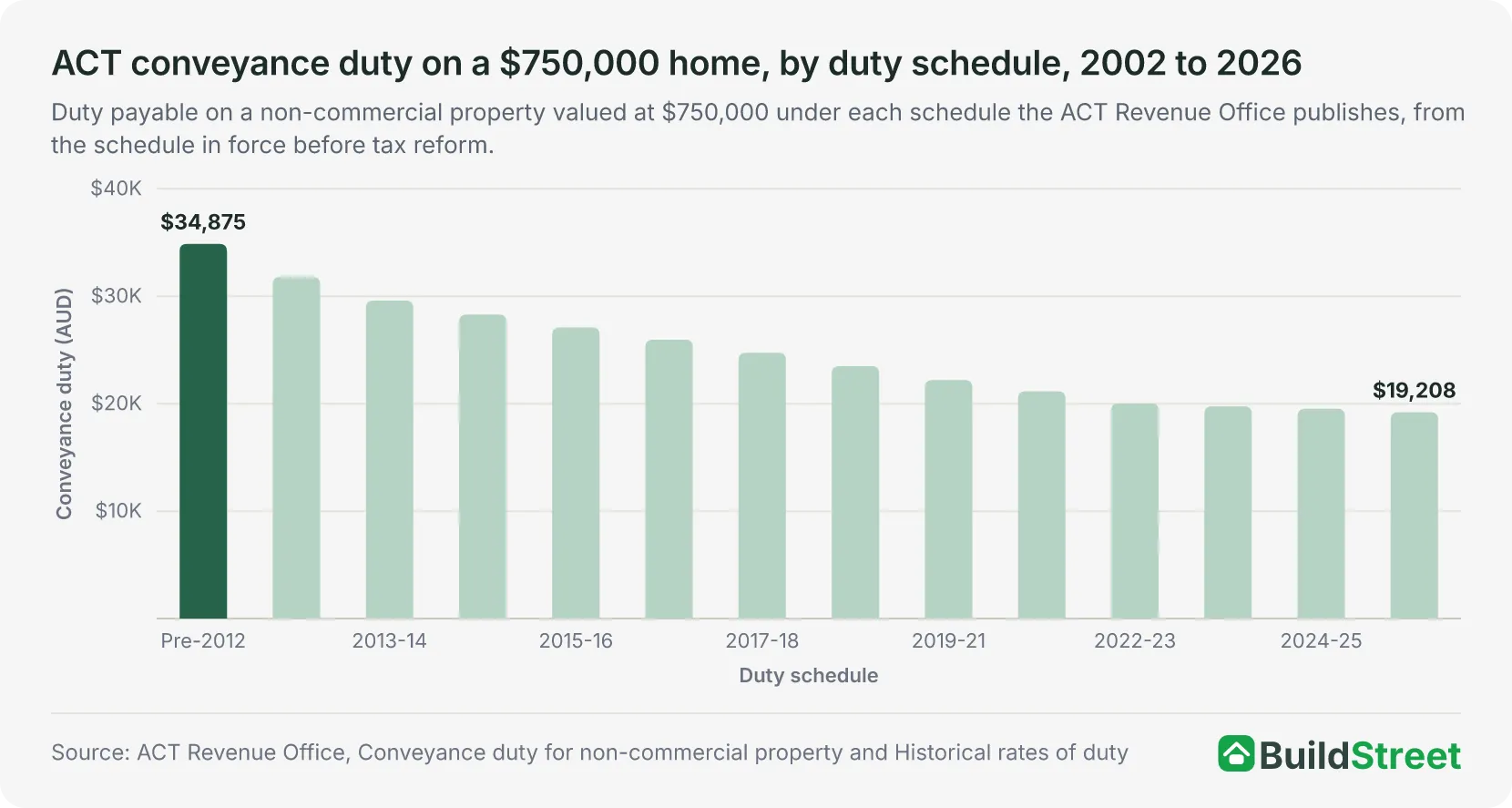
The ACT has reduced conveyance duty on a $750,000 home from $34,875 under the rates that applied before 5 June 2012 to $19,208 for an eligible owner-occupier under the rates introduced from 1 July 2025. This is a reduction of $15,667, or 45 per cent89. A buyer who is not an eligible owner-occupier pays $22,200 on the same home under the rates introduced from 1 July 20258.
The ACT Government began a 20-year program in 2012 to gradually remove stamp duty on property purchases and replace the lost revenue through annual general rates10. The ACT Revenue Office states that the change is not intended to increase the total amount of tax collected from ACT residents.
The program followed the ACT Taxation Review of May 2012, which recommended removing stamp duty over a period of 10 to 20 years11. The review estimated that for every dollar collected in stamp duty, around 38 cents in economic value was lost.
For 2026-27, ACT general rates on a residential block include a fixed annual charge of $884 plus an additional charge based on land value, with rates ranging from 0.2842 per cent to 0.6018 per cent across different value bands3. For a block with an average land value of $450,000, the annual general rates are $2,543.45 before additional charges.
The 2026-27 Police, Fire and Emergency Services Levy of $458 and Safer Families Levy of $70 are charged separately12.
The ACT Government projected that average residential general rates would increase by 7 per cent a year between 2017-18 and 2021-22, the second stage of the reform13. For 2026-27, the average residential general rates bill, including levies, is expected to increase by 5 per cent12.
| ACT general rates on a residential block, by average unimproved value, 2026-27 | |||
|---|---|---|---|
| Average unimproved value | Fixed charge | Valuation charge | General rates |
| $300,000 | $884.00 | $977.70 | $1,861.70 |
| $450,000 | $884.003 | $1,659.45 | $2,543.45 |
| $600,000 | $884.00 | $2,401.50 | $3,285.50 |
| $750,000 | $884.00 | $3,155.85 | $4,039.85 |
| $1,000,000 | $884.00 | $4,423.60 | $5,307.60 |
Source · ACT Revenue Office, Calculating rates
From 1 July 2026, the ACT removed the property price limit and income requirement from its Home Buyer Concession Scheme14. Under the new rules, a buyer who has not owned property in the previous five years and lives in the home for at least 12 months may qualify for a full stamp duty concession. A buyer who receives the full concession pays no duty at purchase and pays general rates every year.
Section 05 · Who gains
Which costs less over time: stamp duty or an annual land tax?
In the illustrative NSW calculation, which excludes borrowing costs, the owner of a $1,000,000 home with a $500,000 land value pays less in annual property tax than the $39,187 duty if the tax stays unchanged and they sell within 19 years, and more after that5. In the NSW Government's example from 2022, a first home buyer of a $1,000,000 house who sold after 10 years would pay property tax worth $19,881 in today's dollars at the time of the calculation, compared with $40,090 in upfront transfer duty at the rates then in force2.
For a $799,000 apartment sold after seven years, the same example estimated the tax at $7,221 in comparable terms, compared with $30,883 in duty2.
In the illustrative calculation, the lower the proportion of a home's price made up by land value, the longer it takes for the annual property tax to equal the upfront duty. This is because the tax is charged on land value while duty is charged on the property's full value.
For 2026-27, the NSW property tax on properties in the former scheme that are not owner-occupied is $1,743.12 plus 1.170 per cent of land value, or $7,593.12 on a $500,000 land value, compared with $2,054.83 for an owner-occupier5. At that rate, the tax equals the $39,187 duty on a $1,000,000 home after six years with a flat tax, or five years if it increased by 4 per cent a year.
An ACT owner who bought before 2012 paid conveyance duty under the earlier rates and continues to pay annual general rates, which have increased as part of the ACT Government's shift away from stamp duty13. The ACT Taxation Review recommended that the move to rates take into account conveyance duty paid by property owners before the changes11.
A first home buyer in New South Wales signing a contract in 2026-27 for a home valued at $800,000 or less has no duty to compare with an annual tax, because the First Home Buyers Assistance Scheme exempts that purchase1.
Section 06 · Limits
What is excluded from the stamp duty and annual land tax comparison?
The comparison does not account for changes in future land values, which affect the annual tax but are unknown when a home is bought. Under First Home Buyer Choice, the tax is based on the land value at the beginning of the previous financial year5. In the ACT, rates use a five-year average of land values, which spreads the effect of a sudden increase over several years3.
Future changes to government tax policies are also excluded. NSW property tax rates are adjusted each year using a formula set by law5. The ACT Government sets its rates in each budget, and for 2026-27 it reduced the fixed charge and adjusted the rates applied to different land values14.
The amount of money needed upfront when buying a home is not included in the break-even figures either. Stamp duty is generally an additional upfront purchase cost, and the ACT Revenue Office describes conveyance duty as a barrier for first home buyers10 and a factor that discourages existing owners from moving.
The break-even figures also exclude NSW council rates, conveyancing fees and lenders' mortgage insurance. They cover New South Wales only.
Land tax on investment property is set out in land tax rates, thresholds and exemptions in each state and territory.
Section 07
Frequently asked questions
Is stamp duty or the NSW property tax cheaper over time?
Stamp duty is cheaper than the NSW property tax only for an owner who keeps the home past the break-even year, which in an illustrative calculation at 2026-27 rates is 15 to 20 years for a $1,000,000 home with a $500,000 land value. When borrowing costs are included at 6.2 per cent, the break-even point extends to 26 years if the tax rises by 4 per cent a year, while an unchanged annual tax never reaches the equivalent cost of duty under this model.
Can first home buyers in NSW still choose property tax instead of stamp duty?
First home buyers in NSW can no longer choose the property tax, because First Home Buyer Choice closed on 30 June 2023. An eligible first home buyer signing a contract in 2026-27 pays no transfer duty on a home valued at $800,000 or less and reduced duty on one valued at less than $1,000,000, under the First Home Buyers Assistance Scheme.
How much is the NSW property tax in 2026-27?
The NSW property tax for an owner-occupier in 2026-27 is $464.83 plus 0.318 per cent of the land value, and $1,743.12 plus 1.170 per cent for land that is not owner-occupied. An owner's tax on the same land cannot rise by more than 4 per cent from one year to the next if the property's use does not change.
Does the ACT still charge stamp duty?
The ACT still charges conveyance duty at reduced rates, with an eligible owner-occupier paying $19,208 on a $750,000 home under the rates introduced from 1 July 2025, compared with $34,875 before tax reform began in 2012. From 1 July 2026, buyers who have not owned property in the previous five years and live in the home for at least 12 months may qualify for a full duty concession, with no price cap or income threshold.
References
- Revenue NSW — Calculate Transfer Duty · revenue.nsw.gov.au ↑ b c d e f
- NSW Government, First Home Buyer Choice fact sheet · nsw.gov.au ↑ b c d
- ACT Revenue Office, Calculating rates · revenue.act.gov.au ↑ b c d
- Revenue NSW, First Home Buyer Choice · revenue.nsw.gov.au ↑ b
- Revenue NSW, How property tax is calculated · revenue.nsw.gov.au ↑ b c d e f g h i j k
- Revenue NSW, Pay your property tax · revenue.nsw.gov.au ↑
- RBA Statistical Table F6 — Housing Lending Rates · Reserve Bank of Australia ↑
- ACT Revenue Office, Conveyance duty for non-commercial property · revenue.act.gov.au ↑ b
- ACT Revenue Office, Historical rates of duty · revenue.act.gov.au ↑
- ACT Revenue Office, Tax reform · revenue.act.gov.au ↑ b
- ACT Treasury, ACT Taxation Review, May 2012 · treasury.act.gov.au ↑ b
- ACT Treasury, Cost of Living Statement, 2026-27 · treasury.act.gov.au ↑ b
- ACT Treasury, Budget 2016-17 fact sheet: Taxation reform (general rates) · treasury.act.gov.au ↑ b
- ACT Revenue Office, ACT Budget 2026-27 updates · revenue.act.gov.au ↑ b
