
Published 30 Sept 2026
 What does it cost to build a house in Australia?Average build costs by state and dwelling type from the ABS building activity data, and what the figures include and leave out, from land to site costs.
 Why the advertised base price isn't the build priceWhat a builder's "from" price covers, and the site costs, upgrades and fees that sit outside it before a new home is finished.
Section 01 · The basics
What is stamp duty and how is the duty calculated?
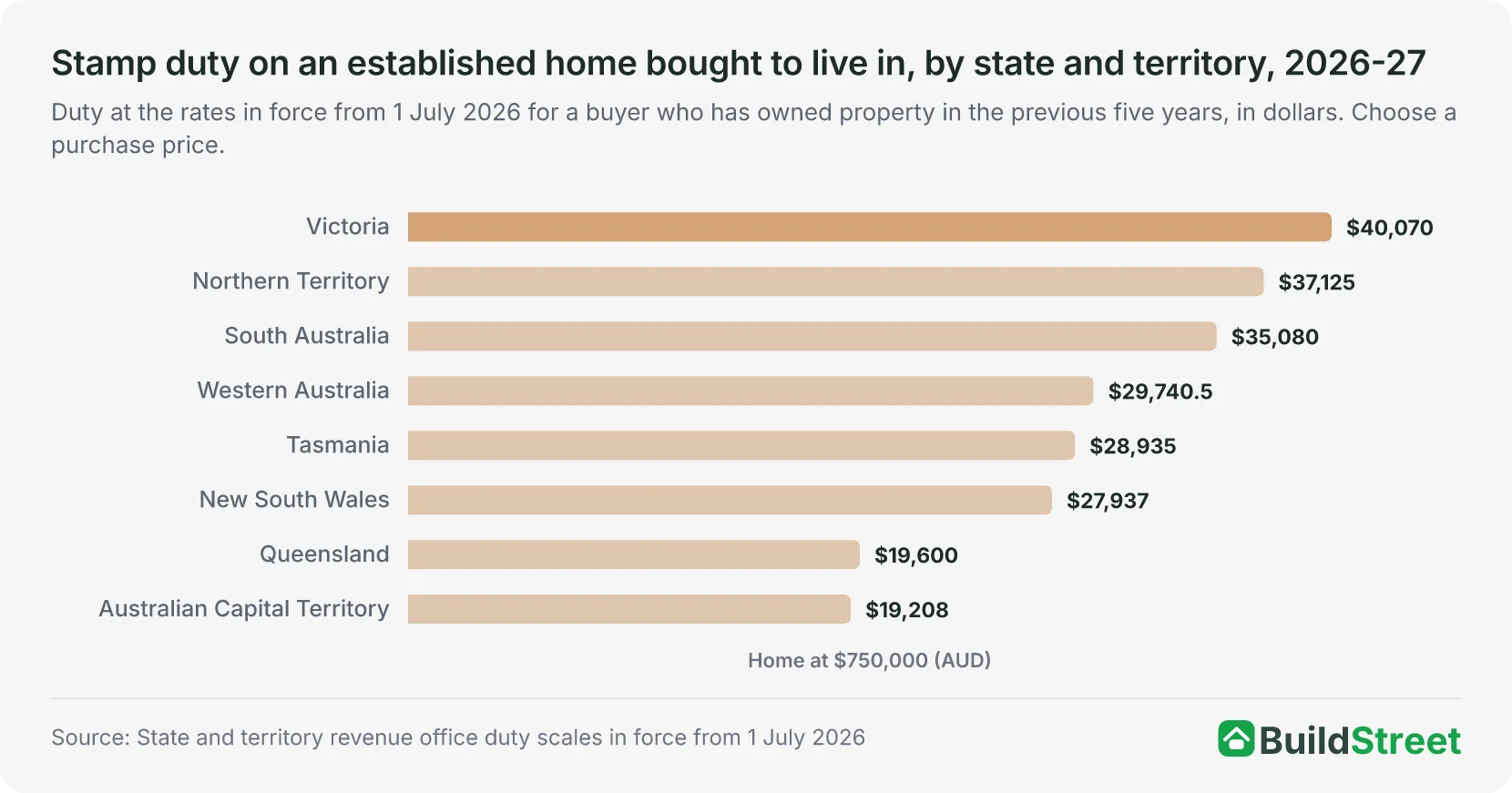
Stamp duty is a tax each Australian state and territory charges on the purchase of land, including a home. The amount generally rises with the property price, based on a scale set by each jurisdiction1. Under the rates in force from 1 July 2026, the duty on a $750,000 established home bought to live in is $27,937 in New South Wales, for a buyer who has owned property in the previous five years.
The eight revenue offices give the same tax different names:
- transfer duty in New South Wales, Queensland and Western Australia
- land transfer duty in Victoria
- property transfer duty in Tasmania
- stamp duty in South Australia
- conveyance duty in the Australian Capital Territory and the Northern Territory.
Most jurisdictions calculate duty using price brackets. Each bracket charges a fixed base amount up to a set threshold, plus a rate for every $100, or part of $100, above that threshold2. Victoria sets some rates as a percentage of the property value rather than as an amount per $1003.
Worked example · $750,000 home in New South Wales
This is an illustrative calculation based on the New South Wales general rates for 2026-27. A $750,000 price falls in the bracket from $387,000 to $1,290,000, which charges $11,602 plus $4.50 for every $100 above $387,0001. The $363,000 above the threshold is 3,630 lots of $100. At $4.50 for each $100, this adds $16,335, bringing the total duty to $27,937.
Three jurisdictions charge one rate on the whole value within part of their scales. Victoria charges 5.5 per cent of the whole value from $960,000 to $2,000,0003. The ACT charges $4.54 for every $100 of the whole value above $1,455,0004. The Northern Territory charges 4.95 per cent of the whole value from $525,000 to less than $3,000,000, and uses a formula below $525,0005.
Three jurisdictions charge less when the buyer will live in the home. Victoria's principal place of residence rates apply up to $550,0006, Queensland's home concession rates apply at every price7, and the ACT's owner-occupier rates are lower than its other rates up to $1,455,0004. For transactions from 1 August 2026, Queensland's home concessions apply only to Australian citizens, permanent residents and specified foreign retirees8.
Section 02 · The scales
What are the stamp duty rates in each state and territory?
Among the six states, the highest rate applied to the top property-value brackets ranges from $4.50 for every $100 in Tasmania, for values above $725,000, to $7.00 for every $100 in New South Wales, where the higher residential rate applies above $3,870,00091.
New South Wales adjusts its thresholds each year in line with the consumer price index. Its 2026-27 brackets start at $18,000, $38,000, $103,000, $387,000 and $1,290,0001. The ACT set its 2026-27 rates from 1 July 2026, with residential rates unchanged from 2025-264.
Victoria's general rates apply to contracts entered into on or after 1 July 20213. Western Australia's general rate has applied to transactions from 2 July 201410, and Tasmania's scale to transfers from 21 October 20139. South Australia uses a nine-bracket scale for all buyers11, while the Northern Territory's rates are set under its Stamp Duty Act 19785.
| Dutiable value | Transfer duty, general rates for 2026-27 |
|---|---|
| Up to $18,000 | $1.25 for each $100 or part (minimum $20) |
| $18,000 to $38,000 | $225 plus $1.50 for each $100 or part over $18,000 |
| $38,000 to $103,000 | $525 plus $1.75 for each $100 or part over $38,000 |
| $103,000 to $387,000 | $1,662 plus $3.50 for each $100 or part over $103,000 |
| $387,000 to $1,290,000 | $11,602 plus $4.50 for each $100 or part over $387,000 |
| More than $1,290,000 | $52,237 plus $5.50 for each $100 or part over $1,290,000 |
| More than $3,870,000 (residential land) | $194,137 plus $7.00 for each $100 or part over $3,870,000 |
Source · Revenue NSW, How to calculate transfer duty (last updated 19 August 2026).
Section 03 · Worked examples
How much stamp duty is payable at $500,000, $750,000, $1 million and $1.5 million?
Stamp duty on a $1 million established home bought to live in ranges from $30,850 in Queensland to $55,000 in Victoria under the rates in force from 1 July 2026, for a buyer who has owned property in the previous five years73. These are illustrative calculations based on each state and territory's published rates.
Investors pay more than home buyers at all four prices in Queensland, at $500,000, $750,000 and $1 million in the ACT, and at $500,000 in Victoria24. At these four prices, the duty in the other five jurisdictions is the same for both.
| State or territory | $500,000 | $750,000 | $1 million | $1.5 million |
|---|---|---|---|---|
| New South Wales | $16,687 | $27,937 | $39,187 | $63,787 |
| Victoria | $21,970 | $40,070 | $55,000 | $82,500 |
| Queensland | $8,750 | $19,600 | $30,850 | $59,600 |
| Western Australia | $17,765 | $29,740.50 | $42,615.50 | $68,365.50 |
| South Australia | $21,330 | $35,080 | $48,830 | $76,330 |
| Tasmania | $18,247.50 | $28,935 | $40,185 | $62,685 |
| Australian Capital Territory | $8,408 | $19,208 | $33,958 | $68,100 |
| Northern Territory | $23,928.60 | $37,125 | $49,500 | $74,250 |
Source · state and territory revenue office duty scales in force from 1 July 2026.
Worked example · $500,000 home in Victoria
This is an illustrative calculation based on Victoria's principal place of residence rates. A $500,000 home bought to live in falls in the bracket from $440,000 to $550,000, which charges $18,370 plus 6 per cent of the value above $440,0006. Six per cent of the $60,000 above the threshold is $3,600, bringing the total duty to $21,970.
The same home bought as an investment is charged at the general rates, $2,870 plus 6 per cent of the value above $130,000, for total duty of $25,0703. The difference of $3,100 is the saving from the principal place of residence rates across that bracket6.
Worked example · $1.5 million home in the ACT
This is an illustrative calculation based on the ACT's rates from 1 July 2026. Above $1,455,000 the ACT charges $4.54 for every $100 of the whole value, for owner-occupiers and other buyers alike4.
A $1,500,000 price is 15,000 lots of $100, which produces duty of $68,100, or 4.54 per cent of the purchase price.
Section 04 · Highest and lowest
Which states and territories have the highest and lowest stamp duty?
Victoria has the highest stamp duty among the eight states and territories on an established home bought to live in at $750,000, $1 million and $1.5 million, at $40,070, $55,000 and $82,500 respectively, under the rates in force from 1 July 20263. At $500,000 the Northern Territory has the highest duty, at $23,928.605.
The ACT has the lowest duty among the eight states and territories at $500,000 and $750,000, at $8,408 and $19,208 respectively, for a buyer who does not qualify for its Home Buyer Concession Scheme4. Queensland has the lowest at $1 million and $1.5 million, at $30,850 and $59,600, under its home concession rates7.
Duty on a $750,000 home bought to live in ranges from 2.56 per cent of the price in the ACT to 5.34 per cent in Victoria43.
For an investment property, the ACT has the lowest duty among the eight states and territories at $750,000, at $22,200, compared with $26,775 in Queensland42.
| Stamp duty as a share of the purchase price, home bought to live in, by state and territory, 2026-27 | ||||
|---|---|---|---|---|
| State or territory | $500,000 | $750,000 | $1 million | $1.5 million |
| New South Wales | 3.34% | 3.72% | 3.92% | 4.25% |
| Victoria | 4.39% | 5.34% | 5.50% | 5.50% |
| Queensland | 1.75% | 2.61% | 3.08% | 3.97% |
| Western Australia | 3.55% | 3.97% | 4.26% | 4.56% |
| South Australia | 4.27% | 4.68% | 4.88% | 5.09% |
| Tasmania | 3.65% | 3.86% | 4.02% | 4.18% |
| Australian Capital Territory | 1.68% | 2.56% | 3.40% | 4.54% |
| Northern Territory | 4.79% | 4.95% | 4.95% | 4.95% |
Source · state and territory revenue office duty scales in force from 1 July 2026.
Section 05 · Concessions
What stamp duty concessions apply to first home buyers, pensioners and off-the-plan buyers?
Six of the eight states and territories have a stamp duty exemption or concession for first home buyers open to new contracts. From 1 July 2026 the ACT charges no duty to eligible home buyers at any price12. Victoria and the ACT have a pensioner concession open to new contracts, while Victoria, Western Australia and the ACT have an off-the-plan concession1314.
Which first home buyers pay no stamp duty?
In New South Wales, eligible first home buyers pay no transfer duty on a new or existing home valued at $800,000 or less, and reduced duty applies to homes valued up to $1 million15. In the NSW Government's example for 2026-27, a first home buyer of a $900,000 home pays $19,593.50, compared with $34,687 at the general rates.
In Victoria, eligible first home buyers pay no duty on a new or established home or vacant land valued at up to $600,000, and reduced duty on one valued from $600,001 to $750,00016.
Queensland charges no transfer duty to eligible first home buyers of a new home or of vacant land for transactions from 1 May 2025, with no cap on the value17. For an established home, its first home concession applies to homes valued under $800,000 and can reduce duty by up to $24,5258.
Western Australia's first home owner rate, for transactions from 7 May 2026, charges no duty up to $600,000. A rate of $16.15 for every $100 above $600,000 applies up to $800,000. Above $800,000 the first home owner rate does not apply, and the general rate is charged on the whole value18. First home buyers of vacant land pay no duty up to $450,00010.
South Australia's first home buyer relief covers new homes, off-the-plan apartments and vacant land, but not established homes, with no value cap for contracts from 6 June 202419.
In the ACT, buyers who are 18 or over, have not owned property in the previous five years and live in the home for at least one year pay no conveyance duty on a home or residential land under the Home Buyer Concession Scheme12.
Tasmania's exemption for first home buyers of established homes valued at $750,000 or less ended for transactions settling after 30 June 202620.
The Northern Territory has no stamp duty concession for first home buyers open to new contracts, as the home concessions in its Stamp Duty Act 1978 apply only to conveyances on or before 30 June 20215.
The Northern Territory's House and Land Package Exemption removes duty for any buyer of a house and land package from a building contractor under a contract signed from 1 July 2022 to 30 June 2027, with no value cap21.
Which pensioners pay less stamp duty?
In Victoria, eligible pensioners and concession card holders buying a home to live in pay no duty on a property valued at $600,000 or less and reduced duty from $600,001 to $750,000, for contracts from 1 July 202313.
From 1 July 2026, eligible buyers under the ACT's Pensioner Duty Concession Scheme, which covers pensioners who own a home and move to another, pay no duty at any price22.
Queensland states that no additional concessions apply to seniors card or pensioner concession card holders7.
Revenue NSW does not list a specific transfer duty concession for pensioners23.
Tasmania's 50 per cent concession for pensioners downsizing ended for transactions where the former home settled after 30 June 202524.
Which off-the-plan purchases get a stamp duty concession?
Victoria's off-the-plan concession deducts construction costs incurred after the contract date from the dutiable value. It applies to buyers who qualify for the principal place of residence concession, up to $550,000 after the deduction, or for first home buyer relief, up to $750,00025.
A temporary version applies to every buyer of a strata apartment, unit or townhouse, including investors, with no value threshold, for contracts from 21 October 2024 to before 21 April 202726.
Western Australia's off-the-plan concession covers 100 per cent of the duty, up to $50,000, on a purchase valued at $800,000 or less made before construction begins. The concession tapers to 50 per cent at $900,000 or more, and applies to contracts from 12 March 2026 to 30 June 202814. From 12 March 2026, the concession also covers survey-strata and community titles land schemes, including free-standing homes.
In the ACT, owner-occupiers buying an off-the-plan unit pay no duty for contracts exchanged from 1 July 2026, with no value limit27.
New South Wales lets a buyer who will live in an off-the-plan home defer payment for up to 12 months, with payment due at the earliest of 15 months after signing, settlement or assignment of the contract28.
Tasmania's 50 per cent off-the-plan concession for apartments and units valued at $750,000 or less is not available for agreements executed after 30 June 202629.
In Queensland and South Australia, first home buyer relief on new homes also covers off-the-plan purchases1719.
Section 06 · Foreign buyers
What stamp duty surcharges do foreign buyers pay in each state and territory?
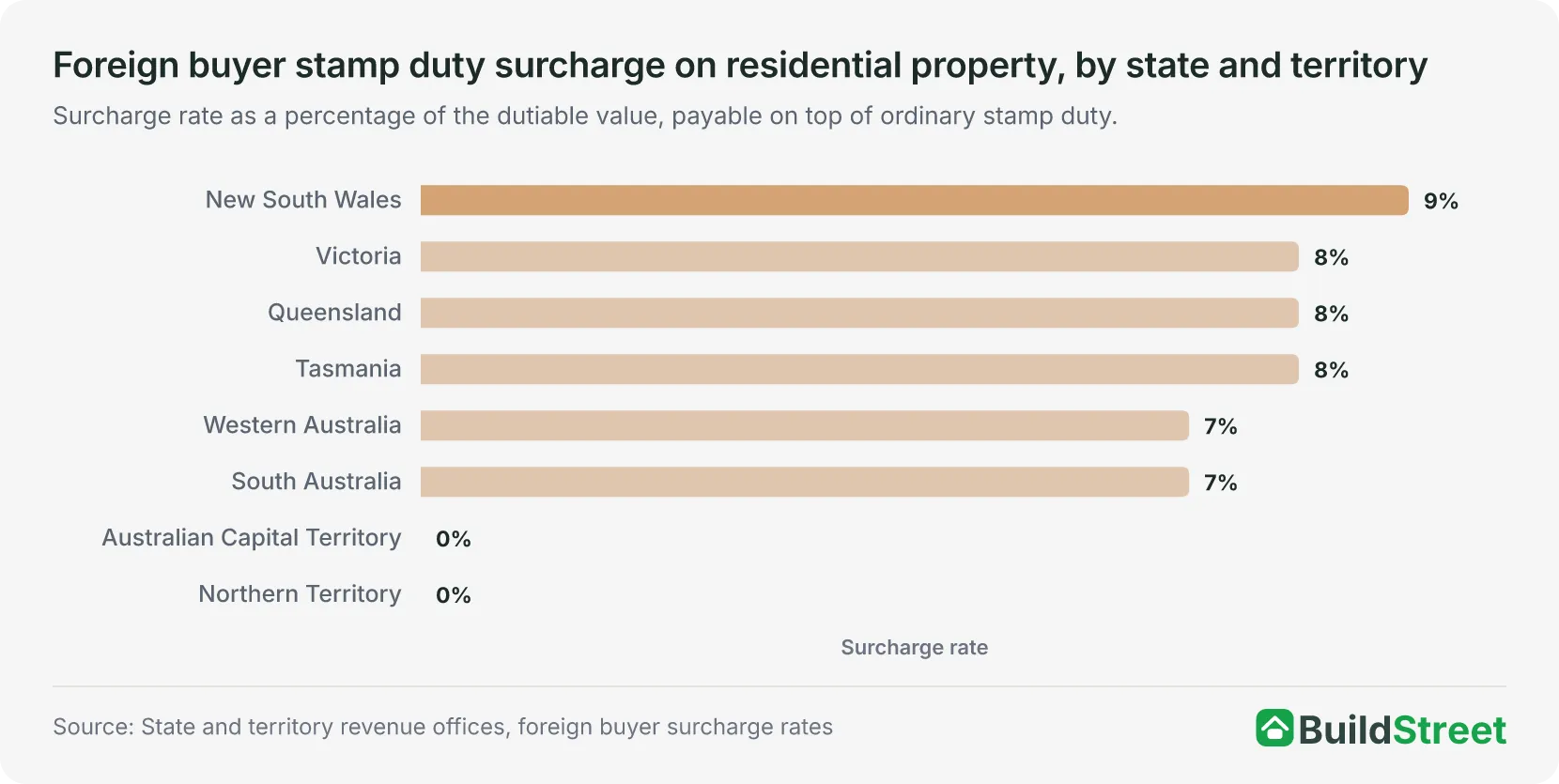
Foreign buyers of residential property pay a stamp duty surcharge of 7 to 9 per cent of the value on top of ordinary duty in all six states. The ACT and Northern Territory do not charge an equivalent stamp duty surcharge45.
New South Wales charges the highest surcharge among the six states, at 9 per cent of the dutiable value30. Victoria31, Queensland32 and Tasmania33 each charge 8 per cent, while Western Australia34 and South Australia35 each charge 7 per cent.
In Revenue NSW's example, a foreign person buying a $1 million home pays $90,000 in surcharge purchaser duty and $39,187 in transfer duty, for a total of $129,18730.
Queensland raised its surcharge from 7 per cent to 8 per cent from 1 July 202432. New South Wales raised its surcharge from 8 per cent to 9 per cent for transactions after 31 December 202430.
The other four rates have been in place for longer. South Australia has charged 7 per cent since 1 January 201835, and Western Australia has charged 7 per cent since 1 January 201934. Victoria has charged 8 per cent since 1 July 201931, and Tasmania has charged 8 per cent since 1 April 202033.
Victoria's temporary off-the-plan concession does not apply to its foreign purchaser additional duty26, and South Australia's first home buyer relief does not apply to its foreign ownership surcharge19.
Section 07 · Share of price
What share of a median house price is stamp duty in each capital city?
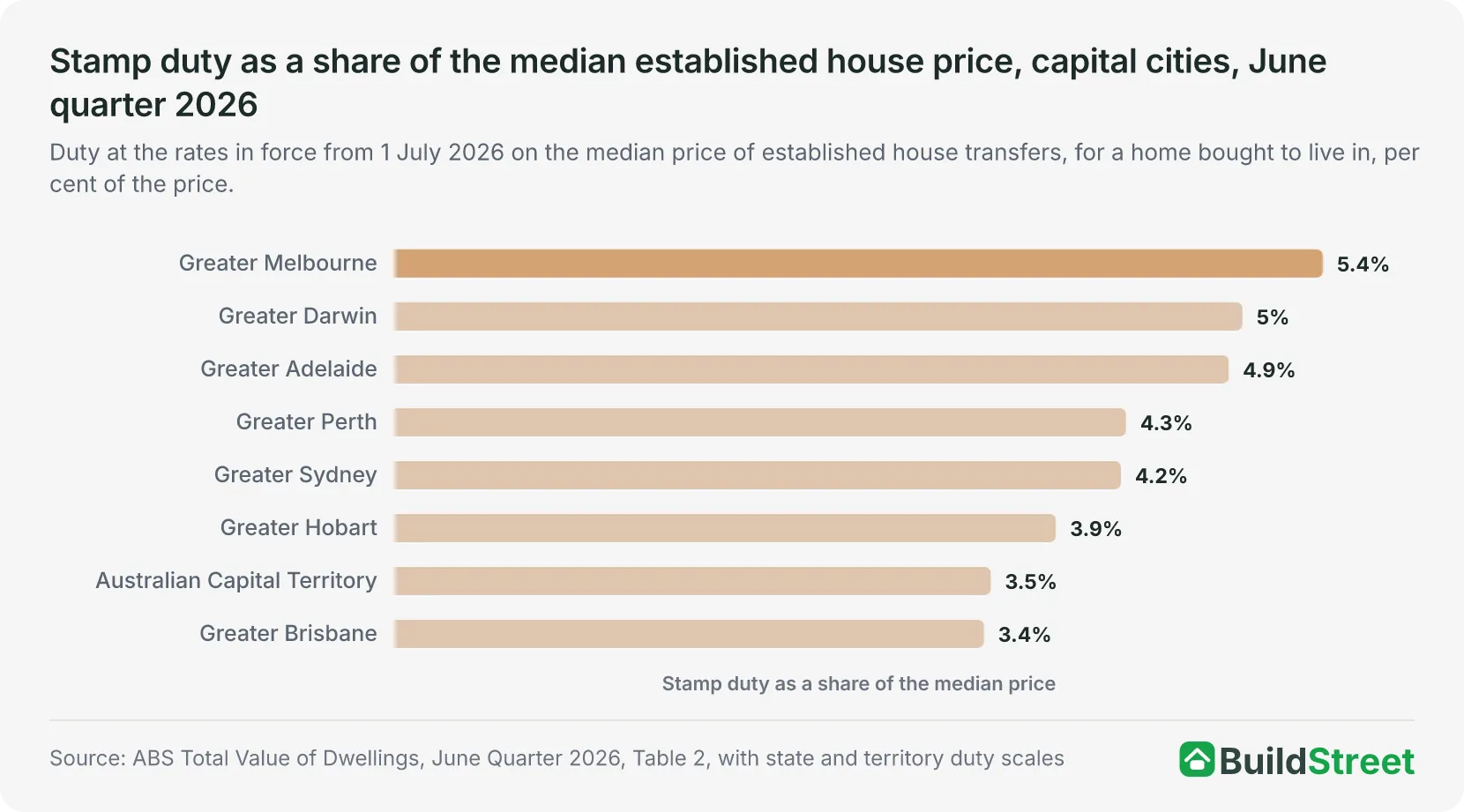
Greater Melbourne had the highest stamp duty as a share of the median established house price among the eight capital cities in the June quarter 2026, at 5.42 per cent, or $46,070 on a median price of $850,000373. These are illustrative calculations based on the ABS median prices and the rates in force from 1 July 2026.
Greater Brisbane had the lowest stamp duty as a share of the median price among the eight capital cities, at 3.44 per cent, or $39,762.50 on a median of $1,155,000377. The ACT followed at 3.48 per cent. Greater Sydney had the largest stamp duty amount among the eight capital cities, at $63,105, or 4.24 per cent of its median price of $1,487,600371.
The ABS median prices for the June quarter 2026 are preliminary and can be revised in the following quarter38. They are unstratified medians of established house transfers, so they exclude new houses and attached dwellings39.
| Stamp duty on the median established house price, capital cities, June quarter 2026 | |||
|---|---|---|---|
| Capital city | Median price | Stamp duty | Share of price |
| Greater Melbourne | $850,000 | $46,070 | 5.42% |
| Greater Darwin | $752,500 | $37,248.75 | 4.95% |
| Greater Adelaide | $975,000 | $47,455 | 4.87% |
| Greater Perth | $1,010,000 | $43,130.50 | 4.27% |
| Greater Sydney | $1,487,600 | $63,105 | 4.24% |
| Greater Hobart | $750,000 | $28,935 | 3.86% |
| Australian Capital Territory | $1,030,000 | $35,878 | 3.48% |
| Greater Brisbane | $1,155,000 | $39,762.50 | 3.44% |
Source · ABS Total Value of Dwellings, June Quarter 2026, Table 2; state and territory revenue office duty scales.
Section 08
Frequently asked questions
How much is stamp duty on a $750,000 house?
Stamp duty on a $750,000 established home bought to live in ranges from $19,208 in the ACT to $40,070 in Victoria under the rates in force from 1 July 2026, for a buyer who has owned property in the previous five years. In New South Wales, the duty is $27,937, and in Queensland it is $19,600 under the home concession rate.
Where is stamp duty cheapest in Australia?
The ACT has the lowest stamp duty on an established home bought to live in at $500,000 and $750,000, and Queensland has the lowest at $1 million and $1.5 million, under the rates in force from 1 July 2026 for a buyer who has owned property in the previous five years. Eligible home buyers in the ACT who have not owned property in the previous five years pay no duty at any price from 1 July 2026.
Do first home buyers pay stamp duty in Australia?
Eligible first home buyers pay no stamp duty on qualifying purchases in New South Wales, Victoria, Queensland, Western Australia and South Australia, with value limits in some cases. Eligible home buyers in the ACT pay no duty at any price from 1 July 2026. Tasmania's exemption does not apply to transactions settling after 30 June 2026, and the Northern Territory has no first home buyer duty concession open to new contracts.
How much stamp duty do foreign buyers pay?
Foreign buyers of residential property pay a surcharge on top of ordinary stamp duty of 9 per cent of the value in New South Wales, 8 per cent in Victoria, Queensland and Tasmania, and 7 per cent in Western Australia and South Australia. The ACT and the Northern Territory do not charge a foreign buyer stamp duty surcharge, although the ACT charges foreign owners of residential land an annual land tax surcharge.
Do pensioners pay stamp duty?
Pensioners generally pay ordinary stamp duty, but Victoria and the ACT have pensioner concessions available for new contracts. Victoria charges eligible pensioners no duty on a home valued at $600,000 or less, and the ACT charges eligible pensioners moving home no duty at any price from 1 July 2026. Queensland states that no additional concessions apply to seniors or pensioner concession card holders, and Revenue NSW lists no specific pensioner concession.
Is stamp duty charged on an off-the-plan apartment?
Stamp duty is charged on off-the-plan purchases, but Victoria, Western Australia and the ACT offer concessions for eligible buyers. New South Wales lets buyers who will live in the home defer payment for up to 12 months. In Queensland and South Australia, first home buyer relief on new homes also covers off-the-plan purchases.
References
- Revenue NSW — Calculate Transfer Duty · revenue.nsw.gov.au ↑ b c d e
- Queensland Revenue Office, Transfer duty rates · qro.qld.gov.au ↑ b c d
- State Revenue Office Victoria — Land transfer duty current rates (non-principal place of residence) · sro.vic.gov.au ↑ b c d e f g h
- Taxation Administration (Amounts Payable - Duty) Determination 2026 (ACT), DI2026-155 · legislation.act.gov.au ↑ b c d e f g h i
- Stamp Duty Act 1978 (NT) · legislation.nt.gov.au ↑ b c d e
- State Revenue Office Victoria, Land transfer duty, principal place of residence, current rates · sro.vic.gov.au ↑ b c
- Queensland Revenue Office — Transfer Duty Concession Rates · qro.qld.gov.au ↑ b c d e
- First home concession for transfer duty · qro.qld.gov.au ↑ b
- State Revenue Office Tasmania — Rates of duty · sro.tas.gov.au ↑ b
- Department of Treasury and Finance WA — Transfer duty assessment · wa.gov.au ↑ b
- RevenueSA, Rates of stamp duty · revenuesa.sa.gov.au ↑
- About the Home Buyer Concession Scheme · revenue.act.gov.au ↑ b c
- State Revenue Office Victoria, Pensioner and concession cardholder duty reduction, contracts from 1 July 2023 · sro.vic.gov.au ↑ b
- Department of Treasury and Finance WA, Apply for the off-the-plan duty concession · wa.gov.au ↑ b
- NSW Government, First Home Buyers Assistance Scheme · nsw.gov.au ↑
- State Revenue Office Victoria — First home buyer duty exemption or concession · sro.vic.gov.au ↑
- Queensland Revenue Office — First home new home transfer duty concession · qro.qld.gov.au ↑ b
- Duties fact sheet — First Home Owner Rate of Duty · wa.gov.au ↑
- RevenueSA, First home buyer relief · revenuesa.sa.gov.au ↑ b c
- First home buyers of established homes duty relief · sro.tas.gov.au ↑
- House and Land Package Exemption · nt.gov.au ↑
- ACT Revenue Office, Pensioner Duty Concession Scheme · revenue.act.gov.au ↑
- Revenue NSW, Transfer duty exemptions and concessions · revenue.nsw.gov.au ↑
- State Revenue Office Tasmania, Pensioners downsizing to a new home duty concession · sro.tas.gov.au ↑
- Temporary off-the-plan duty concession · sro.vic.gov.au ↑
- State Revenue Office Victoria, Strata apartments and townhouses temporary concession · sro.vic.gov.au ↑ b
- ACT Revenue Office, Off the plan unit duty exemption · revenue.act.gov.au ↑
- Revenue NSW, Off-the-plan property purchases · revenue.nsw.gov.au ↑
- State Revenue Office Tasmania, Off-the-plan apartment or unit duty concession · sro.tas.gov.au ↑
- Revenue NSW, What is surcharge purchaser duty · revenue.nsw.gov.au ↑ b c
- State Revenue Office Victoria, Foreign purchaser additional duty current rates · sro.vic.gov.au ↑ b
- Queensland Revenue Office, Assessing AFAD · qro.qld.gov.au ↑ b
- State Revenue Office Tasmania, Foreign investor duty surcharge rates · sro.tas.gov.au ↑ b
- Department of Treasury and Finance WA, About foreign buyers duty · wa.gov.au ↑ b
- RevenueSA, Foreign ownership surcharge · revenuesa.sa.gov.au ↑ b
- ACT Revenue Office, Foreign ownership surcharge for land tax · revenue.act.gov.au ↑
- ABS Total Value of Dwellings, June Quarter 2026 — Table 2. Median price and number of transfers (capital city and rest of state) · Australian Bureau of Statistics ↑ b c
- ABS Total Value of Dwellings, June quarter 2026 (Cat. 6432.0), Table 1 · Australian Bureau of Statistics ↑
- abs.gov.au · Australian Bureau of Statistics ↑
