

Published 30 Sept 2026
 What stamp duty costs in every Australian stateThe transfer duty a buyer pays when purchasing a home, the other state tax on property, compared across the states and territories.
 How stamp duty has changed over timeHow stamp duty thresholds and revenue have changed in Australia, and the debate over replacing stamp duty with a broad land tax.
Section 01 · The basics
What is land tax and who pays land tax in Australia?
Seven of Australia's eight states and territories charge land tax, an annual tax on the value of land, and the Northern Territory does not1. The tax is calculated on the value of the land itself, not on the buildings on it2.
An owner generally becomes liable when the combined value of all their taxable land is above the jurisdiction's threshold on the date used to assess land tax. Revenue NSW applies its threshold to the combined land value of all property an owner holds, not to each property individually3.
The assessment date differs by jurisdiction. New South Wales and Victoria assess the land an owner holds at midnight on 31 December for the following calendar year's land tax45. Queensland and South Australia assess ownership at midnight on 30 June26. Tasmania classifies land as at 1 July each year7, and the ACT assesses land tax quarterly, on a property's status on 1 July, 1 October, 1 January and 1 April8.
Revenue NSW lists vacant land, holiday homes, investment properties and commercial properties among the land that attracts the tax4.
In the ACT, land tax applies only to residential properties that are not a principal place of residence, such as rented or vacant homes, and does not apply to commercial properties910.
Section 02 · Rates and thresholds
What are the land tax rates and thresholds in each state and territory?
New South Wales has the highest general tax-free threshold among the six states, at $1,075,000 of land value for the 2026 land tax year3. Victoria has the lowest general threshold among the six states, at $50,000 under the scale for the 2024 to 2033 land tax years11.
Once the threshold is exceeded, land tax is calculated using a fixed amount, a marginal rate or both. The amount generally rises as the total taxable land value increases. Three states also have additional features:
- New South Wales charges $100 plus 1.6 per cent of land value above the general threshold, and $88,036 plus 2 per cent above a premium threshold of $6,571,0003.
- Queensland sets its threshold by owner type, at $600,000 of total taxable value for individuals12 and $350,000 for companies and trustees13.
- Western Australia charges the metropolitan region improvement tax of 0.14 per cent of value above $300,000 on land in the Perth metropolitan region, on top of land tax14.
The ACT combines a fixed charge of $1,778 a year from 1 July 2026 with a percentage charge based on each property's average unimproved value. The percentage charge starts at 0.54 per cent and reaches $23,100 plus 1.26 per cent of the value above $2 million8.
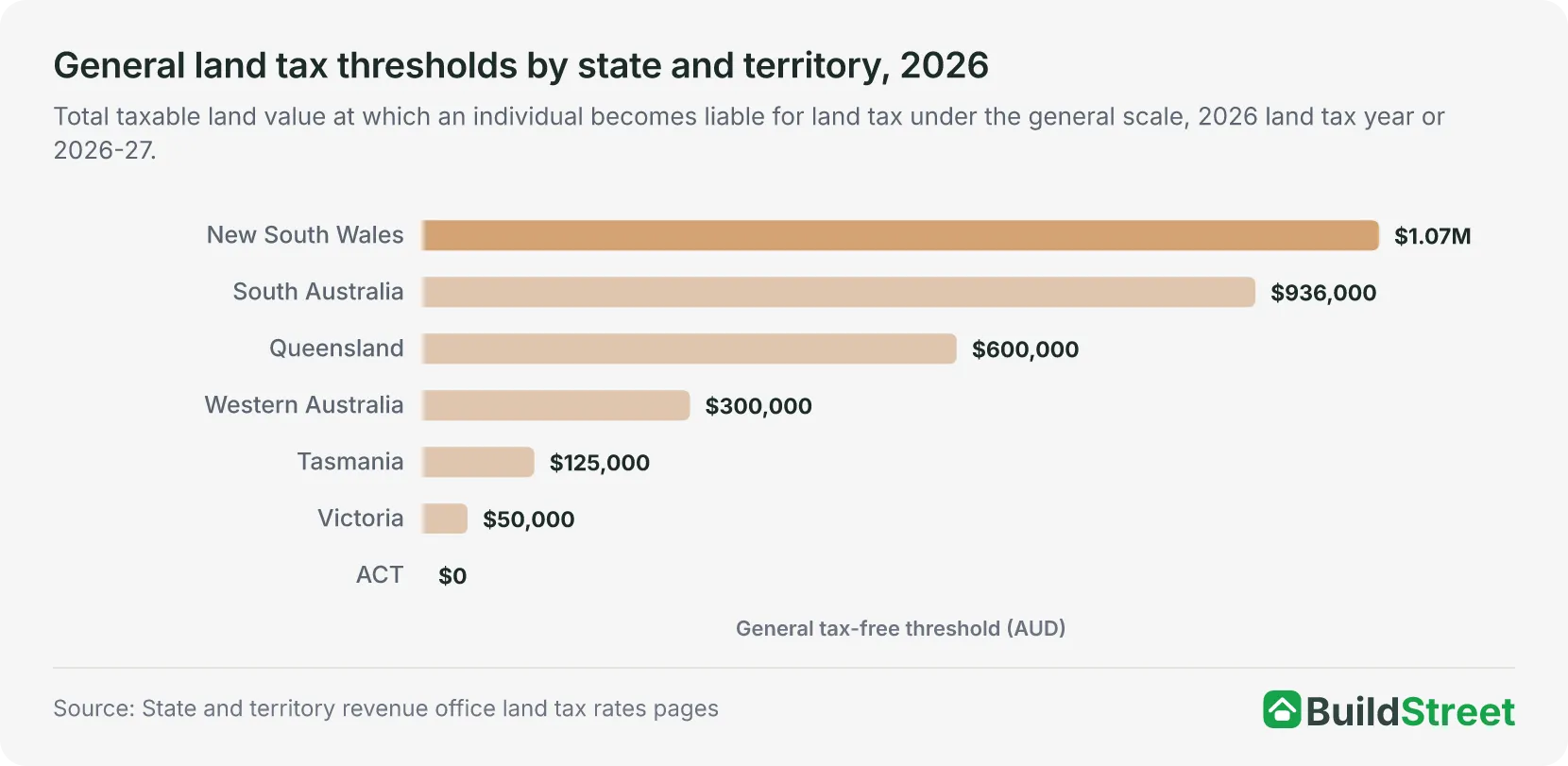
| General land tax thresholds and rates for individuals by state and territory, 2026 | ||||
|---|---|---|---|---|
| Jurisdiction | Tax-free threshold | Tax just above the threshold | Top marginal rate | Land value used |
| New South Wales | $1,075,000 | $100 plus 1.6% of value above $1,075,000 | 2% above $6,571,000 | Three-year average of land value |
| Victoria | $50,000 | $500 flat from $50,000 to less than $100,000 | 2.65% above $3,000,000 | Site value |
| Queensland | $600,000 | $500 plus 1c per $1 above $600,000 | 2.25c per $1 above $10,000,000 | Lower of statutory value and three-year averaged value |
| South Australia | $936,000 | $0.50 per $100 above $936,000 | $2.40 per $100 above $3,504,000 | Site value |
| Western Australia | $300,000 | $300 flat from $300,001 to $420,000 | 2.67c per $1 above $11,000,000 | Unimproved value, capped at 150% of the previous year's |
| Tasmania | $125,000 | $50 plus 0.45% of value above $125,000 | 1.5% above $500,000 | Assessed land value |
| ACT | None | $1,778 fixed charge plus 0.54% of average unimproved value | 1.26% above $2,000,000 | Average unimproved value over up to five years |
| Northern Territory | No land tax | No land tax | No land tax | No land tax |
Source · Revenue NSW; State Revenue Office Victoria; Queensland Revenue Office; RevenueSA; Western Australia Department of Treasury and Finance; State Revenue Office of Tasmania; ACT Revenue Office.
Worked example · $680,000 of taxable land in Queensland
In the Queensland Revenue Office's example, an individual whose land has a total taxable value of $680,000 pays $1,300 of land tax for the year, which is $500 plus 1 cent for each dollar of the $80,000 above the $600,000 threshold12.
Section 03 · The home
How does the principal place of residence exemption from land tax work?
The owner's principal place of residence is generally exempt from land tax in every state that levies it, and the ACT's land tax does not apply to a principal place of residence4515161779.
Revenue NSW requires the owner to have used and occupied the home continuously since 1 July before the 31 December assessment date. From the 2026 land tax year, the people living in the home must together own at least 25 per cent of it18. Victoria requires the owner to live on the land for at least six months from 1 July of the year before the assessment19.
Queensland requires the owner to have occupied a home on the land on or before 30 June15. Tasmania treats a property as principal residence land where the owners of at least a 50 per cent interest ordinarily reside there on 1 July20. The ACT exempts a home if the owner was living there on the first day of the quarter. It can also exempt a home where a new owner moves in within three months of taking ownership and does not rent the home out21.
An owner who buys a new home before selling the old one may hold two homes on the assessment date. New South Wales and Victoria can exempt both homes for one land tax year where the conditions are met1819, and Queensland has a transitional home exemption for an owner between homes on 30 June22.
Is land exempt from land tax while a new home is built?
Six of the seven jurisdictions that levy land tax offer an exemption, concession or rebate for land where the owner's future home is being built. Queensland is the exception.
Revenue NSW allows a concession for up to four years after an owner takes ownership of land to build, renovate or extend a home, with an extension to six years in exceptional circumstances. The owner must then live in the home continuously for at least six months and earn no income from it18.
In Victoria, land on which a principal place of residence is being built can be exempt for up to four tax years after the works start, and the owner must apply for the exemption23. From 1 January 2027, the requirement to move in within four years will be removed, under legislation that received royal assent on 23 June 2026.
RevenueSA may exempt land for up to two financial years while a future home is built or substantially renovated, and the owner must then live there for at least 12 months16. Western Australia may exempt a newly built home for up to two consecutive assessment years where construction runs across both years24.
Tasmania offers a new home builders rebate for the financial year in which the owner's home is built and occupied25, and the ACT's exemption for homes that are unfit for occupation can cover a home under construction21.
Queensland has no equivalent exemption. In the Queensland Revenue Office's example, an owner cannot claim the transitional home exemption on a new home that is still under construction at 30 June, because it is not considered habitable on that date22.
| Land tax relief while the owner's future home is built, by state and territory, 2026 | |||
|---|---|---|---|
| Jurisdiction | Relief | Time limit | Condition after completion |
| New South Wales | Concession for land bought to build or renovate a home | Up to 4 years from ownership, extendable to 6 | Owner lives in the home continuously for at least 6 months |
| Victoria | Exemption for land where the home is being built or renovated, on application | Up to 4 tax years after works start | Owner uses the land as the principal place of residence for at least 6 months |
| Queensland | None; a home under construction at 30 June is not habitable | Not applicable | Not applicable |
| South Australia | Exemption while building or substantially renovating a future home | Up to 2 financial years | Owner lives in the home for at least 12 months |
| Western Australia | Exemption for a newly constructed or refurbished residence | Up to 2 consecutive assessment years | Owner occupies the home as primary residence in the second year |
| Tasmania | New home builders rebate | The financial year the dwelling is built and occupied | Occupied as principal residence by the owner or a related person |
| ACT | Unfit for occupation exemption, which covers a home under construction | Not stated on the exemptions page | Not stated on the exemptions page |
| Northern Territory | No land tax | No land tax | No land tax |
Source · Revenue NSW; State Revenue Office Victoria; Queensland Revenue Office; RevenueSA; Western Australia Department of Treasury and Finance; State Revenue Office of Tasmania; ACT Revenue Office.
Section 04 · Investment property
How does land tax apply to investment properties?
Investment properties are generally taxable land in every jurisdiction that levies land tax. Outside the ACT, where land tax is calculated on each property's own average unimproved value, the value of investment properties is generally added to the owner's other taxable land before the tax scale is applied.
Revenue NSW, the State Revenue Office of Victoria, the Queensland Revenue Office and Tasmania's State Revenue Office each list rental or investment properties among taxable land4527. Western Australia assesses land that the owner is not using as their principal place of residence14, and the ACT charges land tax on rented and vacant residential properties10.
Combining the value of taxable properties can take an owner above a land tax threshold even when no individual property exceeds it. In Revenue NSW's example, an owner's two non-exempt properties have a combined land value of $1,350,000, above the $1,075,000 general threshold, while the owner's home is left out because it is exempt4.
The ownership structure can change the threshold and the scale. In New South Wales, a special trust does not receive the land tax threshold and pays a flat 1.6 per cent up to the premium threshold, then 2 per cent26. Victoria taxes land held on trust from $25,000 under a separate trust scale11. South Australia applies a trust threshold of $25,00027, and Queensland assesses companies and trustees from $350,00013.
Victoria also charges a vacant residential land tax on residential land with a home that was vacant for more than six months in the previous calendar year. The tax has applied across Victoria since 202528. The rate is 1 per cent of capital improved value in the first year of liability, 2 per cent in the second year and 3 per cent from the third year29.
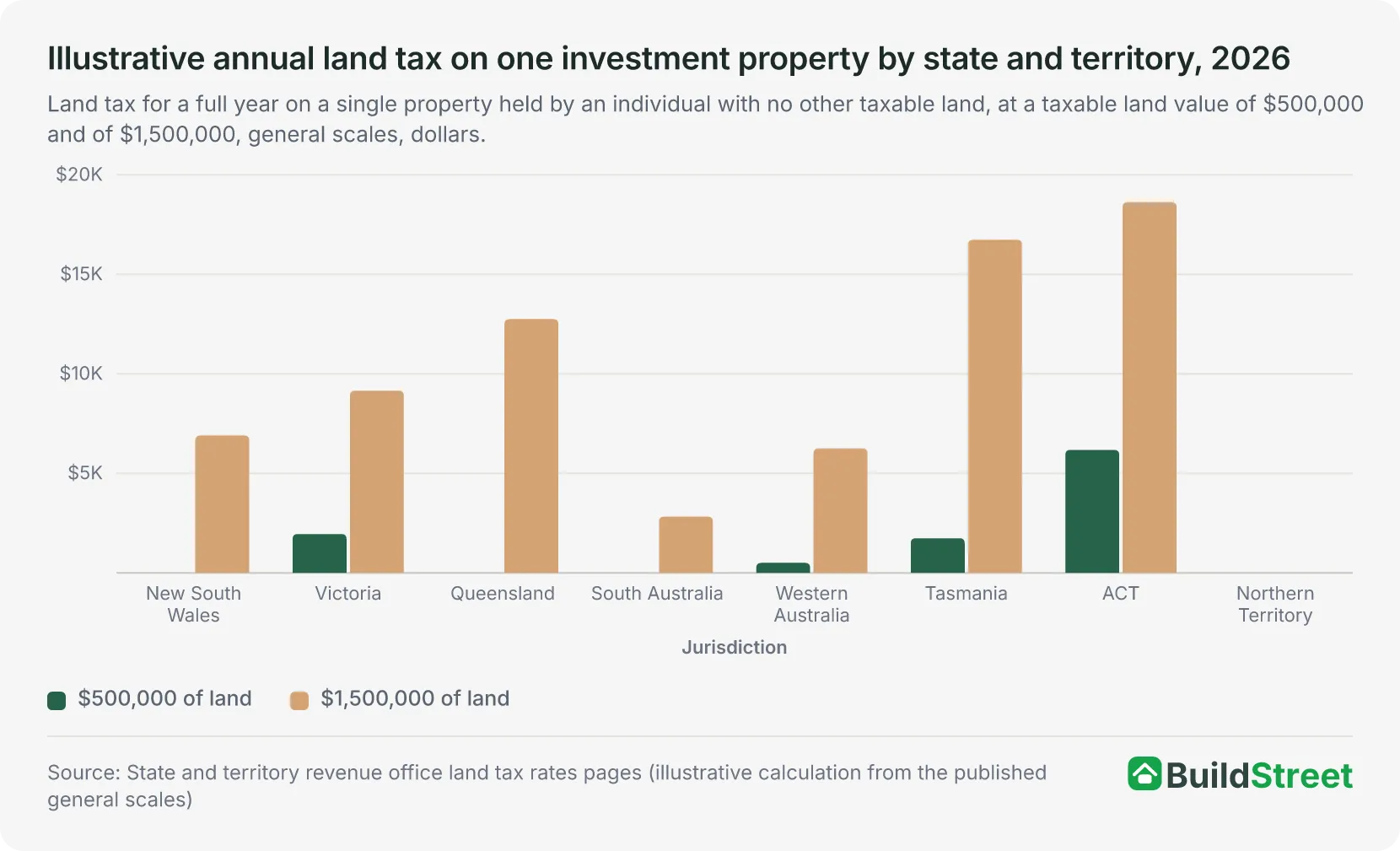
The following figures are illustrative calculations based on each jurisdiction's published general scale. They assume an individual owns one investment property, has no other taxable land and receives no exemption, surcharge or concession.
On land with a taxable value of $500,000, the illustrative land tax for a year is nil in New South Wales, Queensland and South Australia, compared with $6,178 in the ACT. On land with a taxable value of $1,500,000, the ACT has the highest illustrative land tax among the seven jurisdictions that levy it, at $18,628, followed by Tasmania at $16,737.50. The amounts are $6,900 in New South Wales and $9,150 in Victoria.
Section 05 · Foreign owners
What land tax surcharges apply to foreign owners in each state and territory?
Five of the seven jurisdictions that levy land tax add a surcharge for foreign or absentee owners, with the highest rate of 5 per cent of land value in New South Wales3031. The surcharges are calculated differently in each jurisdiction, so the rates are not directly comparable.
New South Wales charges surcharge land tax on residential land owned by a foreign person at 2 per cent of land value from 2018 to 2022, 4 per cent in 2023 and 2024 and 5 per cent from the 2025 land tax year30. No tax-free threshold applies, and the surcharge is payable even where the property is exempt from ordinary land tax.
Victoria's absentee owner surcharge increased from 2 per cent from 2020 to 2023 to 4 per cent from the 2024 land tax year, and applies on top of the general and trust rates32. The surcharge does not apply to Australian citizens and permanent residents who live overseas.
Queensland applies a 3 per cent surcharge to absentees, and to foreign companies and trustees of foreign trusts on taxable value above $350,0003313. In the Queensland Revenue Office's example, an absentee with $400,000 of taxable land pays $3,800, made up of $2,300 under the absentee scale and a $1,500 surcharge33.
Tasmania's foreign investor land tax surcharge is 2 per cent of the assessed land value of the foreign-owned portion of general land acquired on or after 1 July 2022. It can apply even where the land value is below the general land tax threshold34.
The ACT's surcharge of 0.75 per cent of average unimproved value a year has applied to foreign owners of residential land since 1 July 201831.
RevenueSA's land tax pages list no foreign-owner surcharge, and neither do Western Australia's land tax pages2714.
| Land tax surcharges on foreign and absentee owners by state and territory, 2026 | ||||
|---|---|---|---|---|
| Jurisdiction | Surcharge | Rate | Base | Threshold |
| New South Wales | Surcharge land tax on foreign persons | 5% | Land value of residential land | None; payable on exempt land too |
| Victoria | Absentee owner surcharge | 4% | Total taxable value, on top of the general or trust rates | Not payable below $50,000 ($25,000 for trusts) |
| Queensland | Absentee and foreign company or trust surcharge | 3% | Taxable value above $350,000 | $350,000 |
| South Australia | None listed | None | Not applicable | Not applicable |
| Western Australia | None listed | None | Not applicable | Not applicable |
| Tasmania | Foreign investor land tax surcharge | 2% | Foreign-owned portion of general land acquired on or after 1 July 2022 | Can apply below the land tax threshold |
| ACT | Foreign ownership surcharge | 0.75% | Average unimproved value of residential land | No threshold stated |
| Northern Territory | No land tax | No land tax | No land tax | No land tax |
Source · Revenue NSW; State Revenue Office Victoria; Queensland Revenue Office; RevenueSA; Western Australia Department of Treasury and Finance; State Revenue Office of Tasmania; ACT Revenue Office.
Section 06 · Revenue
How much land tax revenue do Australia's states and territories collect?
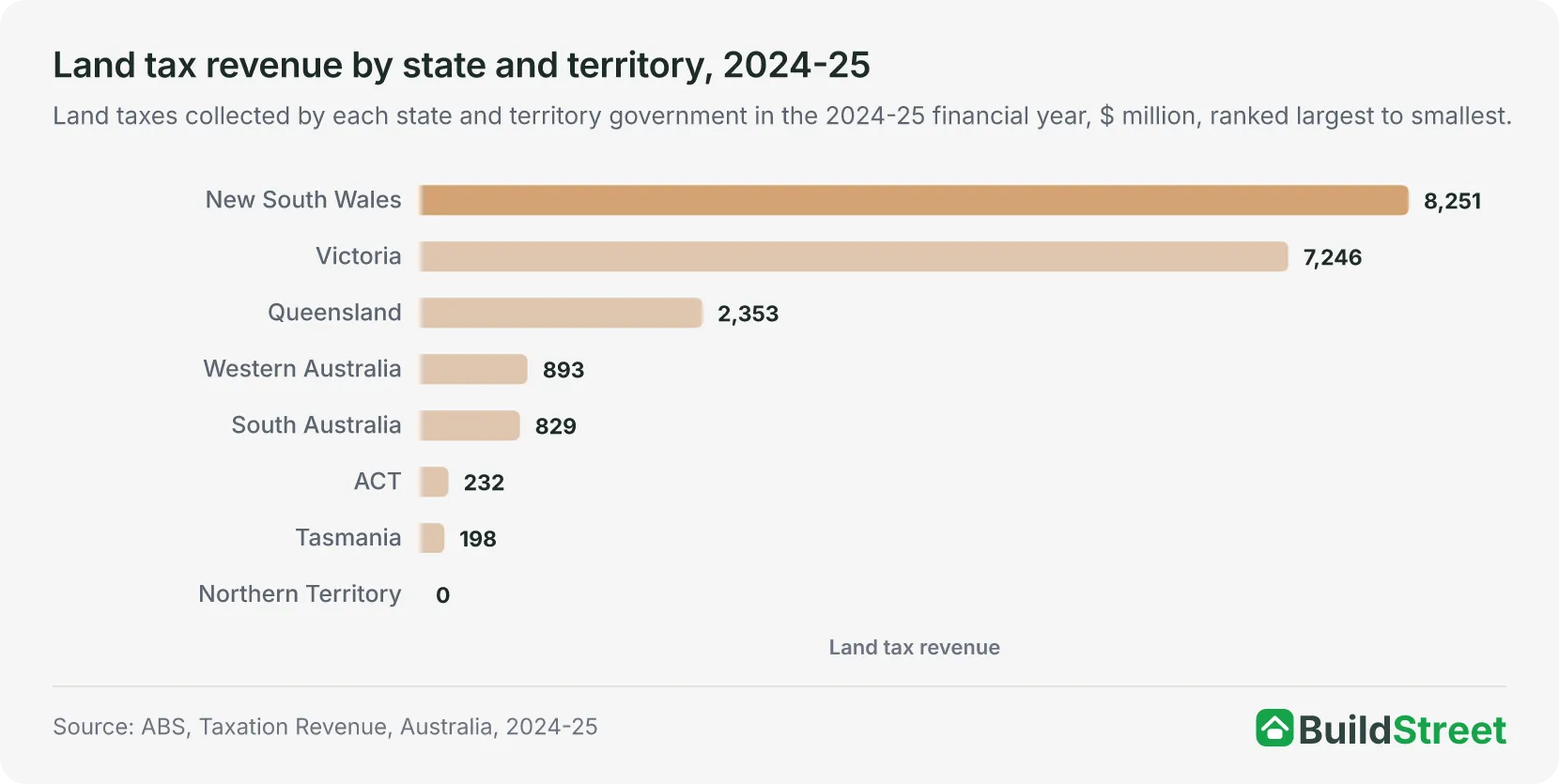
State and territory governments collected $20,002 million in land tax in 2024-25, according to the ABS taxation revenue data35.
New South Wales recorded the largest land tax revenue of any state or territory, at $8,251 million, followed by Victoria at $7,246 million and Queensland at $2,353 million35. Each of the other four jurisdictions that levy land tax collected less than $1 billion.
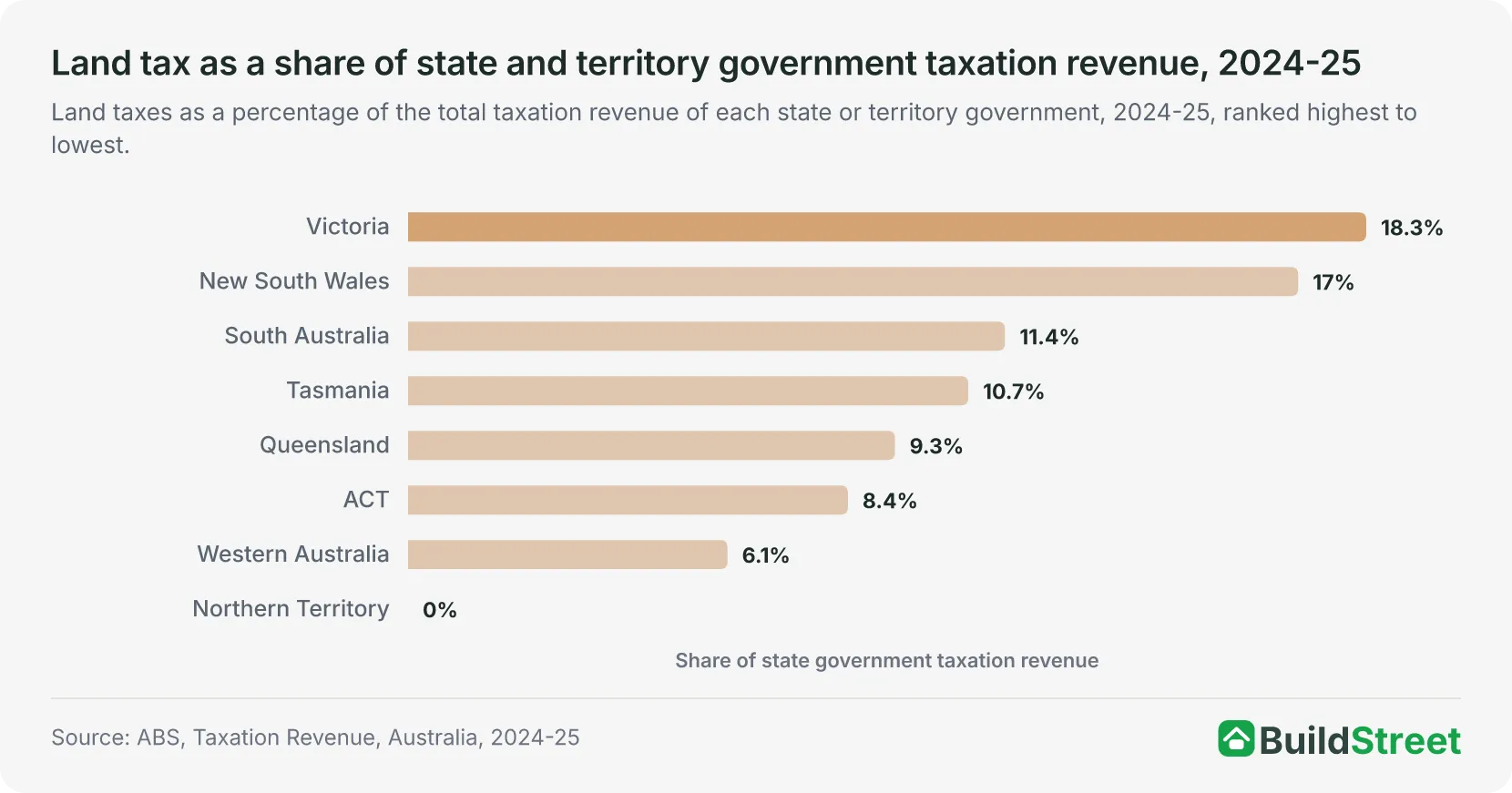
Victoria recorded the highest land tax share of state or territory government taxation revenue of any jurisdiction in 2024-25, at 18.3 per cent, compared with 17.0 per cent in New South Wales36. Western Australia recorded the lowest share among the seven jurisdictions that levy land tax, at 6.1 per cent.
Across all states and territories, land tax accounted for 14.2 per cent of state and territory government taxation revenue in 2024-2536. Across all levels of government, land tax represented 2.4 per cent of the $839.0 billion in total taxation revenue collected that year37.
Section 07 · The trend
How has land tax revenue changed across Australia's states and territories since 2015-16?
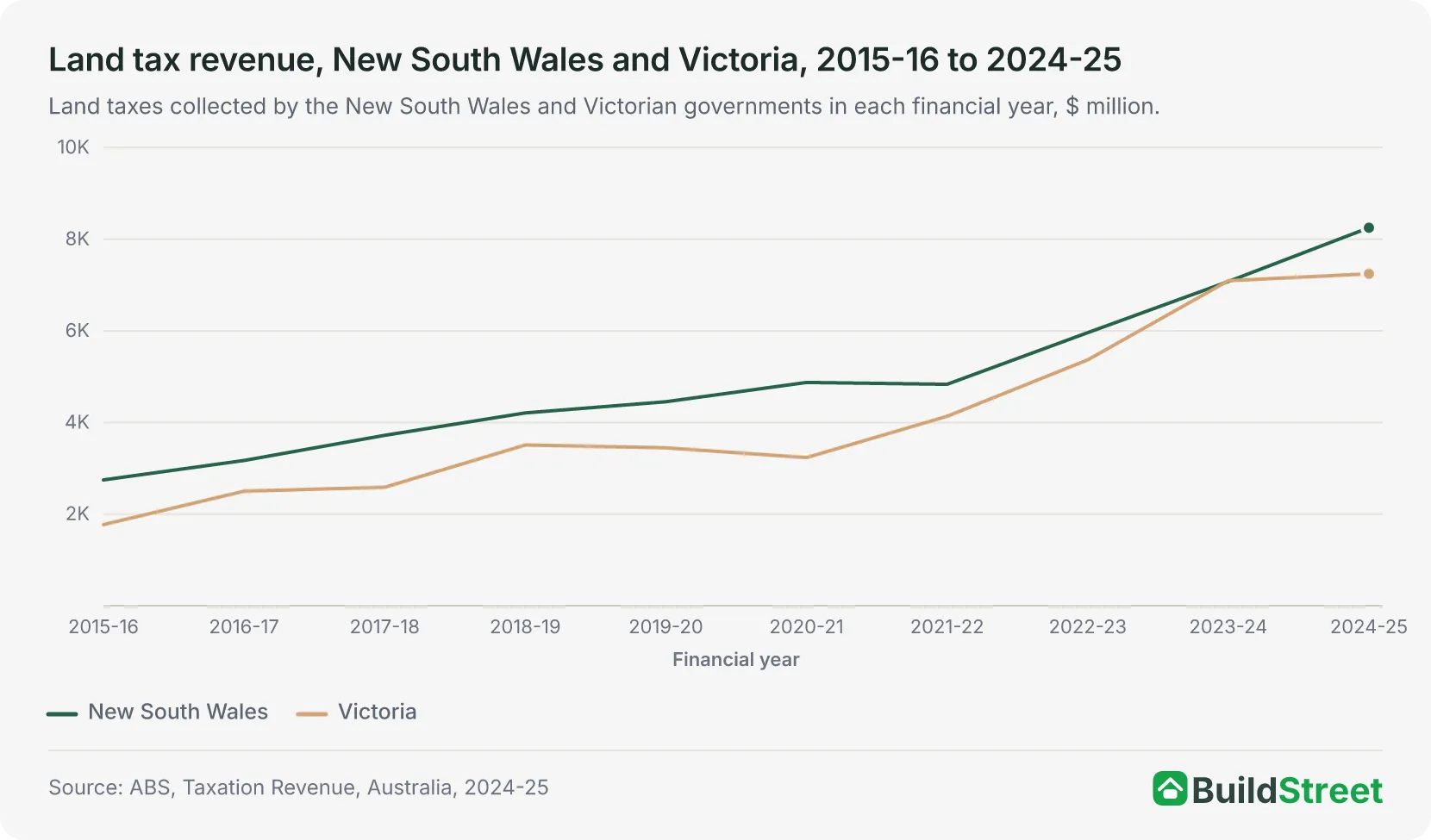
Land tax revenue across all states and territories increased from $7,237 million in 2015-16 to $20,002 million in 2024-25, making it 2.76 times its 2015-16 level35. Revenue increased by 10.1 per cent in 2024-25, from $18,171 million in 2023-24.
Victoria's land tax revenue increased from $1,771 million in 2015-16 to $7,246 million in 2024-25, making it 4.1 times its 2015-16 level35. New South Wales's land tax revenue increased from $2,747 million to $8,251 million over the same period, making it 3.0 times its 2015-16 level.
Victoria collected more land tax than New South Wales in 2023-24, at $7,094 million compared with $7,077 million. This was the only year between 2015-16 and 2024-25 when Victoria collected more than New South Wales35.
Western Australia was the only state whose land tax revenue was lower in 2024-25 than in 2015-16, at $893 million compared with $941 million35.
| Land tax revenue by state and territory, selected years, 2015-16 to 2024-25 ($ million) | |||||
|---|---|---|---|---|---|
| Jurisdiction | 2015-16 | 2019-20 | 2023-24 | 2024-25 | Change, 2015-16 to 2024-25 |
| New South Wales | 2,747 | 4,453 | 7,077 | 8,251 | +200.4% |
| Victoria | 1,771 | 3,447 | 7,094 | 7,246 | +309.1% |
| Queensland | 1,010 | 1,406 | 2,026 | 2,353 | +133.0% |
| South Australia | 570 | 640 | 746 | 829 | +45.4% |
| Western Australia | 941 | 784 | 837 | 893 | −5.1% |
| Tasmania | 97 | 125 | 186 | 198 | +104.1% |
| ACT | 101 | 143 | 206 | 232 | +129.7% |
| Northern Territory | 0 | 0 | 0 | 0 | No land tax |
| All states and territories | 7,237 | 10,999 | 18,171 | 20,002 | +176.4% |
Source · ABS, Taxation Revenue, Australia, 2024-25, data cube 55060DO001, Tables 2 to 10.
How have land tax thresholds and rates changed since 2020?
From the 2024 land tax year, Victoria cut its general tax-free threshold from $300,000 to $50,000 and raised its rates under the COVID Debt Repayment Plan, a set of temporary changes that apply until 30 June 20333839. New South Wales froze its thresholds at their 2024 levels from the 2025 land tax year, after raising the general threshold from $692,000 in 2019 to $1,075,000 in 2024340.
South Australia revised how it combined taxable land owned by the same owner from midnight on 30 June 202041, and its indexed general threshold increased from $482,000 in 2021-22 to $936,000 in 2026-272742. Tasmania raised its threshold from $25,000 before 1 July 2021 to $125,000 from 1 July 202443.
The ACT added a new tax bracket starting at $1 million from 1 July 2024 and lifted its marginal rates above $275,000 from 1.12 and 1.14 per cent to between 1.24 and 1.26 per cent4445. Western Australia's general scale has applied unchanged since the 2015-16 financial year46.
| Changes to land tax rules by state and territory, 2020 to 2027 | ||
|---|---|---|
| From | Jurisdiction | Change |
| 30 June 2020 | South Australia | Revised aggregation provisions; a separate, higher trust scale with a $25,000 threshold |
| 1 July 2021 | Tasmania | Threshold raised from $25,000 to $50,000 |
| 1 July 2022 | Tasmania | Threshold raised to $100,000; foreign investor land tax surcharge of 2% on land acquired from this date |
| 2023 land tax year | New South Wales | Foreign person surcharge raised from 2% to 4% |
| 2024 land tax year | Victoria | Threshold cut from $300,000 to $50,000, flat charges and a 0.1 percentage point rate increase to 2033; absentee owner surcharge raised from 2% to 4% |
| 1 July 2024 | Tasmania | Threshold raised to $125,000 |
| 1 July 2024 | ACT | New $1,000,000 band; marginal rates above $275,000 raised to 1.24% to 1.26% |
| 2025 land tax year | New South Wales | Thresholds frozen at their 2024 levels; foreign person surcharge raised to 5% |
| 1 January 2025 | Victoria | Vacant residential land tax extended to the whole state, at 1% rising to 3% by the third year of liability |
| 2026 land tax year | New South Wales | Home exemption requires the occupants to own at least 25% together |
| 1 January 2026 | Victoria | Absentee owner surcharge applies to New Zealand citizens; exemption for owner-occupied land valued under $300,000 with a temporary residence |
| 1 July 2026 | South Australia | General threshold indexed from $833,000 to $936,000 |
| 1 July 2026 | ACT | Fixed charge increased from $1,693 to $1,778 |
| 1 January 2027 | Victoria | Four-year limit on the move-in date for the construction exemption removed |
Source · Revenue NSW; State Revenue Office Victoria; RevenueSA; State Revenue Office of Tasmania; ACT Revenue Office; ACT Legislation Register.
Section 08
Frequently asked questions
Do you pay land tax on your own home in Australia?
The owner's principal place of residence is generally exempt from land tax in every state that levies it, provided the owner meets the relevant occupation and ownership conditions. In the ACT, land tax applies only to residential property that is not a principal place of residence.
Is there land tax in the Northern Territory?
No. The Northern Territory Government states that there is no land tax in the NT1, and the ABS recorded no Northern Territory land tax revenue from 2015-16 to 2024-25.
Do you pay land tax on vacant land while building a house?
Vacant land is generally taxable, but New South Wales, Victoria, South Australia, Western Australia, Tasmania and the ACT offer an exemption, concession or rebate for land where the owner's future home is being built. Each has its own time limit and conditions. Queensland has no equivalent exemption, and a home still under construction at 30 June is not treated as habitable.
Which state has the highest land tax threshold?
New South Wales has the highest general land tax threshold among the six states, at $1,075,000 of land value for the 2026 land tax year. The threshold has been frozen at its 2024 level. Victoria has the lowest general threshold among the six states, at $50,000, while the ACT has no tax-free threshold and the Northern Territory levies no land tax.
Which state collects the most land tax in Australia?
New South Wales recorded the largest land tax revenue of any state or territory in 2024-25, at $8,251 million, according to the Australian Bureau of Statistics35. All state and territory governments together collected $20,002 million, equivalent to 14.2 per cent of their taxation revenue.
Do foreign owners pay extra land tax in Australia?
Foreign or absentee owners can pay a land tax surcharge in five jurisdictions: 5 per cent in New South Wales, 4 per cent in Victoria, 3 per cent in Queensland, 2 per cent in Tasmania and 0.75 per cent in the ACT. Each jurisdiction calculates the surcharge differently. RevenueSA's and Western Australia's land tax pages list no foreign-owner surcharge.
References
- Northern Territory Government, Property taxes · nt.gov.au ↑ b
- Queensland Revenue Office, New to land tax · qro.qld.gov.au ↑ b c
- Revenue NSW, Land tax thresholds and rates · revenue.nsw.gov.au ↑ b c d
- Revenue NSW, What is land tax? · revenue.nsw.gov.au ↑ b c d e f
- State Revenue Office Victoria, Understanding land tax · sro.vic.gov.au ↑ b c d
- RevenueSA, How land tax is assessed · revenuesa.sa.gov.au ↑
- State Revenue Office Tasmania, Land tax · sro.tas.gov.au ↑ b c
- ACT Revenue Office, How land tax is calculated · revenue.act.gov.au ↑ b
- ACT Revenue Office, Land tax · revenue.act.gov.au ↑ b
- ACT Revenue Office, About land tax · revenue.act.gov.au ↑ b
- State Revenue Office Victoria, Land tax current rates · sro.vic.gov.au ↑ b
- Queensland Revenue Office, Land tax rates for individuals · qro.qld.gov.au ↑ b
- Queensland Revenue Office, Land tax rates for companies and trusts · qro.qld.gov.au ↑ b c
- Government of Western Australia, Land tax assessment · wa.gov.au ↑ b c
- Queensland Revenue Office, Home exemption for individuals · qro.qld.gov.au ↑ b
- RevenueSA, Principal place of residence exemption (land tax) · revenuesa.sa.gov.au ↑ b
- Government of Western Australia, Apply for a land tax exemption · wa.gov.au ↑
- Revenue NSW, Principal place of residence exemption · revenue.nsw.gov.au ↑ b c
- State Revenue Office Victoria, Principal place of residence exemption · sro.vic.gov.au ↑ b c d
- State Revenue Office of Tasmania, Principal residence land · sro.tas.gov.au ↑
- ACT Revenue Office, Land tax exemptions · revenue.act.gov.au ↑ b
- Queensland Revenue Office, Transitional home exemption · qro.qld.gov.au ↑ b
- State Revenue Office Victoria, Exemption for construction or renovation of a principal place of residence · sro.vic.gov.au ↑
- Government of Western Australia, Land tax exemption for a newly constructed or refurbished residence (form FLT24A) · wa.gov.au ↑
- State Revenue Office of Tasmania, New home builders rebate · sro.tas.gov.au ↑
- Revenue NSW, How trusts are assessed for land tax · revenue.nsw.gov.au ↑
- RevenueSA, Land tax rates and thresholds · revenuesa.sa.gov.au ↑ b c
- State Revenue Office Victoria, Understanding vacant residential land tax · sro.vic.gov.au ↑
- State Revenue Office Victoria, Vacant residential land tax current rates · sro.vic.gov.au ↑
- Revenue NSW, What is surcharge land tax? · revenue.nsw.gov.au ↑ b
- ACT Revenue Office, Foreign ownership surcharge for land tax · revenue.act.gov.au ↑ b
- State Revenue Office Victoria, Understanding the absentee owner surcharge · sro.vic.gov.au ↑
- Queensland Revenue Office, Land tax rates for absentees · qro.qld.gov.au ↑ b
- State Revenue Office of Tasmania, Foreign investor land tax surcharge: rate of surcharge · sro.tas.gov.au ↑
- ABS, Taxation Revenue, Australia, 2024–25, data cube 55060DO001 · Australian Bureau of Statistics ↑ b c d e f g
- ABS, Taxation Revenue, Australia, 2024-25, data cube 55060DO002 · Australian Bureau of Statistics ↑ b
- ABS, Taxation Revenue, Australia, 2024-25 · Australian Bureau of Statistics ↑
- State Revenue Office Victoria, COVID Debt Repayment Plan · sro.vic.gov.au ↑
- State Revenue Office Victoria, Land tax historical rates · sro.vic.gov.au ↑
- Revenue NSW, 2024-2025 State Budget · revenue.nsw.gov.au ↑
- RevenueSA, Land tax transition fund · revenuesa.sa.gov.au ↑
- RevenueSA, 2026–27 land tax rates and thresholds · revenuesa.sa.gov.au ↑
- State Revenue Office Tasmania, Rates of land tax · sro.tas.gov.au ↑
- Taxation Administration (Amounts Payable: Land Tax) Determination 2021 (ACT), DI2021-169 · legislation.act.gov.au ↑
- Taxation Administration (Amounts Payable: Land Tax) Determination 2024 (ACT), DI2024-181 · legislation.act.gov.au ↑
- Land Tax Act 2002 (WA) · legislation.wa.gov.au ↑
