


Published
 What state and territory budgets expect for stamp duty and land taxState and territory budget forecasts for transfer duty and land tax revenue to 2029-30, and how the balance between the two taxes is changing.
 Stamp duty in each state and territoryThe duty rates, first-home concessions and foreign-buyer surcharges in every Australian state and territory, with the duty payable at four home prices.
Section 01 · Transaction taxes
How does Australia's reliance on stamp duty and other transaction taxes compare with other countries?
Australia recorded the second-highest share of tax revenue from taxes on financial and capital transactions among the 38 OECD countries in 2023, at 4.0 per cent, according to the OECD's Revenue Statistics 20251. Korea recorded the highest share, at 5.8 per cent, while the OECD average was 1.2 per cent.
These transaction taxes cover more than stamp duty on homes. They include taxes on property transfers and other transactions involving financial assets, such as shares and securities1.
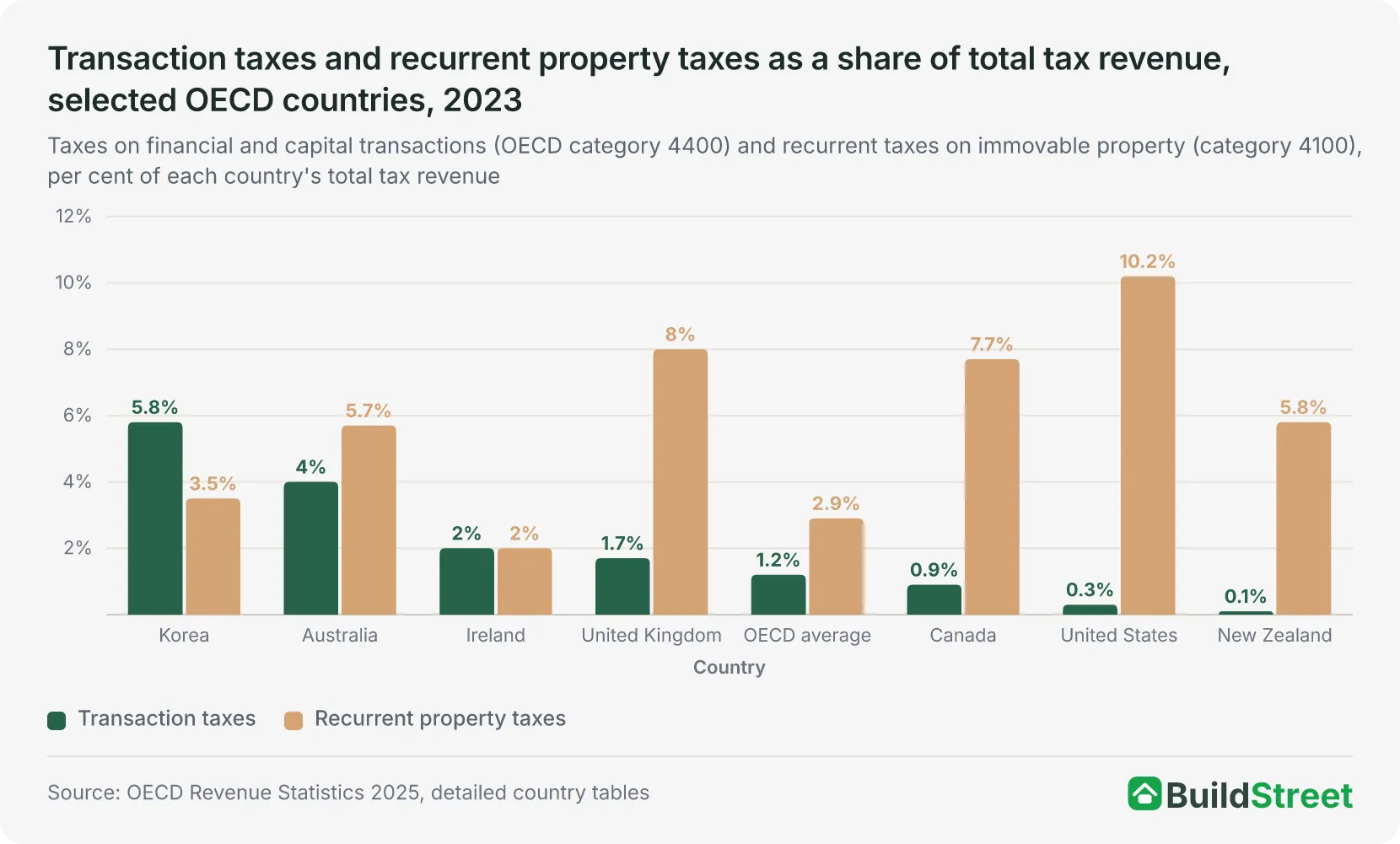
Transaction taxes accounted for 2.0 per cent of Ireland's total tax revenue in 2023 and 1.7 per cent of the United Kingdom's1. Canada, the United States and New Zealand had transaction-tax shares of 0.9 per cent, 0.3 per cent and 0.1 per cent respectively.
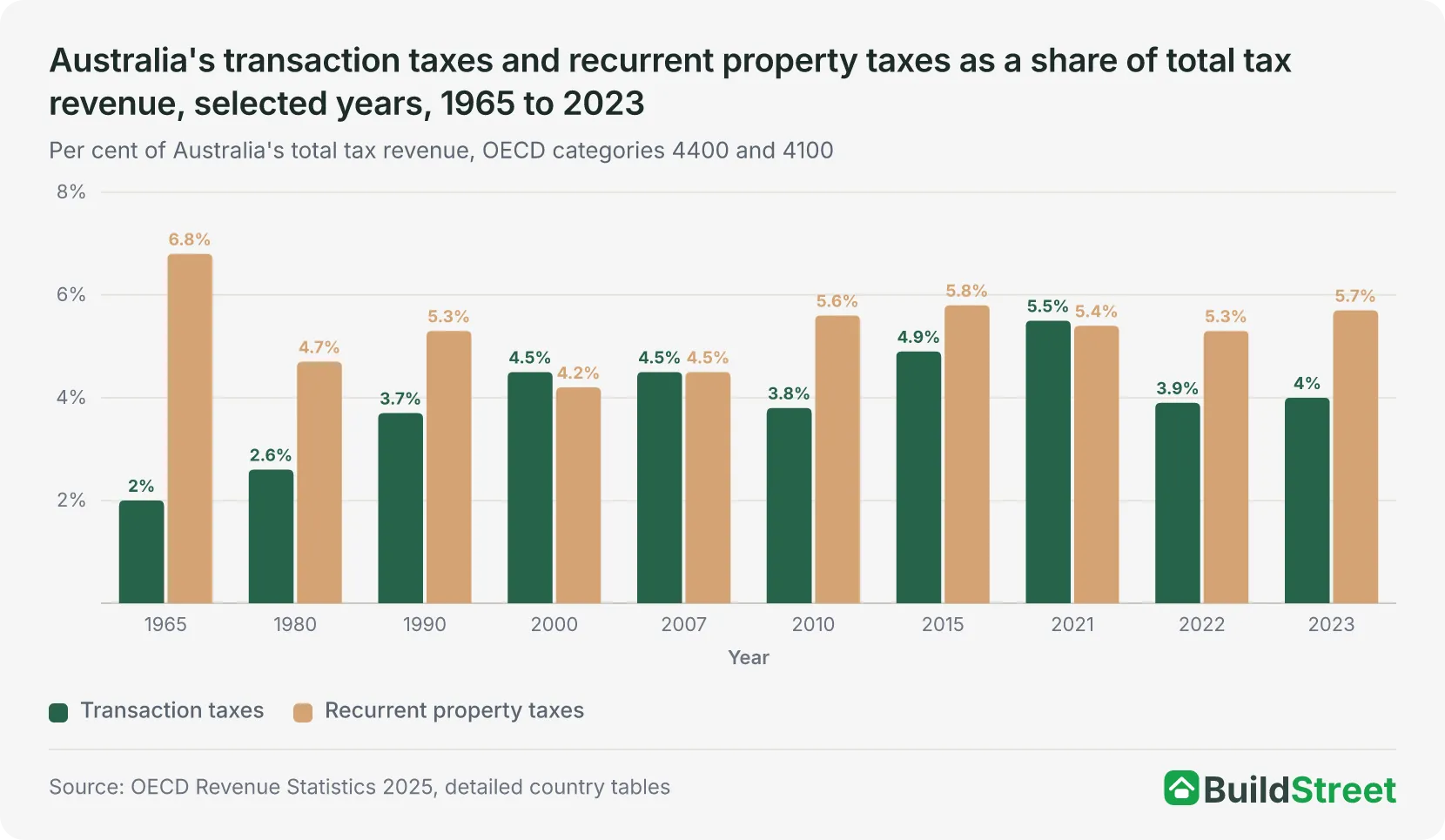
Australia's transaction-tax share rose from 2.0 per cent in 1965 to 4.5 per cent in 2000. It was 5.5 per cent in 2021, 3.9 per cent in 2022 and 4.0 per cent in 20231.
Section 02 · Annual property taxes
How does Australia's land tax compare with other countries?
Australia recorded the sixth-highest share of tax revenue from annual taxes on land and buildings among the 38 OECD countries in 2023, at 5.7 per cent, compared with an OECD average of 2.9 per cent1. The OECD calls these recurrent property taxes, which are charged regularly on land and buildings.
The United States recorded the highest share of tax revenue from recurrent property taxes among the 38 OECD countries in 2023, at 10.2 per cent, followed by the United Kingdom at 8.0 per cent and Canada at 7.7 per cent1. New Zealand, Korea and Ireland had recurrent property tax shares of 5.8 per cent, 3.5 per cent and 2.0 per cent respectively.
All property taxes together accounted for 9.7 per cent of Australia's total tax revenue in 2023, making it the sixth-highest share among the 38 OECD countries2. The OECD average for all property taxes, a category that also includes taxes on net wealth, estates, inheritances and gifts, was 5.1 per cent1.
| Property taxes as a share of total tax revenue, selected OECD countries, 2023 | |||||
|---|---|---|---|---|---|
| Country | Recurrent property taxes (%) | Rank of 38 | Transaction taxes (%) | Rank of 38 | All property taxes (%) |
| United States | 10.21 | 1 | 0.3 | 31 | 11.3 |
| United Kingdom | 8.01 | 2 | 1.7 | 10 | 10.5 |
| Canada | 7.7 | 3 | 0.9 | 16 | 9.9 |
| New Zealand | 5.8 | 4 | 0.1 | 33 | 5.9 |
| Australia | 5.71 | 6 | 4.01 | 2 | 9.71 |
| Korea | 3.5 | 12 | 5.81 | 1 | 11.5 |
| OECD average | 2.9 | not ranked | 1.21 | not ranked | 5.11 |
| Ireland | 2.0 | 19 | 2.0 | 8 | 4.6 |
Source · OECD Revenue Statistics 2025, Tables 5.1 to 5.38.
The guide to land tax in each state and territory sets out the land tax thresholds and rates in each state and territory.
Section 03 · Duty on a home
What does a home buyer pay in stamp duty in Australia and overseas?
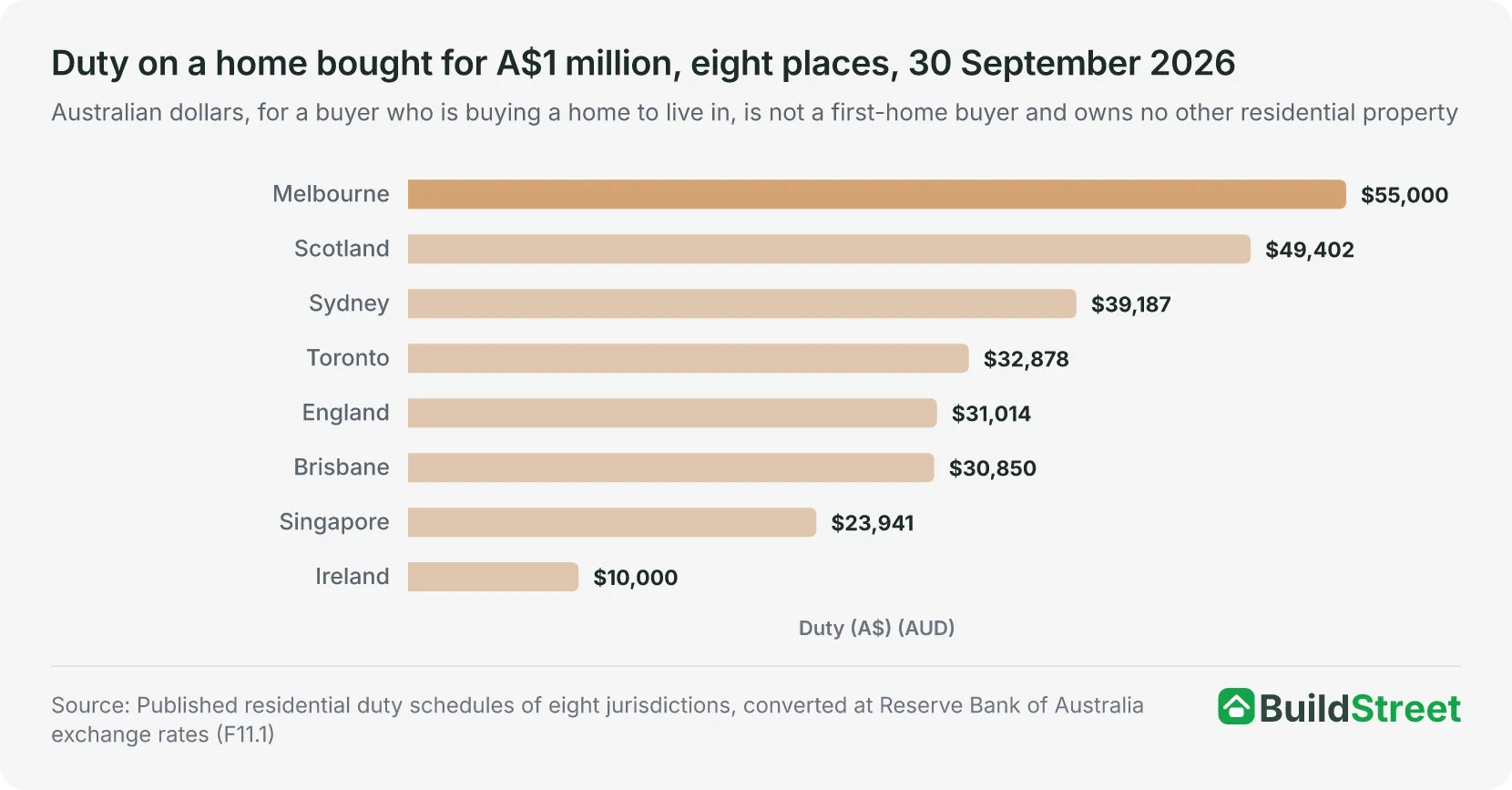
Melbourne had the highest stamp duty among the eight places compared, at $55,000 on a $1 million home3. This represented 5.5 per cent of the price under Victoria's general land transfer duty rates as at 30 September 2026. Ireland recorded the lowest duty, at $10,000, or 1.0 per cent of the price4. Irish stamp duty on the equivalent price of €615,000 was €6,150.
The calculations are based on a buyer purchasing a home to live in, who is not a first-home buyer and owns no other residential property. Overseas prices and duties are converted at the Reserve Bank of Australia's exchange rates for 30 September 20265.
Scotland recorded the second-highest duty among the eight places, at $49,402, or 4.9 per cent of the price6. Scotland's Land and Buildings Transaction Tax on the equivalent price of £526,700 was £26,020.
Sydney recorded duty of $39,187, or 3.9 per cent of the price, under the New South Wales general transfer duty rates7.
Toronto recorded duty of $32,878, or 3.3 per cent of the price89. A buyer in Toronto pays both Ontario's land transfer tax and the City of Toronto's municipal land transfer tax, which apply the same rates below C$2 million89. The two taxes together totalled C$32,546 on the equivalent price of C$989,9008.
England recorded duty of $31,014, or 3.1 per cent of the price10. England's Stamp Duty Land Tax on £526,700 was £16,335.
In Brisbane, duty under Queensland's home concession rate was $30,850, or 3.1 per cent of the price11, compared with $38,025 under the general transfer duty rates12.
Singapore recorded duty of $23,941, or 2.4 per cent of the price13. Singapore's Buyer's Stamp Duty on S$891,200 was S$21,336.
| Duty on a home bought for A$1 million, eight places, 30 September 2026 | |||||
|---|---|---|---|---|---|
| Place | Tax | Price in local currency | Duty in local currency | Duty (A$) | Duty as a share of the price (%) |
| Melbourne | Victorian land transfer duty, general rates | A$1,000,000 | A$55,000 | 55,000 | 5.5 |
| Scotland | Land and Buildings Transaction Tax | £526,700 | £26,020 | 49,402 | 4.9 |
| Sydney | New South Wales transfer duty | A$1,000,000 | A$39,187 | 39,187 | 3.9 |
| Toronto | Ontario land transfer tax plus Toronto municipal land transfer tax | C$989,900 | C$32,546 | 32,878 | 3.3 |
| England | Stamp Duty Land Tax | £526,700 | £16,335 | 31,014 | 3.1 |
| Brisbane | Queensland transfer duty, home concession rate | A$1,000,000 | A$30,850 | 30,850 | 3.1 |
| Singapore | Buyer's Stamp Duty | S$891,200 | S$21,336 | 23,941 | 2.4 |
| Ireland | Stamp duty, residential rates | €615,000 | €6,150 | 10,000 | 1.0 |
Source · Revenue NSW; State Revenue Office Victoria; Queensland Revenue Office; GOV.UK; Revenue Scotland; Revenue (Ireland); Ontario Ministry of Finance; City of Toronto; IRAS; RBA F11.1.
Worked example · $1 million home in Sydney
This is an example calculation based on the New South Wales general transfer duty thresholds that apply from 1 July 2026. For a dutiable value from $387,001 to $1,290,000, duty is $11,602 plus $4.50 for every $100 over $387,0007.
On a $1 million home, the value over $387,000 is $613,000, which adds $27,585 at $4.50 for every $100. The duty is $11,602 plus $27,585, or $39,187.
The article on stamp duty in each Australian state and territory sets out the rates, concessions and surcharges in all eight jurisdictions.
Section 04 · No stamp duty
Which countries have no stamp duty?
New Zealand abolished stamp duty under the Stamp Duty Abolition Act 1999, which applies to documents signed after 20 May 1999, the date the Act received royal assent14.
New Zealand's recurrent taxes on land and buildings accounted for 5.8 per cent of its total tax revenue in 2023, compared with an OECD average of 2.9 per cent1. The OECD records NZ$198 million of transaction-tax revenue for New Zealand in 2023, or 0.1 per cent of total tax revenue, which it lists as instrument duty.
Five OECD countries recorded no revenue, or less than 0.01 per cent of total tax revenue, from taxes on financial and capital transactions in 2023: Czechia, Estonia, Iceland, Lithuania and the Slovak Republic1. Czechia's real property transfer tax raised CZK 11.6 billion in 2015 and CZK 9 million in 2023.
However, no recorded transaction-tax revenue does not necessarily mean property transfers are free of government charges. The OECD does not count a fee that is clearly related to the cost of providing a service as a tax1.
Section 05 · Reforms
How are other countries reforming property taxes?
England plans to introduce an additional annual property tax from April 2028 for homes worth £2 million or more. The proposed High Value Council Tax Surcharge would be paid alongside existing council tax, under the UK government's proposals15. The government announced the surcharge in the 2025 Budget and consulted on its design from 19 May to 14 July 2026.
The consultation proposes four tax bands. The lowest is £2,500 a year for properties worth £2 million to £2.5 million, and the highest is £7,500 a year for properties worth more than £5 million15.
The surcharge is forecast to raise around £430 million a year from 2028-29. Fewer than 1 per cent of residential properties in England would be subject to it15.
Since 2 October 2024, Ireland has charged residential stamp duty of 6 per cent on the portion of the price above €1.5 million. The lower rates are 1 per cent up to €1 million and 2 per cent from €1 million to €1.5 million4.
Singapore increased its highest residential Buyer's Stamp Duty rate from 4 per cent to 6 per cent on 15 February 2023. The previous rate had applied since 20 February 201813.
Toronto introduced higher municipal land transfer tax rates on 1 April 2026 for homes with one or two single-family residences worth more than C$3 million. The rates range from 4.40 per cent on the portion above C$3 million to 8.60 per cent on the portion above C$20 million9.
In Australia, the Australian Capital Territory (ACT) began replacing stamp duty on property transfers with higher annual land taxes, known as general rates, in 2012-13. The reform was introduced in five-year stages16.
Progress in the ACT has slowed during the long transition, according to the OECD's Economic Survey of Australia 2026. New South Wales cancelled a similar move after a change of government17.
20 May 1999
New Zealand's Stamp Duty Abolition Act 1999 received royal assent. Stamp duty does not apply to legal documents executed after 20 May 1999.
2012-13
The Australian Capital Territory began replacing property transfer duty with higher annual land taxes, known as general rates, in five-year stages.
15 February 2023
Singapore's top marginal Buyer's Stamp Duty rate on residential property rose from 4 per cent to 6 per cent.
2 October 2024
Ireland's 6 per cent residential stamp duty rate on the portion above €1.5 million took effect.
1 April 2026
Toronto's graduated municipal land transfer tax rates for homes worth more than C$3 million took effect.
April 2028
England's proposed High Value Council Tax Surcharge on homes worth £2 million or more is due to start.
Source · Stamp Duty Abolition Act 1999 (NZ); ACT Budget 2019-20; IRAS; Revenue (Ireland); City of Toronto; GOV.UK.
Section 06 · The OECD average
What if Australia's stamp duty matched the OECD average?
If transaction taxes had accounted for the OECD average of 1.18 per cent of Australia's total tax revenue in 2023, they would have raised about $9.4 billion1. This compares with the $32.1 billion actually collected, a difference of about $22.6 billion.
This is an example calculation that applies the OECD average share, 1.2 per cent when rounded, to Australia's 2023 total tax revenue of $798.3 billion1. It is not a forecast and does not account for changes in property prices, sales volumes or buyer behaviour.
If the same $22.6 billion were raised through annual property taxes instead, their share of Australia's total tax revenue would rise from 5.7 per cent to about 8.5 per cent1. That would be higher than the United Kingdom's share of 8.0 per cent but lower than the United States' share of 10.2 per cent in 2023.
The OECD's Economic Survey of Australia 2026 recommends replacing state property transfer taxes with annual land taxes to bring property taxation more closely into line with taxes on other assets17. According to the OECD, transaction taxes increase the cost of moving, which can limit workers' ability to relocate and discourage older homeowners from moving to smaller homes.
The OECD also reports that annual property tax revenue is more stable from year to year than stamp duty revenue17. An initial loss of revenue is identified as a key obstacle to the switch, and the federal government may have a role in compensating states and territories for the early shortfall.
The article on stamp duty and land tax forecasts shows what state and territory budgets expect for both taxes to 2029-30.
Section 07
Frequently asked questions
Does New Zealand have stamp duty?
No, New Zealand abolished stamp duty under the Stamp Duty Abolition Act 1999, which applies to legal documents executed after 20 May 1999. Annual taxes on land and buildings accounted for 5.8 per cent of New Zealand's total tax revenue in 2023.
How much stamp duty is payable on a $1 million home in Sydney?
Transfer duty on a $1 million home in Sydney is $39,187, or 3.9 per cent of the price, under the New South Wales thresholds that apply from 1 July 2026. The figure is for a buyer who is not a first-home buyer and claims no concession.
Is stamp duty higher in Australia than in the United Kingdom?
In the comparison of $1 million homes as at 30 September 2026, stamp duty was higher in Melbourne ($55,000) and Sydney ($39,187) than in England ($31,014). Duty was $49,402 in Scotland and $30,850 in Brisbane under Queensland's home concession rate.
References
- OECD Revenue Statistics 2025 · doi.org ↑ b c d e f g h i j k l m n o p q r s t u
- OECD, Revenue Statistics 2025: Australia country note · oecd.org ↑
- State Revenue Office Victoria — Land transfer duty current rates (non-principal place of residence) · sro.vic.gov.au ↑
- Revenue (Ireland), Stamp Duty and property: rates · revenue.ie ↑ b
- Reserve Bank of Australia, Exchange Rates, Statistical Table F11.1 · Reserve Bank of Australia ↑
- Revenue Scotland, Land and Buildings Transaction Tax: residential property · revenue.scot ↑
- Revenue NSW — Calculate Transfer Duty · revenue.nsw.gov.au ↑ b
- Ontario Ministry of Finance, Calculating land transfer tax · ontario.ca ↑ b c d
- City of Toronto, Municipal Land Transfer Tax and Municipal Non-Resident Speculation Tax rates and fees · toronto.ca ↑ b c
- GOV.UK, Stamp Duty Land Tax: residential property rates · gov.uk ↑ b
- Queensland Revenue Office — Transfer Duty Concession Rates · qro.qld.gov.au ↑ b
- Queensland Revenue Office, Transfer duty rates · qro.qld.gov.au ↑
- Inland Revenue Authority of Singapore, Buyer's Stamp Duty (BSD) · iras.gov.sg ↑ b
- Stamp Duty Abolition Act 1999 (New Zealand) · Parliamentary Counsel Office ↑
- GOV.UK, High Value Council Tax Surcharge (consultation) · gov.uk ↑ b c
- ACT Budget 2019-20, ACT tax reform program on track · treasury.act.gov.au ↑
- OECD Economic Surveys: Australia 2026 · oecd.org ↑ b c
- State Revenue Office Victoria, Land transfer duty, principal place of residence, current rates · sro.vic.gov.au ↑
