

Published 6 Aug 2026
Owner-builders are not covered for defects in their own work under any operating statutory home warranty scheme in Australia. Four of eight states and territories exclude owner-built work outright, while three direct cover to a future owner. Tasmania's 2023 amendments were enacted but have not commenced as yet.
Where statutory cover exists, it varies by state: published amounts run from $200,000 to $400,000, permit thresholds from $10,000 to $25,000, and owner-builder statutory periods from five years to seven years and six months. These figures govern different forms of cover, obligations and legal periods and are not directly comparable.
 What home warranty insurance covers in Australia: state-by-state rules, limits and claim triggersHome warranty insurance requirements vary substantially across Australia. Cover becomes compulsory above $3,300 of building work in Queensland and at or above $25,000 in the Northern Territory. Betwee…
 What happens when a home builder becomes insolvent in Australia?When a residential builder becomes insolvent mid-build, the amount a homeowner may recover depends on the state or territory, the contract date, the certificate and the way the builder failed. Austral…
Section 01 · Owner-builder status
How owner-builder status affects insurance requirements
New South Wales, Queensland, South Australia and the ACT exclude owner-built work from statutory home warranty cover outright.
Victoria, Western Australia and the Northern Territory operate a scheme that can reach the property but directs the benefit to a future owner rather than the person who built it. The remaining jurisdiction, Tasmania, has enacted amendments that have not commenced, so no operating scheme has commenced yet.
The differences reflect how the schemes are structured. Statutory home warranty cover is constructed around a contract between a consumer and a licensed builder. Work performed personally by the owner-builder falls outside ordinary statutory cover for the owner-builder's own benefit.
Responsibility for the work generally transfers to the owner-builder through the permit. In New South Wales, an owner-builder carries the same responsibility for the work as a licensed builder would. In Western Australia, the holder of an owner-builder approval is the person responsible for the building work on their own home. Whether an insurance obligation attaches at that same point depends on the jurisdiction.
Four jurisdictions state the exclusion directly:
- New South Wales: excludes home building compensation cover for work done by the owner-builder.
- South Australia: excludes an owner-builder from taking out building indemnity insurance for work they perform themselves.
- Queensland: excludes owner-builder work from cover under the Queensland Building and Construction Commission Act 1991.
- ACT: sets it out in legislation rather than guidance. Section 87(b) of the Building Act 2004 provides that Part 6, which is where the statutory warranties, standard conditions, insurance and fidelity certificate provisions sit, does not apply once an owner-builder licence has been granted.
The three approaches apply at different stages. An outright exclusion operates from the start. Cover directed to a future owner may become relevant when the property is sold. In Tasmania, the position may change when the enacted amendments commence.
How the rules differ in Victoria, Western Australia, the Northern Territory and Tasmania
Victoria and Western Australia defer the insurance requirement rather than removing it entirely. In both jurisdictions, statutory scheme cover is not required before the owner-builder begins work. Cover becomes mandatory only if the home is sold within the relevant period.
The Northern Territory sequences it the other way. An owner-builder must obtain a fidelity fund certificate before the building permit is issued, but the cover it buys responds only after the property is transferred and only if one of four listed events occurs: the owner-builder becomes bankrupt, dies, disappears, or has their registration cancelled. Until then, the owner-builder bears the completion and defect risks directly.
Tasmania requires a $5 million public liability certificate of currency to accompany the permit application. The current Residential Building Work Contracts and Dispute Resolution Act 2016 passes statutory warranties to a person who later acquires an owner-built residential building. No operating owner-builder home warranty insurance obligation was confirmed in official material.
Section 02 · Types of cover
What insurance is available to owner-builders in Australia?
Six of eight Australian jurisdictions publish a headline statutory cover amount, ranging from $200,000 to $400,000. None of those schemes pays that amount to the owner-builder for defects in their own work.
The distinction is between statutory cover that may protect a consumer or future owner and the project or liability insurance an owner-builder may need to arrange separately.
How statutory cover differs from project and liability insurance
Statutory warranty cover and project or liability insurance cover different risks.
Statutory schemes respond to specified failures involving a licensed builder, while project and liability policies respond to events on the site itself: someone is injured, materials are stolen, a storm damages partly completed work. Official guidance treats the two as separate obligations rather than alternatives.
For eligible contracts signed from 1 July 2026, Victoria's Home Warranty expressly includes eligible incomplete, defective or non-compliant work where the builder is unable or unwilling to complete or fix it. Other jurisdictions define their claim triggers differently. New South Wales lists death, insolvency, disappearance and licence suspension following non-compliance with a money order, while Queensland covers specified non-completion, unrectified defects, and subsidence or settlement.
The schemes are more accurately compared by their stated claim triggers than ranked as uniformly broad or narrow.
Official guidance identifies different insurance categories for owner-builders:
- New South Wales categorises public liability insurance as strongly recommended for the owner-builder, workers compensation cover as a type to consider, and contract works insurance as expected of contractors.
- The ACT lists workers compensation, public liability and expanded home insurance as the categories relevant to owner-builders.
- South Australia points to insuring owner-supplied items during construction and insuring the completed building.
- Tasmania makes public liability insurance a condition of the permit rather than a recommendation.
- Victoria names theft, fire and storm damage, personal injury, and public risks and accidents as the risk categories to insure against before starting.
These forms of cover are not interchangeable. Public liability insurance does not pay to rectify defective work, while a statutory scheme does not cover stolen building materials.
Published statutory home warranty cover limits
Six jurisdictions publish a headline monetary amount. Each governs a different legal object: a scheme limit in Victoria and Queensland, cover of up to $340,000 in New South Wales, a minimum cover amount in the ACT, a cap on an insurer's liability in South Australia, and a payout limit in Western Australia. The amounts are therefore not directly comparable as a ranking.
The published amounts span $200,000 to $400,000, with three of the six jurisdictions publishing a $200,000 amount. Two changed recently: the South Australian figure rose from $80,000 to $250,000 in November 2025, an increase of 212.5%, while the ACT's rose from $85,000 to $200,000 on 1 January 2025. The ACT Responsibilities page continues to display the superseded $85,000 figure.
Western Australia publishes two further figures alongside its payout limit: loss-of-deposit cover of $40,000, and a permitted excess of $500 that the owner or their successors in title may have to pay on a claim.
None of these six headline amounts is payable to an owner-builder for defects in their own work during construction. However, eligible owner-built work may later be covered for the benefit of a purchaser.
Victoria's owner-builder home warranty covers defective, incomplete or non-compliant work that was not identified in the defects inspection report. The purchaser is the beneficiary, not the seller, and the owner-builder may still be directed to return and fix the work or to pay for its rectification. Western Australia's resale policy similarly covers the new owner for the remainder of the seven-year period.
Section 03 · Statutory schemes
Home warranty insurance rules for owner-built homes
Seven separate scheme names are in use across Australia's eight states and territories, and none covers an owner-builder's own work for their own benefit.
There is no national product, and in most jurisdictions no product is even called home warranty insurance. Every state and territory uses a different label, and the treatment of owner-built work differs with it.
The table below sets each regulator's own scheme name against what it does with the owner's work and with a licensed contractor's, one column at a time across all eight jurisdictions.
| Statutory scheme names and their treatment of owner-built work, by state and territory, Australia | |||
|---|---|---|---|
| Jurisdiction | Statutory scheme | Owner-builder's own work | Licensed contractor's package |
| New South Wales | Home building compensation (HBC) | Cover is not available. | Required where the contract exceeds $20,000. |
| Victoria | Home Warranty from 1 July 2026; Domestic Building Insurance for earlier policies | Not treated as a registered builder's insured contract during the build. | Required for eligible new contracts over $20,000. |
| Queensland | Queensland Home Warranty Scheme | Not covered under the QBCC Act 1991. | General trigger of more than $3,300 including GST, but no premium is payable for work for a permitted owner-builder. |
| Western Australia | Home indemnity insurance (HII) | Not required before building; mandatory on an early sale. | Required for residential building work over $20,000. |
| South Australia | Building indemnity insurance (BII) | Cannot be taken out for self-performed work. | Required at $20,000 or more for approved domestic work. |
| Tasmania | No operating owner-builder scheme confirmed | Not confirmed in current official material. | Not confirmed in current official material. |
| Australian Capital Territory | Residential building insurance and fidelity certificates | Excluded by Building Act 2004 s 87(b). | General trigger of $12,000 or more, but Part 6 does not apply where an owner-builder licence has been granted. |
| Northern Territory | Fidelity fund certificate | Certificate required, but cover is designed for future owners. | Required for prescribed work regardless of value for a new house; over $25,000 for floor-area-increasing work. |
Source · Building Commission NSW; Building and Plumbing Commission (Vic); QBCC; Building and Energy (WA); SA.GOV.AU and PlanSA; Consumer, Building and Occupational Services (Tas) and the Residential Building Work Contracts and Dispute Resolution Act 2016; ACT City and Environment Directorate and the Building Act 2004; Northern Territory Government.
The schemes affect owner-built homes in different ways. In some jurisdictions, owner-built work is excluded outright. In Victoria, Western Australia and the Northern Territory, cover may instead protect a future owner.
Statutory cover for licensed contractor packages
Statutory cover can apply to work performed by licensed contractors on an owner-builder project, but only four jurisdictions publish a contractor-package threshold that clearly applies in this context.
Work an owner-builder contracts out to a licensed builder can attract statutory cover in four jurisdictions, each using a $20,000 threshold:
- New South Wales requires a licensed contractor who contracts directly with an owner-builder to provide home building compensation cover where that contract exceeds $20,000, with the certificate coming before work starts or payment is made.
- Victoria requires registered builders on eligible new domestic contracts signed from 1 July 2026 to obtain Home Warranty for work over $20,000.
- Western Australia requires a registered builder to obtain home indemnity insurance for residential building work valued at more than $20,000, including work contracted directly by an owner-builder.
- South Australia requires an insurance certificate from each building work contractor carrying out domestic building work valued at $20,000 or more that forms part of a development approval, provided to the council before that work commences.
Queensland and the ACT publish lower general triggers, at more than $3,300 including GST and $12,000 respectively, but neither applies to work performed inside a permitted owner-builder project. In Queensland, no premium is payable. In the ACT, the statutory exclusion removes the part of the Act that would otherwise require cover. The Northern Territory's certificate requirements attach to prescribed categories of residential building work rather than the value of an individual contractor package.
In New South Wales and South Australia, the threshold applies to the value of the individual contract rather than the project as a whole. Cover can therefore vary across the same project. South Australian guidance describes contractor cover as divided by the scope and value of each insured contract, so a project involving several trade contracts is not covered by one policy applying to the entire build.
Engaging an unregistered domestic builder in Victoria may also invalidate Home Warranty cover, leaving the owner-builder personally liable for the resulting defects.
Section 04 · Sale obligations
Owner-builder sale rules and statutory periods by state
Seven jurisdictions state a period relevant to owner-builder work, but not every period is a resale window. The measures include sale-document duties, periods during which insurance must be obtained on sale, protection for later owners, and claim or proceeding limits. They range from five years to seven years and six months and begin from different statutory events.
- Length: from five years to seven years and six months.
- Starting point: four different trigger events.
- What it governs: four different obligations.
The ACT states no owner-builder resale insurance period in its current guidance.
The length of a period does not indicate how many obligations apply. New South Wales has the longest period at 7 years 6 months and one sale requirement, a warning in the contract; Victoria is shorter at 6 years and has four, being cover, a notice, an inspection report and warranties.
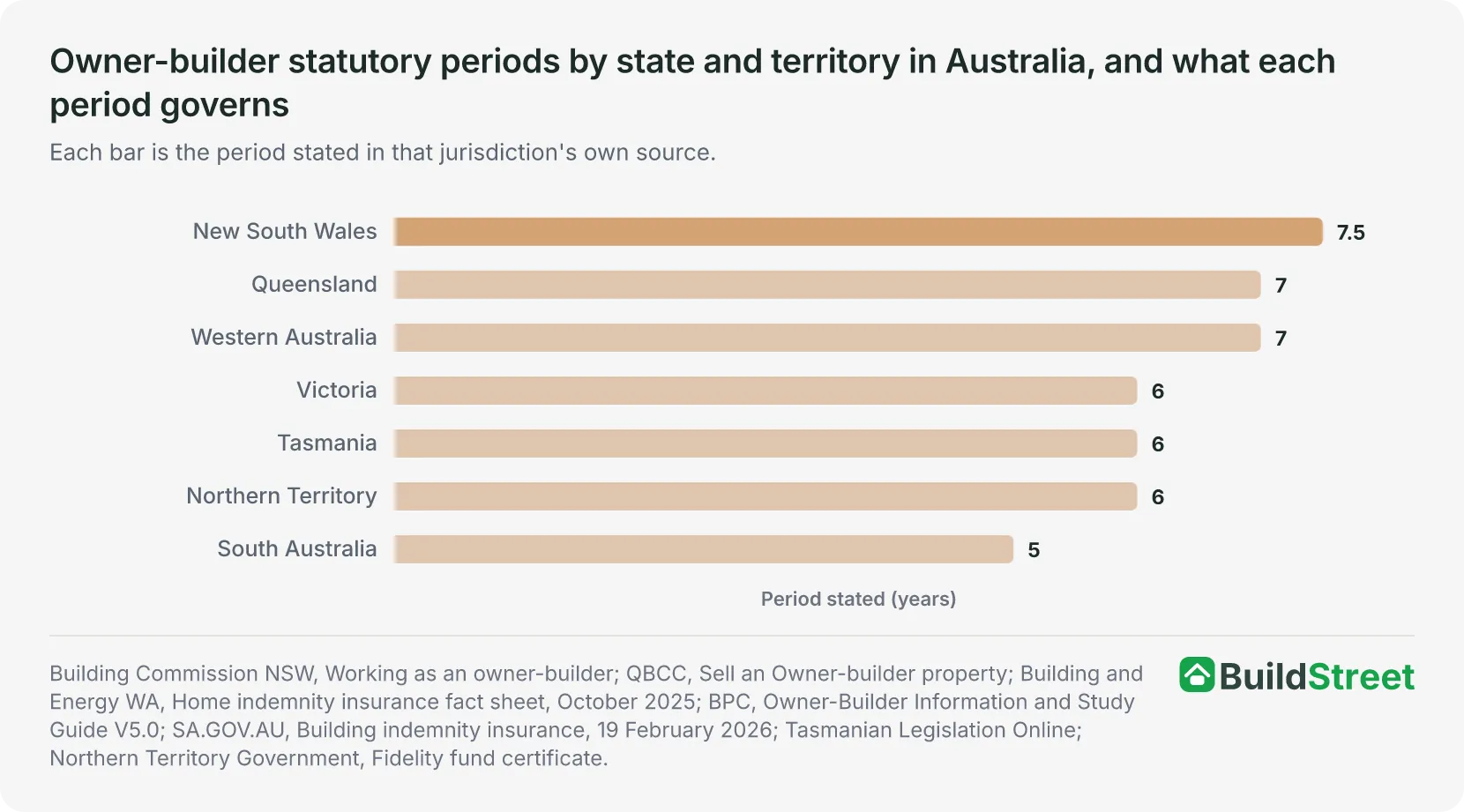
Six years is the most common figure, stated by three of the seven jurisdictions, and in each it governs something different: an insurance requirement in Victoria, a proceeding limit in Tasmania, and cover for a later owner in the Northern Territory.
Only Victoria and Western Australia use the period as a window during which an owner-builder must obtain insurance before selling. The other periods relate to a warning, notice, title notation, claim limit or protection for a later owner.
South Australia's five-year period is also different from the others. It applies to defective-work claims under a contractor's building indemnity policy, rather than to an owner-builder resale insurance requirement.
Owner-builder resale rules and protection periods by state and territory
The obligations behind those periods fall into three groups: buy cover, provide a document, or do nothing specific at the sale.
| Owner-builder requirements on an early sale by state and territory | ||
|---|---|---|
| Jurisdiction | What the sale rule requires | Period and what it runs from |
| New South Wales | The sale contract must include the prescribed consumer warning. The work stays uninsured; the next immediate owner receives statutory warranty rights. | 7 years 6 months from issue of the owner-builder permit |
| Victoria | Obtain Home Warranty or DBI cover, provide the notice of cover, obtain a defects inspection report no older than six months from a prescribed practitioner, and give statutory warranties in the contract of sale. | 6 years, generally from completion; see the caution below |
| Queensland | Give the buyer two copies of the prescribed notice and obtain a signed copy by the time the contract is signed. The notice states that the owner-built work is not covered by insurance. | Owner-builder advice stays on the title for 7 years |
| Western Australia | Obtain home indemnity insurance from an approved insurer and give the purchaser a valid certificate before the sale contract is finalised. | 7 years from grant of the building permit; the policy covers the remainder |
| South Australia | Disclose whether building indemnity insurance is in place. No separate owner-builder resale insurance trigger was identified in current official guidance. | BII defective-work claims usually up to 5 years from completion |
| Tasmania | No owner-builder resale insurance step identified. A purchaser or later acquirer of an owner-built residential building receives statutory warranties by operation of the Act. | Proceedings generally within 6 years of practical completion |
| Australian Capital Territory | No owner-builder resale insurance trigger identified. Regulatory rectification responsibility can continue after the sale. | No owner-builder resale insurance period identified |
| Northern Territory | No purchase step at sale. Cover becomes available to the new owner only after transfer and only on one of four listed events. | Structural-defect cover described as 6 years after completion |
Source · As listed for the chart above, together with PlanSA Advisory Notice Building 03/25 (November 2025) and the ACT City and Environment Directorate, Responsibilities.
Two of the eight jurisdictions require an insurance product on an early sale, while three require a warning, notice or disclosure. The remaining three impose nothing specific at the point of sale, although Tasmania and the Northern Territory provide protection to a later owner through other mechanisms.
The difference is most visible when Victoria and South Australia are compared. A Victorian owner-builder selling in year five faces four separate obligations before the contract can be signed. A South Australian owner-builder selling in the same year faces one, and it is a disclosure rather than a purchase.
Victoria's owner-builder resale period
Victoria's resale window is stated two ways: six years in one current official source and six and a half years in another. The period therefore requires qualification.
The Victorian obligations are cumulative rather than alternative. The defects inspection report must comply with section 137B of the Building Act 1993, must be no older than six months, must list all defective or non-compliant work with detailed photographs, and a copy goes to the buyer.
Work listed in the report is excluded from cover, because it has been disclosed to the purchaser. Defective work not included in the report may instead support a claim against the seller for breach of the statutory warranties.
Selling without the report, the cover and the warranties attracts 100 penalty units in Victoria, and the purchaser may seek to have the contract of sale treated as voidable. The warranties cannot be contracted out of, and they extend to later owners.
Western Australia enforces its rule differently. Failing to give a prospective purchaser a valid certificate of insurance before the sale contract is finalised can lead to prosecution and a $10,000 fine. Where home indemnity insurance cannot be obtained at all, the property cannot lawfully be sold within seven years of the building permit being granted.
The document-based rules carry their own consequences too. In New South Wales, omitting the prescribed warning can allow a purchaser to void the contract before settlement. In Queensland, omitting the prescribed notice means a warranty that the work was carried out properly is implied into the sale, and the seller may be liable under that warranty.
Section 05 · Permits
What permits and insurance do owner-builders need?
Two jurisdictions require an insurance document at the owner-builder permit or approval stage: Tasmania and the Northern Territory. South Australia imposes a conditional requirement that attaches to contracted packages rather than to the owner-builder's own application. Elsewhere, the permit and the insurance are separate steps that meet later, if at all.
- Tasmania requires a $5 million public liability certificate of currency with the owner-builder permit application, together with evidence of a Construction Industry OHS Induction Course, or white card. For Class 1a work, evidence of an owner-builder course completed within the previous 12 months is also required. The form states it will not be processed without the attachments.
- The Northern Territory requires a fidelity fund certificate before the building permit is issued. An owner-builder certificate is required for eligible work to build or extend a home where the work exceeds $25,000. The certificate remains separate from the building permit.
- South Australia routes the certificates through the council. Where a domestic building work contract is in place at the time of application, the certificate must accompany the building consent application. Otherwise, it must be lodged before commencement of the relevant work.
- Western Australia also requires a home indemnity insurance certificate with a building permit application for contracted work. However, this requirement applies to a registered builder and does not require an owner-builder to obtain cover before building their own home.
New South Wales, Victoria, Queensland, Western Australia and the ACT set their owner-builder and insurance thresholds independently.
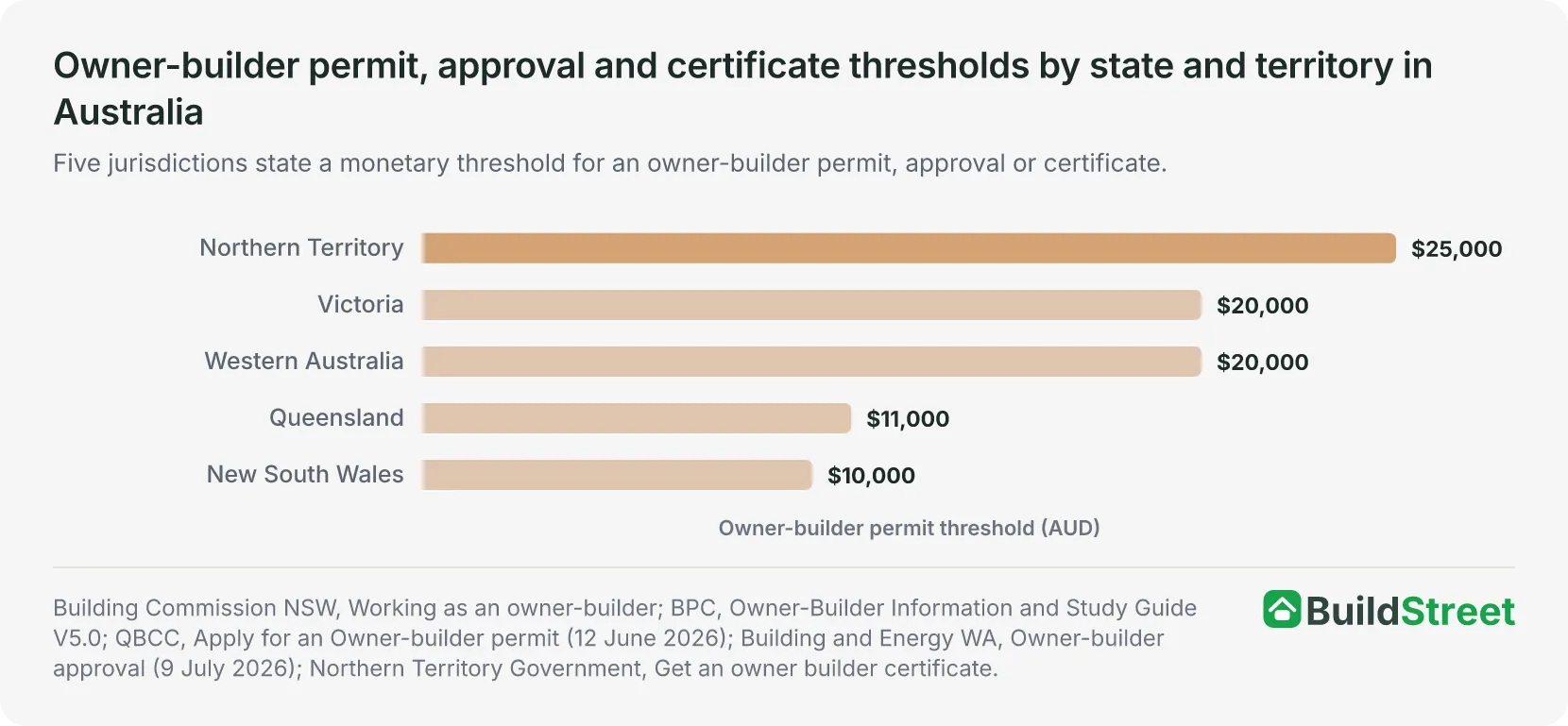
The permit thresholds span $10,000 to $25,000. Statutory-cover triggers use different tests and do not always apply within an owner-builder project.
| Statutory-cover thresholds within owner-builder projects | |||
|---|---|---|---|
| Jurisdiction | General trigger | Applies inside an owner-builder project | What the trigger attaches to |
| New South Wales | More than $20,000 | Yes | The value of the individual contract between the licensed contractor and the owner-builder. |
| Victoria | More than $20,000 | Yes | Eligible new domestic building contracts signed from 1 July 2026. |
| Western Australia | More than $20,000 | Yes | Residential building work, with the builder taking out cover in the owner's name. |
| South Australia | $20,000 or more | Yes | Each contractor's package of approved domestic building work forming part of a development approval. |
| Queensland | More than $3,300 including GST | No | Most residential building work under the scheme. A premium is not payable for work performed for an owner builder who holds a permit for the work. |
| Australian Capital Territory | $12,000 or more | No | Certain alterations or additions to certain kinds of existing residence. Section 87(b) disapplies Part 6, which contains the insurance provisions, where an owner-builder licence has been granted. |
| Northern Territory | No value threshold for a new house; more than $25,000 for floor-area-increasing work | Not as a package test | Prescribed residential building work and the owner-builder's own fidelity certificate, rather than the value of an individual contractor package. |
| Tasmania | None published | No trigger identified | No operating owner-builder or contractor scheme trigger was identified in current official material. |
Source · QBCC, Who pays home warranty and when; ACT City and Environment Directorate, Responsibilities; Building Commission NSW, Working as an owner-builder; BPC, Home Warranty (30 June 2026); Building and Energy WA, Home indemnity insurance fact sheet (October 2025); PlanSA Advisory Notice Building 03/25 (November 2025); Northern Territory Government, Fidelity fund certificate.
Seven jurisdictions publish a general monetary trigger for statutory cover, but only four apply a contractor-value threshold within an owner-builder project. New South Wales, Victoria and Western Australia above that amount, and South Australia at $20,000 or more.
Queensland's general trigger is the lowest of the eight at $3,300, but no premium is payable for work performed for an owner-builder who holds a permit. The ACT's $12,000 trigger also does not apply once an owner-builder licence has been granted. The Northern Territory applies its certificate requirements to prescribed categories of work rather than to the value of each contractor package.
Dollar thresholds for owner-builders in Victoria
A Victorian owner-builder can encounter three separate monetary tests on one project:
Victoria runs three separate dollar tests that an owner-builder can encounter on one project:
- Contracting out domestic building work valued at over $10,000 including labour and materials generally requires a registered domestic builder and a major domestic building contract.
- Undertaking owner-builder domestic building work valued at over $20,000 requires a certificate of consent from the Building and Plumbing Commission (BPC).
- A registered builder engaged on eligible new work over $20,000 must obtain Home Warranty.
The two $20,000 tests apply to different things: one to the owner's project, and one to an individual contract.
The Victorian guide notes that some tradespeople attempt to split trades or split contracts to fall below the $10,000 threshold. Western Australia applies a similar rule for its owner-builder threshold.
A Victorian certificate of consent is valid for 12 months from the date of issue, or until the building permit lapses if one is obtained. The Building and Plumbing Commission generally cannot issue a certificate where the applicant has held an owner-builder building permit within the previous five years.
The BPC may refuse a certificate where the applicant has previously entered into a contract of sale without obtaining the cover required of an owner-builder.
Section 06 · Risks and liabilities
What risks and liabilities do owner-builders carry?
Owner-builders can remain personally responsible for defective work, site safety, rectification and uninsured losses.
In Tasmania, an owner-builder's permit declaration acknowledges possible liability to subsequent owners for defective work for up to 10 years after completion or the issue of an occupancy permit. In Victoria and the ACT, a regulatory rectification order can still be issued against an owner-builder after the property has been sold.
The difference from using a licensed builder is not only the absence of statutory cover for the owner-builder's own work. Duties that would ordinarily sit with a licensed builder sit with the owner, and some continue after the property changes hands.
No comparable national data on owner-builder claims, disputes or defect rates was identified in official sources, so the differences below are differences in stated duty rather than in measured outcome.
Uninsured and non-delegable owner-builder risks
Work health and safety responsibility can transfer to the owner-builder through the permit or approval process:
- The Tasmanian permit declaration has the applicant confirm they are the person in control of a business or undertaking under the Work Health and Safety Act 2012.
- Western Australia describes the owner-builder as responsible for safe-site management, supervision, certification and defect rectification.
- Queensland places site, quality, work health and safety, contracting and certification duties on the owner-builder.
Defect liability can extend to later owners. The Tasmanian declaration records that the applicant is responsible for the quality of the work and may be liable to subsequent owners for defective building work up to 10 years after completion or the issue of an occupancy permit.
This 10-year declaration is separate from Tasmania's six-year statutory-warranty proceeding period. The figures appear in different documents and govern different obligations.
In New South Wales, the owner-builder may face a statutory-warranty claim from the next owner. In Victoria, a purchaser who finds defective work that did not appear on the required defects report can claim against the seller for breach of the statutory warranties.
Rectification directions can survive a sale. The ACT states that a rectification order may issue even after the property has been sold. In Victoria, the regulator can direct an owner-builder to rectify defective, incomplete or non-compliant work that was not identified in the defects inspection report, and may recover rectification costs from the seller.
A rectification order differs from an insurance claim because it requires work to be completed or corrected rather than providing funds for the loss.
Site and property losses can also remain with the owner-builder. Victorian guidance identifies theft of materials, property or money, fire and storm damage, personal injury, and public risks and accidents as relevant insurance risks. South Australian guidance refers to cover for owner-supplied materials during construction and for the completed building.
These risks may otherwise be covered under a licensed builder's contract works or public liability policies, depending on the policy terms.
Statutory cover may also be divided across several contracts. A licensed-builder client has one contract and one certificate, while an owner-builder project can involve several contractor packages. Only packages that meet the applicable threshold generate statutory cover.
Sale penalties and contract consequences
The main sale penalties and contract consequences are covered in Section 4. In summary, Victoria and Western Australia publish quantified penalties for failing to meet owner-builder sale requirements, while New South Wales, Victoria and Queensland attach consequences to the sale contract itself.
Section 07 · Comparison
How owner-builder insurance rules differ across states
The eight jurisdictions differ in their permit triggers, scheme names, thresholds, sale obligations and residual liabilities. One finding is consistent across all eight: no statutory scheme pays an owner-builder for defects in their own work.
State and territory comparison
Four attributes distinguish the eight jurisdictions: the owner-builder permit trigger, whether statutory cover applies to the owner's own work, the requirements on an early sale, and the main residual exposure.
Reading across a row gives one jurisdiction's position; reading down a column shows which attributes move and which hold.
| Owner-builder permit triggers, statutory cover and sale obligations by state and territory | ||||
|---|---|---|---|---|
| Jurisdiction | Permit or approval trigger | Statutory cover for own work | On an early sale | Main exposure |
| New South Wales | Permit for work over $10,000 where the owner performs or supervises without a licensed builder supervising | HBC cover not available | Prescribed consumer warning within 7 years 6 months of permit issue | Guarantees the work; may face a statutory-warranty claim from the next owner |
| Victoria | Certificate of consent for owner-builder domestic work over $20,000 | Not treated as an insured contract during the build | Home Warranty or DBI cover, notice of cover, defects inspection report and statutory warranties | Personal liability for undisclosed defects; rectification order and cost recovery |
| Queensland | Permit for work over $11,000 including GST | Not covered under the QBCC Act 1991 | Two copies of the prescribed notice, one signed by contract signing | No scheme payout for own work; implied warranty if the notice is omitted |
| Western Australia | Approval may be required where a building permit is needed and work exceeds $20,000 | No HII required before building | HII from an approved insurer covering the remainder of 7 years from the permit | Professional-builder responsibilities; HII responds only after specified circumstances |
| South Australia | No dollar threshold identified; duties hinge on approved domestic building work | Cannot take out BII for self-performed work | Disclose whether BII is in place | Self-performed work has no BII behind it; contractor cover fragmented by contract |
| Tasmania | Permit for relevant Class 1a, 8 and 10 work; $5 million public liability certificate required | No operating owner-builder scheme confirmed | Statutory warranties pass to the acquirer; proceedings generally within 6 years | Direct defect liability and site safety duties without a confirmed scheme backstop |
| Australian Capital Territory | Licence for building work needing building approval; work starts after a commencement notice | Excluded from Part 6 by Building Act 2004 s 87(b) | No resale insurance trigger identified | No Part 6 protection; can be ordered to rectify non-compliant work after sale |
| Northern Territory | Certificate to build or extend a home where work exceeds $25,000, separate from the building permit | Fidelity certificate required, but cover is for future owners | No purchase step; cover available after transfer and one of four listed events | Carries completion and defect risk directly until transfer and a trigger event |
Source · The 25 official sources listed in the references.
The statutory-cover column is the one that does not materially change across the table. None of the eight jurisdictions provides cover that pays an owner-builder for their own defective or incomplete work.
Sale obligations vary more widely. New South Wales and Queensland require a warning or notice, South Australia requires disclosure, Victoria and Western Australia require insurance-related steps, and Tasmania and the Northern Territory pass protection to a later owner through other mechanisms.
Permit thresholds do not indicate the overall weight of the obligations. New South Wales has the lowest monetary permit trigger, at $10,000, but one sale-document requirement. Victoria uses a $20,000 trigger and imposes four requirements on an early sale.
Recent owner-builder scheme and threshold changes
Three jurisdictions changed a threshold or a scheme during the nine months to 31 July 2026.
South Australia's building indemnity insurance threshold rose from $12,000 to $20,000 on 10 November 2025, and the same amending regulations raised the limit on an insurer's liability from $80,000 to $250,000, a calculated rise of 212.5%.
The Northern Territory's certificate threshold rose from $12,000 to $25,000 on 30 March 2026, applying to fidelity certificates issued after that date.
Queensland's owner-builder sale notice page was published in 2021 and remained the current official statement of the rule in the sources used for this article.
References
- NSW Government – Working as an owner-builder · nsw.gov.au
- Information for owner-builders · sira.nsw.gov.au
- Selling an owner-built home · bpc.vic.gov.au
- Owner-Builder Information and Study Guide, V5.0 · bpc.vic.gov.au
- Building and Plumbing Commission (Victoria): Home Warranty · bpc.vic.gov.au
- Apply for an Owner-builder permit · qbcc.qld.gov.au
- Sell an Owner-builder property · qbcc.qld.gov.au
- Understanding the Queensland Home Warranty Scheme · qbcc.qld.gov.au
- Owner-builder approval · wa.gov.au
- Department of Local Government, Industry Regulation and Safety (WA): Home indemnity insurance factsheet · wa.gov.au
- Department for Housing and Urban Development (SA): Advisory Notice Building 03/25 - Building Indemnity Insurance · plan.sa.gov.au
- Building Work Contractors (Building Indemnity Insurance) Amendment Regulations 2025 · legislation.sa.gov.au
- Building indemnity insurance · sa.gov.au
- Building surveyors and owner builders · cbos.tas.gov.au
- Application for owner builder permit, version 1.0 · cbos.tas.gov.au
- Residential Building Work Contracts and Dispute Resolution Act 2016 (Tas) · legislation.tas.gov.au
- Residential Building (Home Warranty Insurance Amendments) Bill 2023 fact sheet · parliament.tas.gov.au
- Responsibilities · planning.act.gov.au
- Building Act 2004 (ACT), ss.88, 89F · legislation.act.gov.au
- Get an owner builder certificate · nt.gov.au
- Northern Territory Government – Fidelity fund certificate · nt.gov.au
- State Insurance Regulatory Authority (NSW): Home building compensation for homeowners · sira.nsw.gov.au
- Queensland Building and Construction Commission – Queensland Home Warranty Scheme · qbcc.qld.gov.au
- Who pays home warranty and when · qbcc.qld.gov.au
- ACT Planning – Residential building work insurance · planning.act.gov.au
