

Published 30 July 2026
Seven of Australia's eight states and territories run an active last-resort scheme for homeowners whose builder fails partway through a job. However, the protection available depends heavily on where the work is carried out. Among the five that publish a directly comparable maximum payout, the most a scheme will pay ranges from $200,000 in Queensland and Western Australia to $400,000 in Victoria. The contract value that triggers cover varies just as much, from Queensland's $3,300 general threshold to the Northern Territory's $25,000 for additions that increase floor area; different kinds of threshold, not a directly comparable pair.
Those maximums are not like-for-like. Schemes differ in the work they cover, what has to go wrong before a claim can be made, how long cover lasts and what sub-limits sit inside the headline figure. A maximum payout is also a different kind of number from a minimum required insurance sum or a percentage-of-contract limit, so the ACT and Northern Territory amounts do not belong in the same comparison. Tasmania is the only jurisdiction with no confirmed operating scheme at all.
 Why builder insolvencies increased after 2020Construction company failures rose from 1,284 in 2021-22 to 3,596 in 2024-25, a 180% increase in three years, before easing to 3,472 in 2025-26. Construction remained the single largest industry for i…
 What happens when a home builder becomes insolvent in Australia?When a residential builder becomes insolvent mid-build, the amount a homeowner may recover depends on the state or territory, the contract date, the certificate and the way the builder failed. Austral…
Section 01 · Overview
Home warranty insurance schemes across Australia
Seven of the eight state and territory schemes are active, and each uses a different name. Thresholds start at $3,300 and run up to $25,000.
Home warranty insurance is a last resort. It responds when a builder cannot finish the job or cannot meet a valid claim for defective work, usually because they have died, disappeared, become insolvent or lost their registration.
The different names reflect real structural differences. A fidelity fund is a pooled guarantee run by an approved body, while an insurance policy is a contract with an insurer. Both are grouped here because they do the same job for a home owner, not because they are the same legal instrument.
| Home warranty insurance schemes and provider models in each Australian state and territory | ||
|---|---|---|
| Jurisdiction | Scheme name | Provider model |
| Queensland | Queensland Home Warranty Scheme | Government-administered statutory scheme |
| Victoria | Home Warranty Insurance from 1 July 2026; Domestic Building Insurance for earlier contracts | Government scheme managed by the Building and Plumbing Commission |
| New South Wales | Home Building Compensation insurance | icare Home Building Compensation Fund, currently the only insurer providing cover |
| South Australia | Building Indemnity Insurance | Approved private insurers with government reinsurance |
| Western Australia | Home Indemnity Insurance | Approved private insurers |
| Australian Capital Territory | Residential building work insurance or fidelity cover | Authorised private insurer or approved fidelity fund |
| Northern Territory | Fidelity fund certificate | Approved fidelity fund |
| Tasmania | No active home warranty insurance scheme identified | Legislated last-resort scheme not shown as operational in current official consumer guidance |
Source · State and territory scheme guidance and legislation, listed in the references. Current settings at 29 July 2026.
Who carries the risk changes from one jurisdiction to the next:
- Queensland and Victoria run government schemes.
- New South Wales has a single government insurer.
- South Australia and Western Australia use approved private insurers.
- The Northern Territory uses a fidelity fund rather than an insurance policy.
- The ACT allows either an insurer or a fund.
- Tasmania has the legislation but no confirmed operating scheme.
Section 02 · Comparison
Home warranty insurance cover by state and territory
Five jurisdictions publish a maximum payout on a directly comparable basis. Cover ranges from $200,000 to $400,000, a ratio of 2.0 between the highest and lowest, with a median amount of $250,000.
The ACT sets a minimum insurance amount rather than a maximum payout, while Northern Territory sources give a fidelity-certificate minimum alongside a percentage-of-contract limit, and Tasmania has no confirmed operating scheme, so none of the three jurisdictions is included in the maximum payout comparison.
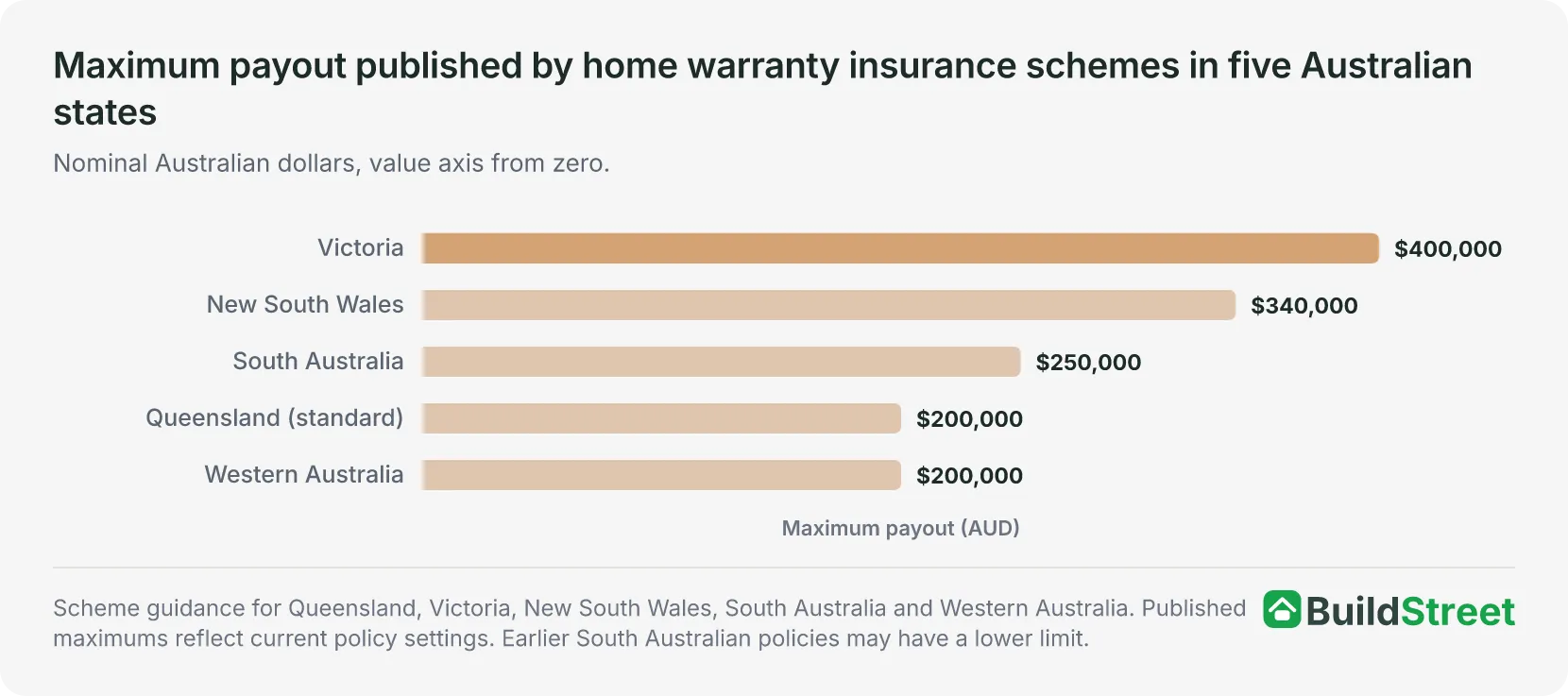
A state at the top of this range can still pay out less than one at the bottom, once sub-limits, excesses and the definition of eligible work are counted.
| urisdiction | Scheme | Contract threshold | Cover | Claim trigger | Periods and notes | Source |
|---|---|---|---|---|---|---|
| Victoria (highest maximum payout) | Home Warranty Insurance | Contracts over $20,000, from 1 July 2026 | $400,000 maximum | Builder unable or unwilling to complete or rectify the work | Earlier contracts: former Domestic Building Insurance arrangements continue to apply | Building and Plumbing Commission Victoria |
The $25,000 Northern Territory threshold for qualifying additions and extensions is 7.6 times Queensland’s $3,300 threshold. However, the two figures apply to different definitions of work and are not equivalent thresholds within a common national scheme.
Some published figures carry qualifications that are not captured by the headline amounts.
Western Australia: $40,000 deposit sub-limit
Loss of deposit is covered to $40,000, and an insurer may charge a $500 excess. The fact sheet lists the deposit cover separately from the $200,000 completion limit without stating whether it sits inside that limit.
Australian Capital Territory: $200,000 prescribed
The current regulation prescribes a $12,000 contract threshold, a $200,000 insurance amount, a five-year insurance period, a 180-day claim period and a maximum $500 excess. A prescribed insurance amount is the sum a policy must provide, not the ceiling on what a scheme will pay, so it is not equivalent to the charted maximums and the Territory stays outside that chart. The amount rose from $85,000 on 1 January 2025, an increase of 135.3% calculated from the two published amounts.
Northern Territory: published cover measures are not directly comparable
The government consumer page states no dollar maximum. Fidelity Fund NT states cover of up to $200,000, subject to a 20% contract-price limit. The regulations prescribe $200,000 as the minimum fidelity-certificate amount and require non-completion cover of at least 20% of the contract price. A minimum certificate amount and a percentage-of-contract limit are not the same measure as a maximum payout, so the Territory stays outside the five-jurisdiction chart. Claims must be lodged within 90 days.
Recent changes to home warranty insurance schemes, 2023 to 2026
Several jurisdictions have altered thresholds, prescribed amounts, administration or scheme rules in the past three years. As a result, figures in older guidance may no longer reflect current settings.
2023
Tasmania legislates to enable a scheme
Enabling legislation allowed a residential building warranty insurance scheme to be reintroduced. However, enabling legislation does not confirm that a scheme is operating.
1 January 2025
ACT raises the minimum insurance amount
The minimum amount of residential building work insurance rose from $85,000 to $200,000, and the claim lodgement period increased from 90 days to 180 days.
1 July 2025
Building and Plumbing Commission begins operating
The Building and Plumbing Commission began operating and took over the domestic building insurance functions previously administered by the Victorian Managed Insurance Authority. Domestic Building Insurance remained the applicable scheme for eligible contracts and policies issued before Home Warranty began on 1 July 2026.
10 November 2025
South Australia raises its threshold
The building indemnity insurance threshold rose from $12,000 to $20,000, lining it up with New South Wales and Western Australia.
30 March 2026
Northern Territory reforms take effect
For fidelity fund certificates issued after this date, the threshold for additions and extensions that increase floor area rose from $12,000 to $25,000.
1 July 2026
Victoria's Home Warranty Insurance scheme begins
For eligible contracts entered into from this date, cover is required above $20,000 with a maximum of $400,000, and can apply where the builder is unable or unwilling to finish or fix the work. Contracts signed earlier stay under the former Domestic Building Insurance arrangements.
Section 03 · Queensland
How does Queensland’s Home Warranty Scheme work?
At $3,300, Queensland’s threshold is the lowest in the country, well under the $20,000 used in New South Wales, South Australia and Western Australia. The standard maximum is $200,000, with an optional increase to $300,000. Structural defects are generally covered for six years and six months, and claims must usually be lodged within three months of the defect being identified.
The scheme is government-run rather than sold by private insurers, and it responds to both non-completion and defective work, with conditions that vary by claim type.
That six-year-and-six-month cover period is the longest published structural period among the schemes reviewed, although Queensland allows an extension in some circumstances. Shorter limits apply to non-structural and other claims.
The $300,000 amount is optional rather than the standard level of cover, so a Queensland policy is not automatically equal to a scheme that publishes $300,000 as its standard maximum.
Section 04 · Victoria
What does Victoria’s home warranty insurance cover?
Victoria's maximum cover is $400,000, the highest in the country. It applies to eligible contracts signed from 1 July 2026, when the Home Warranty Insurance scheme started, on domestic building work worth more than $20,000.
Cover can apply where the builder is unable or unwilling to finish the work or fix defective work. That is a broader trigger than the death, disappearance or insolvency test most other jurisdictions use.
Contracts signed before 1 July 2026 stay under the former Domestic Building Insurance arrangements, on the terms attached to those contracts. The applicable rules depend on the contract date, not on when the claim is made.
Section 05 · New South Wales
How does home warranty insurance work in New South Wales?
New South Wales sets its maximum payout at $340,000, above the $200,000 standard maximums in Queensland and Western Australia and below Victoria’s $400,000. Cover is required on residential work over $20,000 including GST.
The current term is Home Building Compensation insurance, and icare’s Home Building Compensation Fund is the only insurer that provides this cover.
The trigger goes beyond death, disappearance and insolvency. It also responds where a builder’s or tradesperson’s licence is suspended for failing to comply with a money order.
Claims for major defects can be made for six years and other losses for two years. New apartment buildings are covered only when they are three storeys or lower, so the scheme does not cover buyers in taller new apartment developments.
Section 06 · Tasmania
Does Tasmania have home warranty insurance?
Tasmania is the only Australian jurisdiction without a confirmed operating home warranty insurance scheme. A mandatory last-resort scheme covering contracts over $20,000 was legislated in 2023 and was expected to start in mid-2025.
There is no current operational scheme page, approved provider or official confirmation that the scheme began operating. The expected mid-2025 start date published in 2024 does not confirm that it took effect.
Section 07 · Scheme differences
How home warranty insurance differs by state and territory
Contract thresholds vary by a factor of 7.6 across the eight jurisdictions, structural defect periods run from five years to six years and six months, and claim lodgement periods range from 90 days to 180 days. Three of the eight jurisdictions do not publish a maximum payout that is directly comparable with the other five.
Those differences sit behind the headline amounts: what work is covered, what has to happen before a claim can proceed, how tall a building can be, and how long the claim window stays open. They come from the published rules rather than from any government finding, and no jurisdiction is ranked on how well its scheme performs, because the administrative statistics are not published on a common basis.
Contract value thresholds
The same renovation can be covered in one state and uncovered in another.
Work priced between Queensland's $3,300 threshold and the ACT's $12,000 is covered in one jurisdiction and not the other, and stays outside the $20,000 threshold used in Victoria, New South Wales, South Australia and Western Australia. The threshold range spans 7.6 times from lowest to highest, calculated from the $3,300 Queensland and $25,000 Northern Territory figures rather than from the five charted jurisdictions.
Claim triggers
Claim triggers depend on what happens to the builder.
In most jurisdictions, cover responds only once the builder is unable to meet their obligations because of a specified event, not simply because work is defective. Most schemes require the builder’s death, disappearance or insolvency before a claim can proceed. Queensland is one exception: its scheme responds to non-completion or defects, with conditions that vary by claim type. Victoria’s Home Warranty Insurance is another, applying where the builder is unable or unwilling to complete or rectify the work. New South Wales also includes licence suspension for failure to comply with a money order. As a result, eligibility for a claim involving similar defective work may differ between jurisdictions while the builder is still trading.
Building height and dwelling type
Some home warranty schemes exclude taller apartment buildings.
New South Wales covers new apartment buildings only up to three storeys, though renovations can be covered regardless of height. The ACT scheme is framed around houses and apartment buildings of three storeys and below. These schemes do not extend to new apartment buildings above those height limits, regardless of the headline cover amount.
Sub-limits and excesses
Identical maximum payouts may include different sub-limits.
Queensland and Western Australia both publish $200,000, but Queensland applies sub-limits to accommodation, removal and storage, while Western Australia sets a $40,000 loss-of-deposit sub-limit, allows a $500 excess and pays the contract value where that is lower. Maximum payouts are also nominal figures, and none of the sources reviewed states that the amounts are indexed.
Defect and lodgement periods
Defect and claim periods vary between jurisdictions.
Structural or major defect periods run from five years in South Australia to six years and six months in Queensland. Non-structural periods run from one year in the Northern Territory to two years in New South Wales and under Victoria’s former Domestic Building Insurance arrangements. Claim lodgement periods are separate from defect periods. The Northern Territory allows 90 days for lodging a claim, compared with 180 days in the ACT.
Cover figures that are not comparable
Three jurisdictions do not publish a directly comparable maximum payout.
Northern Territory sources use different measures of cover. The government consumer page states no dollar maximum, Fidelity Fund NT states up to $200,000 subject to a 20% contract-price limit, and the regulations set $200,000 as a minimum certificate amount with non-completion cover of at least 20% of the contract price. The ACT prescribes a minimum insurance amount rather than a maximum payout, and Tasmania has no confirmed active scheme. These differences prevent a complete national comparison of maximum payouts using official guidance alone.
What determines whether home warranty protection applies?
What a residential building contract protects depends on five things:
- the state or territory where the contract is signed
- the value of the work
- the height and type of the building
- the date the contract was signed
- what happens to the builder afterwards
A comparison based only on maximum payouts shows the headline amounts but does not capture differences in eligibility, claim triggers, sub-limits or access.
References
- Queensland Building and Construction Commission – Queensland Home Warranty Scheme · qbcc.qld.gov.au
- Queensland Building and Construction Commission – Maximum home warranty entitlements · qbcc.qld.gov.au
- Building and Plumbing Commission Victoria – Domestic Building Insurance and Home Warranty · bpc.vic.gov.au
- Building and Plumbing Commission (Victoria): Time limits and amounts for Home Warranty · bpc.vic.gov.au
- Building and Plumbing Commission Victoria – New BPC putting consumers first from day one · bpc.vic.gov.au
- State Insurance Regulatory Authority (NSW): Home building compensation for homeowners · sira.nsw.gov.au
- State Insurance Regulatory Authority (NSW): Home building compensation for builders and tradies · sira.nsw.gov.au
- South Australian Government Financing Authority – Building Indemnity Insurance · safa.sa.gov.au
- Department of Local Government, Industry Regulation and Safety (WA): Home indemnity insurance factsheet · wa.gov.au
- Building (General) Regulation 2008 (ACT), Part 4 · legislation.act.gov.au
- ACT Planning – Residential building work insurance · planning.act.gov.au
- Northern Territory Government – Fidelity fund certificate · nt.gov.au
- Fidelity Fund NT: For Homeowners · fidelityfundnt.com.au
- Building (RBI and Fidelity Fund Schemes) Regulations 2012 (NT) · legislation.nt.gov.au
- Premier of Tasmania: Home Warranty Insurance for Tasmanians a step closer · premier.tas.gov.au
- Residential Building Work Contracts and Dispute Resolution Act 2016 (Tas) · legislation.tas.gov.au
- Residential Building (Home Warranty Insurance Amendments) Act 2023 (Tas), s.2 · legislation.tas.gov.au
- Consumer, Building and Occupational Services Tasmania – Financial Assistance Package for consumers affected by construction company failures · cbos.tas.gov.au
