

Published 3 Aug 2026 · Updated 16 Sept 2026
When a residential builder becomes insolvent mid-build, the amount a homeowner may recover depends on the state or territory, the contract date, the certificate and the way the builder failed. Australia has no national home warranty scheme, and cover rules and payout limits differ across jurisdictions.
In 2025–26, 712 residential building companies entered external administration or had a controller appointed for the first time, according to ASIC.
Each of the eight selected scheme limits or statutory minimums is below the corresponding ABS 2024–25 average new-house cost for its state or territory. Their illustrative limit-to-cost ratios range from 31.0% in the ACT to 82.4% under Victoria's new scheme, with a median of 48.3%.
The measures are not directly comparable. They include total caps, policy limits, a per-category maximum, statutory minimum cover levels and Tasmania's temporary assistance maximum. In Queensland, non-completion accounted for 58.1% of the $284.4 million in home warranty claims approved over the five years to 2024–25.
 What home warranty insurance covers in AustraliaState-by-state rules, thresholds, cover limits and claim triggers, plus how the cover sits alongside statutory warranties and defects liability periods.
 How many homes are built in Australia each year?Two distinct cycles have shaped Australia's housing output since 2010:
Section 01 · First response
What happens first when a builder becomes insolvent mid-build?
In 2025–26, 712 residential building companies entered external administration or had a controller appointed for the first time, down 13.1% on the 819 recorded in 2024–25.
However, an external administration or controller appointment does not necessarily mean that a builder is insolvent or that work will stop.
A company under voluntary administration hands control to an administrator, who reports back to creditors on the options, including the option to continue trading.
Most home warranty schemes only respond to a defined event. A builder entering administration therefore does not, by itself, establish that a homeowner is eligible to make a claim.
Five matters commonly addressed before a home warranty claim
Official guidance in Victoria, Queensland and New South Wales identifies five common checks that may occur before a claim is lodged.
- Site records and project documents: Schemes can require mitigation and evidence, and site-security cover can carry its own deadline.
- The builder's legal entity and status: The contract name, ABN and ACN are matched against ASIC or AFSA records, and the administrator or liquidator is contacted.
- Contract termination requirements: Queensland generally requires a validly terminated fixed-price contract for a non-completion claim, while other schemes respond to specified insolvency, deregistration or licence events instead.
- The certificate or policy: Thresholds, building types, storey limits, contract dates and provider arrangements all differ.
- Notification requirements and deadlines: New South Wales guidance requires notification even before a claim trigger occurs.
The order differs by jurisdiction: contract termination is a precondition in one scheme and may create risks in others.
How often residential builders enter external administration
The 2025–26 count was the first annual decline in the five years covered by the ASIC series. Before this decline, the number of residential building companies entering external administration or having a controller appointed rose 156.7% from 319 in 2021–22 to 819 in 2024–25.
Not all of those appointments represent confirmed insolvencies. ASIC's Series 1 counts the first time a company enters external administration or has a controller appointed, which the regulator uses as a proxy for corporate insolvency rather than a count of it.
This article groups the appointments into three categories
- a liquidation category,
- administration or restructuring, and
- receiver or controller appointments.
The liquidation category includes 23 provisional-liquidator appointments in 2025–26. A provisional liquidator appointment does not, by itself, establish that a company will be wound up.
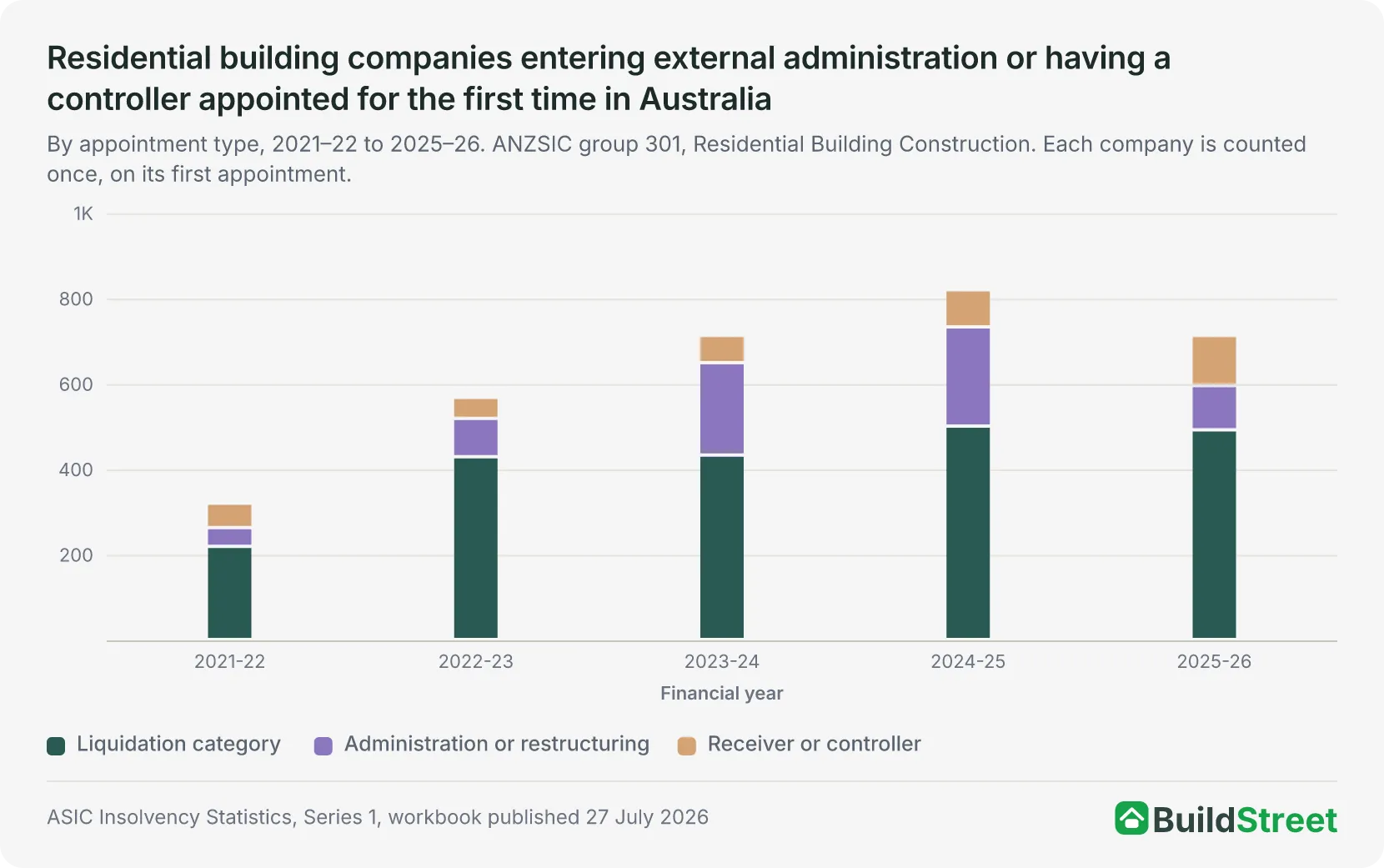
The composition moved as much as the total did. Administrations and restructurings peaked at 232 in 2024–25 and more than halved the following year, while receiver and controller appointments fell from 57 to 49 in 2022–23 and have risen in each year since, reaching 117. Across the five years, the liquidation category accounted for 2,069 of 3,129 appointments, or 66.1%.
New South Wales accounted for 322 of the 712 appointments in 2025–26, ahead of Victoria on 217 and Queensland on 114, measured by principal place of business.
Section 02 · Checking cover
How home warranty cover is confirmed in each state and territory
Contract-value thresholds for mandatory cover span almost an eightfold range across Australia, from $3,300 in Queensland to $25,000 in the Northern Territory. Each state and territory operates its own regime. Because Victoria has separate arrangements based on the contract date, the comparison contains nine entries.
Contracts signed in Victoria on or after 1 July 2026 fall under the new first-resort Home Warranty scheme, and earlier contracts remain on last-resort Domestic Building Insurance. Each scheme issues a certificate, notice of cover or approved-provider record, and each provides its own search route:
- Queensland uses a property insurance search against premiums received by the Queensland Building and Construction Commission (QBCC).
- Victoria uses the Notice of Cover or a policy search through the Building and Plumbing Commission.
- New South Wales uses the HBC certificate and HBC Check.
- Western Australia uses records held by the certificate issuer, insurer or permit authority.
Contract-value thresholds by jurisdiction
The applicable contract-value threshold determines whether mandatory cover is required before a certificate or scheme record is checked.
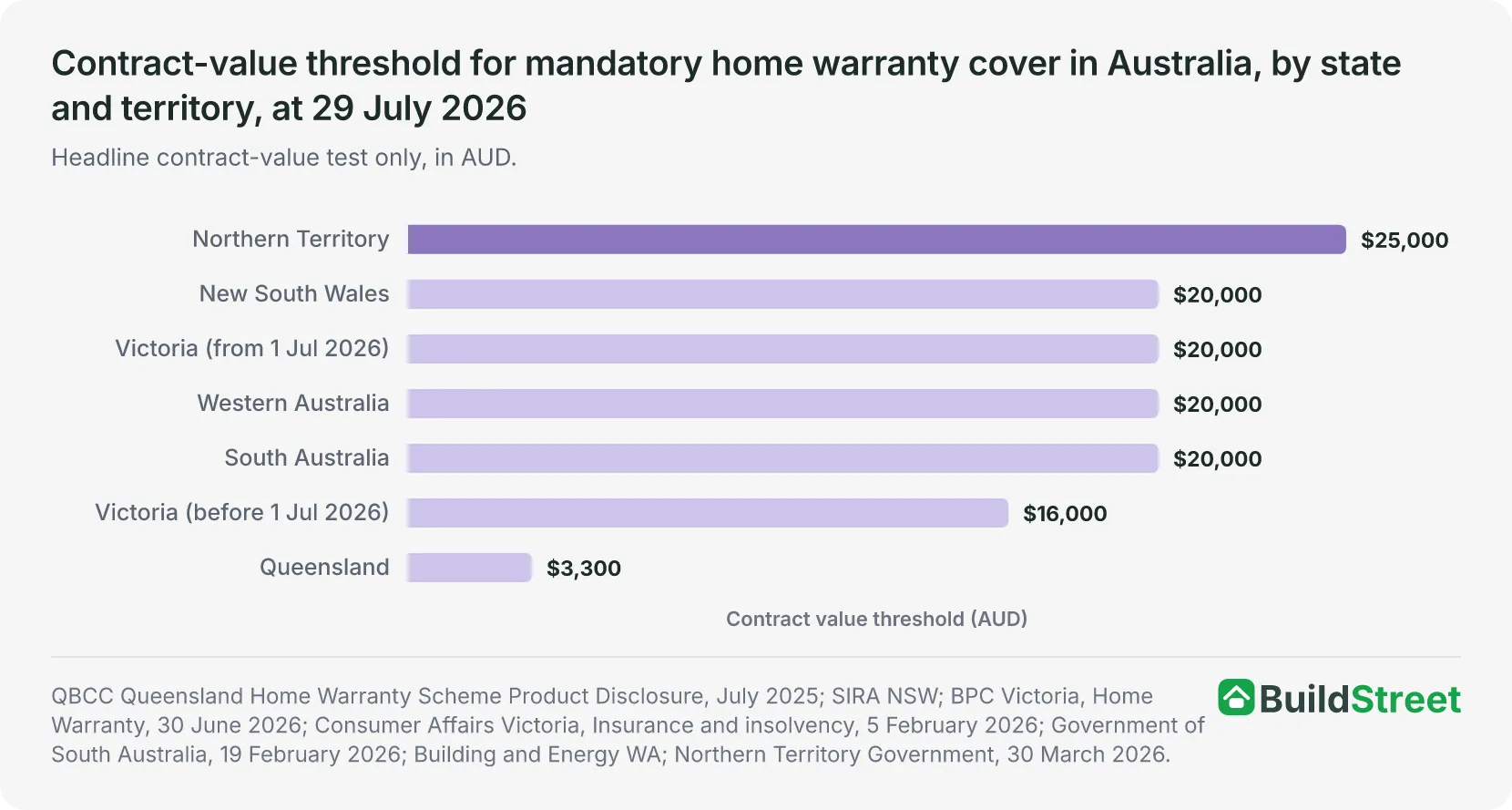
Queensland's $3,300 threshold applies to work that would fall well below the requirement everywhere else, including many single-trade renovations. At the other end, the Northern Territory's $25,000 threshold leaves a band of mid-sized jobs outside mandatory cover that would attract it in five other jurisdictions.
Victoria's two cohorts differ by $4,000, so contracts signed days apart in mid-2026 can sit on either side of the threshold and fall under different claim models.
The ACT works differently again. Rather than a value threshold, its rules require evidence of cover before the commencement notice, and apply to houses and apartments up to three storeys.
Section 03 · Claims process
How do home warranty claims work in Australia?
Lodgement windows run from 90 days to 12 months, but the deadlines apply to different claim types and begin from different events.
Queensland generally requires a contract to have been validly terminated because of the builder's default before a non-completion claim can proceed. Several schemes respond instead to a listed insolvency, deregistration or licence event, and Victoria's new scheme can respond where a builder is unable or unwilling to complete, without waiting for insolvency.
The seven common stages in a home warranty claim
The claims process can be organised into seven common stages, although the legal requirements and their order differ by jurisdiction. Most of the differences occur in the stages before a claim is lodged.
| Common claims backbone drawn from official scheme guidance, Australia, current at 29 July 2026 | ||
|---|---|---|
| Stage | What the step involves | Where jurisdictions diverge |
| 1. Site records and project documents | Photographs of the site, work completed, materials, defects and safety risks, and preservation of contracts, variations, plans, permits, invoices and messages. | Schemes can require mitigation and evidence, and site-security cover can carry its own deadline. |
| 2. Confirmation of the builder's identity and status | Matching the contract name, ABN and ACN, checking ASIC or AFSA, and contacting the administrator or liquidator. | Administration is not automatically liquidation or proof the builder will not continue. |
| 3. Contract termination requirements | Advice ahead of terminating, paying subcontractors or appointing another builder. | Queensland often needs valid termination; other schemes recognise specified insolvency, deregistration or licence events. |
| 4. Certificate or policy verification | Finding the certificate, Notice of Cover or policy, then checking the state register, insurer or permit authority. | Thresholds, building types, storey limits, contract dates and provider arrangements differ. |
| 5. Notification of the insurer or scheme | Written notice where required, including where the claim trigger or final loss has not yet been established. | Deadlines run from different starting events and range from 90 days to 12 months. |
| 6. Claim lodgement and supporting evidence | Contract, variations, plans and specifications, payment ledger, notices, reports and photographs, correspondence, certificate and insolvency evidence. | A still-trading builder may first receive a complaint or rectification notice; this can be waived after specified insurable events. |
| 7. Assessment and review | Assessment of liability and loss, expert reports, tenders, requests for further information and any review or appeal process. | A liability decision is not necessarily the end: scope, tendering, completion and review can each add time. |
Source · ASIC, Wind up an insolvent company; SIRA NSW, Make a home building compensation claim; Consumer Affairs Victoria, Insurance and insolvency, 5 February 2026; BPC Victoria, Making a claim, 30 June 2026; QBCC Product Disclosure, July 2025; Northern Territory Government, 30 March 2026.
Stages six and seven are broadly common across jurisdictions, although Victoria's new scheme may require a written complaint where the builder is still trading.
Home warranty claim lodgement deadlines by jurisdiction
The published deadlines are not directly comparable because they apply to different claim types and begin from different events. The shortest named window is 90 days, which applies to Northern Territory defective-work claims.
For Northern Territory certificates issued from 30 March 2026, a defective-work claim must be made within the cover period. The 90-day deadline therefore does not apply to a mid-build non-completion claim.
| Published claim lodgement windows by scheme, Australia, current at 29 July 2026 | ||
|---|---|---|
| Jurisdiction and cohort | Published window | Measured from |
| Northern Territory: defective work, certificates from 30 Mar 2026 | 90 days, within the cover period | The later of awareness of the defect and the trigger event |
| Northern Territory: non-completion, certificates from 30 Mar 2026 | Within the applicable cover period | The cover period, not a 90-day clock |
| Australian Capital Territory | 180 days | Awareness; increased from 90 days from 1 January 2025 |
| Victoria: DBI, contracts before 1 Jul 2026 | 180 days | Learning of the insolvency |
| Queensland: non-completion | 3 months | The date the contract ends |
| New South Wales: incomplete work and deposit | 12 months | The failure; the insurer is to be notified promptly |
| Victoria: Home Warranty, contracts from 1 Jul 2026 | 12 months | The event for incomplete work and site security; awareness for defects |
| Western Australia | Policy-specific | Not stated in the official fact sheet reviewed |
| South Australia | Policy-specific | Not stated in the official guidance reviewed |
| Tasmania: assistance package | Not stated | The package states that no standard timeframe can be provided |
Source · Building (RBI and Fidelity Fund Schemes) Regulations 2012 (NT), in force 30 March 2026, reg 40; Northern Territory Government, Fidelity fund certificate, 30 March 2026; ACT EPSDD, Residential building work insurance; Consumer Affairs Victoria, 5 February 2026; QBCC Product Disclosure, July 2025, printed p. 4; SIRA NSW; BPC Victoria, Time limits and value limits, 30 June 2026; Building and Energy WA, October 2025; SAFA; CBOS Tasmania.
The longest published window in the table is 12 months, compared with 90 days for the shortest specified claim type. This does not mean one scheme always provides four times as long to lodge a claim, because the deadlines cover different losses and begin from different events.
The Northern Territory defective-work clock runs from the later of defect awareness and the trigger event. The ACT clock begins when the homeowner becomes aware of the relevant insured event, such as the builder's insolvency, death or disappearance, rather than a building problem. Queensland's runs from the date the contract ends, which can precede awareness of any defect.
Victoria's new scheme adds a step the others do not share in the same form. Where the builder is still trading, a written complaint and a 28-day builder response period generally apply before a claim proceeds, though this may not be required after some insurable events.
Section 04 · Scope of cover
What home warranty insurance covers for incomplete and defective work
Every insurance-based scheme separates the cost of completing an unfinished home and the cost of repairing defective work after completion. Non-completion cover is often subject to a separate limit and may provide a smaller entitlement than defect cover. Where a scheme sets it as a share of the contract price, that share is 20% or 30%.
The two types of cover can also operate over different periods. In at least one jurisdiction, a non-completion payment reduces the amount remaining for a later defective-work claim.
Victoria's Home Warranty limits incomplete work to 30% of the contract price including variations, inside its $400,000 total, and older Victorian DBI policies may be limited to 20%.
Northern Territory regulations take the opposite approach and set a floor. An authorised policy must provide non-completion cover of at least 20% of the total contract price.
Three other jurisdictions calculate non-completion cover differently:
- Queensland pays the actual cost to complete, less the unpaid balance of the original contract, with reductions available in defined circumstances.
- Western Australia pays up to the completion cost or the contract value, whichever is lower.
- South Australia contributes to completion costs above the original contract price, subject to the policy limit.
Incomplete work, how it is limited
- Victoria, from 1 Jul 2026
30% of contract price
- Victoria, older DBI
May be 20%
- Northern Territory
At least 20%
- Tasmania, work started
20% of contract
- Tasmania, no work started
5% of contract
- Western Australia deposit cover
$40,000
Defect cover periods after completion
- New South Wales
6 yrs / 2 yrs
- Victoria
6 yrs / 2 yrs
- Queensland, structural
6 yrs 6 mths
- Western Australia
6 yrs from PC
- South Australia
5 yrs
- Northern Territory
6 yrs / 1 yr
Source · Note: Limits and defect periods as published by each scheme. Tasmania does not publish a defect period, so it is not listed in the second card. Source: BPC Victoria, Time limits and value limits, 30 June 2026; Consumer Affairs Victoria, 5 February 2026; Building (RBI and Fidelity Fund Schemes) Regulations 2012 (NT), as in force 30 March 2026, regs 17 and 48; CBOS Tasmania; Building and Energy WA, October 2025; SIRA NSW; QBCC Product Disclosure, July 2025; SAFA.
Living costs and site-protection payments can be included within the main scheme limit rather than provided in addition to it.
Victoria allows up to $12,000 for accommodation and $5,000 for site security, both counting toward the $400,000 total. Queensland's $200,000 category maximum includes up to $5,000 for alternative accommodation, removal and storage.
Queensland home warranty claims by cause
Queensland approved $284.4 million in home warranty claims across the five years to 2024–25. Non-completion accounted for 58.1% of the approved value, which was more than defective work and subsidence combined.
No comparable multi-year breakdown was located for another scheme in the official sources reviewed. The Queensland data therefore provides a state-specific measure of how approved claim value was distributed by cause, rather than a national pattern.
| Approved claims by cause and claims received, Queensland Home Warranty Scheme, 2020–21 to 2024–25 | |||||
|---|---|---|---|---|---|
| Measure | 2020–21 | 2021–22 | 2022–23 | 2023–24 | 2024–25 |
| Non-completion ($m) | 9.9 | 13.4 | 47.5 | 62.9 | 31.4 |
| Defective work ($m) | 16.6 | 16.9 | 17.3 | 21.7 | 23.5 |
| Subsidence ($m) | 4.8 | 5.7 | 3.8 | 4.1 | 5.8 |
| Total approved ($m) | 31.3 | 35.1 | 68.6 | 88.7 | 60.7 |
| Claims received (no.) | 1,537 | 1,856 | 2,745 | 2,299 | 1,964 |
| Costs recovered ($m) | 3.2 | 2.3 | 4.8 | 3.9 | 4.3 |
| Non-completion share of total approved (%) | 31.6 | 38.2 | 69.2 | 70.9 | 51.7 |
Source · QBCC Annual Report 2024–25, page 22, Table 21.
Approved non-completion claims rose from $9.9 million in 2020–21 to $62.9 million in 2023–24, then fell to $31.4 million in 2024–25, a decrease of 50.1% on the published annual figures. Approved defective-work claims moved differently, rising in every year from $16.6 million to $23.5 million, an increase of 41.6% over the five years, calculated the same way and in nominal terms.
Non-completion was the largest single claim category by approved value in three of the five years.
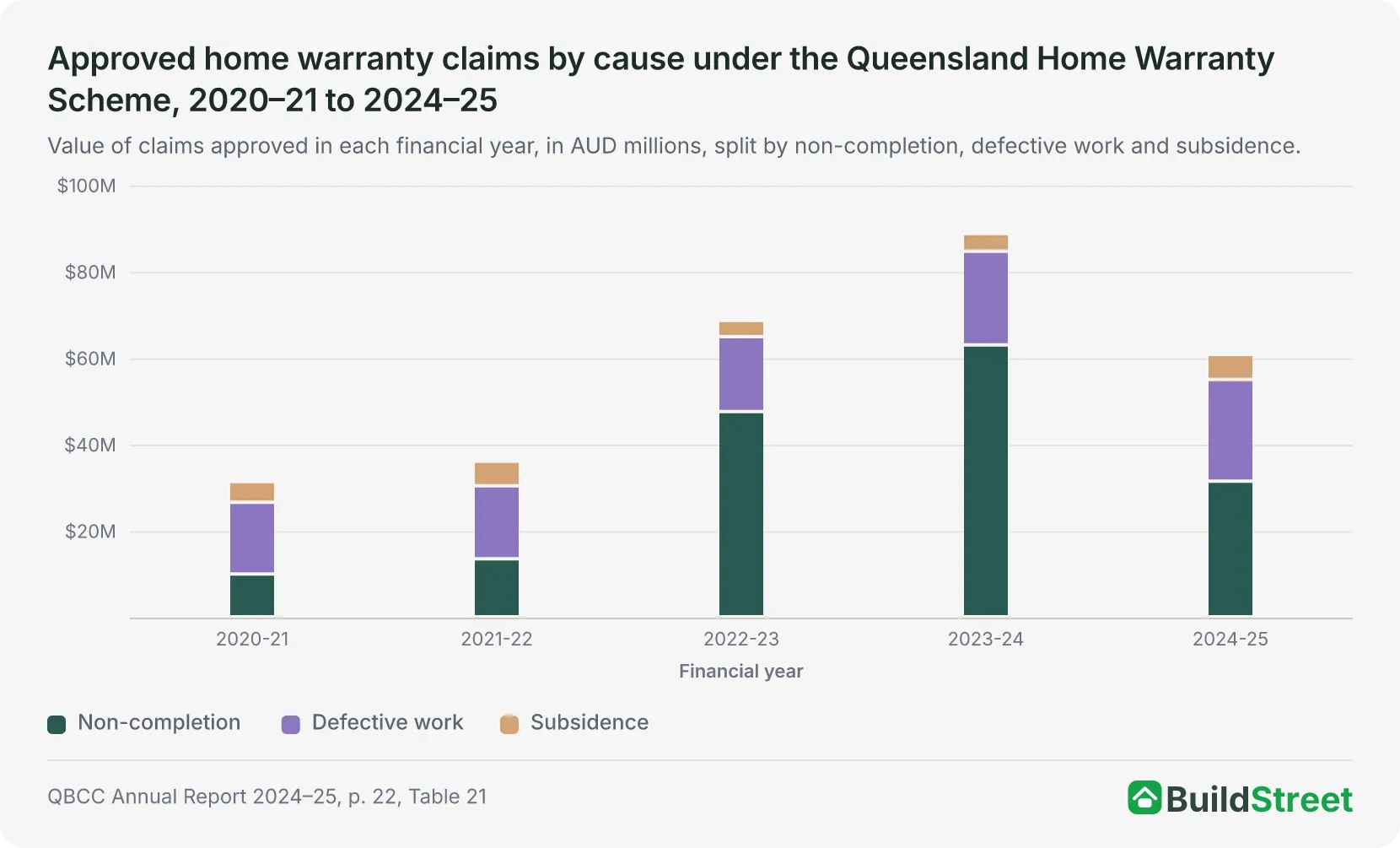
Movement in non-completion accounts for almost all of the shape of the series. Defective work and subsidence together moved within a range of $8.2 million across the whole period, while non-completion moved through a range of $53.0 million.
Claims received peaked at 2,745 in 2022–23, one year before approved value peaked, and stood at 1,964 in 2024–25. This sequence is consistent with, but does not prove, a lag between claim lodgement and approval.
Section 05 · Limits and costs
Home warranty payout limits compared with new-house costs
Five of the eight current regimes set their headline figure at $200,000, and each of the eight selected limits is below the average cost of a new house in its own state or territory.
However, the figures do not represent the same type of cover. New South Wales, Victoria and Western Australia publish a total policy cap or limit, while Queensland publishes a maximum for each category of loss.
The ACT and the Northern Territory publish a statutory minimum a policy must meet, not a ceiling. Tasmania publishes a maximum assistance amount under a package that is not insurance. The figures should therefore be treated as an illustrative comparison rather than a direct ranking of scheme generosity.
Home warranty limits compared with average new-house costs
| Scheme limit or statutory minimum by type, and share of the state or territory average new-house cost, Australia, limits at 29 July 2026 against ABS 2024–25 costs | ||||
|---|---|---|---|---|
| Jurisdiction and regime | Type of limit | Limit ($) | ABS avg new house, 2024–25 ($) | Share (%) |
| Victoria: Home Warranty, from 1 Jul 2026 | Total cap | 400,000 | 485,292 | 82.4 |
| South Australia: BII, specified policies | Policy limit | 250,000 | 389,949 | 64.1 |
| New South Wales: HBC Fund | Total cap | 340,000 | 565,749 | 60.1 |
| Western Australia: home indemnity insurance | Total cap | 200,000 | 407,114 | 49.1 |
| Tasmania: assistance package | Maximum assistance | 200,000 | 420,756 | 47.5 |
| Queensland: QHWS standard | Per-category maximum | 200,000 | 458,868 | 43.6 |
| Northern Territory: RBI / fidelity scheme | Minimum total cover | 200,000 | 475,310 | 42.1 |
| Australian Capital Territory: RBWI | Minimum cover | 200,000 | 645,052 | 31.0 |
| Illustrative median across the eight selected limits | Mixed measures | n/a | n/a | 48.3 |
Source · SIRA NSW; BPC Victoria, Time limits and value limits, 30 June 2026; QBCC Product Disclosure, July 2025, printed p. 3; Building and Energy WA, October 2025; SAFA; CBOS Tasmania; ACT EPSDD; Building (RBI and Fidelity Fund Schemes) Regulations 2012 (NT), as in force 30 March 2026, regs 17 and 48; ABS Building Activity, Australia, Average Cost workbook released 8 April 2026, Table 1.
Each selected figure is below its jurisdiction's average build cost, from 31.0% in the ACT to 82.4% in Victoria, with an illustrative median of 48.3%.
Five of the eight figures are $200,000. Differences between those five ratios therefore reflect differences in average new-house costs rather than differences in the headline amount.
The underlying measures differ too: total caps, policy limits, a per-category maximum, statutory minimums and non-insurance assistance are all treated as one column here, so the median is illustrative of mixed measures rather than a single payout cap.
The ACT has the widest gap, with a $200,000 statutory minimum against the country's highest average new-house cost at $645,052. A statutory minimum sets the least cover a policy must provide, not the most it can pay. The ACT ratio therefore represents the minimum required cover relative to the average cost, rather than a payout ceiling. Victoria's is the narrowest, and it is the only regime whose limit was set in 2026.
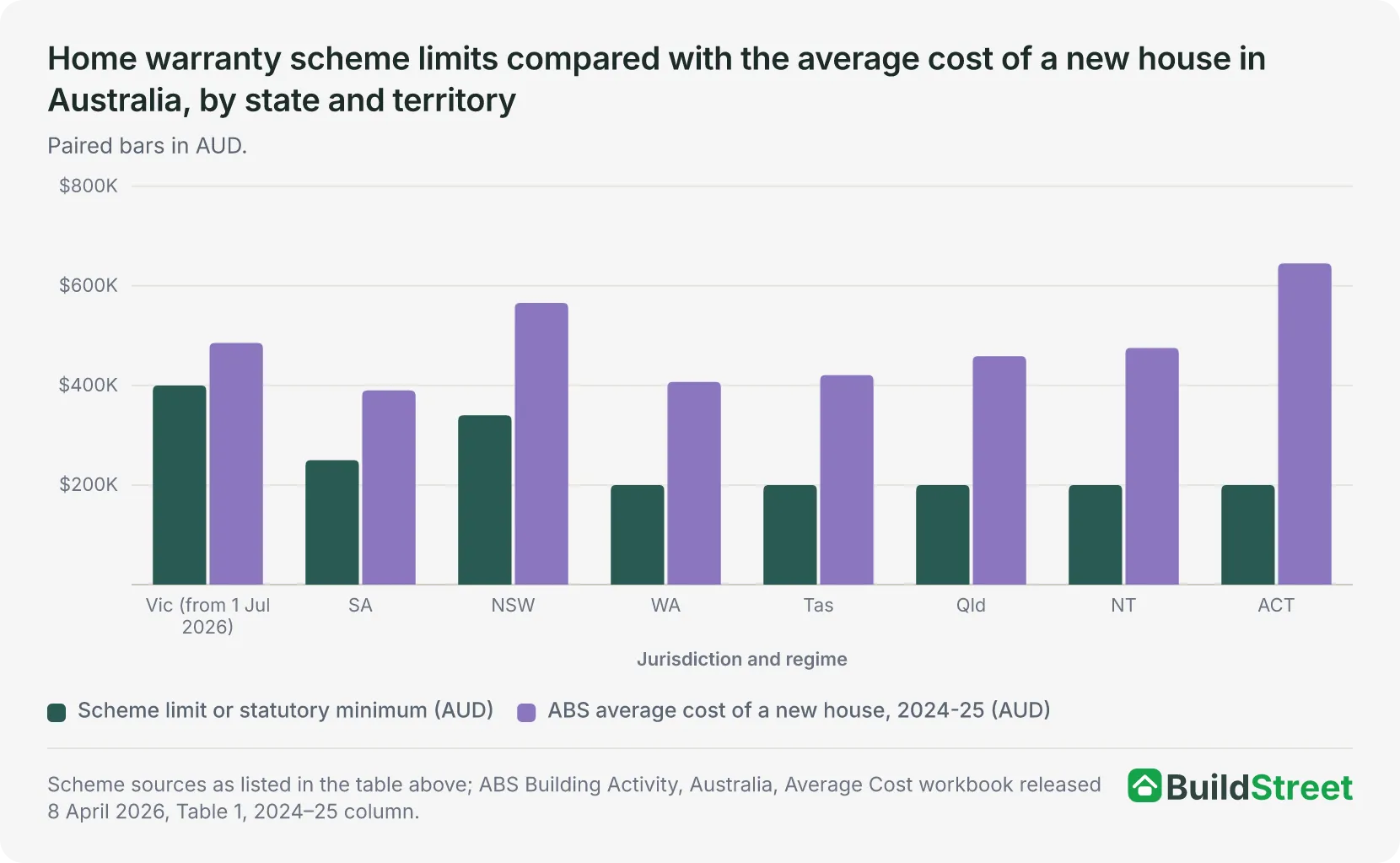
The selected figure exceeds half the state or territory average in only three of the eight comparisons: Victoria, South Australia and New South Wales.
In Victoria, where the two figures are closest, the difference is still $85,292 when compared with the average new-house cost. This does not represent the amount an individual claimant would need to contribute, because the ABS average is not a claimant's contract price or completion cost.
Average new-house construction costs since 2010–11
The national average cost of a new house rose from $268,613 in 2010–11 to $474,939 in 2024–25, an increase of 76.8% in nominal terms. Part of the distance between caps and costs reflects that movement rather than any change in the caps.
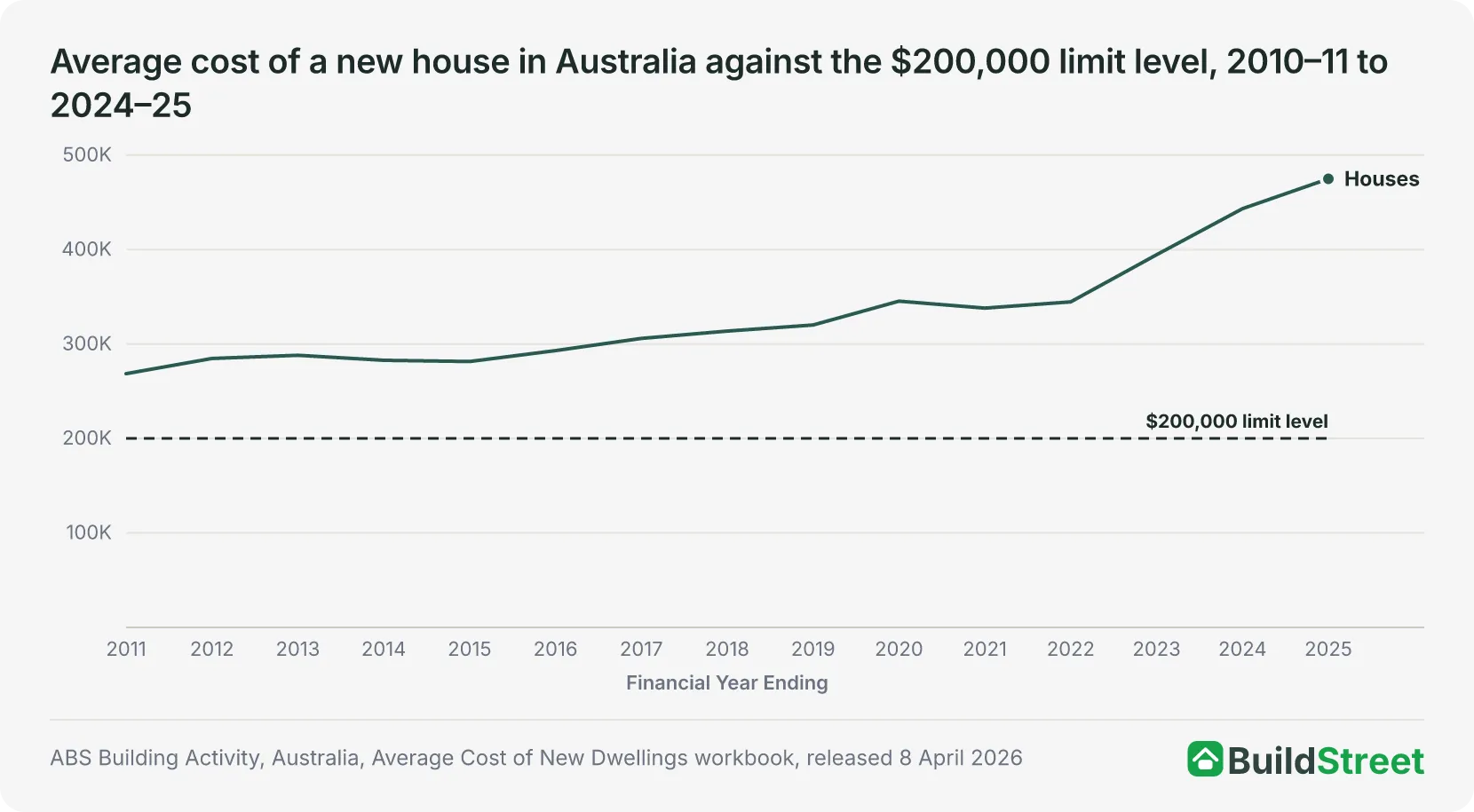
Most of the increase occurred during the final three years of the series. Measured against that average, $200,000 covered 74.5% of a national-average build in 2010–11 and 42.1% in 2024–25.
Both figures are calculated from the ABS annual averages and are illustrative, since $200,000 was not the limit in force in the earlier year and the schemes setting it today express it in different ways.
QBCC Annual Report 2024–25, page 22, Table 21
Section 06 · Timeframes
Home warranty claim deadlines and resolution times
The best available evidence shows that 14 of 21 sampled liability decisions in New South Wales were made within 90 days, from a 30-claim audit with fieldwork in September 2022. No comparable measure of the total time from claim lodgement to a finished house was located in the official sources reviewed.
Home warranty claim timing can refer to three different periods:
- the lodgement deadline, which ranges from 90 days to 12 months depending on the scheme, claim type and starting event;
- the time taken to reach a liability decision, which determines whether the claim is accepted; and
- the total time required to repair or complete the project, which may include scoping, expert assessment, tendering and construction after the liability decision.
The audit sample is small, relates to one scheme and measures liability decisions rather than end-to-end claim resolution. It therefore cannot be treated as a typical national claim timeframe.
Claim volumes do not fill the gap either. Queensland received 2,745 claims in 2022–23, and 1,964 in 2024–25, but a count of claims received says nothing about how long any of them took.
Section 07 · Gaps in cover
What home warranty insurance does not cover
The largest potential gap arises where the cost to complete exceeds the policy limit. The balance falls on the homeowner, and the illustrative median of the eight limit-to-build-cost ratios is 48.3%. That median is drawn from mixed measures and does not itself quantify any homeowner's exposure.
Beyond the limit, the official policy documents converge on a set of recurring exclusions.
Excluded or limited across schemes
- Cost to complete above the limit
Not covered
- Overpayments and advance payments
Reduce entitlement
- Wear and poor maintenance
Excluded
- Minor cosmetic defects
Excluded, Victoria
- Uninsured or unregistered work
Excluded, Victoria
- Excess payable
Up to $500, WA and NT
Where the contract or building type decides it
- Queensland, cost-plus contracts
No completion cover
- Queensland, construction management
No completion cover
- NSW, high-rise new homes
Exclusions apply
- Victoria, over 3 storeys with 3+ homes
Outside scope
- ACT, above 3 storeys
Outside scope
- WA, owner-builder work
Rules differ
Source · Note: Exclusions as published by each scheme. The Northern Territory entries are exclusions the regulations permit, not exclusions every policy contains. Victoria's test combines two conditions: more than three storeys and more than two homes, so storey count alone does not decide it. Source: QBCC Product Disclosure, July 2025, printed p. 4; Building (RBI and Fidelity Fund Schemes) Regulations 2012 (NT), as in force 30 March 2026, regs 15, 18, 46 and 49; Building and Energy WA, October 2025, printed p. 3; Consumer Affairs Victoria, 5 February 2026; BPC Victoria, 30 June 2026; SIRA NSW; ACT EPSDD.
The first group of exclusions applies broadly across schemes. The second depends on decisions made before any problem arises. Queensland's exclusion of cost-plus and construction-management contracts from non-completion cover turns on the contract type chosen at signing. Defect cover may still apply to the same work.
Northern Territory regulations set out what an authorised policy is permitted to exclude, which includes payments above the contract price, wear and poor maintenance, loss of income, value or opportunity, inconvenience, and delay damages. The regulations permit these exclusions, but do not require every policy to contain them.
Recoveries from insolvent or defaulting builders
Recovered paid-out costs reached $18.5 million across the five years to 2024–25, including $4.3 million in 2024–25, against $284.4 million in claims approved over the same period.
The two figures should not be treated as a recovery rate. Recoveries can relate to claims approved in earlier years, and approved amounts are not the same as cash paid, so the numerator and denominator do not describe a matched group of claims.
What published home warranty data does not answer
Four gaps constrain what published figures can support.
| Gaps in the published evidence on builder insolvency and home warranty claims, Australia, at 29 July 2026 | |
|---|---|
| Gap | What the published data does not provide |
| No national resolution-time series | The schemes publish lodgement deadlines and one audited decision sample. No comparable median time to a completed house was located in the official sources reviewed. |
| No clean insolvency count | ASIC's Series 1 records first-time external administration and controller appointments, which the regulator uses as a proxy for insolvency. In 2025–26, 69.0% of residential builder appointments fell in the liquidation category; the rest were restructurings, administrations or security enforcement, and not all of those end the company. |
| No track record for Victoria's new scheme | Home Warranty applied to contracts signed from 1 July 2026, and no official claims data was located for the new scheme in the sources reviewed. The older DBI cohort continues alongside it. |
| No confirmed Tasmanian scheme | A temporary assistance package operates for eligible failures since 1 July 2021, and no official page confirming a commenced home warranty scheme was located as at 29 July 2026. |
One published inconsistency also affects the Queensland figures. In the 2021–22 row, the three claim causes sum to $36.0 million against a published approved-claims total of $35.1 million. The other four years reconcile exactly, and the published totals are used throughout the article.
References
- ASIC — Wind up an insolvent company · asic.gov.au
- ASIC Australian insolvency statistics (Series 1, latest release) · asic.gov.au
- ASIC — Information Sheet 80: How to interpret ASIC's corporate insolvency statistics · asic.gov.au
- State Insurance Regulatory Authority (NSW): Home building compensation for homeowners · sira.nsw.gov.au
- SIRA NSW — Make a home building compensation claim · sira.nsw.gov.au
- SIRA NSW — Claims Management Audit Report: icare HBCF · sira.nsw.gov.au
- Consumer Affairs Victoria — Insurance and insolvency · consumer.vic.gov.au
- Building and Plumbing Commission (Victoria): Home Warranty · bpc.vic.gov.au
- Building and Plumbing Commission (Victoria): Time limits and amounts for Home Warranty · bpc.vic.gov.au
- Building and Plumbing Commission (Victoria): Make a Home Warranty claim · bpc.vic.gov.au
- QBCC — Queensland Home Warranty Scheme Product Disclosure (July 2025) · qbcc.qld.gov.au
- Queensland Building and Construction Commission: Annual Report 2024-25 · qbcc.qld.gov.au
- QBCC — Insurance search for a property · qbcc.qld.gov.au
- WA Government – Building or renovating your home · wa.gov.au
- Department of Local Government, Industry Regulation and Safety (WA): Home indemnity insurance factsheet · wa.gov.au
- South Australian Government Financing Authority — Building Indemnity Insurance: About BII · safa.sa.gov.au
- Government of South Australia: Building indemnity insurance · sa.gov.au
- Consumer, Building and Occupational Services Tasmania – Financial Assistance Package for consumers affected by construction company failures · cbos.tas.gov.au
- ACT Planning – Residential building work insurance · planning.act.gov.au
- Northern Territory Government – Fidelity fund certificate · nt.gov.au
- Building (RBI and Fidelity Fund Schemes) Regulations 2012 (NT), as in force 30 March 2026 · legislation.nt.gov.au
- ABS Building Activity, Australia, March 2026 (Cat. 8752.0) · Australian Bureau of Statistics
