

Published 6 Aug 2026
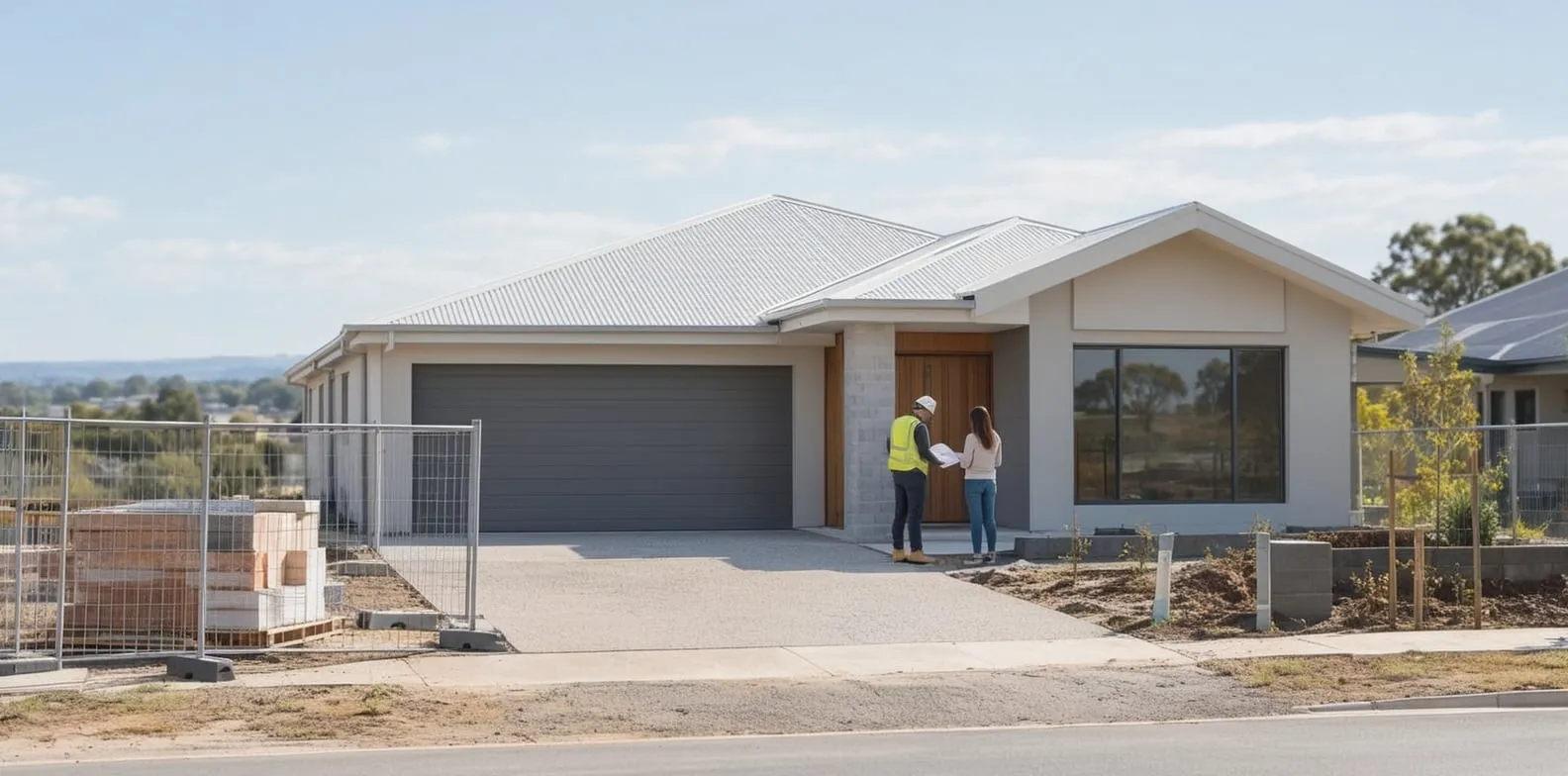
Building and owning a new home can involve several types of insurance, with different policies applying during construction and after completion.
Costs vary by location, regulation and risk. In 2024–25, average home and contents insurance premiums reached $4,966 in north Western Australia, more than double the $2,310 average across the rest of Australia.
For new builds, statutory home warranty insurance becomes compulsory above thresholds ranging from $3,300 in Queensland to $25,000 in the Northern Territory, based on requirements current as at July 2026. Tasmania has no equivalent scheme.
Separately, the Australian Prudential Regulation Authority's (APRA) 2026 stress-test analysis estimates one in seven Australian homes already faces insurance premiums high enough to be considered priced out of the market. This figure is projected to rise to around 1 in 4 by 2050.
No Australian government source publishes a single national average covering all insurance costs for a new build.
 A history of Australian housing policy: every major scheme and how it workedHow grants, guarantees and supply-side programmes have shaped Australian housing since 1990, and what the approvals, completions and social housing data shows about their effect.
 Australian building material costs: how much prices have increased since 2020Building material costs are still rising, but much more slowly than during the pandemic cost surge.
Section 01 · Scope
What insurance is required when building a new home?
Building a new home typically requires several types of insurance during construction, with home and contents insurance generally taking effect only at completion or handover.
During construction, four types of cover come into play:
- Contract works insurance
- Public liability insurance
- Workers' compensation insurance
- Professional indemnity insurance, for design and certification roles
Most states and territories also require a compulsory statutory scheme, known as home warranty or indemnity insurance. In most jurisdictions, this cover responds only after a prescribed event, such as the builder's death, disappearance or insolvency. Queensland's defect cover and Victoria's first-resort scheme can respond in other prescribed circumstances, while Tasmania has no equivalent compulsory insurance scheme.
Home and contents insurance usually becomes relevant only around completion, handover or occupation, depending on the policy terms and finance arrangements.
| Insurance that may apply when building a new home in Australia | ||
|---|---|---|
| Type | What it covers | When it applies |
| Contract works insurance | Loss or damage to materials, work in progress and the site itself from theft, vandalism, fire, storm and similar risks | Throughout construction, until handover |
| Public liability insurance | Injury to other people, or damage to their property, arising from the building work | Throughout construction |
| Workers' compensation | Injury to workers employed on the site | Throughout construction, where required, for employers |
| Professional indemnity | Errors in design, certification or advice by building professionals | Where a practitioner provides design or certification services |
| Statutory home warranty or indemnity | Financial loss to the homeowner if the builder cannot complete the work or fails to fix defects. Most schemes require a prescribed trigger event, although Queensland's defect cover and Victoria's first-resort scheme can respond in other circumstances. | Compulsory above a dollar threshold in seven of eight jurisdictions, from $3,300 to $25,000. Tasmania has no equivalent compulsory insurance scheme |
| Home and contents insurance | The completed dwelling, fixtures and household belongings | After construction |
Source · NSW Government, insurance requirements for contractors; Queensland Building and Construction Commission; Moneysmart, choosing home insurance, 2026.
Section 02 · Construction cover
What is the difference between contract works and public liability insurance?
Contract works insurance and public liability insurance serve different purposes, and both may apply to a residential building project. Contract works insurance protects the partially completed home, materials and work in progress against risks such as theft, vandalism, fire and storm damage until handover.
Public liability insurance covers claims arising from the building work, if someone is injured or another property is damaged.
Queensland's building regulator says most residential contracts require both types of cover, while Queensland Home Warranty Insurance is taken out separately on the homeowner's behalf.
NSW guidance similarly warns that without contract works and public liability cover, the property owner may be exposed to loss or liability because they own the site where the work is being carried out.
Insurance at this stage can also be a condition of finance: lenders typically want proof of current cover before releasing funds.
Section 03 · Warranty vs household insurance
What is the difference between home warranty insurance and home insurance?
These two products are often confused because both are commonly referred to as "home insurance". Home warranty insurance and home insurance cover different risks and apply at different stages of the building and ownership process.
Home warranty insurance, sometimes called home indemnity insurance, is a statutory scheme protecting the homeowner if a builder cannot complete the work or fails to fix defects. This cover is taken out before construction begins, but the protection it provides usually continues for several years after the home is completed.
Home and contents insurance is an ordinary household policy covering the dwelling and belongings once the house is occupied. Home building insurance covers the repair or replacement of the house and fixtures, while contents insurance covers belongings separately. Neither product replaces statutory home warranty insurance.
Seven of Australia's eight states and territories require a compulsory home warranty or indemnity scheme once the value of the building work exceeds a prescribed dollar threshold.
Tasmania has no equivalent compulsory insurance scheme. It instead relies on statutory warranties under its building legislation and a Financial Assistance Package administered by Consumer, Building and Occupational Services for consumers affected by a builder's death, disappearance or insolvency since 1 July 2021. A permanent Home Warranty Insurance scheme has been under development, but its commencement date and operational status could not be verified from the supplied official sources.
In most jurisdictions, these schemes operate as last-resort protections, with cover triggered only after a prescribed event, typically the builder's death, disappearance, insolvency or loss of registration.
Queensland and Victoria are the exceptions. In Queensland, homeowners can make a defect claim even if the builder is still operating, provided the builder has been directed to rectify the defect and has failed to do so. Victoria's First Resort Home Warranty Scheme commenced on 1 July 2026. It may cover eligible incomplete, defective or non-compliant work and is not limited to cases in which the builder has died, disappeared or become insolvent.
Thresholds, trigger conditions, maximum cover and cover periods all differ meaningfully between jurisdictions, as the comparison below shows.
| Statutory home warranty and indemnity insurance by state and territory, 2026 | ||||
|---|---|---|---|---|
| Jurisdiction | Threshold | When cover may respond | Maximum cover | Cover period |
| NSW | Work over $20,000 incl. GST | Builder's death, disappearance, insolvency, or licence loss/suspension after a compensable order | Up to $340,000, subject to limits and the type of loss | 6 years major defects, 2 years other loss |
| Queensland | Work over $3,300 incl. materials, labour and GST | Non-completion claims require the building contract to have been lawfully terminated because of the contractor's default, unless the contractor has died, been deregistered, or become bankrupt or insolvent and had their licence cancelled. Defect claims, including those for subsidence and settlement, can be made once the builder has been directed to rectify the defect and has failed to do so, even if still trading | Up to $200,000 per contract (standard cover); up to $300,000 if optional additional cover is taken out within 30 days of the contract | Structural defects: 6 years 6 months from the earliest of premium payment date, contract date or work commencing. Claim must be lodged within 3 months of first becoming aware of defect. Non-structural defects: 6 months from substantial completion. Claim must be lodged within 7 months. Non-completion: contract must end within 2 years of work commencing. Claim must be lodged within 3 months of the contract ending |
| Victoria | Work over $20,000, homes of 3 storeys or less (First Resort Home Warranty Scheme, current from 1 July 2026) | First resort: incomplete, defective or non-compliant work, available even while the builder is still trading, not only on death, disappearance or insolvency | Maximum $400,000 total assistance per home | Cover commences from the earliest prescribed event. Major defects may be covered for up to 6 years after completion; other defects or non-compliant work may be covered for up to 2 years. Existing DBI policies continue under their current terms |
| Western Australia | Residential building work over $20,000, subject to legislated exemptions | Builder's death, disappearance, insolvency, or deregistration by the State Administrative Tribunal/Building Services Board | Deposit loss up to $40,000; incomplete or defective work up to $200,000 | Construction period plus 6 years from practical completion. A separate rule applies to owner-builders: cover is also required if an owner-built home is sold within 7 years of the building licence being issued |
| South Australia | Work valued at $20,000 or more requiring development approval, current from 10 November 2025 (previously $12,000 or more) | Builder's death, disappearance or insolvency | Up to $250,000 for policies issued from 1 Oct 2025 (previously $150,000) | 5 years from practical completion |
| ACT | Work over $12,000 requiring building approval | Builder's death, disappearance or insolvency | Minimum $200,000 from 1 January 2025 (up from $85,000) | 5 years from certificate of occupancy; claims must be lodged within 180 days of discovery |
| Northern Territory | Work over $25,000, current from 30 March 2026 (previously $12,000); Fidelity Fund NT certificate | Builder's death, disappearance, bankruptcy or deregistration; claims must be lodged within 90 days of discovering a defect or trigger event | Non-completion up to 20% of contract price; combined cap $200,000 | 1 year non-structural defects, 6 years structural defects |
| Tasmania | No compulsory insurance threshold in force | Not applicable; owners rely on statutory warranties under building legislation, not a trigger-based insurance policy | Not applicable under existing framework | Statutory warranty periods apply. A permanent Home Warranty Insurance scheme has been under development; commencement date and operational status could not be verified against a current official source. For the most current requirements, refer to CBOS |
Source · SIRA, home building compensation; Queensland Building and Construction Commission, maximum amounts covered and time limits for cover and claims; Building and Plumbing Commission Victoria, First Resort Home Warranty Scheme; WA Government, home indemnity insurance and owner-builder obligations; SA Government, Building Indemnity Insurance (SAFA/Consumer and Business Services); ACT Planning, residential building work insurance; NT Government and Fidelity Fund NT, Building Legislation Amendment (Fidelity Fund) Act 2025; CBOS Tasmania, Financial Assistance Package for consumers affected by construction company failures.
Statutory warranty premiums are typically built into the contract price and paid by the builder or on the homeowner's behalf. Home and contents insurance is a separate, ongoing expense arranged once the property is complete.
Section 04 · Location risk
How location and natural hazards affect home insurance costs
Home insurance costs vary significantly by location, with premiums in northern Australia generally higher than those in the rest of the country because of greater exposure to cyclone risk.
Since 2022, the Australian Competition and Consumer Commission (ACCC) has published five insurance monitoring reports tracking home, strata and small business premiums in northern Australia and comparing them with premiums across the rest of the country. It also assessed the effect of the government's cyclone reinsurance pool.
The fifth and final report, released in June 2026, marked the end of this monitoring programme. The figures below compare the first full year of available data, 2022–23, with the final year, 2024–25.
December 2023
Report 22022–23 premiums, pool still in transition
North WA averaged $4,395, the Northern Territory $2,922, north Queensland $2,918, and the rest of Australia $1,779. Most insurers had not yet joined the pool.
June 2026
Report 5, final2024–25 premiums, monitoring role concludes
North WA reached $4,966, the Northern Territory $3,546, north Queensland $3,117, and the rest of Australia $2,310.
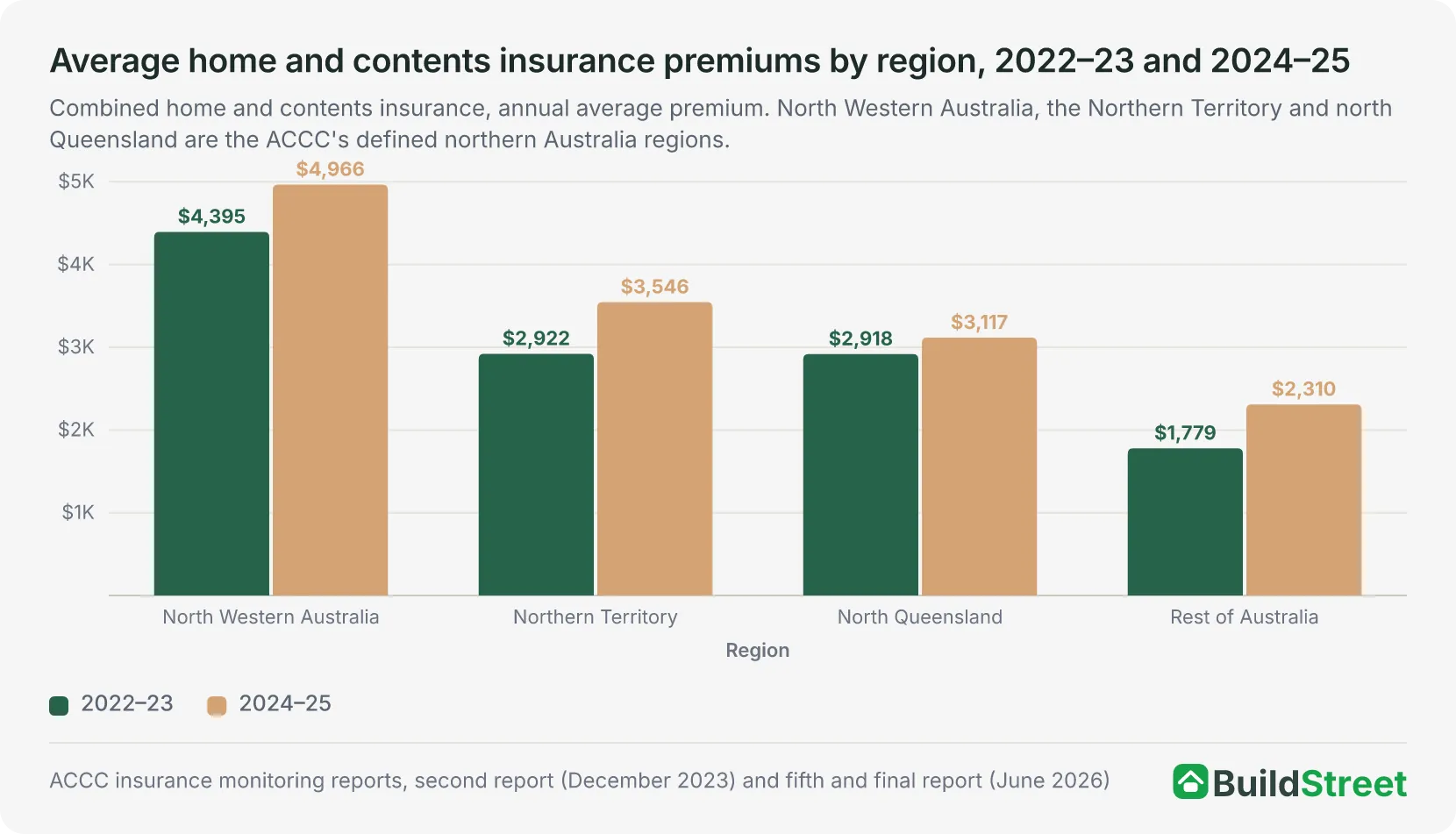
Every northern region recorded a higher average premium than the rest of Australia in both years, but the gap narrowed between 2022–23 and 2024–25.
Based on the reported average premiums, north Western Australia's premium was about 2.5 times the rest-of-Australia average in 2022–23 and about 2.2 times the average in 2024–25, while north Queensland's gap narrowed more sharply, from about 1.6 times to about 1.3 times. This largely reflected faster premium growth across the rest of Australia rather than falling premiums in the northern regions.
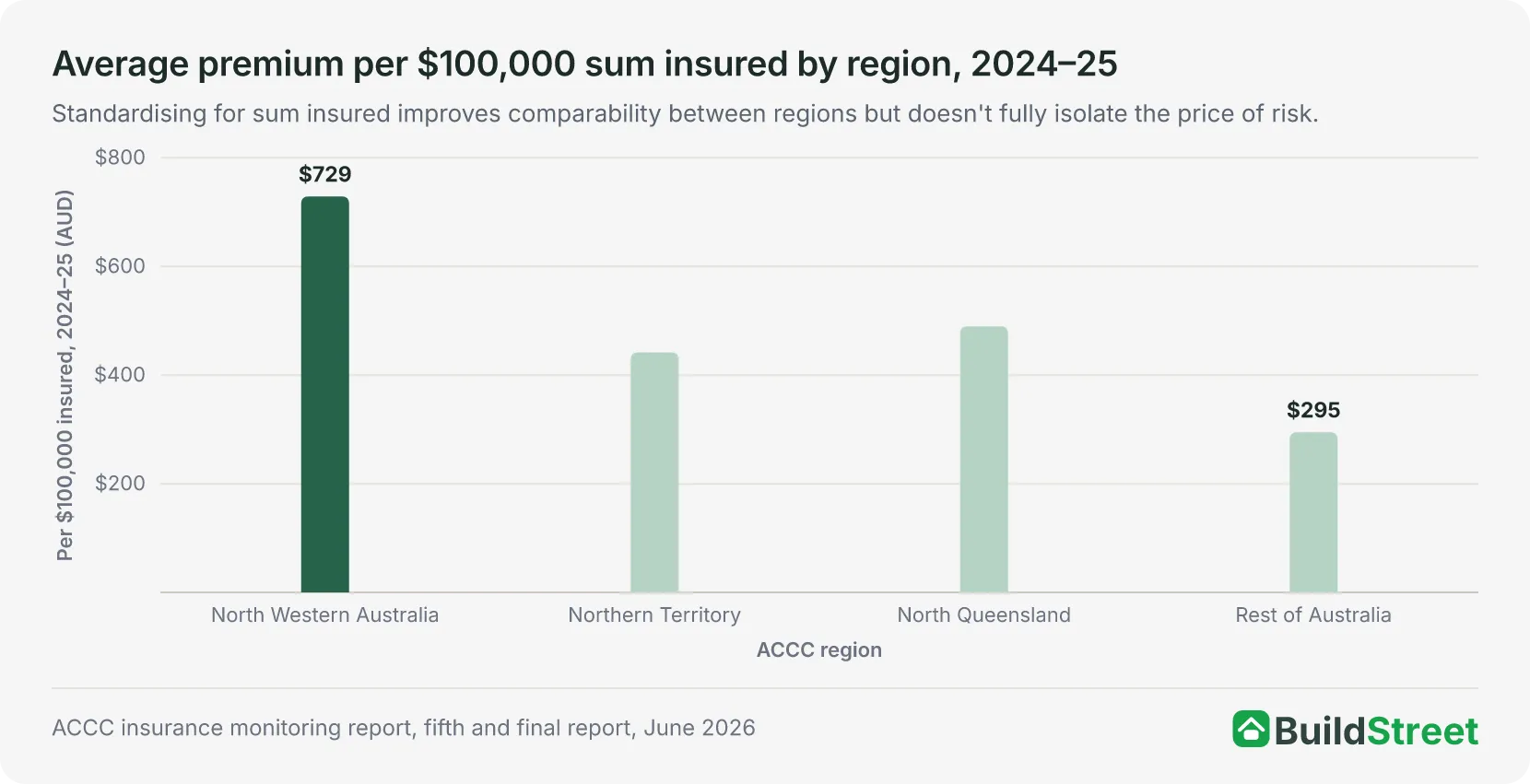
Measured per $100,000 sum insured, premiums in north Western Australia were about 2.5 times the rest-of-Australia average. North Queensland's average was about 1.7 times as high, while the Northern Territory's was about 1.5 times as high. The ACCC links part of this difference in typical sum insured to higher rebuilding costs and more stringent building standards in the north.
How the cyclone reinsurance pool affected home insurance costs
The Australian Government's cyclone reinsurance pool, run by the Australian Reinsurance Pool Corporation, was designed to lower reinsurance costs and pass the savings on to policyholders in medium and higher cyclone-risk areas. The ACCC and the pool's operator report different cumulative figures, because they measure different things.
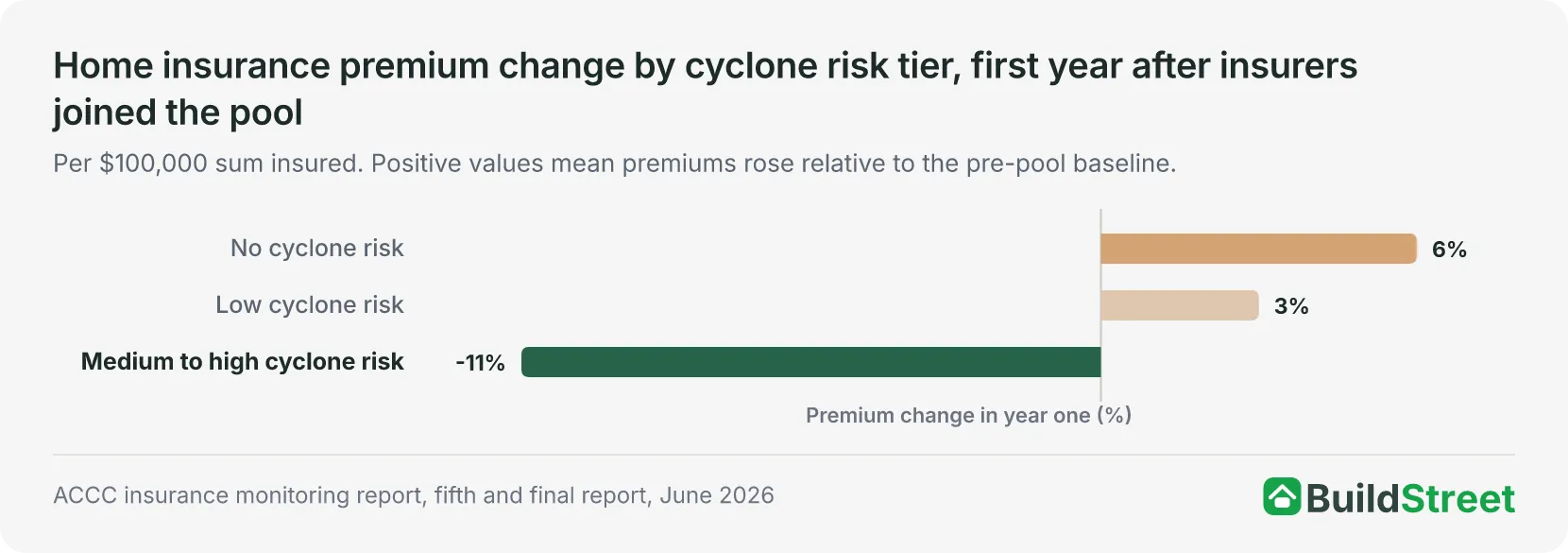
Measured per $100,000 sum insured, the ACCC's renewal-based analysis found that home insurance premiums in medium to high cyclone-risk areas fell by an average of 11% in the first year after insurers joined the cyclone reinsurance pool. This increased to a cumulative reduction of 14% over two years.
The two-year figure represents the total reduction across the period, not an additional reduction on top of the first year's 11%.
Over the same first-year period, premiums outside these areas rose by 3% in low-risk areas and 6% in no-risk areas.
Using a different methodology, the Australian Reinsurance Pool Corporation tracked standardised new-business quotes from October 2022 to January 2026, reporting a larger cumulative reduction of 37% in the highest-risk wind bands.
The results are not directly comparable because the ACCC measured renewal outcomes, while the pool operator measured new-business quotes.
An ACCC-commissioned survey found that about half of participating households rated their home insurance as unaffordable or barely affordable, regardless of their cyclone-risk category. This reflects the views of survey participants and should not be interpreted as a measured result for all Australian households.
How climate risk could affect home insurance affordability by 2050
APRA's analysis suggests a much larger share of Australian homes could be priced out of insurance within a generation as climate-related risk pushes premiums higher relative to household income.
Its first Insurance Climate Vulnerability Assessment (Mind the Gap), published in March 2026, is a prudential stress test rather than a forecast or prediction.
Working with Australia's five largest general insurers, APRA assessed how the national home insurance protection gap might evolve to 2050 under two severe-but-plausible climate scenarios: one driven by higher physical weather risk, and the other by greater economic disruption from the transition to a lower-emissions economy.
The assessment covered around 10 million existing freestanding houses. Strata properties, which account for around 15% of Australian homes, were excluded, and underinsurance (cover that exists but is inadequate) was not directly assessed.
For the assessment, APRA classified a home as priced out of insurance if its estimated annual premium equalled at least four weeks of the household's income.
Using that measure, it estimates that 1 in 7 Australian houses, around 1.4 million homes, are priced out of insurance as at 2026. Under both climate scenarios, this is projected to widen to about 1 in 4 by 2050, an increase of roughly 1 million homes.
The analysis also suggests that regional and rural communities will be affected disproportionately, with the home insurance protection gap in rural areas projected to exceed 40% by 2050 under both scenarios.
APRA, Mind the Gap, Insurance Climate Vulnerability Assessment (CVA), March 2026. The assessment covered around 10 million existing freestanding houses, excluding strata properties; a household was counted as priced out of insurance where its estimated premium reached at least four weeks of household income. Underinsurance was not directly assessed. APRA describes the Insurance CVA as a stress test exploring severe-but-plausible scenarios, not a forecast or prediction of future outcomes.
Homes in high flood-risk areas usually face higher premiums, or may even have flood cover excluded altogether.
The ACCC's 2026 report gives two examples from insurers:
- New customers in the highest flood-risk category could see quote premiums rise more than 300% if flood cover became mandatory for that product
- Policyholders with extreme flood risk could see book premiums rise by an average of $730 at renewal
Section 05 · Building standards
How flood, bushfire and cyclone standards can affect insurance costs
Building in an area exposed to flood, bushfire or cyclone risk may require a home to meet additional construction standards. These requirements can increase estimated rebuilding costs, which may raise the sum insured and the insurance premium.
The ACCC confirms this and notes that the estimated sum insured is based primarily on rebuilding cost. It also states that building costs are generally higher in northern Australia, due in part to remoteness and more stringent building standards.
How hazard exposure affects insurance premiums
Each step is supported by official sources, but no single source publishes a national dollar figure for the final link in this chain.
Hazard exposure identified (flood, bushfire or cyclone-prone area)
Building standard applies (AS 3959, flood hazard standard, NCC wind provisions)
Estimated rebuilding cost rises
Sum insured rises to match rebuilding cost
Premium rises with sum insured
Source: ACCC insurance monitoring report, June 2026; National Emergency Management Agency; Queensland Reconstruction Authority.
| Australian building standards for flood, bushfire and cyclone prone areas | ||
|---|---|---|
| Hazard | Standard or rule | Where it applies |
| Flood | The Australian Building Codes Board (ABCB) Standard for Construction of Buildings in Flood Hazard Areas, referenced by the National Construction Code (NCC), setting performance requirements for flood-resistant design of buildings in declared flood-hazard areas. It addresses structural and life safety rather than property protection, and is performance-based: it does not mandate specific materials or designs, leaving designers to choose a compliant solution | Applies where a state, territory or local government has declared a flood-hazard area and adopted the relevant NCC provisions; application is not uniform nationally and depends on local declarations |
| Bushfire | AS 3959:2018, Construction of buildings in bushfire-prone areas, called up through the NCC, with jurisdiction-specific variations (for example, NSW modifies it through Planning for Bush Fire Protection) | Applies in bushfire-prone areas declared by local or state government, across all states and the ACT, not only Queensland and WA |
| Cyclone | AS/NZS 1170.2 wind regions C (cyclonic) and D (severe cyclonic), referenced by the NCC and AS 4055 for housing; buildings must be designed to withstand the relevant design wind speed for their site | Region C runs broadly from around Bundaberg northward along the Queensland coast, and across northern WA and the NT. Region D covers specific, more limited parts of the WA coast. Exact boundaries and site classification depend on distance from the coast, not a single fixed distance rule |
| Cyclone (NT) | NT building regulations have required cyclone-resistant construction since the 1970s, following Cyclone Tracy in 1974 | Cyclone-prone parts of the Northern Territory |
Source · Australian Building Codes Board, National Construction Code and Standard for Construction of Buildings in Flood Hazard Areas; National Emergency Management Agency; Queensland Government; Queensland Reconstruction Authority; Northern Territory Government.
No official source in the supplied material publishes an Australia-wide dollar estimate of how much flood, bushfire or cyclone standards add to construction or insurance costs.
Section 06 · Finance
Construction loans and insurance requirements for new homes
Insurance can affect a financed new-home build in two ways:
- Lenders may require proof of insurance before releasing construction funds.
- Lenders mortgage insurance may apply when a borrower has a high loan-to-value ratio.
For the construction project itself, NSW Government guidance says when a build or renovation is financed with a loan, the lender typically requires a current certificate of insurance before releasing funds because the property serves as security for the loan.
If a homeowner accepts a cash settlement following an insurance claim, the payment may be made to the lender rather than the homeowner, depending on the lender's policy. This reflects the lender's financial interest in the insured property.
APRA's climate vulnerability stress test brings these two issues together. It finds that a widening home insurance protection gap could increase credit risk for banks. A mortgaged property that is uninsured or underinsured after a weather event may provide less security for the loan if the borrower defaults.
Under APRA's higher physical-risk scenario, expected annual losses from weather-related events are estimated to increase from under $7 billion in 2024 to more than $16 billion by 2050. This is a stress-test scenario rather than a forecast.
Construction borrowers may therefore be required to maintain relevant insurance during the build and after completion. Lenders mortgage insurance remains a separate product linked to the size of the loan rather than the construction risk itself.
Section 07 · Renovations and rebuilds
What insurance applies to renovations and owner-builder projects?
Knockdown rebuilds and major renovations may be subject to the same statutory insurance thresholds as new-home construction, but the treatment depends on each jurisdiction's scheme definitions and the type of contract.
Requirements may differ for:
- Demolition-only or staged contracts
- Work below the relevant threshold
- Projects that retain part of an existing structure
Owner-builder projects can also be subject to separate insurance and resale rules.
In NSW, home building compensation cover is no longer available for work carried out by the owner-builder themselves. However, each licensed contractor they engage directly must still provide cover if their contract exceeds $20,000.
If an owner-built home is sold within 7 years and 6 months of the permit being issued, NSW requires a consumer warning to be included in the contract of sale. Western Australia has a similar requirement: selling an owner-built dwelling within 7 years triggers a home indemnity insurance requirement in the relevant cases.
NSW Government, working as an owner-builder; SIRA, home building compensation; WA Government, information and obligations for registered building services providers.
References
- ACCC, Insurance Monitoring Report, June 2026 · accc.gov.au
- ACCC media release – Cyclone reinsurance pool reduces premiums in high-risk areas but affordability pressures persist · accc.gov.au
- ACCC media release – Insurance prices in northern Australia remain high while cyclone reinsurance pool in transition · accc.gov.au
- ACCC media release – Cyclone reinsurance pool lowering premiums in high-risk areas but affordability concerns remain · accc.gov.au
- ACCC – Insurance monitoring, programme overview and full list of reports · accc.gov.au
- Australian Reinsurance Pool Corporation – Cyclone Pool continues to deliver premium relief and insurance access in high-risk areas · arpc.gov.au
- Australian Reinsurance Pool Corporation – ARPC welcomes ACCC's findings on premium reductions · arpc.gov.au
- APRA, Mind the Gap: An Insurance Climate Vulnerability Assessment, March 2026 · apra.gov.au
- APRA – APRA stress test shows how the widening home insurance protection gap may impact Australia's financial system resilience · apra.gov.au
- NSW Government – Insurance requirements for contractors working on your home · nsw.gov.au
- NSW Government – Working as an owner-builder · nsw.gov.au
- SIRA – Home building compensation · sira.nsw.gov.au
- SIRA – Insurance obligations for residential building works · sira.nsw.gov.au
- Queensland Building and Construction Commission – What is home warranty insurance · qbcc.qld.gov.au
- Queensland Building and Construction Commission – Maximum amounts covered · qbcc.qld.gov.au
- Queensland Building and Construction Commission – Time limits for cover and claims · qbcc.qld.gov.au
- Queensland Building and Construction Commission – Defective work dispute (direction to rectify process) · qbcc.qld.gov.au
- Queensland Building and Construction Commission – Who pays the premium · qbcc.qld.gov.au
- Building and Plumbing Commission Victoria – Domestic Building Insurance and Home Warranty · bpc.vic.gov.au
- Consumer Affairs Victoria – About builders, tradespeople and other building practitioners · consumer.vic.gov.au
- WA Government – Building or renovating your home · wa.gov.au
- WA Government – Information and obligations for registered building services providers (home indemnity insurance) · wa.gov.au
- South Australian Government Financing Authority – Building Indemnity Insurance · safa.sa.gov.au
- ACT Planning – Residential building work insurance · planning.act.gov.au
- Northern Territory Government – Fidelity fund certificate · nt.gov.au
- Consumer, Building and Occupational Services Tasmania – Financial Assistance Package for consumers affected by construction company failures · cbos.tas.gov.au
- ASIC Moneysmart, Choosing Home Insurance, accessed July 2026 · moneysmart.gov.au
- ASIC Moneysmart, Storm, Flood and Fire Insurance · moneysmart.gov.au
- Moneysmart – Lenders mortgage insurance, glossary · moneysmart.gov.au
- Australian Building Codes Board – Standard for Construction of Buildings in Flood Hazard Areas · ncc.abcb.gov.au
- Australian Building Codes Board / NCC – Part G5, Construction in bushfire-prone areas · ncc.abcb.gov.au
- National Emergency Management Agency – Standards on the Construction of Buildings in Flood Hazard Areas · nema.gov.au
- Queensland Reconstruction Authority – Resilient homes building guidance · qra.qld.gov.au
