
Published 15 Sept 2026 · Updated 21 Sept 2026
A builder can generally change the price of a quote or tender until the building contract is signed, because the home building Acts of New South Wales, Victoria and Queensland regulate the price through the contract rather than setting a validity period for a quote or tender. The three states require the contract to state the price and include a warning where that price can change. New South Wales caps the deposit at 10 per cent1, while Victoria and Queensland cap it at 5 per cent for contracts of $20,000 or more23. Each state also provides a five-business-day cooling-off period for qualifying contracts after the owner receives the signed copy231. House construction output prices rose 5.9 per cent in the year to June 2026, the highest annual rise since June quarter 2023, according to the Australian Bureau of Statistics (ABS) Producer Price Indexes4.
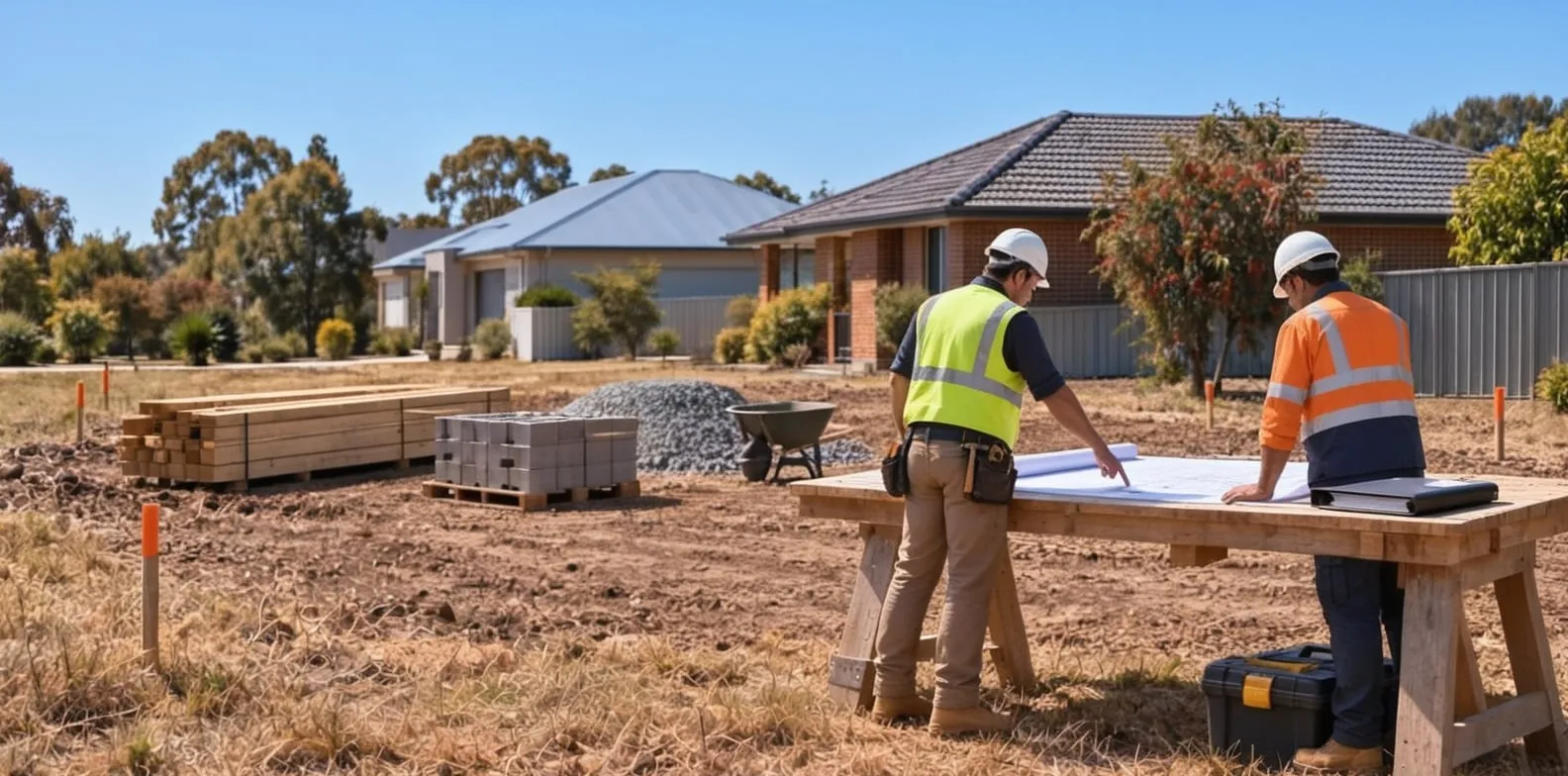
 Fixed-price building contractsWhat a fixed price fixes once the contract is signed, and the prime cost, provisional sum and variation mechanisms that can still move it.
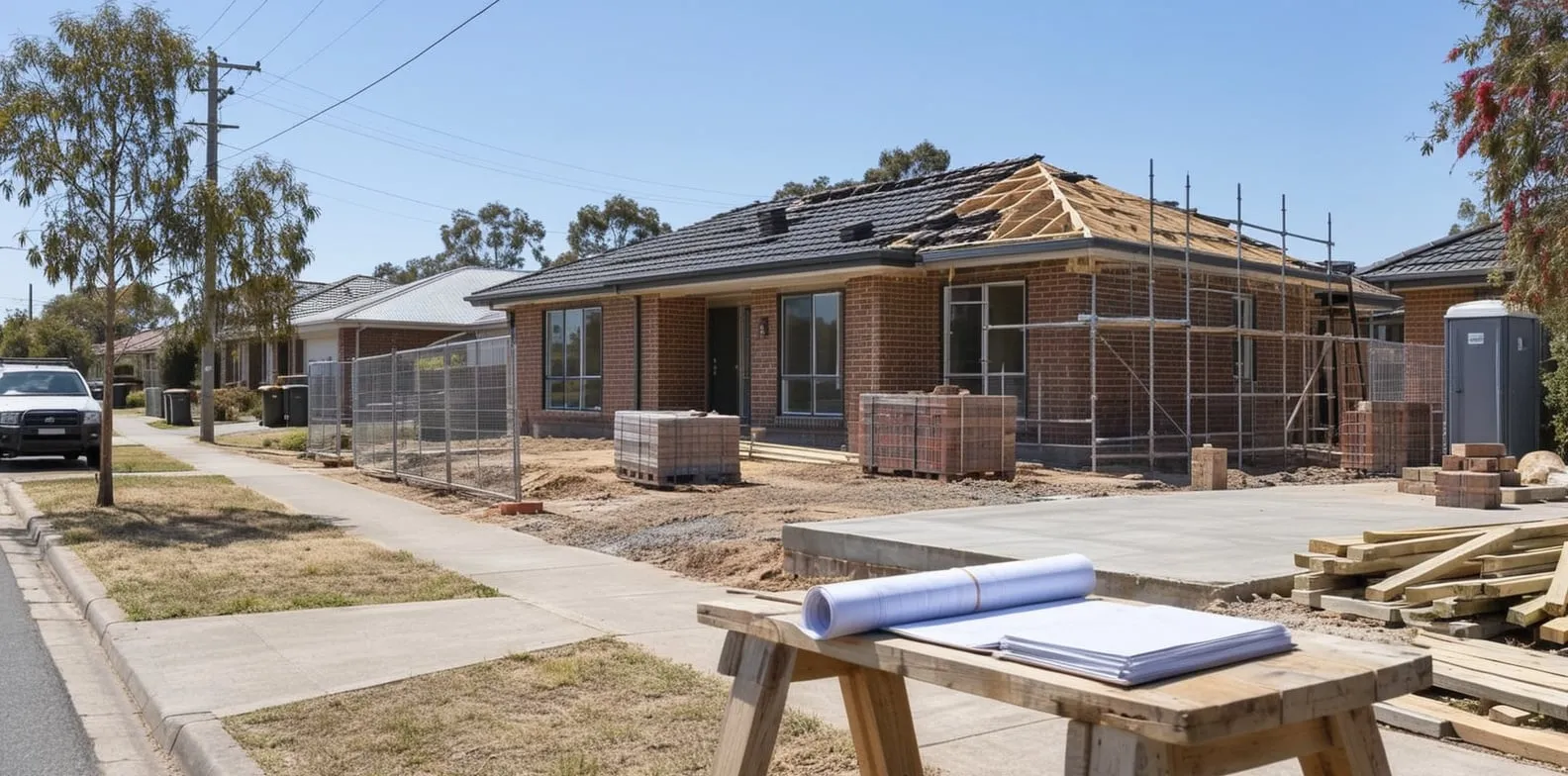
 Base price vs site costsThe advertised base price is the starting point of a quote, not the build price. Site costs, connections and upgrades are added before the tender.
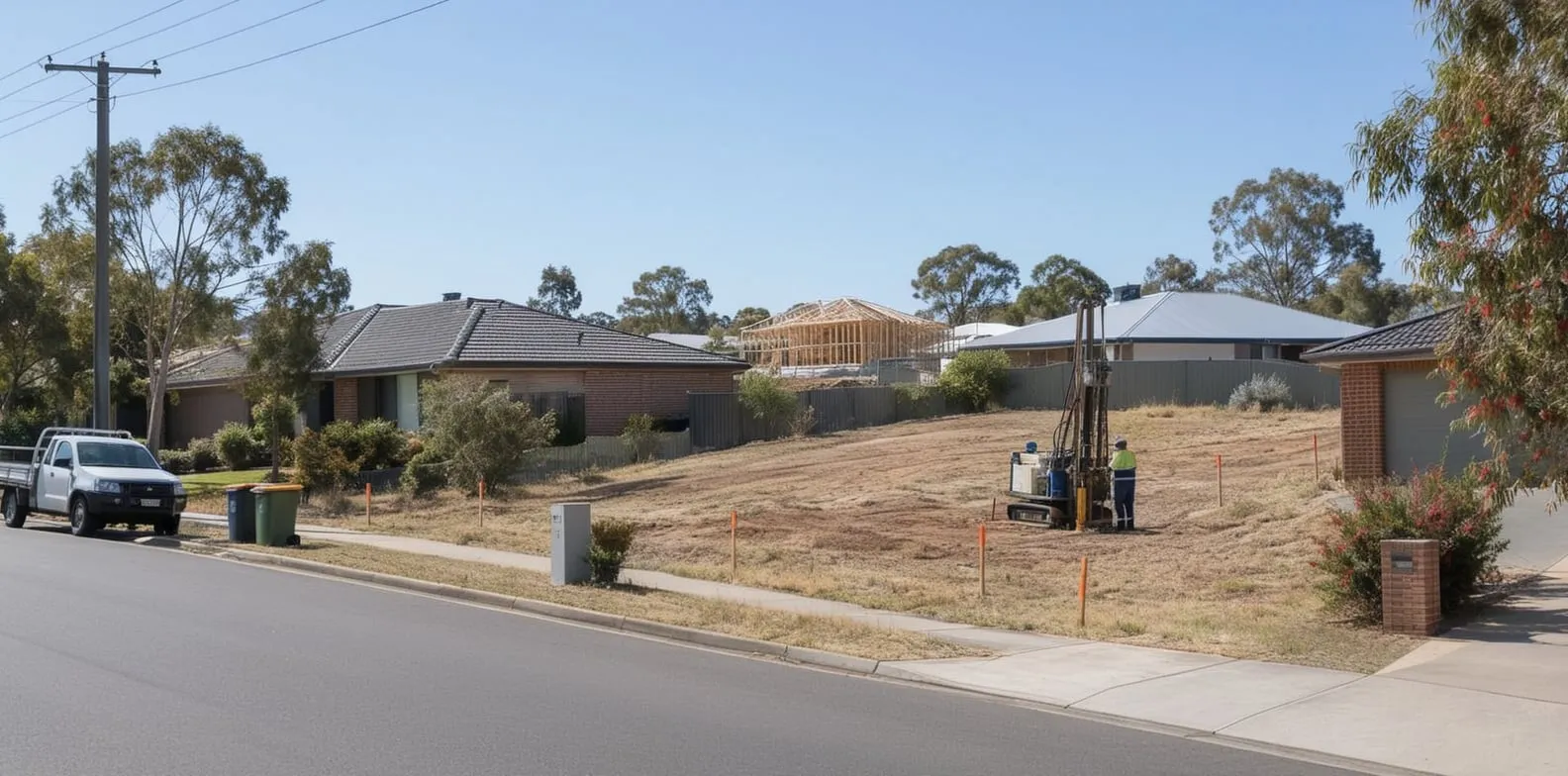
 Provisional sums and prime cost itemsThe two allowances every state lets a contract carry, and how each one can raise the final price after signing.
Section 01 · The answer
When does a building contract fix the price?
The home building Acts of New South Wales, Victoria and Queensland regulate the price through a signed building contract and do not set a validity period for a quote or tender. In New South Wales a contract for residential building work worth more than $20,000 must state the contract price in a prominent position on its first page. Where the price is not known or may be varied, the contract must also carry a warning and an explanation of the provision that allows the variation1. Victoria and Queensland have similar requirements, with the warning placed next to the price in Victoria and on the first page of the contract schedule in Queensland.
Before a building contract is signed, a quote generally stands as the builder's offer for the period the quote states. Building Commission NSW states that encouraging a customer to sign quickly to avoid a price increase can be a sales tactic rather than a legal requirement5.
Once the contract is signed, the price can change through the mechanisms allowed by the contract and relevant legislation. Consumer Affairs Victoria describes these changes as including variations agreed after signing and prime cost or provisional sum items whose make, model or price is not known at signing6, and the Victorian Act makes it an offence for a builder to demand, recover or retain more than the contract price unless the Act authorises the amount3.
Section 02 · The deposit
What does a preliminary agreement or tender fee cover?
A payment made before the building contract is signed generally covers the preliminary work the agreement describes, such as a soil test, a contour survey or plans and specifications, rather than fixing the price of the house. The Queensland Building and Construction Commission (QBCC) describes preliminary agreements as agreements made before a building contract that let a licensed contractor be paid upfront for initial work. It states that this work is often needed to calculate an accurate price for the building contract7. Some preliminary agreements include fees or penalties where the owner does not proceed after receiving the final price, and the QBCC states that such charges may be illegal.
In Victoria, a document may be a contract regardless of what it is called. Consumer Affairs Victoria lists terms including a preliminary agreement, a quote, an order, a provisional quote to build on the land and an authorised tender acceptance, and states that a pre-construction contract covering more than a soil report, such as design or specification work, is a building contract8. Where the price of such a contract is more than $10,000 it is a major domestic building contract, following the Supreme Court of Victoria's 2009 decision in Director of Consumer Affairs v Glenvill Pty Ltd that preparatory work agreements are building contracts under the Act9.
The deposit under the building contract itself is capped in all three states. New South Wales caps it at 10 per cent of the contract price1. Victoria caps it at 5 per cent where the contract price is $20,000 or more, and 10 per cent below $20,000. An owner who has paid more may cancel the contract at any time before completion3. Queensland caps it at 10 per cent for a regulated contract under $20,000, 5 per cent at $20,000 or more, and 20 per cent where the value of off-site work is more than half the contract price2. In Queensland the deposit includes any payment demanded before the contracted services begin at the site, including a home warranty insurance premium.
The QBCC states that an amount paid above the lawful deposit is not recoverable through a Queensland Home Warranty Scheme claim for a deposit refund10. Consumer Affairs Victoria gives the same warning that domestic building insurance may not cover advance payments above the permitted deposit6.
What the home warranty schemes pay where a builder fails after the deposit is paid is covered in the home building insurance article.
Section 03 · The contract
How do NSW, Victoria and Queensland fix the price when the contract is signed?
All three states require the building contract to state the price and identify provisions that can change it. Qualifying contracts also have a cooling-off period of five business days after the owner receives a copy of the signed contract. Victoria adds separate restrictions on cost escalation clauses that the other two states do not have.
In Victoria a major domestic building contract that allows the price to change, other than through a cost escalation clause, must carry a warning that the price is subject to change. The warning must be placed next to the price, use the approved form and identify the provisions that allow the change3. Without the warning, a price-change clause can only be used to lower the price.
A cost escalation clause, meaning a provision that lets the price rise to reflect increased labour or material costs or the cost of delay, is treated separately. A Victorian builder generally must not enter a domestic building contract containing one unless the contract price is more than $500,000 or the clause is in a form approved by the Director.
The clause is also void unless the builder gives the owner an approved notice explaining it before signing and the owner signs or initials next to the clause3. Increases from changes to government taxes or charges, and from prime cost items or provisional sums, are outside the definition.
By 1 December 2026 at the latest, the Domestic Building Contracts Amendment Act 2025 replaces that rule. A cost escalation clause will be prohibited where the contract price is less than $1,000,000, the total increase under such clauses will be capped at 5 per cent of the contract price, and the builder will have to provide the invoices supporting the cost increase11. The Act passed the Victorian Parliament on 11 September 2025, and Consumer Affairs Victoria states that the current laws remain in force until the new provisions commence12. The same amendment will allow an owner to end a major domestic building contract where the price increases by 15 per cent or more after signing11.
Queensland law requires a level 2 regulated contract, meaning a contract worth $20,000 or more, to state a fixed price in a prominent position on the first page of the contract schedule, or state how the price will be calculated if it is not fixed. If the price may change under a provision of the contract, the same page must carry a warning and a brief explanation of that provision2. New South Wales applies its warning rule to contracts worth more than $20,000, and its Consumer Building Guide describes a fixed price or lump sum contract as one where the builder agrees upfront to a fixed amount for the whole job, while noting that unforeseen changes during construction may affect the final cost13.
The cooling-off period runs from receipt of the signed copy in each state. In New South Wales a person who contracts for residential building work worth more than $20,000 may cancel the contract within five clear business days after being given a copy of the signed contract, and the builder may keep only reasonable out-of-pocket expenses1. In Victoria the owner may withdraw from a major domestic building contract within five clear business days after receiving a copy of the signed contract, and the builder may retain $100 plus approved out-of-pocket expenses3.
In Queensland the owner may withdraw from a regulated contract within five business days after receiving a copy of the signed contract. For contracts of $20,000 or more, the period restarts if the consumer building guide is provided later2.
In Victoria and Queensland the right is lost where the owner received independent legal advice before signing, or where the parties had an earlier contract on substantially the same terms for the same home.
| Price, deposit and cooling-off rules for a new-home building contract, New South Wales, Victoria and Queensland, 2026 | |||
|---|---|---|---|
| Rule | New South Wales | Victoria | Queensland |
| Contract threshold for the full rules | More than $20,000 (Home Building Act 1989 s 7, Regulation cl 5) | More than $10,000, a major domestic building contract (s 3) | More than $3,300, a regulated contract; level 2 at $20,000 or more (Sch 1B ss 1, 5, 7) |
| Where the price is stated | Prominent position on the first page (s 7(4)) | Stated in the contract (s 31(1)(j)) | Prominent position on the first page of the contract schedule (Sch 1B s 14(4)) |
| Warning if the price can change | Warning and explanation next to the price (s 7(5)) | Warning next to the price in the approved form, naming the clauses; without it a clause can only lower the price (s 33) | Warning and brief explanation on the first page of the schedule (Sch 1B s 14(6), (7)) |
| Cost escalation clause | No specific ban; the warning rule applies | Not allowed unless the price is more than $500,000 or the clause is in an approved form; void without notice and initials (s 15). From 1 December 2026 at the latest: not below $1,000,000, capped at 5% (Amendment Act 2025 s 11) | No specific ban; the warning rule applies |
| Maximum deposit | 10% of the contract price (s 8) | 5% at $20,000 or more; 10% below (s 11) | 10% under $20,000; 5% at $20,000 or more; 20% where off-site work is more than half the price (Sch 1B s 33) |
| Cooling-off period | 5 clear business days after receiving the signed copy, contracts over $20,000 (s 7BA) | 5 clear business days after receiving the signed copy (s 34) | 5 business days after receiving the signed copy and, at $20,000 or more, the consumer building guide (Sch 1B s 35) |
| Builder keeps on withdrawal | Reasonable out-of-pocket expenses (s 7BA(3)) | $100 plus approved out-of-pocket expenses (s 34(3)) | $100 plus reasonable out-of-pocket expenses (Sch 1B s 38) |
Source · Home Building Act 1989 (NSW) and Home Building Regulation 2014 (NSW); Domestic Building Contracts Act 1995 (Vic) and Domestic Building Contracts Amendment Act 2025 (Vic); Queensland Building and Construction Commission Act 1991 (Qld), Schedule 1B
Section 04 · The prices
How fast have house construction prices risen in Australia?
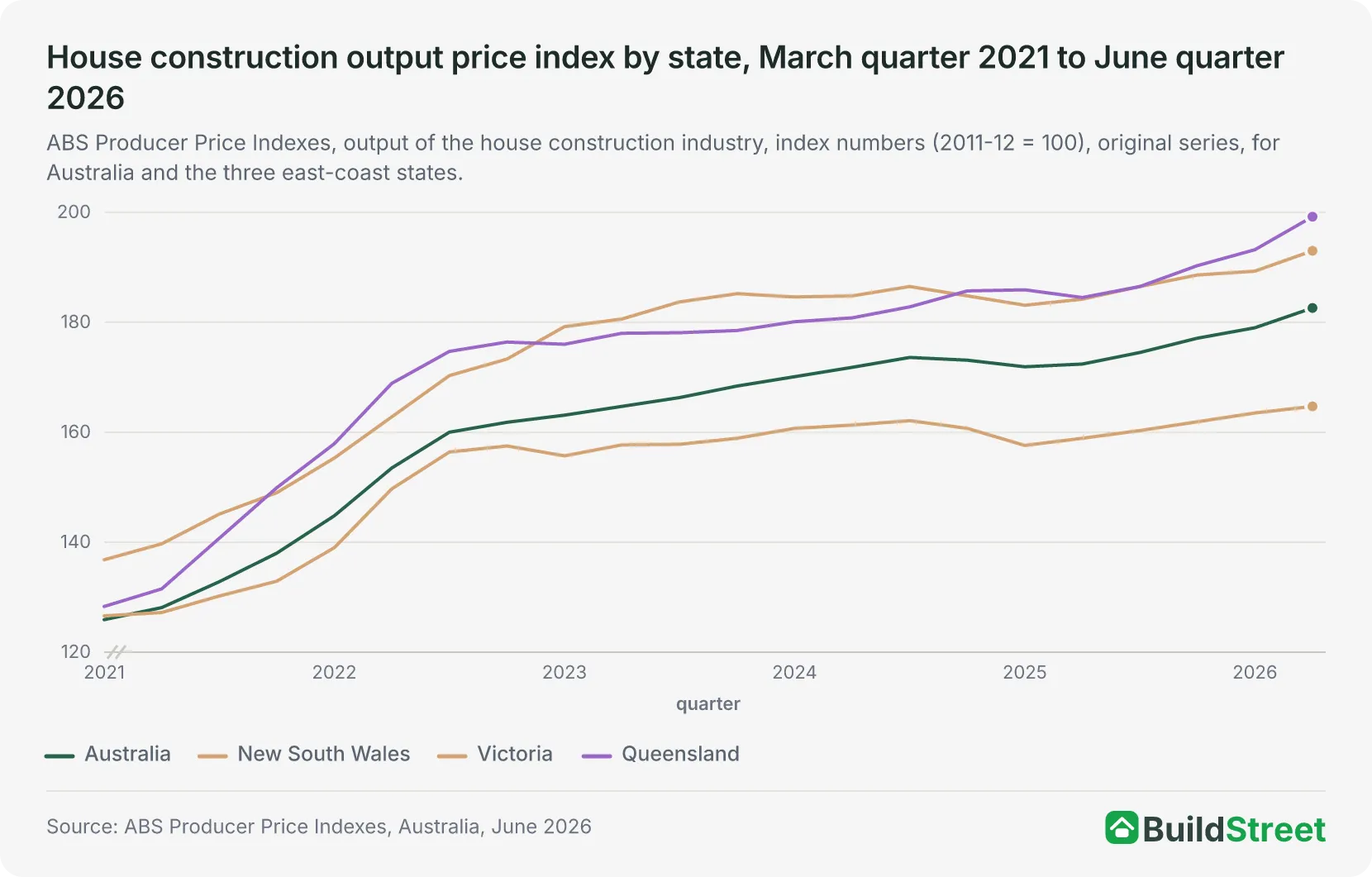
House construction output prices rose 5.9 per cent in the year to June quarter 2026, the highest annual rise since June quarter 2023, according to the Australian Bureau of Statistics (ABS) Producer Price Indexes4. Prices rose 2.0 per cent in the June quarter alone, the largest quarterly rise since September quarter 2022. The ABS partly attributed the increase to fuel surcharges and fees passed on by builders after fuel prices rose in April and May.
The three east-coast states recorded different annual increases. Queensland recorded the largest annual rise of the three, at 8.0 per cent, from an index of 184.5 in June quarter 2025 to 199.2 in June quarter 2026. This compared with increases of 4.8 per cent in New South Wales and 3.7 per cent in Victoria4. Tasmania recorded the largest annual rise of any state or territory, at 11.5 per cent, and Victoria the smallest of the six states, at 3.7 per cent.
Over five years the national index rose 42.5 per cent, from 128.1 in June quarter 2021 to 182.6 in June quarter 2026, and Queensland's rose 51.5 per cent over the same period4.
The percentage changes can also be applied to a hypothetical base price to show their scale. This does not represent how an individual builder would change a quote. At the national annual rate of 5.9 per cent, a base price of $400,000 would rise by $23,600 to $423,600. At Queensland's 8.0 per cent the same base price would rise by $32,000 to $432,0004. Applying the national June quarter 2026 increase of 2.0 per cent to the same amount gives an increase of $8,000.
The index measures prices across the house construction industry, not the price list of an individual builder or the cost of a specific house.
| House construction output price index by state and territory, June quarter 2025 to June quarter 2026 | ||||
|---|---|---|---|---|
| State or territory | June quarter 2025 | June quarter 2026 | Annual change | June quarter 2026 change |
| Australia | 172.4 | 182.6 | 5.9% | 2.0% |
| New South Wales | 184.2 | 193.0 | 4.8% | 2.0% |
| Victoria | 158.9 | 164.7 | 3.7% | 0.7% |
| Queensland | 184.5 | 199.2 | 8.0% | 3.1% |
| South Australia | 165.6 | 179.7 | 8.5% | 3.4% |
| Western Australia | 201.9 | 219.7 | 8.8% | 2.6% |
| Tasmania | 180.5 | 201.3 | 11.5% | 4.7% |
| Northern Territory | 126.8 | 132.6 | 4.6% | 1.4% |
| Australian Capital Territory | 160.3 | 168.3 | 5.0% | 2.9% |
Source · ABS Producer Price Indexes, Australia, June 2026, Table 17
Section 05 · Price holds
How do builder price holds and quote validity periods work?
A price hold is a builder's own pricing term that keeps a quoted price for a stated period if its conditions are met. Among the documents reviewed the longest is 13 months, offered by Brighton Homes in Queensland on the price nominated in the quote and building agreement14. The hold is conditional on four dated steps, and the builder states that it may withdraw or amend the promotion at any time. The four conditions are:
Pay the quotation acceptance fee
A $3,000 fee within 14 days of the issue of the quotation.
Accept the consolidated tender
Within seven days of its issue.
Sign the building agreement
Within seven days of its issue.
Be ready to start on site
Every requirement in the building agreement for construction to commence, met within 13 months of the quotation date.
Because Brighton's time limits run from different documents and payments, the practical length of its hold depends on when each step occurs14.
Other builder documents reviewed give dates for their inclusions but do not state how long a quoted price remains valid before signing. Simonds Homes' Victorian inclusions booklet states that its 2025 inclusions are effective from 24 July 2025 and that the builder reserves the right to withdraw or alter them without notice, while listing a fixed price guarantee among the builder's claims15. Hotondo Homes' national inclusions list records that its inclusions and suppliers were compiled in May 2025 and may change at any time without notice16. G.J. Gardner Homes Goulburn's brochure promises a fixed price building contract with no surprises without dating the document17. None of these three documents states how long a quoted price is held before the contract is signed.
Allworth Homes is the one builder in the BuildStreet catalogue whose design pages carry an explicit price effective date. Its embedded design records state a Sydney price, a regional price and a price effective date for each size variant, which was 17 August 2026 when checked. The catalogue holds 536 such dated entries across the builder's 268 designs, captured in July 2026 when the effective date was 18 May 202618.
| Price and inclusions date stamps in six builder documents reviewed, New South Wales, Victoria and Queensland, 2025 to 2026 | ||
|---|---|---|
| Builder and document | Date the document states | Price or inclusions term |
| Brighton Homes, offer terms and conditions (Qld) | Windows counted from the quotation, tender and agreement dates | 13-month price hold on the quoted price; $3,000 quotation acceptance fee within 14 days |
| Allworth Homes, design page records (NSW) | Price effective date 17 August 2026 | Sydney and regional base prices per size variant, each carrying the effective date |
| Simonds Homes, Inspirations 2025 inclusions booklet (Vic) | Inclusions effective 24 July 2025 | Fixed price guarantee claimed; inclusions may be withdrawn or altered without notice |
| Hotondo Homes, Sanctuary inclusions list (national) | Compiled May 2025 | Inclusions and suppliers may change at any time without notice |
| G.J. Gardner Homes Goulburn, Designer Inclusions brochure (NSW) | Undated | Fixed price building contract with no surprises |
| Coral Homes, Designer Standard Inclusions page (Qld and NSW) | Undated | No price-validity statement; facades and display items stated as indicative and subject to change |
Source · Brighton Homes offer terms and conditions; Allworth Homes design page records as held in the BuildStreet design catalogue; Simonds Homes Inspirations 2025 Inclusions booklet, VIC; Hotondo Homes Sanctuary Inclusions List – National; G.J. Gardner Homes Goulburn Designer Inclusions brochure; Coral Homes Designer Standard Inclusions page
Section 06 · Dated prices
How does BuildStreet date the advertised price on each design card?
Every advertised price in the BuildStreet catalogue carries the date it was retrieved from the builder's website. As at 11 September 2026, 3,064 of the 5,845 active designs in the catalogue, or 52 per cent, carried a price19. The remaining designs come from the 17 builders that publish no price, and the catalogue records them as price on enquiry instead of estimating a price.
The prices were captured between 7 and 27 July 2026. As at 11 September 2026, 11 of the 33 builders still had prices based on data captured on 9 July. A design card shows the base price as a from-price with a line underneath that names the price type, the inclusion tier where the builder publishes one, the sales region and the retrieval date, in the form "base house, region, retrieved date"19. Where a builder also publishes its own effective date on the price, as Allworth Homes does, the record carries that date as well as the retrieval date.
The retrieval date shows when BuildStreet last recorded the advertised price. BuildStreet keeps no price history and updates each builder's catalogue manually, so a builder may change a price after it was captured. The retrieval date therefore does not confirm that the advertised price is still current.
How the advertised base price relates to the tender price, with site costs and connections added, is covered in the base price article.
How BuildStreet shows dated prices for designs that fit a block
BuildStreet reads your lot's dimensions from the cadastre (the official map of land parcels), tests which catalogue designs fit inside the setbacks, and shows each design's advertised base price with the date it was retrieved from the builder. Type your address to see the prices and their dates for your block.
Section 07
Frequently asked questions
Can a builder increase the price after a deposit is paid?
Paying a fee or deposit before the building contract is signed does not necessarily fix the price of the house. A builder can generally reprice a quote or tender until the building contract is signed. After the contract is signed, the price can change only through provisions allowed by the contract and relevant state law.
How long is a builder's quote valid for?
No NSW, Victorian or Queensland law sets a validity period for a builder's quote, so the period depends on the quote or the builder's price-hold terms. Among the documents reviewed, Brighton Homes holds a quoted price for 13 months where a $3,000 quotation acceptance fee is paid within 14 days of the quotation and the tender and building agreement are each accepted within seven days of issue.
What is the maximum deposit on a new home building contract?
The maximum deposit is 10 per cent of the contract price in New South Wales, and 5 per cent in Victoria and Queensland for contracts of $20,000 or more. Queensland allows 20 per cent where more than half the contract price is for work completed off-site, and both Victoria and Queensland allow 10 per cent on contracts under $20,000.
Can a fixed-price building contract include a rise-and-fall clause?
In Victoria a cost escalation clause is generally not allowed unless the contract price is more than $500,000 or the clause is in a form approved by the Director. By 1 December 2026, the minimum contract price will rise to $1 million and increases under these clauses will be capped at 5 per cent of the contract price. New South Wales and Queensland do not have the same specific restriction, but contracts must identify provisions that allow the price to change.
How much have house construction prices risen in Australia?
House construction output prices rose 5.9 per cent in the year to June quarter 2026 and 2.0 per cent in the June quarter alone, according to the Australian Bureau of Statistics (ABS) Producer Price Indexes. Queensland recorded a larger annual rise than New South Wales or Victoria, at 8.0 per cent.
Does a cooling-off period apply to a home building contract?
Yes. Qualifying contracts in New South Wales and Victoria have a cooling-off period of five clear business days, while Queensland provides five business days. The period generally runs from receipt of the signed contract. The amounts a builder may retain after withdrawal differ between the three states.
References
- Home Building Act 1989 (NSW) · legislation.nsw.gov.au ↑ b c d e
- Queensland Building and Construction Commission Act 1991 (Qld), Schedule 1B · legislation.qld.gov.au ↑ b c d e
- Domestic Building Contracts Act 1995 (Vic) · legislation.vic.gov.au ↑ b c d e f g
- ABS Producer Price Indexes, Australia, June 2026 (Cat. 6427.0) · Australian Bureau of Statistics ↑ b c d e
- NSW Government (Building Commission NSW), Contracts for residential building work · nsw.gov.au ↑
- Deposits and payments for building work, Consumer Affairs Victoria · consumer.vic.gov.au ↑ b
- QBCC, Contracts and agreement types · qbcc.qld.gov.au ↑
- Pre-construction building contracts, Consumer Affairs Victoria · consumer.vic.gov.au ↑
- Preliminary agreements for home building projects, Consumer Affairs Victoria · consumer.vic.gov.au ↑
- Deposits and progress payments, Queensland Building and Construction Commission · qbcc.qld.gov.au ↑
- Domestic Building Contracts Amendment Act 2025 (Vic), No. 36 of 2025 · content.legislation.vic.gov.au ↑ b
- Consumer Affairs Victoria, New domestic building contract laws passed in Victoria · consumer.vic.gov.au ↑
- Consumer Building Guide, Building Commission NSW (version 2025) · nsw.gov.au ↑
- Offer terms and conditions, Brighton Homes · brightonhomes.net.au ↑ b
- Simonds Homes, Inspirations 2025 Inclusions booklet, VIC · cdn.simonds.com.au ↑
- Hotondo Homes, Sanctuary Inclusions List, National · storage.hotondo.com.au ↑
- G.J. Gardner Homes Goulburn, Designer Inclusions brochure · media.aws.gjgardner.com.au ↑
- Allworth Homes, design page records (Altona design page) · allworthhomes.com.au ↑
- BuildStreet lot report and catalogue price cards · buildstreet-gs59z.ondigitalocean.app ↑ b
- Home Building Regulation 2014 (NSW) · legislation.nsw.gov.au
- Consumer Affairs Victoria, Building contracts checklist · consumer.vic.gov.au
- Cooling-off period, Queensland Building and Construction Commission · qbcc.qld.gov.au
