

Published 15 Sept 2026 · Updated 18 Sept 2026
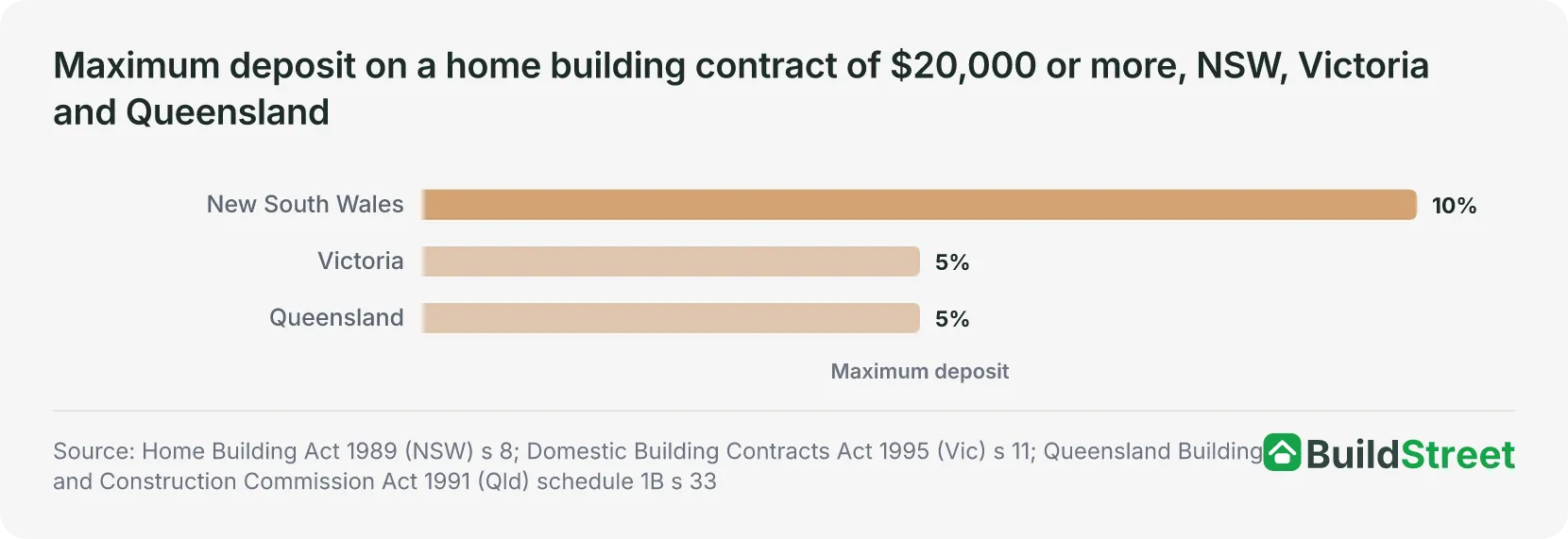
A fixed-price building contract fixes the price of the work described in its plans and specifications, but the home building contract laws of New South Wales, Victoria and Queensland set out how that price can still change. Queensland's home warranty rules define a fixed price residential contract as one whose price is fixed except for prime cost items, provisional sums and increases for rising labour or material costs or delays.1 Once a contract reaches the relevant value threshold in each state, it must include a warning where the price can change. The deposit on a contract of $20,000 or more is capped at 10 per cent of the contract price in New South Wales and 5 per cent in Victoria and Queensland.
 Why the advertised base price is not the build priceThe site costs, connections and allowances that sit between a builder's advertised base price and the contract price, and where each one is disclosed.
 Home warranty insurance by stateThe compulsory home building insurance schemes of New South Wales, Victoria and Queensland, what each covers and what triggers a claim.
Section 01 · What is fixed
What does a fixed-price building contract fix?
A fixed-price building contract fixes the price of the work described in its plans and specifications, subject to the circumstances in which the contract price is allowed to change under each state's laws.
Victoria's Act puts the ceiling directly: a builder must not demand, recover or keep any amount above the contract price unless the Act allows it2. Prime cost items, provisional sums, variations and, where permitted, a cost escalation clause are the authorised routes.
For Queensland home warranty insurance, a fixed-price residential contract can still include three things: prime cost items, provisional sums and increases to reflect increased costs of labour or materials or delays in carrying out the work1. A contract can include all three and still be a fixed price contract for insurance purposes.
A cost plus contract works differently. The final price is not known when the contract is signed. Queensland defines it as a contract where the amount the builder will receive cannot be accurately calculated at the start, even without prime cost items and provisional sums3.
In Victoria, cost plus contracts are generally limited to contracts of $1 million or more, or renovation work that cannot be accurately priced until some work has been carried out. The contract must contain the builder's fair and reasonable estimate of the total amount2.
The QBCC reports that final costs under cost plus contracts are often considerably higher than the homeowners initially expected, and sometimes more than double their expectation4.
Which insurance scheme stands behind a fixed price if the builder fails, and what each state's scheme pays, is covered in Home warranty insurance by state.
Section 02 · The warning
Where must the contract price and the price-change warning appear?
All three states require contracts above their relevant value thresholds to disclose when the price can change. New South Wales and Queensland also specify where the contract price must appear.
In New South Wales, for a contract price over $20,000, a known price must appear prominently on the first page of the contract. If the price is not known, or can change under the contract, the contract must carry a warning and an explanation of the clause that allows the change. If the price is known, the warning sits next to it5. Contracting without that content is an offence.
In Victoria, a major domestic building contract, which Consumer Affairs Victoria defines as work worth more than $10,000, must include an approved warning where the price can change. The warning must specify the provisions of the contract that allow for the change. Without the warning, a price-change clause can only lower the price, not raise it2. The Act sets no first-page rule for the price itself.
In Queensland, the rule applies to domestic building (level 2 regulated) contracts with a price of $20,000 or more. A fixed price must be stated in a prominent position on the first page of the contract schedule. If the price can change, the same page must also include a prominent warning and a brief explanation of the provision that allows the change3. A Queensland builder must not start work before the contract complies with those requirements.
| Contract-value thresholds and price-disclosure rules, NSW, Victoria and Queensland, 2026 | |||
|---|---|---|---|
| Rule | New South Wales, Home Building Act 1989 | Victoria, Domestic Building Contracts Act 1995 | Queensland, QBCC Act 1991 schedule 1B |
| Contract the rules apply to | Contract price over $20,000 (s 7, Regulation cl 5) | Major domestic building contract, work worth more than $10,000 | Level 2 regulated contract, price of $20,000 or more (s 7, Regulation s 45) |
| Position of the price | Prominent position on the first page of the contract if the price is known (s 7(4)) | No first-page rule | A fixed price in a prominent position on the first page of the contract schedule (s 14(4)) |
| Price-change warning | Warning and explanation of the provision, next to the price if the price is known (s 7(5)) | Warning next to the price, in the approved form, naming the provisions that allow the change (s 33(2)) | Warning and a brief explanation, in a prominent position on the first page of the schedule (s 14(6), (7)) |
| If the requirement is not met | Contracting is an offence (s 7A) | The provision operates only to decrease the price (s 33(3)) | Work must not start before the contract complies (s 30) |
Source · Home Building Act 1989 (NSW) and Home Building Regulation 2014 (NSW); Domestic Building Contracts Act 1995 (Vic) and Consumer Affairs Victoria; Queensland Building and Construction Commission Act 1991 (Qld) schedule 1B and Queensland Building and Construction Commission Regulation 2018.
Section 03 · Estimates inside the price
How do prime cost items and provisional sums work in a fixed price?
Two kinds of estimate can be included in a fixed-price contract in all three states, and the estimate is replaced by the actual cost under the contract's terms. A prime cost item is a dollar allowance for a product not yet chosen, or whose price is not yet known. A provisional sum is an estimate for a piece of work that the builder cannot price accurately when the contract is signed2. Queensland defines both terms in the same way3.
Queensland and Victoria set requirements for how these estimates are calculated. In Queensland the builder warrants that a provisional sum or prime cost item has been calculated with reasonable care and skill, having regard to all the information reasonably available when the contract is signed, including information about the site3. Victoria gives the same warranty for provisional sums and makes it an offence to enter a contract with a prime cost item or provisional sum amount that is less than the reasonable cost of the item or the work2.
Victoria also requires more detail to be provided. In a major domestic building contract each item or sum needs a separate schedule with a detailed description and a breakdown of the estimate, including estimated material quantities and unit costs. The builder must give the owner a copy of any invoice, receipt or other document that shows the actual cost as soon as practicable2.
Queensland requires a price that is not fixed to state how it will be calculated, including any allowances, in the contract schedule. The QBCC's guide explains that items a contractor cannot price exactly may be covered by an allowance instead of being included in the fixed price component of the contract6.
The New South Wales Act takes a different approach. The Home Building Act 1989 does not use the terms prime cost item or provisional sum in its contract rules, and the NSW Government's guidance describes prime cost items as items that cannot be costed exactly before the work begins and are listed as 'prime cost' items (PCs) in the contract7.
| Prime cost item and provisional sum rules, NSW, Victoria and Queensland, 2026 | |||
|---|---|---|---|
| Rule | New South Wales | Victoria | Queensland |
| Terms defined in the Act | No; described in NSW Government guidance | Yes, s 3(1) | Yes, schedule 1B ss 1 and 10 |
| Builder's warranty on the estimate | Not in the Act | Provisional sums calculated with reasonable care and skill (s 20) | Provisional sums and prime cost items calculated with reasonable care and skill (s 26) |
| Estimate below the reasonable cost | Not in the Act | An offence, 35 penalty units (s 21) | Not in the Act |
| Schedule and cost breakdown required | Not in the Act | Yes, in a major domestic building contract (s 22) | A price that is not fixed must state its method, including allowances (s 14(5)) |
| Evidence of the actual cost | Not in the Act | Copy of any invoice, receipt or other document (s 23) | Not in schedule 1B |
Source · Home Building Act 1989 (NSW); Domestic Building Contracts Act 1995 (Vic); Queensland Building and Construction Commission Act 1991 (Qld) schedule 1B; NSW Government, Contracts for residential building work.
Section 04 · After signing
How can variations, delays and rise-and-fall clauses change the price?
A variation, which is an agreed change to the plans or specifications after signing, can change the contract price by changing the scope of the work. All three states regulate how variations are documented.
In Queensland, the builder must give the owner a written copy of every variation within five business days of agreeing to it or before the variation work starts. The builder must not start that work before the building owner agrees to the variation in writing, and cannot require the price increase to be paid before the variation work starts3.
Victoria has different rules depending on who requests the variation. An owner-requested change can proceed without a costed notice only if the builder reasonably believes the change needs no permit variation, causes no delay and will not add more than 2 per cent to the original contract price. Any other change needs a notice stating its cost and effect and the owner's signed request. For a builder-requested variation, the builder can generally recover additional money only after following the notice requirements and where the change is needed because of circumstances that could not reasonably have been foreseen when the contract was signed2.
A Queensland builder may claim an extension of time only for three kinds of delay: one that could not reasonably be foreseen and was beyond the builder's control, one caused by the owner, or one resulting from a properly documented variation. The claim must be made in writing within 10 business days of the builder becoming aware of the delay.3
In Victoria an owner may end a major domestic building contract if the price rises by 15 per cent or more, or the work takes more than one and a half times as long as the contract allows, for reasons the builder could not reasonably have foreseen. Prime cost items, provisional sums and owner-requested variations are excluded from this calculation.2
A delay can affect the price where the contract includes a cost escalation clause, also called a rise-and-fall clause. This allows the price to increase to reflect higher labour or material costs, or costs caused by delays. Victoria bars such a clause unless the contract price is more than $500,000 or the clause is in a form approved by the regulator. The clause is also ineffective unless the builder gave the owner an approved notice explaining it before signing and the owner signed or initialled next to it.2 Victoria has not yet approved any cost escalation clauses.
Neither the New South Wales Act nor Queensland's schedule 1B bans such a clause in a home building contract. In those states, it is treated as a price-change provision and is subject to the relevant warning requirements. Queensland's insurance definition of a fixed price also allows for increases linked to labour, material costs or delays.1
Section 05 · Deposits and payments
What are the deposit and progress payment rules for home building contracts?
The maximum deposit on a new-home contract of $20,000 or more is 10 per cent of the contract price in New South Wales and 5 per cent in Victoria and Queensland. New South Wales fixes the cap at 10 per cent of the contract price for all residential building work5.
Victoria caps the deposit at 5 per cent of any contract price that is $20,000 or more and 10 per cent below that, provided the deposit is taken before work starts. An owner may end the contract before completion if the builder takes more than the permitted amount2.
Queensland caps the deposit at 5 per cent for contracts of $20,000 or more and 10 per cent for regulated contracts above $3,300 but below $20,000. The cap can rise to 20 per cent where more than half of the contract price is for off-site work3.
After the deposit, progress payments are linked to the work completed or costs incurred. New South Wales authorises only two kinds of progress payment on a contract over $20,000. These are a set amount or percentage paid when a clearly defined stage is completed, or a payment for work already done or costs already incurred, supported by invoices or receipts5. Queensland requires every claim after the deposit to be linked to work completed on site and no more than the value of that work3.
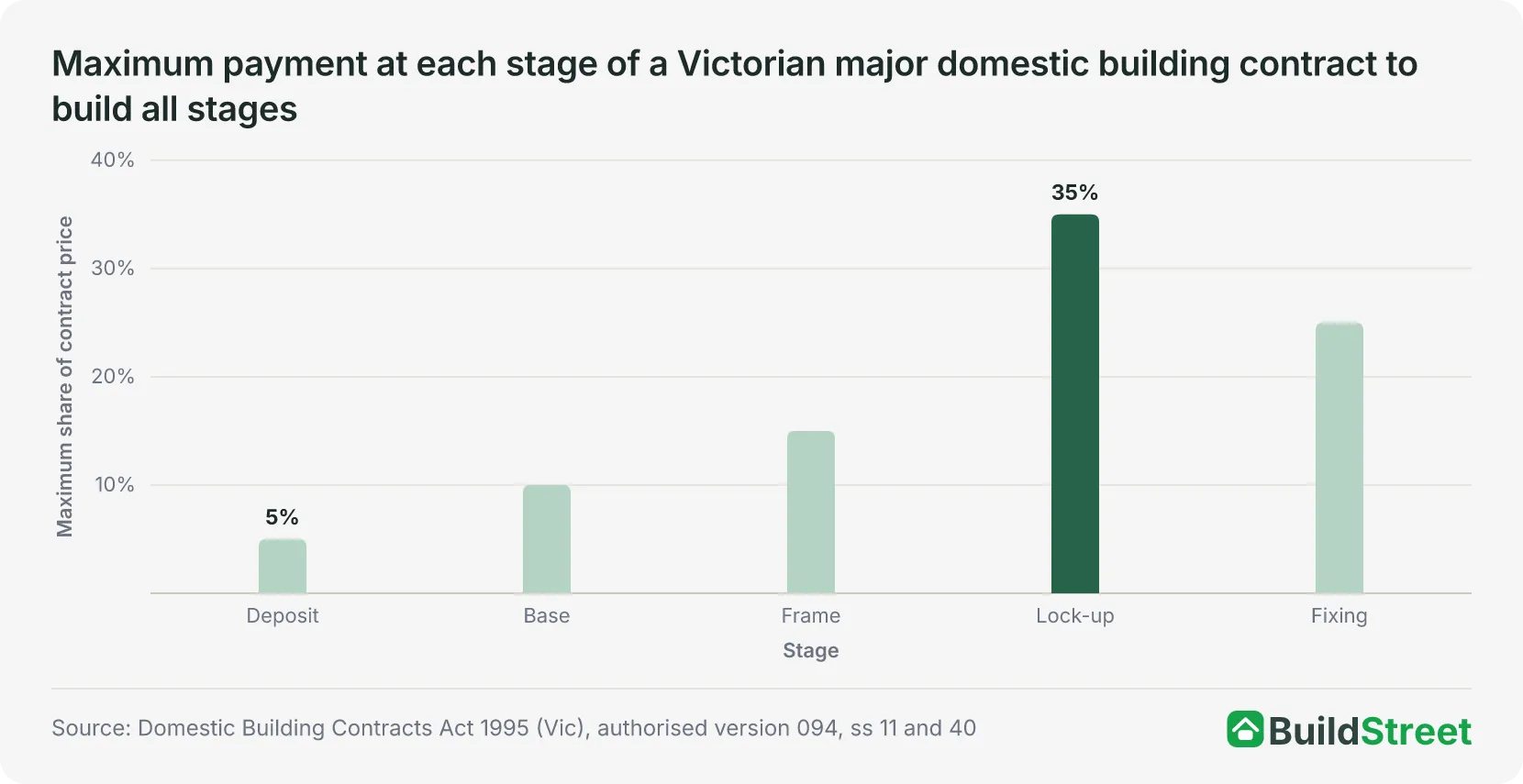
Victoria caps each stage of a major domestic building contract at 10 per cent at the base stage, 15 per cent at frame, 35 per cent at lock-up and 25 per cent at fixing, unless the parties agree to a different schedule under the regulations2. With the 5 per cent deposit those stages account for 90 per cent of the contract price. The remaining balance is due on completion under the contract's terms.
Section 06 · Cooling-off
How long is the cooling-off period on a home building contract?
The cooling-off period is five business days in all three states, counted from the day the owner receives a copy of the signed contract. New South Wales gives five business days on a contract over $20,0005, Victoria five business days on a major domestic building contract2, and Queensland five business days on a regulated contract. In Queensland, the cooling-off period can be extended if the owner of a contract worth $20,000 or more receives the consumer building guide late.3
The right has limits. In Victoria the builder may keep $100 plus approved out-of-pocket expenses, and an owner who has already signed a substantially identical contract with the same builder for the same home or land cannot withdraw.2
Queensland lets the builder keep the same $100 plus reasonable out-of-pocket expenses, and the cooling-off right is lost if the owner received formal legal advice about the contract before signing3. Consumer Affairs Victoria states that an owner who engaged a lawyer to review the contract before signing is not entitled to the cooling-off period9.
Before signing, a New South Wales builder must give the owner the Consumer Building Guide for residential building work worth more than $5,000.5 In Queensland, a builder must give the owner the QBCC Consumer Building Guide before they sign a domestic building contract worth $20,000 or more.3
| Deposit caps, progress payments and cooling-off periods, NSW, Victoria and Queensland, 2026 | ||||
|---|---|---|---|---|
| State | Deposit cap, $20,000 or more | Deposit cap, under $20,000 | Progress payments | Cooling-off period |
| New South Wales | 10% | 10% | Stage payments or as-invoiced payments, contracts over $20,000 (s 8A) | 5 clear business days, contracts over $20,000 (s 7BA) |
| Victoria | 5% | 10% | Base 10%, frame 15%, lock-up 35%, fixing 25%, unless agreed otherwise (s 40) | 5 clear business days, major contracts (s 34) |
| Queensland | 5% | 10%, over $3,300 | Directly related to progress on site and proportionate to the work (s 34) | 5 business days, regulated contracts over $3,300 (s 35) |
Source · Home Building Act 1989 (NSW) and Home Building Regulation 2014 (NSW); Domestic Building Contracts Act 1995 (Vic); Queensland Building and Construction Commission Act 1991 (Qld) schedule 1B and Queensland Building and Construction Commission Regulation 2018.
Section 07 · The marketing
What do builders' advertised fixed-price offers include?
Among the four builder inclusions documents BuildStreet has reviewed, two advertise a fixed price and both set site conditions for that price in the same document. G.J. Gardner Homes' Goulburn brochure offers a fixed price building contract, with no surprises, while its slab allowance assumes an 'M' soil rating, and its utility connections are priced to a "10 metre run"10.
Simonds Homes' Victorian booklet lists a fixed price guarantee among its selling points. Its foundations section states the slab is engineer designed up to 'H1' class, maximum 300mm fall and no existing fill. Site costs will be adjusted if founding conditions differ. The closing fine print adds that additional costs will be incurred for structural changes and the selection of some design options11.
The other two documents make no fixed-price claim. Hotondo Homes' national list uses site-cost allowances instead. It includes a site costs allowance for a 650m² block up to 300mm fall and a connection allowance covering 10 m of power, a 6 m water run and a 45 m sewer connection and 60 m stormwater connection12.
Coral Homes' Designer Standard Inclusions page makes no fixed-price claim and no site-cost basis in either direction13. None of the four marketing documents is the contract itself. The binding price and any provisions that allow it to change are set out in the signed contract and its schedules.
How the four documents handle allowances line by line, and how to line two builders' lists up against each other, is covered in How to compare builder inclusions like-for-like.
| Fixed-price claims and site-cost assumptions in four builders' advertised inclusions documents, 2025 editions | |||
|---|---|---|---|
| Builder | Fixed-price claim | Site or founding assumption stated with it | Connection basis |
| G.J. Gardner Homes | "Fixed price building contract, with no surprises" | Footings and slab "allowing for a soil rating of "M" | "10 metre run for Utility Services included (water, power, sewer)" |
| Simonds Homes | "Fixed price guarantee" | Slab "engineer designed up to 'H1' class, maximum 300mm fall and no existing fill. Site costs will be adjusted if founding conditions differ." | Services "immediately adjacent to the allotment"; electricity, telephone and gas connection fees not included |
| Hotondo Homes | None | "Site Costs Allowance 650m² block up to 300mm fall" | "Connection Allowance": power up to 10 m, 6 m water run, 45 m sewer and 60 m stormwater |
| Coral Homes | None | None stated | None stated |
Source · The four builders' published inclusions documents, retrieved 7 July 2026.
Section 08 · Outside the price
What costs are not included in a fixed-price building contract?
Some costs are outside the contract price because legislation allows them to be excluded, while others are excluded under the builder's own documents. In Victoria, a builder may exclude third-party charges for connecting or installing services such as gas, electricity, telephone, water and sewerage, as well as planning or building permits. The contract must state immediately after the price that the cost is not included and give a reasonable estimate of the amount2. Queensland's law also excludes amounts paid directly by the owner to a third party for connecting services or obtaining a development approval3.
The builders' own documents draw the second boundary. Simonds Homes' booklet lists furniture, lighting fittings, security systems, fireplaces, air conditioning, carpets, floor tiling outside wet areas, landscaping, fencing, driveway and paving as not included, along with electricity, telephone and gas connection fees charged by retailers11. Coral Homes' site disclaimer lists window coverings, landscaping, fencing, pools, water features and decorative lighting among the items not supplied by Coral Homes13. If a document does not mention an item, its status is unknown rather than excluded.
BuildStreet's beyond-the-build checklist separates confirmed exclusions, items not found in the builder's published document and general budget prompts. For a selected design's builder it lists confirmed exclusions where the builder's own document states that an item is not included. Items absent from a published list are marked as not found, meaning their status is unknown. The checklist also includes general budget prompts such as driveway, landscaping, fencing, window coverings and flyscreens without attributing them to the builder. No cost figure is attached to any row14.
See what a base price leaves out
BuildStreet's beyond-the-build checklist uses a shortlisted builder's published inclusions document to separate items stated as not included, items not mentioned and general costs that can sit outside a base contract. It does not include cost estimates and does not replace the signed contract or professional advice.
Section 09
Frequently asked questions
Is a fixed price building contract really fixed?
A fixed price fixes the cost of the work described in the contract's plans and specifications, but the final amount can still change in certain circumstances. Queensland's home warranty rules define a fixed price residential contract as one whose price can still change for prime cost items, provisional sums and increases in labour or material costs, or because of delays. New South Wales, Victoria and Queensland also require contracts to warn where the price can change.
What can change the price in a fixed-price building contract?
Four mechanisms recur across New South Wales, Victoria and Queensland: provisional sums, prime cost items, variations agreed after signing and, where permitted under the contract and state law, a rise-and-fall clause. Some amounts sit outside the contract price altogether, such as service connections and permit fees that a Victorian builder may leave out of the price if the contract gives an estimate.
What is the maximum deposit on a home building contract?
New South Wales caps the deposit at 10 per cent of the contract price under the Home Building Act 1989. Victoria and Queensland cap it at 5 per cent for a contract price of $20,000 or more and 10 per cent below that. In Queensland, the cap can rise to 20 per cent where more than half of the contract price relates to off-site work.
Can a builder increase a fixed price because of rising material costs?
A fixed price can increase because of rising material costs where the contract and state law allow it. Victoria bars a cost escalation clause unless the contract price is more than $500,000 or the clause is in a form approved by the regulator. The owner must also receive the required notice and sign or initial the clause. New South Wales and Queensland allow such a clause but require the price-change warning.
What is a cost plus building contract?
A cost plus contract is one where the final amount payable to the builder cannot be accurately calculated when the contract is signed, even if prime cost items and provisional sums are ignored. Victoria permits cost plus contracts only in specified circumstances, including some higher-value contracts and renovation work that cannot be accurately priced before work begins. The QBCC reports that final costs under cost plus contracts are sometimes more than double the owner's expectation.
How long is the cooling-off period on a home building contract?
The cooling-off period is five clear business days in New South Wales and Victoria and five business days in Queensland, counted from the day the owner receives a copy of the signed contract. The rules differ between states. In Victoria and Queensland, the right can be lost in some circumstances, including where legal advice was received before signing, while in New South Wales the cooling-off period applies to contracts over $20,000.
References
- Queensland Building and Construction Commission Regulation 2018 (Qld) · legislation.qld.gov.au ↑ b c
- Domestic Building Contracts Act 1995 (Vic) · legislation.vic.gov.au ↑ b c d e f g h i j k l m n
- Queensland Building and Construction Commission Act 1991 (Qld), Schedule 1B · legislation.qld.gov.au ↑ b c d e f g h i j k l
- QBCC, Cost plus and construction management contracts · qbcc.qld.gov.au ↑ b
- Home Building Act 1989 (NSW) · legislation.nsw.gov.au ↑ b c d e
- QBCC, Domestic building contracts: general information for owners and contractors · qbcc.qld.gov.au ↑
- NSW Government (Building Commission NSW), Contracts for residential building work · nsw.gov.au ↑
- Consumer Affairs Victoria, New domestic building contract laws passed in Victoria · consumer.vic.gov.au ↑
- Consumer Affairs Victoria, Building contracts checklist · consumer.vic.gov.au ↑
- G.J. Gardner Homes Goulburn, Designer Inclusions brochure · media.aws.gjgardner.com.au ↑
- Simonds Homes, Inspirations 2025 Inclusions booklet, VIC · cdn.simonds.com.au ↑ b
- Hotondo Homes, Sanctuary Inclusions List, National · storage.hotondo.com.au ↑
- Coral Homes, Designer Standard Inclusions · coralhomes.com.au ↑ b
- BuildStreet lot report and catalogue price cards · buildstreet-gs59z.ondigitalocean.app ↑
- Home Building Regulation 2014 (NSW) · legislation.nsw.gov.au
- QBCC, Domestic building contracts · qbcc.qld.gov.au
