
Published 15 Sept 2026 · Updated 18 Sept 2026
A provisional sum is a builder's estimate for work that cannot be priced exactly when a home building contract is signed, such as excavation. A prime cost item is an allowance for a fixture or fitting the owner has not yet selected, such as an oven or tiles. Both can be included in a fixed contract price, and both can change the final amount payable once the actual cost is known. Under the New South Wales and Queensland standard contracts, the builder's margin may also apply when the actual cost exceeds the allowance. The rules on these estimates vary by state: Victoria, Queensland and Western Australia set requirements for estimates that are below reasonable cost, while New South Wales and South Australia address the mechanics through the contract and a statutory notice.
Section 01 · The definitions
What are provisional sums and prime cost items in a home building contract?
A provisional sum is an estimate for work that cannot be priced exactly when the contract is signed, even after the builder has made reasonable inquiries. It covers the work and any materials needed. Under the Domestic Building Contracts Act 1995 (Vic), a provisional sum must not be set below the reasonable cost of carrying out the work1.
A prime cost item is an allowance for an item that has not yet been selected, or whose price is not known when the contract is signed. This commonly applies to fixtures or fittings, with a reasonable allowance covering the item's supply and delivery1.
Queensland law defines both in similar terms. A provisional sum is an estimate of the cost of particular contracted services that the builder, after all reasonable enquiries, cannot state as a definite amount2. A prime cost item is an item that has not been selected or the price is not known at signing, with a reasonable allowance made for it.
The difference is what remains uncertain when the contract is signed. For a provisional sum the work itself cannot be priced. Examples include excavation when soil conditions are uncertain3 in Victoria, unforeseen rock excavation in the Building Commission NSW contract4, and rock or termite removal in Queensland5.
A prime cost item applies when the work is known but the particular product or its price is not. Examples include ovens, taps and tiles in Victoria, a stove in New South Wales and kitchen stoves and bathroom tiling in South Australia3.
Both can form part of a fixed-price building contract. Victoria defines the contract price as the total amount payable under the contract1, and Queensland's home warranty rules define a fixed price residential contract as one whose price is fixed except for specified changes, including prime cost items, provisional sums and increases for rising costs or delays6. The presence of these allowances therefore does not, by itself, make a contract a cost plus contract.
| Provisional sums compared with prime cost items under the Victorian and Queensland Acts | ||
|---|---|---|
| Feature | Provisional sum | Prime cost item |
| What is uncertain at signing | The cost of a piece of work, materials included | The choice or price of an item, typically a fixture or fitting |
| Regulators' examples | Excavation, earthworks, rock, termite removal | Ovens, stoves, taps, tiles, bathroom fittings |
| Victorian definition | An estimate of the cost of carrying out particular work for which the builder, after all reasonable inquiries, cannot give a definite amount, s 3(1) | An item not selected or whose price is not known at signing, for which the builder must make a reasonable allowance, s 3(1) |
| Queensland definition | An estimate of the cost of providing particular contracted services the builder cannot state as a definite amount after all reasonable enquiries, sch 1B s 10 | An item not selected or whose price is not known at signing, for which a reasonable allowance is made, sch 1B s 1 |
| Who resolves it | The builder, when the work is done and its actual cost is known | The owner, by selecting the item in time for the work |
| Where it ends up | Replaced by the actual cost, with the contract's margin on any excess | Replaced by the actual cost, with the contract's margin on any excess |
Source · Domestic Building Contracts Act 1995 (Vic) s 3(1); QBCC Act 1991 (Qld) sch 1B ss 1 and 10.
Section 02 · The adjustment
How does a provisional sum or prime cost item change the contract price?
A provisional sum or prime cost allowance is adjusted once the actual cost is known. If the actual cost is higher than the allowance, the contract price can increase. If it is lower, the contract price can decrease. The exact adjustment depends on the contract.
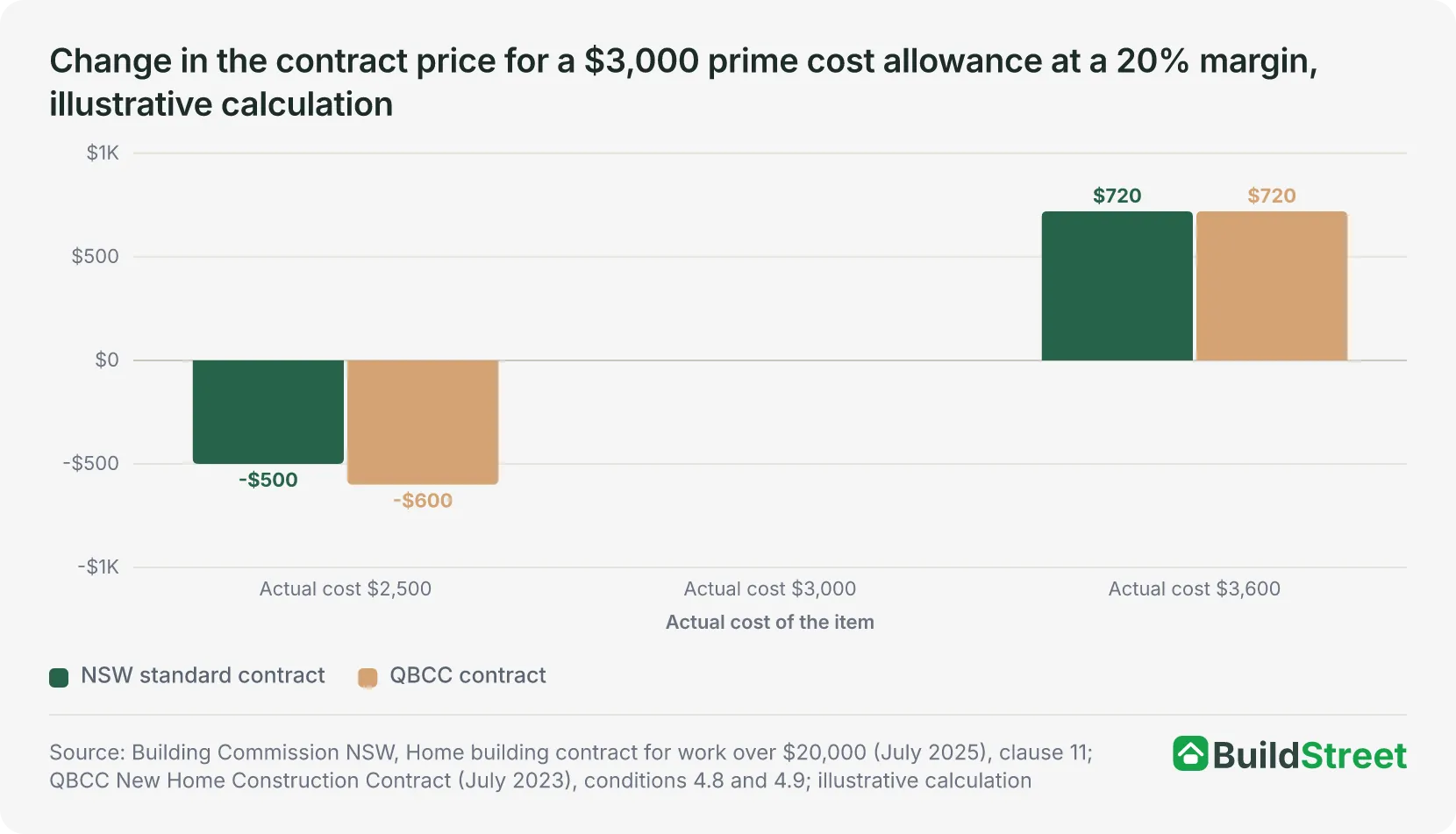
Under the Building Commission NSW contract for work over $20,000, if the actual cost is greater than the allowance, the difference and the contractor's stated margin on the difference are added to the contract price along with the additional GST. If the actual cost is less, the contract price is reduced by the difference4.
The Queensland Building and Construction Commission (QBCC) New Home Construction Contract works slightly differently. If the actual cost is higher, the difference plus the contractor's markup is added. If it is lower, both the difference and the related markup are deducted because the allowance already includes the markup7.
Victoria does not set a specific margin but requires the contract to explain how any extra charge will be calculated1. Consumer Affairs Victoria also states that the contract should show how the additional amount is calculated and the amount to be charged8.
In South Australia the statutory notice given with every domestic building work contract states that choosing a higher-standard prime cost item can add the difference in cost plus a surcharge of up to 15 per cent of the item's cost9.
The builder may also have to provide evidence of the actual cost. In Victoria, the builder must give the owner a copy of any invoice, receipt or other document showing the builder's cost of a prime cost item, or relating to a provisional sum, as soon as practicable after receiving it, with 20 penalty units for a failure1.
The New South Wales contract requires the invoice or receipt when payment is requested. It also allows the owner, with adequate written notice, to be on site while provisional sum work is done to verify its actual cost4.
The QBCC contract also links payment to the work being completed or the item being installed. The contractor cannot claim for a prime cost item or provisional sum work until the progress claim after the item is incorporated or the work completed7.
Section 03 · The schedule
What must a contract show for each provisional sum or prime cost item?
The information a contract must show depends on the state, but it generally identifies the allowance, explains how it is calculated and warns where the final price may change.
A Victorian major domestic building contract must contain a separate schedule for each prime cost item or provisional sum, and the builder must not enter the contract without one, an offence carrying 50 penalty units1. Each schedule must include:
- a detailed description of the item or the work,
- a breakdown of the cost estimate showing at least the estimated quantities of materials and the unit cost to the builder, and
- the method for any charge above the actual increase.
Consumer Affairs Victoria states that a major domestic building contract is required for work worth more than $10,0003. For smaller contracts, the same information must be provided in writing before signing.
In Queensland, contracts worth $20,000 or more are known as level 2 regulated contracts. Such a contract must state a fixed price in a prominent position on the first page of the contract schedule, or, if the price is not fixed, the method for calculating it including any allowances. If a contract term allows the price to change, the first page must also include a warning and brief explanation2.
The QBCC standard contract shows the total amounts for prime cost items and provisional sums in its first schedule. Separate schedules then provide the description of each item, a breakdown of the estimate including the contractor's markup, and the total price including GST7.
In New South Wales the law focuses on warning that the contract price may change rather than setting out a specific prime cost or provisional sum schedule. If the contract price is not known or may be varied, the Home Building Act 1989 requires a warning and an explanation of the provision that allows the change10.
The Act itself does not use the terms prime cost item or provisional sum. The Building Commission NSW standard contract does, with separate schedules for provisional sum work and prime cost items4.
South Australia's statutory notice states that a price that may change or is only an estimate must carry the words THIS PRICE MAY CHANGE or ESTIMATE ONLY next to it. If there is more than one such amount, they must be listed together9.
| What the law requires of a provisional sum or prime cost item, by state | ||||
|---|---|---|---|---|
| State and instrument | Terms defined in the Act | Standard for the estimate | Schedule or disclosure | Consequence of a low estimate |
| NSW, Home Building Act 1989 | No; the standard contract defines them | Contract warranty: estimated with reasonable care and skill, as a competent and experienced contractor would | Warning and explanation next to a price that may be varied, s 7(5); schedules in the standard contract | A contract warranty; the Act sets no penalty specific to the estimates |
| Victoria, Domestic Building Contracts Act 1995 | Yes, s 3(1) | Warranty of reasonable care and skill for provisional sums, s 20; no amount below the reasonable cost, s 21 | Separate schedule per item in a major contract, s 22; invoices to the owner, s 23; warning next to the price, s 33 | Offence, 35 penalty units, s 21 |
| Queensland, QBCC Act 1991 sch 1B | Yes, ss 1 and 10 | Warranty: calculated with reasonable care and skill on the information reasonably available, s 26 | Method including allowances in the contract schedule, and a first-page warning, s 14(5) to (7) | Breach of a statutory warranty; s 26 states no penalty |
| Western Australia, Home Building Contracts Act 1991 | No; the cost plus definition refers to them | Not misstated below the least amount it could reasonably cost, s 12 | Contract in writing setting out all terms, with a prescribed explanatory notice, s 4 | Offence, penalty $10,000, s 12 |
| South Australia, Form 1 notice under the Building Work Contractors Act 1995 | Not verified; the Act was not accessible | Fair and reasonable estimates, per the notice | THIS PRICE MAY CHANGE or ESTIMATE ONLY next to the price, in a single list, per the notice | Not stated in the notice |
Source · the Acts, the QBCC Regulation 2018 s 45, the Building Commission NSW contract (July 2025) and the CBS (SA) Form 1 notice.
Section 04 · Low estimates
What happens when a provisional sum or prime cost estimate was set too low?
In Victoria, a builder must not enter a domestic building contract containing a prime cost item amount below the reasonable cost of supplying the item, or a provisional sum below the reasonable cost of the work. Doing so is an offence carrying 35 penalty units. Whether an estimate is reasonable depends on the information the builder had, or reasonably should have had, when the contract was signed, as well as the nature and location of the site1. The rule does not apply to items or sums the owner supplies or specifies. Separately, the builder warrants that any provisional sum was calculated with reasonable care and skill using all the information reasonably available at the contract date, including the nature and location of the site.
Western Australia also makes an unreasonably low estimate an offence, with a $10,000 penalty. A builder must not enter a contract containing an amount for a prime cost item or provisional sum below the least amount it could reasonably cost, based on what the builder knew or ought reasonably to have known when the contract was signed11.
Queensland treats the estimate as a statutory warranty under a regulated contract. The sum must be calculated with reasonable care and skill using the information reasonably available at signing, including the nature and location of the site2. The New South Wales standard contract includes a similar warranty, based on what a competent and experienced contractor should have taken into account4.
Site conditions are one area where these rules can apply. In Victoria, a builder who was required to obtain foundations data before a major domestic building contract cannot later seek an amount not provided for in the contract if that cost could reasonably have been identified from the data1. Consumer Affairs Victoria states that a builder should not charge for a variation relating to an issue that should have been identified before work started. Its example is rock that could have been predicted from the foundation data8. It also warns owners that an excavation provisional sum can rise substantially if the soil report did not find rock3.
How the soil report sets the class a builder's slab is priced to is covered in the article on soil classification and site costs.
Section 05 · The documents
How do provisional sums and allowances appear in builders' inclusions documents?
Among the four builder inclusions documents reviewed, one states a dollar allowance. G.J. Gardner's Goulburn brochure uses a tile allowance of $30 per square metre, covering the kitchen splashback, the shower bases, the bathroom and ensuite wall and floor tiles and the laundry. The tiles are chosen from the builder's range12. This type of allowance can become a prime cost item when it is included in the contract.
Two documents state site-cost limits or assumptions rather than a dollar amount. Hotondo's national list carries a Site Costs Allowance for a 650 square metre block with up to 300 mm of fall. Its Connection Allowance covers up to 10 m of underground power, a 6 m water run, a 45 m sewer run and 60 m of stormwater13.
Simonds' Victorian booklet prices its waffle slab for a site up to H1 class, with a maximum 300 mm fall and no existing fill. It states that site costs will be adjusted if the site conditions differ14. Coral's Designer page has no siteworks or connections section, so the document does not show how site costs are treated15.
An envelope of this kind becomes a provisional sum, a fixed site-cost line or an exclusion only when the contract is written.
How an advertised base price becomes a contract price is covered in the article on base prices and site costs.
The most common type of unpriced inclusion is a product from the builder's range. Of the 237 inclusion lines extracted from the four documents, 25 describe a product to be chosen from the builder's standard range, six in Coral's page, four in G.J. Gardner's brochure, 10 in Hotondo's list and five in Simonds' booklet. These include bricks, roof tiles, benchtops, splashbacks, wet-area tiles, door handles and entry doors16. None of the 25 carries a price, so the contract must either specify the product or provide an allowance for it.
| Allowance and unpriced lines in four builders' inclusions documents, 2025 | ||||
|---|---|---|---|---|
| Document (series, region) | Lines extracted | Lines with a dollar allowance | Lines from the builder's range | Site-cost or connection envelope |
| Coral Designer (QLD and northern NSW, undated) | 43 | 0 | 6 | None; the siteworks and connections category is absent |
| G.J. Gardner Designer (Goulburn NSW, undated) | 69 | 4 | 4 | Utility runs quantified to 10 m; no block-size or fall envelope |
| Hotondo Sanctuary (national, May 2025) | 60 | 0 | 10 | 650 m² block up to 300 mm fall; power 10 m, water 6 m, sewer 45 m, stormwater 60 m |
| Simonds Inspirations (VIC, effective 24 July 2025) | 65 | 0 | 5 | Slab to H1 class, 300 mm fall, no fill; site costs adjusted if conditions differ |
| All four documents | 237 | 4 | 25 | Two envelopes, one quantified run, one silence |
Source · the four builders' inclusions documents, retrieved 7 July 2026; BuildStreet inclusions corpus extraction of 7 July 2026.
Section 06 · Regulator guidance
What do regulators say about limiting provisional sums and prime cost items?
The Victorian, New South Wales and South Australian regulators all indicate that specifying items before signing can reduce the need for provisional sums and prime cost items. Consumer Affairs Victoria's checklist says to avoid prime cost items where possible by including the make, model, colour and style of each selection so the building cost is final, and not to agree to provisional sum items where possible because they can make the final cost higher3. Its page for builders also states that when everything is specified, the builder can give a fixed price for the work8.
The New South Wales Government's contracts page states that fittings and appliances should be selected before signing, with brand names and models listed so the quoted prices are more accurate17. The owner notes in the Building Commission NSW contract say that excessive use of provisional sums should be avoided. They also explain that uncertain quantities such as rock can be priced using a rate multiplied by an estimated quantity, and that a geotechnical survey can help narrow that estimate before signing4.
South Australia's notice states that prime cost items and provisional sums may change the total amount payable9. The South Australian Government website for builders lists prime cost items, provisional sums and rise and fall clauses as contract terms that can allow the price to change after signing18.
How unpriced items appear in builders' inclusions lists
BuildStreet's inclusions comparison shows published inclusions from different builders side by side and identifies lines with a dollar allowance, a builder's range or no stated price. Those lines may later be dealt with in the contract as specified products, prime cost items, provisional sums or exclusions, depending on the contract terms.
Section 07
Frequently asked questions
What is a provisional sum in a building contract?
A provisional sum is a builder's estimate for work that cannot be priced exactly when the contract is signed, even after reasonable inquiries have been made. It can include materials needed for the work. Excavation and other site work are examples given by regulators. Once the actual cost is known, the contract price is adjusted according to the contract terms.
What is a prime cost item in a building contract?
A prime cost item is an allowance for an item that has not yet been selected, or whose price is not known when the contract is signed. Examples include ovens, taps and tiles. Once the item is selected and its actual cost is known, the contract price is adjusted according to the contract terms.
Is the builder's margin charged on a prime cost item overrun?
Yes, under the New South Wales and Queensland standard contracts reviewed. Under the Building Commission NSW contract for work over $20,000 the amount above the allowance and the builder's stated margin on that amount are added to the contract price, along with any additional GST. Under the QBCC New Home Construction Contract, the difference plus the contractor's markup is added. If the actual cost is lower, the two contracts calculate the reduction differently.
Can a builder set a provisional sum deliberately low?
In Victoria a builder must not enter a domestic building contract containing a prime cost item or provisional sum amount below the reasonable cost of the item or work, an offence carrying 35 penalty units. In Western Australia stating an amount below the least it could reasonably cost carries a $10,000 penalty. In Queensland the builder warrants under a regulated contract that each sum was calculated with reasonable care and skill on the information reasonably available at signing.
Do provisional sum increases count towards the 15 per cent price rise that lets a Victorian owner end a contract?
No, under section 41 of the Domestic Building Contracts Act 1995 (Vic) an owner may end a major domestic building contract when the price rises by 15 per cent or more for reasons the builder could not reasonably have foreseen. Increases from prime cost items, provisional sums and owner-requested variations are not counted towards that 15 per cent threshold.
Are the allowances in a builder's inclusions list the same as provisional sums?
No. An allowance in a builder's marketing material is not automatically a provisional sum or prime cost item. Its treatment depends on what is written into the building contract. Among the four inclusions documents reviewed, one states a dollar allowance, a tile allowance of $30 per square metre, and two state a site-cost envelope such as a 650 square metre block with up to 300 mm of fall.
References
- Domestic Building Contracts Act 1995 (Vic) · legislation.vic.gov.au ↑ b c d e f g h i j k
- Queensland Building and Construction Commission Act 1991 (Qld), Schedule 1B · legislation.qld.gov.au ↑ b c
- Consumer Affairs Victoria, Building contracts checklist · consumer.vic.gov.au ↑ b c d e
- Building Commission NSW, Home building contract for work over $20,000 · nsw.gov.au ↑ b c d e f g
- QBCC, Contracts and agreement types · qbcc.qld.gov.au ↑
- Queensland Building and Construction Commission Regulation 2018 (Qld) · legislation.qld.gov.au ↑
- QBCC New Home Construction Contract, General Conditions · qbcc.qld.gov.au ↑ b c d
- Consumer Affairs Victoria, Changing a domestic building contract price · consumer.vic.gov.au ↑ b c
- Consumer and Business Services (SA), Form 1, Your building contract: your rights and obligations · cbs.sa.gov.au ↑ b c
- Home Building Act 1989 (NSW) · legislation.nsw.gov.au ↑
- Home Building Contracts Act 1991 (WA) · legislation.wa.gov.au ↑
- G.J. Gardner Homes Goulburn, Designer Inclusions brochure · media.aws.gjgardner.com.au ↑
- Hotondo Homes, Sanctuary Inclusions List, National · storage.hotondo.com.au ↑
- Simonds Homes, Inspirations 2025 Inclusions booklet, VIC · cdn.simonds.com.au ↑
- Coral Homes, Designer Standard Inclusions · coralhomes.com.au ↑
- BuildStreet lot report and catalogue price cards · buildstreet-gs59z.ondigitalocean.app ↑ b
- NSW Government (Building Commission NSW), Contracts for residential building work · nsw.gov.au ↑
- SA.GOV.AU, Builder responsibilities · sa.gov.au ↑
