


Published
 How Australia's ageing population is changing housingThe number of people aged 65 and over, where older Australians live and how many downsize, from ABS and ATO data.
 Older renters in Australia: rental stress and housing statisticsAn estimated 364,000 Australian households with a reference person aged 65 and over rented their home in 2019-20, representing about 14.7 per cent of all households in that age group. BuildStreet calc…
Section 01 · Departures
How many people aged 65 and over leave Australia each year?
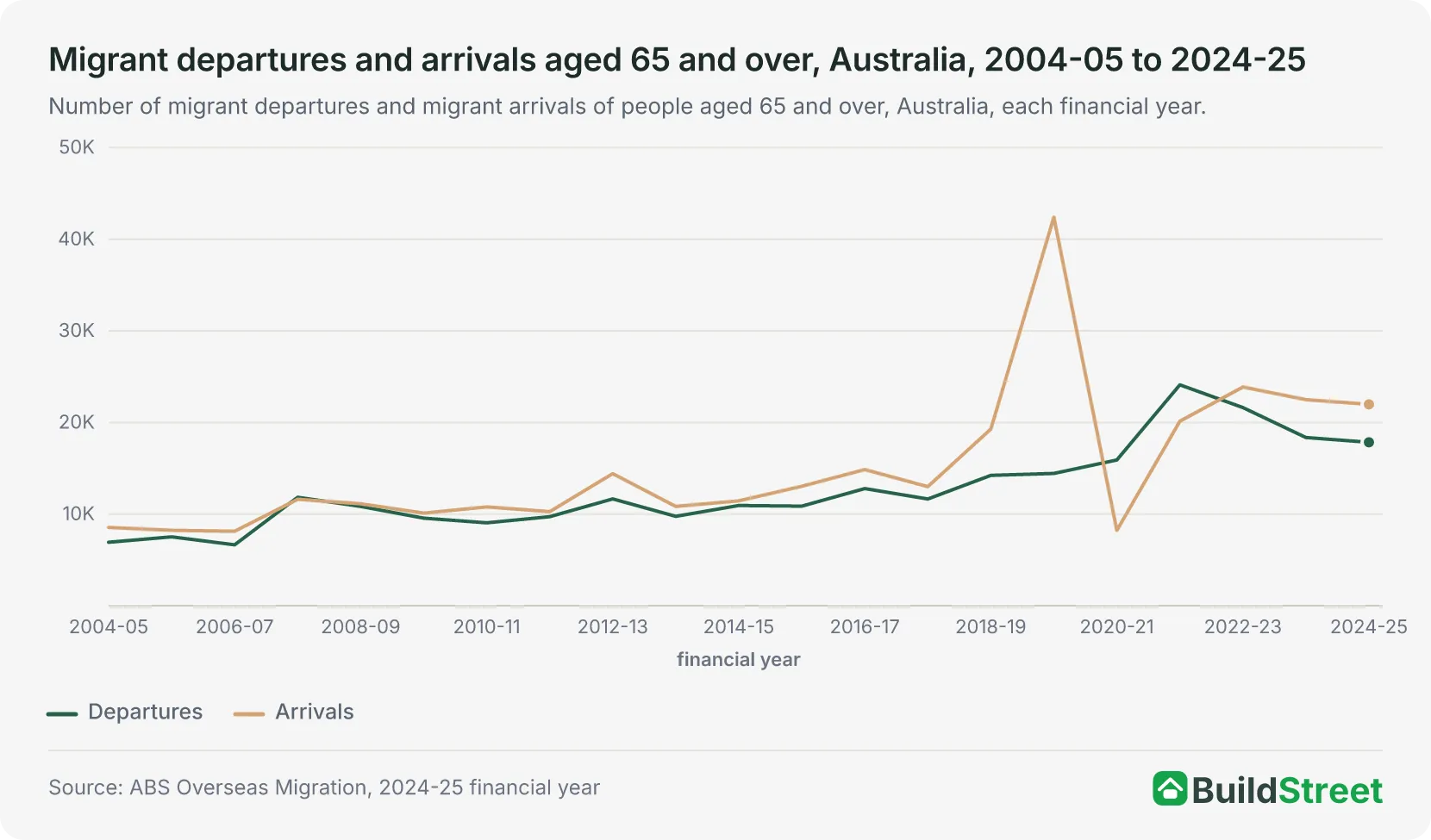
Migrant departures of people aged 65 and over from Australia totalled 17,840 people in 2024-25, according to Australian Bureau of Statistics (ABS) overseas migration data12. They accounted for 6.8 per cent of the 262,800 migrant departures from Australia that year12.
Migrant arrivals aged 65 and over totalled 21,980 in 2024-25, exceeding departures1. Net overseas migration for this age group was a gain of 4,150 people2.
The ABS rounds each figure to the nearest 10 people, which explains why subtracting departures from arrivals gives 4,140 rather than the published net gain of 4,1503. The 2024-25 estimates are preliminary and will be revised.
Migrant departures among people aged 65 and over increased from 6,930 in 2004-05 to a peak of 24,110 in 2021-22, the largest number recorded between 2004-05 and 2024-2512. Net overseas migration for this age group was negative in only three years: 2007-08, 2020-21 and 2021-22, when departures exceeded arrivals12.
Migrant departures among people aged 65 and over in 2024-25 were equivalent to 0.37 per cent of the 4,838,984 people in this age group living in Australia at 30 June 202545. This comparison uses two ABS datasets: migrant departures and estimated resident population.
| Migrant departures by age group, Australia, 2018-19 and 2024-25 | ||
|---|---|---|
| Age group | 2018-19 | 2024-25 |
| 50 to 54 | 10,210 | 8,570 |
| 55 to 59 | 9,750 | 7,440 |
| 60 to 64 | 8,250 | 8,230 |
| 65 and over | 14,2301 | 17,8401 |
| All ages | 309,060 | 262,800 |
Source · ABS Overseas Migration, 2024-25 financial year.
Section 02 · Pensions paid overseas
How many Australian pension recipients live overseas?
The Department of Social Services (DSS) estimated that around 88,000 people receiving an Australian pension were living permanently overseas in 20266. The estimate was published as part of a 2026-27 Budget measure concerning the Pension Supplement. An estimated 3,000 pension recipients move permanently overseas each year.
In June 2026, 73,985 of the 2,718,425 Age Pension recipients, or 2.7 per cent, had no Australian state or territory recorded7. This includes people living overseas and those with an incomplete or invalid address, so the figure does not represent the total number of recipients living overseas.
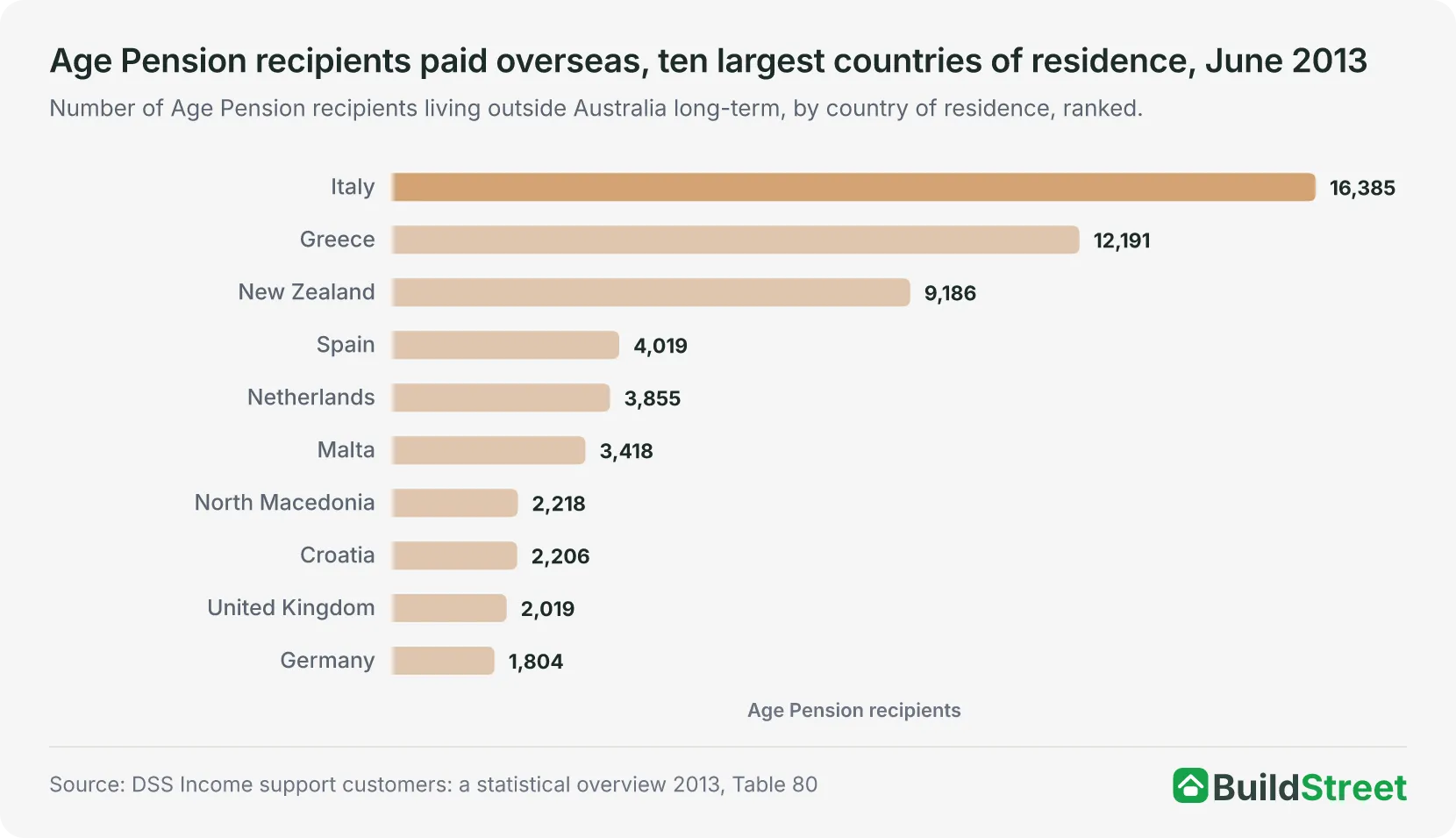
In June 2013, 76,865 Age Pension recipients were paid overseas, up from 23,948 in June 19938. The definition of a long-term absence changed from more than 12 months to more than six months during this period. Italy recorded the largest number of Age Pension recipients paid overseas of any country of residence in June 2013, at 16,385, followed by Greece, at 12,191, and New Zealand, at 9,186.
Section 03 · Older renters
How many people aged 65 and over rent their home in Australia?
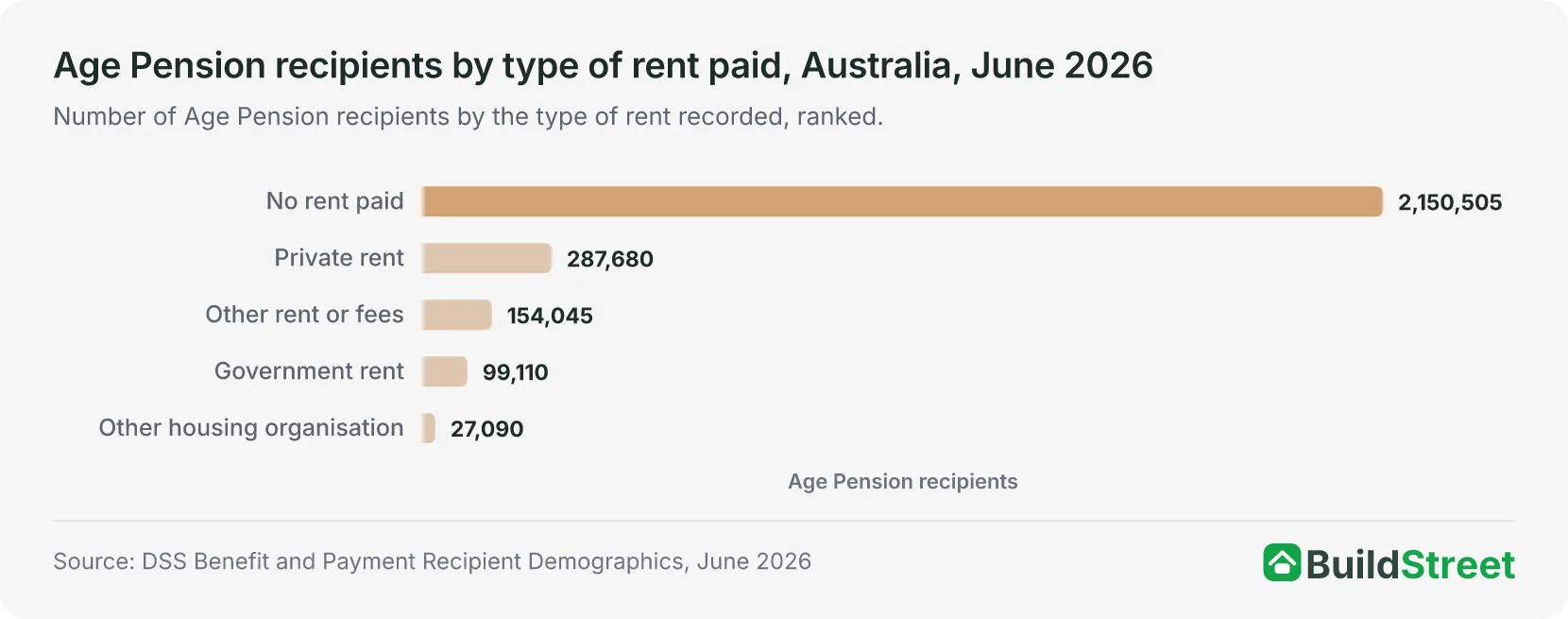
In June 2026, 287,680 Age Pension recipients paid private rent, accounting for 10.6 per cent of the 2,718,425 people receiving the Age Pension, according to DSS payment data7. A further 99,110 recipients paid rent to a state or territory housing authority.
The DSS recorded 749,330 Age Pension recipients, or 27.6 per cent, as non-homeowners in June 20267. A total of 2,150,505 Age Pension recipients, or 79.1 per cent, paid no rent, including those who owned their homes.
According to the ABS Survey of Income and Housing, 16.0 per cent of households headed by someone aged 65 to 74 rented their home in 2019-209. The share was 12.9 per cent for those aged 75 and over, compared with 31.4 per cent across all households10.
Most older households owned their home without a mortgage, at 68.1 per cent for ages 65 to 74 and 79.4 per cent for ages 75 and over910. However, the survey's margins of error overlap, meaning it does not establish a clear difference in renting rates between the two older age groups9.
Among households with a reference person born from 1947 to 1951, home ownership increased from 54 per cent at ages 25 to 29 in 1976 to 82 per cent at ages 70 to 74 in 2021, according to Australian Institute of Health and Welfare (AIHW) analysis of Census data11.
| Housing tenure by age of household reference person, Australia, 2019-20 | ||||||
|---|---|---|---|---|---|---|
| Tenure | 65 to 74 (%) | ± | 75 and over (%) | ± | All (%) | ± |
| Owner without a mortgage | 68.1 | 1.7 | 79.4 | 2.8 | 29.5 | 0.8 |
| Owner with a mortgage | 13.4 | 1.8 | 3.7 | 1.0 | 36.8 | 0.9 |
| Renter, state or territory housing authority | 3.8 | 0.8 | 3.8 | 1.0 | 2.9 | 0.3 |
| Renter, private landlord | 9.5 | 1.5 | 6.0 | 1.6 | 26.2 | 1.0 |
| All renters | 16.09 | 1.9 | 12.9 | 2.3 | 31.4 | 1.0 |
Source · ABS Housing Occupancy and Costs, 2019-20, Table 6.1.
Section 04 · Rental stress
What share of older renters receiving Rent Assistance are in rental stress?
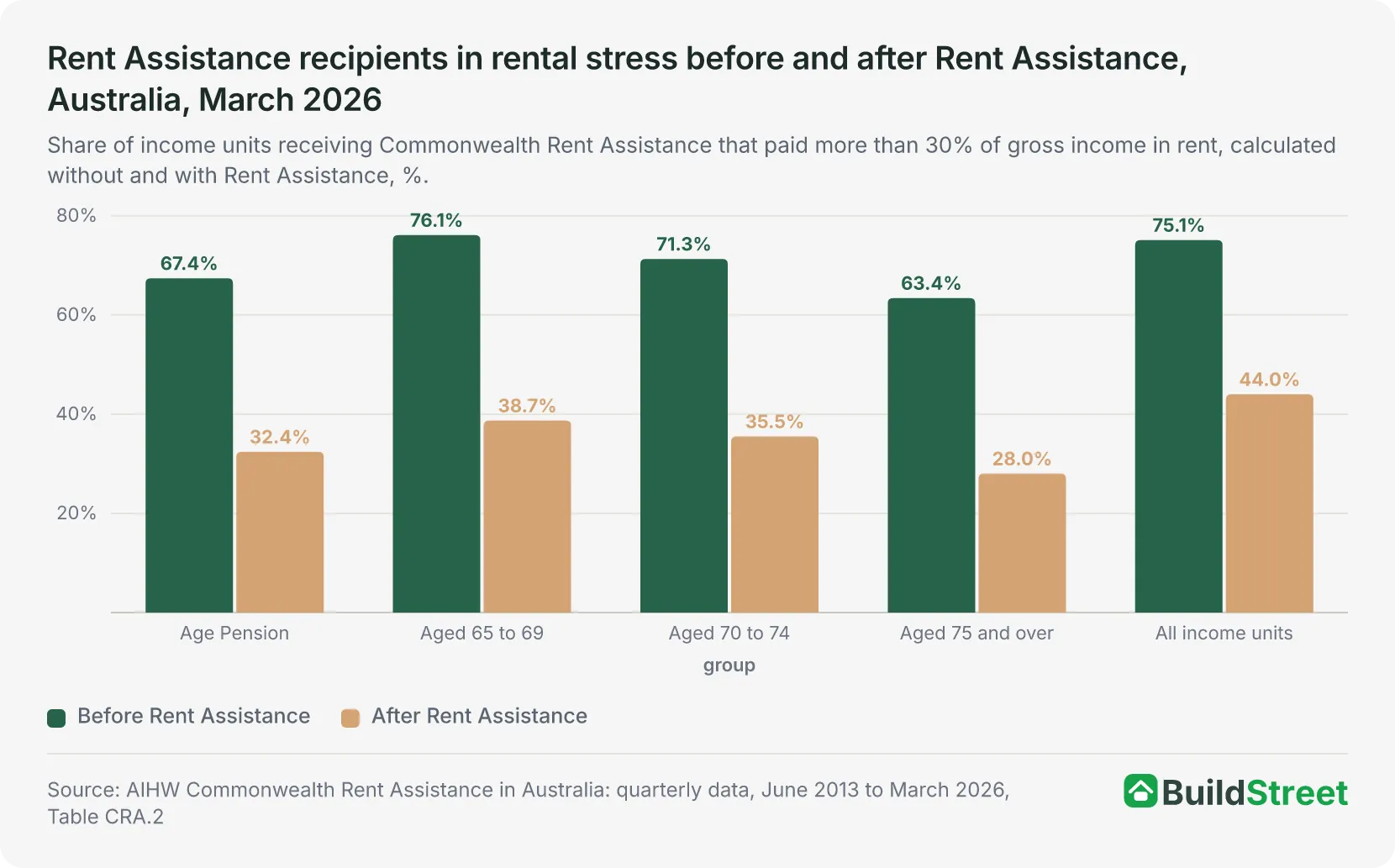
In March 2026, 32.4 per cent of Age Pension income units (single people or couples) receiving Commonwealth Rent Assistance paid more than 30 per cent of their gross income in rent after receiving that assistance, according to AIHW data1213. That was 108,065 of 333,225 income units12. Among all income units receiving Rent Assistance, the share was 44.0 per cent13.
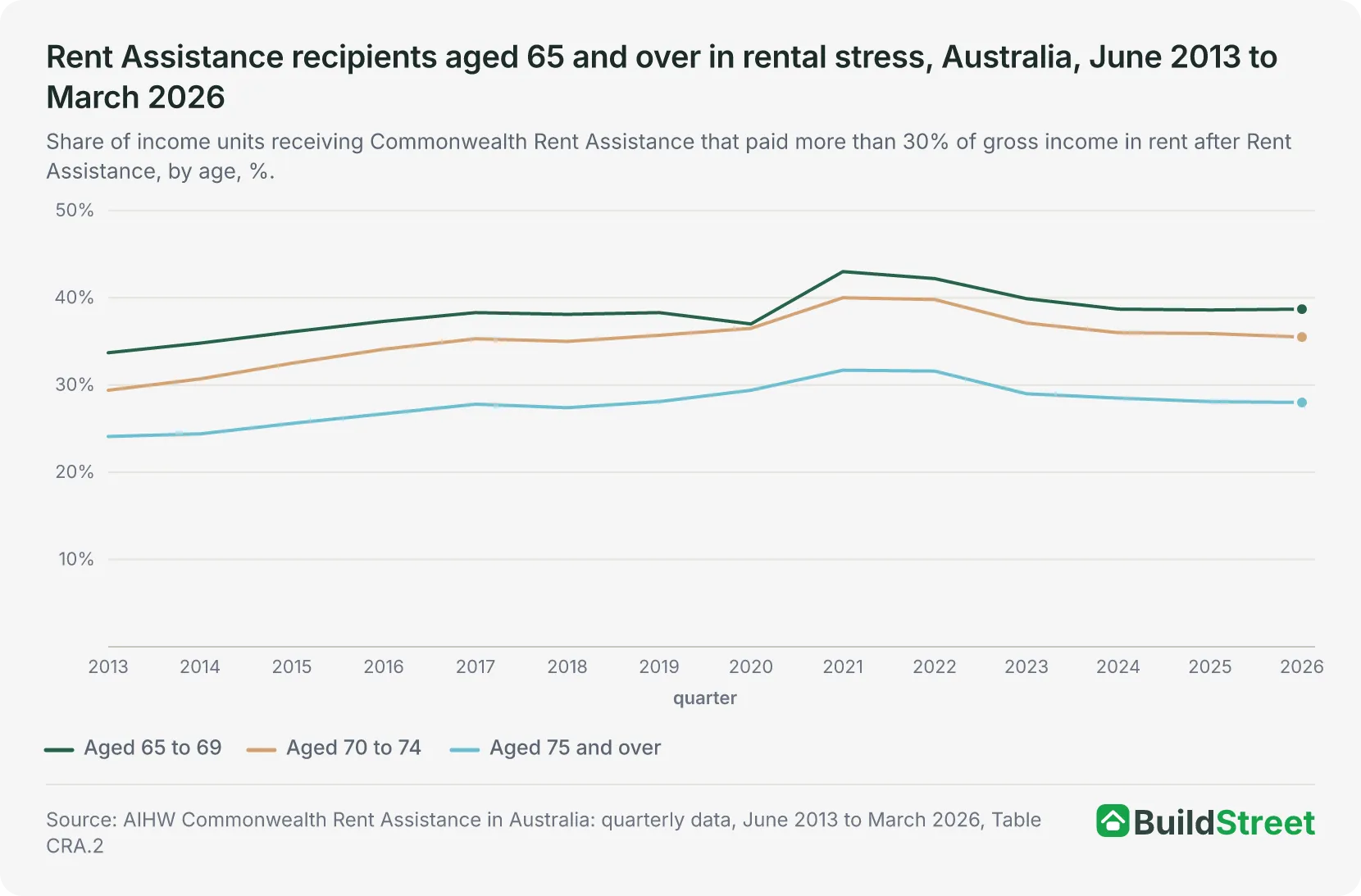
Among income units receiving Rent Assistance, 38.7 per cent of those aged 65 to 69 were in rental stress in March 2026, compared with 35.5 per cent at ages 70 to 74 and 28.0 per cent at ages 75 and over1213.
The AIHW estimated that, without Rent Assistance, 67.4 per cent of Age Pension income units would have paid more than 30 per cent of their gross income in rent1213.
The share of Age Pension income units receiving Rent Assistance that were in rental stress increased from 28.4 per cent in June 2013 to 32.4 per cent in March 20261213. Over the same period, the number of those income units in rental stress increased from 62,915 to 108,0651213.
Across all tenure types, 13.2 per cent of lower-income households with a reference person aged 65 to 74 spent more than 30 per cent of gross income on housing costs in 2019-20, compared with 8.8 per cent at ages 75 and over and 25.1 per cent of all lower-income households, according to ABS Housing Occupancy and Costs data1410.
Among lower-income households renting from a private landlord, across all ages, the share was 58.0 per cent10. The margins of error for the two older age groups overlap, so the survey does not establish a clear difference between them14.
The ABS did not release results from its 2023-24 Survey of Income and Housing, so 2019-20 is the latest period with published housing cost results15.
| Lower-income households spending more than 30% of gross income on housing costs, Australia, 2019-20 | ||
|---|---|---|
| Household reference person | Share (%) | Margin of error (±) |
| Aged 55 to 64 | 25.3 | 3.5 |
| Aged 65 to 74 | 13.214 | 2.3 |
| Aged 75 and over | 8.8 | 2.4 |
| Aged 65 and over | 10.9 | 1.7 |
| All lower-income households | 25.1 | 1.4 |
| Lower-income households renting from a private landlord, all ages | 58.0 | 2.5 |
Source · ABS Housing Occupancy and Costs, 2019-20, Table 5.2.
Section 05 · Payment rates overseas
How much Age Pension is paid to people living overseas?
From 20 September 2026, the maximum Age Pension paid to a single person living outside Australia is $29,520.40 a year, according to Services Australia16.
This is based on 26 fortnightly payments of the maximum basic rate of $1,135.40, excluding the Pension Supplement and Energy Supplement available to eligible recipients in Australia17.
A single recipient in Australia can receive up to $1,237.70 a fortnight including both supplements, or $32,180.20 over 26 fortnights17. The maximum annual payment outside Australia is therefore $2,659.80 lower for a single person and $4,009.20 lower for a couple, before any reduction based on how long the recipient has lived in Australia1618.
Several supplements stop when a recipient moves overseas permanently. The Pension Supplement stops when a recipient leaves Australia permanently or after 12 weeks of a temporary absence, under the rules from 20 September 202619. The Energy Supplement and the Pensioner Concession Card are cancelled on a permanent departure. Rent Assistance also stops on a permanent departure20.
In June 2026, the median Rent Assistance for the 338,705 Age Pension recipient households receiving it was $206.80 a fortnight7. This DSS count differs from the AIHW figure of 333,225 Age Pension income units in the rental stress section, which comes from a different source and date (March 2026).
After 26 weeks outside Australia, the Age Pension rate generally depends on how long the person lived in Australia between the ages of 16 and Age Pension age19.
A person with 35 years or more of residence keeps the full rate in most cases, while someone with fewer years generally receives a reduced amount19. For example, a person with 10 years of Australian residence would receive 10/35ths of the maximum basic rate. Based on September 2026 rates, this equals $8,434.40 a year, before the income and assets tests16.
Australia has international social security agreements with 32 countries, which can affect how a pension is claimed and paid overseas21. Services Australia publishes the rates in Australian dollars and does not compare living costs in other countries.
| Maximum Age Pension in Australia and outside Australia, from 20 September 2026 | ||||
|---|---|---|---|---|
| Recipient | In Australia, per fortnight | In Australia, per year | Outside Australia, per year | Difference per year |
| Single | $1,237.7017 | $32,180.20 | $29,520.40 | $2,659.80 |
| Couple, combined | $1,866.0017 | $48,516.00 | $44,506.80 | $4,009.20 |
Source · Services Australia, Age Pension rates and payment rates for people outside Australia.
Section 06 · Motives
Does official data show whether retirees leave Australia because of housing costs?
The ABS does not record why people aged 65 and over leave Australia2. It records migrant departures by age, sex, state or territory, country of birth and visa or citizenship group.
The DSS records a recipient's state or territory and type of rent paid, but not why they moved overseas7. Rent Assistance stops when a recipient moves overseas permanently, so the AIHW rental stress data does not include people who have moved overseas13.
The data does not identify housing costs as the cause of any departure. Migrant departures among older Australians and rental stress among Rent Assistance recipients relate to different groups, so the figures cannot be used to determine how many older renters moved overseas because of housing costs.
Section 07
Frequently asked questions
How many retirees leave Australia each year?
In 2024-25, 17,840 people aged 65 and over departed Australia as migrants1, according to preliminary Australian Bureau of Statistics estimates. The estimates do not identify retirees separately, so the count covers everyone in that age group, whatever their citizenship or visa.
Can Age Pension recipients keep the payment if they move overseas?
Age Pension recipients can generally continue receiving payments after moving overseas, although the amount may change. From 20 September 2026, the rate for people living overseas excludes the Pension Supplement and Energy Supplement. After 26 weeks overseas, the rate generally depends on how long the recipient lived in Australia between age 16 and Age Pension age. The full basic rate generally requires at least 35 years of Australian residence19.
Which countries outside Australia have the most Age Pension recipients?
Italy, Greece and New Zealand had the highest numbers of Age Pension recipients paid overseas in June 2013, at 16,385, 12,191 and 9,186 respectively, according to the Department of Social Services. The DSS estimated that around 88,000 recipients of Australian pensions were living permanently overseas in 2026, but this estimate was not broken down by country.
How many Age Pension recipients receiving Rent Assistance are in rental stress?
In March 2026, 108,065 Age Pension income units receiving Commonwealth Rent Assistance, or 32.4 per cent, paid more than 30 per cent of their gross income in rent after that assistance, according to the Australian Institute of Health and Welfare. Among all income units receiving Rent Assistance, the share in rental stress was 38.7 per cent at ages 65 to 69 and 28.0 per cent at ages 75 and over.
References
- ABS Net overseas migration: arrivals, departures and net, state/territory, age and sex, financial years, 2004-05 onwards (Data Explorer dataset NOM_FY) · data.api.abs.gov.au ↑ b c d e f g h i j
- ABS Overseas Migration, 2024-25 · Australian Bureau of Statistics ↑ b c d e f g h
- ABS Overseas Migration methodology, 2024-25 · Australian Bureau of Statistics ↑ b
- ABS Quarterly Population Estimates (ERP), Australia, persons aged 65 and over by five-year age group, June quarter 2025 (Data Explorer dataset ERP_Q) · data.api.abs.gov.au ↑
- ABS, National, state and territory population, March 2026 · Australian Bureau of Statistics ↑
- Department of Social Services, Better targeting the Pension Supplement (2026-27 Budget) · dss.gov.au ↑
- DSS Benefit and Payment Recipient Demographics, June 2026 · data.gov.au ↑ b c d e f
- DSS Income support customers: a statistical overview 2013 (Statistical Paper No. 12) · data.gov.au ↑
- ABS Housing Occupancy and Costs, 2019-20, data cube 6: Age of household reference person · Australian Bureau of Statistics ↑ b c d
- ABS Housing Occupancy and Costs, 2019-20 financial year · Australian Bureau of Statistics ↑ b c d
- AIHW: Home ownership and housing tenure · aihw.gov.au ↑
- AIHW Commonwealth Rent Assistance in Australia: quarterly data, data tables June 2013 to March 2026 · aihw.gov.au ↑ b c d e f
- AIHW Commonwealth Rent Assistance in Australia: quarterly data — Rental stress · aihw.gov.au ↑ b c d e f g
- ABS Housing Occupancy and Costs, 2019-20, data cube 5: Housing costs as a proportion of income ranges · Australian Bureau of Statistics ↑ b c
- ABS media statement, Survey of Income and Housing results will not be released · Australian Bureau of Statistics ↑
- Services Australia, Payment schedule and rates for people outside Australia: Age Pension · servicesaustralia.gov.au ↑ b c
- Services Australia, How much Age Pension you can get (rates from 20 September 2026) · servicesaustralia.gov.au ↑ b c d
- Services Australia: Payment schedule and rates for people outside Australia · servicesaustralia.gov.au ↑
- Services Australia, When you leave Australia if you get Age Pension · servicesaustralia.gov.au ↑ b c d
- Services Australia: Travel outside Australia rules for Rent Assistance · servicesaustralia.gov.au ↑
- Department of Social Services, International social security agreements · dss.gov.au ↑
