

Published
 Stamp duty and land tax forecasts to 2029-30What state and territory budgets expect from stamp duty and land tax revenue over the next four years.
 How many Australians own investment propertiesHow the number of property investors has changed since 2010, with portfolio sizes, net rental losses and lending trends.
Section 01 · The changes
What changed for property investors in the 2026 federal budget?
From 1 July 2027, negative gearing for residential property is limited to new builds1. The changes also replace the 50 per cent capital gains tax (CGT) discount for individuals, trusts and partnerships with a system that adjusts the property's purchase cost for inflation (cost base indexation) and applies a 30 per cent minimum tax on capital gains accruing from that date.
Under the new rules, rental losses from an established residential property bought from 7:30pm AEST on 12 May 2026 can only be deducted from other residential property income, including capital gains from residential property, rather than income such as salary or wages1. Any remaining losses can be carried forward and deducted from residential property income in future years2.
The Australian Government announced both measures in the 2026–27 Budget on 12 May 20263. They became law on 26 June 20262. The negative gearing limit applies from the 2027–28 income year onwards.
Treasury estimated that the reforms would raise $3.6 billion in government revenue over the budget forecast period3.
About 1 per cent of taxpayers buy negatively geared properties each year, equivalent to about 230,000 individuals in 2022–231.
The limit applies only to residential property. Commercial property and shares remain under the existing rules1. Certain investment trusts and superannuation funds are also excluded2.
Section 02 · New builds
Why are new homes exempt from the negative gearing and CGT changes?
New builds are exempt because the government wants to direct negative gearing benefits towards investment that increases Australia's housing supply, according to the 2026–27 federal budget3. An investor who buys an eligible new build can continue to claim negative gearing benefits and, when the property is sold, choose between the 50 per cent CGT discount and the new inflation-adjusted system with the minimum tax.
Between 2019 and the December quarter 2025, about 80 to 90 per cent of investor housing loans were used to buy existing dwellings3. According to Treasury, negative gearing and the 50 per cent CGT discount encourage investors to borrow to buy property, increasing competition for existing homes and contributing to higher house prices.
Exempting new builds is expected to reduce the impact of the tax changes on housing supply and encourage more investor purchases of newly built homes3.
Section 03 · Treasury estimates
How many homes does Treasury expect the negative gearing and CGT changes to affect?
Treasury estimated in the 2026–27 Budget that changes to negative gearing and capital gains tax would lead to about 75,000 additional owner-occupiers over the following decade, but also about 35,000 fewer dwellings than if the tax rules had remained unchanged3.
The estimated reduction of about 35,000 dwellings is equivalent to about 0.25 per cent of Australia's total housing stock at the time of the 2026–27 Budget3. Treasury expects this reduction to be more than offset by up to 65,000 new homes supported by the Local Infrastructure Fund over the same decade, together with other housing supply measures in the budget. The fund adds $2 billion to the Australian Government's Homes for Australia plan to support infrastructure needed for new housing.
Treasury estimated that the additional 75,000 owner-occupiers would offset about 10 years of decline in the home ownership rate3.
Treasury also estimated that housing prices would rise by about 2 per cent less over approximately two years than if the tax rules had remained unchanged3. This would save a buyer about $19,000 at the national median price at the time of the budget. Rents are expected to increase by less than $2 a week for a household paying the median rent at the time of the budget1.
| Treasury's estimated housing effects of the negative gearing and CGT changes, Australia, 2026-27 Budget | ||
|---|---|---|
| Measure | Treasury estimate | Period |
| Additional owner-occupiers | about 75,0003 | Over the decade after the budget |
| Dwellings, compared with no tax policy change | about 35,000 fewer3 | Over the decade after the budget |
| New homes supported by the Local Infrastructure Fund | up to 65,0003 | Over the decade after the budget |
| Housing price growth, compared with no tax policy change | about 2% lower | Over a couple of years |
| Rent for a household paying the median rent | less than $2 a week higher | Not stated |
| Receipts from the reforms | $3.6 billion3 | Over the forward estimates |
Source · Budget Paper No. 1 2026–27, Statement 4, Box 4.4; Budget 2026–27 factsheet, Negative Gearing and Capital Gains Tax Reform.
Section 04 · Investor lending
Has investor lending fallen since the 2026 federal budget?
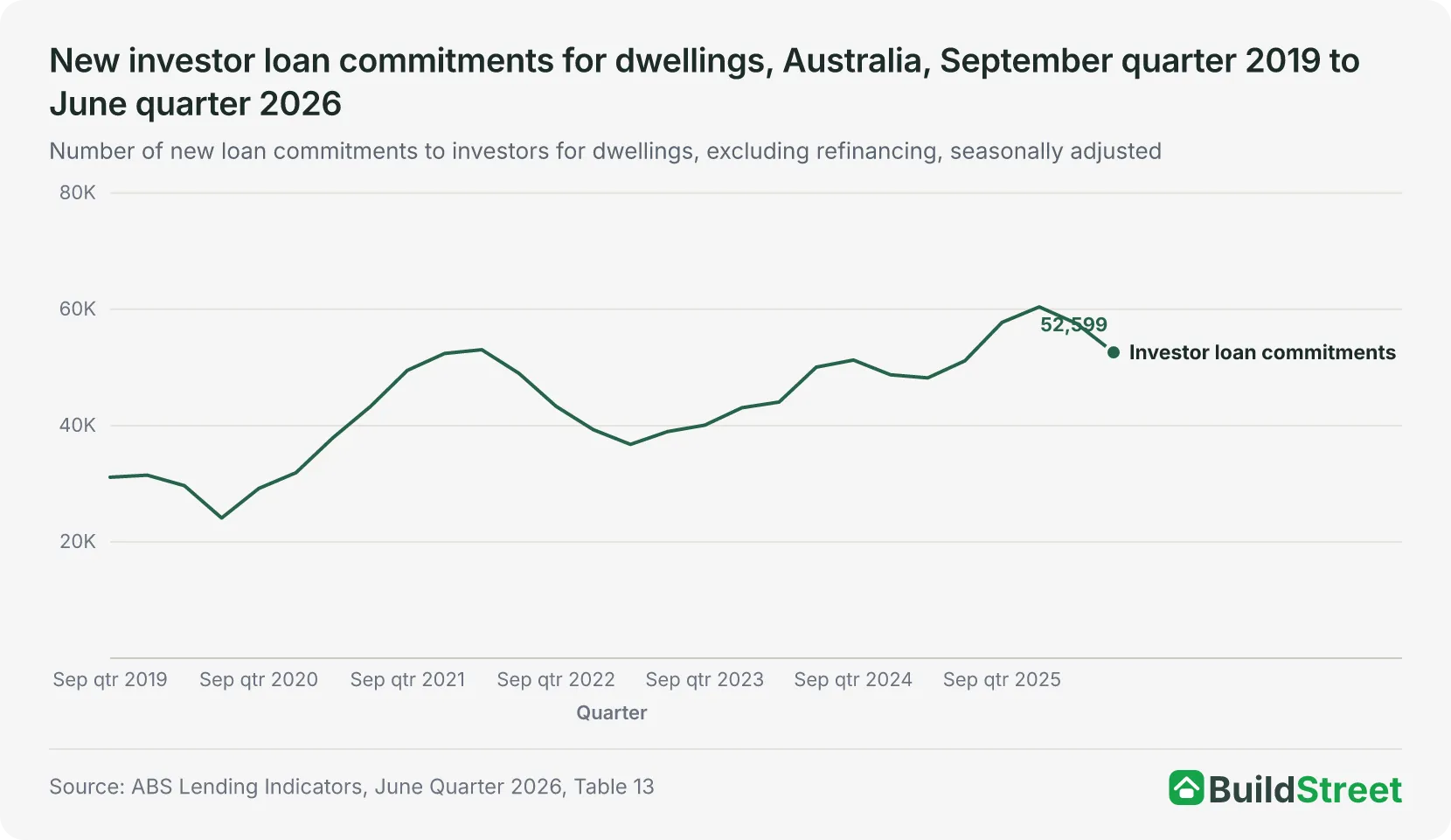
New investor loan commitments for dwellings fell 8.6 per cent in the June quarter 2026, to 52,599 loans, according to the Australian Bureau of Statistics (ABS) Lending Indicators data4. These figures are seasonally adjusted. The total value of those commitments fell 10.2 per cent, to $37.1 billion.
Investor loans to buy existing dwellings fell 14.8 per cent, from 47,727 in the March quarter 2026 to 40,647 in the June quarter 20264. However, investor loans to construct dwellings increased 4.4 per cent, to 8,468, the highest quarterly total between the September quarter 2019 and the June quarter 2026. Loans to buy newly built homes increased 3.7 per cent, to 2,455.
New owner-occupier loan commitments for dwellings fell 3.3 per cent in the June quarter 2026, while loans to first-home buyers fell 2.9 per cent4. Investor commitments were 2.8 per cent higher than in the June quarter 2025.
The data does not show whether the federal budget caused these changes in lending. The next ABS figures, for the September quarter 2026, are due on 11 November 20264.
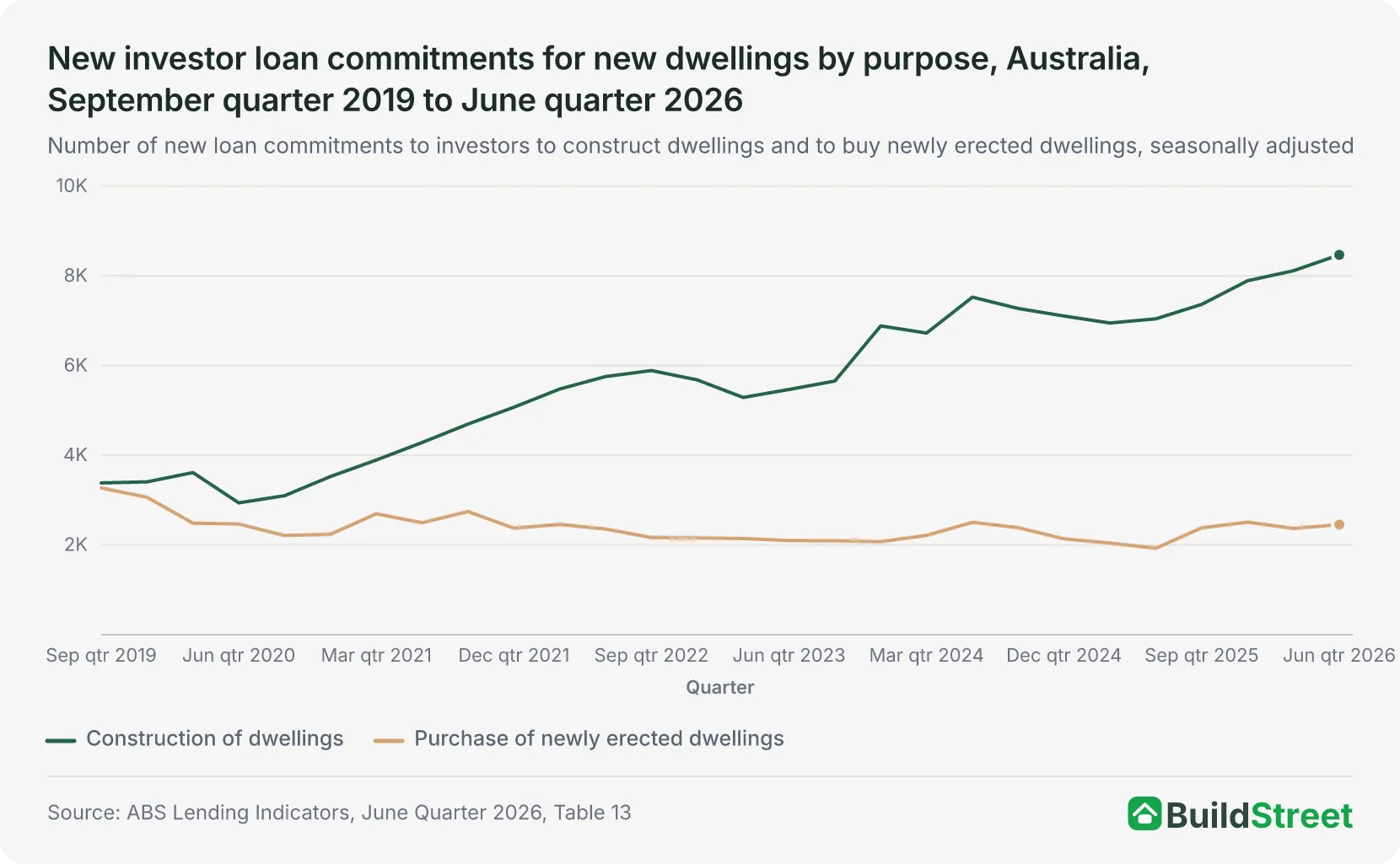
| New investor loan commitments for dwellings by purpose, Australia, June quarter 2025 to June quarter 2026 | |||||
|---|---|---|---|---|---|
| Purpose | Jun qtr 2025 | Mar qtr 2026 | Jun qtr 2026 | Quarterly change, % | Annual change, % |
| Construction of dwellings | 7,042 | 8,114 | 8,4685 | +4.4 | +20.2 |
| Purchase of newly erected dwellings | 1,926 | 2,368 | 2,4555 | +3.7 | +27.5 |
| Purchase of existing dwellings | 41,256 | 47,727 | 40,6475 | −14.8 | −1.5 |
| Total, excluding refinancing | 51,146 | 57,565 | 52,5995 | −8.6 | +2.8 |
Source · ABS Lending Indicators, June Quarter 2026, Table 13.
Section 05 · Builders and buyers
What do the tax changes mean for builders, developers and new-home buyers?
From 1 July 2027, an investor who buys an eligible new dwelling can continue to claim negative gearing benefits and choose the 50 per cent capital gains tax (CGT) discount when selling the property1. However, investors who buy the same property later will not qualify for these exemptions.
The legislation allows the government to set detailed rules for what qualifies as a new dwelling. These rules must support the aim of increasing Australia's housing supply2. The 2026–27 Budget factsheet indicates that a property may qualify if it is built on vacant land or replaces demolished homes with a greater number of new dwellings1.
A dwelling generally qualifies only on its first sale, although a dwelling first owned by its builder can still qualify if it was occupied for no more than 12 months1.
| Examples of eligible and ineligible new builds for negative gearing, 2026-27 Budget | |
|---|---|
| Eligible new build | Not an eligible new build |
| A newly constructed apartment bought off the plan | An established property recently extended to add bedrooms |
| A duplex built through a knock-down rebuild that replaces a single free-standing house | A free-standing house built through a knock-down rebuild that replaces an older, smaller free-standing house |
| Any residential construction on previously vacant land | A granny flat built next to an established property that is not eligible for negative gearing |
| A newly built property occupied for less than 12 months before it is first sold | A newly built property occupied for more than 12 months before it is sold to a later investor |
Source · Budget 2026–27 factsheet, Negative Gearing and Capital Gains Tax Reform, Table 2.
Some state stamp duty exemptions for new builds apply a similar first-purchase rule1. In Queensland, the first home (new home) transfer duty concession applies only to a home that has not previously been occupied or sold as a place of residence, or that has been substantially renovated, according to the Queensland Revenue Office6.
Build-to-rent projects owned by certain investment trusts or eligible superannuation funds are not affected by the negative gearing restriction because these entities are excluded under the legislation2.
The size of the build-to-rent sector is covered in build-to-rent statistics in Australia.
Section 06 · Housing target
Will the negative gearing changes help or hurt the 1.2 million homes target?
The 2026–27 federal budget does not estimate how the negative gearing and CGT changes will affect Australia's target of 1.2 million new homes. Treasury's estimate of about 35,000 fewer dwellings covers 10 years, while the housing target covers five3. The government expects this to be more than offset by up to 65,000 new homes supported by the Local Infrastructure Fund and other housing measures.
The National Housing Accord target is to build 1.2 million new well-located homes over five years from mid-20247. The Australian Government and state and territory governments agreed to the target at National Cabinet in August 2023.
Australia completed 356,010 dwellings in the two years from July 2024 to June 2026, compared with the 480,000 homes that would have been needed to meet an even building pace of 240,000 a year8. Completions reached 47,168 in the June quarter 2026, up 5.8 per cent from the previous quarter, in seasonally adjusted terms.
Progress against the target by quarter and by state is tracked in Is Australia on track to build 1.2 million homes by June 2029?
Section 07
Frequently asked questions
Can investors still negatively gear a new build after the 2026 budget?
Yes. An investor who buys an eligible new build can still deduct a rental loss against salary and other income from 1 July 2027 and can choose the 50 per cent CGT discount or indexation with the minimum tax when selling.
Does a knock-down rebuild count as a new build for negative gearing?
A knock-down rebuild can qualify if it increases housing supply, according to examples in the 2026–27 federal budget. A duplex replacing a single free-standing house can qualify, but a free-standing house that replaces an older, smaller one does not. The detailed eligibility rules are to be set separately by the government.
When do the negative gearing changes start?
The negative gearing limit applies from 1 July 2027, the start of the 2027–28 income year, to established residential properties bought from 7:30pm AEST on 12 May 2026. Properties already owned at that time, including those under a contract not yet settled, can still be negatively geared until they are sold.
How many fewer homes will be built because of the negative gearing and CGT changes?
Treasury estimated in the 2026–27 Budget that about 35,000 fewer dwellings would be built over 10 years compared with no tax policy change. This represents about 0.25 per cent of Australia's housing stock at the time. The estimate is based on modelling, not a forecast. Treasury expects the reduction to be more than offset by up to 65,000 homes supported by the Local Infrastructure Fund and other housing measures.
Do the negative gearing changes apply to build-to-rent projects?
The negative gearing limit does not apply to widely held unit trusts or complying superannuation funds under the Treasury Laws Amendment (Tax Reform No. 1) Act 2026. The federal budget identifies most managed investment trusts as an example of a widely held trust. Whether a build-to-rent project is exempt depends on the type of entity that owns it.
How many new investor home loans were there in the June quarter 2026?
There were 52,599 new investor loan commitments for dwellings in the June quarter 2026, down 8.6 per cent from the previous quarter, according to the Australian Bureau of Statistics (ABS). Investor loans to construct dwellings increased 4.4 per cent to 8,468 over the same quarter. Both figures are seasonally adjusted.
References
- Australian Government, Budget 2026–27 factsheet: Negative Gearing and Capital Gains Tax Reform · budget.gov.au ↑ b c d e f g h i j
- Federal Register of Legislation, Treasury Laws Amendment (Tax Reform No. 1) Act 2026 · legislation.gov.au ↑ b c d e
- Budget Paper No. 1, 2026-27, Statement 4 · budget.gov.au ↑ b c d e f g h i j k l m n
- ABS, Lending Indicators, June quarter 2026 · Australian Bureau of Statistics ↑ b c d
- ABS Lending Indicators, June Quarter 2026, Table 13: Investors, by detailed purpose, new loan commitments (xlsx) · Australian Bureau of Statistics ↑ b c d
- Queensland Revenue Office — First home new home transfer duty concession · qro.qld.gov.au ↑
- National Housing Accord · treasury.gov.au ↑
- Australian Bureau of Statistics, Building Activity, Australia, June 2026 · Australian Bureau of Statistics ↑
