
Published 30 Sept 2026
 What it costs to build a house in AustraliaThe cost of building a new house, from the advertised base price to the site costs and upgrades that sit outside it.
 Torrens, community and strata titleWhat a buyer owns under each form of title, who maintains the shared parts, and how levies and by-laws apply.
Section 01 · The costs
What are the upfront costs of buying a home in Australia?
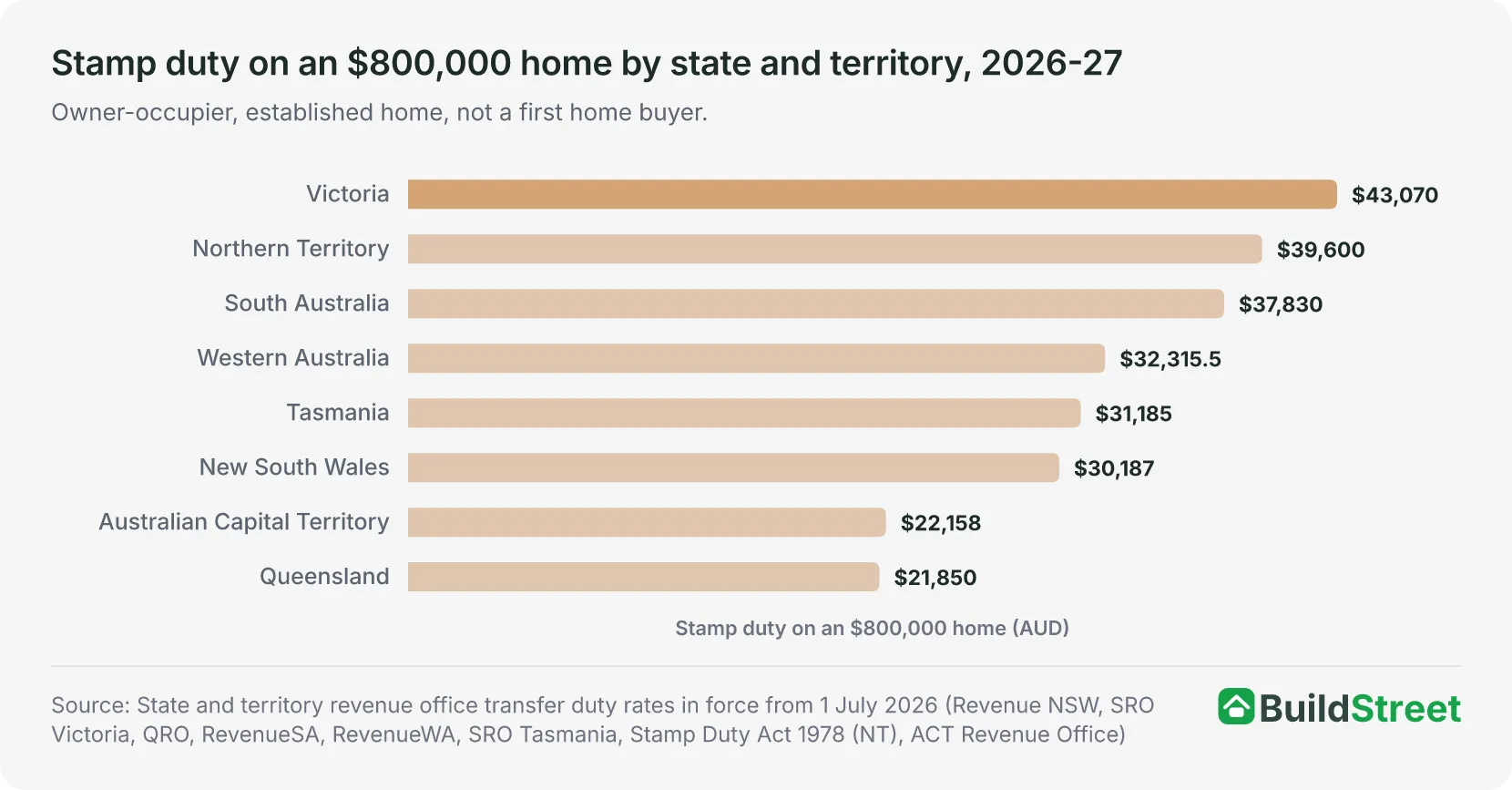
Of the upfront buying costs with published government prices, stamp duty is the largest, ranging from $21,850 to $43,070 on an $800,000 established home depending on the state or territory12. The NSW Government lists seven upfront costs beyond the deposit3:
- transfer duty, or stamp duty
- lenders mortgage insurance, when more than 80 per cent of the purchase price is borrowed
- pest, building or strata reports
- legal or conveyancing fees
- mortgage registration fees
- title registration, or the transfer fee
- loan application fees, including valuation fees.
ASIC's Moneysmart notes that a 20 per cent deposit generally avoids lenders mortgage insurance4. Stamp duty is typically payable within 30 days of settlement.
Official sources publish rate or fee schedules for two of the costs, stamp duty and land registry fees, so worked amounts can be calculated from those schedules. The other costs are set by lenders, insurers and private firms, and no official source publishes a national average, median or range for them.
| Upfront costs of buying a home in Australia and their official price data | ||
|---|---|---|
| Cost | Who sets or charges it | Official price data |
| Stamp duty | State or territory revenue office | Published rate schedules |
| Transfer and mortgage registration | State or territory land registry | Published fee schedules |
| Lenders mortgage insurance | The lender's mortgage insurer, charged to the borrower | No premium schedule; APRA publishes industry premium totals |
| Conveyancing and legal fees | Solicitor or licensed conveyancer | None published |
| Building and pest inspections | Building inspector and pest inspector | None published |
| Loan application fees | The lender | None published |
Source · NSW Government, Costs when buying a home; state and territory revenue offices and land registries; APRA.
Section 02 · Stamp duty
How much is stamp duty on a home in each state and territory?
Victoria has the highest stamp duty of any state or territory on an $800,000 established home bought by an owner-occupier who is not a first home buyer, at $43,0702, while Queensland has the lowest stamp duty, at $21,8501. The Victorian amount is $21,220 more than the Queensland amount, or 1.97 times as much.
Each state and territory charges duty on a sliding scale, with higher rates on higher values. New South Wales charges $11,602 plus $4.50 for every $100 over $387,000 on a home valued up to $1,290,0005, and South Australia charges $21,330 plus $5.50 for every $100 over $500,0006. The Northern Territory charges a flat 4.95 per cent of the whole value between $525,000 and $3 million7, and Victoria charges 5.5 per cent of the whole value between $960,000 and $2 million2. Western Australia and Tasmania both apply their top rates above $725,000, at $5.15 and $4.50 for every $100 respectively89.
Queensland and the ACT charge lower rates to buyers who will live in the home. Queensland's home concession applies $10,150 plus $4.50 for every $100 over $540,000 on a home valued up to $1 million1. The ACT's eligible owner-occupier rates apply up to $1,455,000 and require at least one buyer to live in the home for at least a year10. Victoria's principal place of residence concession applies only up to $550,00011, so general duty rates apply above that value.
| Stamp duty on an established home by state and territory and price, 2026-27 | ||||
|---|---|---|---|---|
| State or territory | $600,000 | $800,000 | $1,000,000 | Share of $800,000 price |
| New South Wales | $21,187 | $30,187 | $39,187 | 3.8% |
| Victoria | $31,070 | $43,070 | $55,000 | 5.4% |
| Queensland | $12,850 | $21,850 | $30,850 | 2.7% |
| South Australia | $26,830 | $37,830 | $48,830 | 4.7% |
| Western Australia | $22,515 | $32,315.50 | $42,615.50 | 4.0% |
| Tasmania | $22,497.50 | $31,185 | $40,185 | 3.9% |
| Northern Territory | $29,700 | $39,600 | $49,500 | 5.0% |
| Australian Capital Territory | $12,728 | $22,158 | $33,958 | 2.8% |
Source · state and territory revenue office rate schedules in force from 1 July 2026; Stamp Duty Act 1978 (NT), Schedule 1.
How much stamp duty did state and territory governments collect in 2024-25?
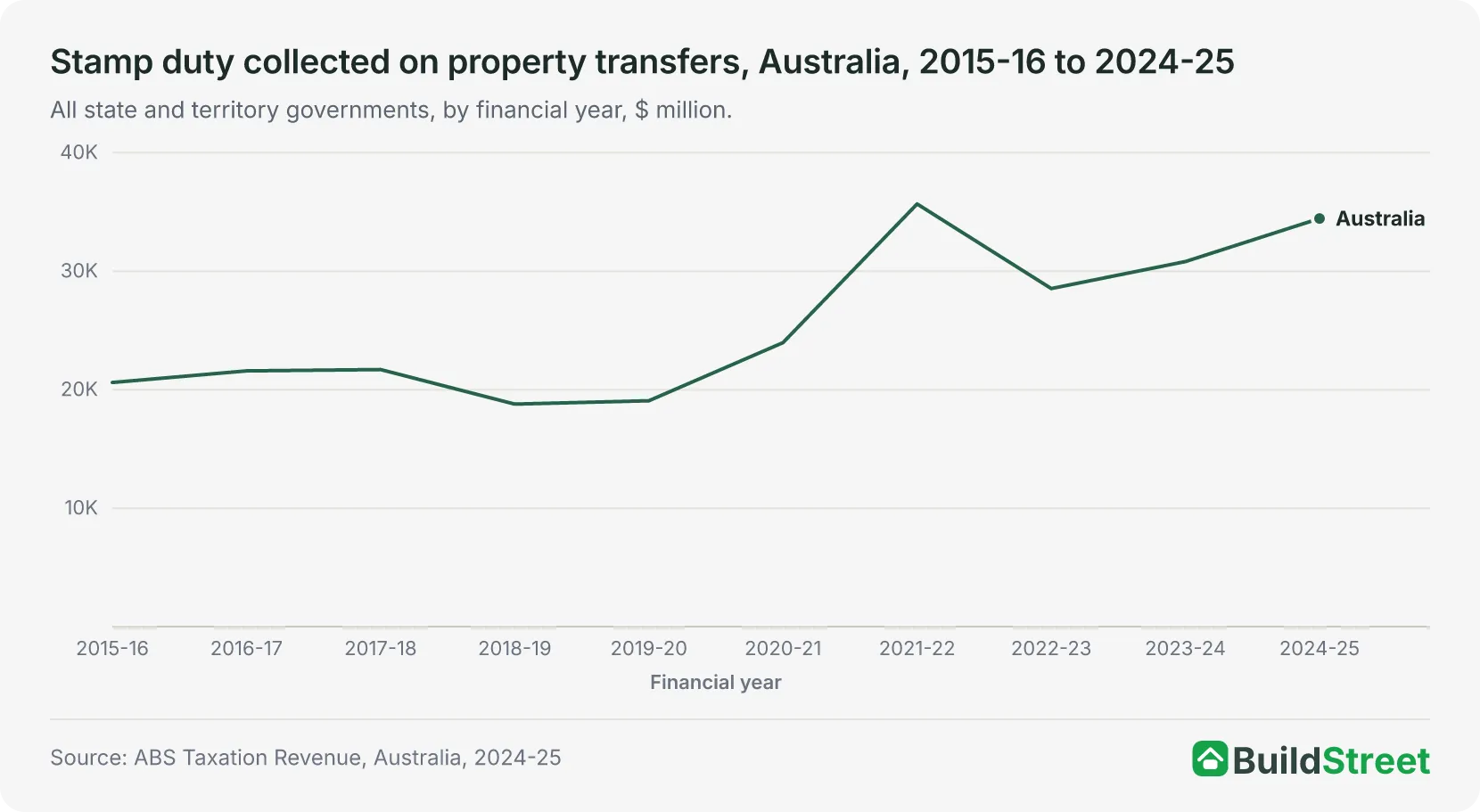
State and territory governments collected $34.4 billion in stamp duty on property transfers in 2024-25, an increase of 11.8 per cent from $30.8 billion in 2023-24, according to the ABS taxation revenue data13. The total covers duty on every type of property transfer, not only homes.
New South Wales recorded the largest collection of any state or territory, at $12.2 billion, followed by Victoria at $9.4 billion13. Queensland recorded the largest percentage increase of any state or territory, at 26.0 per cent, from $5.5 billion in 2023-24 to $6.9 billion in 2024-25. Tasmania and the ACT recorded decreases, of 2.7 per cent and 0.3 per cent respectively.
The 2024-25 total was 3.4 per cent below the 2021-22 total of $35.7 billion, the highest annual total between 2015-16 and 2024-25, and 67.2 per cent above the 2015-16 total of $20.6 billion13. The collections reflect both the number of sales and their values, and the ABS figures do not separate the two.
| Stamp duty collected on property transfers by state and territory, 2023-24 and 2024-25 | |||
|---|---|---|---|
| State or territory | 2023-24, $m | 2024-25, $m | Change |
| New South Wales | 11,415 | 12,224 | +7.1% |
| Victoria | 8,682 | 9,433 | +8.7% |
| Queensland | 5,492 | 6,918 | +26.0% |
| Western Australia | 2,919 | 3,378 | +15.7% |
| South Australia | 1,432 | 1,609 | +12.4% |
| Tasmania | 374 | 364 | -2.7% |
| Australian Capital Territory | 331 | 330 | -0.3% |
| Northern Territory | 166 | 192 | +15.7% |
| Australia | 30,812 | 34,447 | +11.8% |
Source · ABS Taxation Revenue, Australia, 2024-25, Tables 2 to 10.
Section 03 · Mortgage insurance
When does lenders mortgage insurance apply to a home loan in Australia?
Lenders mortgage insurance (LMI) is usually a one-off cost to the borrower when the amount borrowed exceeds 80 per cent of the property's value, and it protects the lender, not the borrower, according to ASIC's Moneysmart14. The premium can be paid at settlement or added to the loan.
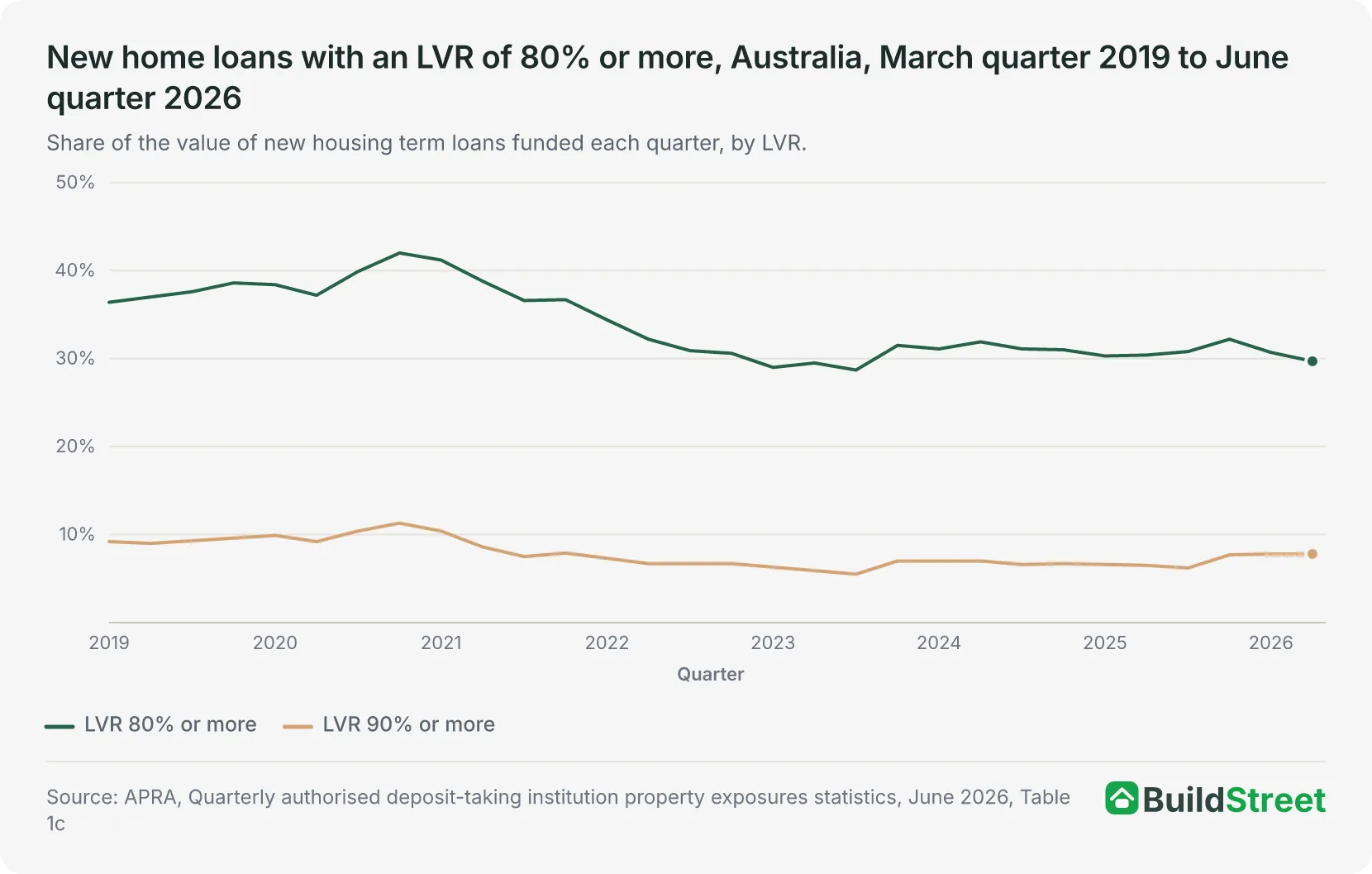
Loans with a loan-to-valuation ratio (LVR) of 80 per cent or more accounted for 29.7 per cent of the value of new housing term loans funded by banks, building societies and credit unions in the June quarter 2026, compared with 30.4 per cent in the June quarter 2025, according to the Australian Prudential Regulation Authority (APRA)15. Loans with an LVR of 90 per cent or more accounted for 7.8 per cent, compared with 6.5 per cent a year earlier.
The share of new term loans with an LVR of 80 per cent or more was highest in the December quarter 2020, at 42.0 per cent, and ranged from 28.7 to 32.2 per cent in every quarter from March 2023 to June 202615.
Under the Australian Government 5% Deposit Scheme, formerly the Home Guarantee Scheme, eligible first home buyers can borrow up to 95 per cent of the property's value without paying LMI, because the government guarantees up to 15 per cent of the value to the lender16. Eligible single parents can borrow up to 98 per cent. Price caps apply by location, from $1.5 million in the New South Wales capital city and regional centres to $500,000 in the rest of South Australia among the states.
Lenders mortgage insurers wrote about $489 million in gross premiums over the four quarters to June 2026, compared with about $513 million over the four quarters to June 2025, according to APRA's general insurance statistics17. No official source publishes individual LMI premiums or a premium schedule by loan size and deposit.
Section 04 · Conveyancing
What do conveyancing and legal fees cover when buying a home?
Conveyancing and legal fees pay a solicitor or licensed conveyancer to handle the legal transfer of a home. No official source publishes a national average, median or range for these fees. The NSW Government states that conveyancers and solicitors are equally qualified to do conveyancing, and that conveyancers in New South Wales must be licensed with NSW Fair Trading18. Their work can include reviewing the contract, handling the transfer and calculating adjustments for council and water rates at settlement.
In Victoria, conveyancers must be licensed and legal practitioners must hold a current practising certificate19. Queensland Government guidance refers home buyers to a solicitor for conveyancing work20.
Fees vary between solicitors and conveyancers. Additional costs passed on to the buyer can include title searches, certificate fees and transfer and mortgage registration fees, according to the NSW Government18. Consumer Affairs Victoria advises getting written quotes from several providers and discussing all disbursements19.
The ABS measures legal and conveyancing services in the Consumer Price Index only as one of five parts of its other financial services group, and uses the Wage Price Index to measure price movements rather than observed conveyancing fees21.
Section 05 · Inspections
What do building and pest inspections cover before buying a home?
A pre-purchase building inspection reports on a home's condition, while a pest inspection checks for timber pests such as termites. No official source publishes a national average or range for their fees. In the ACT, regulations require a building and compliance inspection report to be completed in accordance with Australian Standards22.
In Queensland, only a licensed residential building inspector can complete a pre-purchase building inspection and only a licensed pest controller can complete a termite inspection, according to the Queensland Building and Construction Commission (QBCC)23.
Consumer Affairs Victoria states that building inspections can be carried out by a qualified building inspector, surveyor or architect, with pest inspections arranged separately24. Its guidance describes the inspection fee as small compared with the cost of unforeseen repairs, without giving an amount. ASIC's Moneysmart suggests using the cooling-off period to get a building and pest report4.
Section 06 · Registration fees
How much are transfer and mortgage registration fees in each state and territory?
South Australia had the highest land registry fees of any state or territory on an $800,000 home purchase, at $8,432 to register the transfer and the mortgage25, while the Northern Territory had the lowest land registry fees, at $36226. The fees are set by each state and territory's land registry and change each 1 July.
Four states charge a transfer fee that rises with the property's value:
- South Australia charges $353 plus $105 for every $10,000 above $50,000, or $8,228 at $800,00025.
- Queensland charges $248.04 plus $46.56 for every $10,000 above $180,000, or $3,134.76 at $800,00027.
- Victoria charges $104.30 plus $2.34 for every whole $1,000 for an electronic lodgement, or $1,977 at $800,00028.
- Western Australia charges by $100,000 value band, or $375.10 for a value from $700,001 to $800,00029.
New South Wales, Tasmania, the Northern Territory and the ACT charge a flat transfer fee, ranging from $181 in the Northern Territory26 to $496 in the ACT30. The New South Wales fee is $182.7331 and the Tasmanian fee $256.7632.
Mortgage registration fees range from $129.20 in Victoria, for an electronic lodgement28, to $248.04 in Queensland27.
| Land registry fees on an $800,000 home purchase by state and territory, 2026-27 | ||||
|---|---|---|---|---|
| State or territory | Transfer fee | Mortgage fee | Total | Transfer fee basis |
| New South Wales | $182.73 | $182.73 | $365.46 | Flat |
| Victoria | $1,977 | $129.20 | $2,106.20 | Rises with value |
| Queensland | $3,134.76 | $248.04 | $3,382.80 | Rises with value |
| South Australia | $8,228 | $204 | $8,432 | Rises with value |
| Western Australia | $375.10 | $225.10 | $600.20 | Rises with value |
| Tasmania | $256.76 | $167.58 | $424.34 | Flat |
| Northern Territory | $181 | $181 | $362 | Flat |
| Australian Capital Territory | $496 | $184 | $680 | Flat |
Source · NSW Land Registry Services; Land Use Victoria; Titles Queensland; Land Services SA; Landgate; Land Tasmania; NT Land Titles Office; Access Canberra.
Section 07 · Worked totals
How much are total government charges on a home purchase by state and price?
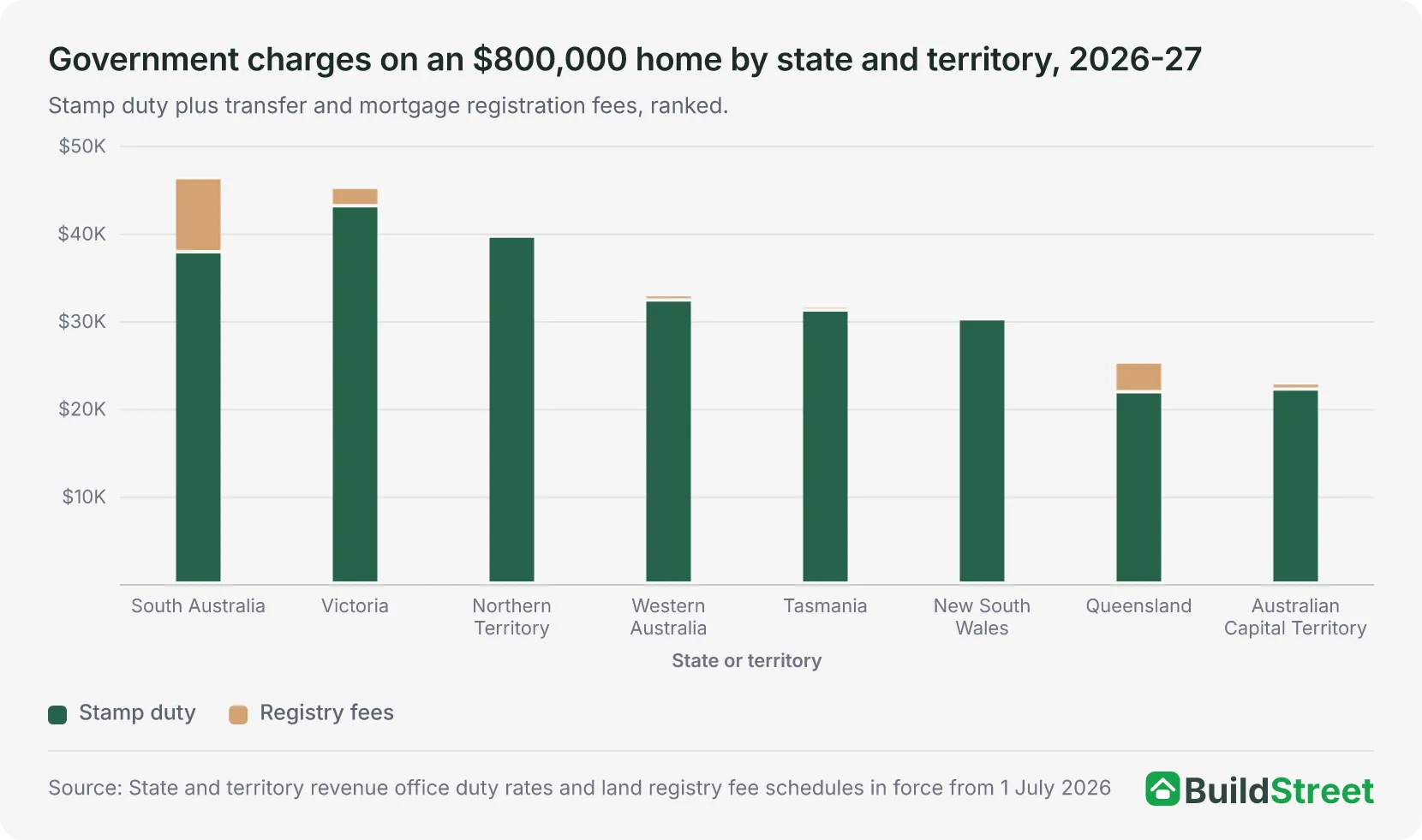
South Australia had the highest total government charges of any state or territory on an $800,000 established home, at $46,262 in stamp duty and land registry fees, while the ACT had the lowest total, at $22,8386251030. These figures are based on rates and fees in force from 1 July 2026 for an owner-occupier who is not a first home buyer.
South Australia's total is higher than Victoria's total of $45,176.20, although Victoria has the higher stamp duty, because South Australia's transfer fee of $8,228 is the largest of any state or territory at this price. Queensland has the lowest stamp duty at $800,000, but its transfer fee of $3,134.7627 lifts its total to $25,232.80, above the ACT's total.
South Australia also had the highest total at $600,000 and $1,000,000, at $33,162 and $59,362 respectively, and the ACT the lowest total, at $13,408 and $34,638.
| Stamp duty and land registry fees on an established home by state and territory and price, 2026-27 | |||
|---|---|---|---|
| State or territory | $600,000 | $800,000 | $1,000,000 |
| New South Wales | $21,552.46 | $30,552.46 | $39,552.46 |
| Victoria | $32,708.20 | $45,176.20 | $57,574.20 |
| Queensland | $15,301.60 | $25,232.80 | $35,164 |
| South Australia | $33,162 | $46,262 | $59,362 |
| Western Australia | $23,075.20 | $32,915.70 | $43,255.70 |
| Tasmania | $22,921.84 | $31,609.34 | $40,609.34 |
| Northern Territory | $30,062 | $39,962 | $49,862 |
| Australian Capital Territory | $13,408 | $22,838 | $34,638 |
Source · state and territory revenue offices and land registries, rates and fees in force from 1 July 2026.
Section 08
Frequently asked questions
How much is stamp duty on an $800,000 home in Australia?
Stamp duty on an $800,000 established home ranges from $21,850 in Queensland to $43,070 in Victoria for an owner-occupier who is not a first home buyer, under the rates in force from 1 July 2026. First home buyers who meet their state or territory's conditions can pay less or nothing.
Which state has the highest stamp duty in Australia?
Victoria has the highest stamp duty of any state or territory on an established home at $600,000, $800,000 and $1,000,000, at $31,070, $43,070 and $55,000 respectively, for an owner-occupier who is not a first home buyer. The comparison uses the rates in force from 1 July 2026 and excludes first home buyer relief.
Is lenders mortgage insurance required with a deposit under 20 per cent?
Lenders mortgage insurance is usually payable when the amount borrowed exceeds 80 per cent of the property's value, and it protects the lender, not the borrower, according to ASIC's Moneysmart14. Eligible first home buyers using the Australian Government 5% Deposit Scheme can borrow up to 95 per cent of the value without paying lenders mortgage insurance16.
How much does conveyancing cost when buying a home?
No official source publishes an average or typical fee for conveyancing or legal work on a home purchase. Fees vary between solicitors and conveyancers and can include additional costs such as searches and registration fees.
How much are land registry fees when buying a home?
Land registry fees to register the transfer and one mortgage on an $800,000 home range from $362 in the Northern Territory to $8,432 in South Australia under the 2026-27 fee schedules. South Australia, Queensland, Victoria and Western Australia charge transfer fees that rise with the property's value.
References
- Queensland Revenue Office — Transfer Duty Concession Rates · qro.qld.gov.au ↑ b c d
- State Revenue Office Victoria — Land transfer duty current rates (non-principal place of residence) · sro.vic.gov.au ↑ b c
- NSW Government, Costs when buying a home · nsw.gov.au ↑ b
- ASIC Moneysmart, Buying a house · moneysmart.gov.au ↑ b
- Revenue NSW — Calculate Transfer Duty · revenue.nsw.gov.au ↑ b c
- RevenueSA, Rates of stamp duty · revenuesa.sa.gov.au ↑ b
- Stamp Duty Act 1978 (NT) · legislation.nt.gov.au ↑
- Department of Treasury and Finance WA — Transfer duty assessment · wa.gov.au ↑ b c
- State Revenue Office Tasmania — Rates of duty · sro.tas.gov.au ↑
- ACT Revenue Office, Conveyance duty for non-commercial property · revenue.act.gov.au ↑ b c
- State Revenue Office Victoria, Land transfer duty, principal place of residence, current rates · sro.vic.gov.au ↑
- State Revenue Office Victoria — First home buyer duty exemption or concession · sro.vic.gov.au ↑ b
- ABS, Taxation Revenue, Australia, 2024-25 · Australian Bureau of Statistics ↑ b c
- ASIC Moneysmart, Save for a house deposit · moneysmart.gov.au ↑ b
- APRA, Quarterly authorised deposit-taking institution property exposures statistics, June 2026 · apra.gov.au ↑ b
- Australian Government 5% Deposit Scheme · firsthomebuyers.gov.au ↑ b
- APRA, Quarterly general insurance performance statistics, June 2026 · apra.gov.au ↑
- NSW Government, Conveyancing for property buyers and sellers · nsw.gov.au ↑ b c
- Consumer Affairs Victoria, Seek expert advice on property · consumer.vic.gov.au ↑ b
- Queensland Government, Appointing a solicitor · qld.gov.au ↑
- ABS, Consumer Price Index: Concepts, Sources and Methods, 2025, Appendix 3 · Australian Bureau of Statistics ↑
- Civil Law (Sale of Residential Property) Regulation 2004 (ACT) · legislation.act.gov.au ↑
- QBCC, Buying or selling a home · qbcc.qld.gov.au ↑
- Consumer Affairs Victoria, Inspect properties before you buy · consumer.vic.gov.au ↑
- Land Services SA, Fees and charges 2026-27 · landservices.com.au ↑ b c
- NT Government, Transfer your land title · nt.gov.au ↑ b
- Titles Queensland, Titles Registry fees FY2026/27 · titlesqld.com.au ↑ b c
- Land Use Victoria, 2026-27 fees · land.vic.gov.au ↑ b
- Landgate, Land transaction fees · landgate.wa.gov.au ↑
- Access Canberra, Land title lodgement, registration and search fees · accesscanberra.act.gov.au ↑ b
- NSW Land Registry Services, Fees · nswlrs.com.au ↑
- Land Tasmania, Land Titles Office fees · nre.tas.gov.au ↑
- Consumer Affairs Victoria, Settlement · consumer.vic.gov.au ↑
