

Published 29 Sept 2026
What is an easement?
The registered rights recorded on a lot's second schedule: drainage, sewer and access easements, how they are found on the plan, and what can be built over them.
What are estate design guidelines?
The private rulebook that binds masterplanned-estate buyers through the land contract, and sometimes through the title itself, with an approval panel before the builder lodges.
What is a setback?
The front, side and rear distances the state codes, council plans and estate covenants keep clear, and how the strictest layer decides the buildable envelope.
Section 01 · The three titles
What is the difference between Torrens, community and strata title?
Torrens title is the registered ownership system used in New South Wales, Victoria and Queensland. The registered owner of a lot generally holds it subject only to the interests recorded on its title, and to the exceptions in each state's laws. Community and strata title are different forms of subdivision built on that registered ownership system1.
Victoria's Transfer of Land Act 1958 states the rule as the registered proprietor holding the land, except in case of fraud, subject to the encumbrances recorded on the relevant title and generally free from other encumbrances2. The NSW Registrar General describes a similar principle, with the State Government guaranteeing that the registered owners recorded in the NSW land title system are the owners of the land3.
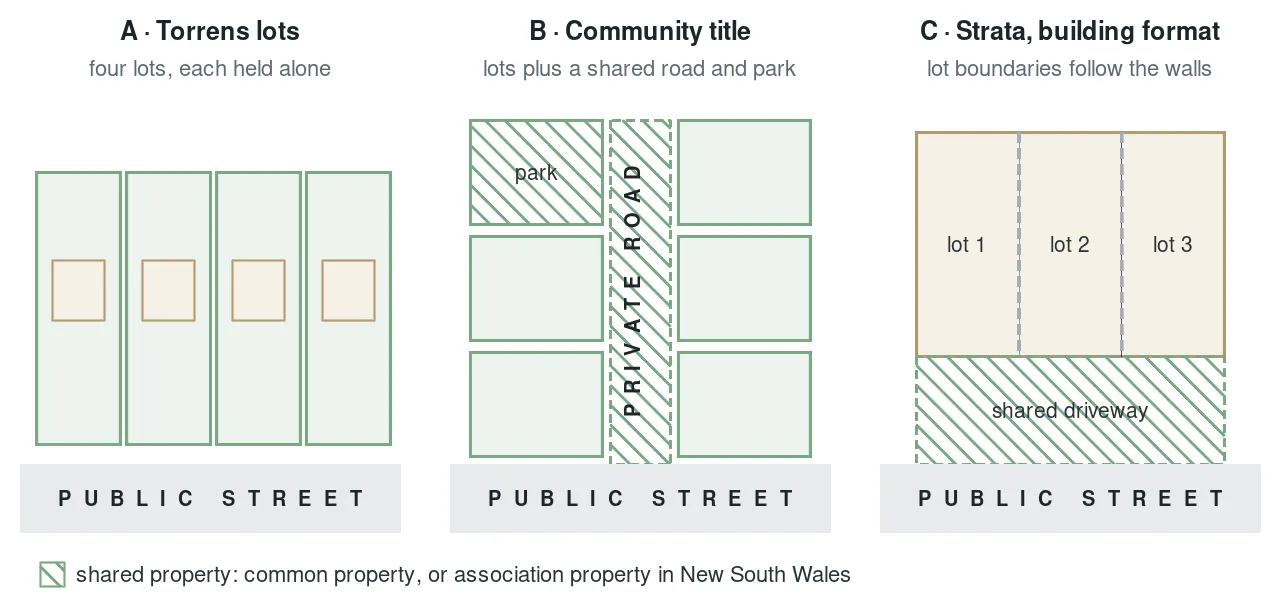
Community title adds shared property to an individually owned lot. In a New South Wales community scheme, a lot owner owns and maintains the buildings on their lot and also shares the use and maintenance costs of association property, which is held by the scheme's association4.
Queensland defines a community titles scheme as scheme land of two or more lots plus common property, identified by a single community management statement recorded by the registrar5. In Victoria a similar arrangement can apply through an owners corporation where a plan of subdivision includes common property6. Driveways, pathways and fences are among the things a plan can declare to be common property7.
Strata title sets lot boundaries within a building rather than boundaries marked only on the ground. In Queensland a building format plan can define a lot using structural elements such as floors, walls and ceilings5. NSW Fair Trading describes neighbourhood schemes as similar to strata schemes but typically consisting of freestanding houses or townhouses8.
The Australian Capital Territory uses a different land tenure system. The ACT Government describes leasehold as its system of land tenure. A residential Crown lease usually runs for 99 years9.
| Torrens, community and strata title compared for a house-and-land lot, NSW, Victoria and Queensland, 2026 | |||
|---|---|---|---|
| Feature | Torrens lot | Community title lot | Strata lot |
| What the buyer holds | The whole surveyed lot, subject to the interests recorded on its folio | The surveyed lot plus a share of the common property (Victoria, Queensland) or membership of the association that holds it (NSW) | A lot bounded by the building's floors, walls and ceilings, plus a share of the common property |
| Shared property | None | Roads, parks and facilities declared common or association property on the plan | The structure and grounds outside the lot boundary |
| Who maintains the house | The owner | The owner: the building is inside the lot | The body corporate for structural elements, the owner inside the lot (Queensland building format) |
| Levies | None: no association or body corporate exists | Annual contributions from a budget, by the basis the association's budget uses (NSW), lot liability (Victoria) or contribution schedule lot entitlement (Queensland) | Annual contributions from a budget, with the structure and its insurance inside the budget |
| Rules on the lot | Estate covenants by contract or by a registered restriction only | Management statement by-laws (NSW), owners corporation rules (Victoria), community management statement by-laws (Queensland) | Strata by-laws registered with the strata plan (NSW), owners corporation rules (Victoria), community management statement by-laws (Queensland) |
| Created by | Registration of the plan of subdivision or survey | The plan plus a registered management statement (NSW, Queensland) or an owners corporation provided for on the plan (Victoria) | A strata plan or a building format plan |
Source · Land Title Act 1994 (Qld), Body Corporate and Community Management Act 1997 (Qld), Subdivision Act 1988 (Vic), Owners Corporations Act 2006 (Vic), NSW Registrar General and NSW Fair Trading community-scheme pages.
Section 02 · What the buyer holds
What are the boundaries of a lot under each title type?
Under a plain Torrens title, the buyer of a greenfield lot holds the whole lot within the boundaries shown on the registered plan, and nothing on the plan is shared. Queensland's Land Title Act 1994 provides that a lot is created when the plan is registered. Titles Queensland's practice manual also records that surveyed land has used a Lot on Plan description since 1985, with an eight-digit title reference used to record dealings on the title10.
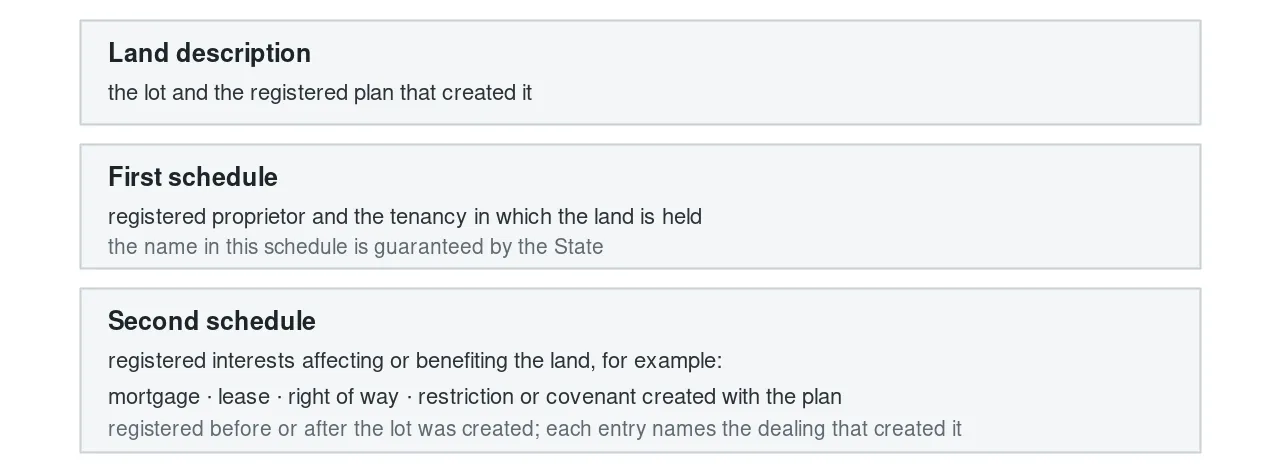
In New South Wales, the registry's search guide describes the title record as a land description, the registered owner and how the land is held, as well as the registered interests that affect or benefit the land11.
Under community title, the buyer holds an individual lot together with an interest in shared property, although the ownership structure differs by state. In Queensland, the lot owners share ownership of the common property in proportion to their interest schedule lot entitlements, and the interest in the lot cannot be separated from the interest in the common property7.
In Victoria, common property on a registered plan vests in the lot owners as tenants in common in shares proportional to their lot entitlement. New South Wales works differently: the scheme's association owns the association property rather than the individual lot owners12.
Under strata title, the lot is defined by parts of a building rather than only by boundaries marked on the ground. A Queensland building format plan can define lot boundaries using floors, walls and ceilings5. In Victoria, a lot is a part of land shown on a plan that can be disposed of separately, and land includes buildings and airspace12.
How is one street of house lots titled under Torrens, community and strata title? NSW, Victoria and Queensland
Section 03 · Who maintains what
Who is responsible for maintenance under Torrens, community and strata title?
Under Torrens title outside any scheme, the owner is responsible for the lot and the house on it, and no association or body corporate exists to share the maintenance responsibility. Shared maintenance applies only where a registered plan creates common or association property. In Victoria, a plan with common property must provide for an owners corporation12.
Under a Queensland community titles scheme on a standard format plan, maintenance responsibility follows the lot boundary. The lot owner maintains the inside of the building, the outside of the building within the lot boundary including exterior walls, doors, windows and roof, the building foundations, and all lawns, gardens and driveways inside the lot boundary. The body corporate maintains the roads, gardens, lawns and facilities on common property and any utility infrastructure on common property, as well as shared utility infrastructure5.
In Victoria, the Owners Corporations Act 2006 requires an owners corporation to repair and maintain the common property and related services. A lot owner cannot repair, alter or maintain common property or a shared service without authority13.
In New South Wales, associations are responsible for ensuring association property is looked after, including the cost of maintaining it, and members are responsible for any maintenance and repairs within their own lot. Since 1 July 2025, where an association has taken action against an owner or another person for damage to association property, it cannot delay repairs that affect the safety of buildings or a person's access to or use of the common property or a lot. This was the first stage of community land law reforms, followed by further stages on 27 October 2025 and 1 April 2026, with more changes due later in 202614.
Under a Queensland building format plan, the body corporate maintains essential structural elements of the building (such as foundation structures, roofing structures that provide protection and load-bearing walls) and the foundations and roof of the building. The owner maintains the inside of the lot, including all fixtures and fittings inside the lot5.
| Maintenance responsibility by title type and instrument, NSW, Victoria and Queensland, 2026 | |||
|---|---|---|---|
| Title type | Jurisdiction and instrument | The lot owner maintains | The association, owners corporation or body corporate maintains |
| Torrens lot outside any scheme | NSW, Victoria, Queensland: the registered plan alone | The lot and everything on it | Nothing: no such body exists |
| Community title, standard format | Queensland: Body Corporate and Community Management Act 1997 and its regulation module | The inside and outside of the building, its foundations, and the lawns, gardens and driveways inside the lot boundary | Roads, gardens, lawns and facilities on common property; utility infrastructure on common property, in a boundary structure or serving more than one lot |
| Community title, owners corporation | Victoria: Owners Corporations Act 2006 ss 46 and 47A | The lot; a lot owner must not repair or alter common property or a shared service without authority | The common property and the chattels, fixtures, fittings and services related to it |
| Community or neighbourhood scheme | NSW: Community Land Management Act 2021, as described by NSW Fair Trading | Any maintenance and repairs within the owner's own lot | Association property, including the cost of maintaining it; once it has taken action over damage to that property, it cannot delay repairs affecting safety or access |
| Strata, building format | Queensland: Body Corporate and Community Management Act 1997, building format plan | The inside of the lot, including its fixtures and fittings | Essential structural elements, including load-bearing walls, and the foundations and roof of the building |
Source · Queensland Government body corporate maintenance pages, Owners Corporations Act 2006 (Vic) ss 46 and 47A, NSW Fair Trading community-scheme pages.
Section 04 · Levies
How are community and strata levies set, and who pays?
Levies are set from an annual budget by the association, owners corporation or body corporate. Each lot's share is based on the rules that apply to the scheme, including the lot's entitlement or liability figures12. A Torrens lot outside any scheme has no such body to charge levies.
In New South Wales, a contribution levy is set by the association and is based on a budget covering income and expenses. Contributions are paid into an administrative fund for day-to-day expenses and a capital works fund for major work to association property. A special levy can be charged if those funds are not enough8.
In a New South Wales strata scheme, the owners corporation approves its budget by majority vote at the annual general meeting, levies follow each owner's unit entitlement, and the scheme must have a 10-year plan for major work funded through the capital works fund15.
In Victoria, an owners corporation may set annual fees to cover general administration, maintenance and repairs, insurance and other recurrent obligations. These fees are based on lot liability. Special fees for major or unexpected costs generally follow the same basis, although costs for work that benefits only some lots can be divided according to the benefit received13.
In Queensland, the annual levies that lot owners must pay each year are decided at the annual general meeting using the body corporate's administrative and sinking fund budgets16. Each lot's contribution is generally based on its contribution schedule lot entitlement. A special contribution can cover unexpected costs during the year, and any discount for payment by the due date cannot exceed 20 per cent of the instalment.
For a proposed lot in Queensland, the seller's disclosure statement must state the expected annual body corporate contributions before the contract is signed7.
The New South Wales, Victorian and Queensland agencies cited here do not publish typical levy amounts. The figure a buyer receives comes from the scheme's own budget and, for a proposed lot in Queensland, from the seller's disclosure statement.
Section 05 · By-laws and rules
What can community by-laws and owners corporation rules control?
By-laws and rules can control the appearance and use of individual lots as well as shared property. In New South Wales, community scheme by-laws apply to everyone living and working in the scheme and can cover building or landscaping styles alongside the use of communal roads, parks and pools. Every scheme must have a management statement, registered with NSW Land Registry Services, and its rules apply to people living in, working in or visiting the scheme8.
In Victoria, an owners corporation may make rules by special resolution on matters including the external appearance of lots, building work and landscaping. If it does not make its own rules, the model rules apply. An owners corporation can also regulate work that changes the external appearance of a lot, but its rules cannot unreasonably prevent sustainability items from being installed on the exterior13.
In Queensland, by-laws are recorded in the community management statement. If none are listed, the standard by-laws apply. These can regulate changes to the external appearance of a lot, including changes that require body corporate approval. By-laws can also regulate the use and enjoyment of lots, common property and body corporate services7.
On a plain Torrens lot, design controls can instead come from estate requirements in the land contract or from restrictions recorded on the title. In Victoria, a memorandum of common provisions can form part of a registered instrument. The Alamora estate at Tarneit provides one example, with a registered memorandum that sets building envelopes for certain lots17.
In Queensland, registered covenants are more limited, and estate design controls are generally enforced through the land contract.
How estate design guidelines are written, approved and enforced, and where they are found in a sales pack, is covered in What are estate design guidelines?
Section 06 · The title search
What does a title search show for a house-and-land lot?
A title search lists the registered owner and the registered interests on the lot. The registered plan defines the lot's boundaries. In a scheme, a management statement can also set out the by-laws and entitlement schedules. In Queensland, a current title search "shows current owner and registered interests, including mortgages, easements, covenants, leases and caveats"18.
In New South Wales, paper certificates of title were cancelled on 11 October 2021. Ownership and registered interests are now recorded in the Torrens Title Register19.
In Victoria, registering the plan of subdivision creates, varies or removes any easement, restriction or other rights shown on the plan. A plan that provides for an owners corporation must specify details of lot entitlement and lot liability12. Registered estate restrictions can therefore appear on the same title record as other interests affecting the property.
In a Queensland community titles scheme, the registered documents include the plan of survey and the community management statement. The community management statement identifies the rules applying to the scheme, including its contribution and interest schedules and its by-laws20.
What are the three parts of a Torrens folio in New South Wales?
| Titles Queensland search and lodgement fees for a house lot, 2026-27 | ||
|---|---|---|
| Registry product | Fee schedule item | Fee |
| Current title search | Search for an indefeasible title, item 7(a)(ii) | $25.71 |
| Plan of survey, image | Item 6(b)(ii) | $27.56 |
| Other document, image | Any other instrument or document, including a community management statement, item 6(c) | $50.16 |
| Statement search against a title | Statement of registered dealing, community titles scheme or administrative advice, item 12 | $4.20 |
| First management statement, recording | Establishing a community titles scheme, item 2(d) | $248.04 |
Source · Titles Queensland, FY2026/27 fees.
How the easements, restrictions and covenants created with a subdivision plan read on the folio, and what can be built over them, is covered in What is an easement?
Section 07 · How BuildStreet reads it
How does BuildStreet use title and setback information for a block?
BuildStreet reads a lot's shape from the official land parcel map and applies published state, council and estate rules. It also allows registered setback plans or building envelopes to be added where they contain requirements that are not shown in the land parcel data.
The lot panel accepts four document types: a setback plan, a memorandum of common provisions envelope, a section 88B instrument or another document. The front, rear and side setbacks shown in the document are entered into the lot panel. In the current version, the file remains with the user, while only the entered values and a document reference are stored.
A setback plan or memorandum of common provisions envelope can replace the standard setback values where it sets different requirements. A section 88B instrument or another document can only increase a setback. Any replaced value is shown beside the public value it replaces, and the result is labelled “user-entered, not verified against title”.
BuildStreet does not read the rules of a community title or owners corporation scheme. Whether a lot is part of a scheme, and what its management statement or rules contain, comes from the scheme's documents and disclosure information.
In Victoria, any person may apply for an owners corporation certificate, which must issue within 10 business days of receiving an application and the fee, and must state the fees payable on the lot, the money owing, insurance, repairs and maintenance and the funds held. In New South Wales, community schemes use a section 174 certificate, while in Queensland the expected annual contributions for a proposed lot are stated in the seller's disclosure statement13.
How BuildStreet uses block and setback information
BuildStreet uses the block's mapped shape and the state, council and estate rules available to it. Where a registered setback plan or building envelope contains different setbacks, those values can be added and shown alongside the public values they replace. The result is based on the information entered and does not verify the document against the property's title.
Section 08
Frequently asked questions
Is community title the same as strata title?
No. In New South Wales and Queensland, community title generally gives each house its own lot while sharing areas such as roads, parks or facilities. Strata title can define lot boundaries using the walls, floors and ceilings of a building. In Victoria, shared property can instead be managed through an owners corporation created by the plan of subdivision.
Does a Torrens title house have body corporate fees?
A Torrens title lot that is not part of a community, strata or owners corporation scheme has no body corporate or association and so no levies. Estate design covenants can still bind the lot through the land contract or a registered restriction, but no levy is raised on it.
What is a community management statement in Queensland?
A community management statement is the registered document that sets out key information for a community titles scheme. It includes the contribution and interest schedules and the scheme's by-laws, unless the standard by-laws apply. It is recorded with the plan of survey, and the first community management statement establishes the scheme and body corporate when registered.
What is an owners corporation in Victoria?
An owners corporation is the body that manages and maintains common property in Victoria. It is created when a registered plan of subdivision includes common property. Its members are the owners of the lots on the plan, its annual fees are based on lot liability, and its rules can cover the design and external appearance of lots.
Can community by-laws control the design of a house?
Yes, within the scheme's own instrument. New South Wales community by-laws can cover architectural, building or landscaping styles. In Victoria, an owners corporation can make rules on the external appearance, design, construction and landscaping. In Queensland, changes to a lot's external appearance may require body corporate approval under the applicable by-laws.
References
- Land Title Act 1994 (Qld), current as at 1 August 2025 · legislation.qld.gov.au ↑ b
- Transfer of Land Act 1958 (Vic), authorised version 184 · legislation.vic.gov.au ↑ b c
- NSW Registrar General, Title guarantee · registrargeneral.nsw.gov.au ↑
- NSW Registrar General, Community schemes · registrargeneral.nsw.gov.au ↑
- Queensland Government, body corporate guidance pages · qld.gov.au ↑ b c d e f g h i
- Consumer Affairs Victoria, owners corporations pages · consumer.vic.gov.au ↑
- Body Corporate and Community Management Act 1997 (Qld), current as at 1 August 2025 · legislation.qld.gov.au ↑ b c d e
- NSW Fair Trading, Community and neighbourhood schemes (overview; owner responsibilities; association responsibilities; section 174 certificate) · nsw.gov.au ↑ b c
- ACT Government, Crown leases · planning.act.gov.au ↑
- Titles Queensland, Land Title Practice Manual Part 00, Introduction · titlesqld.com.au ↑
- NSW Land Registry Services, Torrens title Information and Search Guide, March 2013 · nswlrs.com.au ↑
- Subdivision Act 1988 (Vic), authorised version 085 · legislation.vic.gov.au ↑ b c d e
- Owners Corporations Act 2006 (Vic), authorised version 024 · legislation.vic.gov.au ↑ b c d
- NSW Government, Community land law changes in 2026 · nsw.gov.au ↑
- NSW Fair Trading, Strata levies, finances and insurance; Strata by-laws · nsw.gov.au ↑
- qld.gov.au ↑
- Alamora Stage 3 Memorandum of Common Provisions (Villawood, Tarneit VIC) · villawoodproperties.com.au ↑
- Titles Queensland: Searches · titlesqld.com.au ↑
- NSW Registrar General, Cancellation of certificates of title and 100% eConveyancing from 11 Oct 2021 · registrargeneral.nsw.gov.au ↑
- Titles Queensland, Land Title Practice Manual Part 45, Community Title Schemes · titlesqld.com.au ↑
- BuildStreet lot report and catalogue price cards · buildstreet-gs59z.ondigitalocean.app ↑ b
