


Published
 Migration and housing demand across the capitalsHow overseas and internal migration add to population in each capital city, measured against the homes being built there.
 What is driving housing demandPopulation growth, household size and the other measured components behind demand for new homes in Australia.
Section 01 · Citizens leaving
How many Australian citizens emigrate from Australia each year?
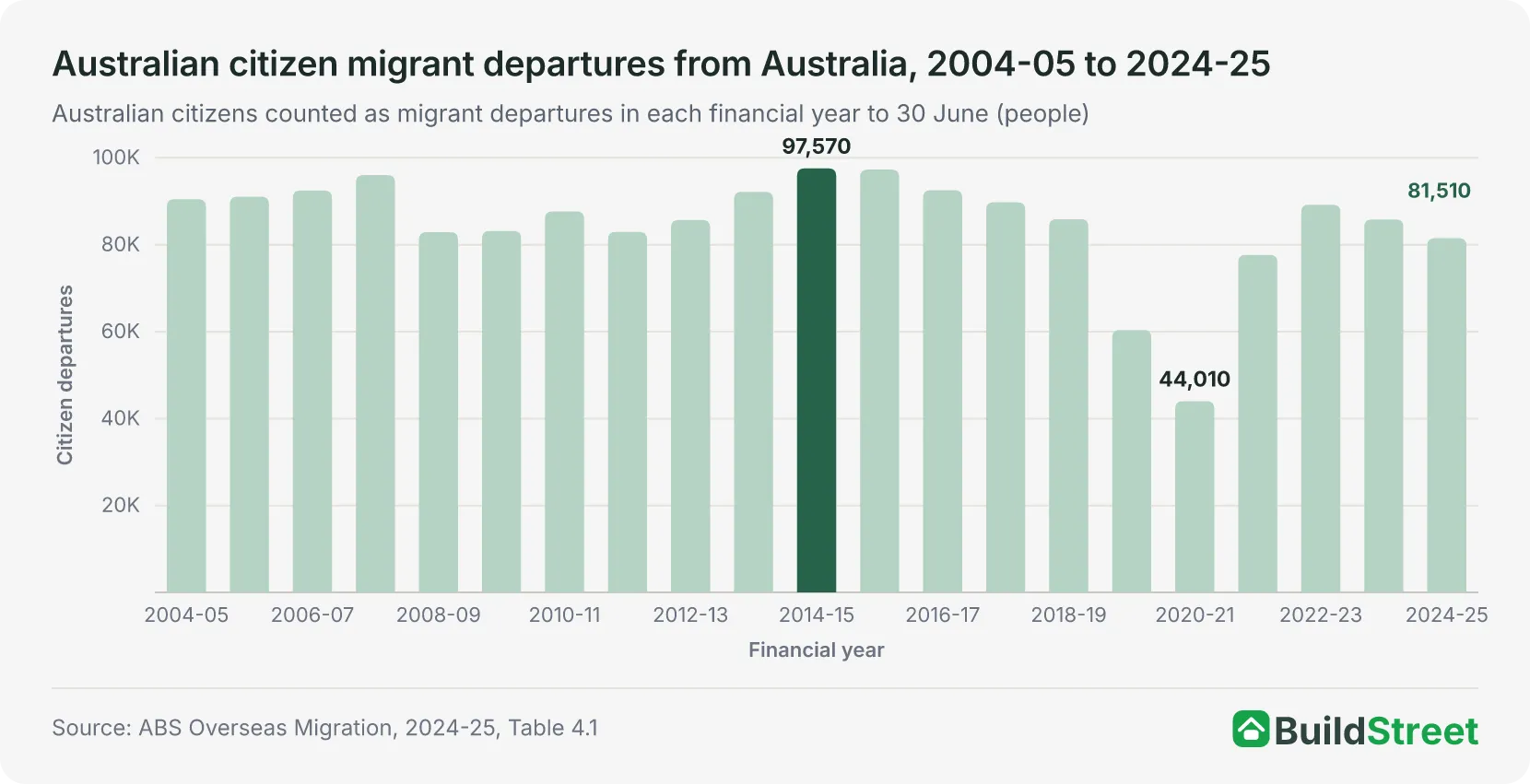
Australian citizens made 81,510 migrant departures from Australia in the 2024-25 financial year, according to the Australian Bureau of Statistics (ABS) Overseas Migration data1. Australian citizen departures fell from 85,820 in 2023-24 to 81,510 in 2024-25, a decrease of 4,310 people, or 5.0 per cent.
A migrant departure is a person counted in Australia's population who leaves and spends at least 12 months overseas within a 16-month period2. The 2024-25 estimates are preliminary and subject to revision, and the next ABS figures for 2025-26 are due to be published on 18 December 20263.
Australian citizen departures ranged from 44,010 in 2020-21 to 97,570 in 2014-15 over the period from 2004-05 to 2024-251. The ABS rounds 2024-25 Australian citizen departures to 82,000, compared with an average of 93,000 a year in the five years before the COVID-19 pandemic, from 2014-15 to 2018-193.
Section 02 · Total migration
How does emigration of Australian citizens compare with net overseas migration?
The net migration loss of 17,450 Australian citizens in 2024-25 was equivalent to 5.7 per cent of Australia's total net overseas migration of 305,570 people, according to the ABS1. Net overseas migration (migrant arrivals minus migrant departures) came from 568,370 arrivals and 262,800 departures across all citizenship and visa groups.
The ABS advises caution when comparing arrivals and departures within a single group, because people often leave with a different visa or citizenship status from the one they arrived with3.
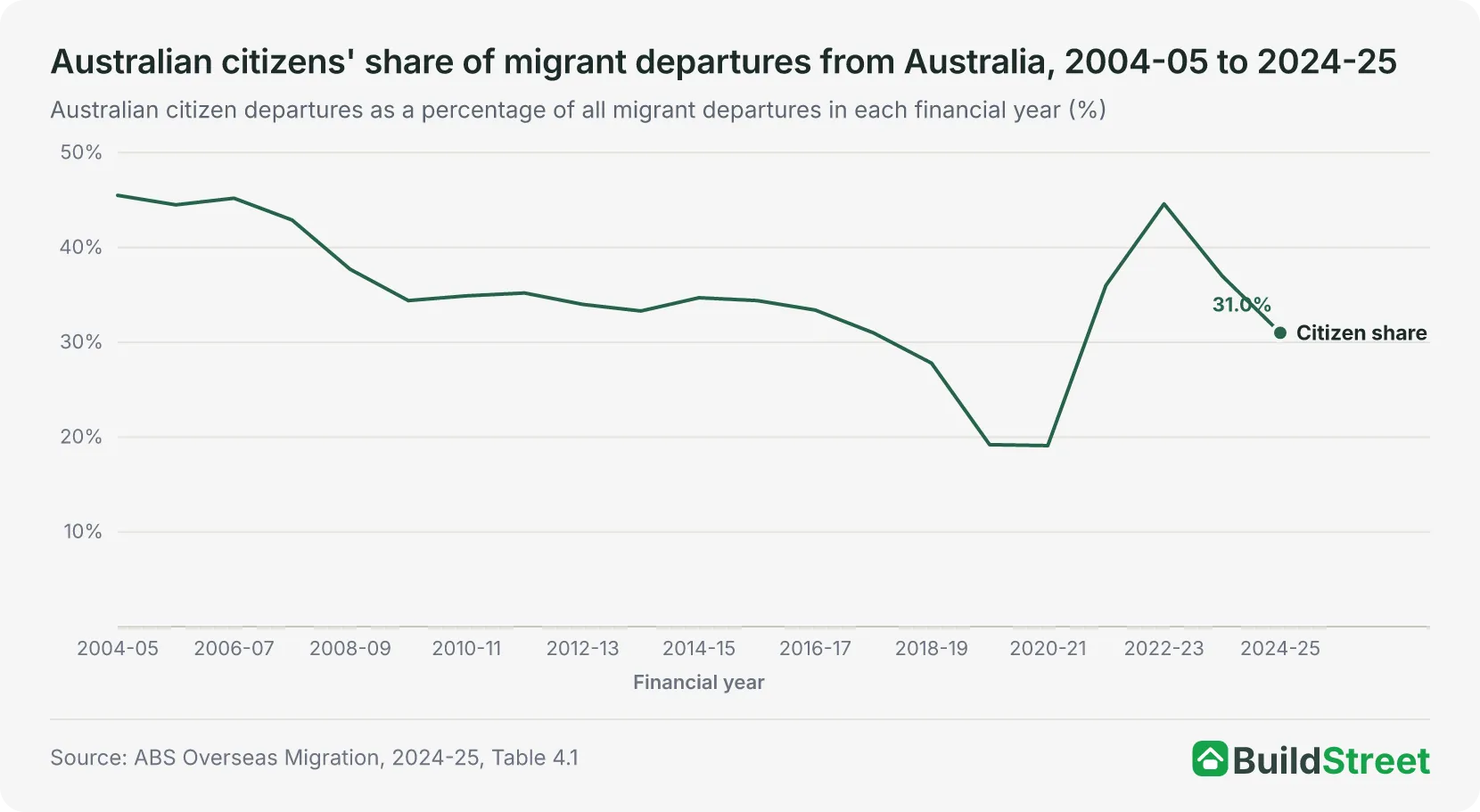
Australian citizens accounted for 31.0 per cent of the 262,800 migrant departures from Australia in 2024-251. Temporary visa holders recorded the largest number of migrant departures among the four citizenship and visa groups, at 147,930 people.
The Australian citizen share of migrant departures fell from 45.5 per cent in 2004-05 to 31.0 per cent in 2024-251. Australian citizens recorded their lowest share of migrant departures from 2004-05 to 2024-25 in 2020-21, at 19.1 per cent.
The ABS estimates 265,400 migrant departures and net overseas migration of 292,100 people for the year ending 31 March 20266. The ABS does not provide a breakdown of Australian citizens in these figures.
| Migrant arrivals and departures by citizenship and visa group, Australia, 2024-25 | ||
|---|---|---|
| Citizenship or visa group | Arrivals | Departures |
| Temporary visa holders | 363,090 | 147,930 |
| Australian citizens | 64,0601 | 81,5101 |
| Permanent visa holders | 88,210 | 18,630 |
| New Zealand citizens | 53,020 | 14,730 |
| Total | 568,3701 | 262,8001 |
Source · ABS Overseas Migration, 2024-25, Table 4.1.
Section 03 · Households
How many households is the net loss of Australian citizens equivalent to?
At the ABS average of 2.6 people per household in 2021, the net migration loss of 17,450 Australian citizens in 2024-25 was equivalent to about 6,700 households, an illustrative calculation rather than an ABS measure7.
The 2.6 figure is the average across all Australian households, and departing citizens may live in smaller or larger households. The ABS does not record the household arrangements of departing Australian citizens, so this calculation does not show how many households actually left Australia or how many homes became available2.
At the same average, the 81,510 Australian citizen departures in 2024-25, before subtracting the 64,060 citizens who arrived, were equivalent to about 31,350 households1. If each person lived alone, the net loss of 17,450 Australian citizens would be equivalent to 17,450 households. This one-person-per-household figure is an upper limit rather than an estimate.
The ABS projects the number of households in Australia to increase from 9,993,900 in 2021 to between 13,265,300 and 13,934,400 in 2046, depending on the assumptions about how people live7. The projected increase is equivalent to about 131,000 to 158,000 households a year from 2021 to 2046.
Household projections are not predictions or forecasts7.
| Australian citizen migration in people and illustrative household equivalents, Australia, 2024-25 | |||
|---|---|---|---|
| Measure | People | Households at 2.6 people each | Households at 1 person each |
| Australian citizen departures | 81,510 | 31,350 | 81,510 |
| Australian citizen arrivals | 64,060 | 24,640 | 64,060 |
| Net loss of Australian citizens | 17,450 | 6,710 | 17,450 |
Source · ABS Overseas Migration, 2024-25, Table 4.1, and ABS Household and Family Projections, Australia, 2021-2046.
Section 04 · Capital cities
Which capital cities record the most overseas departures?
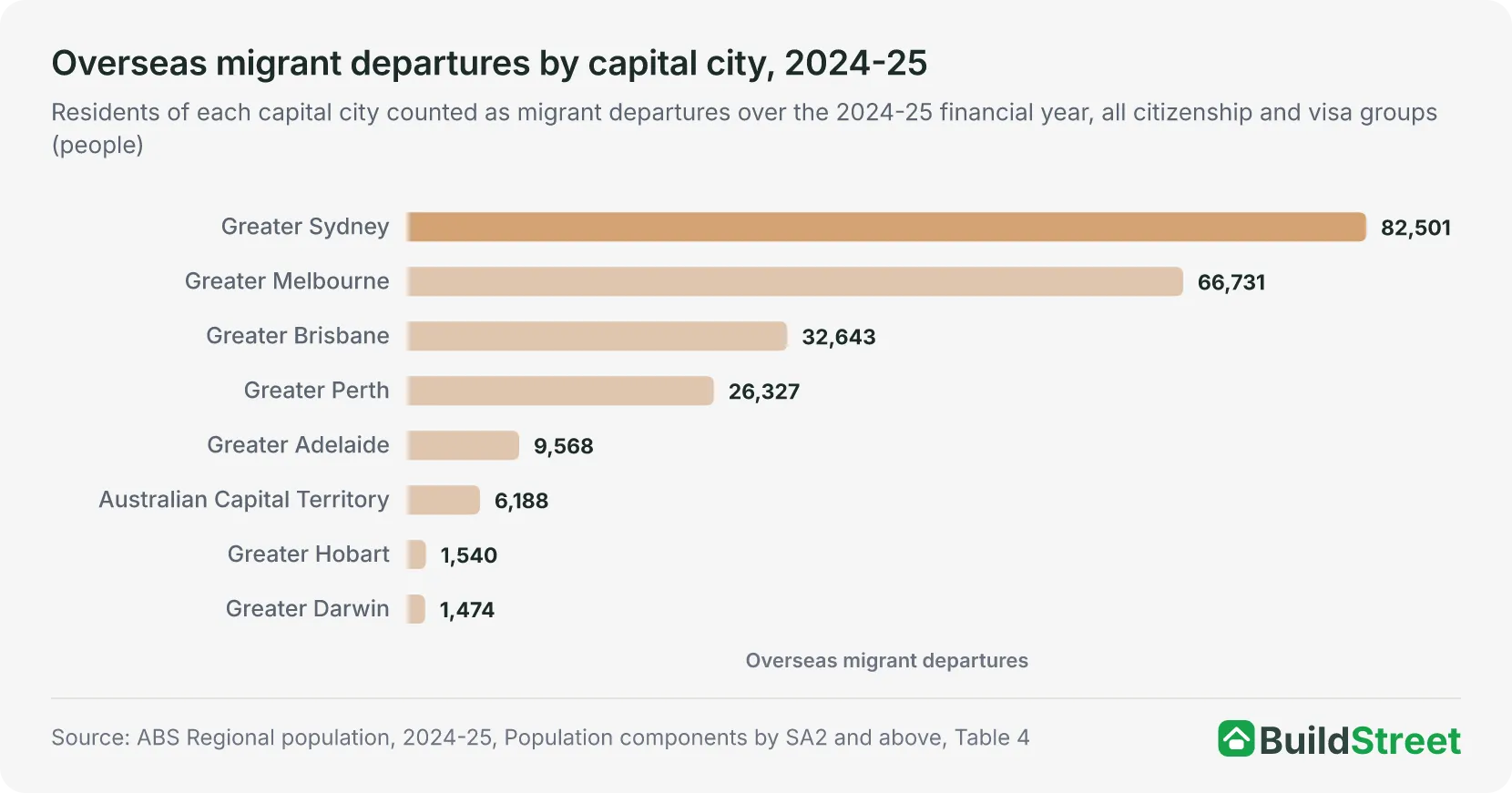
Greater Sydney recorded the largest number of overseas migrant departures among Australia's eight capital cities in 2024-25, at 82,501 people, according to the ABS8. Greater Melbourne followed with 66,731 departures and Greater Brisbane with 32,643.
The eight capital cities accounted for 226,972 of the 265,056 overseas migrant departures in 2024-25, equivalent to 85.6 per cent8. By comparison, the eight capital cities accounted for 67.9 per cent of Australia's population at 30 June 20259.
Greater Sydney also recorded the highest departure rate among the capital cities, at 14.8 departures per 1,000 residents, while Greater Hobart recorded the lowest, at 6.0 per 1,0008.
The ABS estimated 265,056 overseas migrant departures for 2024-25 in March 20268, compared with 262,800 in December 20251. Both figures are preliminary estimates8.
| Overseas migration by capital city, 2024-25 | ||||
|---|---|---|---|---|
| Capital city | Arrivals | Departures | Net overseas migration | Departures per 1,000 residents |
| Greater Sydney | 160,904 | 82,5018 | 78,403 | 14.8 |
| Greater Melbourne | 147,899 | 66,731 | 81,168 | 12.5 |
| Greater Brisbane | 66,577 | 32,643 | 33,934 | 11.8 |
| Greater Perth | 63,616 | 26,327 | 37,289 | 11.0 |
| Greater Adelaide | 27,392 | 9,568 | 17,824 | 6.5 |
| Australian Capital Territory | 11,007 | 6,188 | 4,819 | 12.9 |
| Greater Hobart | 3,373 | 1,540 | 1,833 | 6.0 |
| Greater Darwin | 4,321 | 1,474 | 2,847 | 9.4 |
Source · ABS Regional population, 2024-25, Population components by SA2 and above, Table 4, and Population estimates by SA2 and above, 2001 to 2025, Table 4.
Which states and territories record the most Australian citizen departures?
The ABS does not publish Australian citizen departures by capital city, and its most detailed geographical breakdown for citizenship figures is by state or territory1.
New South Wales recorded the largest number of Australian citizen departures of any state or territory in 2024-25, at 28,130, accounting for 34.5 per cent of Australian citizen departures1. Victoria followed with 21,100 and Queensland with 15,250.
Overseas arrivals and population growth in each capital are covered in Migration and housing demand across the capitals.
| Australian citizen migrant departures and arrivals by state and territory, 2024-25 | |||
|---|---|---|---|
| State or territory | Departures | Arrivals | Share of citizen departures (%) |
| New South Wales | 28,1301 | 22,080 | 34.5 |
| Victoria | 21,1001 | 16,350 | 25.9 |
| Queensland | 15,250 | 12,520 | 18.7 |
| Western Australia | 9,310 | 7,100 | 11.4 |
| South Australia | 3,650 | 2,870 | 4.5 |
| Australian Capital Territory | 2,500 | 2,020 | 3.1 |
| Tasmania | 900 | 700 | 1.1 |
| Northern Territory | 640 | 390 | 0.8 |
| Australia | 81,510 | 64,060 | 100.0 |
Source · ABS Overseas Migration, 2024-25, Tables 4.1 to 4.9.
Section 05 · Returning citizens
How many Australian citizens arrive in Australia each year?
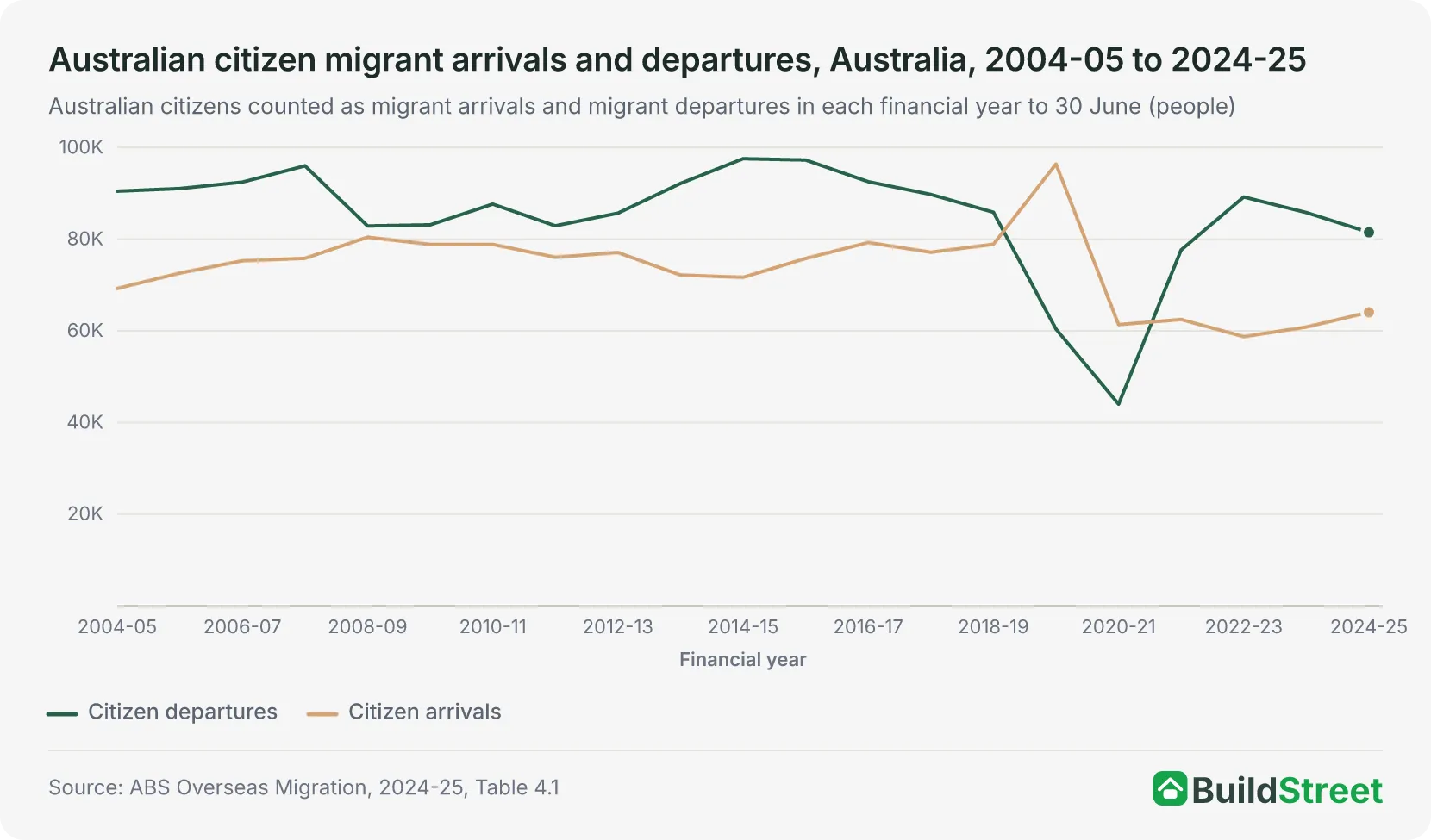
Australian citizens made 64,060 migrant arrivals in Australia in 2024-25, equal to 78.6 per cent of Australian citizen departures in the same year1. Australian citizen migrant arrivals increased from 60,840 in 2023-24 to 64,060 in 2024-25, an increase of 3,220 people, or 5.3 per cent.
Australian citizen migrant arrivals averaged 77,000 a year from 2014-15 to 2018-19, according to the ABS3. Australian citizen arrivals recorded their highest annual number from 2004-05 to 2024-25 in 2019-20, at 96,4101.
For Australian-born migrant arrivals, a group that overlaps with but differs from Australian citizens, the ABS attributes the increase from September 2019 to March 2020 partly to Australians living overseas who returned for short visits before the COVID-19 outbreak, changed their travel plans and stayed long enough to be counted as migrants3.
Citizen departures were higher than citizen arrivals in every year from 2004-05 to 2024-25 except 2019-20 and 2020-21, when citizen migration added 36,020 and 17,360 people respectively1. Citizen migration recorded its largest net loss over the period in 2022-23, at 30,470 people.
Section 06 · Housing targets
How does net migration of Australian citizens compare with Australia's housing target?
The net migration loss of 17,450 Australian citizens in 2024-25 was equivalent to about 6,700 households using the average household size of 2.6 people, or 17,450 households if each person lived alone. These figures can be compared with the National Housing Accord target of 240,000 new homes a year10. These household equivalents represented 2.8 to 7.3 per cent of the annual target.
National Cabinet agreed on 16 August 2023 to a target of 1.2 million new well-located homes over five years from 1 July 2024, equivalent to 240,000 homes a year10.
The target counts new homes built, while net overseas migration counts people. The household equivalents are estimates based on average household size, so the percentages are comparisons only and do not show how many homes become available when people leave Australia. In 2024-25, net overseas migration, which already includes the net loss of Australian citizens, added 305,570 people, about 17.5 times the net migration loss of Australian citizens1.
The ABS does not measure how emigration affects housing demand or what happens to the dwellings that departing Australian citizens lived in. It also does not collect the main reason people leave Australia2. The outgoing passenger card, which previously collected information from departing travellers, was removed on 1 July 2017.
The other measured components of demand for new homes are covered in What is driving housing demand.
Section 07
Frequently asked questions
How many migrant departures from Australia were there in 2024-25?
Australia recorded 262,800 migrant departures in 2024-25, according to the Australian Bureau of Statistics (ABS). Of these, 81,510 were Australian citizens, accounting for 31.0 per cent of all migrant departures.
Do more Australian citizens leave Australia than come back?
Yes. In 2024-25, Australian citizens made 81,510 migrant departures and 64,060 migrant arrivals, resulting in a net migration loss of 17,450 people. Departures exceeded arrivals in every year from 2004-05 to 2024-25 except 2019-20 and 2020-21.
Does emigration reduce housing demand in Australia?
The ABS does not measure whether emigration reduces housing demand, because migration estimates count people rather than dwellings. In 2024-25, the net migration loss of Australian citizens was 17,450 people, compared with net overseas migration of 305,570 people.
How does emigration compare with Australia's housing target?
The net migration loss of Australian citizens in 2024-25 was equivalent to approximately 6,700 households at the average household size, or at most 17,450 households if every person lived alone. This represented 2.8 to 7.3 per cent of the National Housing Accord's annual target of 240,000 new homes. The comparison is illustrative and does not measure how many homes become available through emigration.
Which state or territory recorded the most Australian citizen migrant departures in 2024-25?
New South Wales recorded the largest number of Australian citizen departures of any state or territory in 2024-25, at 28,130, accounting for 34.5 per cent of Australian citizen departures. Victoria followed with 21,100 and Queensland with 15,250.
References
- ABS Overseas migrant arrivals and departures, by visa and citizenship groups, by state/territory, 2004-05 to 2024-25 (data cube 34070DO004) · Australian Bureau of Statistics ↑ b c d e f g h i j k l m n o p q r s t
- ABS Overseas Migration methodology, 2024-25 · Australian Bureau of Statistics ↑ b c
- ABS Overseas Migration, 2024-25 · Australian Bureau of Statistics ↑ b c d e f
- Overseas Arrivals and Departures, Australia, July 2026 (time series tables 1, 7 and 8) · Australian Bureau of Statistics ↑
- ABS article: Use Net Overseas Migration statistics to understand overseas migration, not Overseas Arrivals and Departures · Australian Bureau of Statistics ↑
- ABS, National, state and territory population, March 2026 · Australian Bureau of Statistics ↑
- ABS Household and Family Projections, Australia, 2021-2046 · Australian Bureau of Statistics ↑ b c d
- ABS Regional population, 2024-25: population components by SA2 and above, 2021-22 to 2024-25 (datacube 32180DS0005) · Australian Bureau of Statistics ↑ b c d e f
- ABS Regional population, 2024-25: population estimates by SA2 and above, 2001 to 2025 (datacube 32180DS0003) · Australian Bureau of Statistics ↑
- National Housing Accord · treasury.gov.au ↑ b
- ABS Regional population, 2024-25 · Australian Bureau of Statistics
