

Published 22 Sept 2026
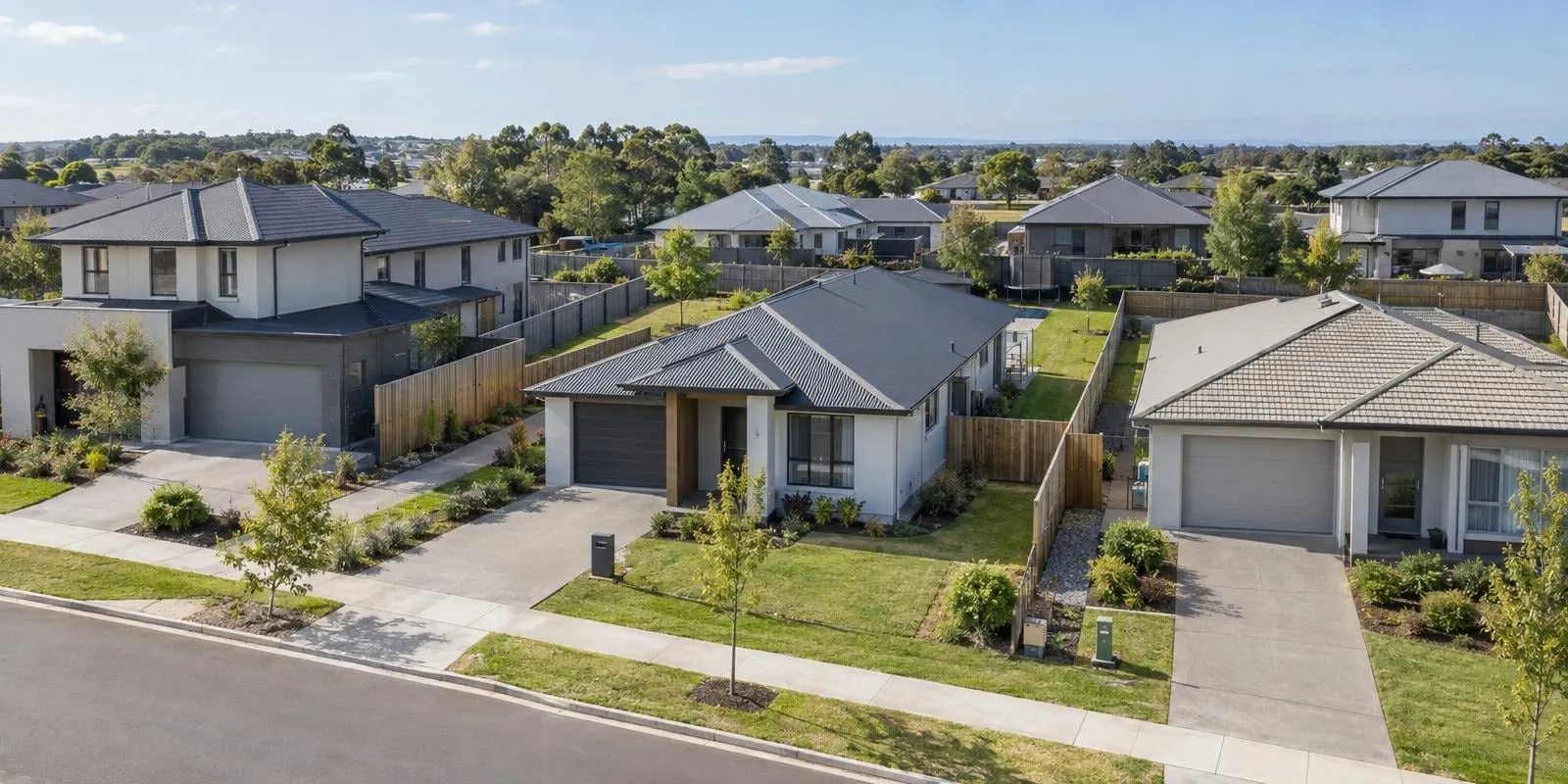 What is a setback?A pool setback is measured from the waterline, a house setback from the wall. The setback article explains how the distances that shape a house's position on the lot are read and applied.
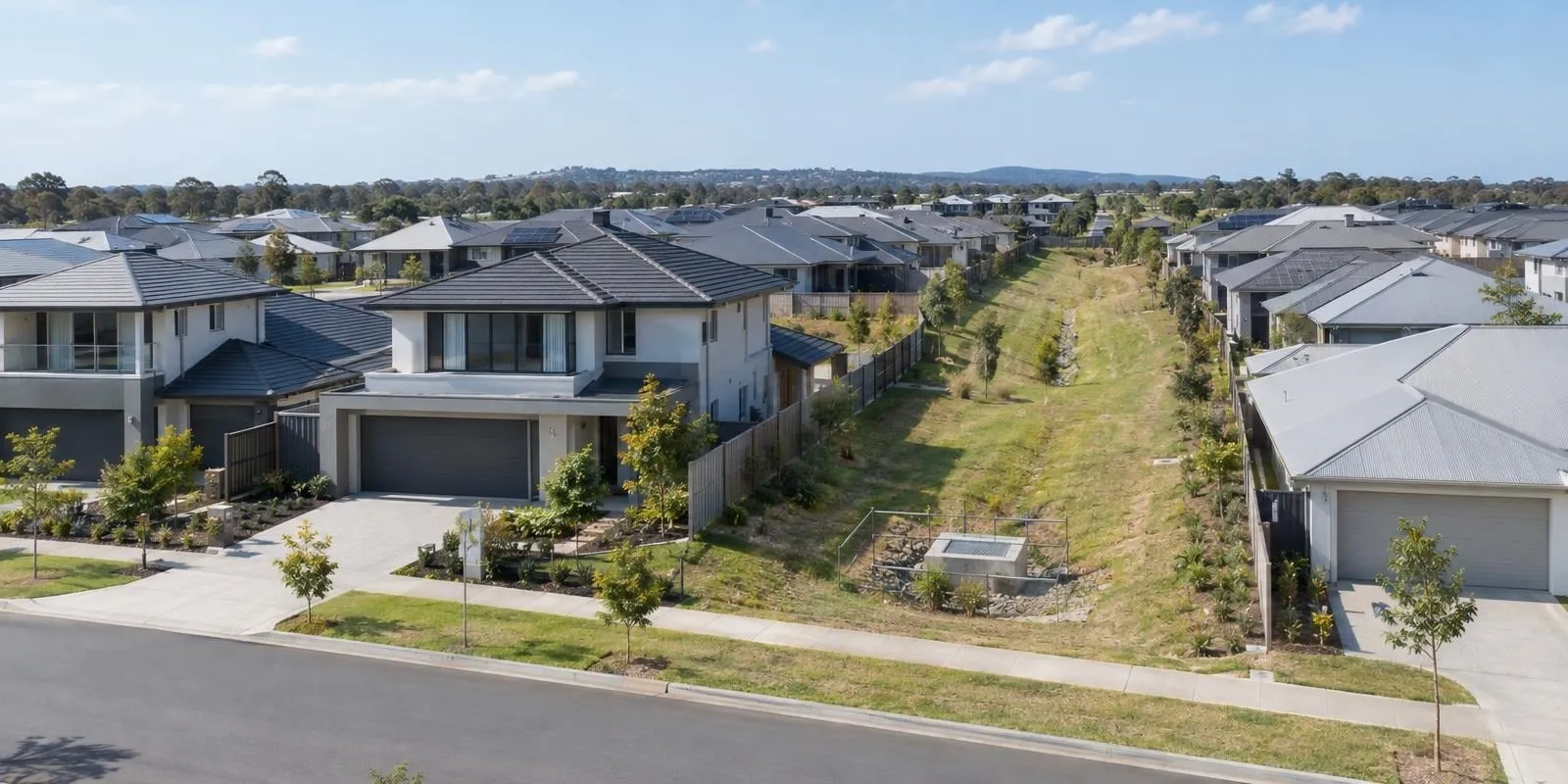 What is an easement?A registered easement across the backyard can rule out the pool position and, in New South Wales, the complying-development path. The easement article covers how to find one on the title.
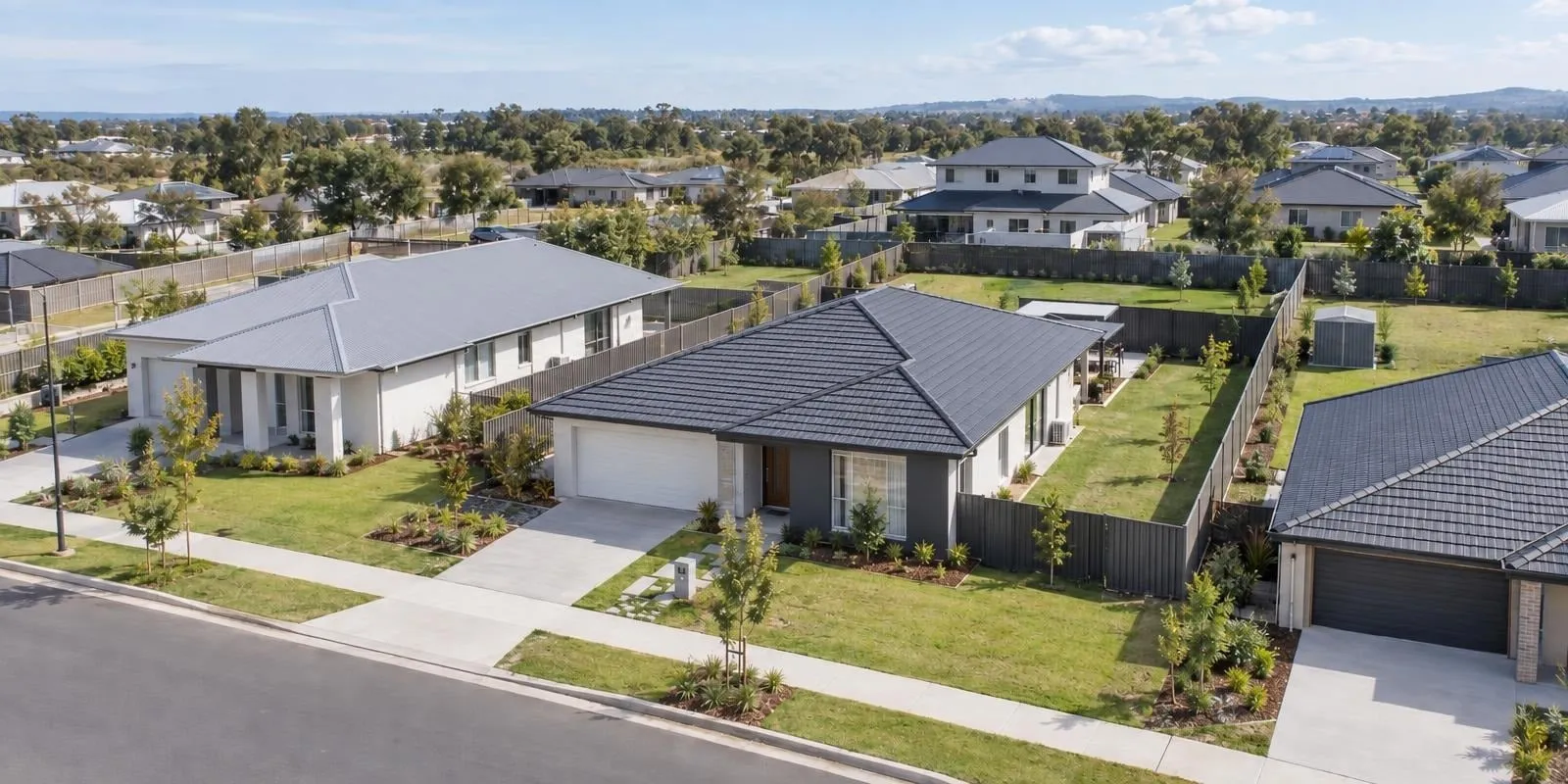 Building envelope explainedThe rear strip a pool needs is what remains of the envelope once the house is placed. The envelope article covers how setbacks and the house footprint leave that strip.
Section 01 · The rule layers
Which rules decide where a backyard pool can go?
A backyard pool in New South Wales, Victoria or Queensland is governed by two separate sets of rules, and on estate land by a third. Siting rules decide where on the lot the water can sit. In New South Wales, these rules are set through the Housing Code for complying development1; in Victoria, through the building permit2; and in Queensland, through state or council siting rules3.
Separate pool safety rules cover the fence or barrier around the pool, registration and other safety requirements4. These rules apply wherever the pool is positioned. Meeting the setback rules does not automatically mean the pool barrier also complies5.
On estate land the developer's design guidelines can add a private layer on top of the state rules. Among the four Queensland estate documents reviewed for this article, one publishes its own pool setback, one does not approve pools through its design panel, one asks for pools to be included in the design submission and one bans pool-style fencing at the street.
| The instruments that govern a backyard pool, New South Wales, Victoria and Queensland, 2026 | ||||
|---|---|---|---|---|
| State | Siting instrument | Pool safety law | Barrier standard applied | Register |
| New South Wales | Codes SEPP Housing Code, clause 3.28, or a council development application | Swimming Pools Act 1992 and Swimming Pools Regulation 2018 | Building Code of Australia, with AS 1926 by construction date | NSW Swimming Pool Register |
| Victoria | Building permit under the Building Regulations 2018; no published pool setback | Building Regulations 2018, Part 9A | Standard set by the pool's construction date | The local council's register |
| Queensland | QDC MP 1.1 and MP 1.2, or a council's alternative siting provisions | Building Act 1975 with QDC MP 3.4 | MP 3.4, calling up and modifying AS 1926-2007 | QBCC pool safety register |
Source · Codes SEPP (NSW) cl 3.28; Swimming Pools Act 1992 (NSW); Swimming Pools Regulation 2018 (NSW) cl 5; Building Regulations 2018 (Vic) regs 28 and 147A; Queensland Development Code MP 1.1, MP 1.2 and MP 3.4; Queensland Government pool safety laws page.
Section 02 · Setbacks
How far from the boundary must a pool be in NSW, Victoria and Queensland?
On the NSW complying-development path the swimming pool waterline must be set back at least 1 m from a side or rear boundary1, and the pool must be located behind the front of the house6. Victoria publishes no single statewide pool setback, and Queensland's existing siting rules generally require 1.5 m from the water's edge to a side or rear boundary, unless a solid wall or fence at least 1.8 m high separates the pool from the boundary3. The measurement in New South Wales and Queensland runs from the water, not from the pool shell or its paving.
The building line is the line of the house's external wall closest to the primary road, so a pool on that path sits beside or behind the house, never in front of it1. On a corner lot the pool's setback from the secondary road is the house's own setback from that road.
The Greenfield Housing Code, which applies in nominated new-release areas, carries the same 1 m waterline setback and extends it to a boundary with a secondary road1.
In Victoria, a pool's location is decided through the building approval process rather than a statewide setback table. The application must show where the pool and its barrier will sit on the lot7. Victoria does not publish a separate statewide setback distance for pools. Other council approvals may also apply. An unroofed pool or spa may also be excluded when calculating how much of the lot is covered by buildings2.
Queensland's existing rules vary according to lot size but use the same basic pool setback distances8. At the street, the water must generally be at least 1.5 m from the street boundary where the top edge of the pool is no more than 1.2 m above ground level3. This setback does not apply where a solid wall or fence at least 1.8 m high separates the pool from the street and extends at least 1 m above the top edge of the pool. At the side and rear boundaries, the water must generally be at least 1.5 m from the boundary, unless the same type of wall or fence separates the pool from it.
Queensland's pool setback rules are changing. The Queensland Housing Code began on 1 September 2026 and is being introduced across council areas, with the transition ending on 1 September 20299. Until the new code applies in an area, the existing state rules or the council's own setback rules continue to apply. The final pool setback rules in the new code were not reviewed for this article. An earlier draft kept the same basic distances: 1.5 m from the street, side and rear boundaries, with an exception allowing a pool closer to a boundary where a suitable solid fence is used10.
| Pool siting rules for a detached house lot, New South Wales, Victoria and Queensland, 2026 | ||||
|---|---|---|---|---|
| State and instrument | Approval path | Rule | Value | Clause |
| NSW, Housing Code | Complying development | Waterline setback from a side or rear boundary | At least 1 m | cl 3.28(7) |
| NSW, Housing Code | Complying development | Position on the lot | Behind the building line of the house; on a corner lot, the house's own setback from the secondary road | cl 3.28(6), (7A) |
| NSW, Housing Code | Complying development | Pump, coping and decking | Pump more than 450 mm from each boundary; coping no more than 1.4 m above ground; decking no more than 600 mm | cl 3.28(3)–(5) |
| NSW, Codes SEPP | Exempt development | Portable pool of no more than 2,000 L | Rear yard, at least 1 m from each boundary, no structural work | cl 2.60 |
| NSW, Greenfield Housing Code | Complying development | Waterline setback | At least 1 m from a side, rear or secondary-road boundary | cl 3C.31(7) |
| Victoria, Building Regulations 2018 | Building permit | Pool setback | None published; the permit drawings show the pool and barrier position | regs 28, 72 |
| Victoria, Building Regulations 2018 | Building permit | Site coverage | An unroofed pool or spa may be disregarded | reg 76(3)(b) |
| Queensland, QDC MP 1.1 and MP 1.2 | Building approval | Water's edge to the road frontage | 1.5 m where the coping is no more than 1.2 m above ground; no requirement behind a solid wall or fence of at least 1.8 m with its top 1.0 m above the coping | A1(d)(i) |
| Queensland, QDC MP 1.1 and MP 1.2 | Building approval | Water's edge to a side or rear boundary | 1.5 m for a part no more than 4.5 m high; waived behind the same kind of wall or fence | A2(a), A2(e) |
Source · Codes SEPP (NSW), clauses 2.60, 3.28 and 3C.31; Building Regulations 2018 (Vic), regulations 28, 72 and 76; Queensland Development Code MP 1.1 and MP 1.2, A1(d)(i) and A2; Business Queensland QDC register.
Section 03 · Approvals
What approval does a backyard pool need?
Some form of approval is needed for a backyard pool in all three states, and only in New South Wales does a small portable pool escape it. In New South Wales a pool that meets the complying-development requirements can be approved without a full council development application. A pool that does not meet those requirements generally needs a development application to the council6.
A portable pool or spa of no more than 2,000 L can be exempt development, needing no planning approval, where it sits in the rear yard at least 1 m from each boundary, is for residential use only and needs no structural work1. The exemption removes the planning approval only, and the barrier law applies to that pool once it can hold water deeper than 300 mm.
A NSW pool build also needs a certifier, temporary child-resistant fencing during construction, and final approval before the pool can be used11.
In Victoria a building permit is required before a pool, spa or barrier is installed unless the work is exempt. A registered building surveyor issues the permit7.
In Queensland a building approval from the council or a private certifier is required before a pool is built12. Other approvals may also be needed, such as where the pool is proposed over a sewer line. Once the pool is completed, the certifier sends its final approval details to the Queensland Building and Construction Commission for the pool register13.
Section 04 · Barriers
How high must a pool fence be under state pool safety laws?
New South Wales and Queensland both publish 1.2 m as the minimum height of a pool barrier measured from finished ground level, and both cap the gap under the fence at 100 mm1114. Victoria does not have one minimum height for every pool because the barrier requirements depend on when the pool was built.
In New South Wales, the barrier requirements for an existing pool depend on its construction date. Pools built from 1 September 2008 to 30 April 2013 are assessed against the 2007 pool barrier standard, while pools built after 1 May 2013 are assessed against the 2012 standard1511.
Where a boundary fence forms part of the barrier it must be 1.8 m high. The rules also set minimum clear areas around the fence to reduce climbing risks11. A CPR sign must be displayed near the pool and be readable from 3 m away4.
In Queensland the same pool barrier standard applies to both new and existing pools. The minimum barrier height is 1.2 m16, and the rules set clear areas around the fence to reduce climbing risks. Boundary fences can also form part of the pool barrier if they meet the required height and clearance rules. Gates must not open towards the pool17.
In Victoria the barrier requirements depend on when the pool was built. Older pools may be allowed to use certain existing building walls or fences as part of the barrier if they meet the applicable requirements2. For later pools, the council determines which barrier standard applies based on the pool's construction date18. In every state, the owner must keep the barrier maintained and the gate closed2.
Pool safety laws also apply to relatively shallow pools. In New South Wales and Victoria, the rules apply to pools4 that can hold water deeper than 300 mm2. In Queensland, they apply from a depth of 300 mm, although fishponds and ornamental water features are excluded19. Portable and inflatable pools are covered at those depths in all three states.
| Published pool barrier requirements for a backyard pool, New South Wales, Victoria and Queensland, 2026 | |||||
|---|---|---|---|---|---|
| State | Law applies from | Minimum barrier height | Boundary fence as part of the barrier | Non-climbable zone | Standard by pool age |
| New South Wales | Water deeper than 300 mm | 1.2 m from finished ground level; gap under the fence no more than 100 mm | 1.8 m high | 900 mm outside the fence and 300 mm inside; horizontal bars at least 900 mm apart | AS 1926-1986, AS 1926.1-2007 or AS 1926.1-2012 by construction date; the current standard once a barrier is altered |
| Victoria | Water deeper than 300 mm | Set by the standard in force at the construction date | Not separately published | Per the applicable standard | Pools before 8 April 1991: a compliant building wall, an AS 1926.1-1993 fence or a 1.5 m paling or imperforate fence |
| Queensland | Water 300 mm or more | 1,200 mm from finished ground level; gap under the fence no more than 100 mm | At least 1,200 mm with the non-climbable zone outside, or 1,800 mm or more with the zone on either side | 900 mm outside; 300 mm clear inside a fence lower than 1,800 mm | MP 3.4 applies to new and existing pools alike |
Source · Swimming Pools Act 1992 (NSW) s 3; Swimming Pools Regulation 2018 (NSW) cl 5; NSW Government pool-owner obligations page; Building Regulations 2018 (Vic) regs 147A to 147C; Queensland Development Code MP 3.4 Schedule 1; QBCC pool fences and non-climbable zones pages; QBCC swimming pool safety laws page.
Section 05 · Registers
Does a pool have to be registered, and how often is the barrier certified?
A backyard pool must be registered in all three states, and Victoria is the only one that also requires a recurring barrier certificate, every four years. New South Wales registers pools on the state's Swimming Pool Register, Victoria on the local council's register, and Queensland on the register kept by the Queensland Building and Construction Commission (QBCC)20.
In New South Wales the owner must ensure the pool's address, type and property type are entered on the register. Owners can register a pool themselves at no charge or ask the council to do it for a fee4. Registration does not certify the barrier. A certificate of compliance is issued after an inspection by the council or a registered certifier and is valid for three years11.
When a NSW property with a pool is sold, the sale contract must include proof that the pool is registered and one of the required pool safety documents. These can include a certificate of compliance, a recent final approval for the pool or a certificate of non-compliance. If the buyer receives a certificate of non-compliance, there are 90 days after settlement to obtain a certificate of compliance11.
In Victoria the owner of a new pool must apply to the council for registration within 30 days of receiving final approval for the pool2 and lodge a pool and spa barrier compliance certificate with the application. A portable pool that remains set up for at least three consecutive days must be registered by the fourth day. A pool removed sooner does not have to be registered, although the barrier rules still apply while it is in use. After each certificate is lodged the council notifies the owner of the next due date, which is four years after the previous certificate was lodged.
In Queensland every residential pool and outdoor spa must be registered with the Queensland Building and Construction Commission20, and an unregistered pool found in an audit can attract a fine. Queensland does not require a new barrier certificate on a fixed cycle. Instead, pool safety certificates are generally required when a property is sold or leased. A certificate for a non-shared pool is valid for two years, while a shared pool certificate is valid for one year21. If a property is sold without a current certificate, a notice must be lodged and the buyer has 90 days after settlement to obtain one.
| Pool registration and barrier certificate requirements, New South Wales, Victoria and Queensland, 2026 | ||||
|---|---|---|---|---|
| State | Register | Deadline for a new pool | Recurring certificate | On sale or lease |
| New South Wales | NSW Swimming Pool Register, by property address; no charge for owners | Not fixed in days; an occupation certificate is needed before the pool is used | None fixed; a certificate of compliance is valid for 3 years and councils run inspection programs | Sale: registration certificate plus a compliance, occupation or non-compliance certificate; buyer has 90 days after a non-compliance certificate. Lease: compliance or occupation certificate |
| Victoria | The local council's register | 30 days after the occupancy permit or certificate of final inspection; a relocatable pool on or before the 4th day erected | A certificate of pool and spa barrier compliance every 4 years | No certificate attaches to the transaction; the register and the 4-year cycle follow the land |
| Queensland | QBCC pool safety register; the certifier lodges a new pool's final certificate | On completion, when the certifier issues the final certificate | None fixed; a pool safety certificate is valid 2 years (non-shared) or 1 year (shared) | Sale or lease needs a current pool safety certificate, or a Form 36 notice with 90 days after settlement to obtain one |
Source · Swimming Pools Act 1992 (NSW) ss 22B, 22D and 30B; Swimming Pools Regulation 2018 (NSW) cl 24; NSW Government pool-owner obligations page; Building Regulations 2018 (Vic) regs 147M, 147N and 147V; Queensland Government registering a pool page; QBCC register a pool and buy, sell or lease pages.
Section 06 · The estate layer
How do estate design guidelines treat swimming pools?
Among the four Queensland estate documents reviewed, the rules for pools vary considerably. One estate publishes a 0 m pool setback, while another does not include pools in its design approval process. North Harbour, at Burpengary East, gives outbuildings, swimming pools and tennis courts 0 m road, side and rear setbacks in its Appendix A table, with 1.0 m from a laneway, one storey and a 4.5 m height cap22. These estate requirements apply in addition to the state's building approval and pool barrier rules.
SkyRidge, at Worongary, does not include swimming pools and spas in its design approval process, so the usual government approvals still apply23. Village Green, at Palmview, asks for pools in the design approval submission as additional information alongside retaining walls, sheds and water tanks24.
Estates also regulate how pool fencing looks from the street, separately from safety law. Aura, at Caloundra South, states that chain mesh, chain link, Colorbond and pool fencing will not be approved as front fencing, and repeats the pool-fencing ban for the secondary street fence25. This does not remove the requirement for a pool barrier. Instead, it limits the types of fencing that can face the street. Pool equipment gets the same treatment: North Harbour requires pools and their equipment to be screened when visible from a street or public space22.
| Pool clauses in four Queensland estate design guidelines, 2023 to 2026 editions | |||
|---|---|---|---|
| Estate, edition | Pool siting | Estate approval | Fencing and equipment |
| North Harbour, 2023 | 0 m road, side and rear setbacks; 1.0 m from a laneway; one storey, 4.5 m maximum | Within the estate's design approval | Pools and equipment screened where visible from a street or public space |
| SkyRidge, 2025 | Not stated | The design approval panel does not approve pools or spas | Pool and spa pumps located away from street view and shown on the site plan |
| Village Green, 2026 | Not stated | Pools included in the design approval submission as additional information | Pool equipment not visible from any street or public space |
| Aura, 2023 | Not stated | Not stated for pools | Pool fencing not approved as front fencing or on the secondary street fence |
Source · North Harbour Design Guidelines, Appendix A and Ground Mounted Plant or Equipment; SkyRidge Design Guidelines, pp 25 and 26; Village Green Home Design Guidelines, Design Approval checklist and Ground Mounted Plant Equipment; Aura Design Essentials, §5.2 and §5.4.
Section 07 · The rear strip
How much backyard depth does a pool need behind the house?
Under the NSW complying-development rules, a pool laid across the block needs its length plus 2 m of lot width and its width plus 1 m of depth from the back wall of the house to the rear boundary, so an 8 m by 4 m family pool needs 10 m of lot width and 5 m of depth. This is an illustrative calculation using the 1 m waterline setback from each side boundary and the rear boundary. Whether a pool fits is usually decided by the space between the back wall of the house and the rear boundary.
The same calculation gives a required width of 9 m and a depth of 4 m for a 7 m by 3 m pool, while a 4.5 m by 2.5 m plunge pool needs 6.5 m of width and 3.5 m of depth. Rotating a pool trades width for depth.
| Lot width and rear-strip depth three test pools need under a 1 m waterline clearance, illustrative calculation, 2026 | ||
|---|---|---|
| Test pool, waterline | Lot width needed at the pool | Back wall to rear boundary needed |
| 8 m × 4 m family pool | 10 m | 5 m |
| 7 m × 3 m pool | 9 m | 4 m |
| 4.5 m × 2.5 m plunge pool | 6.5 m | 3.5 m |
Source · Codes SEPP (NSW), clause 3.28(7).
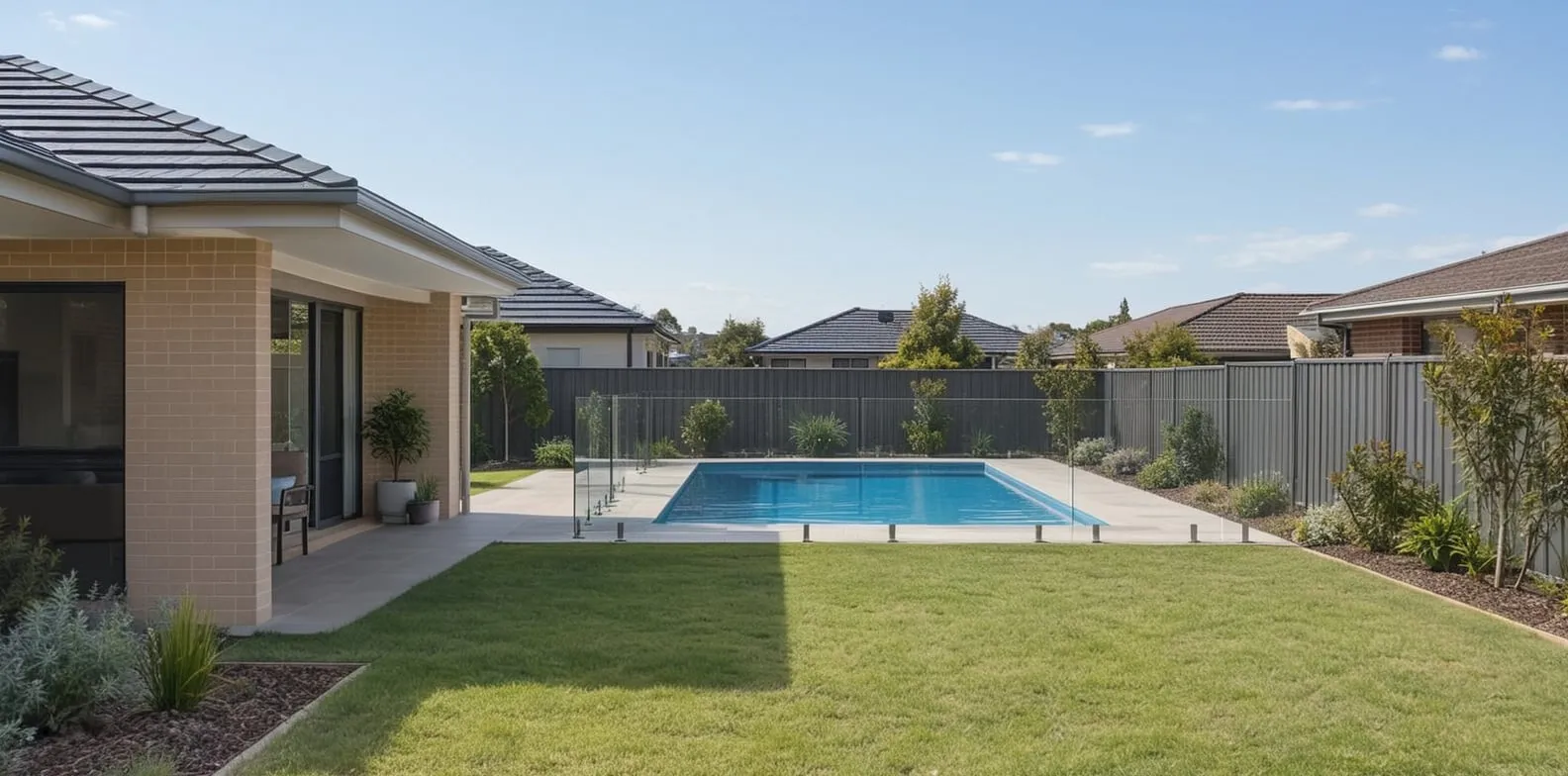
The rear strip a pool needs under the NSW 1 m waterline setback
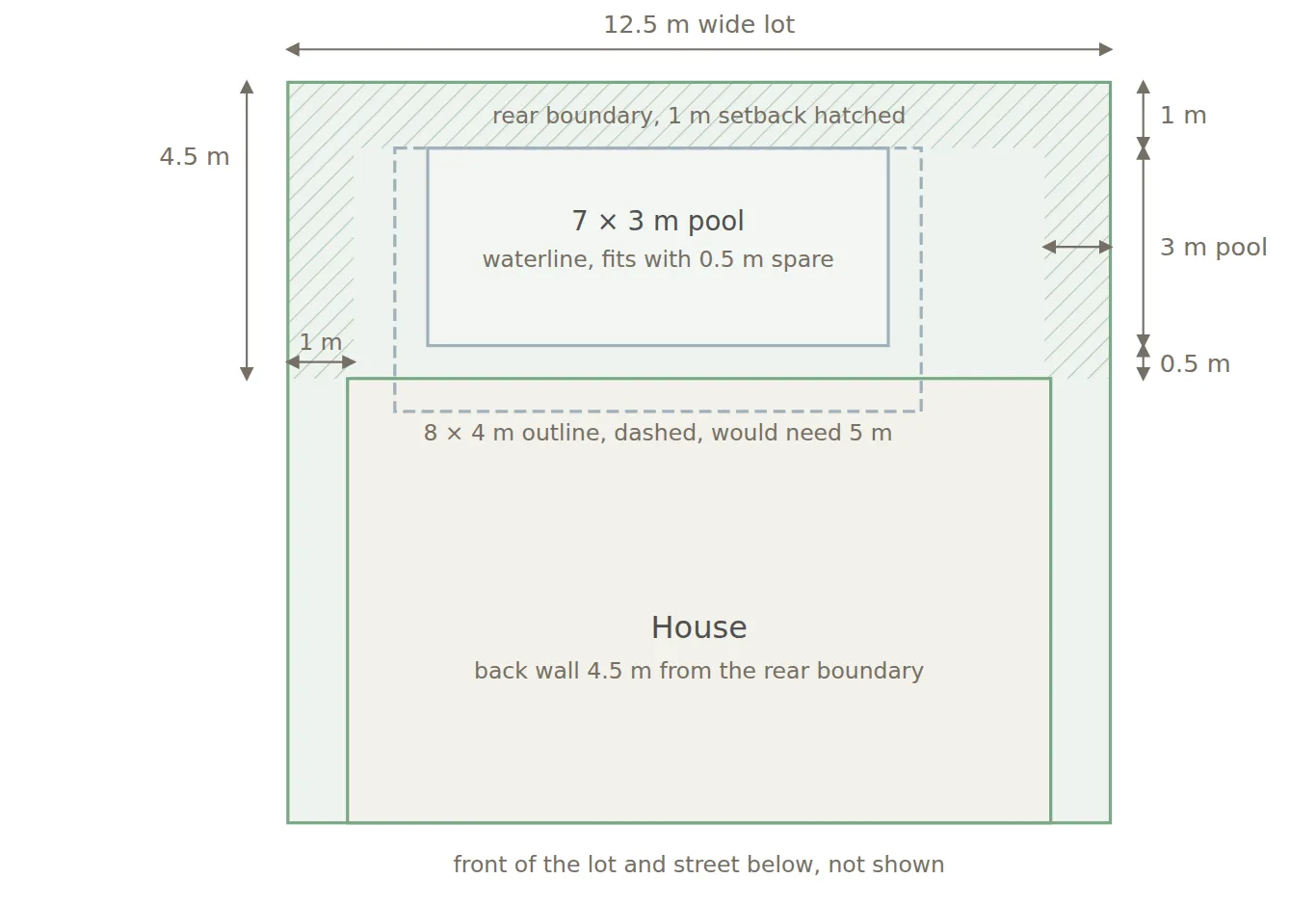
The available space can be reduced by other property restrictions. A registered easement across the backyard can rule out part of the area and, in New South Wales, the complying-development path. On many estate lots, a lot-specific building envelope can also limit where structures may sit.
BuildStreet checks the space left behind each house design and tests whether the three pool sizes could fit with a 1 m waterline clearance on every side. Each result is shown as likely to fit, tight or unlikely. In New South Wales that clearance is the cited complying-development value, while in Victoria and Queensland it is used only as a comparison. The check assesses the available rear space only. A recorded easement, irregular lot or lot-specific building envelope can limit the result to “tight”, and pool barrier requirements are not assessed.
How BuildStreet checks the rear space on a block
BuildStreet reads a lot's dimensions from the official land-parcel map, places the catalogue designs that fit within the available building area, and checks whether an 8 × 4 m, 7 × 3 m or plunge pool could fit behind each design. It also flags recorded easements and other lot features that may affect the result. The check covers available space only and does not assess pool barrier requirements.
Section 08
Frequently asked questions
Can a pool go in the front yard in NSW?
A pool cannot go in the front yard under NSW complying-development rules because it must sit behind the front of the house. A pool proposed in front of the house generally requires a development application to the council.
Do inflatable and portable pools need a fence?
Inflatable and portable pools need a barrier once they can hold water deeper than 300 mm in New South Wales and Victoria, or 300 mm or more in Queensland. In New South Wales a portable pool of up to 2,000 L can be exempt from planning approval, but the pool barrier and registration rules still apply once it reaches that depth.
How high must a boundary fence be if it forms part of the pool fence?
In New South Wales a boundary fence that forms part of the pool barrier must be 1.8 m high. In Queensland a boundary fence used as a barrier may be as low as 1.2 m if the required area outside the fence is kept clear of climbable objects. For fences 1.8 m or higher, the required clear area can be on either side.
Does an unroofed pool count towards site coverage in Victoria?
An unroofed swimming pool or spa may be excluded when calculating how much of a lot is covered by buildings in Victoria. This means the pool itself does not count towards the standard site-coverage limit.
Is a pool safety certificate needed to sell a house with a pool?
In Queensland a property with a non-shared pool generally needs a current pool safety certificate when it is sold. If there is no current certificate, the required notice must be lodged and the buyer has 90 days after settlement to obtain one. In New South Wales, the sale contract must include the required pool registration and safety documents. Victoria does not require a separate pool certificate specifically for the sale because registration and the four-year barrier certificate continue with the property.
Do Queensland's pool setbacks change under the Queensland Housing Code?
The Queensland Housing Code commenced on 1 September 2026 and is being introduced across council areas during a transition period ending on 1 September 2029. Until the new code applies in an area, the existing state or council setback rules continue to apply. The final code chapters published on 1 September 2026 could not be reviewed for this article. The June 2025 consultation draft kept the existing 1.5 m pool setbacks and allowed a pool to be built to a boundary behind a solid fence at least 1 m above the pool level.
References
- State Environmental Planning Policy (Exempt and Complying Development Codes) 2008 (NSW) · legislation.nsw.gov.au ↑ b c d e f
- Building Regulations 2018 (Vic), authorised version 031, incorporating amendments as at 1 September 2026 · content.legislation.vic.gov.au ↑ b c d e f
- Queensland Development Code MP 1.2, Design and siting standard for single detached housing on lots 450 m² and over (2010) · housing.qld.gov.au ↑ b c
- Swimming Pools Act 1992 (NSW), current version 14 August 2026 · legislation.nsw.gov.au ↑ b c d
- Queensland Government, Pool safety laws · qld.gov.au ↑
- NSW Planning Portal, Complying development: swimming pools · planningportal.nsw.gov.au ↑ b
- Building and Plumbing Commission (Vic), Installing a new pool or spa · bpc.vic.gov.au ↑ b
- Queensland Development Code MP 1.1, Design and siting standard for single detached housing on lots under 450 m² (2010) · housing.qld.gov.au ↑
- Business Queensland, Queensland Development Code (register of current parts) · business.qld.gov.au ↑
- Queensland Housing Code, consultation draft (Queensland Development Code Part 1.1, June 2025) · hpw.qld.gov.au ↑
- NSW Government, Owning a pool or spa: your obligations · nsw.gov.au ↑ b c d e f
- Queensland Building and Construction Commission, Build a pool · qbcc.qld.gov.au ↑
- Queensland Building and Construction Commission, Register a pool · qbcc.qld.gov.au ↑
- Queensland Building and Construction Commission, Pool fences · qbcc.qld.gov.au ↑
- Swimming Pools Regulation 2018 (NSW), current version 1 December 2021 · legislation.nsw.gov.au ↑
- Queensland Government, Pool fences and barriers · qld.gov.au ↑
- Queensland Development Code MP 3.4, Swimming pool barriers (2012) · housing.qld.gov.au ↑
- Building and Plumbing Commission (Vic), Pool and spa registration requirements · bpc.vic.gov.au ↑ b
- Queensland Building and Construction Commission, Swimming pool safety laws · qbcc.qld.gov.au ↑
- Queensland Government, Registering a pool or spa · qld.gov.au ↑ b
- Queensland Building and Construction Commission, Buy, sell or lease a property with a pool · qbcc.qld.gov.au ↑
- North Harbour Design Guidelines, Stages 15–45 (updated 31 August 2023) · northharbour.com.au ↑ b
- SkyRidge Design Guidelines: Botanica, Stages 10 & 11, Version 1 (May 2025) · mbh-static.fra1.cdn.digitaloceanspaces.com ↑
- Village Green Home Design Guidelines (Peet QLD, March 2026) · peet.com.au ↑
- Aura Design Essentials, Acacia precinct (October 2023) · stockland.com.au ↑
- Building and Plumbing Commission (Vic), Swimming pools and spas · bpc.vic.gov.au
- Queensland Building and Construction Commission, Non-climbable zones · qbcc.qld.gov.au
