

Published 1 July 2026 · Updated 18 Sept 2026
Granny flats are allowed in every Australian state and territory, but the data is fragmented across industry estimates, planning approvals, building permits and state rules. The clearest available built estimates come from the Housing Industry Association, which estimated that New South Wales built 4,483 granny flats in 2022, down from 5,914 in 2017.
No official source publishes a national count of how many granny flats are built in Australia each year. Because of that, available figures need to be read carefully. An approval is not the same as a completed dwelling, and a state estimate is not the same as a national total.
Every state and territory allows granny flats or equivalent secondary dwellings, although the official names, size limits, approval pathways and rental rules vary. There is also no official national benchmark for the average cost of building a granny flat.
HIA Economics · 2024
 Emerging home types in Australia: modular, prefab, duplexes and the changing dwelling mixDetached houses still make up most of Australia's homes, but their share has slipped over two decades. In 2021, 72.3% of occupied private dwellings were separate houses, down from 75.3% in 2001.
 Australian modular housing statistics 2026: build times, costs and government programmesSix Australian state governments have announced, funded or delivered modular, prefabricated or other off-site construction housing programmes to deliver social, regional and key-worker housing faster.…
Section 01
How many granny flats are built in Australia?
New South Wales has the clearest available granny flat build estimate, with HIA Economics estimating 4,483 builds in 2022. That was down from 5,914 in 2017, a fall of around 24%. The same source estimated that Victoria built 24 granny flats and South Australia built 48 in 2022.
These figures are industry estimates, not official counts. No official source publishes a national count of granny flats built in Australia each year, and the available built estimates cover only three states. They draw on builder survey data and planning sources, and should be read as indicative. The Victorian figure should be treated with particular caution because the sample is very small.
Even in New South Wales, granny flats represent a small share of total housing activity. HIA estimated granny flats accounted for 8.1% of dwelling approvals in New South Wales, compared with 1.1% in South Australia and 0.4% in Victoria. No comparable built-count estimate has been identified for Queensland, Western Australia, Tasmania, the ACT or the Northern Territory.
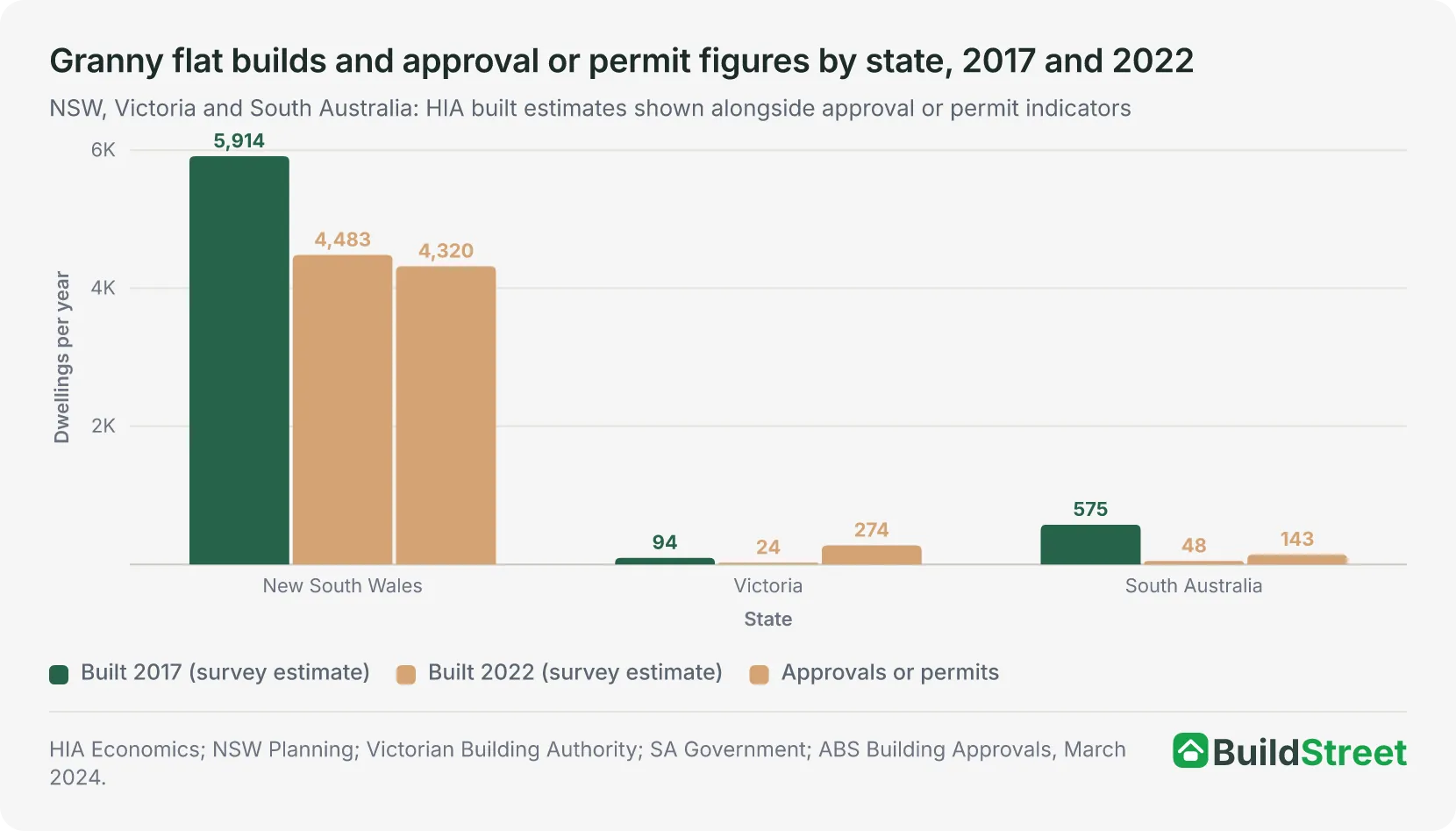
New South Wales also has a more recent approval signal, although it is not a built-count figure. The NSW Planning Portal recorded more than 160 development applications and more than 200 complying development certificates each month for secondary dwellings in October and November 2023. Annualised, that equates to about 4,320 approvals a year, but the figure is based on only two months of data and does not show how many granny flats were completed.
Even in the available HIA estimates, granny flats account for a small share of total housing activity. Nationally, 16,710 dwellings were approved in April 2026 alone, and 43,536 were completed in the December quarter of 2025, both seasonally adjusted.
HIA Economics, March 2024. Shares are industry estimates as a percentage of total dwelling approvals.
Section 02
Why is there no national granny flat count in Australia?
National dwelling statistics record only broad categories such as houses and other residential dwellings. Granny flats are not published as a separate national series, and no official dataset follows a granny flat from application through to completion.
Each step in the process sits in a different system and measures something different:
- an approval is permission to build
- a building permit confirms work can start
- a completion is a finished dwelling
| How granny flats move through the housing data system | ||
|---|---|---|
| Stage | What happens | Official record |
| Stage 1 | Application lodged with council or a certifier | Recorded somewhere in official systems |
| Stage 2 | Approval or building permit issued | Recorded somewhere in official systems |
| Stage 3 | Granny flat actually built | Recorded somewhere in official systems |
| Stage 4 | Counted in a national granny flat series | No national series exists |
Source · ABS, Building Approvals and Building Activity methodology, 2025.
Terminology adds another layer of complexity. Each jurisdiction uses a different official name for the same type of dwelling, so figures rarely line up between states:
- secondary dwelling: NSW and Queensland
- small second home: Victoria
- ancillary dwelling: WA
- ancillary accommodation: SA
- secondary residence: Tasmania and the ACT
- independent unit: Northern Territory
A 2021 building subclass, "detached secondary dwellings", recognises the detached version of this dwelling type within the national classification system. However, it does not create a published national count of granny flats, and it does not cover every possible layout, such as dwellings built inside or attached to the main home.
Section 03
What are the granny flat rules by state and territory?
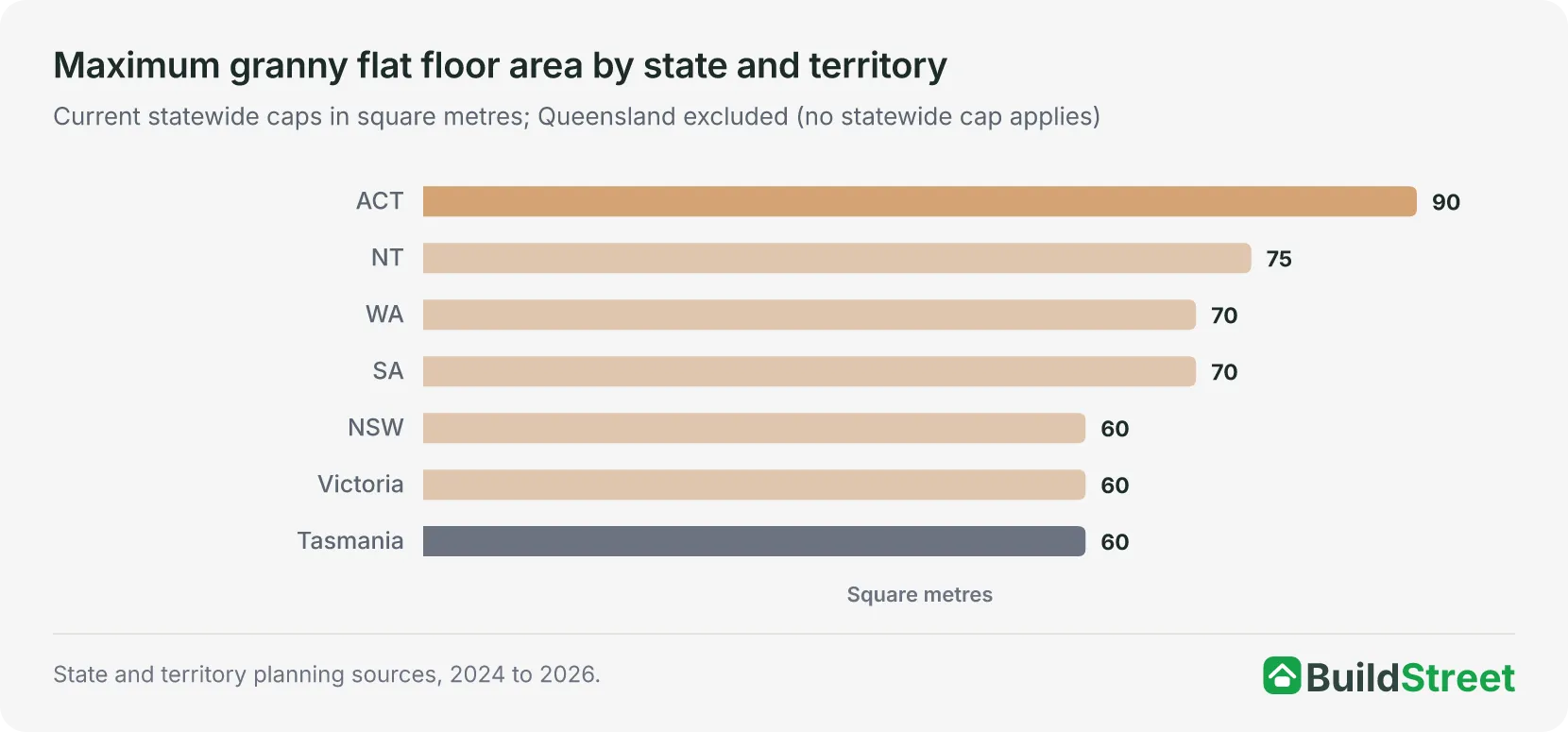
All eight states and territories allow granny flats or equivalent secondary dwellings, but they use different names, size limits and approval pathways. Most jurisdictions cap floor area at 60 to 90 square metres where a cap applies, while Queensland does not have one statewide maximum. Draft or scheduled changes are marked separately because they are not the current law.
Two points apply broadly across the country: a building permit is generally still required, even where a planning permit is not, and a granny flat usually remains on the same title as the main home.
| Jurisdiction | Term used | Max floor area | Planning permit | Rent to non-family | Separate title |
|---|---|---|---|---|---|
| NSW | Secondary dwelling | 60 m² | Not if complying development | No family-only rule | No |
| Victoria | Small second home | 60 m² | Not in most cases; building permit always required | Yes | No |
| Queensland | Secondary dwelling | No statewide max (draft 80 to 100 m²) | Council planning schemes apply; development approval may be required | Yes, since 2022 | No (draft) |
| WA | Ancillary dwelling | 70 m² | Not if R-Codes compliant | Yes | No |
| SA | Ancillary accommodation | 70 m², max 2 bedrooms | Yes, development approval required | Yes | No |
| Tasmania | Secondary residence | 60 m² (draft 90 m²) | Scheme-dependent | Yes | Same title |
| ACT | Secondary residence | 90 m² | Approval required unless exempt | No family-only rule | No |
| NT | Independent unit | 75 m² in certain zones | Usually not if compliant | No family-only rule | No unit title |
Source · State and territory planning sources, 2024 to 2026, compiled from official government pages and legislation. Queensland's proposed 80 to 100 m² size range and Tasmania's proposed 90 m² cap are draft changes, not current law. Local zoning, overlays and building requirements may still affect approval pathways.
Section 04
Granny flat size limits by state and territory
Most jurisdictions cap granny flats at 60 or 70 square metres, although the ACT allows up to 90 m² and Queensland has no statewide maximum floor-area cap. Size limits have also changed in some states since 2022.
South Australia increased its ancillary accommodation cap from 60 m² to 70 m² in November 2024. Tasmania is consulting on a draft change that would lift its secondary residence cap from 60 m² to 90 m². The ACT's missing-middle housing reforms are scheduled to begin on 1 July 2026, including changes to secondary residence requirements.
Section 05
How much does a granny flat cost in Australia?
Granny flat costs vary by site, design, services, approval requirements and builder pricing. Australia does not have an official national average cost to build a granny flat, and no government source publishes a national cost-per-square-metre benchmark or annual granny flat cost series.
The closest official data point is the ABS approval value, but this is not a consumer build price. ABS approval value estimates the value of building work at completion, based on approval documents. It excludes land, demolition and landscaping, includes site preparation, and may differ from the final amount paid by the owner.
Official national average
- No official figure available
No government source publishes a national average build cost, cost per square metre or annual average cost for granny flats.
Official, but not a build cost
- ABS approval value
An estimate of the value of building work when completed, taken from approval documents. Excludes land, demolition and landscaping; includes site preparation. Not a consumer price and can differ materially from the final cost.
Market estimates
- No verified national range included
Market prices vary by builder, site conditions, services, connections and approvals. No verified national cost range is included because official sources do not publish one.
The final cost of a granny flat varies depending on a range of factors beyond the base build:
- site conditions, including slope, access and any rock
- services connections (water, sewer, electricity)
- professional fees and approval costs
- bushfire, flood or heritage overlays
Two granny flats with the same floor area can have different total costs once site conditions, services and approval requirements are included.
Section 06
How granny flat rules changed in Australia from 2021 to 2026
Between 2021 and 2026, granny flat rules changed across several states and territories. Eight of the developments below are already in force, while two are scheduled, draft or not yet commenced. Most changes happened at state level, with jurisdictions generally easing tenancy rules first and lifting size caps later. Federal changes were narrower, covering building classification and a capital gains tax exemption.
2021 · Federal
FederalABS adds a "detached secondary dwellings" subclass
The statistical classification starts to recognise the dwelling type, but it does not create a published national granny flat count.
2021 · Federal
FederalTreasury consults on a capital gains tax exemption for granny flat arrangements; legislation enacted effective 1 July 2021
The exemption applies to formal written arrangements for older Australians or people with disabilities.
26 September 2022 · Queensland
Occupancy restrictions removed
Owners can rent a secondary dwelling to anyone, not only family members.
27 November 2023 · South Australia
Granny flats confirmed for open rental
New planning rules allow ancillary accommodation to be rented to anyone, removing the family-only restriction.
1 December 2023 · Northern Territory
Independent unit cap raised to 75 m²
Maximum floor area increased in certain residential zones.
14 December 2023 · Victoria
Small second homes introduced
Amendment VC253 and updated building regulations remove the planning permit requirement in most cases for dwellings up to 60 m².
10 April 2024 · Western Australia
R-Codes reform removes the minimum lot size
Compliant ancillary dwellings up to 70 m² can now be built on residential lots of any size without planning approval.
22 November 2024 · South Australia
Floor area lifted from 60 to 70 m²
Larger and more accessible ancillary accommodation is now permitted under the updated rules.
1 July 2026 · ACT (scheduled)
Scheduled500 m² block-size requirement removed for secondary residences
Missing-middle reforms notified in May 2026 are scheduled to commence on 1 July 2026.
10 June to 22 July 2026 · Tasmania (draft)
DraftProposal to lift secondary residence size cap to 90 m²
A draft amendment on public exhibition would raise the current 60 m² cap.
Source · ABS; Australian Government Treasury; and state and territory planning authorities, 2021 to 2026.
Section 07
Frequently asked questions
Why does NSW have more granny flats than other states?
NSW accounts for about 8.1% of dwelling approvals in the HIA granny flat data, compared with 0.4% in Victoria. That is roughly twenty times Victoria's estimated share.
Part of the gap is historical. In 2009, New South Wales standardised granny flat approvals and allowed eligible dwellings to proceed as complying development, bypassing a full council application. This created a clearer approval pathway for eligible secondary dwellings.
Planning settings and land values may also help explain the difference. In areas with high rents, low vacancy rates and expensive land, a granny flat can add a smaller rental dwelling on an existing block without creating a separate title. Those conditions are especially relevant in Sydney, although the data does not isolate one cause.
Can granny flats be rented to someone outside the family?
In most states and territories, yes. Several jurisdictions have eased or clarified tenancy rules since 2022.
- Queensland removed occupancy restrictions on 26 September 2022
- South Australia confirmed in 2023 that ancillary accommodation can be rented to anyone
- Victoria allows anyone to live in or rent a small second home, related or not, 14 December 2023
- Western Australia allows a compliant ancillary dwelling to be rented out from 10 April 2024
New South Wales, the ACT and the Northern Territory have no family-only rule in the rules reviewed for this article. Local planning, zoning and building requirements may still apply.
How large can a granny flat be?
The maximum size depends on the state or territory. Most jurisdictions cap granny flats at 60 or 70 square metres. The ACT allows up to 90 m². Queensland has no statewide cap, although a draft proposal refers to 80 to 100 m². Tasmania's current cap is 60 m², with a draft proposal to lift it to 90 m².
Size caps have increased in some jurisdictions since 2022, but draft changes should not be treated as current law.
Why are governments encouraging granny flats?
Governments generally frame granny flats as a way to add smaller rental homes or family accommodation on existing residential blocks. They often describe granny flats as adding housing options without requiring a separate land title or a larger multi-unit development.
The policy framing varies by jurisdiction:
- New South Wales: diverse and affordable housing
- Queensland: rental options and family accommodation
- Western Australia: housing diversity and ageing in place
- South Australia: housing supply pressure
- Tasmania: one and two-bedroom homes on existing blocks
Can a granny flat be sold separately from the main home?
Generally no. In the jurisdictions reviewed, granny flats generally remain on the same title as the main home and cannot be sold as separate properties. Separate title or subdivision is not generally permitted under the rules reviewed for New South Wales, Victoria, Queensland, Western Australia, South Australia, Tasmania, the ACT and the Northern Territory.
References
- ABS Building Approvals, Australia (latest release, Cat. 8731.0) · Australian Bureau of Statistics
- ABS, Building Activity, Australia (latest release, Cat. 8752.0) · Australian Bureau of Statistics
- Australian Bureau of Statistics, Building Approvals, Australia methodology, July 2025 · Australian Bureau of Statistics
- Australian Bureau of Statistics, Functional Classification of Buildings, January 2021 · Australian Bureau of Statistics
- Australian Government Treasury, Supporting older Australians: exempting granny flat arrangements from capital gains tax · treasury.gov.au
- Housing Industry Association, Granny flat fever (2024) · hia.com.au
- NSW Planning, Secondary dwellings · planning.nsw.gov.au
- NSW Planning Portal, Online CDC Data API · planningportal.nsw.gov.au
- Victorian Department of Transport and Planning, Small second homes · planning.vic.gov.au
- Victorian Building Authority, Building Practice Note SI-03: Small second dwellings · swanhill.vic.gov.au
- Queensland Government, Changes to secondary dwellings · planning.qld.gov.au
- Western Australian Government, Revised R-Codes now in effect · wa.gov.au
- PlanSA, New planning rules secure granny flats for rental and boost design for new homes · plan.sa.gov.au
- South Australian Department for Housing and Urban Development, Bigger, more accessible granny flats · dhud.sa.gov.au
- Tasmanian State Planning Office, SPP Amendment 01/2026: Secondary Residences · stateplanning.tas.gov.au
- ACT Legislation Register, Planning (Missing Middle Housing Reform) Major Plan Amendment 2026 · legislation.act.gov.au
- ACT Legislation Register, Territory Plan 2023: Residential Zones Policy · legislation.act.gov.au
- Northern Territory Government, Building an independent unit · nt.gov.au
- Australian Taxation Office, Granny flat arrangements and CGT · ato.gov.au
