

Published 28 Aug 2026 · Updated 18 Sept 2026
Victoria had 7,121,913 residents at the end of 2025, equal to 25.6 per cent of Australia's 27,801,023 people. According to the Australian Bureau of Statistics (ABS) quarterly population data, the state added 117,300 people, or 1.7 per cent, over the year to 31 December 2025. By 30 June 2025, 76.8 per cent of the state's population lived in Greater Melbourne.
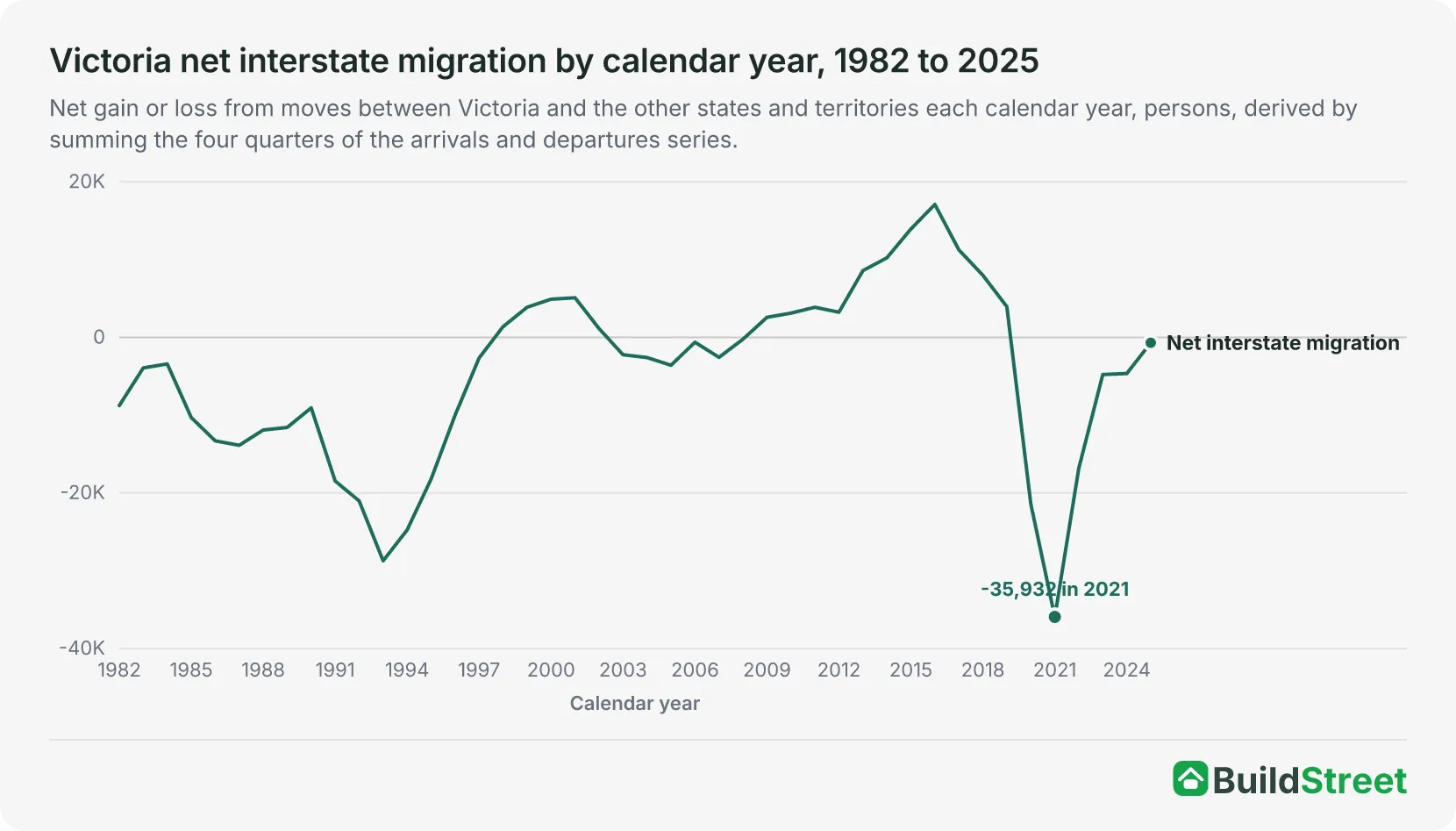
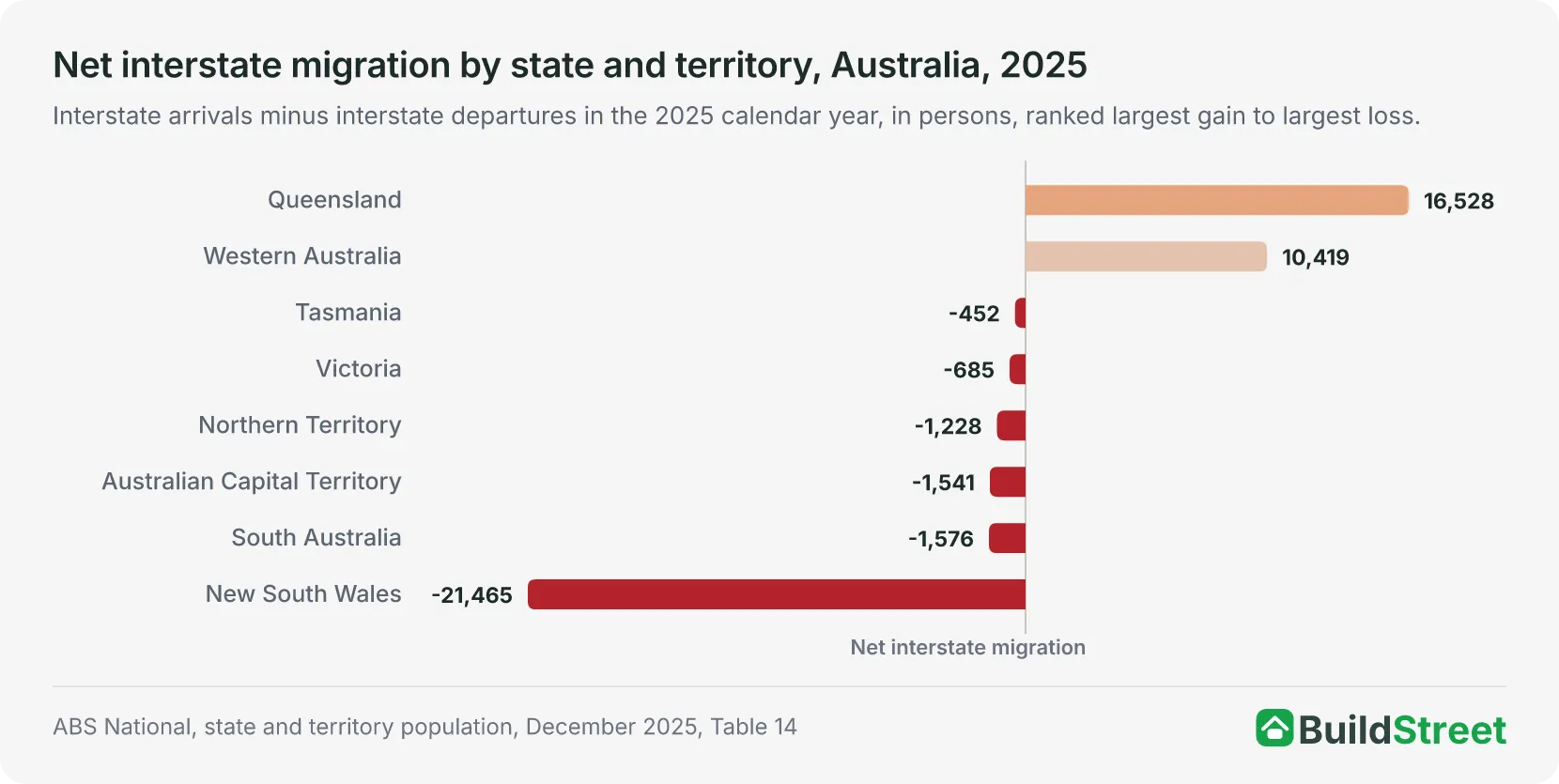 Where interstate migrants goVictoria's net interstate loss narrowed to 685 people in 2025, the smallest of its six consecutive years of loss. The interstate migration article covers the flows between all eight states and territories, and how they shifted from 2020 onwards.
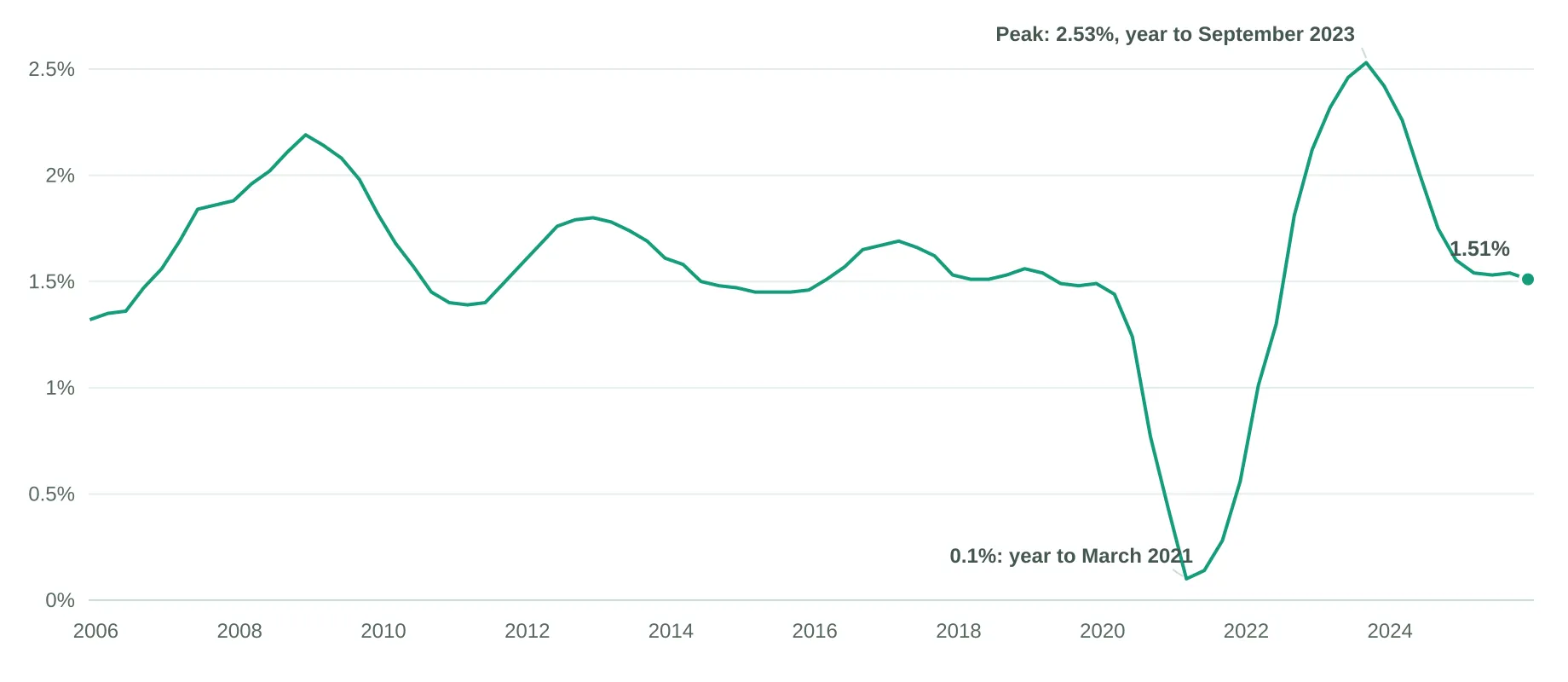 The national picture in fullVictoria held just over a quarter of Australia's people at 31 December 2025. The national population article covers the 27.8 million total, how fast it is changing, and the births, deaths and migration behind it.
Section 01 · The headline number
How many people live in Victoria?
Victoria had an estimated resident population of 7,121,913 at 31 December 2025, the most recent quarter in the ABS data1.
That was 25.6 per cent of Australia's 27,801,023 people. It was the second-largest population of any state or territory, behind New South Wales at 8,641,085 and ahead of Queensland at 5,712,1241.
The ABS updates the estimate each quarter. The next release, covering the March quarter 2026, is due on 17 September 20261.
Section 02 · The pace
How fast is Victoria's population growing?
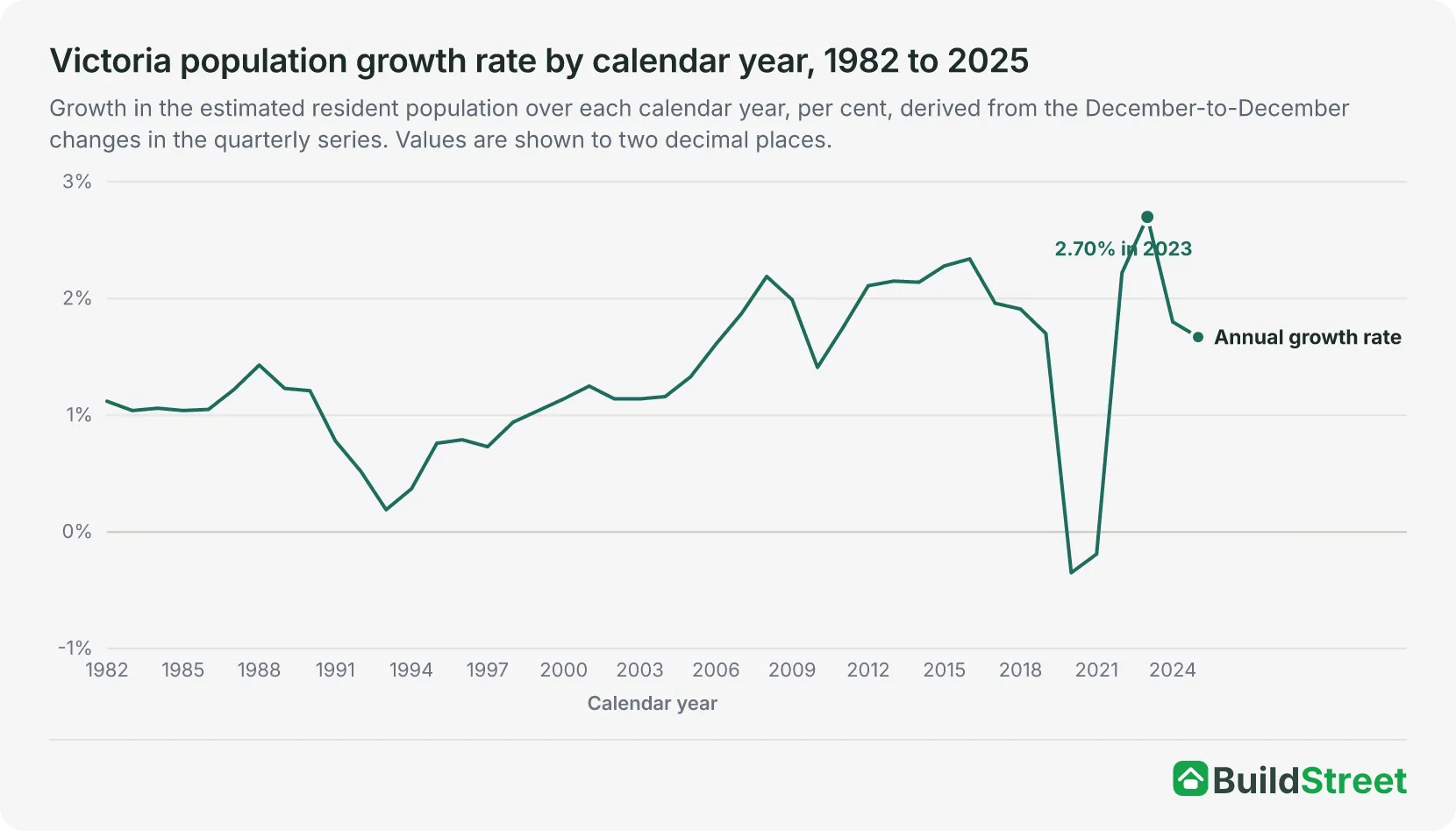
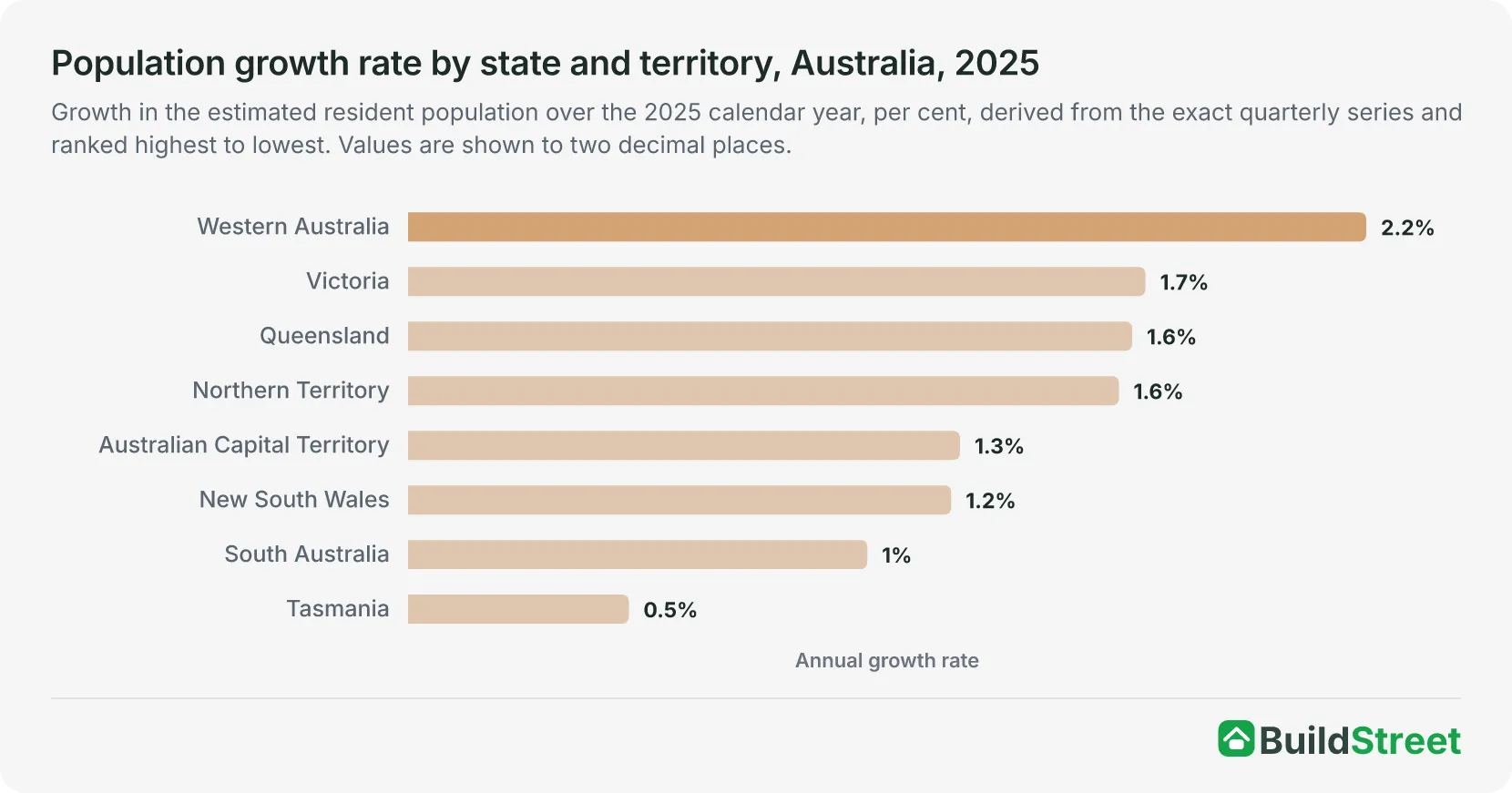
Victoria added 117,315 people, or 1.67 per cent, in the year to 31 December 2025,1 the largest increase of any state or territory. Its growth rate was the second-fastest of the eight states and territories, behind Western Australia's 2.2 per cent.
The years since 2020 include Victoria's only two population declines and its fastest calendar year since 1982. Of the 44 calendar years from 1982 to 2025, the population fell only in 2020, by 22,855 people (0.35 per cent), and 2021, by 12,182 (0.19 per cent). The fastest growth came in 2023, when the state added 180,673 people (2.70 per cent)1. Victoria was the only state or territory whose population fell in either year. Growth then slowed to 123,530 people (1.80 per cent) in 2024 and 117,315 (1.67 per cent) in 2025.
Within those calendar years, year-ending growth, measured over the 12 months to each quarter rather than from December to December, turned negative. Annual growth was negative in five consecutive year-ending readings, from the December quarter 2020 to the December quarter 2021, and the largest fall was 67,224 people (1.02 per cent) in the year to the June quarter 2021. Growth peaked at 187,976 people (2.82 per cent) in the year to the September quarter 20231.
Section 03 · The drivers
What drives population growth in Victoria?
Three components made up the state's growth. In the year to 31 December 2025, net overseas migration added 85,044 people, natural increase (births minus deaths) added 32,956, and net interstate migration reduced the population by 6851. The components totalled 117,315, matching the overall change in population.
The interstate flows came close to balance. Victoria lost a net 685 people to the other states and territories in 2025. A total of 73,691 people arrived from other states and territories, while 74,376 left1. It was the smallest annual net interstate flow, in either direction, since 2008. The loss has narrowed every year since 2021: from 35,932 in 2021 to 16,819 in 2022, 4,764 in 2023, 4,639 in 2024 and 685 in 2025.
Victoria recorded net losses from 1982 to 1997, followed by net gains from 1998 to 2002 and further losses from 2003 to 2008. The state then recorded net gains from 2009 to 2019, before returning to net losses from 2020 to 2025. The largest gain was 17,106 people in 2016 and the deepest loss was 35,932 in 20211.
The national birth and death behind natural increase is covered in the births and deaths article.
| Victoria population growth by component, 2025 | ||
|---|---|---|
| Component | People | Derivation |
| Net overseas migration | +85,044 | 156,565 arrivals minus 71,521 departures |
| Natural increase | +32,956 | 79,594 births minus 46,638 deaths |
| Net interstate migration | -685 | 73,691 arrivals minus 74,376 departures |
| Total growth | +117,315 | Derived sum; the release's summary rounds it to 117,300 |
Source · ABS National, state and territory population, December 2025.
Section 04 · Melbourne and the regions
How much of Victoria's population lives in Melbourne?
More than three-quarters of the state's people lived in the capital at 30 June 2025. Greater Melbourne had 5,435,590 people, while the rest of the state had 1,638,269.2 That meant 76.8 per cent of Victoria's population lived in Greater Melbourne, based on the 7,073,859 people counted across the two regions.
Greater Melbourne's share has increased from 73.5 per cent at 30 June 2001, when Greater Melbourne had 3,500,249 of the 4,763,615 people in the two regions on the same boundaries.2 Greater Sydney's share of the New South Wales two-region total, on the same basis, was 65.6 per cent at 30 June 2025.
Greater Melbourne grew faster than the rest of the state over 2024-25, and its increase was the largest of any Australian capital. Over the financial year, the capital grew by 105,030 people (2.0 per cent) while the rest of the state grew by 17,868 (1.1 per cent). The ABS publishes the changes, rounded, as 105,000 and 17,900, and reports Melbourne's as the largest absolute growth of any capital city3. The ABS reports Greater Melbourne's 2024-25 growth, rounded to the nearest hundred, as natural increase of 32,400 people and net overseas migration of 81,200, offset by a net internal migration loss of 8,600. It states that Sydney and Melbourne had the largest net internal migration losses.
The largest population increases in the state in 2024-25 were on Melbourne's fringe. Rockbank - Mount Cottrell in the outer west grew by 4,600 people, and Fraser Rise - Plumpton, also in the outer west, and Mickleham - Yuroke in the outer north each grew by 4,100. The highest growth rate in the state was Port Melbourne Industrial's 23 per cent, in the inner city3.
The capital's own long-run series is covered in the Melbourne population article.
| Greater Capital City Statistical Area boundaries, at 30 June 2025 | ||||
|---|---|---|---|---|
| Region | Population | Change over 2024-25 | Growth rate % | Share of state % |
| Greater Melbourne | 5,435,590 | +105,030 | 2.0 | 76.8 |
| Rest of Victoria | 1,638,269 | +17,868 | 1.1 | 23.2 |
| Two regions combined | 7,073,859 | +122,898 | 1.8 | 100.0 |
Source · ABS Regional population, 2024-25, Population estimates by SA2 and above data cube.
Section 05 · The national picture
How does Victoria compare with other states and territories?
Victoria was the second most populous of the eight states and territories at 31 December 2025, with 1,519,172 fewer people than New South Wales and 1,409,789 more than Queensland1. Victoria has remained the second most populous jurisdiction throughout the ABS quarterly data, covering 179 quarters from June 1981 to December 2025.
Its 1.67 per cent growth rate in 2025 ranked second behind Western Australia's 2.17 per cent, while its increase of 117,315 people was the largest of any state or territory1.
The ABS reports that net overseas migration was the major contributor to population change in all states and territories in the year to 31 December 20251.
| Population by state and territory, Australia, as at 31 December 2025 | |||
|---|---|---|---|
| State or territory | Population | Change over 2025 | Growth rate % |
| New South Wales | 8,641,085 | +104,611 | 1.23 |
| Victoria | 7,121,913 | +117,315 | 1.67 |
| Queensland | 5,712,124 | +92,162 | 1.64 |
| Western Australia | 3,076,528 | +65,465 | 2.17 |
| South Australia | 1,910,553 | +19,728 | 1.04 |
| Tasmania | 579,110 | +2,908 | 0.50 |
| Australian Capital Territory | 487,202 | +6,033 | 1.25 |
| Northern Territory | 267,478 | +4,240 | 1.61 |
| Australia | 27,801,023 | +412,494 | 1.51 |
Source · ABS National, state and territory population, December 2025, Table 4.
Section 06 · The long run
How has Victoria's population grown since 1981?
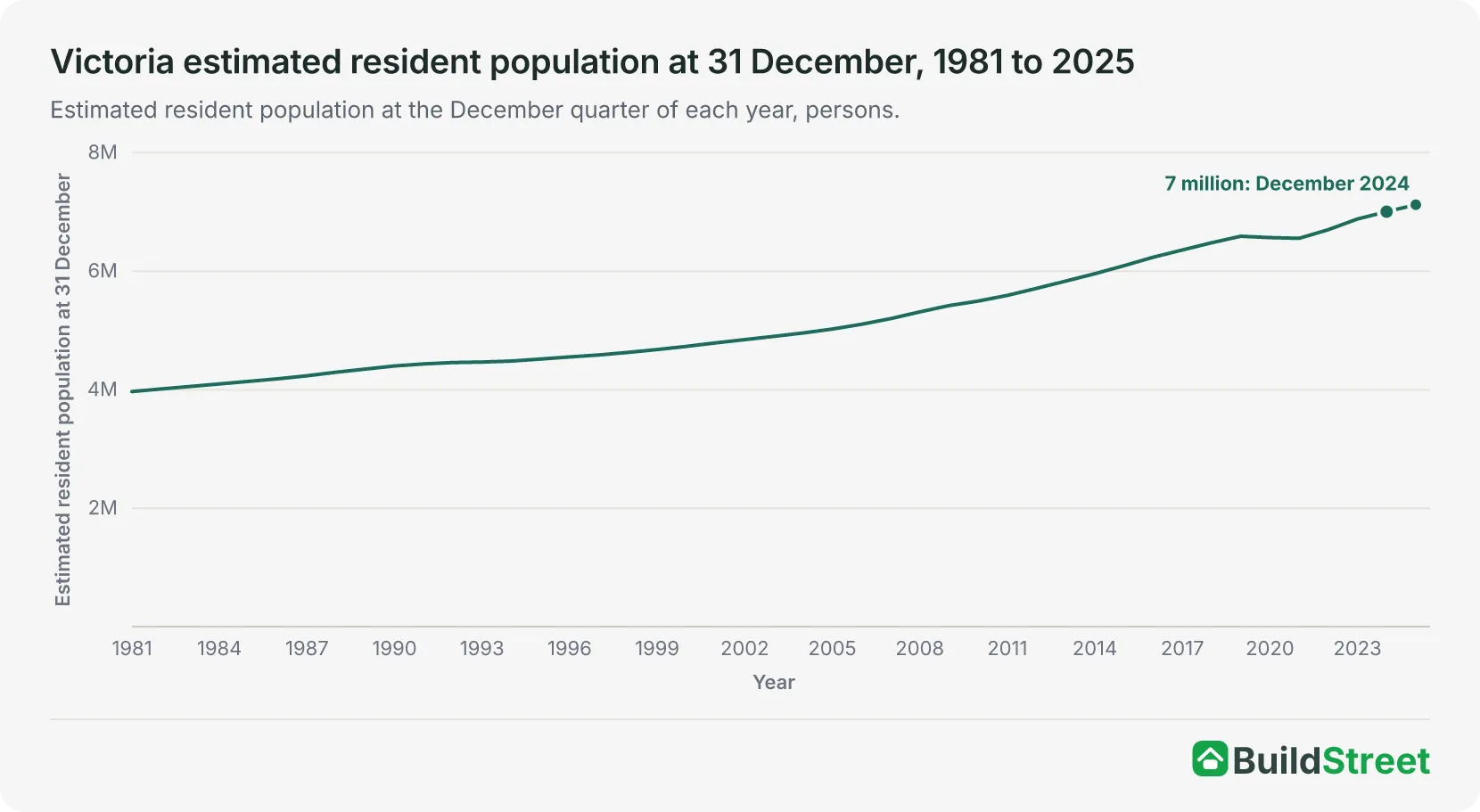
Victoria grew from 3,968,398 people at 31 December 1981 to 7,121,913 at 31 December 2025, adding 3,153,515 people. It first exceeded 7 million in the December quarter of 20241.
By the end of 2025, the state's population was 1.79 times its size at the end of 1981.
Each million milestone is a derived figure marking the first quarter in which the data shows the state at or above the threshold. Victoria first exceeded 4 million people in the September quarter 1982, 5 million in the September quarter 2005, 6 million in the June quarter 2015 and 7 million in the December quarter 20241. The gaps between milestones have narrowed: 23 years from 4 million to 5 million, 9 years and 9 months from 5 million to 6 million, and 9 years and 6 months from 6 million to 7 million.
The state grew by 110,355 people in 2019, before the population fell by 22,855 in 2020 and 12,182 in 2021. Growth then increased to 145,382 people in 2022 and 180,673 in 2023, based on the December-to-December changes in the quarterly population figures1.
| Victoria population milestones, 1982 to 2024 | ||
|---|---|---|
| Milestone | First quarter at or above | Population that quarter |
| 4 million | September quarter 1982 | 4,002,731 |
| 5 million | September quarter 2005 | 5,006,241 |
| 6 million | June quarter 2015 | 6,022,322 |
| 7 million | December quarter 2024 | 7,004,598 |
Source · ABS National, state and territory population, December 2025, Table 4.
Section 07
Victoria population: quick answers
What is the population of Victoria?
Victoria had an estimated resident population of 7,121,913 at 31 December 2025, the most recent quarter in the ABS data, released 18 June 2026. That was 25.6 per cent of Australia's 27,801,023 people and the second-largest population of any state or territory, behind New South Wales. The next update, covering the March quarter 2026, is due on 17 September 2026.
How fast is the Victorian population growing?
Victoria added 117,315 people, or 1.7 per cent, in the year to 31 December 2025; the ABS rounds the change to 117,300. That was the largest increase of any state or territory for the third consecutive year, and the second-fastest growth rate of the eight, behind Western Australia's 2.2 per cent.
Is Victoria losing people to other states?
Victoria recorded a net interstate migration loss of 685 people in the year to 31 December 2025. A total of 73,691 people arrived from other states and territories, and 74,376 left, making it the state's smallest annual net interstate flow since 2008. Based on calendar-year totals from the ABS quarterly data, Victoria recorded net gains from 2009 to 2019 and net losses from 2020 to 2025. The deepest loss was 35,932 people in 2021.
How much of the Victorian population lives in Melbourne?
Greater Melbourne had 5,435,590 of the 7,073,859 people counted across the state's two regions at 30 June 2025, which was 76.8 per cent. The rest of the state had 1,638,269 people. The capital's share was 73.5 per cent at 30 June 2001 on the same boundaries.
References
- ABS National, State and Territory Population, December 2025 · Australian Bureau of Statistics ↑ b c d e f g h i j k l m n o
- ABS Regional population, 2024-25: population estimates by SA2 and above, 2001 to 2025 (datacube 32180DS0003) · Australian Bureau of Statistics ↑ b
- ABS Regional population, 2024-25 · Australian Bureau of Statistics ↑ b
- ABS, National, state and territory population methodology, December 2025 · Australian Bureau of Statistics
