
Published 31 Aug 2026
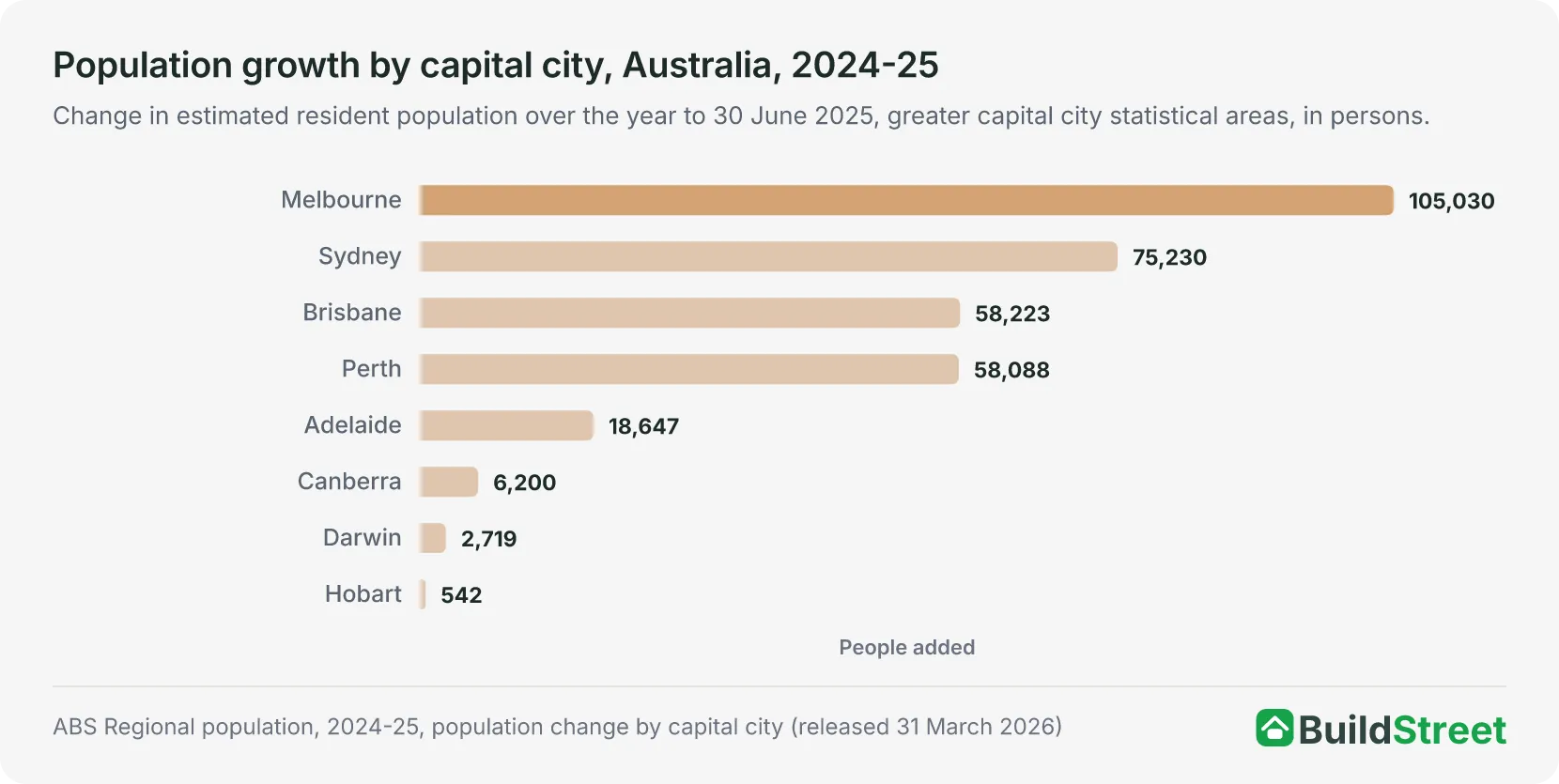 How other cities compareGold Coast - Tweed Heads was Australia's sixth largest urban area at 30 June 2025, and the largest without a capital city. The cities article ranks growth across the country's capitals and regional centres.
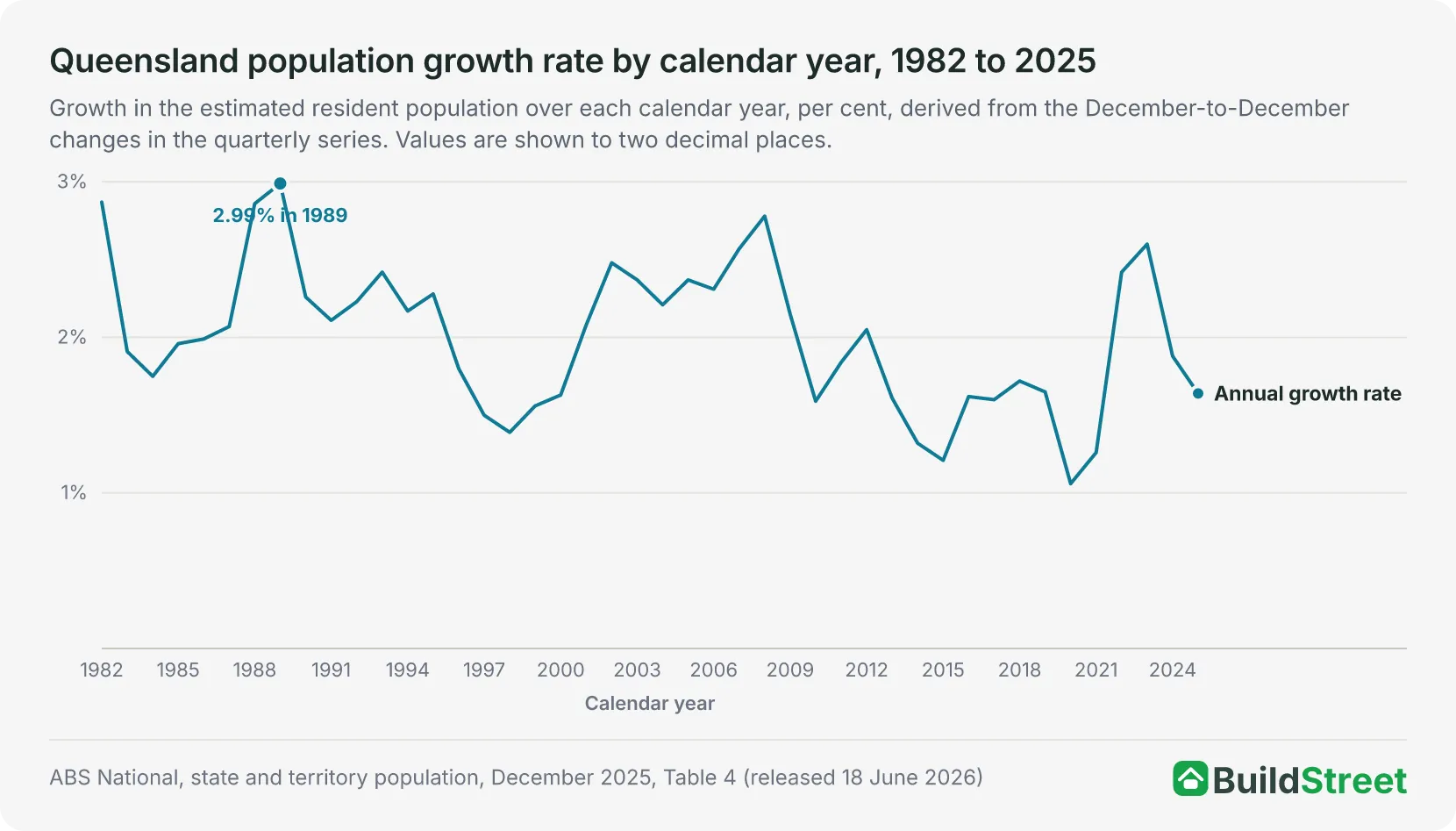 The state pictureQueensland had an estimated resident population of 5,669,764 at 30 June 2025 in the ABS annual series. The state article covers the total, its drivers and the split between Greater Brisbane and the rest of the state.
Section 01 · The headline number
How many people live on the Gold Coast?
The Gold Coast - Tweed Heads Significant Urban Area had an estimated resident population of 761,634 at 30 June 2025. That made it the sixth-largest urban area by population, and the largest that does not contain a capital city. Only the urban areas of Melbourne, Sydney, Brisbane, Perth and Adelaide had larger populations, and the urban area accounted for 2.8 per cent of Australia's 27,613,654 people1. The boundary crosses the Queensland and New South Wales border, grouping the Gold Coast with the connected Tweed Heads area, and the ABS lists it under Queensland.
The ABS updates the estimate once a year, at 30 June. In this release, the estimates are final for 2001 to 2021, revised for 2022 to 2024 and preliminary for 20252. The next release, covering 30 June 2026, is due on 25 March 20273.
Section 02 · The pace
How fast is the Gold Coast's population growing?
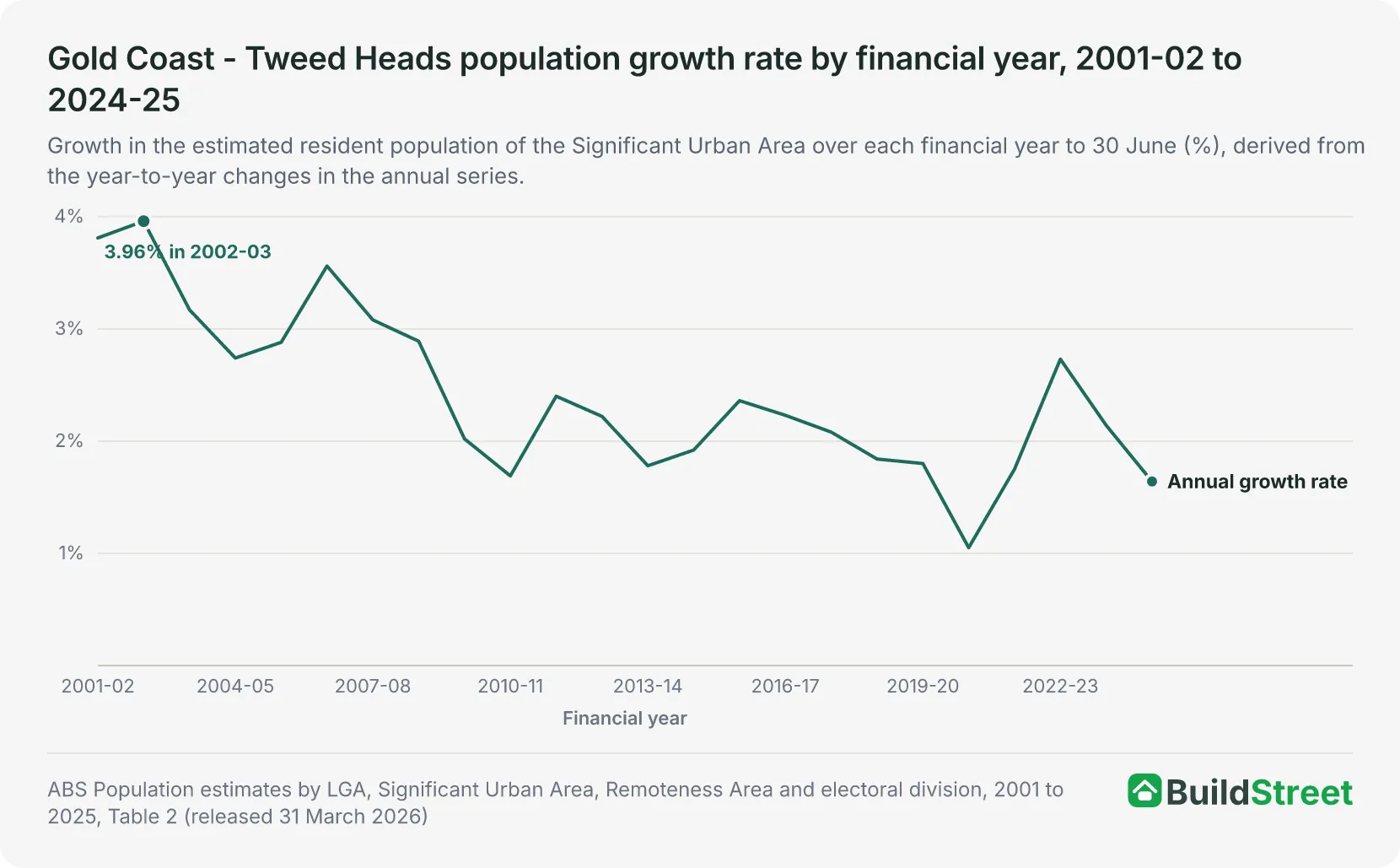
The Gold Coast - Tweed Heads urban area added 12,279 people over the 2024-25 financial year, a growth rate of 1.64 per cent. The rate was the lowest since 2020-21, when growth slowed to 1.05 per cent. The urban area added 12,254 people in 2021-22, 19,496 in 2022-23 and 15,677 in 2023-241.
Growth over the 24 financial years from 2001-02 to 2024-25 ranged from 1.05 per cent to 3.96 per cent, and the population increased every year over that period. The highest rate was 3.96 per cent, an increase of 17,711 people, in 2002-03. The largest increase was 19,496 people (2.73 per cent) in 2022-23. The smallest increase was 7,302 people (1.05 per cent) in 2020-211.
Growth slowed in each of the two years after the 2022-23 peak, from 2.73 per cent to 2.14 per cent, then 1.64 per cent. The urban area grew faster than 3 per cent in five of the seven years to 2007-08, and has not exceeded 3 per cent since1.
Section 03 · The drivers
What drives the Gold Coast's population growth?
In 2024-25, net overseas migration added 8,986 people to the City of Gold Coast, the largest of the three components of population change4. The ABS publishes population-change components for council areas rather than the Gold Coast - Tweed Heads urban area, so this article uses the two council boundaries.
Natural increase (the excess of births over deaths) added 2,300 people to the City of Gold Coast. Net internal migration (moves to and from elsewhere in Australia) added 658. The three components totalled an increase of 11,944 people, a growth rate of 1.76 per cent4.
The pattern differed in the Tweed council area, on the New South Wales side of the border. Net internal migration was its largest component, at 427 people, followed by net overseas migration at 420. Deaths exceeded births, resulting in a natural decrease of 131 people. Overall, the population increased by 716 people or 0.71 per cent4.
The net internal migration figure for the City of Gold Coast is the balance of much larger flows in both directions. During 2024-25, 29,500 people moved to the council area from elsewhere in Australia and 28,842 moved out5. Together, the two council areas added 12,660 people over the year, compared with 12,279 in the urban area. The figures cover different boundaries and are not directly comparable4.
| Components of population change by council area, 2024-25 | ||||
|---|---|---|---|---|
| Council area (LGA) | Natural increase | Net internal migration | Net overseas migration | Total change |
| Gold Coast (Qld) | +2,300 | +658 | +8,986 | +11,944 |
| Tweed (NSW) | -131 | +427 | +420 | +716 |
Source · ABS Population estimates and components by LGA, 2024 to 2025, Tables 3 (Queensland) and 1 (New South Wales)
Section 04 · The growth areas
Where on the Gold Coast is the population growing fastest?
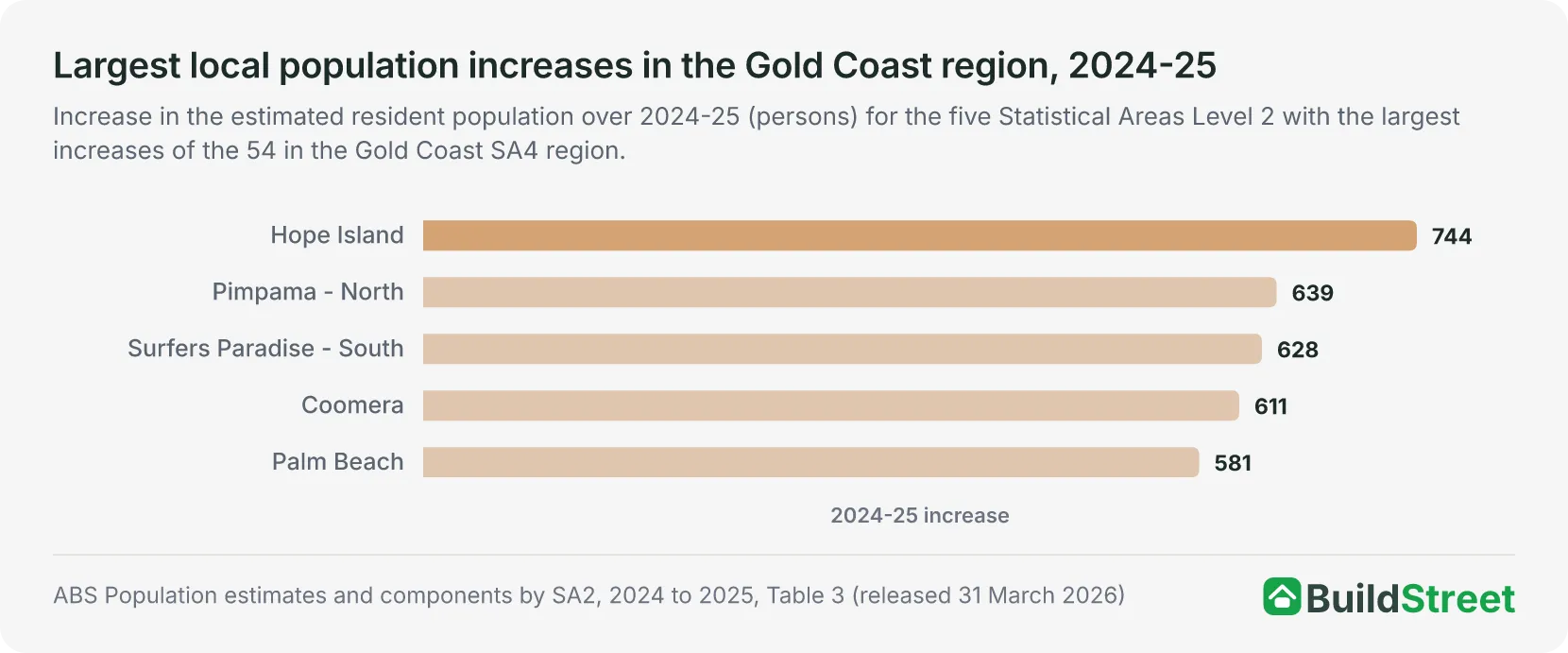
Hope Island recorded the largest increase among the 54 local statistical areas in the Gold Coast region in 2024-25, adding 744 people (4.2 per cent) to reach 18,253. The highest growth rates in the region, both published at 4.8 per cent, were in Pimpama - North, which added 639 people, and Main Beach, which added 2036.
Growth was concentrated in the region's north. Three of the five largest increases sit in the Ormeau - Oxenford area: Hope Island, Pimpama - North and Coomera, which added 611 people (2.6 per cent). The other two were on the coast, where Surfers Paradise - South added 628 people (3.7 per cent) and Palm Beach added 581 (3.2 per cent)6.
On the New South Wales side, growth was slower. Kingscliff - Fingal Head, at 174 people (1.1 per cent), and Tweed Heads, at 167 (0.8 per cent), recorded the two largest increases among the eight local statistical areas in the Tweed Valley area6. Across the two broader statistical regions, the Gold Coast region grew from 695,870 to 708,085 people over 2024-25, an increase of 12,215 (1.76 per cent), while the Richmond - Tweed region, which includes the Tweed Valley, grew from 263,901 to 265,824, an increase of 1,923 (0.73 per cent)7.
| The fastest growing areas of the Gold Coast region, 2024-25 | |||||
|---|---|---|---|---|---|
| Area (SA2) | District (SA3) | 30 June 2024 | 30 June 2025 | Change | Growth rate % |
| Hope Island | Ormeau - Oxenford | 17,509 | 18,253 | +744 | 4.2 |
| Pimpama - North | Ormeau - Oxenford | 13,202 | 13,841 | +639 | 4.8 |
| Surfers Paradise - South | Surfers Paradise | 16,782 | 17,410 | +628 | 3.7 |
| Coomera | Ormeau - Oxenford | 23,702 | 24,313 | +611 | 2.6 |
| Palm Beach | Coolangatta | 18,097 | 18,678 | +581 | 3.2 |
Source · ABS Population estimates and components by SA2, 2024 to 2025, Table 3
Section 05 · The state picture
How does the Gold Coast compare with other cities in Queensland?
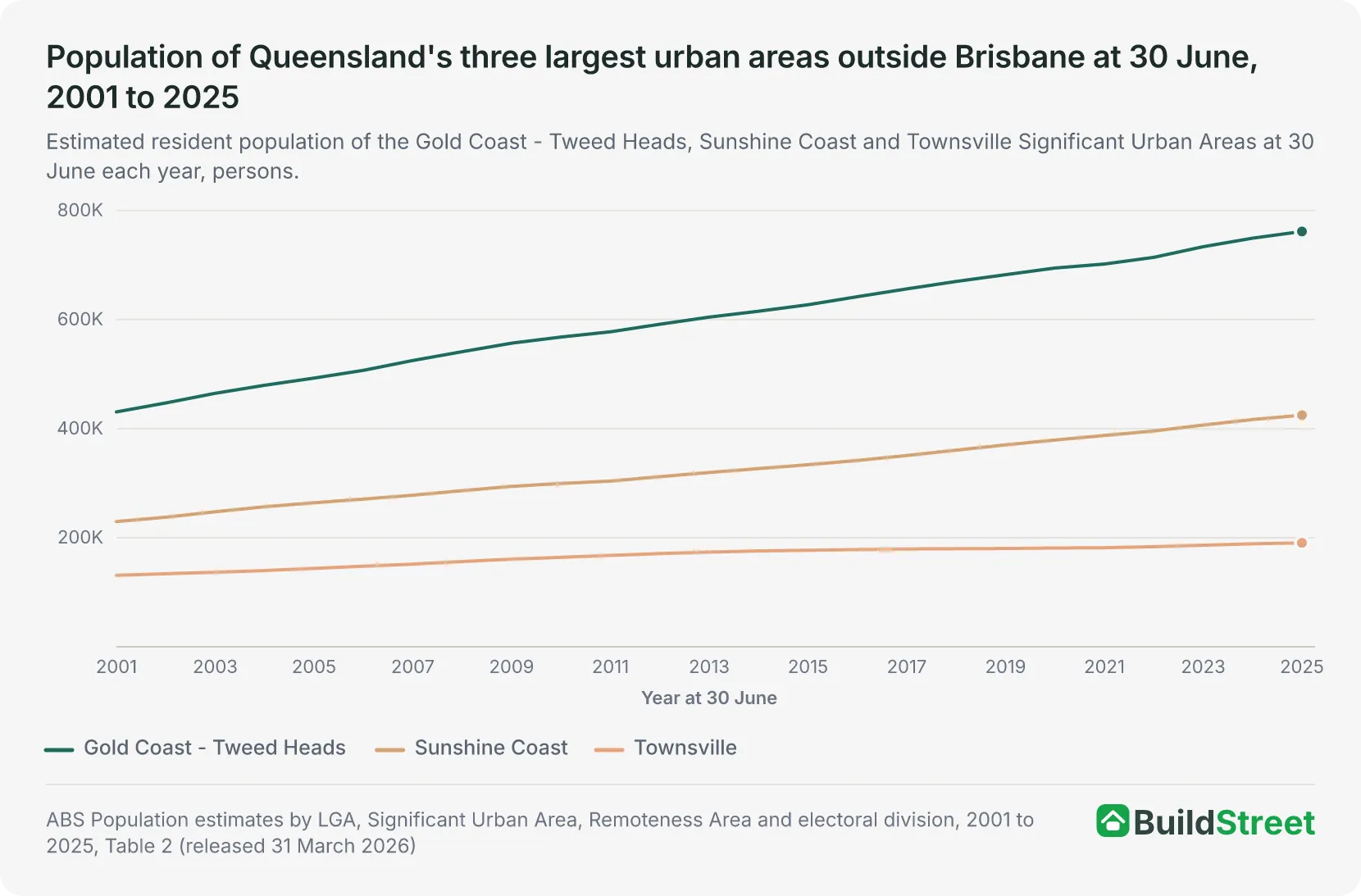
Gold Coast - Tweed Heads was Queensland's second largest urban area at 30 June 2025, behind Brisbane. Brisbane had 2,745,086 people, ahead of Gold Coast - Tweed Heads at 761,634, the Sunshine Coast at 424,741, Townsville at 190,551, Cairns at 164,149 and Toowoomba at 153,7811. Gold Coast - Tweed Heads had more people than the Sunshine Coast and Townsville combined, whose totals sum to 615,292.
The urban area was larger than the Sunshine Coast in every year from 2001 to 2025, and the gap widened from 201,122 people at 30 June 2001 to 336,893 at 30 June 20251.
Growth in 2024-25 was faster elsewhere in Queensland's south east: 2.08 per cent in Brisbane and 1.92 per cent on the Sunshine Coast, against 1.64 per cent for Gold Coast - Tweed Heads. Toowoomba grew 1.28 per cent, Townsville 0.93 per cent and Cairns 0.86 per cent1. Across the state, Greater Brisbane added 58,223 people (2.10 per cent) over the year and the rest of Queensland added 39,651 (1.42 per cent)7.
Brisbane's population trends are covered in the Brisbane population article.
Section 06 · The national rank
Where does the Gold Coast rank among Australia's largest cities?
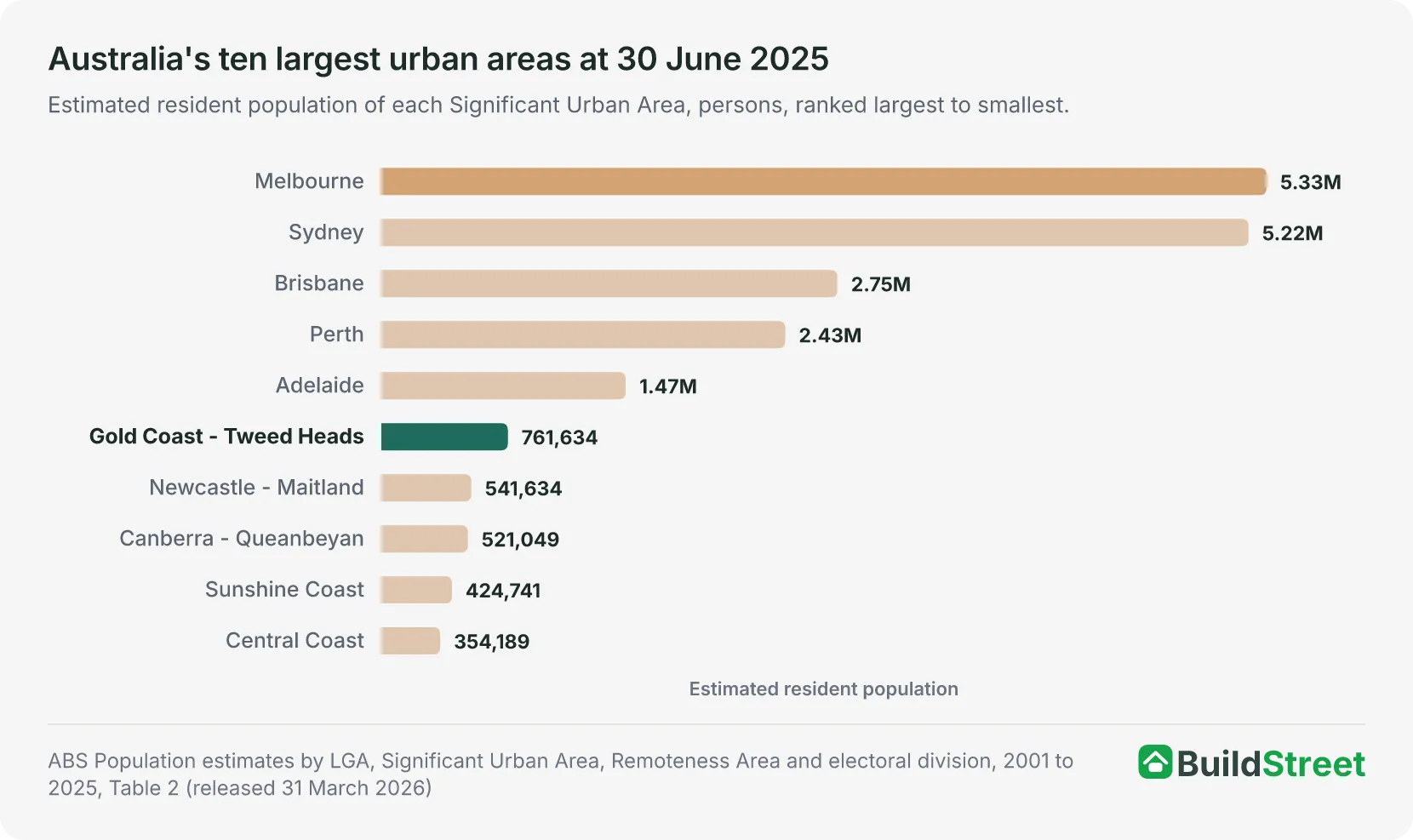
Gold Coast - Tweed Heads was the sixth largest of Australia's Significant Urban Areas at 30 June 2025. The five larger urban areas were Melbourne at 5,328,274 people, Sydney at 5,219,674, Brisbane at 2,745,086, Perth at 2,430,757 and Adelaide at 1,470,9381.
Among the urban areas that do not contain a capital city, Gold Coast - Tweed Heads was the largest, ahead of Newcastle - Maitland at 541,634 and the Sunshine Coast at 424,741. Its population was exactly 220,000 higher than Newcastle - Maitland at 30 June 2025, up from a gap of 17,906 at 30 June 20011.
Growth in 2024-25 varied across the ten largest urban areas, from 0.68 per cent on the Central Coast to 2.40 per cent in Perth. Gold Coast - Tweed Heads grew 1.64 per cent, the fifth highest rate among the ten largest urban areas, behind Perth, Brisbane, Melbourne and the Sunshine Coast and ahead of Sydney's 1.37 per cent1.
| Australia's ten largest urban areas, as at 30 June 2025 | |||
|---|---|---|---|
| Urban area (SUA) | Population | Change over 2024-25 | Growth rate % |
| Melbourne | 5,328,274 | +102,910 | 1.97 |
| Sydney | 5,219,674 | +70,670 | 1.37 |
| Brisbane | 2,745,086 | +56,017 | 2.08 |
| Perth | 2,430,757 | +56,991 | 2.40 |
| Adelaide | 1,470,938 | +18,417 | 1.27 |
| Gold Coast - Tweed Heads | 761,634 | +12,279 | 1.64 |
| Newcastle - Maitland | 541,634 | +6,953 | 1.30 |
| Canberra - Queanbeyan | 521,049 | +5,894 | 1.14 |
| Sunshine Coast | 424,741 | +8,018 | 1.92 |
| Central Coast | 354,189 | +2,401 | 0.68 |
Source · ABS Population estimates by LGA, Significant Urban Area, Remoteness Area and electoral division, 2001 to 2025, Table 2
Section 07 · The long run
How has the Gold Coast's population changed since 2001?
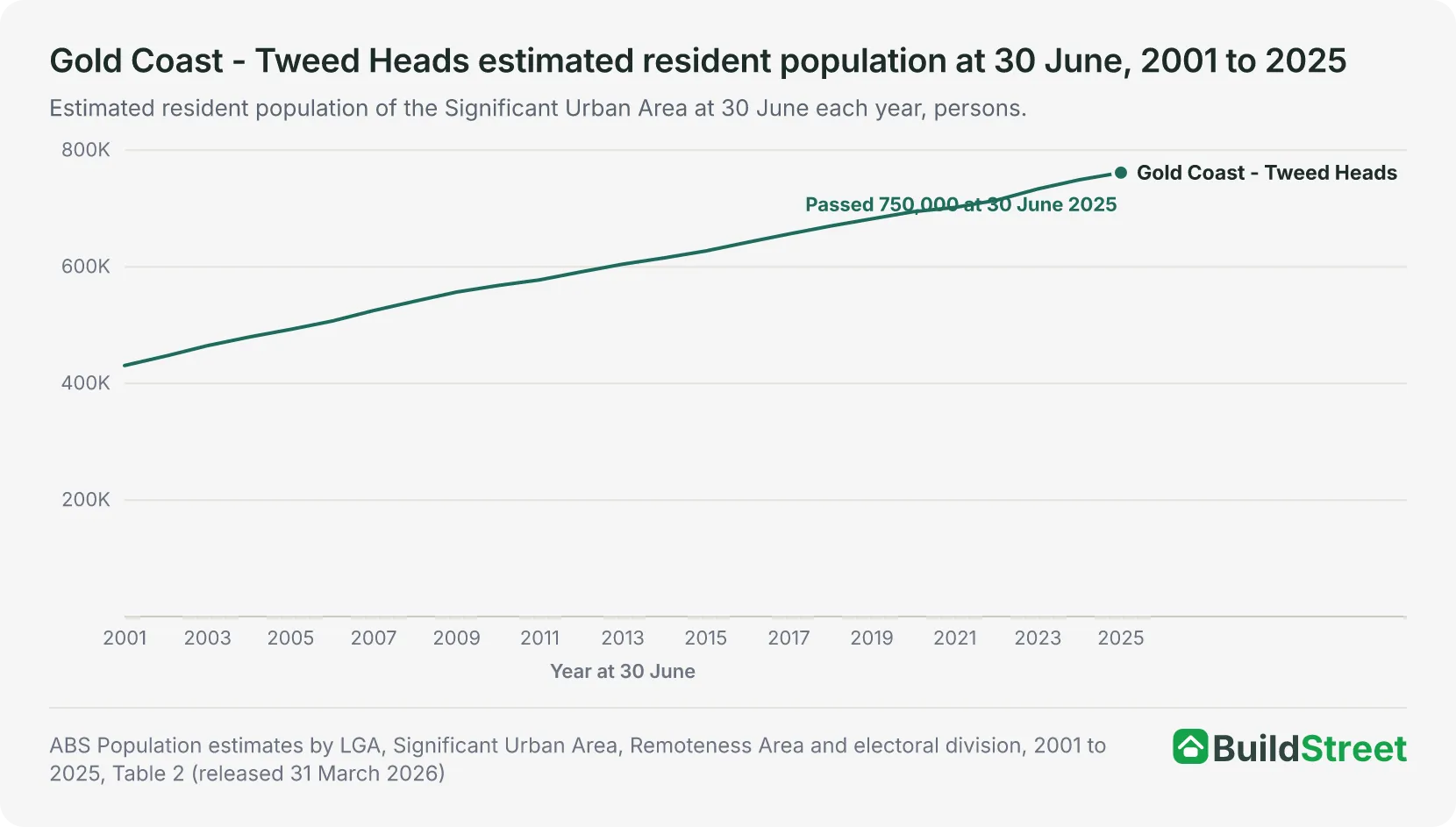
The urban area added 330,918 people between 30 June 2001 and 30 June 2025, growing from 430,716 to 761,634. The 2025 population was 1.77 times its 30 June 2001 population1.
Gold Coast - Tweed Heads first exceeded 500,000 at 30 June 2006, 550,000 at 30 June 2009, 600,000 at 30 June 2013, 650,000 at 30 June 2017, 700,000 at 30 June 2021 and 750,000 at 30 June 20251. Each of the five steps between these milestones took three or four years.
The City of Gold Coast council area grew from 379,679 people at 30 June 2001 to 691,230 at 30 June 2025, 1.82 times its 2001 population. The Tweed council area passed 100,000 residents for the first time at 30 June 2024, reaching 100,328, and held 101,044 a year later, up from 73,980 at 30 June 20011.
| Gold Coast - Tweed Heads population milestones in the annual series | ||
|---|---|---|
| Milestone | First 30 June at or above | Population that year |
| 500,000 | 30 June 2006 | 506,937 |
| 550,000 | 30 June 2009 | 556,785 |
| 600,000 | 30 June 2013 | 604,584 |
| 650,000 | 30 June 2017 | 656,327 |
| 700,000 | 30 June 2021 | 701,928 |
| 750,000 | 30 June 2025 | 761,634 |
Source · ABS Population estimates by LGA, Significant Urban Area, Remoteness Area and electoral division, 2001 to 2025, Table 2
Section 08
Gold Coast population: quick answers
How many people live on the Gold Coast?
The Gold Coast - Tweed Heads Significant Urban Area had a population of 761,634 at 30 June 2025. This includes the connected urban area on both sides of the Queensland and New South Wales border. The 2025 estimate is preliminary.
Is the Gold Coast Australia's sixth largest city?
Yes, on urban-area boundaries. Gold Coast - Tweed Heads was Australia's sixth-largest Significant Urban Area at 30 June 2025, with 761,634 residents, behind Melbourne, Sydney, Brisbane, Perth and Adelaide. Capital cities are usually reported on Greater Capital City boundaries, which differ, so the ranking depends on the boundary used.
How fast is the Gold Coast's population growing?
The Gold Coast - Tweed Heads population grew by 12,279 people, or 1.64 per cent, in 2024-25. This was the lowest annual growth rate since 2020-21, but the population still increased over the year.
What is the difference between Gold Coast - Tweed Heads and the City of Gold Coast?
Gold Coast - Tweed Heads is an ABS statistical urban area that crosses the Queensland and New South Wales border, while the City of Gold Coast is a local government area entirely within Queensland. At 30 June 2025, Gold Coast - Tweed Heads had 761,634 residents and the City of Gold Coast had 691,230.
Section 09
Australia population statistics
References
- ABS Regional population, 2024-25: population estimates by LGA and Significant Urban Area, 2001 to 2025 (datacube 32180DS0004) · Australian Bureau of Statistics ↑ b c d e f g h i j k l m
- ABS Regional population methodology, 2024-25 · Australian Bureau of Statistics ↑
- ABS Regional population, 2024-25 · Australian Bureau of Statistics ↑
- ABS Regional population, 2024-25: population estimates and components by LGA, 2024 to 2025 (datacube 32180DS0002) · Australian Bureau of Statistics ↑ b c d
- ABS Regional population, 2024-25: population components by LGA, 2021-22 to 2024-25 (datacube 32180DS0006) · Australian Bureau of Statistics ↑
- ABS Regional population, 2024-25: population estimates and components by SA2, 2024 to 2025 (datacube 32180DS0001) · Australian Bureau of Statistics ↑ b c
- ABS Regional population, 2024-25: population estimates by SA2 and above, 2001 to 2025 (datacube 32180DS0003) · Australian Bureau of Statistics ↑ b
