
Published 28 Aug 2026 · Updated 18 Sept 2026
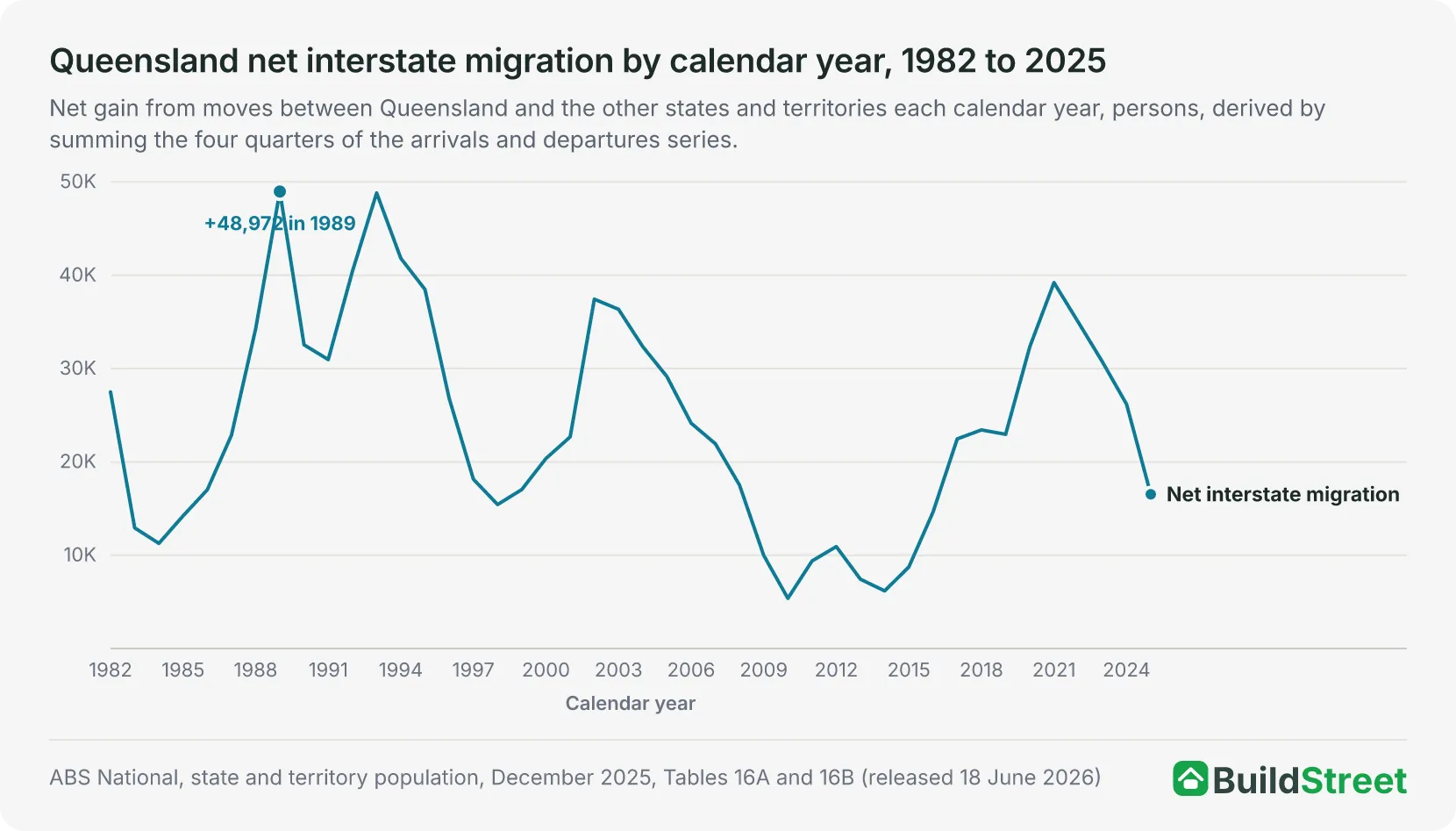
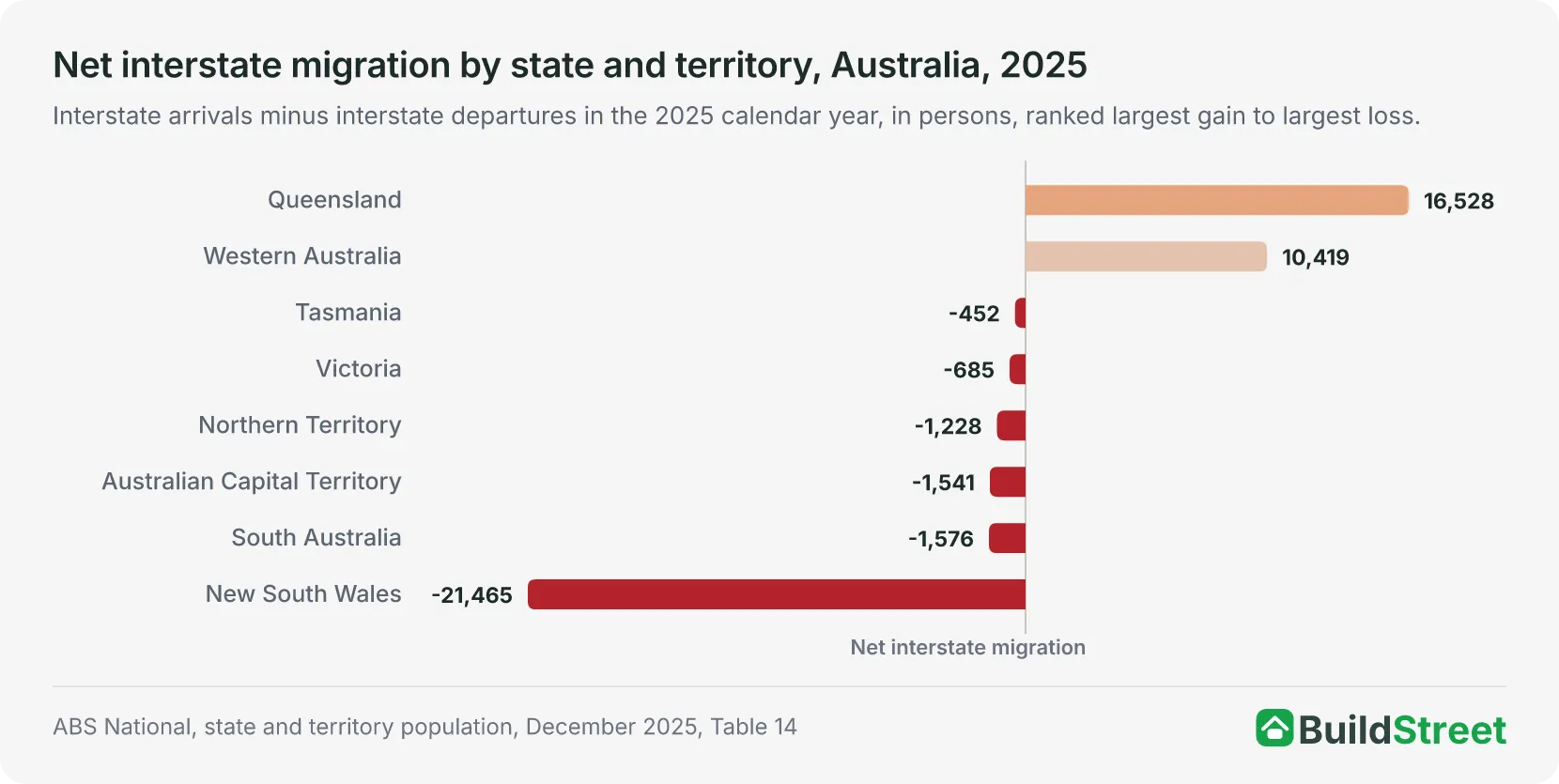 Where interstate migrants goQueensland gained a net 16,528 people from the other states and territories in 2025, the largest gain of any jurisdiction, in the 44th consecutive year of net gains in the series. The interstate migration article covers the flows between all eight states and territories, and how they shifted from 2020 onwards.
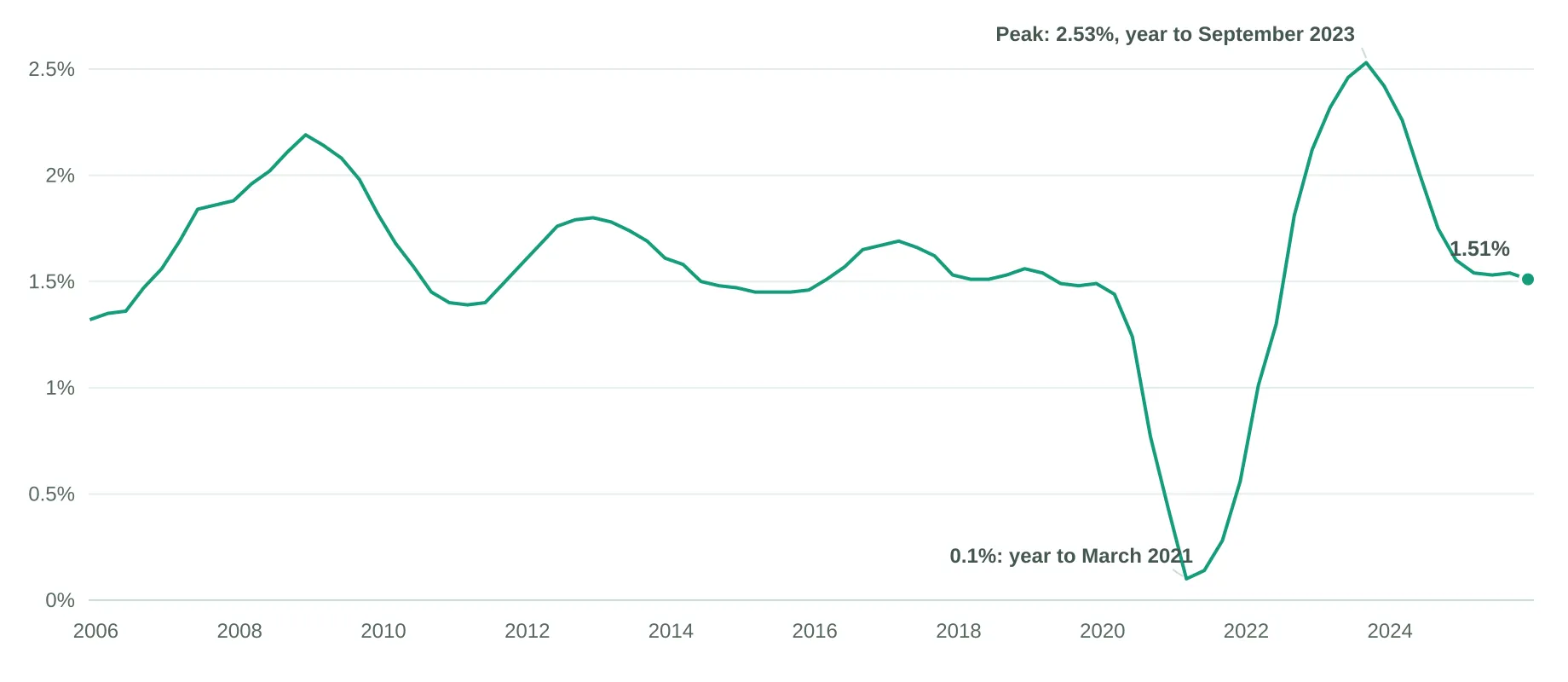 The national picture in fullQueensland held about a fifth of Australia's people at 31 December 2025. The national population article covers the 27.8 million total, how fast it is changing, and the births, deaths and migration behind it.
Section 01 · The headline number
How many people live in Queensland?
Queensland had an estimated resident population of 5,712,124 at 31 December 2025, the most recent quarter in the ABS series1.
That represented 20.5 per cent of Australia's 27,801,023 people. It was the third largest population of any state or territory, behind New South Wales at 8,641,085 and Victoria at 7,121,9131.
The ABS updates the estimate each quarter. The next release, covering the March quarter 2026, is due on 17 September 20261.
Section 02 · The pace
How fast is Queensland's population growing?
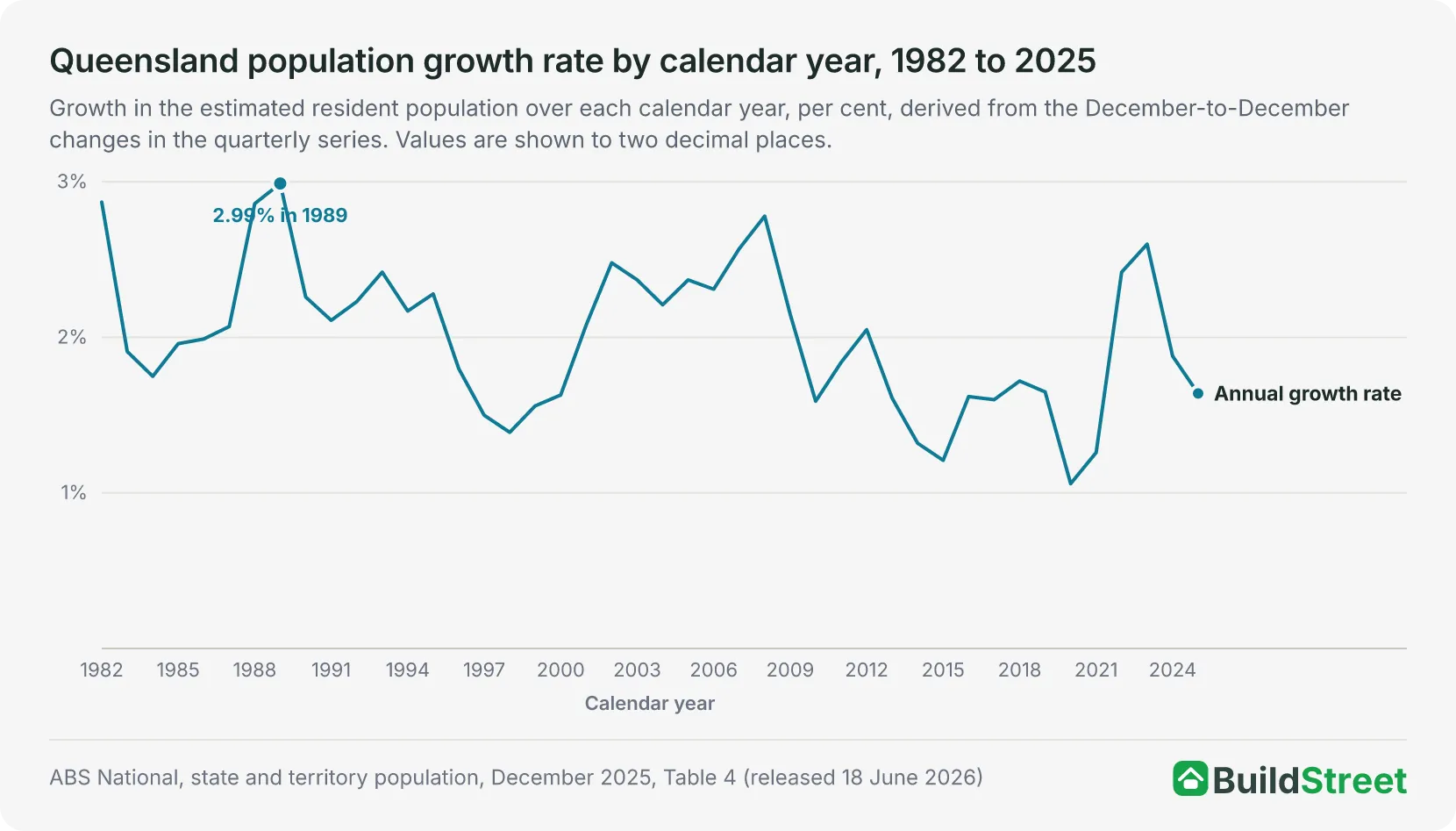
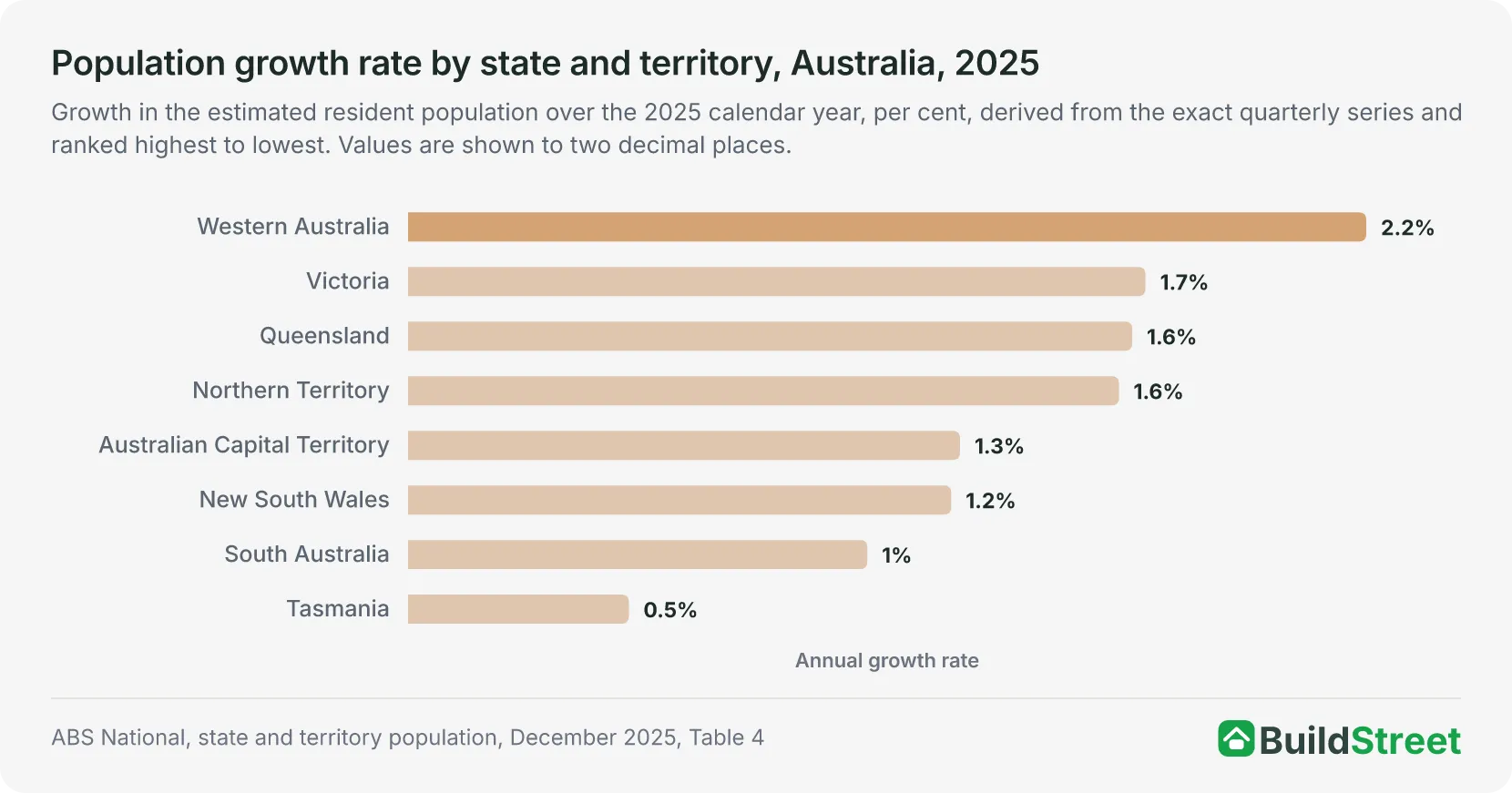
Queensland added 92,162 people, or 1.64 per cent, in the year to 31 December 2025. The ABS summary rounds this to 92,200 people or 1.6 per cent1. That was the third largest increase of the eight states and territories, behind Victoria's 117,315 and New South Wales's 104,611, and the third fastest rate, behind Western Australia's 2.17 per cent and Victoria's 1.67 per cent.
The slowest growth rate was 1.06 per cent in 2020, when the state added 54,588 people, while the smallest annual increase was 43,793 people in 1984. The fastest rate was 2.99 per cent in 1989, when the state added 83,138 people, while the largest increase was 139,798 people in 2023, when the population grew by 2.60 per cent1.
Section 03 · The drivers
What drives population growth in Queensland?
Queensland's population growth came from three components in the year to 31 December 2025. Net overseas migration added 54,604 people, natural increase, the difference between births and deaths, added 21,030, and net interstate migration added 16,5281. Together, the three components added 92,162 people.
Queensland recorded the largest net interstate migration gain in the country in 2025. A total of 97,433 people arrived from other states and territories and 80,905 left, resulting in a net gain of 16,528. Western Australia, with a net gain of 10,419, was the only other jurisdiction to gain; the other six recorded net losses1. Queensland's net gain was its smallest since 2016 and declined from 39,206 in 2021 to 34,986 in 2022, 30,725 in 2023, 26,181 in 2024 and 16,528 in 2025.
Queensland recorded a net interstate gain in every one of the 44 calendar years from 1982 to 2025, derived from calendar-year sums of the quarterly arrivals and departures series, and was the only state or territory to do so. New South Wales recorded a net loss in every year over the same period1. The largest annual gains were 48,972 in 1989 and 48,816 in 1993, while the smallest was 5,384 in 2010, and the 2021 gain of 39,206 was the largest since 1994.
The national birth and death series behind natural increase is covered in the births and deaths article.
| Queensland population growth components, year to 31 December 2025 | ||
|---|---|---|
| Component | People | Derivation |
| Net overseas migration | +54,604 | 105,512 arrivals minus 50,908 departures |
| Natural increase | +21,030 | 59,442 births minus 38,412 deaths |
| Net interstate migration | +16,528 | 97,433 arrivals minus 80,905 departures |
| Total growth | +92,162 | Derived sum; the release's summary rounds it to 92,200 |
Source · ABS National, state and territory population, December 2025.
Section 04 · Brisbane and the regions
How much of Queensland's population lives in Brisbane?
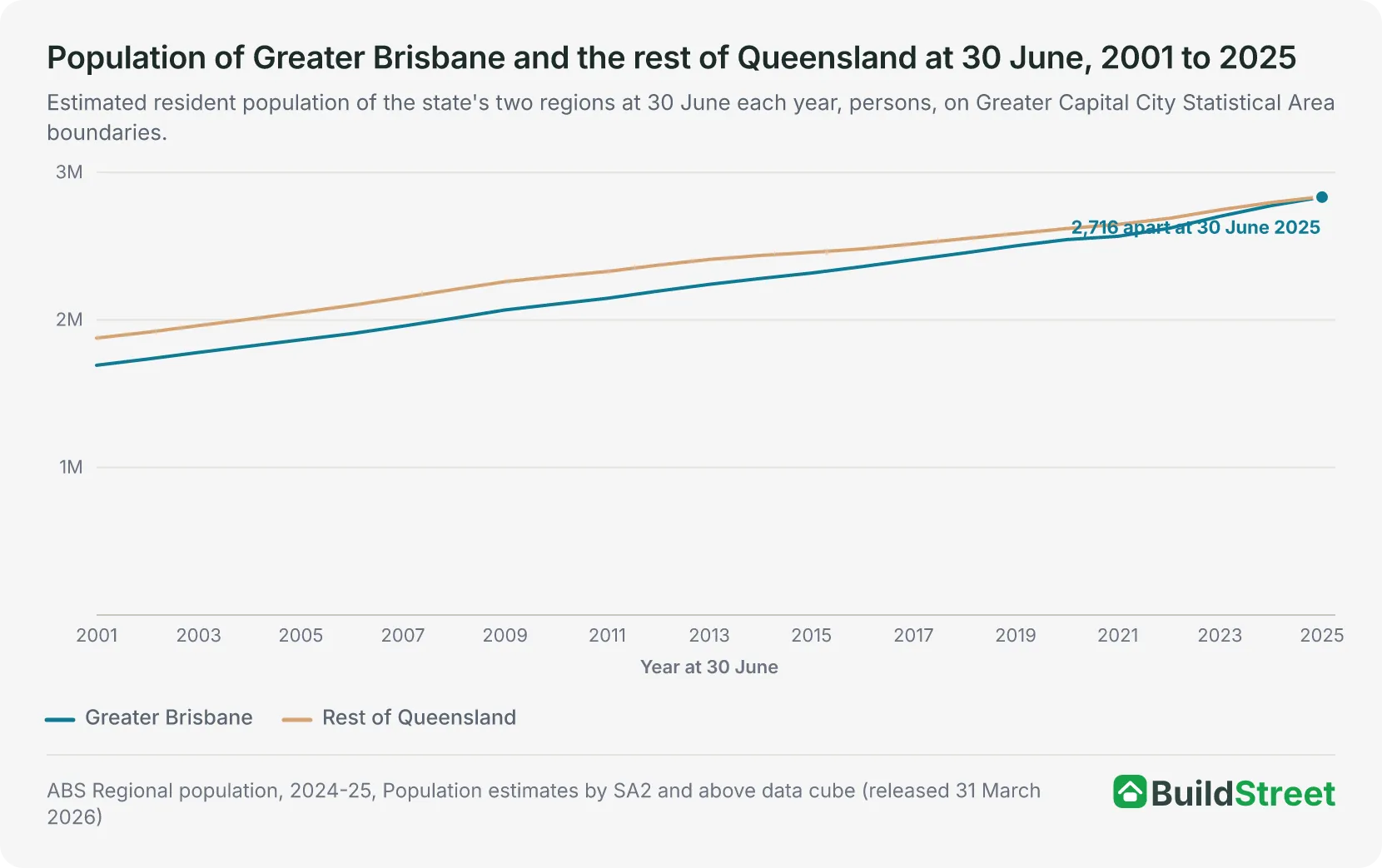
Queensland's population was split almost evenly between the capital and the rest of the state at 30 June 2025. Greater Brisbane had 2,833,524 people and the rest of Queensland had 2,836,240, so the capital accounted for 50.0 per cent of the 5,669,764 people across the two regions, derived by division; the rest of the state's population was 2,716 larger2. Brisbane's share was the lowest of the five mainland state capitals at 30 June 2025, on the same boundaries: Perth held 80.6 per cent of its two-region total, Adelaide 78.4, Melbourne 76.8 and Sydney 65.6. Among the six states only Hobart's 44.3 per cent was lower. Queensland and Tasmania were the only states in which more people lived outside the capital than in it.
Brisbane's share rose from 47.4 per cent of the two-region total at 30 June 2001 to 50.0 per cent at 30 June 2025. The rest of the state's population exceeded the capital's by 184,357 people at 30 June 2001. The gap widened to 195,097 by 30 June 2008, before narrowing in every year except 2021, to 2,716 at 30 June 20252.
Greater Brisbane grew faster than the rest of the state over 2024-25. The capital grew by 58,223 people (2.1 per cent) and the rest of the state by 39,651 people (1.4 per cent)2. The ABS rounds these increases to 58,200 and 39,700 respectively3. It reports Greater Brisbane's 2024-25 growth, rounded to the nearest hundred, as net overseas migration of 33,900 people, natural increase of 13,200 and a net internal migration gain of 11,100. Brisbane and Perth were the only capital cities to record net internal migration gains.
The largest population increases in the state in 2024-25 were in areas around Brisbane and on the Sunshine Coast. Ripley, in Ipswich, grew by 3,100 people, Caloundra West - Baringa on the Sunshine Coast by 2,000 and Chambers Flat - Logan Reserve, in Logan, by 1,800. The highest growth rates were recorded in Ripley and in Morayfield, in Moreton Bay, both at 15 per cent3.
The capital's own long-run series is covered in the Brisbane population article.
| Greater Capital City Statistical Area boundaries, at 30 June 2025 | ||||
|---|---|---|---|---|
| Region | Population | Change over 2024-25 | Growth rate % | Share of two-region total % |
| Greater Brisbane | 2,833,524 | +58,223 | 2.1 | 50.0 |
| Rest of Queensland | 2,836,240 | +39,651 | 1.4 | 50.0 |
| Two regions combined | 5,669,764 | +97,874 | 1.8 | 100.0 |
Source · ABS Regional population, 2024-25, Population estimates by SA2 and above data cube.
Section 05 · The national picture
How does Queensland compare with other states and territories?
Queensland was the third most populous of the eight states and territories at 31 December 2025, with 1,409,789 fewer people than Victoria and 2,635,596 more than Western Australia. Queensland has remained the third most populous jurisdiction throughout the ABS quarterly series, covering 179 quarters from June 1981 to December 20251.
Queensland's 1.64 per cent growth rate in 2025 ranked third, behind Western Australia's 2.17 per cent and Victoria's 1.67 per cent, with the Northern Territory next at 1.61 per cent. Its population increase of 92,162 people also ranked third, behind Victoria's 117,315 and New South Wales's 104,6111. On net interstate migration Queensland ranked first, recording a 16,528 gain in 2025.
Net overseas migration was the major contributor to population change in all states and territories in the year ending 31 December 20251.
| Population by state and territory, Australia, as at 31 December 2025 | |||
|---|---|---|---|
| State or territory | Population | Change over 2025 | Growth rate % |
| New South Wales | 8,641,085 | +104,611 | 1.23 |
| Victoria | 7,121,913 | +117,315 | 1.67 |
| Queensland | 5,712,124 | +92,162 | 1.64 |
| Western Australia | 3,076,528 | +65,465 | 2.17 |
| South Australia | 1,910,553 | +19,728 | 1.04 |
| Tasmania | 579,110 | +2,908 | 0.50 |
| Australian Capital Territory | 487,202 | +6,033 | 1.25 |
| Northern Territory | 267,478 | +4,240 | 1.61 |
| Australia | 27,801,023 | +412,494 | 1.51 |
Source · ABS National, state and territory population, December 2025, Table 4.
Section 06 · The long run
How has Queensland's population grown since 1981?
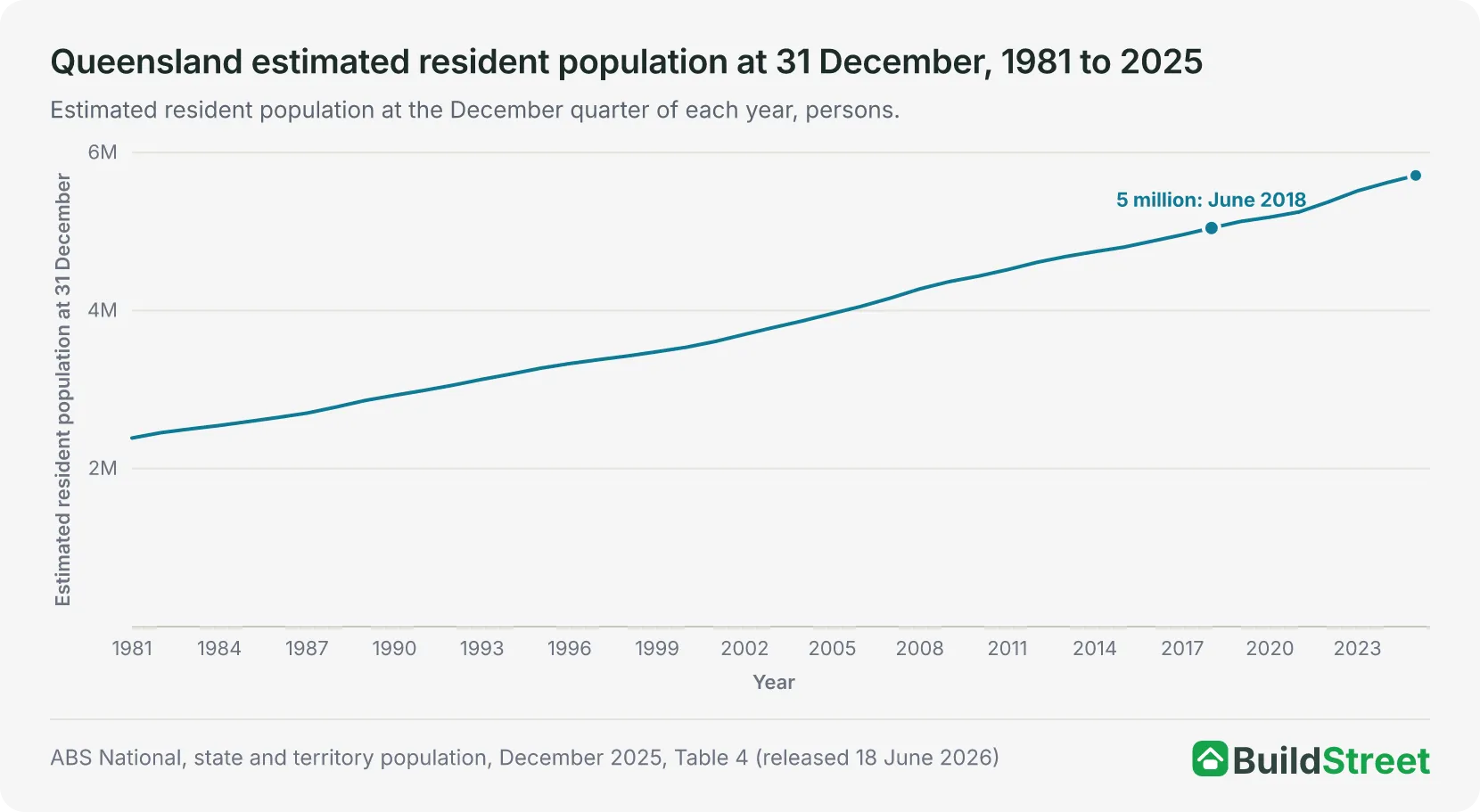
Queensland's population grew from 2,387,943 at 31 December 1981 to 5,712,124 at 31 December 2025, an increase of 3,324,181 people1.
Queensland first exceeded 3 million people in the March quarter of 1992, 4 million in the June quarter of 2006 and 5 million in the June quarter of 20181. The gap between reaching 3 million and 4 million was 14 years and three months, while the gap from 4 million to 5 million was 12 years.
The annual population increase fell from 83,307 people in 2019 to 54,588 in 2020, then rose to 65,343 in 2021, to 127,006 in 2022 and to 139,798 in 20231.
| Queensland population milestones, 1992 to 2018 | ||
|---|---|---|
| Milestone | First quarter at or above | Population that quarter |
| 3 million | March quarter 1992 | 3,010,322 |
| 4 million | June quarter 2006 | 4,007,992 |
| 5 million | June quarter 2018 | 5,006,623 |
Source · ABS National, state and territory population, December 2025, Table 4.
Section 07
Queensland population: quick answers
What is the population of Queensland?
Queensland had an estimated resident population of 5,712,124 at 31 December 2025, the most recent quarter in the ABS series, released 18 June 2026. That was 20.5 per cent of Australia's 27,801,023 people and the third largest population of any state or territory, behind New South Wales and Victoria. The next update, covering the March quarter 2026, is due on 17 September 2026.
How fast is the Queensland population growing?
Queensland added 92,162 people, or 1.6 per cent, in the year to 31 December 2025; the ABS rounds the increase to 92,200. That was the third largest increase and the third fastest growth rate among the eight states and territories. Queensland's population has increased in every calendar year from 1982 to 2025.
How many people move to Queensland from other states?
Queensland recorded a net interstate migration gain of 16,528 people in 2025, with 97,433 arrivals from other states and territories and 80,905 departures. That was the largest net interstate migration gain of any state or territory; Western Australia, at 10,419, was the only other jurisdiction to gain. Queensland recorded a net interstate migration gain in all 44 calendar years from 1982 to 2025.
How much of the Queensland population lives in Brisbane?
Greater Brisbane had 2,833,524 of the 5,669,764 people living across Brisbane and the rest of Queensland at 30 June 2025, which was 50.0 per cent. The rest of Queensland had slightly more people, at 2,836,240. The capital's share was 47.4 per cent at 30 June 2001 on the same boundaries.
References
- ABS National, State and Territory Population, December 2025 · Australian Bureau of Statistics ↑ b c d e f g h i j k l m n
- ABS Regional population, 2024-25: population estimates by SA2 and above, 2001 to 2025 (datacube 32180DS0003) · Australian Bureau of Statistics ↑ b c
- ABS Regional population, 2024-25 · Australian Bureau of Statistics ↑ b
- ABS, National, state and territory population methodology, December 2025 · Australian Bureau of Statistics
