
Published 31 Aug 2026 · Updated 16 Sept 2026
Greater Brisbane had 2,833,524 residents at 30 June 2025, the third-largest population among Australia's eight capital cities, according to the Australian Bureau of Statistics (ABS) Regional population data. The city added 58,223 people in the 2024-25 financial year, and its growth rate of 2.10 per cent was the second fastest of the eight capitals, behind Perth. Brisbane and Perth were the only capitals to report net internal migration gains in 2024-25, with Brisbane's gain of 11,077 the larger. Greater Brisbane accounted for 49.98 per cent of the population across Queensland's two broad regions at 30 June 2025. Its population also increased in every year from 2001 to 2025.
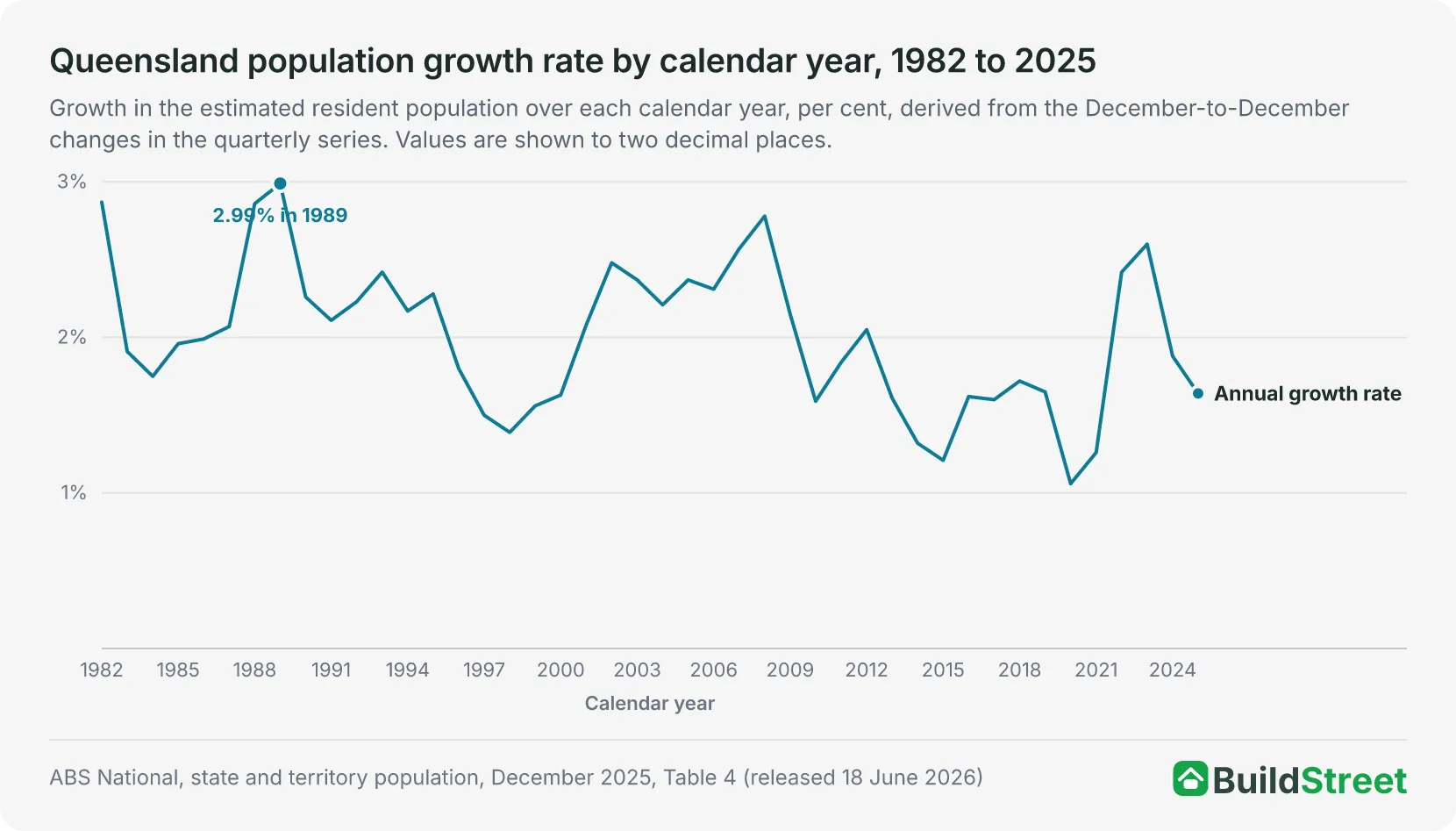 The state around the cityGreater Brisbane held just under half of the people in Queensland's two broad regions at 30 June 2025. The state page covers Queensland's total, its growth and its components of change.
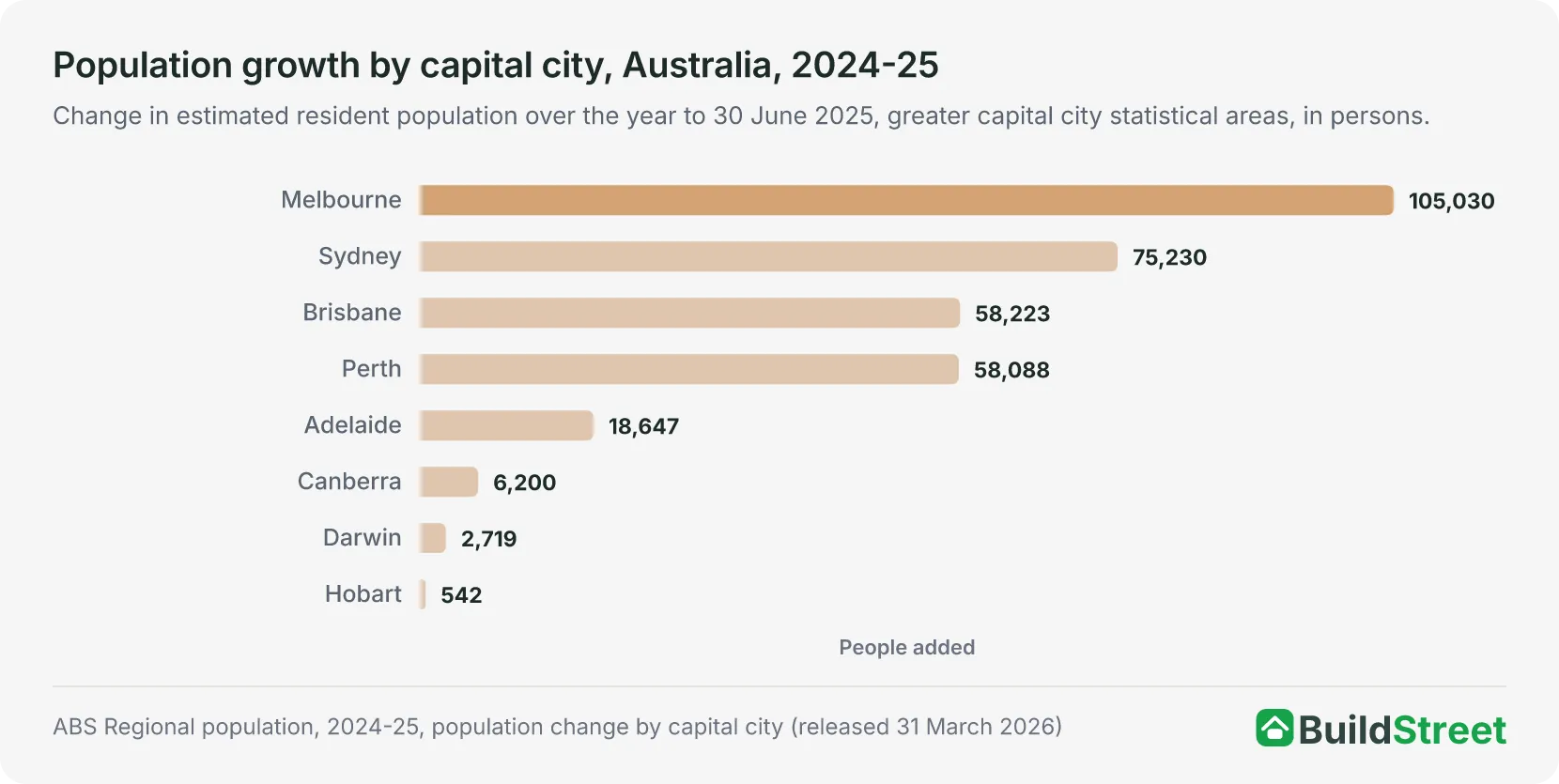 How other cities compareBrisbane had the second fastest growth rate of the capitals in 2024-25, behind Perth, while Melbourne added the most people. The cities article ranks growth across Australia's capitals and regional centres.
Section 01 · The headline number
How many people live in Brisbane?
Greater Brisbane had an estimated resident population of 2,833,524 at 30 June 20251. That was the third-largest population of the eight capital cities, 380,759 more than Greater Perth's 2,452,765 and 2,602,066 fewer than Greater Melbourne's 5,435,590. About one in ten people in Australia lived in Brisbane, equivalent to 10.3 per cent of the national population of 27,613,6542.
The ABS updates the city estimate once a year, at 30 June, and the 30 June 2025 estimate is preliminary and subject to revision. The next release, covering 30 June 2026, is due on 25 March 20271.
Section 02 · The pace
How fast is Brisbane's population growing?
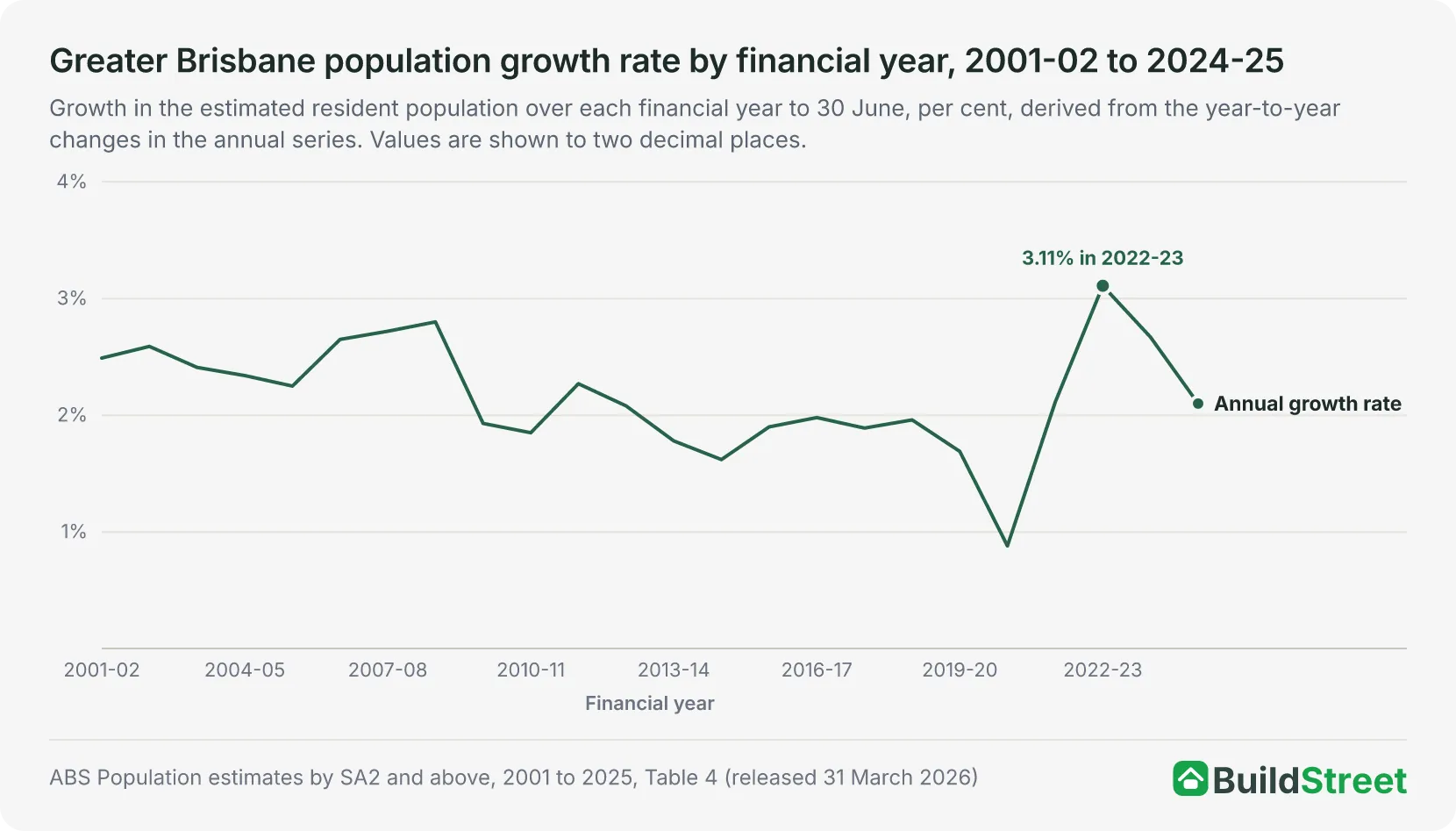
Greater Brisbane added 58,223 people, or 2.10 per cent, in 2024-25. The ABS capital city data rounds the growth rate to 2.1 per cent, the second fastest of the eight capitals, behind Perth's 2.4 per cent. Brisbane recorded the third largest population increase, behind Melbourne's 105,030 and Sydney's 75,2301. It was also the city's smallest increase in three years, after 81,446 (3.11 per cent) in 2022-23 and 72,088 (2.67 per cent) in 2023-242.
Across the 24 financial years from 2001-02 to 2024-25, Greater Brisbane's population growth ranged from 0.88 to 3.11 per cent, with growth recorded every year. The fastest year was 2022-23, when the city added 81,446 people (3.11 per cent), the largest increase and the highest rate over the period. The slowest was 2020-21, when the city added 22,335 people (0.88 per cent). Greater Sydney and Greater Melbourne populations fell over the same year, by 33,728 and 85,788 respectively2.
The slowest and fastest years were two years apart. Growth slowed in each of the two years after the 2022-23 peak.
Section 03 · The drivers
What drives Brisbane's population growth?
Brisbane's population growth in 2024-25 came from all three components. Net overseas migration added 33,934 people to Greater Brisbane, natural increase (births minus deaths) added 13,212, and net internal migration (moves to and from elsewhere in Australia) added 11,077. Together, the three components added 58,223 people, matching the city's total population growth. Brisbane's net overseas migration gain was the fourth largest of the eight capital cities, behind Melbourne's 81,168, Sydney's 78,403 and Perth's 37,2891.
Brisbane and Perth were the only capitals with net internal migration gains in 2024-25. Brisbane's gain of 11,077 was the larger of the two, ahead of Perth's 8,211, and the largest of the eight capitals. Every other capital recorded a net loss, from Sydney's 33,282 to Darwin's 1,4301.
Greater Brisbane recorded a net internal migration gain from 2021-22 to 2024-25. The net gain was 20,614 in 2021-22, 14,998 in 2022-23, 15,161 in 2023-24 and 11,077 in 2024-25, the smallest of the four. In 2021-22, the net internal migration gain of 20,614 exceeded the net overseas migration gain of 17,555. Net overseas migration peaked at 52,854 in 2022-23, then fell to 43,794 in 2023-24 and 33,934 in 2024-251.
State-to-state flows across all eight states and territories are covered in the interstate migration article.
| Components of Greater Brisbane population change, 2024-25 | ||
|---|---|---|
| Component | People | Derivation |
| Net overseas migration | +33,934 | 66,577 arrivals minus 32,643 departures |
| Natural increase | +13,212 | 29,834 births minus 16,622 deaths |
| Net internal migration | +11,077 | 82,078 arrivals minus 71,001 departures |
| Total growth | +58,223 | Derived sum; the release's commentary rounds it to 58,200 |
Source · ABS Population components by SA2 and above, 2021-22 to 2024-25, Table 4
Section 04 · The growth areas
Where in Brisbane is the population growing fastest?
The city's fastest-growing areas in 2024-25 were on its outer edges. The ABS identified Ripley (up by 3,100 people) in Ipswich and Chambers Flat - Logan Reserve (1,800) in Logan among the Queensland areas with the largest population increases. Ripley (15 per cent), Morayfield (15 per cent) in Moreton Bay and Greenbank - North Maclean (14 per cent) in Logan were the areas with the highest growth rates. Ripley grew from 20,328 to 23,459 people over the year, Chambers Flat - Logan Reserve from 15,063 to 16,875 and Morayfield from 6,812 to 7,8261.
Ripley's 3,131-person increase was the largest of any area in Queensland, and its 15.4 per cent growth rate was the state's highest. The state's second largest increase, 1,980 in Caloundra West - Baringa on the Sunshine Coast, was outside Greater Brisbane. Ripley also recorded Queensland's largest net internal migration gain, at 2,660 people, while Redbank Plains, also in Ipswich, had the state's largest natural increase, 460, and Brisbane City had the state's largest net overseas migration gain, at 9031.
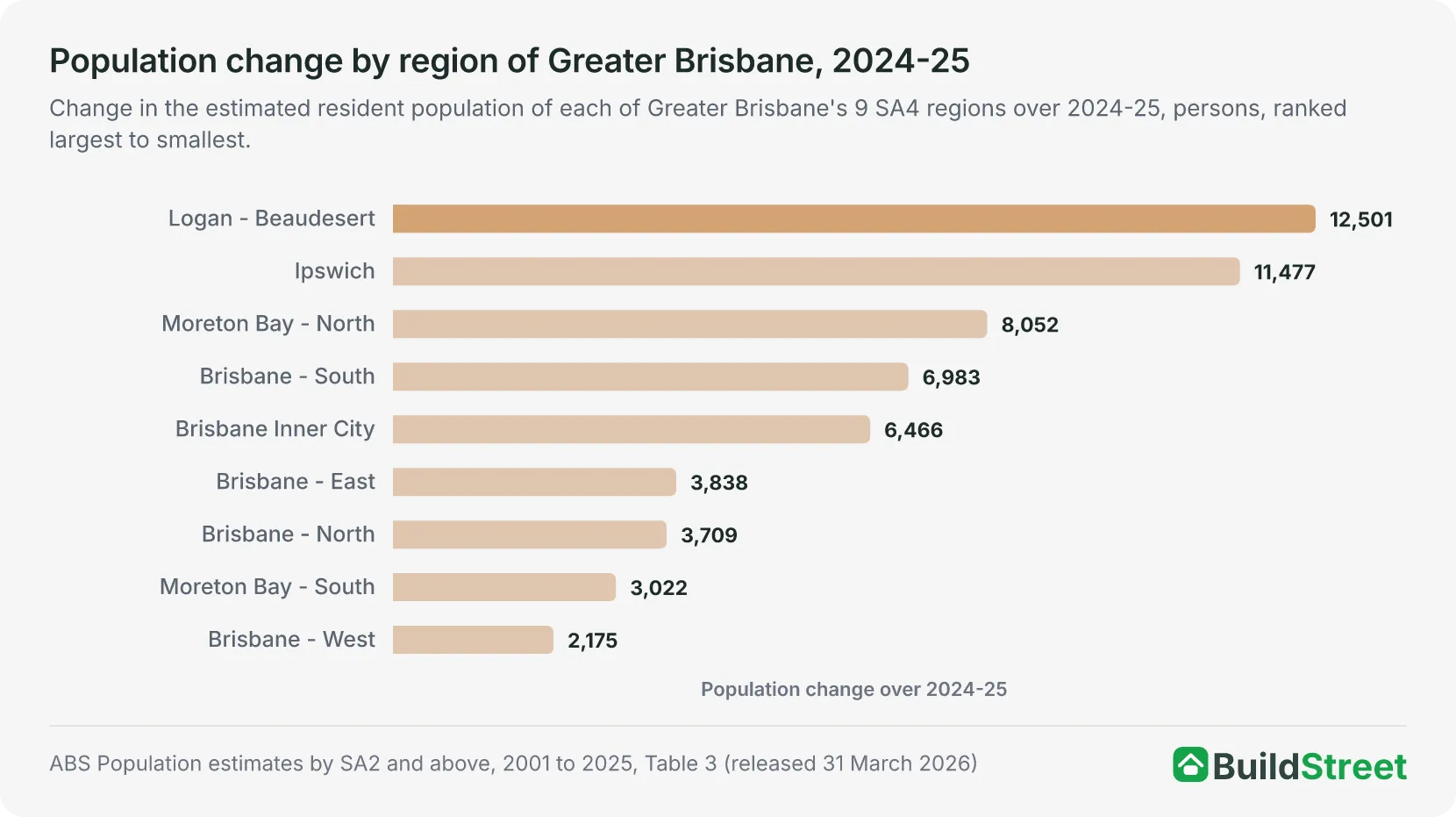
Every broad region of the city grew in 2024-25. Logan - Beaudesert added 12,501 people and Ipswich added 11,477, the two largest increases across Greater Brisbane's nine broad regions. Brisbane - West recorded the smallest increase at 2,1752. The centre of population for Greater Brisbane was in Highgate Hill, south of the central business district, in June 2025 and moved 80 metres south-west in 2024-251.
| The fastest growing areas of Brisbane, 2024-25 | |||||
|---|---|---|---|---|---|
| Area (SA2) | Region (SA4) | 30 June 2024 | 30 June 2025 | Change | Growth rate % |
| Ripley | Ipswich | 20,328 | 23,459 | +3,131 | 15.4 |
| Chambers Flat - Logan Reserve | Logan - Beaudesert | 15,063 | 16,875 | +1,812 | 12.0 |
| Greenbank - North Maclean | Logan - Beaudesert | 11,115 | 12,691 | +1,576 | 14.2 |
| Morayfield | Moreton Bay - North | 6,812 | 7,826 | +1,014 | 14.9 |
Source · ABS Population estimates and components by SA2, 2024 to 2025, Table 3
Section 05 · The state share
How much of Queensland's population lives in Brisbane?
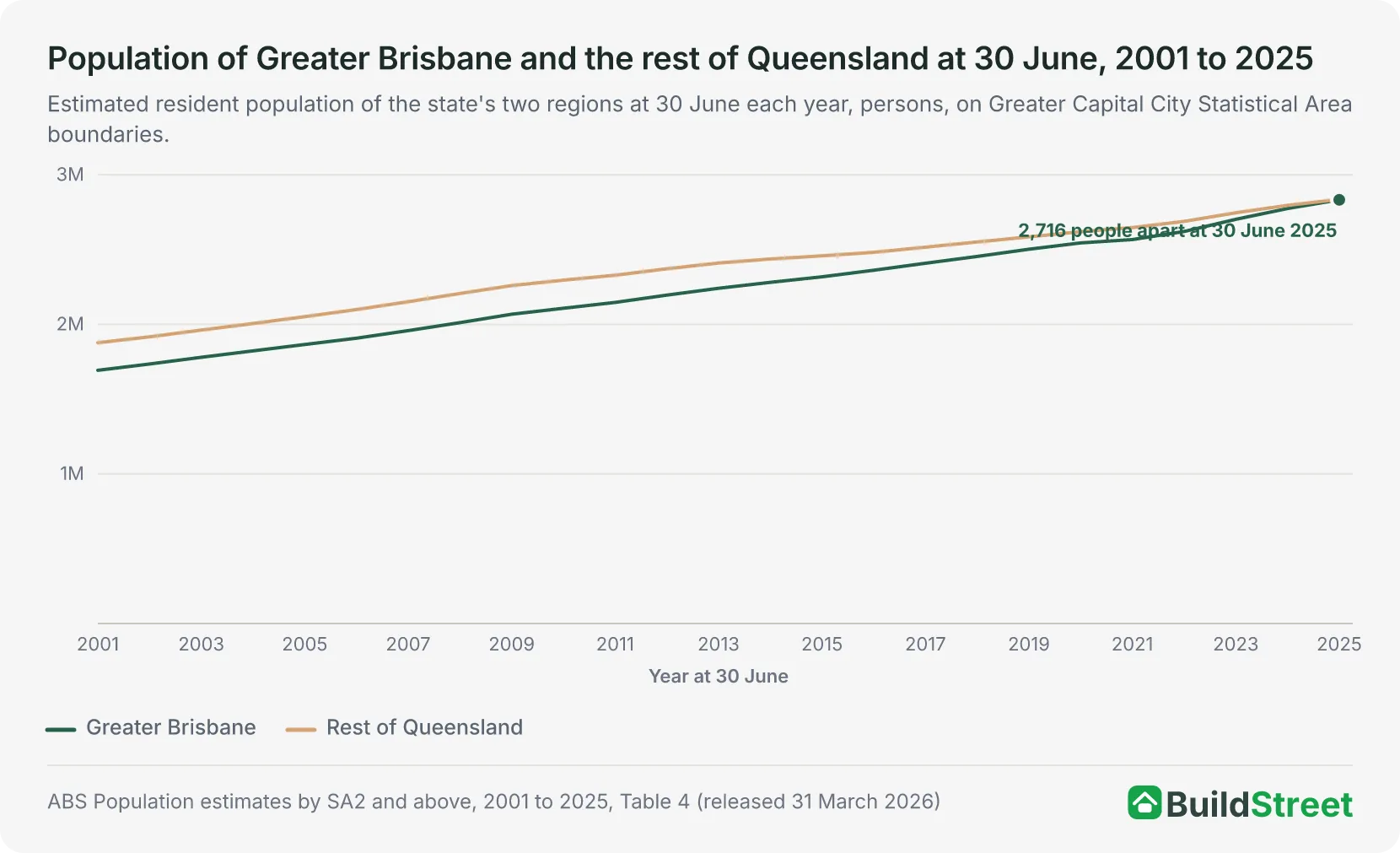
More of Queensland's people lived outside the capital than in it at 30 June 2025, a pattern shared only with Tasmania among the six states. Greater Brisbane had 2,833,524 residents and the rest of Queensland had 2,836,240, giving the capital a 49.98 per cent share of the 5,669,764 people across the state's two regions. The rest of Queensland had 2,716 more people than Greater Brisbane2.
By 30 June 2025 the gap had nearly closed. The rest of Queensland had 184,357 more people than Greater Brisbane at 30 June 2001, compared with just 2,716 more in 2025. The difference peaked at 195,097 in 2008, then narrowed in every year from 2008-09 to 2024-25 except 2020-21. Over the same period, Greater Brisbane's share of the population across Queensland's two broad regions rose from 47.42 per cent to 49.98 per cent. The rest of Queensland added 39,651 people (1.42 per cent) over 2024-25, the largest increase among Australia's seven rest-of-state and rest-of-territory regions2.
Brisbane had the fifth-highest share of a state's population living in its capital among Australia's six states at 30 June 2025. Perth accounted for 80.6 per cent of its state's two-region population, Adelaide 78.4 per cent, Melbourne 76.8 per cent, Sydney 65.6 per cent, Brisbane 49.98 per cent and Hobart 44.3 per cent2.
Section 06 · The other capitals
How does Brisbane compare with Australia's other capital cities?
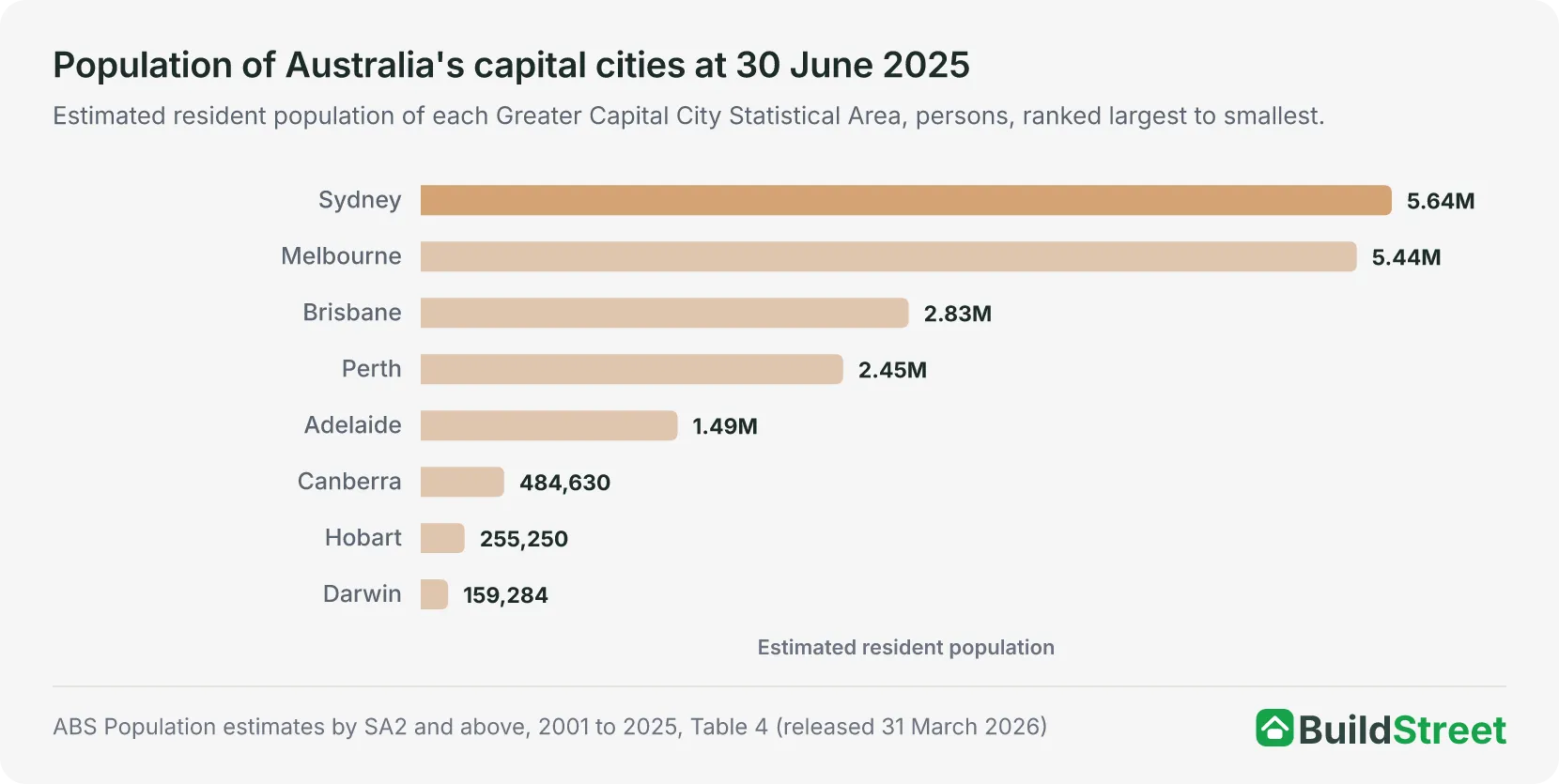
Brisbane was the third largest of the eight capital cities by population at 30 June 2025, with 2,833,524 people, behind Sydney's 5,638,830 and Melbourne's 5,435,590. Perth, the fourth largest at 2,452,765, had 380,759 fewer people than Brisbane2.
Population growth rankings were different from the size rankings in 2024-25. Perth had the highest growth rate of the eight capitals, at 2.4 per cent, followed by Brisbane at 2.1 per cent and Melbourne at 2.0 per cent. Melbourne recorded the largest increase, at 105,030 people, followed by Sydney's 75,230, Brisbane's 58,223 and Perth's 58,0881. Brisbane added 135 more people than Perth, despite Perth recording the faster growth rate2.
The eight capitals had a combined population of 18,750,888 at 30 June 2025, after growing by 324,679 or 1.8 per cent in 2024-25. Brisbane accounted for 15.1 per cent of the combined capital city population1.
Melbourne's population trends are covered in the Melbourne population article.
| Population of Australia's capital cities, as at 30 June 2025 | |||
|---|---|---|---|
| Capital city | Population | Change over 2024-25 | Growth rate % |
| Sydney | 5,638,830 | +75,230 | 1.35 |
| Melbourne | 5,435,590 | +105,030 | 1.97 |
| Brisbane | 2,833,524 | +58,223 | 2.10 |
| Perth | 2,452,765 | +58,088 | 2.43 |
| Adelaide | 1,491,015 | +18,647 | 1.27 |
| Canberra | 484,630 | +6,200 | 1.30 |
| Hobart | 255,250 | +542 | 0.21 |
| Darwin | 159,284 | +2,719 | 1.74 |
| All capital cities | 18,750,888 | +324,679 | 1.76 |
Source · ABS Population estimates by SA2 and above, 2001 to 2025, Table 4
Section 07 · The long run
How has Brisbane's population changed since 2001?
The city added 1,139,968 people between 30 June 2001 and 30 June 2025, growing from 1,693,556 to 2,833,524. The increase was the third largest of the eight capitals, behind Melbourne's 1,935,341 and Sydney's 1,536,250. Brisbane's population in 2025 was 1.67 times its 2001 level, the second highest ratio among the capitals, behind Perth's 1.692.
Greater Brisbane first exceeded 2 million people at 30 June 2008, 2.5 million at 30 June 2019 and 2.75 million at 30 June 20242. It took 11 years to grow from 2 million to 2.5 million and five years from 2.5 million to 2.75 million.
Brisbane's population increased in every year from 2001-02 to 2024-25. Its smallest increase came in 2020-21, when the city added 22,335 people (0.88 per cent), while Sydney and Melbourne both recorded population declines that year. Brisbane's largest increase was 81,446 (3.11 per cent) in 2022-23. Growth then slowed to 72,088 in 2023-24 and 58,223 in 2024-252.
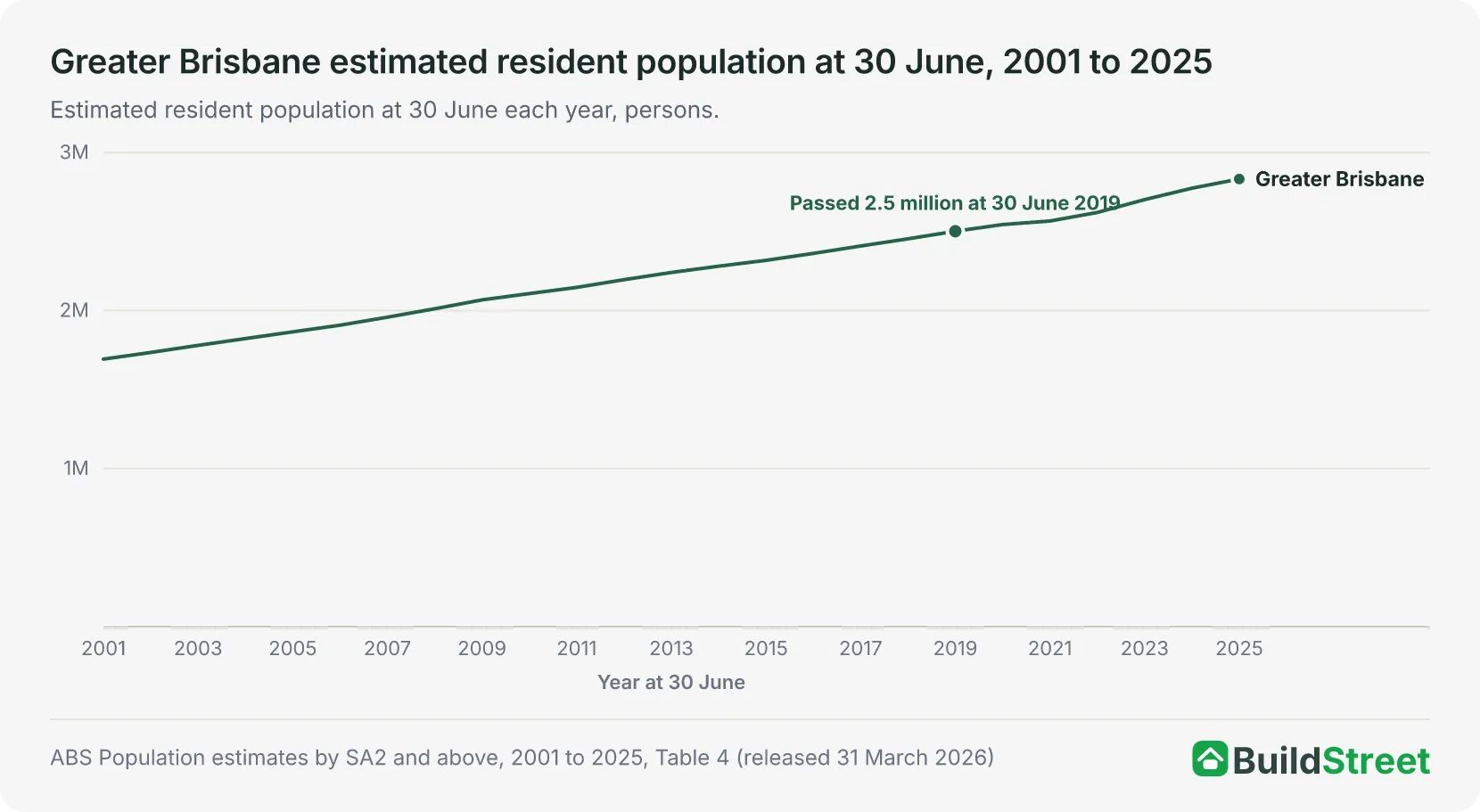
| Greater Brisbane population milestones, 2001 to 2025 | ||
|---|---|---|
| Milestone | First 30 June at or above | Population that year |
| 2 million | 30 June 2008 | 2,012,204 |
| 2.5 million | 30 June 2019 | 2,503,078 |
| 2.75 million | 30 June 2024 | 2,775,301 |
Source · ABS Population estimates by SA2 and above, 2001 to 2025, Table 4
Section 08
Brisbane population: quick answers
How many people live in Brisbane?
Greater Brisbane had an estimated resident population of 2,833,524 at 30 June 2025, according to the ABS Regional population data released on 31 March 2026. That was the third largest population of Australia's eight capital cities and 10.3 per cent of the national total of 27,613,654 on the same series. The 30 June 2025 estimates are preliminary and subject to revision. The next release, covering 30 June 2026, is due on 25 March 2027.
How fast is Brisbane's population growing?
Greater Brisbane added 58,223 people, or 2.10 per cent, over the 2024-25 financial year. The ABS rounds the growth rate to 2.1 per cent, the second fastest of the eight capital cities, behind Perth's 2.4 per cent. Growth peaked at 81,446 people (3.11 per cent) in 2022-23, and the population increased in every year of the series from 2001-02, including 2020-21, when the Sydney and Melbourne populations fell.
Is Brisbane bigger than Perth?
Yes. Greater Brisbane had a larger population than Greater Perth at 30 June 2025 on the ABS Greater Capital City Statistical Area boundaries, with 2,833,524 residents to Perth's 2,452,765, a gap of 380,759 people. The two cities' population increases differed by 135 people over 2024-25: 58,223 in Brisbane and 58,088 in Perth. Perth's published growth rate was higher, at 2.4 per cent.
Section 09
Australia population statistics
References
- ABS Regional population, 2024-25 · Australian Bureau of Statistics ↑ b c d e f g h i j k
- ABS Regional population, 2024-25: population estimates by SA2 and above, 2001 to 2025 (datacube 32180DS0003) · Australian Bureau of Statistics ↑ b c d e f g h i j k l
- ABS Regional population methodology, 2024-25 · Australian Bureau of Statistics
- ABS Regional population, 2024-25: population components by SA2 and above, 2021-22 to 2024-25 (datacube 32180DS0005) · Australian Bureau of Statistics
- ABS Regional population, 2024-25: population estimates and components by SA2, 2024 to 2025 (datacube 32180DS0001) · Australian Bureau of Statistics
