
Published 2 Sept 2026 · Updated 15 Sept 2026
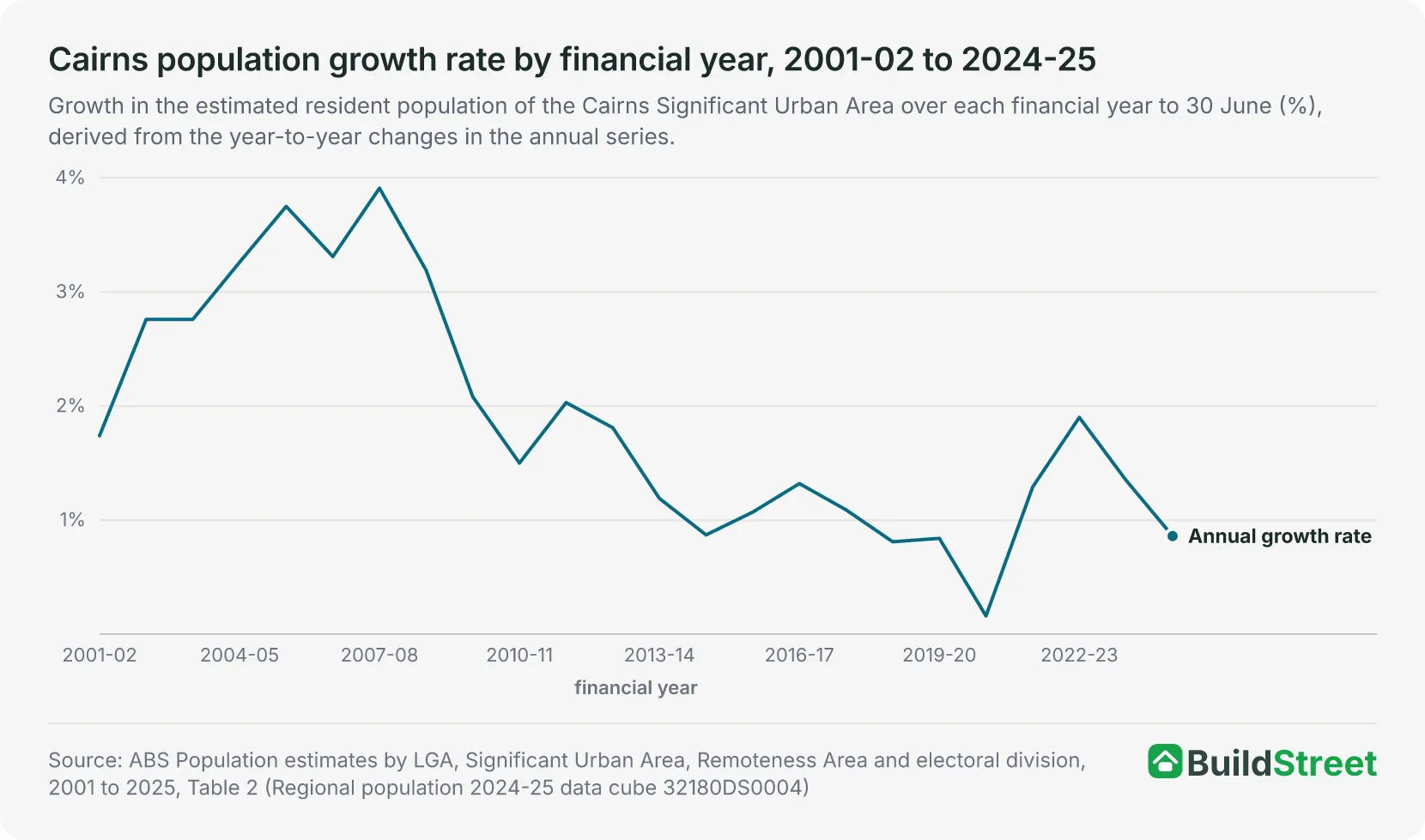 How Cairns comparesCairns was Queensland's fifth largest urban area at 30 June 2025, with 164,149 people, 26,402 fewer than Townsville. The Cairns article covers its growth, its drivers and its long-run series.
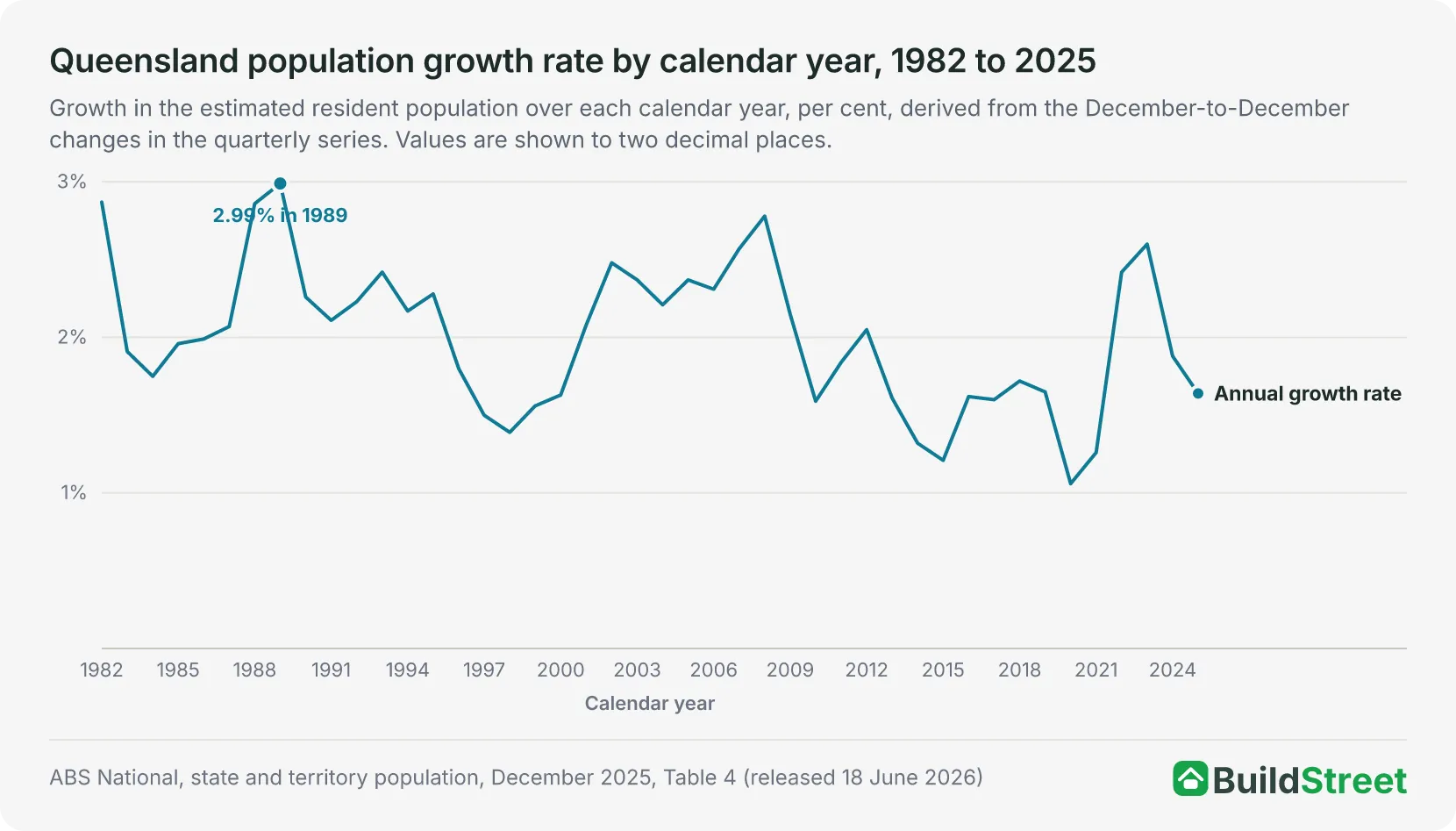 The state pictureQueensland had an estimated resident population of 5,669,764 at 30 June 2025 in the ABS annual series. The state article covers the total, its drivers and the split between Greater Brisbane and the rest of the state.
Section 01 · The headline number
How many people live in Townsville?
The Townsville Significant Urban Area had an estimated resident population of 190,551 at 30 June 2025. That made it the fourth-largest of the 19 urban areas in Queensland, behind Brisbane at 2,745,086 people, Gold Coast - Tweed Heads at 761,634 and the Sunshine Coast at 424,741, and the largest of the state's other 16 urban areas2. Townsville accounted for 3.4 per cent of Queensland's estimated 5,669,764 people and 0.7 per cent of Australia's 27,613,654 people3.
The ABS publishes population estimates annually for 30 June. In the 2024-25 release, the estimates are final for 2001 to 2021, revised for 2022 to 2024 and preliminary for 20254. The next release, covering 30 June 2026, is due on 25 March 20271.
Section 02 · The pace
How fast is Townsville's population growing?
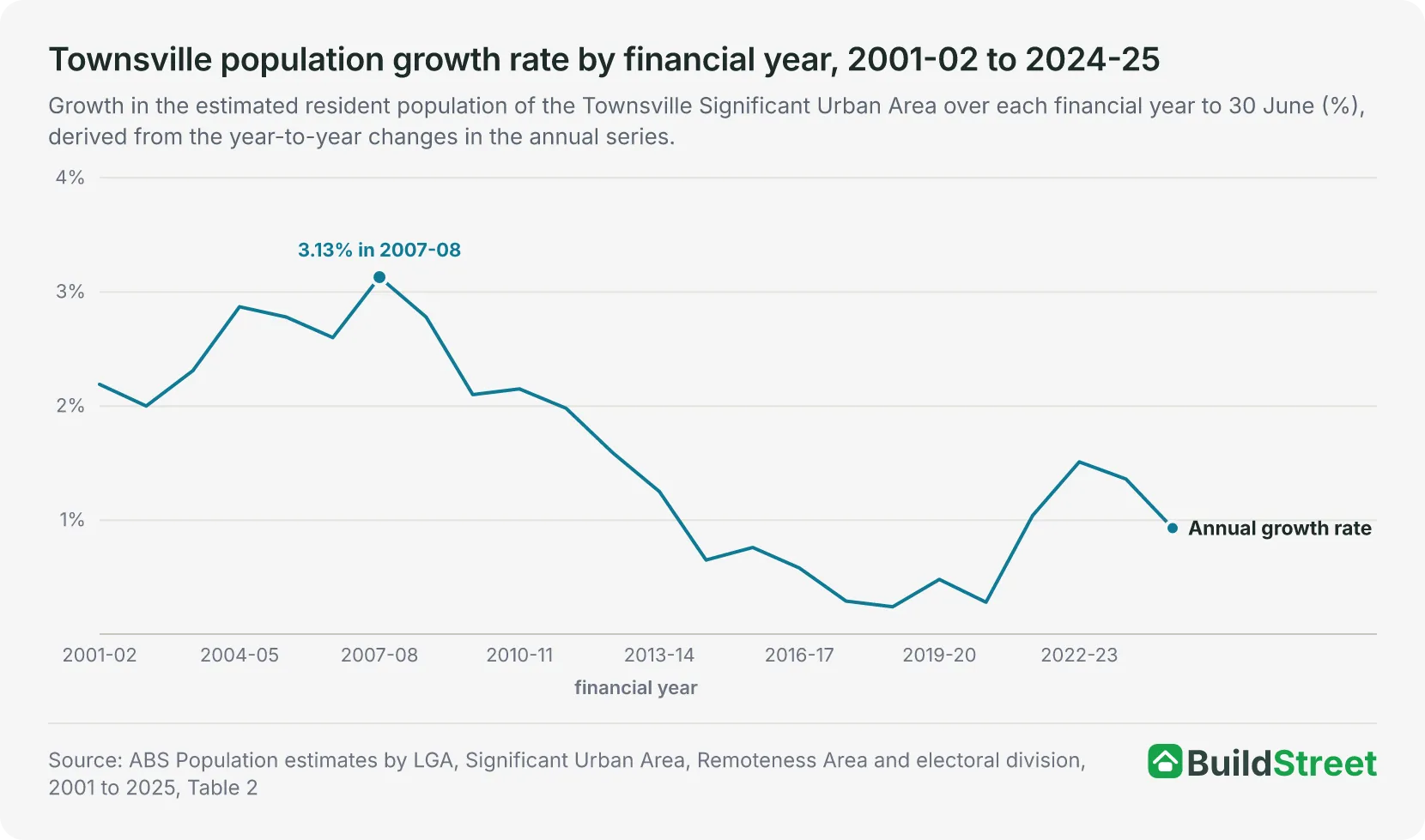
The Townsville urban area added 1,752 people, or 0.93 per cent, in 2024-25, growing from 188,799 at 30 June 2024 to 190,551 at 30 June 2025. The increase was the smallest since 2020-21, when the urban area added 511 people. The three years between recorded larger gains: 1,881 in 2021-22, 2,769 in 2022-23 and 2,540 in 2023-242.
Across the 24 financial years from 2001-02 to 2024-25, the growth ranged from 0.24 per cent to 3.13 per cent, and the population increased in every year. The fastest growth occurred in 2007-08, when the urban area added 4,750 people (3.13 per cent), both the largest annual increase and the highest growth rate during the period. The lowest growth occurred in 2018-19, when the urban area added 437 people (0.24 per cent)2.
Growth was 2.0 per cent or more in each of the ten years from 2001-02 to 2010-11. The rate fell below 2 per cent in 2011-12, at 1.98 per cent, and was below 1 per cent in every year from 2014-15 to 2020-21. It rose to 1.04 per cent in 2021-22 and 1.51 per cent in 2022-23, then fell to 1.36 per cent in 2023-24 and 0.93 per cent in 2024-25.2
Section 03 · The drivers
What drives Townsville's population growth?
Net overseas migration was the largest component of population growth in the City of Townsville council area in 2024-25, adding 1,225 people. Natural increase (the excess of births over deaths) added 890 people. Net internal migration (moves to and from elsewhere in Australia) added 1736. Together, the three components accounted for the council area's increase of 2,288 people, and net overseas migration accounted for about 54 per cent of that increase.
The ABS publishes components of change for council areas and smaller statistical areas, but not directly for urban areas, so this section uses both.1
Net overseas migration was the largest component in each of the three years from 2022-23 to 2024-25. In 2021-22, natural increase was the largest. Births in the council area fell from 2,571 in 2021-22 to 2,315 in 2024-25. Deaths rose from 1,247 to 1,425 across the four years. Natural increase, the difference between births and deaths, fell from 1,324 to 890. Net internal migration stayed between 164 and 348 people a year7.
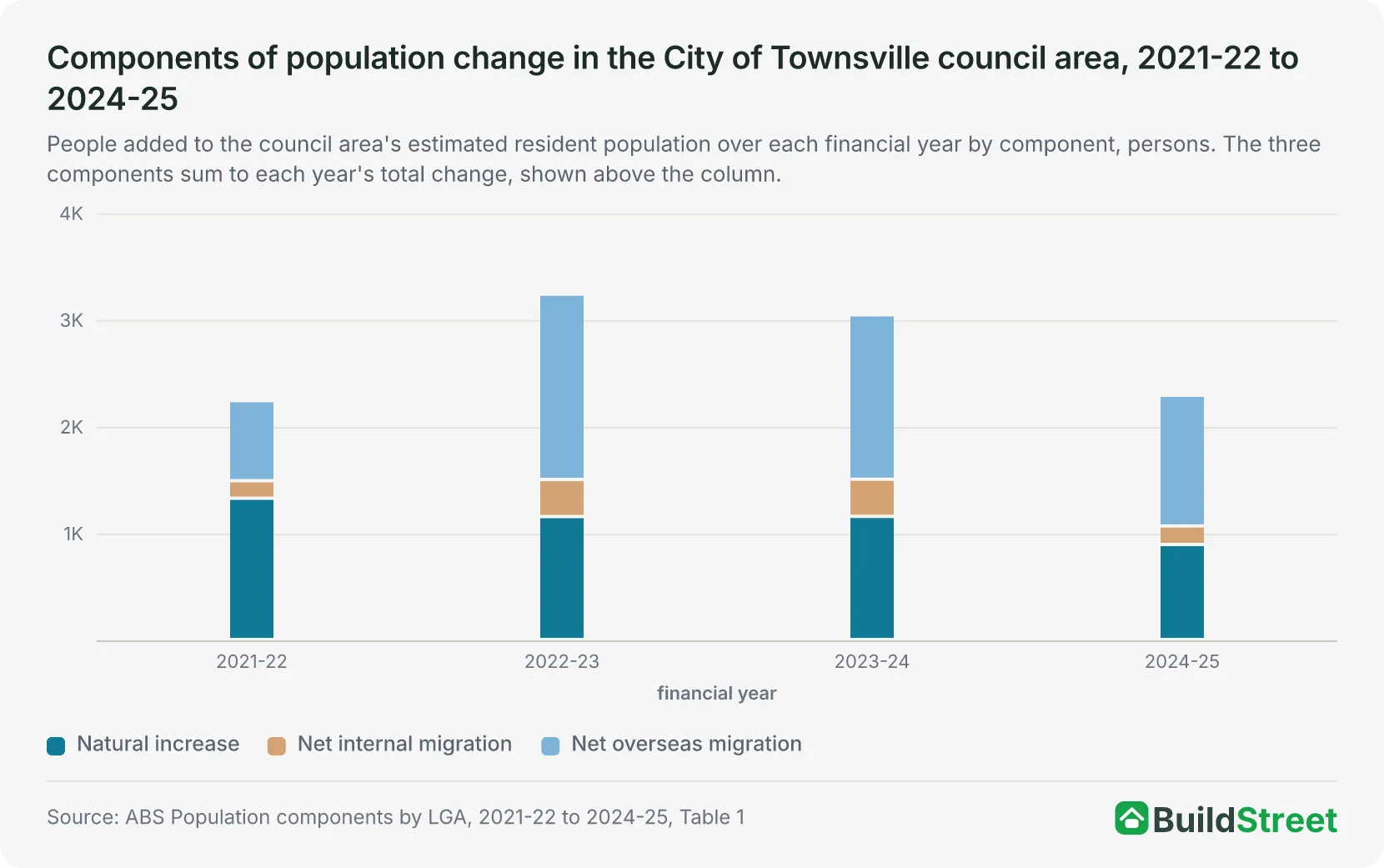
Inside the urban boundary, net internal migration was negative in 2024-25. The urban area's components were calculated by combining figures for the 23 smaller statistical areas that make it up. Natural increase added 840 people, net overseas migration added 1,194 and net internal migration subtracted 282. Together, the three components accounted for the urban area's increase of 1,7525. The three areas outside the urban boundary, Northern Beaches, Townsville - South and Magnetic Island, together gained 455 people from net internal migration over the year, more than offsetting the loss inside the urban area.
| Components of population change by boundary, Townsville, 2024-25 | |||||
|---|---|---|---|---|---|
| Boundary | Natural increase | Net internal migration | Net overseas migration | Total change | Population at 30 June 2025 |
| Urban area (SUA) | +840 | -282 | +1,194 | +1,752 | 190,551 |
| Statistical region (SA3) | +894 | +173 | +1,226 | +2,293 | 206,266 |
| Council area (LGA) | +890 | +173 | +1,225 | +2,288 | 206,260 |
| Wider region (SA4) | +918 | +255 | +1,376 | +2,549 | 249,097 |
Source · ABS Population estimates and components by LGA, 2024 to 2025, Table 3, and ABS Population estimates and components by SA2, 2024 to 2025, Table 3
Section 04 · The growth areas
Where in Townsville is the population growing fastest?
Burdell - Mount Low recorded the largest increase among the 26 smaller areas in the Townsville region in 2024-25, adding 590 people (2.7 per cent) to reach 22,202. Its population was also the largest of the 26. Bohle Plains added 505 people, the second-largest increase, growing 5.1 per cent. Townsville - South, which lies outside the urban boundary, added 338 people and recorded the region's highest growth rate, at 6.1 per cent5. The three largest increases together accounted for 1,433 of the region's total population increase of 2,293 people, or 62 per cent.
Six of the 26 areas lost population over the year. Kirwan - West recorded the largest decline, falling by 85 people (0.6 per cent), from 15,200 to 15,115. Mundingburra recorded the highest rate of decline, at 1.0 per cent, falling by 37 people. Net internal migration was the largest component of growth in each of the three areas with the largest increases, and it was negative in all six areas that recorded declines5.
The wider Townsville region, comprising the ABS-defined areas of Townsville and Charters Towers - Ayr - Ingham, grew from 246,548 to 249,097 people in 2024-25, an increase of 2,549 (1.03 per cent). The Charters Towers - Ayr - Ingham area itself grew from 42,575 to 42,831, an increase of 256 (0.60 per cent)3.
| The largest population increases by area, Townsville, 2024-25 | |||||
|---|---|---|---|---|---|
| Area (SA2) | Inside the urban boundary | 30 June 2024 | 30 June 2025 | Change | Growth rate % |
| Burdell - Mount Low | Yes | 21,612 | 22,202 | +590 | 2.7 |
| Bohle Plains | Yes | 9,961 | 10,466 | +505 | 5.1 |
| Townsville - South | No | 5,523 | 5,861 | +338 | 6.1 |
| Northern Beaches | No | 7,034 | 7,196 | +162 | 2.3 |
| Deeragun - Jensen | Yes | 6,647 | 6,770 | +123 | 1.9 |
| Condon - Rasmussen | Yes | 11,348 | 11,457 | +109 | 1.0 |
Source · ABS Population estimates and components by SA2, 2024 to 2025, Table 3
Section 05 · The state picture
How does Townsville compare with other cities in Queensland?
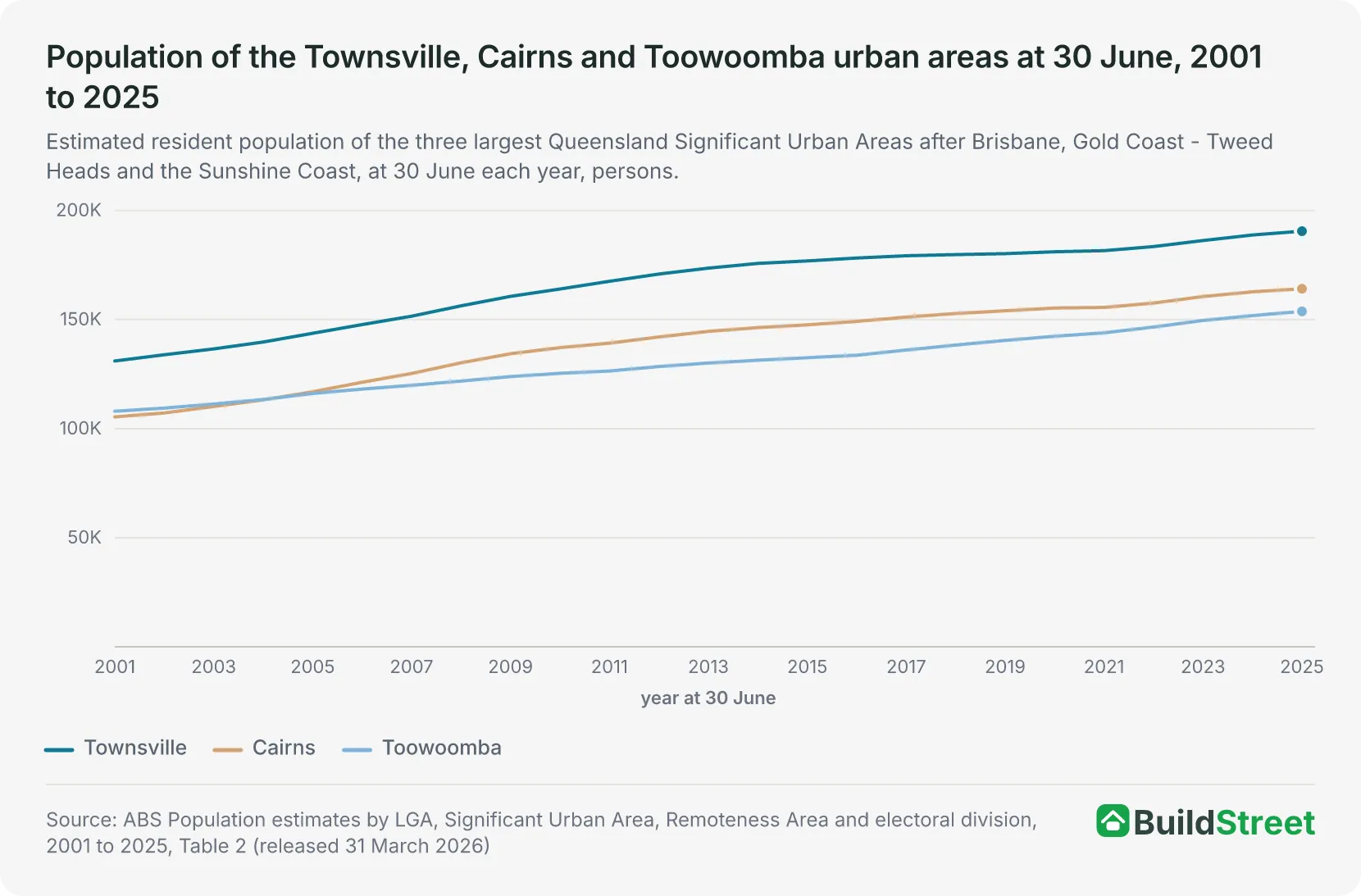
Townsville was the fourth largest of the 19 urban areas in Queensland at 30 June 2025, behind Brisbane, Gold Coast - Tweed Heads and the Sunshine Coast, and held fourth place in every year from 2001 to 2025. Cairns, at 164,149 people, and Toowoomba, at 153,781, were the next largest, followed by Mackay at 89,761. Gold Coast - Tweed Heads crosses the Queensland and New South Wales border, so its population includes residents of both states2.
The gap between Townsville and Cairns was 25,645 people at 30 June 2001 and 26,402 at 30 June 2025, after reaching its widest point of 29,433 at 30 June 2014. Cairns had the highest percentage growth of the three urban areas over the 24 years, increasing by 55.8 per cent from a smaller population base. Townsville grew by 45.4 per cent and Toowoomba by 42.4 per cent.2
In 2024-25, Townsville grew by 0.93 per cent, against 0.86 per cent for Cairns and 1.28 per cent for Toowoomba. Its rate ranked 12th among the state's 19 urban areas, of which Mount Isa was the only one to lose population2. Queensland as a whole grew by 1.76 per cent over the year, from 5,571,890 to 5,669,764 people. The population outside Greater Brisbane grew by 1.42 per cent, from 2,796,589 to 2,836,240, and Greater Brisbane grew by 2.10 per cent1.
Brisbane's population data is covered in the Brisbane population article.
Section 06 · The national rank
Where does Townsville rank among Australia's largest cities?
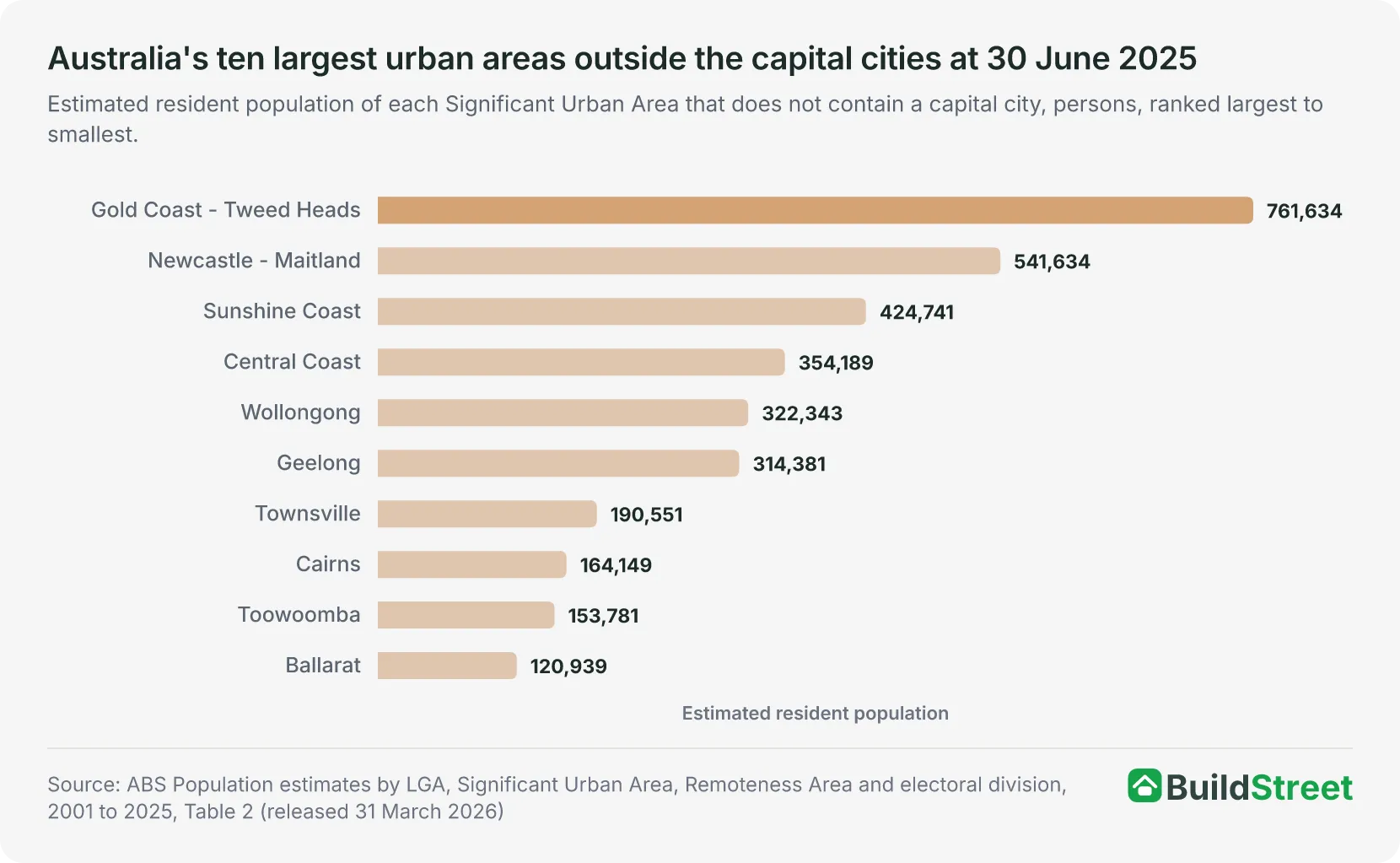
Townsville was the 14th largest of Australia's 102 urban areas at 30 June 2025, a rank it has held in every year since 2001. Of the 13 larger urban areas, seven contained capital cities. The other six were Gold Coast - Tweed Heads, Newcastle - Maitland, the Sunshine Coast, the Central Coast, Wollongong and Geelong. Hobart, the smallest capital-city urban area above Townsville, had 233,736 people. Darwin was the only capital-city urban area with fewer people than Townsville, with a population of 145,0192.
Among the urban areas that do not contain a capital city, Townsville was the seventh largest, behind Gold Coast - Tweed Heads at 761,634, Newcastle - Maitland at 541,634, the Sunshine Coast at 424,741, the Central Coast at 354,189, Wollongong at 322,343 and Geelong at 314,381.2
Growth in 2024-25 varied across the 20 urban areas with 100,000 people or more, from 0.15 per cent in Hobart to 2.40 per cent in Perth. Townsville's growth rate of 0.93 per cent ranked 16th of the 20, above Cairns at 0.86 per cent, Bendigo at 0.84 per cent, the Central Coast at 0.68 per cent and Hobart2.
| Australia's ten largest urban areas outside the capital cities, as at 30 June 2025 | |||
|---|---|---|---|
| Urban area (SUA) | Population | Change over 2024-25 | Growth rate % |
| Gold Coast - Tweed Heads | 761,634 | +12,279 | 1.64 |
| Newcastle - Maitland | 541,634 | +6,953 | 1.30 |
| Sunshine Coast | 424,741 | +8,018 | 1.92 |
| Central Coast | 354,189 | +2,401 | 0.68 |
| Wollongong | 322,343 | +3,642 | 1.14 |
| Geelong | 314,381 | +6,360 | 2.06 |
| Townsville | 190,551 | +1,752 | 0.93 |
| Cairns | 164,149 | +1,404 | 0.86 |
| Toowoomba | 153,781 | +1,943 | 1.28 |
| Ballarat | 120,939 | +2,098 | 1.77 |
Source · ABS Population estimates by LGA, Significant Urban Area, Remoteness Area and electoral division, 2001 to 2025, Table 2
Section 07 · The long run
How has Townsville's population changed since 2001?
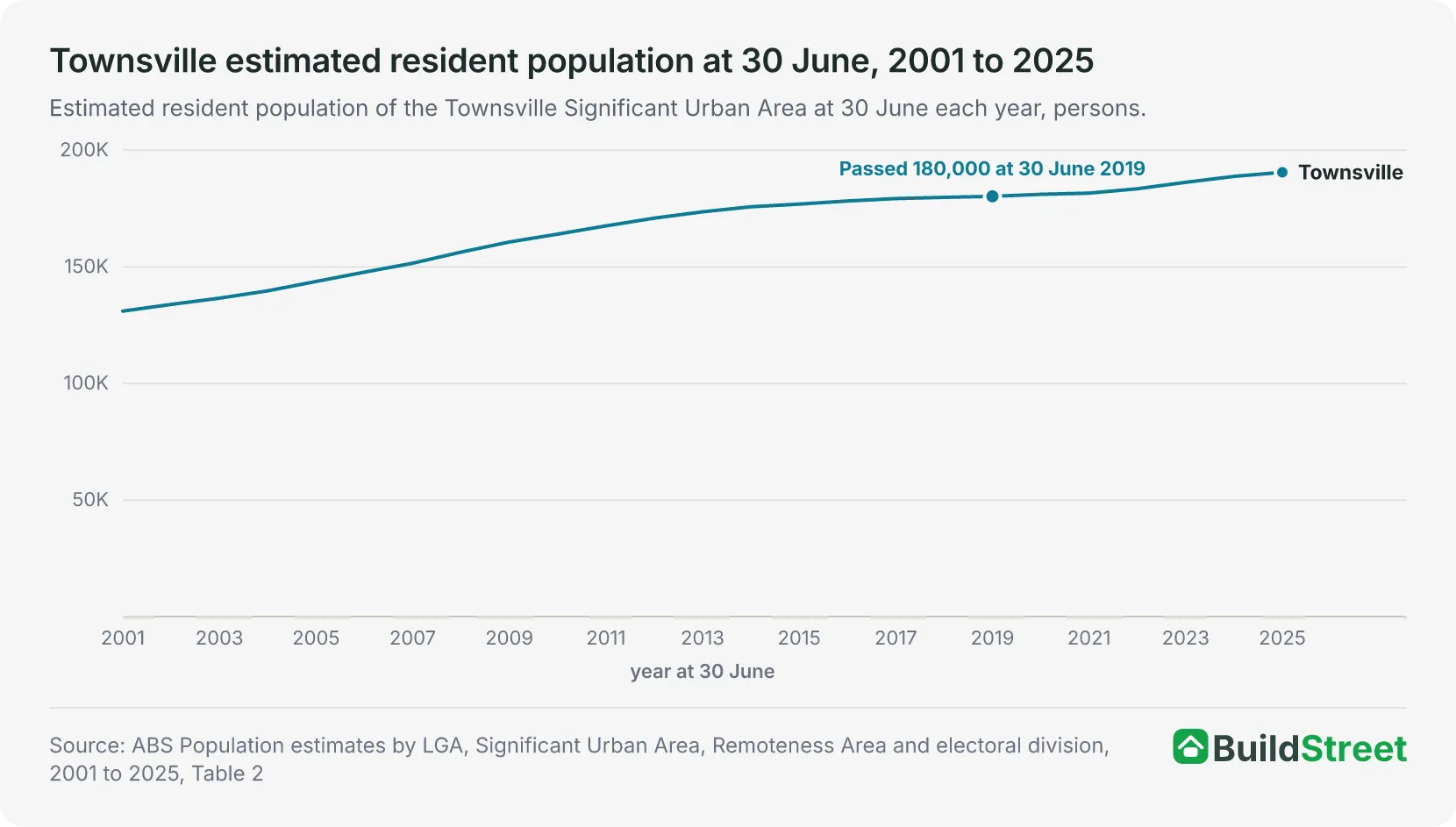
The urban area added 59,533 people between 30 June 2001 and 30 June 2025, growing from 131,018 to 190,551. That is an increase of 45.4 per cent2.
Townsville first exceeded 150,000 at 30 June 2007, 160,000 at 30 June 2009, 170,000 at 30 June 2012, 180,000 at 30 June 2019 and 190,000 at 30 June 20252. The intervals between these milestones were two years to 160,000, three years to 170,000, seven years to 180,000 and six years to 190,000.
The City of Townsville council area grew from 142,012 at 30 June 2001 to 200,930 at 30 June 2023, the first 30 June at or above 200,000. It had 206,260 people at 30 June 2025, the seventh-largest population among Queensland's 78 council areas2.
| Townsville urban area population milestones in the annual series | ||
|---|---|---|
| Milestone | First 30 June at or above | Population that year |
| 150,000 | 30 June 2007 | 151,560 |
| 160,000 | 30 June 2009 | 160,657 |
| 170,000 | 30 June 2012 | 170,885 |
| 180,000 | 30 June 2019 | 180,239 |
| 190,000 | 30 June 2025 | 190,551 |
Source · ABS Population estimates by LGA, Significant Urban Area, Remoteness Area and electoral division, 2001 to 2025, Table 2
Section 08
Townsville population: quick answers
How many people live in Townsville?
The Townsville Significant Urban Area had an estimated resident population of 190,551 at 30 June 2025. That was the fourth-largest population of the 19 urban areas in Queensland, and the 14th largest in Australia. The 30 June 2025 estimates are preliminary. The next release, covering 30 June 2026, is due on 25 March 2027.
Is Townsville bigger than Cairns?
Townsville had 190,551 people at 30 June 2025 and Cairns had 164,149, a gap of 26,402 people. Townsville was larger in every year from 2001 to 2025. Cairns grew by 55.8 per cent over the 24 years, compared with 45.4 per cent for Townsville. However, Townsville added more people in 2024-25, increasing by 1,752 compared with 1,404 in Cairns.
How fast is Townsville's population growing?
The Townsville urban area added 1,752 people, or 0.93 per cent, in 2024-25. The largest annual increase was 4,750 people, or 3.13 per cent, in 2007-08. The smallest was 437 people, or 0.24 per cent, in 2018-19. The 2024-25 rate was the lowest since 2020-21.
What is the difference between the Townsville urban area and the City of Townsville?
The Townsville urban area is a Significant Urban Area, an ABS boundary covering the connected urban centre. It had 190,551 people at 30 June 2025. The City of Townsville is a local government area with a different, larger boundary. It had 206,260 people on the same date, 15,709 more than the urban area. The three statistical areas in the Townsville SA3 that sit outside the urban boundary, Northern Beaches, Townsville - South and Magnetic Island, had 15,715 people between them. ABS figures for the two boundaries are not interchangeable.
Is Townsville the largest city in north Queensland?
Townsville was the largest urban area in north Queensland based on the comparisons in this article, with 190,551 people at 30 June 2025. Cairns had 164,149 people and Mackay had 89,761. The ABS does not define north Queensland as a separate region, so this is not an official ABS regional ranking.
When did Townsville's population pass 200,000?
The Townsville urban area had not reached 200,000 people by 30 June 2025, when its estimated resident population was 190,551. It first exceeded 190,000 at that date. The City of Townsville council area, a larger boundary, passed 200,000 for the first time at 30 June 2023, reaching 200,930, and had 206,260 people at 30 June 2025.
Section 09
Australia population statistics
References
- ABS Regional population, 2024-25 · Australian Bureau of Statistics ↑ b c d
- ABS Regional population, 2024-25: population estimates by LGA and Significant Urban Area, 2001 to 2025 (datacube 32180DS0004) · Australian Bureau of Statistics ↑ b c d e f g h i j k l m n o p
- ABS Regional population, 2024-25: population estimates by SA2 and above, 2001 to 2025 (datacube 32180DS0003) · Australian Bureau of Statistics ↑ b
- ABS Regional population methodology, 2024-25 · Australian Bureau of Statistics ↑ b
- ABS Regional population, 2024-25: population estimates and components by SA2, 2024 to 2025 (datacube 32180DS0001) · Australian Bureau of Statistics ↑ b c d
- ABS Regional population, 2024-25: population estimates and components by LGA, 2024 to 2025 (datacube 32180DS0002) · Australian Bureau of Statistics ↑ b
- ABS Regional population, 2024-25: population components by LGA, 2021-22 to 2024-25 (datacube 32180DS0006) · Australian Bureau of Statistics ↑
