
Published 2 Sept 2026
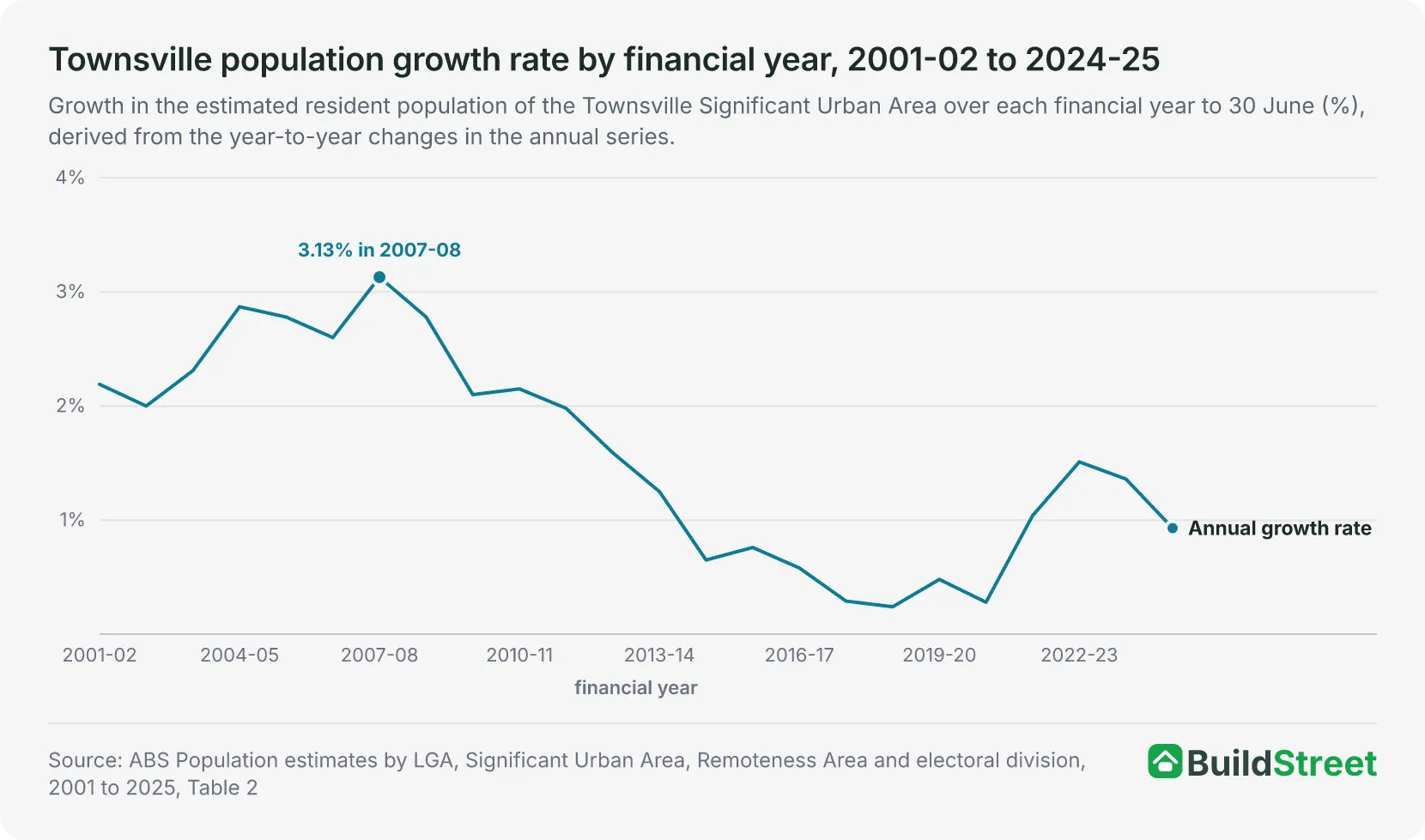 Townsville, Queensland’s fourth largest urban areaTownsville was the fourth largest urban area in Queensland at 30 June 2025, with 190,551 people, and Cairns the fifth. The Townsville article covers its total, drivers and long-run series on the same ABS boundaries.
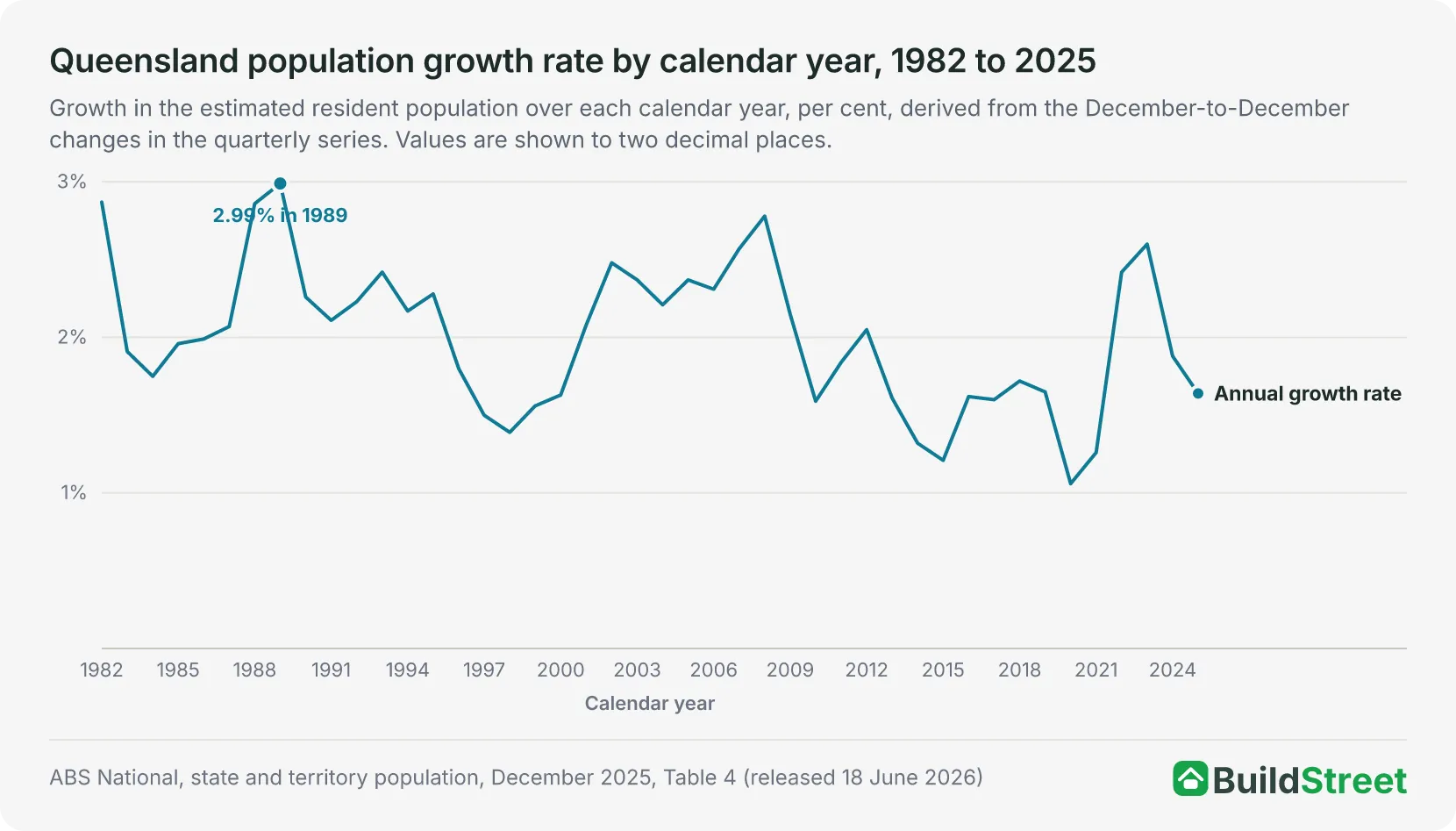 The state pictureQueensland had an estimated resident population of 5,669,764 at 30 June 2025 in the ABS annual series. The state article covers the total, its drivers and the split between Greater Brisbane and the rest of the state.
Section 01 · The headline number
How many people live in Cairns?
The Cairns Significant Urban Area had an estimated resident population of 164,149 at 30 June 2025. That was the fifth largest of Queensland’s 19 urban areas, behind Brisbane, Gold Coast - Tweed Heads, the Sunshine Coast and Townsville, and the 15th largest of the urban areas in Australia1. Cairns accounted for 2.9 per cent of Queensland’s estimated 5,669,764 people and 0.59 per cent of Australia’s 27,613,654 people2.
The ABS publishes population estimates annually for 30 June. In the 2024-25 release, the estimates are final for 2001 to 2021, revised for 2022 to 2024 and preliminary for 20253. The next release, covering 30 June 2026, is due on 25 March 20274.
Section 02 · The pace
How fast is the population of Cairns growing?
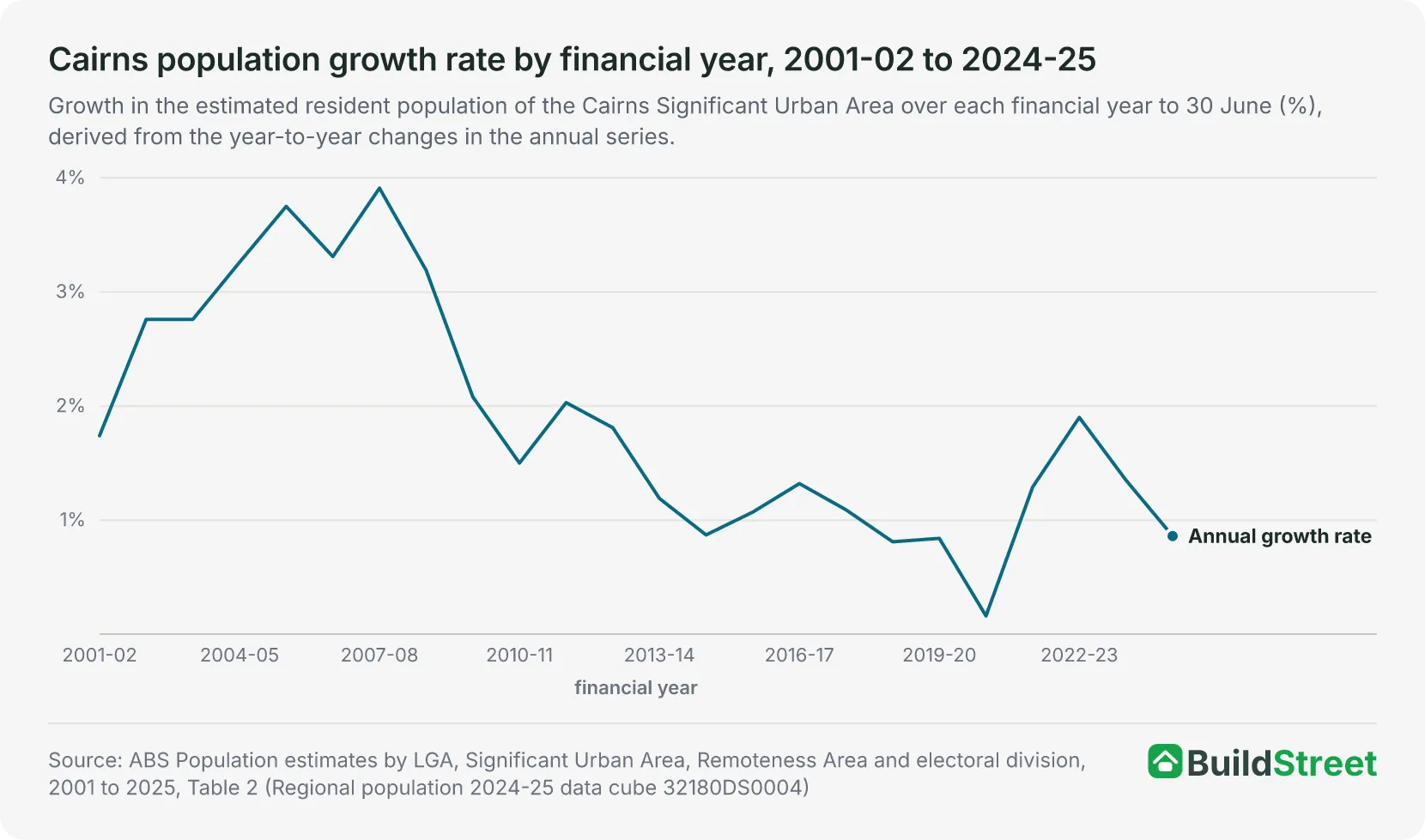
The Cairns urban area grew by 1,404 people, or 0.86 per cent, in 2024-25. The increase was the smallest since 2020-21, when the urban area added 253 people. The three years in between recorded larger gains of 2,008 in 2021-22, 2,996 in 2022-23 and 2,167 in 2023-241.
Across the 24 financial years from 2001-02 to 2024-25, annual growth ranged from 0.16 per cent to 3.91 per cent, and the population increased in every year. The highest rate, 3.91 per cent, was recorded in 2007-08, when Cairns added 4,905 people, also the largest increase during this period. Growth stayed above 3 per cent for five consecutive years, from 2004-05 to 2008-091.
The slowest year was 2020-21, at 253 people (0.16 per cent). Growth in the ten years from 2011-12 to 2020-21 ranged from 0.16 per cent to 2.03 per cent. Even the fastest year of that decade grew more slowly than any year from 2004-05 to 2008-09. The rate rose from 1.29 per cent in 2021-22 to 1.90 per cent in 2022-23, then slowed to 1.35 per cent in 2023-24 and 0.86 per cent in 2024-25.
Section 03 · The drivers
What drives population growth in Cairns?
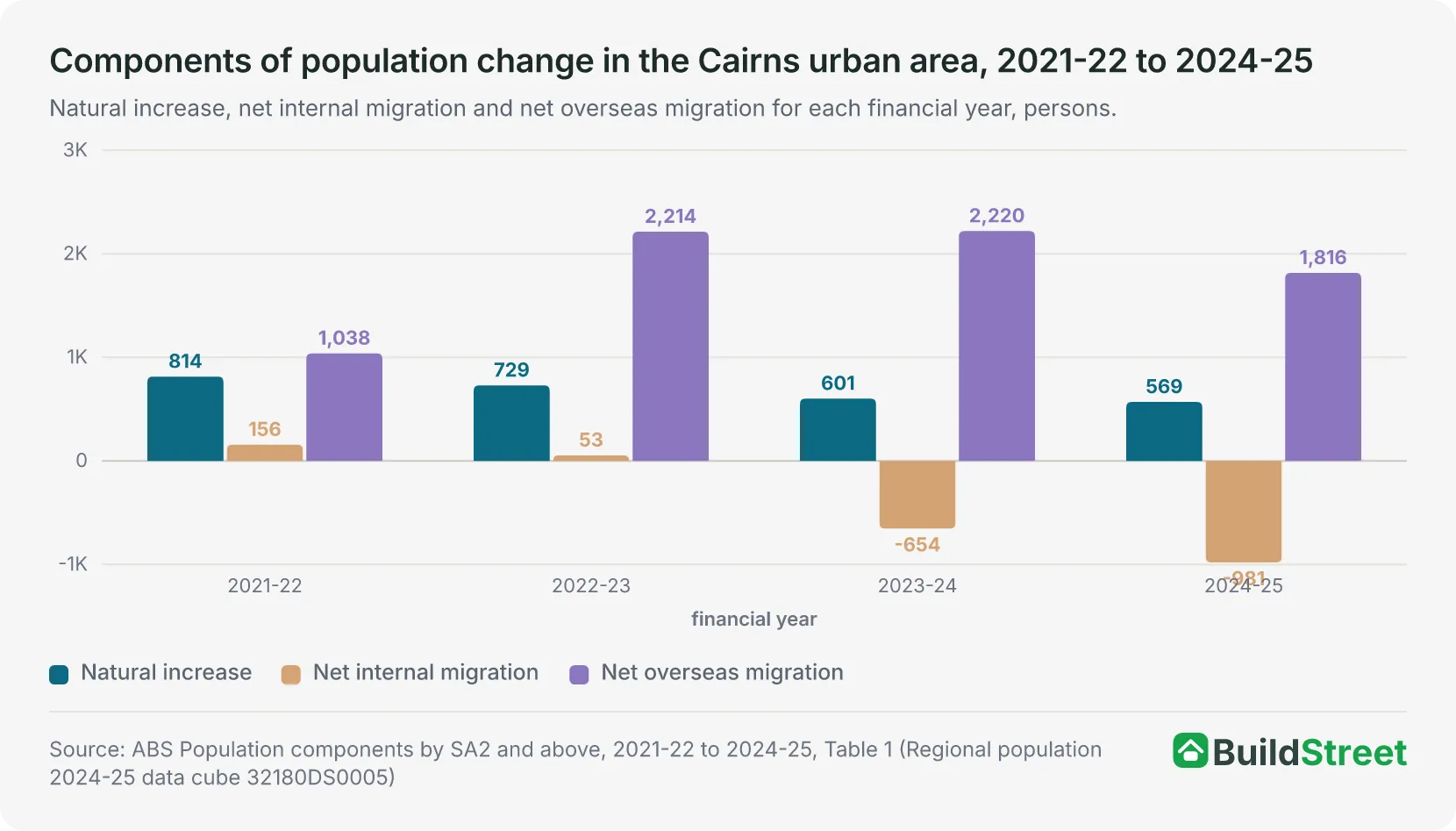
Net overseas migration was the largest contributor to population growth in the Cairns urban area in 2024-25, adding 1,816 people. Natural increase (the excess of births over deaths) added 569 people. Net internal migration (moves to and from elsewhere in Australia) subtracted 981. Together, the three components accounted for the urban area’s increase of 1,4046.
The ABS does not publish population components for urban areas, so the Cairns figures are calculated by adding the published data for the 18 smaller areas that make up the urban area.
Net overseas migration was the largest component in each of the four years from 2021-22 to 2024-25, adding 1,038 people in 2021-22, 2,214 in 2022-23, 2,220 in 2023-24 and 1,816 in 2024-25. Net internal migration added 156 people in 2021-22 and 53 in 2022-23, then subtracted 654 in 2023-24 and 981 in 2024-25. Natural increase declined in each year, from 814 in 2021-22 to 569 in 2024-257.
The pattern varied by council area. The Cairns Regional Council area gained 1,761 people over 2024-25. Net overseas migration added 1,859, natural increase added 643 and net internal migration subtracted 741. Net overseas migration was also the largest component in three of the five council areas that border Cairns: Cassowary Coast, Douglas and Mareeba. Net internal migration was the largest component in Tablelands, at 273 people, and natural increase was the largest in Yarrabah, at 425. Deaths exceeded births in Cassowary Coast, Douglas and Tablelands.
| Components of population change by council area in and around Cairns, 2024-25 | ||||
|---|---|---|---|---|
| Council area (LGA) | Natural increase | Net internal migration | Net overseas migration | Total change |
| Cairns | +643 | -741 | +1,859 | +1,761 |
| Tablelands | -74 | +273 | +128 | +327 |
| Cassowary Coast | -15 | +85 | +231 | +301 |
| Mareeba | +18 | +97 | +150 | +265 |
| Douglas | -4 | -36 | +171 | +131 |
| Yarrabah | +42 | -27 | +0 | +15 |
Source · ABS Population estimates and components by LGA, 2024 to 2025, Table 3
Section 04 · The growth areas
Where in Cairns is the population growing fastest?
Trinity Beach - Smithfield recorded both the largest 2024-25 increase and the highest growth rate of the 18 areas that make up the Cairns urban area, adding 500 people (2.6 per cent) to reach 19,862 at 30 June 2025. Clifton Beach - Kewarra Beach grew by 213 people (1.7 per cent), Redlynch 160 (1.1 per cent) and Cairns City 138 (1.0 per cent)6. Three of the 18 areas declined over the year: Earlville - Bayview Heights lost 32 people, Manunda 31 and Whitfield - Edge Hill 2.
The wider Cairns region covers 33 smaller areas. Gordonvale - Trinity, which lies outside the urban area boundary, had the highest 2024-25 growth rate among the 33 areas, at 2.8 per cent, growing from 11,103 people at 30 June 2024 to 11,413 at 30 June 2025. Cairns City had the largest net overseas migration gain among these 33 areas, at 546 people, and the largest net internal migration loss, at 4136. The Cairns - North region grew 1.48 per cent over the year, adding 926 people, and Cairns - South grew 0.71 per cent, adding 7882.
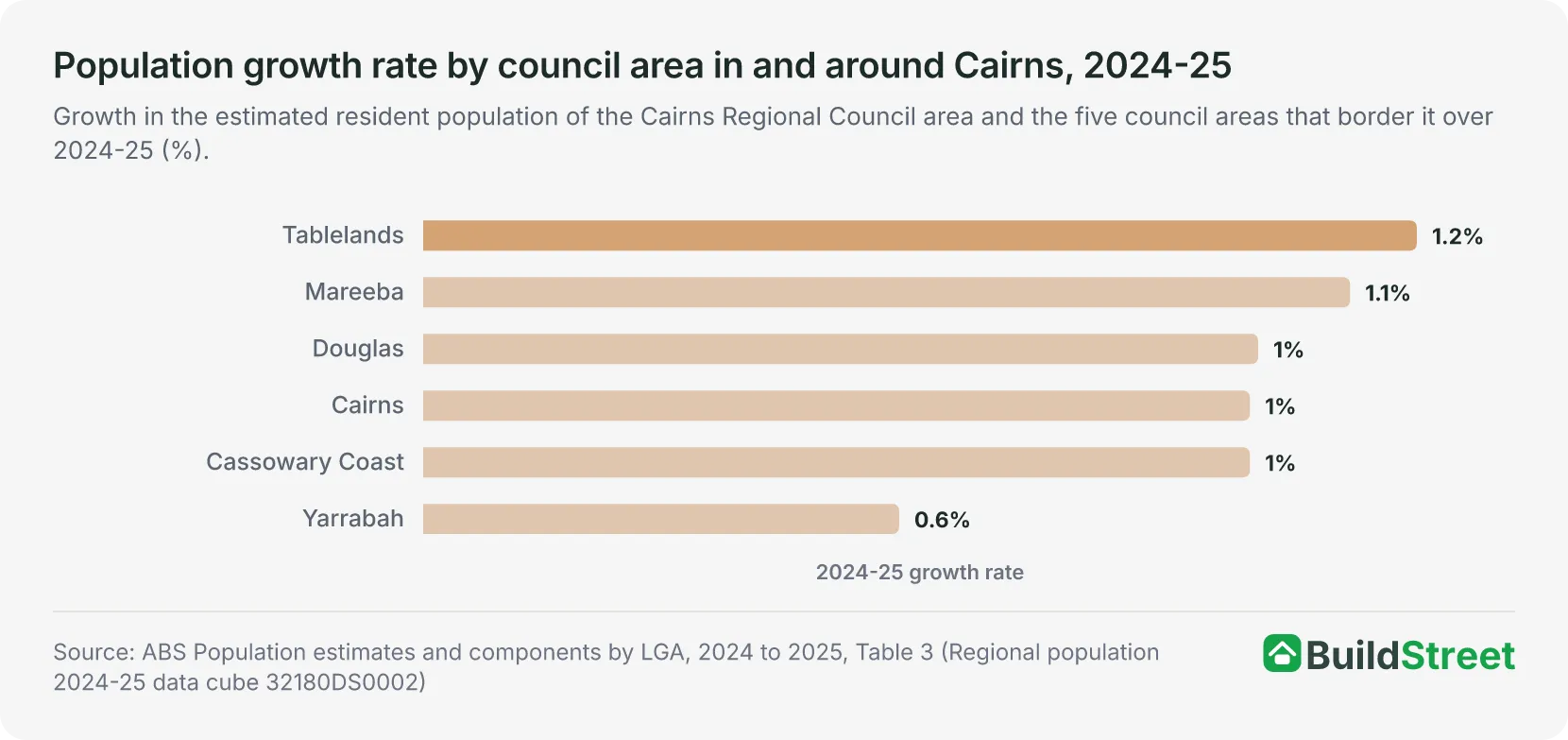
Among the six council areas, Tablelands grew fastest in 2024-25, at 1.19 per cent, followed by Mareeba at 1.11 per cent and Douglas at 1.00 per cent. Cairns and Cassowary Coast both grew 0.99 per cent, and Yarrabah 0.57 per cent5.
| The five largest population increases in the Cairns SA4 region, 2024-25 | ||||||
|---|---|---|---|---|---|---|
| Area (SA2) | Region (SA3) | In the urban area | 30 June 2024 | 30 June 2025 | Change | Growth rate % |
| Trinity Beach - Smithfield | Cairns - North | Yes | 19,362 | 19,862 | +500 | 2.6 |
| Gordonvale - Trinity | Cairns - South | No | 11,103 | 11,413 | +310 | 2.8 |
| Clifton Beach - Kewarra Beach | Cairns - North | Yes | 12,547 | 12,760 | +213 | 1.7 |
| Mareeba | Tablelands (East) - Kuranda | No | 12,577 | 12,752 | +175 | 1.4 |
| Tully | Innisfail - Cassowary Coast | No | 11,693 | 11,867 | +174 | 1.5 |
Source · ABS Population estimates and components by SA2, 2024 to 2025, Table 3
Section 05 · The state picture
How does Cairns compare with other cities in Queensland?
Cairns was the fifth largest of the 19 urban areas in Queensland at 30 June 2025. Brisbane had 2,745,086 people, Gold Coast - Tweed Heads had 761,634, the Sunshine Coast had 424,741, Townsville had 190,551 and Cairns had 164,149. Toowoomba, at 153,781, and Mackay, at 89,761, were the next largest1.
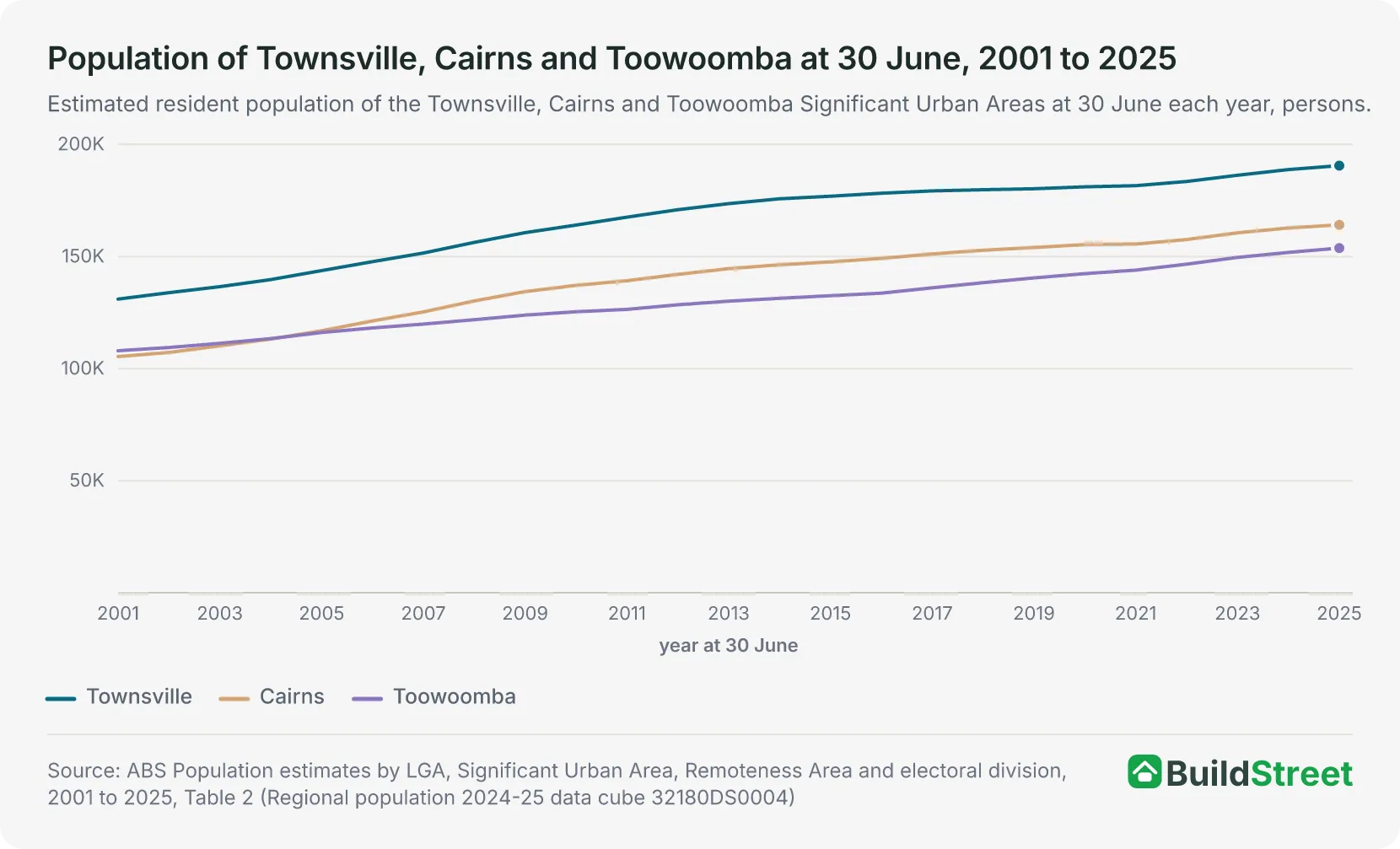
Cairns ranked fifth in Queensland from 30 June 2005, when its population reached 116,891 and passed Toowoomba at 116,121. Toowoomba had been larger in each of the previous four years, and was 2,602 people larger at 30 June 2001. The gap widened to 15,528 people at 30 June 2016 before narrowing to 10,368 at 30 June 20251.
Between 30 June 2001 and 30 June 2025, Townsville, the state’s fourth-largest urban area, added 59,533 people, an increase of 45.4 per cent, and Cairns added 58,776, an increase of 55.8 per cent. The gap between them was 25,645 people at 30 June 2001 and 26,402 at 30 June 2025.
In 2024-25, Cairns’s growth rate of 0.86 per cent was the second lowest among the state’s seven largest urban areas, above Mackay’s 0.84 per cent and below Townsville’s 0.93 per cent and Toowoomba’s 1.28 per cent1. Across the rest of Queensland outside Greater Brisbane, the population grew by about 39,700 people, or 1.4 per cent, in 2024-254.
The state’s population data is covered in the Queensland population article.
Section 06 · The national rank
Where does Cairns rank among Australia’s largest cities?
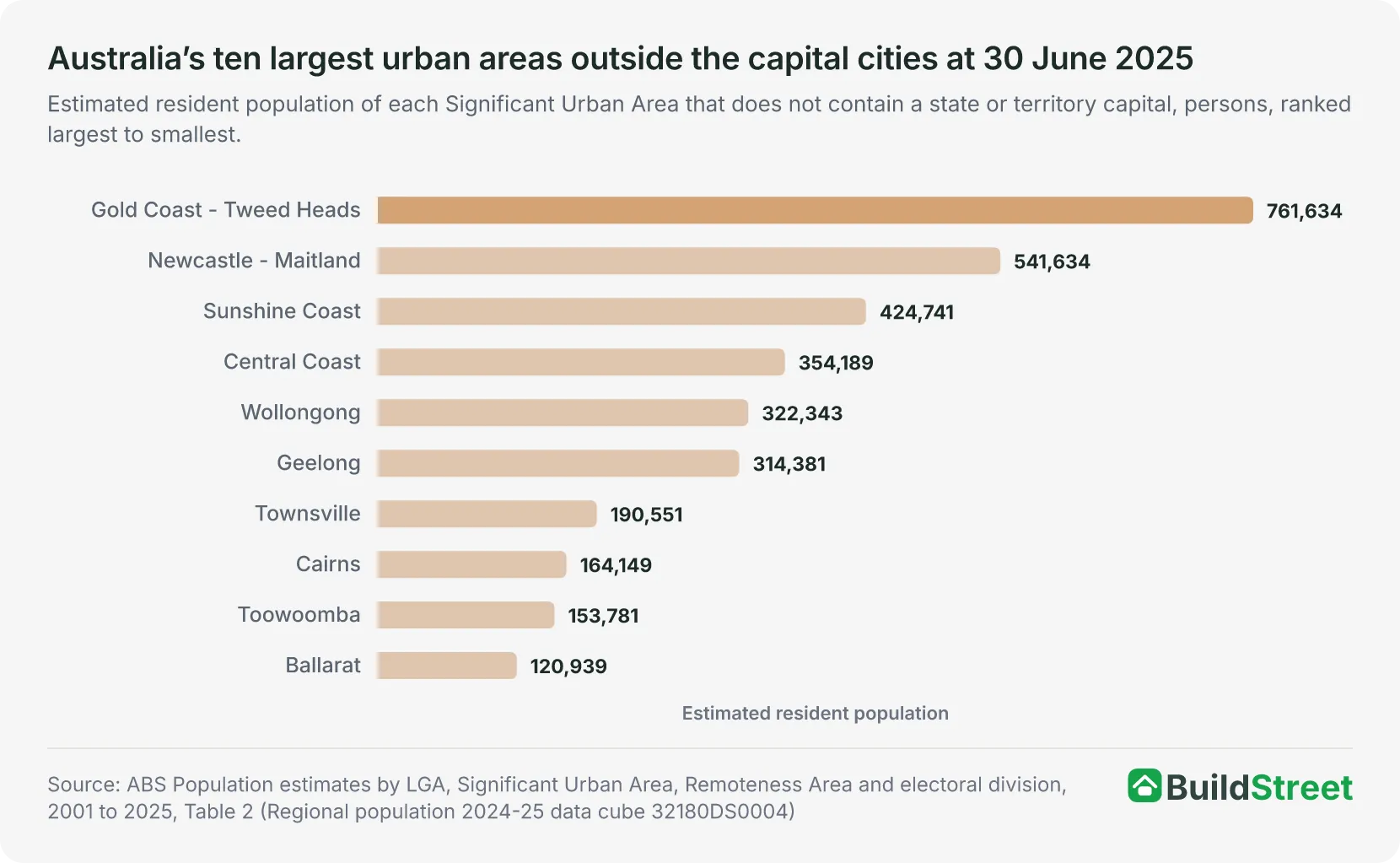
Cairns was Australia’s fifteenth-largest urban area at 30 June 2025. Seven of the 14 larger urban areas were capital cities: every capital except Darwin. The other seven were Gold Coast - Tweed Heads with 761,634 people, Newcastle - Maitland with 541,634, the Sunshine Coast with 424,741, the Central Coast with 354,189, Wollongong with 322,343, Geelong with 314,381 and Townsville with 190,5511. Toowoomba ranked 16th with 153,781 people, followed by Darwin with 145,019.
Among the 94 urban areas that do not contain a capital city, Cairns ranked eighth. Its national rank was 16th at 30 June 2001, when Toowoomba was larger, and Cairns ranked 15th from 30 June 2005 onwards.
Growth in 2024-25 varied across the 20 largest urban areas, from 0.15 per cent in Hobart to 2.40 per cent in Perth. Cairns’s 0.86 per cent ranked 17th of the 20, above Bendigo at 0.84 per cent, the Central Coast at 0.68 per cent and Hobart at 0.15 per cent, and below Townsville at 0.93 per cent1.
| Australia’s 11th to 20th largest urban areas, as at 30 June 2025 | |||||
|---|---|---|---|---|---|
| Rank | Urban area (SUA) | Listed under | Population | Change over 2024-25 | Growth rate % |
| 11 | Wollongong | New South Wales | 322,343 | +3,642 | 1.14 |
| 12 | Geelong | Victoria | 314,381 | +6,360 | 2.06 |
| 13 | Hobart | Tasmania | 233,736 | +346 | 0.15 |
| 14 | Townsville | Queensland | 190,551 | +1,752 | 0.93 |
| 15 | Cairns | Queensland | 164,149 | +1,404 | 0.86 |
| 16 | Toowoomba | Queensland | 153,781 | +1,943 | 1.28 |
| 17 | Darwin | Northern Territory | 145,019 | +2,520 | 1.77 |
| 18 | Ballarat | Victoria | 120,939 | +2,098 | 1.77 |
| 19 | Bendigo | Victoria | 106,493 | +883 | 0.84 |
| 20 | Albury - Wodonga | New South Wales | 102,435 | +1,183 | 1.17 |
Source · ABS Population estimates by LGA, Significant Urban Area, Remoteness Area and electoral division, 2001 to 2025, Table 2
Section 07 · The long run
How has the population of Cairns changed since 2001?
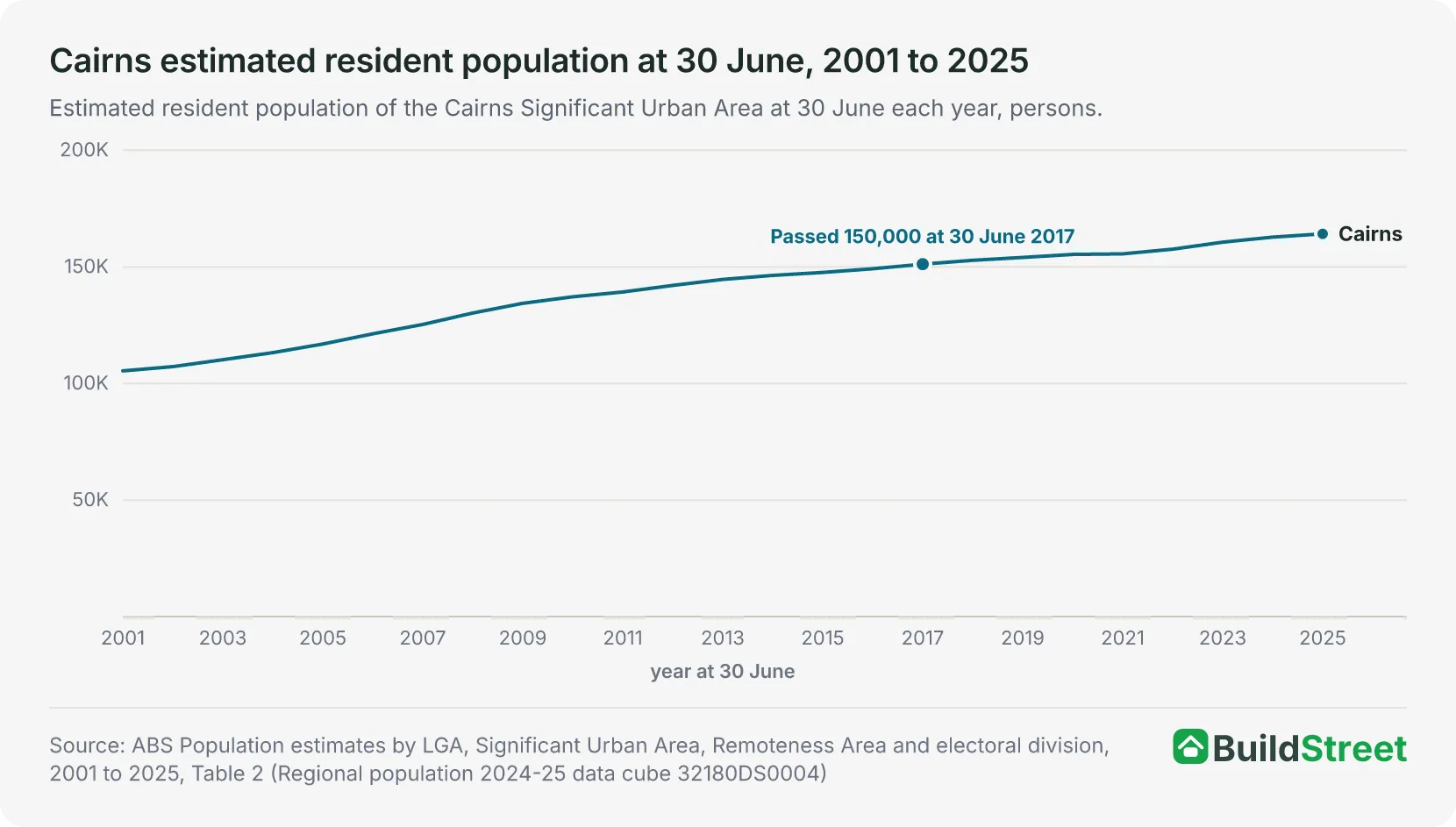
The urban area added 58,776 people between 30 June 2001 and 30 June 2025, growing from 105,373 to 164,149, an increase of 55.8 per cent1.
About half of that increase, 28,982 people, occurred in the eight years to 30 June 2009, when the population reached 134,355. The remaining 29,794 occurred in the 16 years from 30 June 2009 to 30 June 2025.
Cairns first exceeded 110,000 people at 30 June 2003, 120,000 at 30 June 2006, 130,000 at 30 June 2008, 140,000 at 30 June 2012, 150,000 at 30 June 2017 and 160,000 at 30 June 20231. The intervals between the 10,000-person milestones lengthened from two years, between 2006 and 2008, to six years, between 2017 and 2023.
Over the same period, the Cairns Regional Council area grew from 115,373 at 30 June 2001 to 179,334 at 30 June 2025, an increase of 63,961 people (55.4 per cent)1.
| Cairns population milestones in the annual series | ||
|---|---|---|
| Milestone | First 30 June at or above | Population that year |
| 110,000 | 30 June 2003 | 110,165 |
| 120,000 | 30 June 2006 | 121,276 |
| 130,000 | 30 June 2008 | 130,197 |
| 140,000 | 30 June 2012 | 142,038 |
| 150,000 | 30 June 2017 | 151,150 |
| 160,000 | 30 June 2023 | 160,578 |
Source · ABS Population estimates by LGA, Significant Urban Area, Remoteness Area and electoral division, 2001 to 2025, Table 2
Section 08
Cairns population: quick answers
How many people live in Cairns?
The Cairns Significant Urban Area had an estimated resident population of 164,149 at 30 June 2025, according to ABS Regional population data published on 31 March 2026.1 Cairns ranked fifth among Queensland’s 19 urban areas and 15th among Australia’s 102 urban areas. The 30 June 2025 estimates are preliminary. The next release, covering 30 June 2026, is due on 25 March 2027.4
Is Cairns bigger than Townsville?
No. Townsville had 190,551 people at 30 June 2025 and Cairns 164,149, a gap of 26,402 people.1 They were the fourth and fifth largest urban areas in Queensland. Between 30 June 2001 and 30 June 2025, Cairns grew by 55.8 per cent, compared with 45.4 per cent for Townsville. The gap between them grew from 25,645 people at 30 June 2001 to 26,402 at 30 June 2025.
How fast is the population of Cairns growing?
The Cairns urban area added 1,404 people, or 0.86 per cent, in 2024-25.1 The population increased in each financial year from 2001-02 to 2024-25. The largest annual increase was 4,905 people, or 3.91 per cent, in 2007-08. The smallest was 253 people, or 0.16 per cent, in 2020-21. The 2024-25 increase was the smallest since 2020-21.
What is the difference between the Cairns urban area and the Cairns Regional Council area?
The Cairns Significant Urban Area is an ABS statistical boundary built from 18 of the 20 Statistical Areas Level 2 in the Cairns - North and Cairns - South regions (Gordonvale - Trinity and Lamb Range are left out), and it had 164,149 people at 30 June 2025. The Cairns Regional Council area is a local government area, a different boundary covering 1,689.3 square kilometres against the urban area’s 253.8, and it had 179,334 people on the same date.1 ABS figures for the two boundaries are not directly interchangeable.
When did the population of Cairns pass 150,000?
The Cairns urban area first exceeded 150,000 people at 30 June 2017, when its population was 151,150.1 It first passed 125,000 at 30 June 2007 and 160,000 at 30 June 2023.
Section 09
Australia population statistics
- Alice Springs population
- Ballarat population
- Brisbane population
- Byron Bay population
- Darwin population
- Geelong population
- Gold Coast population
- Melbourne population
- NSW population
- Perth population
- Queensland population
- Sunshine Coast population
- Townsville population
- Victoria population
- Western Australia population
References
- ABS Regional population, 2024-25: population estimates by LGA and Significant Urban Area, 2001 to 2025 (datacube 32180DS0004) · Australian Bureau of Statistics ↑ b c d e f g h i j k l m n o p q
- ABS Regional population, 2024-25: population estimates by SA2 and above, 2001 to 2025 (datacube 32180DS0003) · Australian Bureau of Statistics ↑ b c
- ABS Regional population methodology, 2024-25 · Australian Bureau of Statistics ↑ b
- ABS Regional population, 2024-25 · Australian Bureau of Statistics ↑ b c
- ABS Regional population, 2024-25: population estimates and components by LGA, 2024 to 2025 (datacube 32180DS0002) · Australian Bureau of Statistics ↑ b c
- ABS Regional population, 2024-25: population estimates and components by SA2, 2024 to 2025 (datacube 32180DS0001) · Australian Bureau of Statistics ↑ b c
- ABS Regional population, 2024-25: population components by SA2 and above, 2021-22 to 2024-25 (datacube 32180DS0005) · Australian Bureau of Statistics ↑ b
