
Published 26 June 2026 · Updated 18 Sept 2026
Australia has more than two dozen federal, state and territory housing schemes in 2026, including deposit guarantees, shared equity schemes, first home owner grants and stamp duty concessions. More than 230,000 Australians had used the Home Guarantee Scheme since January 2020, based on Housing Australia's 2024-25 reporting.
The national public housing waitlist reached 189,536 households in June 2025, the highest figure recorded since 2014. Median house prices in Brisbane, Perth and Adelaide each rose more than 12% in the year to March 2026, placing those markets above the federal 5% Deposit Scheme price caps in each city.
Source · Building Approvals, Australia, March 2026 · from www.abs.gov.au
 First home buyer support in Australia in 2026: grants, guarantees and concessions by stateMore than one in three first home buyers nationally used the federal deposit guarantee scheme in 2024–25, up from one in ten in 2020–21, the scheme's first full year of operation. Seasonally adjusted…
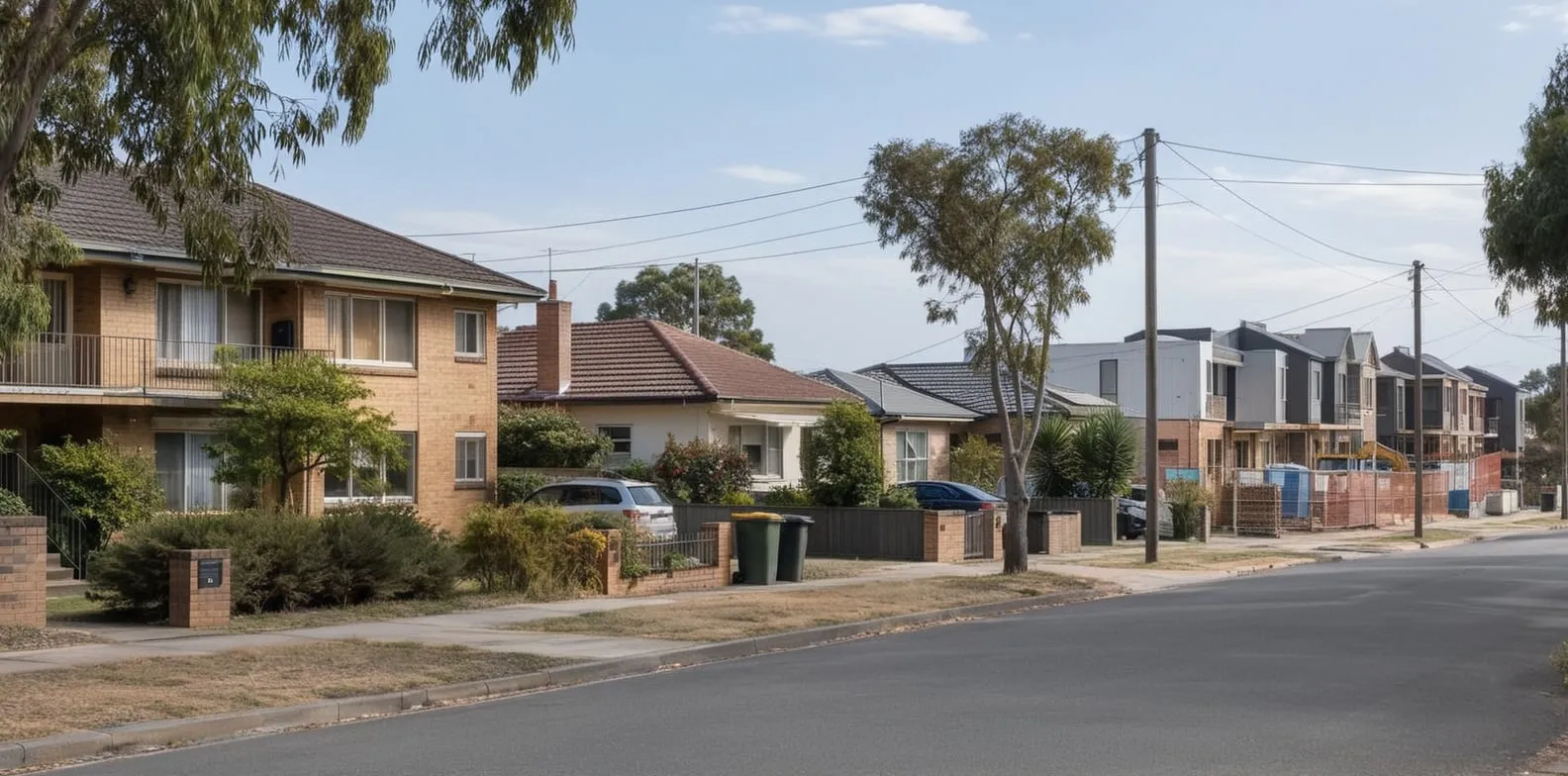 A history of Australian housing policy: every major scheme and how it workedIn 2025, dwelling approvals rose 13.3%, while completions fell 2.9%. Over the same period, the share of Australian households in social housing fell from 4.7% in 2013 to 4.0% in 2025, despite governme…
Section 01 · FEDERAL SCHEMES
Federal government housing schemes in Australia
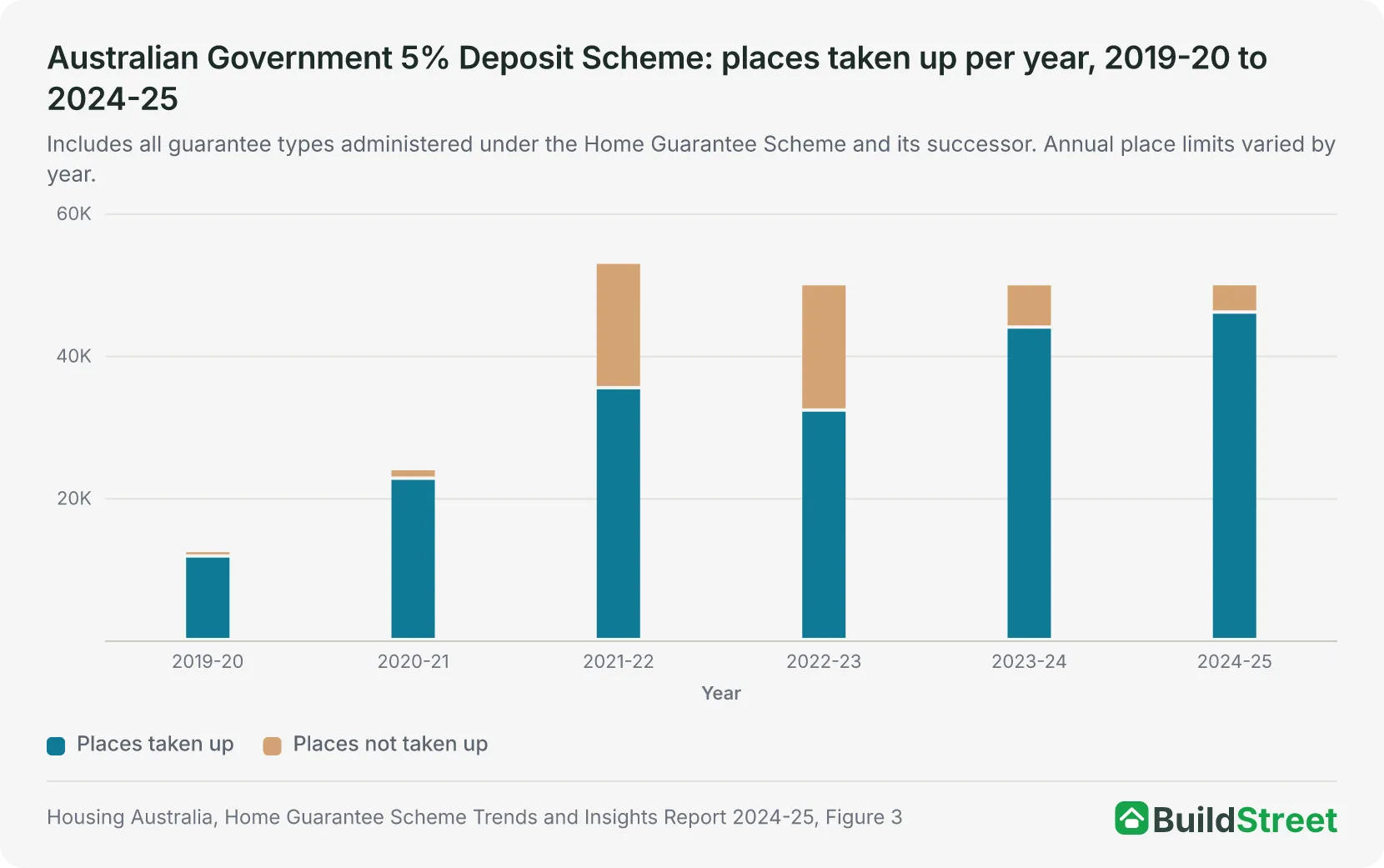
The federal 5% Deposit Scheme supported 1 in 3 first home buyers nationally in 2024-25, with 46,022 of 50,000 available places taken up.
Federal housing support falls into two broad categories:
- buyer support schemes, including deposit guarantees, shared equity and superannuation savings;
- supply-side programmes that fund new social and affordable housing.
Most federal buyer and supply schemes listed here are administered by Housing Australia, while the First Home Super Saver Scheme is administered by the Australian Taxation Office.
Deposit and purchase support schemes
Australian Government 5% Deposit Scheme
Deposit guarantee. Formerly the Home Guarantee Scheme, this scheme allows eligible buyers to purchase a home with a 5% deposit without paying lenders mortgage insurance. Income caps were removed from 1 October 2025 and annual place limits were lifted. In 2024-25, 46,022 of 50,000 places were taken up (92%), with the First Home Guarantee and Regional First Home Buyer Guarantee both reaching 100% uptake. The Family Home Guarantee for single parents reached only 22% uptake.
Min. deposit: 5% (2% for single parents). No income cap from Oct 2025.
Help to Buy Scheme
Shared equity. The federal government contributes up to 40% equity on new homes (30% on existing homes), reducing the buyer's loan size and required deposit to 2%. Up to 10,000 places per year are available. The Help to Buy Act 2024 received Royal Assent in December 2024, with the scheme commencing in 2025-26. Income caps: $100,000 for individuals and $160,000 for single parents and joint applicants.
Min. deposit: 2%. Property price caps vary by location. Income-tested.
First Home Super Saver Scheme
Superannuation savings. The First Home Super Saver Scheme allows first home buyers to make voluntary super contributions and later withdraw eligible amounts, plus associated earnings, to put towards a deposit. The lifetime withdrawal cap is $50,000 per person. Concessional contributions are generally taxed at 15%, which is usually less than the buyer's marginal income tax rate. The tax benefit varies depending on income, contribution type and individual tax position. Administered by the ATO.
Annual voluntary contribution limit: $15,000. Lifetime cap: $50,000.
Family Home Guarantee
Single parents. Targets single parents and single legal guardians with dependants, including those who are not first home buyers. A 2% deposit is sufficient, with the government guaranteeing the remainder to 80% LVR. Only 1,088 of 5,000 places were taken up in 2024-25, the lowest uptake rate of any federal scheme. Absorbed into the 5% Deposit Scheme structure from October 2025.
Min. deposit: 2%. No income cap from Oct 2025 under the 5% Deposit Scheme.
Joint borrowers received 59% of federal guarantees in 2024-25
59% of guarantees went to joint borrowers in 2024-25, down from 62% the previous year. Buyers under 30 made up 49% of all participants.
Median purchase prices for scheme participants rose year-on-year:
- Joint borrowers (median income $134,000) paid a median of $640,000, up 6%.
- Single borrowers (median income $85,000) paid $500,000, up 9%.
Key workers, primarily nurses and teachers, made up 28% of recipients.
Section 02 · STATE AND TERRITORY SCHEMES
State and territory first home buyer schemes in Australia
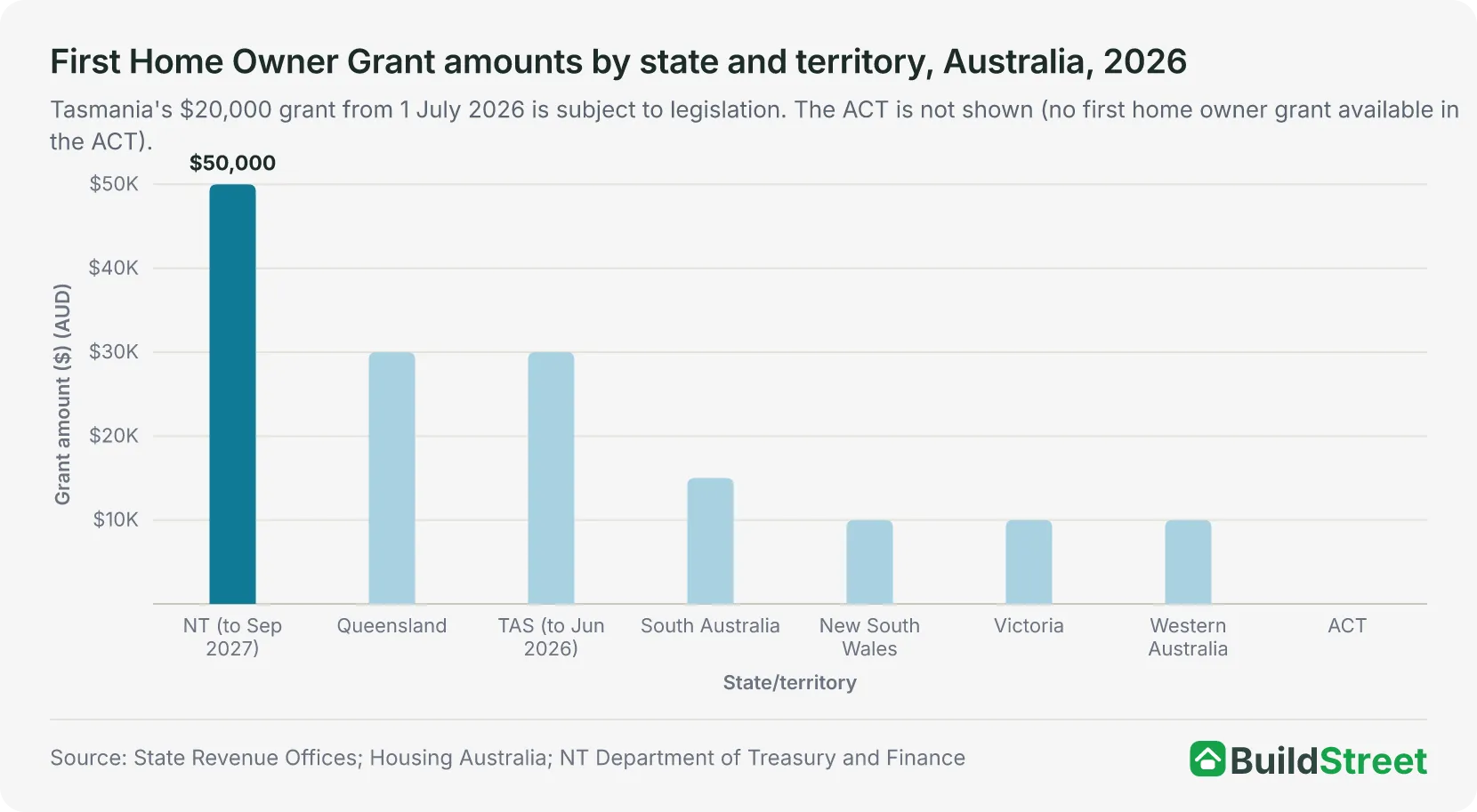
Grant amounts range from $10,000 in NSW, Victoria and Western Australia to $50,000 under the NT's HomeGrown Territory Grant.
Every state and territory offers some form of stamp duty concession for eligible buyers. Several jurisdictions have active shared equity schemes, while the federal 5% Deposit Scheme operates nationally.
- First home buyer grant
- $10,000
- New homes only. No income test; price cap applies.
- Stamp duty relief
- Exempt to $800,000
- Concession applies up to $1,000,000. Applies to new and existing homes.
- Shared equity scheme
- None
- No state shared equity scheme available.
- Occupancy requirement
- 12 months
- Must occupy as principal place of residence.
- First home buyer grant
- $10,000
- New homes only.
- Stamp duty relief
- Exempt to $600,000
- Taper applies up to $750,000. Applies to new and existing homes.
- Shared equity scheme
- BuyAssist
- Low income only. Victorian Homebuyer Fund closed. BuyAssist remains active.
- Occupancy requirement
- 12 months
- Must occupy as principal place of residence.
- First home buyer grant
- $30,000
- For contracts signed to 30 June 2026; new home must be valued under $750,000. Reverts to $15,000 otherwise.
- Stamp duty relief
- Nil on new homes
- No transfer duty on new homes or vacant land from May 2025. No price cap applies.
- Shared equity scheme
- Boost to Buy
- QLD Boost to Buy (Round 2): 30% new / 25% existing. 500 places in Round 2. Active.
- Occupancy requirement
- 6 months
- Must occupy as principal place of residence for six continuous months.
- First home buyer grant
- $15,000
- New homes and eligible land. No price cap from June 2024.
- Stamp duty relief
- Relief
- Duty relief on new homes and land from June 2023. No price cap applies.
- Shared equity scheme
- None
- No state shared equity scheme available.
- Occupancy requirement
- 6 months
- Must reside continuously for at least six months, commencing within 12 months of completion.
- First home buyer grant
- $10,000
- Metro FHOG cap raised to $800,000 from May 2026.
- Stamp duty relief
- Exempt to $600,000
- Concession to $800,000. Bill introduced 17 June 2026, pending Parliament. System updates estimated late July 2026. Pre-update transactions refunded retrospectively.
- Shared equity scheme
- Urban Connect: up to 35%
- Keystart. Launched Oct 2025. Max govt contribution $250,000. Min 2% deposit. Property cap $800,000. Income caps: $128,000 singles / $197,000 couples (as at May 2026).
- Occupancy requirement
- 6 months
- Six continuous months required.
- First home buyer grant
- $30,000
- For eligible transactions to 30 June 2026. Reduces to $20,000 from 1 July 2026 subject to legislation.
- Stamp duty relief
- 100% exempt
- On existing homes valued at $750,000 or less, for transactions settling on or before 30 June 2026 only. No equivalent exemption after that date.
- Shared equity scheme
- MyHome: up to 40%
- New builds capped at $300,000 equity. Min 2% deposit. Price cap: $800,000 new / $750,000 existing. Income: $97,797–$118,571 single / $112,468–$136,358 couple (from 1 July 2025).
- Occupancy requirement
- 6 months
- Six continuous months required.
- First home buyer grant
- $50,000 (HomeGrown)
- HomeGrown Territory Grant replaced the old FHOG in late 2024: contract or build start by 30 Sept 2027; applications close 30 Sept 2028; no price cap. A separate FreshStart New Home Grant ($30,000) is available for eligible buyers who are not first home buyers; the two grants cannot be combined; FreshStart applications close 31 Dec 2027.
- Stamp duty relief
- Exempt
- New home and land packages exempt to June 2027. No general concession for other purchases.
- Shared equity scheme
- None
- No state shared equity scheme available.
- Occupancy requirement
- 12 months
- Must occupy as principal place of residence.
- First home buyer grant
- None
- FHOG ended in 2019. Replaced by stamp duty support only.
- Stamp duty relief
- Concession to $1,020,000
- Home Buyer Concession Scheme from July 2025. Zero duty announced from 1 July 2026 (2026-27 Budget). Implementing instrument not yet registered as at 18 June 2026.
- Shared equity scheme
- None
- No state shared equity scheme available.
- Occupancy requirement
- 12 months
- Must occupy as principal place of residence.
First Home Owner Grant amounts by state and territory
First Home Owner Grants (FHOG) are one-off cash payments available on new homes. The amount varies by jurisdiction, from $10,000 in NSW, Victoria and Western Australia to $50,000 under the NT's HomeGrown Territory Grant.
The ACT has no first home owner grant. It replaced the FHOG in 2019 with stamp duty concessions at a higher threshold.
Most first-home owner grant-style payments apply to new homes only. Buyers of established properties may be eligible for stamp duty concessions in some jurisdictions, but generally do not receive a cash grant.
Common eligibility conditions across most jurisdictions include:
- At least one applicant must be an Australian citizen or permanent resident.
- The buyer must occupy the property as their principal place of residence.
- Any applicable property price cap must be met.
Occupancy requirements vary by jurisdiction:
- QLD, SA, TAS, WA: six continuous months.
- NSW, VIC, NT, ACT: 12 months.
Stamp duty concessions for first home buyers by state and territory
Stamp duty concessions reduce the upfront cost of buying by cutting or eliminating transfer tax. In NSW and Victoria, stamp duty on a median-priced property can exceed $30,000.
| State / territory | Full exemption threshold | Concession to | Applies to |
|---|---|---|---|
| NSW | $800,000 | $1,000,000 | New and existing homes |
| Victoria | $600,000 | $750,000 | New and existing homes |
| Queensland | No cap | No cap | New homes and vacant land only (from May 2025) |
| South Australia | No cap | N/A | New homes and eligible land (from June 2023) |
| Western Australia | $600,000 (announced from 7 May 2026) | $800,000 | New and existing homes under the First Home Owner Rate. The Bill was introduced on 17 June 2026, with system updates expected in late July 2026. Eligible pre-update transactions are expected to be refunded retrospectively. |
| Tasmania | $750,000 | N/A | Existing homes; 100% exemption applies to transactions settling on or before 30 June 2026 only |
| NT | No cap | N/A | New home and land packages only (to June 2027) |
| ACT | $1,020,000 | N/A | New and existing; zero duty announced from 1 July 2026 (2026-27 Budget). Implementing instrument not yet registered as at 18 June 2026 |
Source · State Revenue Offices, 2026.
Section 03 · SHARED EQUITY
Shared equity schemes in Australia
Active shared equity schemes in Australia can provide government or housing authority equity contributions of up to 40%, with minimum buyer deposits from 2%.
Unlike a deposit guarantee, a shared equity scheme gives the government or housing authority a financial stake in the property. The buyer owns and occupies the home, while the government or housing authority holds a share of the equity. If the property is later sold or the buyer repays the government share, the amount owed generally moves with the property's value.
Several state shared equity schemes have closed in recent years. The federal Help to Buy Scheme commenced in 2025-26 after the Help to Buy Act 2024 received Royal Assent in December 2024.
Help to Buy cannot be combined with another state or territory shared equity scheme, loan or guarantee for the same purchase. Some recipients may also qualify for separate grants, concessions or exemptions, depending on the rules in their jurisdiction.
| Scheme | Jurisdiction | Max govt equity | Min buyer deposit | Places / year | Status |
|---|---|---|---|---|---|
| Help to Buy | Federal | 40% new / 30% existing | 2% | 10,000 | Active |
| MyHome | Tasmania | 40% new / 30% existing | 2% | Not capped | Active |
| Urban Connect (Keystart) | Western Australia | 35% | 2% | 1,000 | Active (from Oct 2025) |
| BuyAssist | Victoria | Varies | Varies | Limited | Active, low income only |
| Victorian Homebuyer Fund | Victoria | N/A | N/A | N/A | Closed |
| QLD Boost to Buy | Queensland | 30% new / 25% existing | 2% | 500 places in Round 2 | Active |
Source · Housing Australia; Homes Tasmania; Keystart WA; HomesVic.
Section 04 · ELIGIBILITY AND PRICE CAPS
Government housing scheme eligibility and property price caps
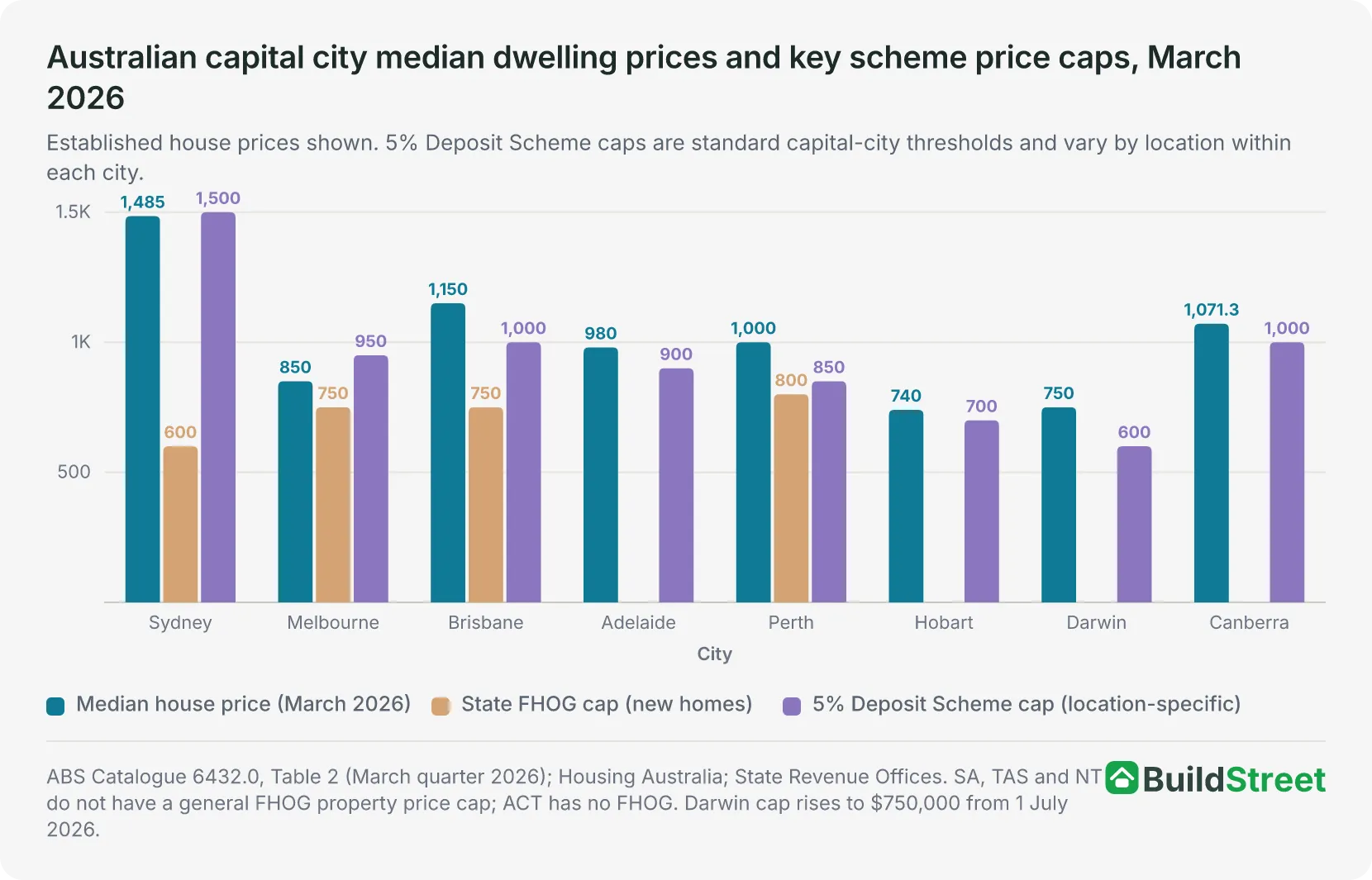
As at March 2026, median established house prices were above the federal 5% Deposit Scheme price cap in Brisbane, Perth, Adelaide, Canberra and Hobart. Darwin was close to the cap, depending on whether the pre-1 July 2026 or post-1 July 2026 cap is used.
Most buyer schemes use property price caps to define eligibility. Price growth in Brisbane, Perth and Adelaide exceeded 12% in the year to March 2026, widening the gap between median established house prices and federal 5% Deposit Scheme caps in those cities.
This comparison uses ABS median established house transfer prices as a market benchmark. Scheme eligibility depends on the actual purchase type, postcode and price cap. Units, townhouses, house-and-land packages, off-the-plan homes and some outer-suburban purchases may remain below the relevant cap even where the median established house price is above it.
| City | Median house price | 1-year change | Median unit price | 1-year change |
|---|---|---|---|---|
| Sydney | $1,485,000 | -2.3% | $848,000 | +1.6% |
| Melbourne | $850,000 | +1.2% | $615,000 | -1.6% |
| Brisbane | $1,150,000 | +18.6% | $834,500 | +18.4% |
| Adelaide | $980,000 | +12.9% | $740,000 | +12.0% |
| Perth | $1,000,000 | +17.6% | $735,000 | +22.5% |
| Hobart | $740,000 | +3.5% | $610,000 | +9.4% |
| Darwin | $750,000 | +20.5% | $430,000 | +11.7% |
| Canberra | $1,071,300 | +7.1% | $625,000 | +4.2% |
Source · ABS Catalogue 6432.0, Total Value of Dwellings, Table 2.
In Perth, the WA FHOG metro cap is $800,000, 20% below the March 2026 median house price of $1,000,000. The federal 5% Deposit Scheme cap in Perth is $850,000, also below the median. Eligible purchases are more likely to sit below the median established house price, including some units, townhouses, new builds and lower-priced houses.
Brisbane's median of $1,150,000 exceeds the federal cap of $1,000,000. Adelaide ($980,000 median, $900,000 federal cap) and Canberra ($1,071,300 median, $1,000,000 federal cap) also exceed their respective caps.
Sydney and Melbourne median house prices remain below the 5% Deposit Scheme caps of $1,500,000 and $950,000 respectively.
The removal of income caps from the 5% Deposit Scheme in October 2025 opened the scheme to eligible buyers regardless of income. Property price caps remain one of the main eligibility limits in higher-priced capital city markets.
Income limits for Australian housing schemes
| Scheme | Singles income cap | Couples / joint cap | Notes |
|---|---|---|---|
| 5% Deposit Scheme | None (from Oct 2025) | None (from Oct 2025) | Income caps removed 1 Oct 2025 |
| Help to Buy | $100,000 | $160,000 | Individual / single parent and joint applicants; prior year taxable income |
| State FHOGs (most) | None | None | No income test; price cap applies instead |
| WA Urban Connect | $128,000 | $197,000 | Keystart equity scheme; income-tested (as at May 2026) |
| TAS MyHome | $97,797–$118,571 | $112,468–$136,358 | Limits vary by property type. Existing homes: $97,797 single / $112,468 couple. New homes: $118,571 single / $136,358 couple. Updated 1 July 2025 |
Source · Housing Australia; State Revenue Offices; Homes Tasmania.
Section 05 · SUPPLY PROGRAMMES AND HOUSING NEED
Government social and affordable housing supply programmes
Federal housing support also includes supply-side programmes that fund new social and affordable housing. Major measures since 2023 include the $10 billion Housing Australia Future Fund, the $2 billion Social Housing Accelerator and the $9.3 billion National Agreement on Social Housing and Homelessness.
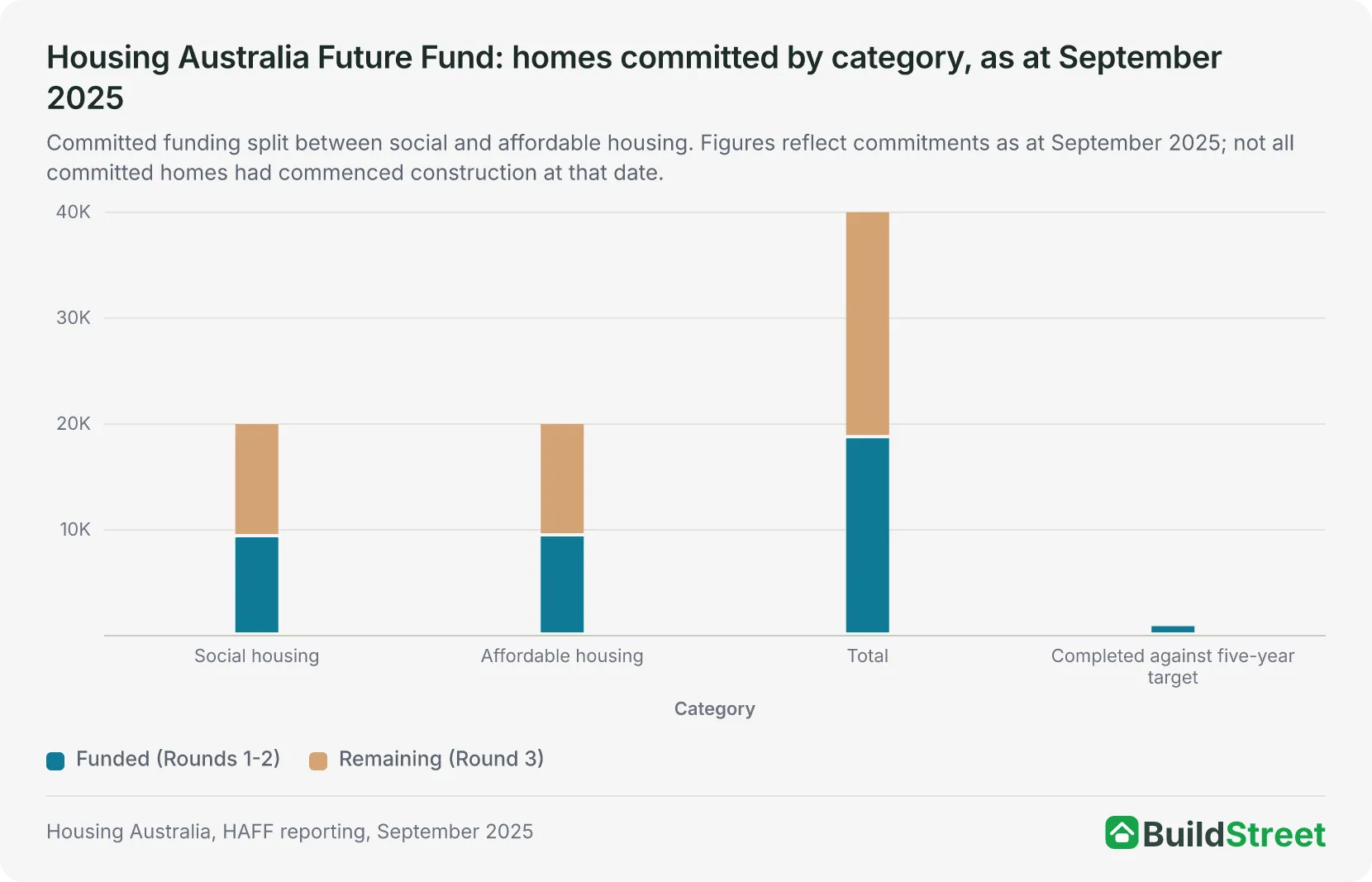
The Housing Australia Future Fund Facility and National Housing Accord Facility had committed support for 18,650 social and affordable homes across the first two funding rounds. The Social Housing Accelerator had completed 1,057 homes, with a further 3,194 under construction or committed, according to October 2025 reporting.
The Housing Australia Future Fund
The Housing Australia Future Fund is a $10 billion co-investment fund established in November 2023. It supports social and affordable housing through community housing providers, with a target of 40,000 new homes by 2029: 20,000 social homes and 20,000 affordable homes.
Across the first two funding rounds, Housing Australia committed support for 18,650 homes through the Housing Australia Future Fund Facility and National Housing Accord Facility:
- 9,284 social housing dwellings
- 9,366 affordable housing dwellings
Round 3 opened in January 2026 to fund the remaining 21,350.
The HAFF includes a $600 million ring-fence for Indigenous-led housing, with 10% of all social housing funding reserved for First Nations households.
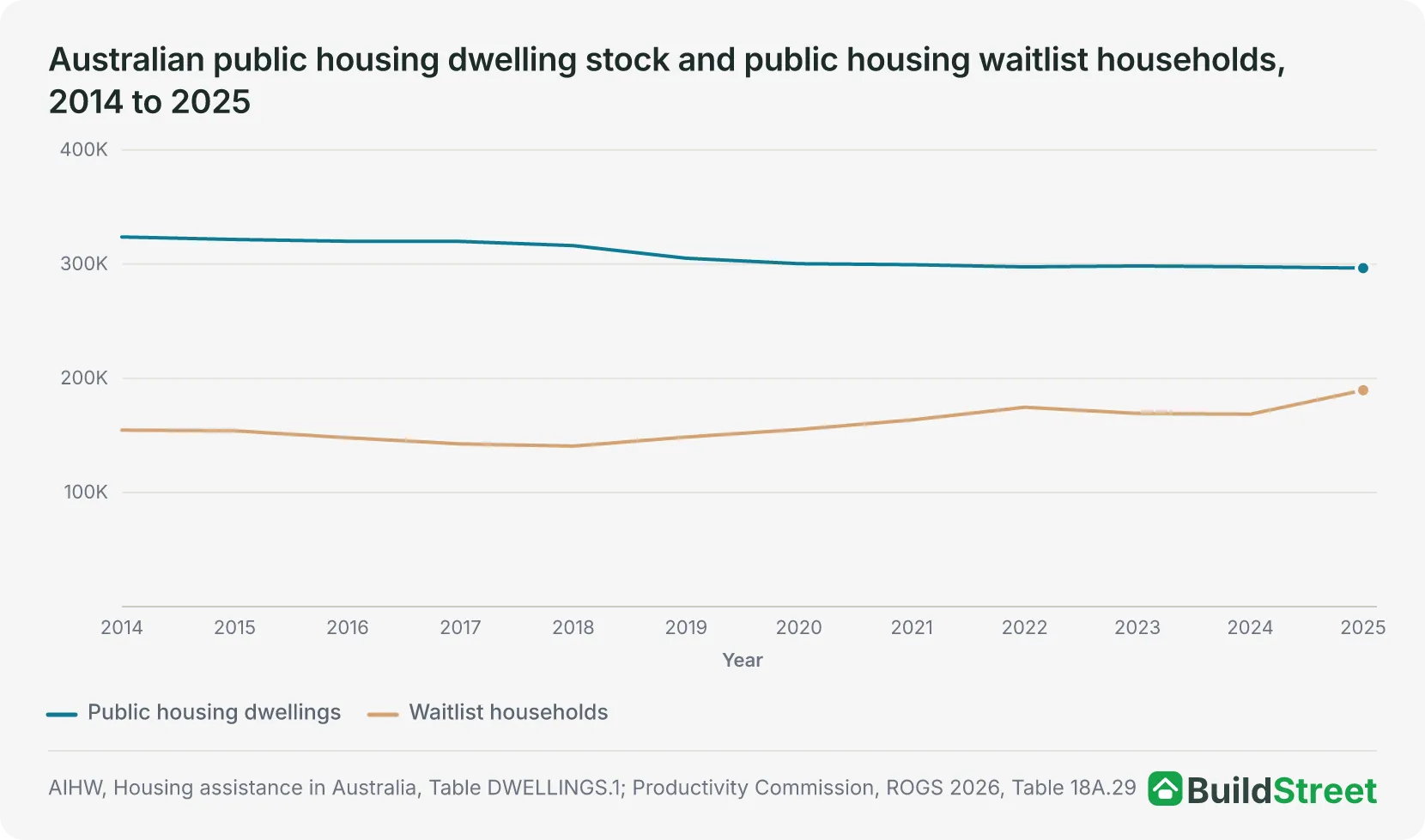
Public housing stock has fallen while the public housing waitlist has grown
Public housing stock fell from 323,803 dwellings in 2014 to 297,684 in 2024, a reduction of 26,119 dwellings.
The national public housing waitlist grew from around 155,000 households in 2014 to 189,536 households at 30 June 2025.
Community housing expanded from around 30,000 to 119,000 dwellings between 2006 and 2024. Social housing as a whole represented about 4.1% of all households in 2024, down from around 4.6% in 2014.
Section 06 · HOW SCHEMES HAVE CHANGED
How Australian government housing schemes changed from 2023 to 2026
The federal deposit guarantee scheme grew from 11,742 places taken up in 2019-20 to 46,022 in 2024-25.
Income caps were removed in October 2025, making the scheme available to eligible buyers at any income level. During the same period, several housing schemes were established, expanded, renamed or closed.
November 2023
Housing Australia Future Fund established
The $10 billion HAFF was legislated and established, targeting 40,000 new social and affordable homes by 2029 through community housing providers. A $600 million Indigenous housing ring-fence was included.
December 2024
Help to Buy Act legislated
The Help to Buy Act 2024 received Royal Assent in December 2024, following Senate negotiations. The federal shared equity scheme commenced in 2025-26, providing up to 40% equity on new homes for eligible buyers with a 2% deposit and up to 10,000 places per year.
May 2025
Queensland removes transfer duty on eligible new homes and vacant land
Queensland removed transfer duty on eligible new homes and vacant land from 1 May 2025, with no price cap applied. The previous Queensland first-home buyer duty concession had applied a full exemption only up to $700,000.
October 2025
Federal deposit guarantee scheme becomes the 5% Deposit Scheme
The Home Guarantee Scheme was renamed the Australian Government 5% Deposit Scheme. Income caps (previously $125,000 for singles, $200,000 for couples) were removed, and annual place limits were lifted. The scheme is now open to any eligible Australian buyer regardless of income.
References
- Housing Australia, Home Guarantee Scheme Trends and Insights Report 2024–25 · housingaustralia.gov.au
- ABS Total Value of Dwellings, March quarter 2026 · Australian Bureau of Statistics
- Australian Institute of Health and Welfare (AIHW), Housing assistance in Australia 2025 · aihw.gov.au
- Productivity Commission, Report on Government Services 2026 — Part G Section 18 Housing data tables (June 2026 release) · pc.gov.au
- 5% Deposit Scheme property price caps · firsthomebuyers.gov.au
- Australian Government 5% Deposit Scheme, 2026 · firsthomebuyers.gov.au
- Australian Government Help to Buy Scheme, 2026 · firsthomebuyers.gov.au
- Homes Tasmania — MyHome shared equity scheme, contribution rates and property price caps · homestasmania.com.au
- Homes Tasmania — Eligibility for home ownership assistance · homestasmania.com.au
- Keystart WA — Urban Connect Shared Equity Home Loan · keystart.com.au
- Government of Western Australia — 2026–27 Housing Taxation Package · wa.gov.au
- RevenueWA — First Home Owner Grant · wa.gov.au
- ACT Government — ACT Budget 26–27: Cutting stamp duty for all ACT first home buyers · cmtedd.act.gov.au
- ACT Revenue Office — Home Buyer Concession Scheme · revenue.act.gov.au
- Ministers' Media Centre — Social housing builds surging ahead, October 2025 · ministers.pmc.gov.au
- Housing Australia — Opening today: call for submissions, HAFF Round 3 to support 21,350 homes (30 January 2026) · housingaustralia.gov.au
- Revenue NSW — First Home Buyers Assistance Scheme · revenue.nsw.gov.au
- State Revenue Office Victoria — First home buyer duty exemption or concession · sro.vic.gov.au
- Queensland Revenue Office — First home new home transfer duty concession · qro.qld.gov.au
- Queensland Revenue Office — First home buyer relief from 1 May 2025 · qro.qld.gov.au
- RevenueSA — First Home Owner Grant · revenuesa.sa.gov.au
- RevenueSA — Stamp duty relief for eligible first home buyers · revenuesa.sa.gov.au
- State Revenue Office Tasmania — First home buyers grants and concessions · sro.tas.gov.au
- Northern Territory Government — Buying or building a new home: HomeGrown Territory and FreshStart New Home grants · nt.gov.au
- Northern Territory Department of Treasury and Finance — HomeGrown Territory guide to the grants · treasury.nt.gov.au
Methodology: Federal scheme uptake and borrower data are drawn from the Housing Australia Home Guarantee Scheme Trends and Insights Report 2024–25. Median dwelling prices are from ABS Catalogue 6432.0 (March quarter 2026), Table 2. Public housing stock data are from AIHW Housing assistance in Australia 2025 (Table DWELLINGS.1). Public housing waitlist data to June 2024 are from AIHW Housing assistance in Australia 2025 (Table HOUSEHOLDS.26). The June 2025 waitlist figure of 189,536 households is from the Productivity Commission Report on Government Services 2026 (Table 18A.29, Newly allocated households and households on waitlist, Public housing). State and territory scheme eligibility rules are from the relevant state Revenue Offices and administering agencies, current as at 18 June 2026. Price cap figures for the 5% Deposit Scheme are standard capital-city thresholds and vary by location. Scheme rules change regularly; all figures should be verified with the relevant administering body before any application decision is made.
