Can Victoria meet its housing target? Approvals, completions and supply gaps
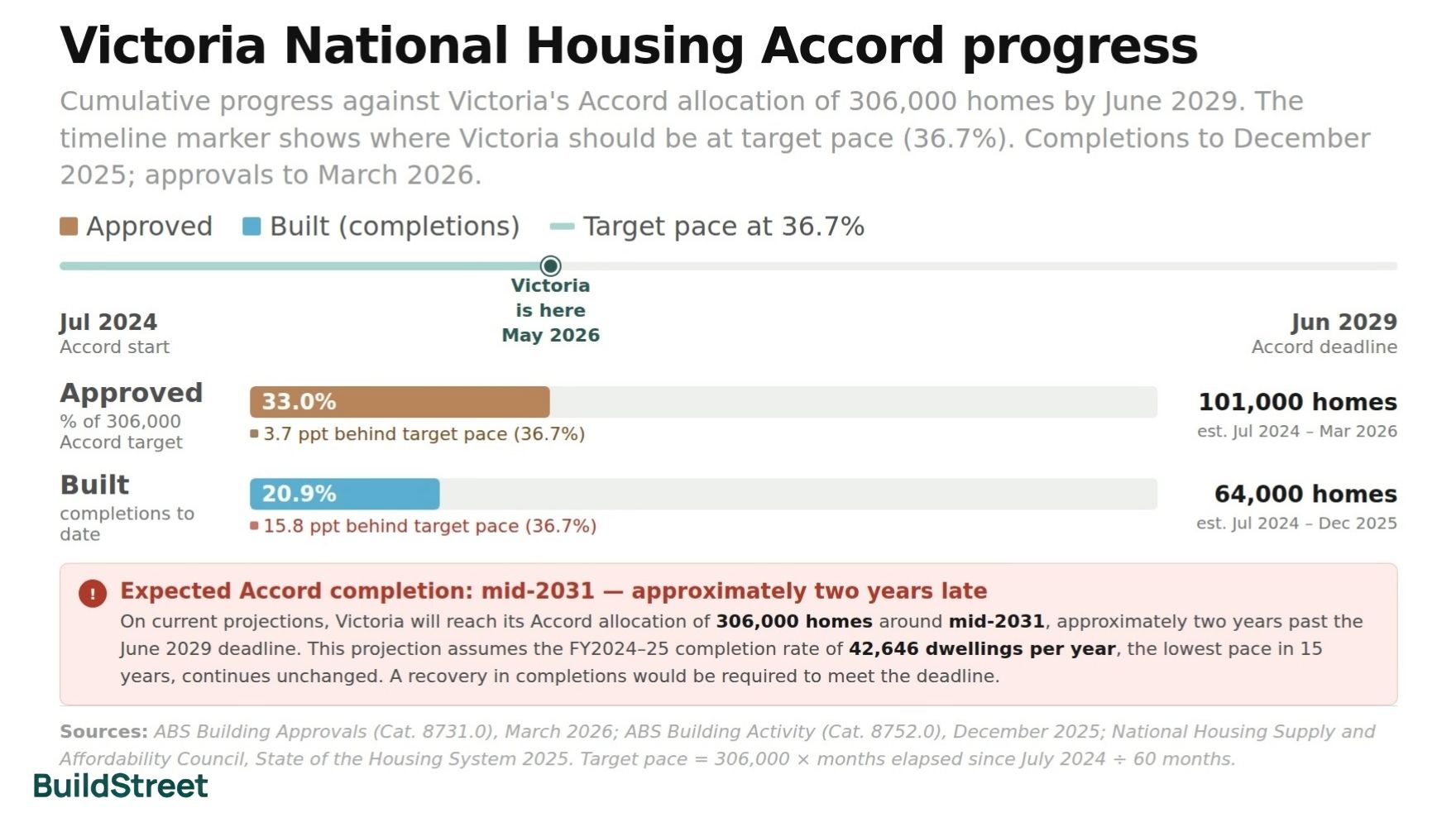
Victoria completed 42,646 dwellings in FY2024–25, the lowest annual total in 15 years and well below the level needed to keep pace with population growth.
While approvals increased to 56,581 over the same period, not every approved project reached completion. Construction costs, longer build times, and a weaker apartment pipeline have slowed the flow of new housing into the market.
Victoria's Accord target
306,000
New homes required, 2024–25 to 2028–29
Annual completions required
61,200
Dwellings per year to meet Victoria's Accord share
Completions FY2024–25
42,646
Equal to 70% of the required annual Accord pace
Annual shortfall
18,554
Finished homes below the 61,200 Accord pace
SECTION 01 · THE HOUSING TARGET
How many homes does Victoria need to build?
The federal National Housing Accord sets a national target of 1.2 million new homes over five years from 2024–25 to 2028–29. Each state and territory's share is allocated based on population. Victoria, with a 25.5% share of Australia's population, is responsible for 306,000 of those homes. This is the second-largest allocation nationally, behind New South Wales (376,000). Meeting that target requires Victoria to deliver approximately 61,200 dwellings a year across the five-year Accord period.
Victoria's long-term housing needs are larger. The state's population is projected to reach 10.3 million by 2051, up from around 7.1 million today, requiring 2.24 million additional dwellings over that period. The Accord covers only the first five years of that challenge.
Victoria's share of the National Housing Accord is 306,000 new homes between 2024–25 and 2028–29. That works out to about 61,200 homes a year, or 5,100 a month. Victoria has reached that pace before — completions were above 61,200 in FY2016–17, FY2017–18 and FY2018–19, peaking at 74,683 homes in FY2018–19. Since then, completions have fallen.
What 61,200 homes a year actually looks like
168
homes needed every single day, 365 days a year
1,177
per week, including weekends and public holidays
5,100
per month, every month, to June 2029
How Victoria compares with other states
Victoria is one of the stronger-performing states under current Housing Accord projections, although it is still expected to fall slightly short of its allocation. Early 2026 estimates suggest the state will deliver around 287,000 homes over the five-year Accord period, equal to 94% of its target of 306,000 homes.
That is one of the highest projected delivery rates nationally, behind only the ACT and Western Australia. By comparison, Australia as a whole is projected to deliver around 980,000 homes against the national target of 1.2 million, equal to about 82% of the target.
| State / Territory | Accord target | Est. supply 2024–29 | Pop. share | Est. as % of target | Est. completion |
|---|---|---|---|---|---|
| New South Wales | 376,000 | 258,000 | 31.4% | 69% | Jun 2031 |
| Victoria | 306,000 | 287,000 | 25.5% | 94% | Dec 2029 |
| Queensland | 246,000 | 204,000 | 20.5% | 83% | Sep 2030 |
| Western Australia | 129,000 | 129,000 | 10.8% | 100% | Jun 2029 |
| South Australia | 84,000 | 66,000 | 7.0% | 78% | Mar 2031 |
| Tasmania | 26,000 | 13,000 | 2.2% | 51% | Dec 2033 |
| ACT | 21,000 | 22,000 | 1.8% | 103% | Jun 2029 |
| Northern Territory | 11,000 | 4,000 | 1.0% | 34% | After 2034 |
| Australia (total) | 1,200,000 | 980,000 | 100% | 82% | Sep 2030 |
Source: National Housing Supply and Affordability Council, State of the Housing System 2025. Figures rounded to nearest 1,000.
SECTION 02 · APPROVALS
Victoria housing approvals rise but remain below target
Victoria approved 56,581 dwellings in FY2024–25, up 9% from 51,921 in FY2023–24. While this shows improvement, both years remained below the 61,200 homes a year needed to meet Victoria's Accord allocation. Across the two years, approvals were about 13,900 dwellings below that annual pace.
Building approvals show how many dwellings have received permission to be built. They are an early indicator of future supply because homes usually take 12 to 24 months to move from approval to completion.
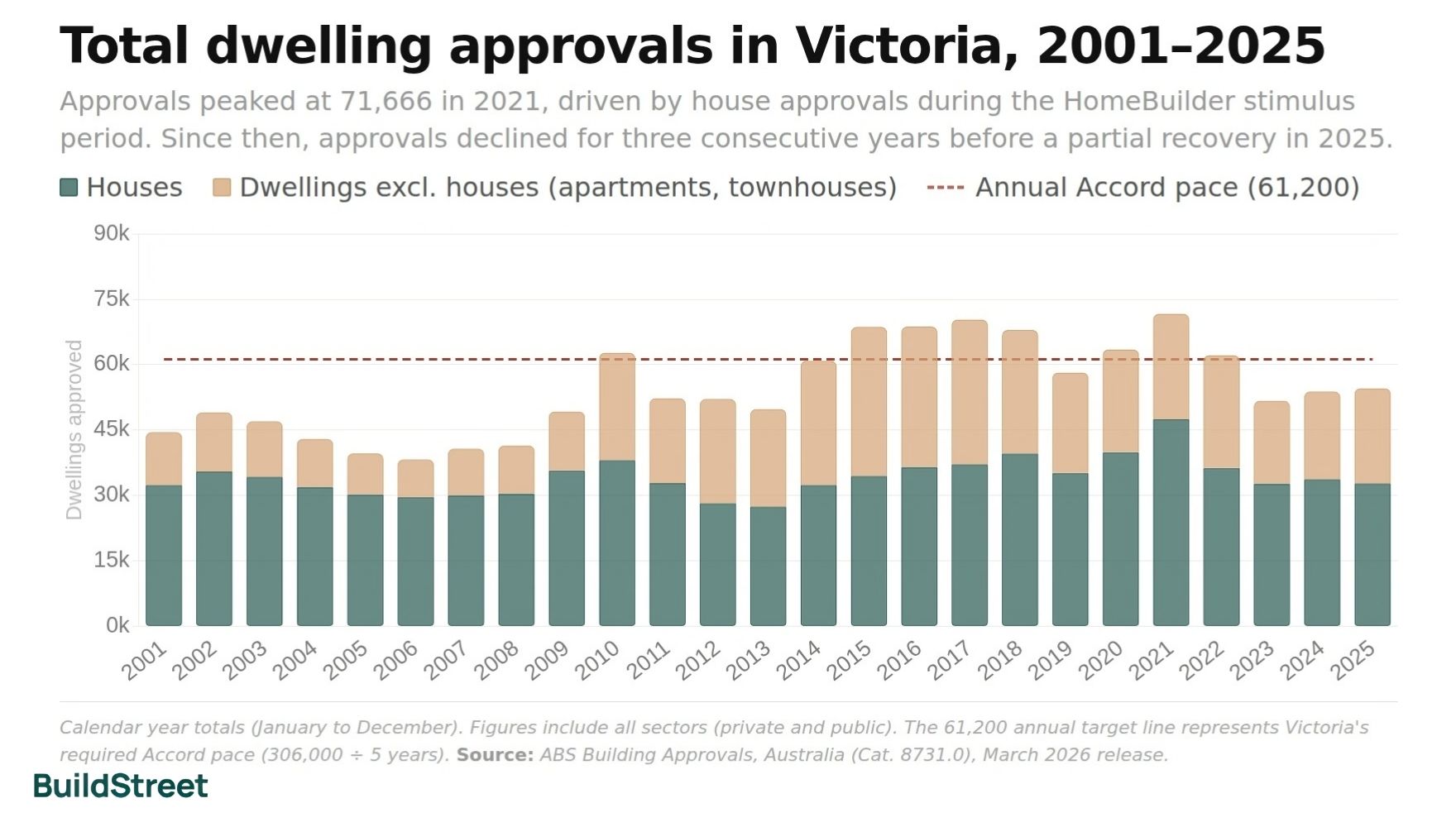
Total dwelling approvals in Victoria, 2001–2025 (calendar year)
Approvals peaked at 71,666 in 2021, driven by house approvals during the HomeBuilder stimulus period. Approvals declined for three consecutive years before a partial recovery in 2025.
Source: ABS Building Approvals, Australia (cat. 8731.0), March 2026 release. Original series, calendar-year totals.
| Financial year | Houses | Other dwellings | Total approvals | % of Accord pace |
|---|---|---|---|---|
| FY2020–21 | 46,637 | 22,081 | 68,718 | 112% |
| FY2021–22 | 39,978 | 26,199 | 66,177 | 108% |
| FY2022–23 | 34,197 | 21,247 | 55,444 | 91% |
| FY2023–24 | 33,480 | 18,441 | 51,921 | 85% |
| FY2024–25 | 32,851 | 23,730 | 56,581 | 92% |
FY2023–24 was the lowest total on record for a full financial year in this dataset. Source: ABS Building Approvals (cat. 8731.0), March 2026 release.
March approvals show uneven momentum
In March 2026, Victoria recorded 5,236 dwelling approvals, up from 4,351 in March 2025 — an increase of about 20% over the year. The monthly benchmark for Victoria's Accord allocation is about 5,100 approvals. March 2026 was slightly above that level, but monthly approvals can move around sharply, so one month is not enough to confirm a sustained trend.
Monthly dwelling approvals in Victoria, Jan 2020 – Mar 2026
The 2021 peak reflects the HomeBuilder stimulus. The decline through 2023–24 brought monthly approvals to their lowest level since records began. March 2026 at 5,236 sits roughly at the 5,100 monthly Accord pace.
Source: ABS Building Approvals, Australia (cat. 8731.0), March 2026 release. Original series. Monthly Accord pace = 306,000 ÷ 60.
SECTION 03 · COMPLETIONS
How many homes are being completed in Victoria?
Victoria completed 42,646 dwellings in FY2024–25, equal to 70% of the 61,200 annual pace implied by its Accord allocation. That is the lowest financial year completion total since FY2009–10, and well below the record of 74,683 completions in FY2018–19.
Completions are the measure of housing supply, because a home is not available to live in until it is finished. Approvals and commencements show what has been planned or started; completions show what has been delivered.
Completions FY2024–25
42,646
Lowest since FY2009–10, equal to 70% of the Accord pace
Peak completions FY2018–19
74,683
That record exceeded the 61,200 Accord pace by 22%, but has not been sustained
Annual shortfall FY2024–25
18,554
Between completions and the 61,200 Accord pace
Quarterly dwelling completions in Victoria, Mar 2000 – Dec 2025
Completions peaked in late 2018 and early 2019. Recent quarters have been running below the 15,300 quarterly pace needed to meet the Accord allocation.
Source: ABS Building Activity, Australia (cat. 8752.0), Table 39, December quarter 2025.
Victoria's completions rose between 2015 and 2019 as apartments approved in 2012 to 2017 reached handover. At the peak in FY2018–19, 42,046 apartments and other attached dwellings were completed, more than double the level of a decade earlier. Once that pipeline cleared, total completions fell. In FY2024–25:
- Apartment and other dwelling completions reached 19,948, down 53% from the FY2018–19 peak of 42,046
- House completions reached 22,698, the lowest level since the mid-2000s
- Combined completions of 42,646 represent 70% of the 61,200 annual Accord pace
House completions have remained in the range of 22,000 to 27,000 per year throughout the period. The apartment component has driven the overall decline.
| Financial year | Houses | Other dwellings | Total | % of Accord pace |
|---|---|---|---|---|
| FY2016–17 | 27,782 | 35,681 | 63,463 | 104% |
| FY2017–18 | 27,001 | 38,062 | 65,063 | 106% |
| FY2018–19 (peak) | 32,637 | 42,046 | 74,683 | 122% |
| FY2019–20 | 25,536 | 34,399 | 59,935 | 98% |
| FY2020–21 | 23,335 | 27,867 | 51,202 | 84% |
| FY2021–22 | 25,705 | 19,487 | 45,192 | 74% |
| FY2022–23 | 25,654 | 22,961 | 48,615 | 79% |
| FY2023–24 | 23,991 | 22,874 | 46,865 | 77% |
| FY2024–25 | 22,698 | 19,948 | 42,646 | 70% |
Source: ABS Building Activity (cat. 8752.0), Table 39, December quarter 2025.
Victoria: approvals, commencements and completions by financial year, FY2000–01 to FY2024–25
Completions lag approvals and commencements by roughly 12 to 24 months. The apartment pipeline approved in 2015–17 drove a completions surge in 2017–19. Since then, completions have fallen to their lowest level in fifteen years.
Source: ABS Building Approvals (cat. 8731.0); ABS Building Activity (cat. 8752.0), December quarter 2025.
Victoria approved 56,581 dwellings in FY2024–25, but completed 42,646 homes in the same year. That leaves a gap of 13,935 dwellings between what was approved and what was finished. This shows the delay between planning approval and handover, and the pressure from construction costs, labour shortages, project viability and builder capacity.
SECTION 04 · MELBOURNE PIPELINE
Melbourne housing approvals, targets and pipeline
Greater Melbourne is home to 5.4 million people, about 77% of Victoria's total population, and has grown by more than 1.9 million residents since 2001, an increase of 55%. Growth is not even across the city: outer growth corridors in the west and north have added population at a faster rate, while established middle-ring suburbs have grown more slowly.
Victoria population growth: Greater Melbourne vs rest of Victoria, 2001–2025
Greater Melbourne accounted for 84% of Victoria's total population growth between 2001 and 2025. The city's population fell in 2021 due to pandemic-related net overseas migration losses, then returned to growth from 2022 onwards.
Source: ABS Regional Population, 2024–25 (cat. 3218.0). Estimated Resident Population at 30 June; 2025 preliminary.
Plan for Victoria assigns specific housing targets to every local government area in the state. The City of Melbourne has been allocated 119,500 additional dwellings by 2051, entirely through infill development. Outer-growth LGAs like Melton (109,000) and Wyndham (99,000) carry larger totals but are expected to meet most of them through greenfield expansion.
Melton: greenfield growth
341%
Population growth since 2001
52,500 → 231,500 residents
Boroondara: density mandate
65,500
New homes required by 2051
All must be built on already-developed land
| LGA | Target to 2051 | Infill | Greenfield | Growth type |
|---|---|---|---|---|
| City of Melbourne | 119,500 | 119,500 | 0 | Infill only |
| Melton | 109,000 | 5,000 | 104,000 | Predominantly greenfield |
| Wyndham | 99,000 | 25,000 | 74,000 | Mixed, greenfield dominant |
| Casey | 87,000 | 28,500 | 58,500 | Mixed, greenfield dominant |
| Hume | 79,000 | 25,500 | 53,500 | Mixed, greenfield dominant |
| Whitehorse | 76,500 | 76,500 | 0 | Infill only |
| Boroondara | 65,500 | 65,500 | 0 | Infill only |
| Nillumbik | 6,500 | 6,500 | 0 | Constrained (Green Wedge) |
Selected LGAs across inner city, middle-ring established suburbs and outer-growth corridors. Source: DTP Victoria, Plan for Victoria — Metropolitan LGA housing targets, February 2025.
Boroondara shows the infill challenge. With around 178,000 residents, limited undeveloped land and a target of 65,500 additional homes by 2051, most growth would need to come from higher-density housing near tram, rail and activity corridors. Melton shows the greenfield model — its population grew from about 52,500 in 2001 to more than 231,500 in 2025, a rise of 341%. Its target of 109,000 dwellings is mainly expected to come from greenfield expansion.
The Suburban Rail Loop East is also being linked to future housing supply. New Priority Residential Zones across the six SRL East station precincts are intended to support around 70,000 dwellings close to major transport.
SECTION 05 · REGIONAL VICTORIA
Regional Victoria housing growth and supply pressures
Victoria's housing challenge is not limited to Greater Melbourne, but regional demand is uneven. Outside Greater Melbourne, Victoria's population grew from roughly 1.26 million in 2001 to 1.64 million in 2025, an increase of about 30%. Areas within commuting distance of Melbourne have grown at a faster rate, while more remote regional centres have grown slower or remained stable.
Population growth in selected Victorian cities and regions, 2001–2025
Mitchell Shire — an outer growth area along the Hume corridor — leads regional growth. Among major regional centres, Greater Geelong grew 54%, Ballarat 49% and Greater Bendigo 42% between 2001 and 2025.
Source: ABS Regional Population, 2024–25 (cat. 3218.0). LGA boundaries based on 2025 classifications.
Plan for Victoria allocates 425,600 new dwellings to regional and rural LGAs by 2051, about 19% of the state's total long-term requirement. The targets vary by location, growth pattern and local constraints:
- Mitchell Shire carries the largest regional target at 66,000 homes, of which 56,000 are greenfield. It sits along the Hume Freeway corridor and functions as an extension of Melbourne's northern growth corridor.
- Ballarat is expected to deliver 46,900 dwellings, with 28,000 as infill and 18,900 as greenfield.
- Queenscliffe carries the smallest target at 400 dwellings to 2051, reflecting its environmental and heritage constraints.
| Regional LGA | Target to 2051 | Non-greenfield | Greenfield |
|---|---|---|---|
| Mitchell | 66,000 | 10,000 | 56,000 |
| Ballarat | 46,900 | 28,000 | 18,900 |
| Baw Baw | 25,700 | n/a | n/a |
| Moorabool | 20,000 | n/a | n/a |
| Bass Coast | 19,250 | n/a | n/a |
| Greater Shepparton | 15,250 | n/a | n/a |
| Latrobe | 13,000 | n/a | n/a |
| Queenscliffe | 400 | n/a | n/a |
Greenfield/non-greenfield split is only available where DTP Victoria has published the breakdown. Source: DTP Victoria, Plan for Victoria — Regional LGA housing targets, February 2025.
Under the Development Facilitation Programme, projects worth at least $15 million in regional Victoria qualify for state-level planning consideration, compared with the $50 million threshold in Melbourne, provided at least 10% of dwellings are classified as affordable.
SECTION 06 · HOUSING MIX
How has Victoria's housing mix changed?
Victoria's housing mix has changed over time, shifting from detached-house dominance in the early 2000s to a stronger apartment and townhouse pipeline in the mid-2010s, before house approvals rose again after 2020.
Houses made up 73% of all dwelling approvals in Victoria in 2001. By 2015, apartments and townhouses had grown to roughly half of approvals, bringing the split close to 50/50. By 2025, houses accounted for 60% of approvals.
Victoria dwelling approvals by type, 2001–2025 (calendar year)
Apartment and townhouse approvals increased between 2010 and 2018, then declined as construction costs rose and developer financing tightened. House approvals rose in 2021 due to HomeBuilder, then returned to longer-run levels. In 2025, houses accounted for 60% of all approvals.
Source: ABS Building Approvals, Australia (cat. 8731.0), March 2026 release. Original series, calendar year totals.
Knock-down rebuilds are the primary mechanism for increasing density in established suburbs. Victoria has recorded 70,570 dwellings approved through knock-down rebuild projects in recent years, second only to New South Wales nationally. Average yields per site depend on the replacement type:
- Apartment block replacement: average of 9.5 new dwellings per site
- Townhouse replacement: average of 3.0 dwellings per site
Homeowners can also build a second dwelling of up to 60 square metres in their backyard without a council planning permit, provided the block is at least 300 square metres and free of environmental overlays. Around 700,000 existing lots are estimated to be eligible. If 5% of eligible owners build, that would add approximately 35,000 dwellings without any new land being acquired.
Apartment yield
9.5×
Average dwellings per knock-down rebuild site when replaced with apartments
Townhouse yield
3.0×
Average yield when a house is knocked down for townhouses
Backyard-eligible lots
700k
Existing lots eligible to add a 60m² second dwelling without a permit
SECTION 07 · THE SUPPLY GAP
Victoria's supply gap and forward pipeline
Victoria's housing target depends on completions, not just approvals. The gap is clearest when recent completion levels are compared with the annual delivery pace implied by the Accord. Victoria exceeded the 61,200-home annual pace for three consecutive years: FY2016–17, FY2017–18 and FY2018–19. Completions peaked at 74,683 in FY2018–19, but have fallen steadily since then.
In FY2024–25, Victoria completed 42,646 dwellings, equal to 70% of the Accord pace and the lowest annual result in 15 years.
The two-year deficit is larger than the approvals data alone suggests. Completions have run below approvals throughout this period. The gap between approvals and completions reflects:
- The time lag between approval and handover (typically 12 to 24 months)
- Projects that commence but stall before completion
- Builder insolvencies that leave buildings partly constructed
Residential building output prices have risen above 5% per year in recent periods. Projects approved at one cost point may not be viable to build by the time they reach the construction stage. Construction cost pressures and industry insolvencies contribute to the attrition between approval and completion.
Under construction (Dec 2025)
60,527
Down from a peak of 74,578 in March 2022 — a fall of nearly 19%
Approved but not commenced
5,352
Small queue suggests bottleneck is at the front of the pipeline
Fewer active worksites
−14,051
Compared with the March 2022 peak; points to a thinner completions pipeline
Source: ABS Building Activity (cat. 8752.0), Tables 77 and 80, December quarter 2025.
The number of dwellings under construction is a forward indicator for completions. At December 2025, 60,527 dwellings were under construction in Victoria, down 19% from a peak of 74,578 in March 2022. Without an increase in commencements, completions are unlikely to recover.
To reach the 61,200 annual Accord pace, Victoria needs to increase its FY2024–25 completion rate of 42,646 by around 44%. The record year of FY2018–19, at 74,683 completions, exceeded the Accord pace but has not been sustained. A recovery would require growth in both house completions and the apartment pipeline, against current construction cost levels and labour supply constraints.
General information only
This article draws on publicly available data from the ABS and Victorian Government. It is general information only and does not constitute financial, investment or property advice.
ABS Building Approvals, Australia (cat. 8731.0), March 2026 release
ABS Building Activity, Australia (cat. 8752.0), December quarter 2025
ABS Regional Population, 2024–25 (cat. 3218.0)
DTP Victoria — Plan for Victoria, LGA housing targets, February 2025
Victorian Government — Victoria's Housing Statement, 2024–2034
National Housing Supply and Affordability Council — State of the Housing System 2025
Chart Snapshots