How long does it take to build a house in Australia?
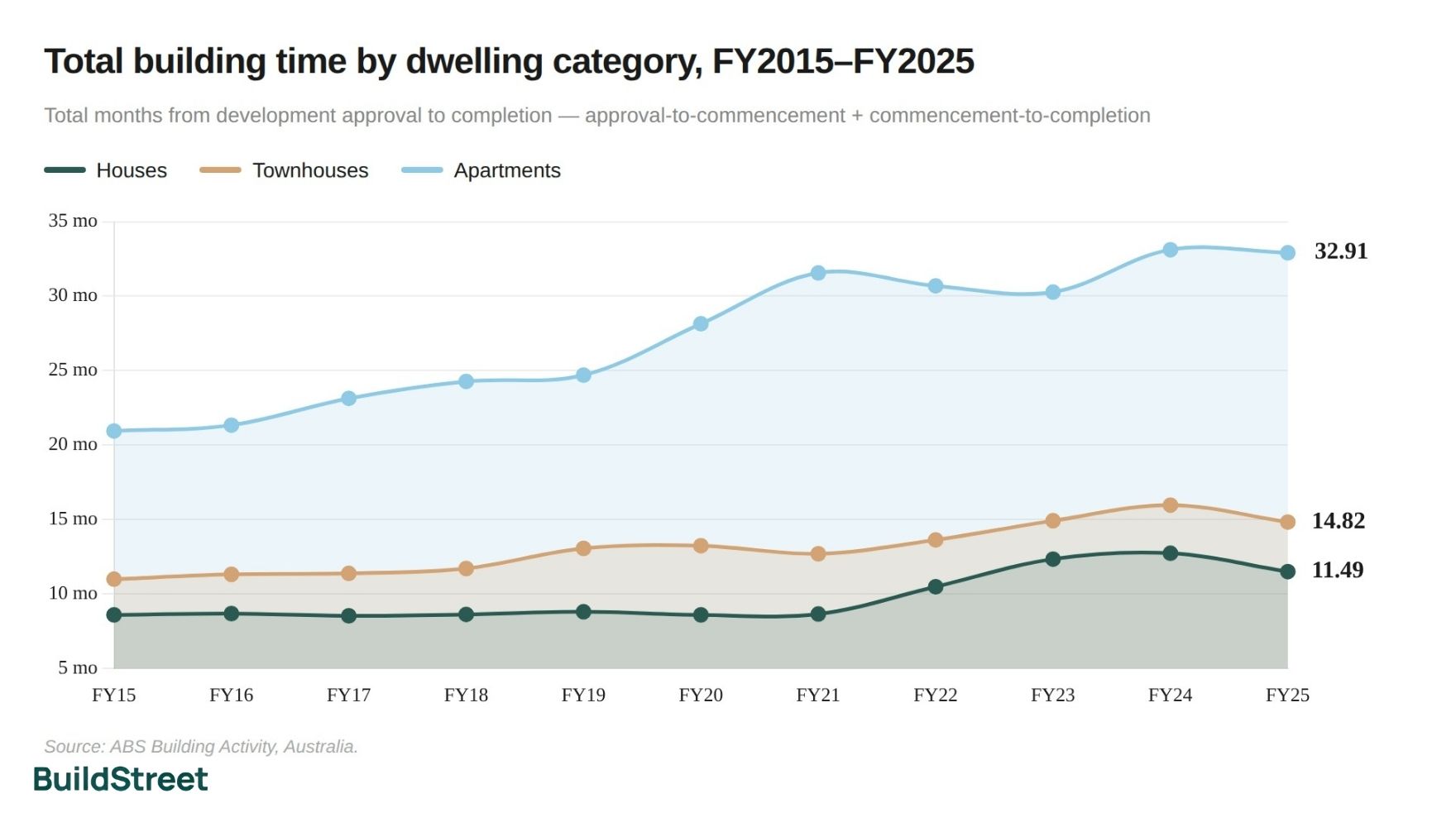
The average time from approval to handover is now about 11.5 months for a house, 14.8 months for a townhouse and almost 33 months for an apartment in Australia. While homes still take much longer to build than they did before COVID, new data suggests conditions are starting to improve. Houses and townhouses were completed faster last year, while apartments remain the slowest part of the market by a wide margin. The past decade of data shows how sharply the system slowed, and where it is now beginning to recover.
Average house build time
11.5 mo
▼ 9.7% faster than FY2024
Average townhouse
14.8 mo
▼ 7.1% faster than FY2024
Average apartment
32.9 mo
Still near record highs
How many homes are built in Australia each year?
Australia has completed 262,592 homes in the first six quarters of the National Housing Accord, leaving the country 97,408 homes behind the pace needed to reach 1.2 million by June 2029. Detached houses continue to make up the largest share of completions, but apartment output remains well below what is needed to meet density targets.
How many homes are built in Australia each year? →Which states have the fastest and slowest home build times?
Post-pandemic construction delays pushed build times to record highs, but the wait from approval to handover is getting shorter. By early 2026, detached houses were averaging around 12 to 13 months from approval to completion, down from 17 months in 2022. If that trend holds, completions should start rising through 2026 and 2027.
Which states have the fastest and slowest build times? →Section 01
Home build time trends in Australia (2015–2025)
For most of the 2010s, build times in Australia were relatively steady. Then COVID disrupted the system. Government stimulus triggered a surge in new construction, but labour and materials could not keep up. By 2022, build times had blown out across houses, townhouses and apartments. In 2025, houses and townhouses are finally starting to improve. Apartments are still moving in the wrong direction.
Total building time by dwelling category, FY2015–FY2025
Total months from development approval to completion — approval-to-commencement + commencement-to-completion
Source: ABS Building Activity, Australia.
| Financial Year | Houses | Townhouses | Apartments |
|---|---|---|---|
| FY2015 | 2.86 qtrs8.6 mo | 3.66 qtrs11.0 mo | 6.98 qtrs20.9 mo |
| FY2016 | 2.89 qtrs8.7 mo | 3.77 qtrs11.3 mo | 7.11 qtrs21.3 mo |
| FY2017 | 2.84 qtrs8.5 mo | 3.79 qtrs11.4 mo | 7.71 qtrs23.1 mo |
| FY2018 | 2.87 qtrs8.6 mo | 3.90 qtrs11.7 mo | 8.09 qtrs24.3 mo |
| FY2019 | 2.93 qtrs8.8 mo | 4.35 qtrs13.1 mo | 8.23 qtrs24.7 mo |
| FY2020 | 2.86 qtrs8.6 mo | 4.41 qtrs13.2 mo | 9.38 qtrs28.1 mo |
| FY2021 | 2.88 qtrs8.6 mo | 4.23 qtrs12.7 mo | 10.52 qtrs31.6 mo |
| FY2022 | 3.49 qtrs10.5 mo | 4.54 qtrs13.6 mo | 10.23 qtrs30.7 mo |
| FY2023 | 4.11 qtrs12.3 mo | 4.97 qtrs14.9 mo | 10.09 qtrs30.3 mo |
| FY2024 | 4.24 qtrs12.7 mo | 5.32 qtrs16.0 mo | 11.04 qtrs33.1 mo |
| FY2025 | 3.83 qtrs11.5 mo | 4.94 qtrs14.8 mo | 10.97 qtrs32.9 mo |
What is driving the improvement?
For houses, almost all of the improvements came from the commencement-to-completion phase, which fell from 10.4 months in FY2024 to 9.2 months in FY2025, cutting more than five weeks off the average build. Townhouses saw a similar shift, with the same phase easing from 12.9 months to 11.7 months. Neither category saw meaningful improvement in the approval-to-commencement phase, which suggests pre-construction pipelines are stabilising but not yet accelerating.
Houses
Approval → Start
0.76 qtrs
Start → Finish
3.07 qtrs
Total FY2025
3.83 qtrs · 11.5 mo
Townhouses
Approval → Start
1.03 qtrs
Start → Finish
3.91 qtrs
Total FY2025
4.94 qtrs · 14.8 mo
Apartments
Approval → Start
1.39 qtrs
Start → Finish
9.58 qtrs
Total FY2025
10.97 qtrs · 32.9 mo
Section 02
Which states improved the most?
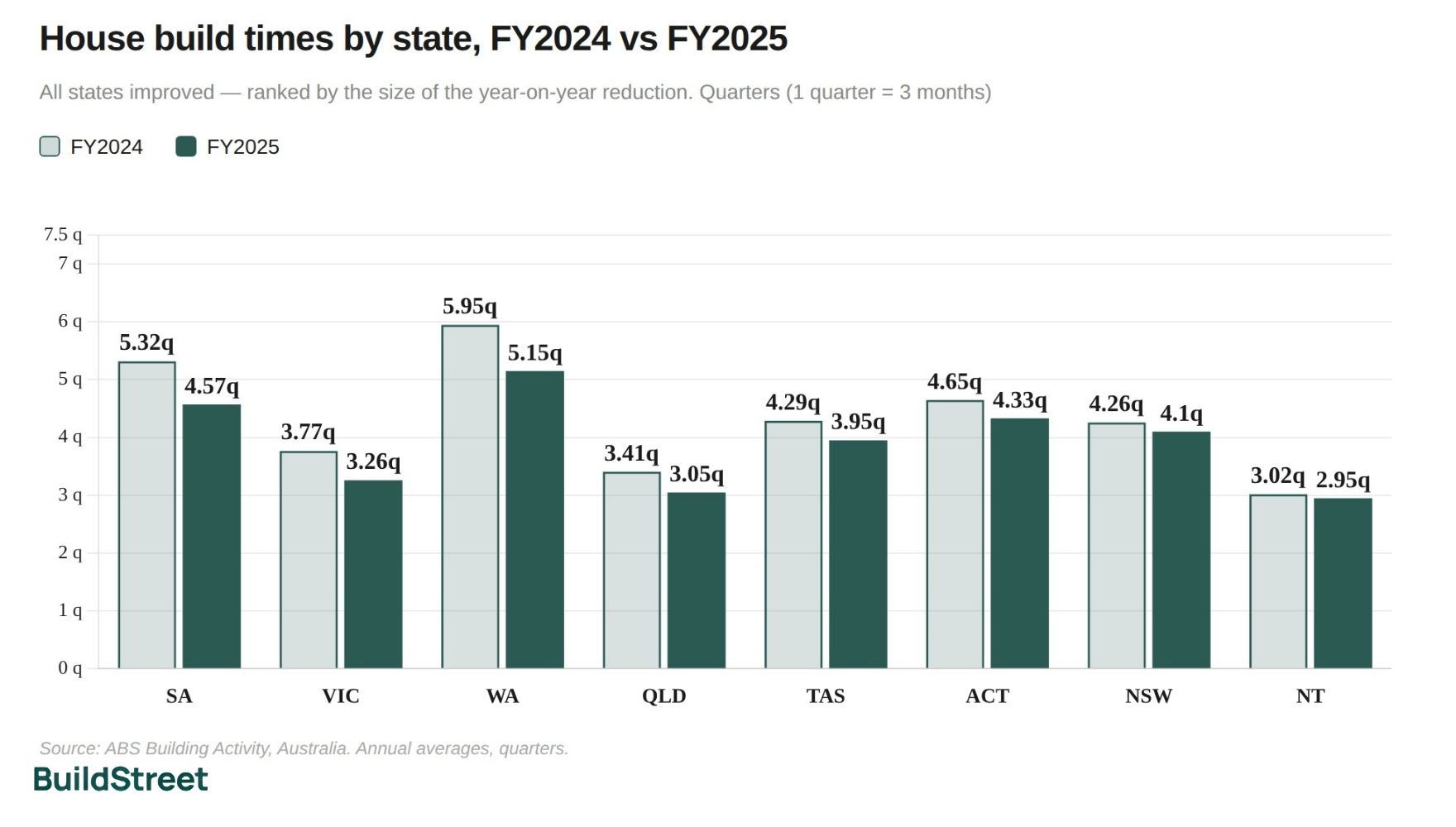
Every state and territory in Australia built houses faster in 2025 than in 2024. That has not happened in years. But the improvement was far from even, with some states making much bigger gains than others.
House build times by state, FY2024 vs FY2025 (quarters)
All states improved — ranked by the size of the year-on-year reduction
- FY2024
- FY2025
Source: ABS Building Activity, Australia. Annual averages, quarters.
| State / Territory | FY2024 | FY2025 | Change |
|---|---|---|---|
| South Australia | 5.32 qtrs16.0 mo | 4.57 qtrs13.7 mo | ▼ 14.1% faster |
| Victoria | 3.77 qtrs11.3 mo | 3.26 qtrs9.8 mo | ▼ 13.5% faster |
| Western Australia | 5.95 qtrs17.9 mo | 5.15 qtrs15.5 mo | ▼ 13.4% faster |
| Queensland | 3.41 qtrs10.2 mo | 3.05 qtrs9.2 mo | ▼ 10.6% faster |
| Tasmania | 4.29 qtrs12.9 mo | 3.95 qtrs11.9 mo | ▼ 7.9% faster |
| ACT | 4.65 qtrs14.0 mo | 4.33 qtrs13.0 mo | ▼ 6.9% faster |
| New South Wales | 4.26 qtrs12.8 mo | 4.10 qtrs12.3 mo | ▼ 3.8% faster |
| Northern Territory | 3.02 qtrs9.1 mo | 2.95 qtrs8.9 mo | ▼ 2.3% faster |
South Australia, Victoria, and Western Australia recorded the sharpest single-year drops, each cutting build times by more than 13%. For WA in particular, this is a meaningful turning point. The state accumulated the worst backlog during the boom years and is now showing one of the strongest rates of improvement as its pipeline begins to clear and labour supply catches up to demand.
NSW and the NT moved the least, at 3.8% and 2.3% faster, respectively. NSW's large and complex pipeline means improvements take longer to show up in the averages, and the NT's small volume makes it more susceptible to project-by-project variation.
Biggest improvement — South Australia
▼ 14.1%
5.32 → 4.57 qtrs · saved ~2.3 months
National average improvement
▼ 9.7%
4.24 → 3.83 qtrs · all states improved
Smaller gain — NSW
▼ 3.8%
4.26 → 4.10 qtrs · still above average
Section 03
Apartments remain the weakest part of the market
Houses and townhouses are getting faster, but apartments are barely moving. Build times improved by just 0.6% in 2025, effectively no change at all. Worse, the time spent actually building on site increased compared with a year earlier. Apartment projects remain close to their slowest levels on record.
Build times by dwelling type, FY2020 vs FY2024 vs FY2025 (months)
Pre-COVID baseline, peak, and latest — where each category stands today
- FY2020 (Pre-COVID)
- FY2024 (Peak)
- FY2025 (Latest)
Source: ABS Building Activity, Australia. Converted to months (quarters × 3).
| Dwelling Type | FY2020 (Pre-COVID) | FY2024 (Peak) | FY2025 (Latest) | FY2024 to 2025 |
|---|---|---|---|---|
| Houses | 2.86 qtrs8.6 mo | 4.24 qtrs12.7 mo | 3.83 qtrs11.5 mo | ▼ 9.7% faster |
| Townhouses | 4.41 qtrs13.2 mo | 5.32 qtrs16.0 mo | 4.94 qtrs14.8 mo | ▼ 7.1% faster |
| Apartments | 9.38 qtrs28.1 mo | 11.04 qtrs33.1 mo | 10.97 qtrs32.9 mo | ▼ 0.6% (marginal) |
Houses — FY2025
11.5 mo
▼ 9.7% on FY2024 · improving
Townhouses — FY2025
14.8 mo
▼ 7.1% on FY2024 · improving
Apartments — FY2025
32.9 mo
▼ 0.6% · still near record highs
Why are apartments in a different category?
Apartments face structural constraints that detached houses do not. Large, complex multi-storey projects are more exposed to coordination risk, material cost volatility and tighter financing conditions. The average time between approval and commencement is 4.2 months for apartments, compared with 2.3 months for houses, suggesting many projects are stalling between approval and groundbreak as pre-sales soften or lending conditions tighten.
What this means for the housing supply
Australia needs more homes, and apartments are a big part of that plan. But if they keep taking this long to build, the country will keep falling short of its housing goals. An apartment approved today might not be ready to move into until 2028.
Section 04
Is Australia on track to hit its 1.2 million housing target?
Australia has a big goal: build 1.2 million new homes by June 2029 under the National Housing Accord. For a long time, that number looked very hard to reach. But with build times now improving, the picture is starting to look a little more hopeful.
According to the NHSAC March 2026 quarterly report, Australia is on track to deliver between 900,000 and 950,000 new homes by June 2029. That still falls short of the 1.2 million target, but it is a much better outlook than what the data showed 12 to 18 months ago.
Why do build times matter for this target?
Faster build times mean homes that are already approved get finished sooner. Every month cut from a build time is a home that enters the market earlier. As houses and townhouses speed up, more of the existing pipeline turns into actual completions.
National Housing Accord target
1.2M
New homes needed by June 2029
Projected delivery (NHSAC, Mar 2026)
900–950K
Estimated homes by June 2029
Likely shortfall
250–300K
Even with build time improvements
The good news is that faster house and townhouse build times feed directly into higher completion numbers. When builders can finish homes more quickly, more completions flow through each year. If the FY2025 improvements hold and spread to more states, Australia could start to close some of that gap.
The bigger challenge is apartments. They make up a large share of the homes needed to hit the 1.2 million target, and they are still taking close to three years to build. Until apartment build times come down and more projects move from approval to construction, that shortfall of 250,000 to 300,000 homes will be difficult to close.
General information only
This article is based on publicly available ABS data. It is general information only and does not constitute financial advice. If you are making decisions about saving for a property purchase, consider speaking with a licensed financial adviser.
Chart Snapshots