Household energy · Build Street
Retrofitting older Australian homes for energy efficiency
About 70% of Australia's 11 million existing homes were built before minimum energy efficiency standards were introduced and have an average rating below 3 stars. By comparison, new homes in adopting jurisdictions generally must meet a 7-star-equivalent standard under the National Construction Code. Despite this performance gap, most upgrades to existing homes remain voluntary.
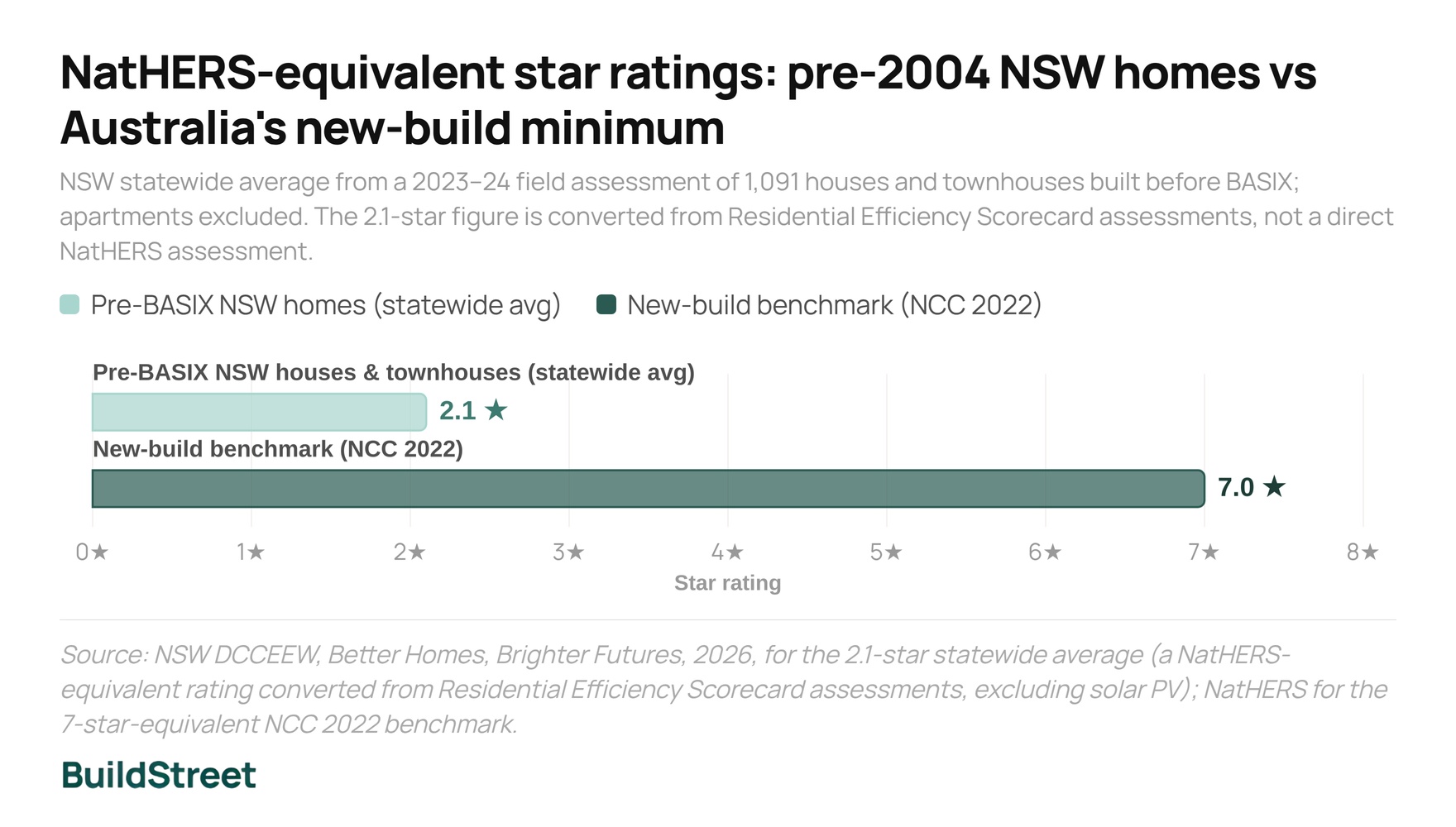
A 2023–24 study of 1,091 NSW houses and townhouses found that homes built before 2004 averaged just 2.1 NatHERS-equivalent stars. After weighting the results to the wider housing stock, researchers estimated that almost one million pre-BASIX NSW homes were in the two lowest rating categories. Private rentals also had less insulation and less access to fixed cooling than comparable owner-occupied homes.
Existing homes pre-standards
70%
About 7.7m of 11m homes, avg. rating below 3 stars
Avg. rating, pre-2004 NSW homes
2.1★
vs 7-star equivalent for new builds
Share of national electricity use
24%
Residential buildings; >10% of emissions · DCCEEW
Private rentals with no fixed cooling
24%
vs 11–12% of owner-occupied homes, NSW field study
Household Energy Upgrades Package
$1.3 billion
$1bn CEFC finance; 110,000+ households intended reach
Victoria rental efficiency mandate
1 Mar 2027
End-of-life heating/hot water must switch to efficient electric
What a NatHERS energy rating actually measures
Existing-home ratings rolled out in stages from July 2025, with Stage 2 and the Home Energy Rating brand launching 1 July 2026. What the star rating covers and how it differs from the compliance rating for new builds.
Read full article →All-electric vs gas connections in new builds
Victoria and the ACT already restrict new gas connections. The state-by-state data on electricity and gas customer numbers, and what's driving the shift for new housing.
Read full article →SECTION 01 · Legacy housing stock
How energy efficient are Australia's older homes?
Around 70% of Australia's 11 million existing homes, roughly 7.7 million properties, were built before minimum energy efficiency standards were introduced, with an estimated average energy rating below 3 stars.
Using current housing-stock modelling, RACE for 2030, drawing on CSIRO's Building Stock Model, estimates that more than 80% of Australian homes are rated 2 stars or lower. This compares with the NCC 2022 7-star-equivalent benchmark for new homes in adopting jurisdictions. NCC 2022 also includes a Whole of Home energy budget that most existing homes were not designed to meet.
Built before min. standards
70%
Avg. rating below 3 stars · DCCEEW, Mar 2026
Rate 2 stars or less (performance)
80%+
CSIRO Building Stock Model
NSW homes in two lowest bands
~1 million
215,677 at 1 star + 773,479 at 2 stars (weighted estimate) · NSW study, 2023–24
Energy efficiency standards milestones for housing in Australia
National regulatory milestones, 2003 to 2026.
Minimum energy efficiency standards introduced for new housing.
6-star rating requirement added via the Building Code of Australia.
NCC 2022 sets a 7-star-equivalent minimum plus a Whole of Home energy budget.
NatHERS Stage 1 for existing homes begins, with first accredited assessors.
Stage 2 launches nationally, alongside the new consumer-facing "Home Energy Rating" brand.
Source: CSIRO; NatHERS; DCCEEW; Business Queensland; energy.gov.au. Jurisdictions adopt NCC updates on their own timelines: Queensland's residential NCC 2022 provisions, for example, commenced 1 May 2024.
NatHERS-equivalent star ratings: pre-2004 NSW homes vs Australia's new-build minimum
NSW statewide average from a 2023–24 field assessment of 1,091 houses and townhouses built before BASIX; apartments excluded.
The 2.1-star figure is converted from Residential Efficiency Scorecard assessments, not a direct NatHERS assessment.
Source: NSW DCCEEW, Better Homes, Brighter Futures, 2026 (statewide average, excluding solar PV); NatHERS for the 7-star NCC 2022 benchmark.
Energy bills for households in very low-rated homes
RACE for 2030 reports that households in 1.7-star homes can pay up to six times more in energy bills than households in modern, efficient homes. This is a bill comparison, not a direct measure of heating and cooling energy use. Actual consumption still depends on climate zone, home size, equipment and occupant behaviour.
Source: No single ABS dataset publicly breaks down the full national housing stock by construction year against these standards milestones. The 70% figure is DCCEEW's estimate; the 80%+ figure is a separate RACE for 2030 estimate drawing on CSIRO's Building Stock Model.
How do NSW private rentals compare with owner-occupied homes?
Private rentals built before 2004 in NSW carry lower average ceiling and wall insulation than owner-occupied homes of the same age, and 24% have no fixed cooling at all, against 11–12% of owner-occupied homes. However, the report found no statistically significant difference in hot or cold weather comfort ratings between privately rented and owner-occupied homes.
Social housing tells a different story: it shows the widest comfort gap of any tenure. In the study, 73% of social housing dwellings received a 1-star cold-weather rating, against 45% of owner-occupied homes, and 54% received a 1-star hot-weather rating, against 36% of owner-occupied homes.
Owner-occupied (pre-2004, NSW)
Private rental (pre-2004, NSW)
Source: NSW DCCEEW, Better Homes, Brighter Futures, 2026, field study of 1,091 NSW houses and townhouses, 2023–24 (pp.37, 41–42).
How can the split incentive affect rental retrofits?
In rental housing, landlords generally pay for property upgrades while tenants receive the direct benefit of lower energy bills. This is commonly described as a split incentive. Eligibility rules vary: NSW's Home Energy Saver zero-interest loan is for eligible homeowners and landlords, while eligible renters can apply directly for the forthcoming discount. Landlord approval, and sometimes strata approval, is required before work can proceed.
When do Victoria's expanded rental efficiency standards begin?
These build on minimum rental standards Victoria has had in place since 2021, including a 2-star minimum heating standard since 2023. From 1 March 2027, heating and hot water systems that reach end of life must generally be replaced with efficient electric systems. At the start of a new lease, rentals must also have four-star showerheads, efficient cooling in the main living area, and ceiling insulation installed where none is present. Draught-proofing follows from 1 July 2027, and efficient cooling becomes mandatory across all rental homes from 1 July 2030.
SECTION 02 · The retrofit sequence
What are the main stages of retrofitting an older home?
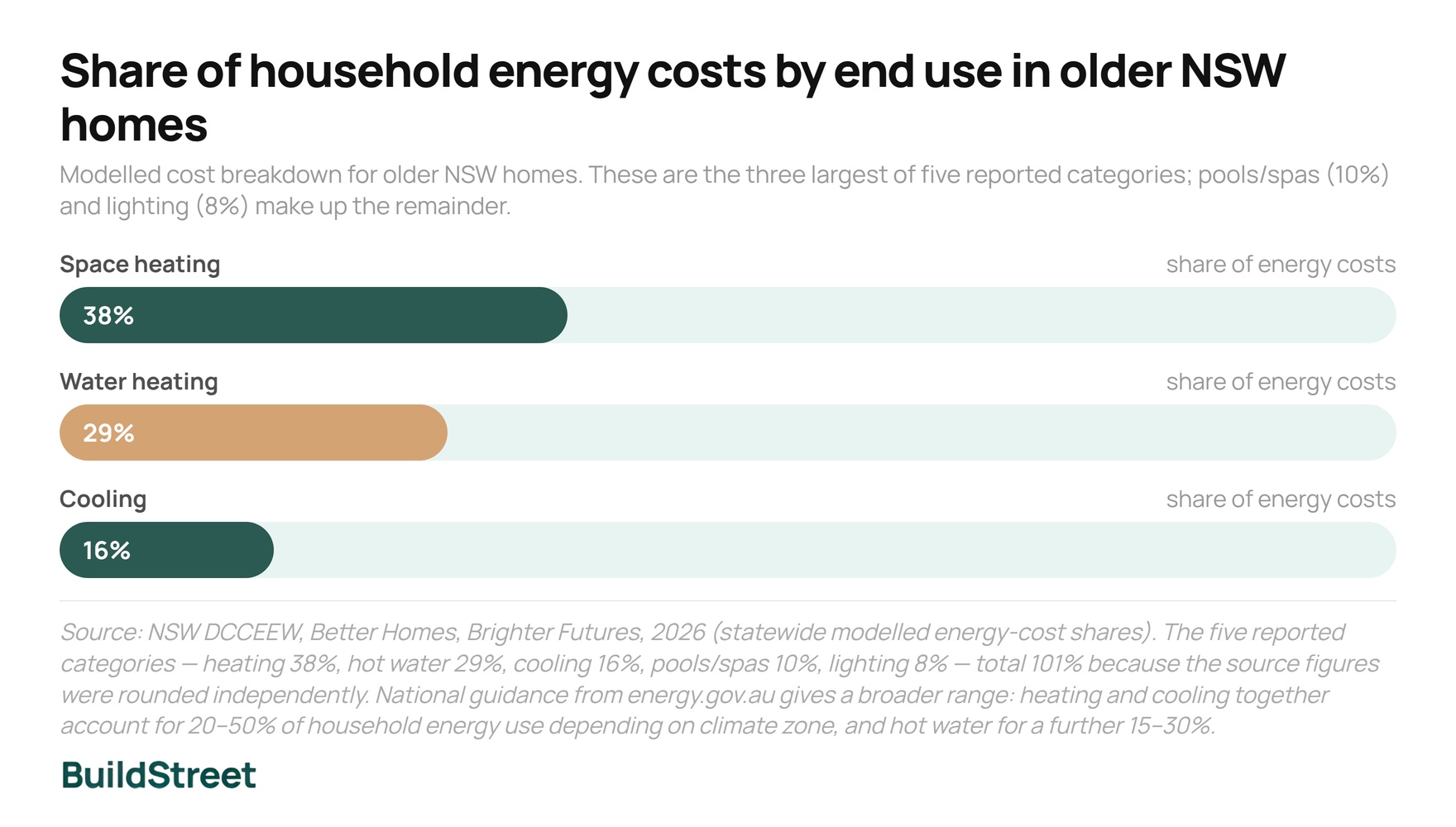
Space heating, hot water and cooling account for 38%, 29% and 16% of household energy costs respectively in older NSW homes, or about 83% combined. Pools and spas (10%) and lighting (8%) make up most of the remainder.
Proportions vary between climate zones. Government guidance and retrofit programmes commonly group measures into three broad categories: the building shell, major appliances, and onsite generation and storage.
Share of household energy costs by end use in older NSW homes
Modelled cost breakdown for older NSW homes. Categories total 101% because source figures were rounded independently.
Source: NSW DCCEEW, Better Homes, Brighter Futures, 2026 (statewide modelled energy-cost shares).
When did home energy ratings for existing homes launch?
NatHERS expanded to existing homes in two stages. Stage 1 began in July 2025 with the first accredited assessors and rating tools. Stage 2 launched on 1 July 2026 with updated tools and certificates, wider assessor accreditation, and a new consumer-facing Home Energy Rating brand and website. Assessments are generally voluntary, although disclosure requirements vary by jurisdiction.
The three broad retrofit categories are:
- Building shell: draught sealing, ceiling and wall insulation, curtains, external shading and, where justified, better windows.
- Appliances: reverse-cycle air conditioning for heating and cooling, a heat pump or solar hot water system, and an induction cooktop.
- Generation and storage: rooftop solar and, depending on the household's load pattern and budget, a battery.
Source: energy.gov.au household guidance; NSW, ACT and Victorian government retrofit program design.
SECTION 03 · Insulation
How much can insulation save on heating and cooling costs?
Ceiling insulation alone can cut heating and cooling costs by up to 45% or more, and insulating the roof, walls and floor together can save over 50%. No official dataset publishes a national average installed cost for insulation in Australia, and reliable, independently verifiable cost figures were not available at the time of writing.
Roof, wall & floor insulation
>50%
Potential heating/cooling cost saving · energy.gov.au
Ceiling insulation alone
Up to 45%+
Heating/cooling cost saving · ICANZ
Wall insulation alone
About 15%
Heating/cooling cost saving · ICANZ
Ceiling insulation is generally considered the easiest of the three types to retrofit. Wall insulation is typically installed during a renovation, while cavities are already open. Underfloor insulation suits homes on stumps or with subfloor access.
| Insulation type | Typical saving | Notes |
|---|---|---|
| Ceiling / roof | Up to 45%+ on heating/cooling costs | Usually the easiest retrofit of the three |
| Walls | About 15% on heating/cooling costs | Typically installed during a renovation, while cavities are open |
| Underfloor | Contributes to the >50% whole-home figure | Suits homes on stumps or with subfloor access |
Source: Payback estimates from government sources vary: Sustainability Victoria cites 5–6 years, while a federal government page cites a 3–5 year payback. Source: energy.gov.au, Insulation and draught proofing; ICANZ; Sustainability Victoria.
SECTION 04 · Glazing and windows
How much energy does double glazing save?
Double glazing cuts heat loss by up to 30% compared with single glazing, and up to 40% of a home's heating energy can escape through windows alone. Windows are one of the largest heat-gain and heat-loss pathways in an Australian home.
No official source publishes a national average price for the work, and reliable, independently verifiable cost figures were not available at the time of writing.
Double glazing vs. single
Up to 30%
Heat-loss reduction · energy.gov.au
Winter heating energy lost
Up to 40%
Through windows · energy.gov.au
Heat gained through windows
~90%
Of a home's total heat gain · energy.gov.au
Window performance can be improved through several separate measures: sealing gaps around frames, fitted curtains and pelmets, external shading, secondary glazing, double-glazed units, and replacement of poorly performing frames or glass. These measures address different forms of heat transfer and are not equivalent to full double glazing.
| Fabric upgrade | Indicative reduction | Metric measured | Source |
|---|---|---|---|
| Ceiling insulation | Up to 45%+ | Heating & cooling cost reduction | ICANZ |
| Double glazing | Up to 30% | Heat-loss reduction vs single glazing | energy.gov.au |
| Draught-proofing | Up to 25% | Reduction on heating bills | energy.gov.au |
| Wall insulation | About 15% | Heating & cooling cost reduction | ICANZ |
Source: These figures measure different things (heat-loss reduction vs heating/cooling cost reduction vs heating-bill reduction) and are not directly comparable or additive. Source: energy.gov.au, Insulation and draught proofing, and Windows; ICANZ.
SECTION 05 · Electrification
How much does home electrification cost in Australia?
A heat pump hot water system uses around 30% of the energy of a conventional electric unit. Reverse-cycle heating and cooling runs at 300 to 600% efficiency, meaning it can deliver three to six units of heating or cooling for each unit of electricity used. A heat pump hot water system typically costs $2,000 to $6,000 installed, according to NSW Government guidance.
Heat pump hot water
~30%
Of the energy used by conventional electric hot water · energy.gov.au
Reverse-cycle heating/cooling
300–600%
Efficient — it moves heat rather than generating it · energy.gov.au
Induction cooktops
~3×
As energy efficient as gas cooktops · energy.gov.au
Payback periods vary by household and depend on the appliances being replaced, local energy tariffs, fixed gas supply charges, climate, equipment condition and available incentives. Hot water has the clearest published cost range of the three.
| Replacing | With | Indicative cost | Notes |
|---|---|---|---|
| Gas or electric-resistive hot water | Heat pump hot water | $2,000–$6,000 | NSW Government estimate for household installs |
| Gas ducted or wall heating | Reverse-cycle air conditioning | Varies by system size | NSW incentives can provide up to $550 for a new 6 kW system or up to $560 when replacing an old unit with a 6 kW split system |
| Gas cooktop | Induction cooktop | Varies by model | No national cost average located |
Source: energy.gov.au, Hot water systems and Heating and cooling; NSW Climate and Energy Action. Reverse-cycle and induction costs are not consistently published nationally.
Heating and cooling account for around 27% of an average NSW household energy bill
Switching a gas heater to an efficient reverse-cycle system could save hundreds of dollars a year, according to NSW Government guidance. This general household figure is not directly comparable with the higher combined heating-and-cooling share modelled for older homes specifically in Section 02. Removing gas entirely can also eliminate the fixed daily supply charge, though the amount varies by retailer, network area and plan.
SECTION 06 · Rebates and incentives
What home energy rebates and loans are available in Australia in 2026?
The federal government committed $1.3 billion to a broader household energy upgrades package, including $1 billion administered through the Clean Energy Finance Corporation's Household Energy Upgrades Fund for discounted finance, and $300 million for social housing upgrades. The fund is intended to reach more than 110,000 households. By the end of 2025, it had supported more than 4,100 homes and over 10,000 completed technology installations.
State and territory programmes fill in the rest, and support varies widely. NSW's relaunched Home Energy Saver is a $557 million package: $480 million in zero-interest loans and $77 million for targeted discounts. The loans opened on 17 June 2026, while discount applications had not yet opened at the time of writing.
| Jurisdiction | Programme | Support | Status, July 2026 |
|---|---|---|---|
| National | Household Energy Upgrades Fund | $1bn CEFC finance (part of $1.3bn package), 110,000+ households intended | Open |
| National | Cheaper Home Batteries Program | About 30% discount on eligible batteries | Open since 1 Jul 2025 |
| NSW | Home Energy Saver | 0% loan up to $15,000; discount up to $4,000 | Loan open; discount applications not yet open |
| Victoria | Solar Homes / Victorian Energy Upgrades | Rebates on solar, hot water, reverse-cycle, insulation | Existing programmes open; ceiling-insulation discounts up to $1,482 begin 1 Oct 2026 |
| ACT | Home Energy Support | Rebate up to $5,000, plus interest-free loan up to $10,000; Sustainable Household Scheme: separate low-interest loan of $2,000–$20,000 | Open |
| WA | Residential Battery Scheme | Up to $1,300 for Synergy customers or $3,800 for Horizon Power customers; no-interest loan up to $10,000 | Open |
| Tasmania | Energy Saver Loan Scheme | 0% loan, $500–$10,000 | Closed to new applications 1 Sep 2025 |
| SA | Retailer Energy Productivity Scheme (REPS) | Discounts, free products or vouchers, depending on retailer | Open |
| Queensland | Supercharged Solar for Renters | Up to $3,500 for landlords to install rental solar | Open since 12 Dec 2025 |
| NT | Solar for Multi Dwellings Grant Scheme | Up to $7,500/dwelling, up to 50% of cost | Open, per current NT Government programme listing |
Source: DCCEEW and energy.gov.au; NSW Climate and Energy Action; Victorian Government; ACT Climate Choices; WA Government; ReCFIT Tasmania; SA Department for Energy and Mining; Queensland Government; NT Government. NSW programme figures reflect the 17 June 2026 relaunch announcement. Other programme settings were reviewed in July 2026 and may change.
How do rebates, loans and discounts differ?
These programmes differ in kind: some are direct rebates, some are concessional loans that still have to be repaid, and some are retailer-delivered incentives that vary by provider, as with South Australia's Retailer Energy Productivity Scheme. They are not equivalent forms of support, and most are also eligibility-tested by income, postcode or property type.
SECTION 07 · Compliance
Do older homes have to meet the same energy standards as new builds?
In jurisdictions that have adopted the NCC 2022 residential energy efficiency provisions, new homes must meet the applicable 7-star-equivalent standard and a Whole of Home energy budget. Existing homes generally have no minimum whole-home energy rating.
The main exceptions are jurisdiction-specific: major renovations or additions may trigger building approval and energy efficiency requirements; the ACT's mandatory rental ceiling-insulation standard commenced 1 April 2023, with most affected properties needing to comply by 30 November 2026; and Victoria already requires an energy-efficient fixed heater in the main living area of applicable rentals, with broader minimum energy efficiency standards phasing in from 1 March 2027.
| Requirement | New homes (NCC 2022) | Existing homes |
|---|---|---|
| Minimum thermal performance | 7-star equivalent, subject to jurisdictional adoption and variations | No general whole-home minimum rating |
| Whole of Home energy budget | Generally 60/100 for houses and 50/100 for apartments, subject to jurisdictional variations | No NCC Whole of Home requirement |
| NatHERS rating | One pathway for demonstrating NCC compliance; other pathways may also apply | Home Energy Ratings are informational and cannot demonstrate NCC compliance |
| Rental minimum standards | Separate from NCC building approval requirements | ACT ceiling-insulation requirements; Victoria's current heating requirement and broader standards phased in from 2027 to 2030 |
Source: NatHERS; Business Queensland; Department of Energy, Environment and Climate Action (Victoria). Existing-home energy ratings cannot be used to demonstrate compliance with the National Construction Code.
Most existing-home upgrades are still a choice, not an obligation
New homes in adopting jurisdictions must demonstrate compliance before approval, while existing homes generally do not have to meet a minimum whole-home star rating. Exceptions include rental-property standards in the ACT and Victoria, as well as requirements that may apply to major renovations.
FAQ
Frequently asked questions
How energy efficient are Australia's older homes on average?+
About 70% of Australia's roughly 11 million existing homes were built before minimum energy efficiency standards were introduced, with an estimated average rating below 3 stars. RACE for 2030, drawing on CSIRO's Building Stock Model, estimates that more than 80% of Australian homes are rated 2 stars or lower on a performance basis, well below the 7-star-equivalent minimum for new homes in adopting jurisdictions.
Which retrofits deliver the largest energy savings?+
Insulating the roof, walls and floor together can save more than 50% on heating and cooling costs, and ceiling insulation alone can cut heating and cooling costs by up to 45% or more. Double glazing can reduce heat loss through windows by up to 30% compared with single glazing, and draught-proofing can cut heating bills by up to 25%. These figures are drawn from separate methodologies and cannot simply be added together.
How much does home electrification cost?+
A heat pump hot water system typically costs $2,000 to $6,000 installed, according to NSW Government guidance. Reverse-cycle air conditioning and induction cooktop costs vary widely by equipment and installation, and no consistent national average is published. Rebates, zero-interest loans and discounts from federal, state and territory programmes offset part of the upfront cost for eligible households.
Do older Australian homes have to meet the 7-star standard?+
No. In jurisdictions that have adopted the NCC 2022 residential energy efficiency provisions, only new homes and certain major renovations must meet the applicable 7-star-equivalent standard and Whole of Home energy budget. Existing homes generally have no minimum whole-home rating. Rental-specific standards apply in the ACT and Victoria, and further Victorian rental standards begin phasing in from 1 March 2027.
General information only
This article is a statistical reference based on publicly available government, research and industry data. Cost and savings figures are indicative unless otherwise stated and may vary by location, climate zone, home condition, equipment and household circumstances. This article does not constitute financial, building or energy advice. Rebate, loan and incentive details were reviewed in July 2026, but programme funding, eligibility requirements and application status may change.
References
- Energy rating scheme to reduce bills and improve household resilience, DCCEEW ministerial release, March 2026
- Residential buildings – energy efficiency, DCCEEW, current July 2026
- Better Homes, Brighter Futures, NSW DCCEEW, 2026
- Living in a glorified tent: energy gaps between older and newer homes, The Conversation, July 2026
- Insulation and draught proofing, energy.gov.au
- Windows, energy.gov.au
- Heating and cooling, energy.gov.au
- Hot water systems, energy.gov.au
- The Value of Insulating Existing Homes, ICANZ, August 2024
- Home window glazing, Sustainability Victoria
- Energy efficiency for rental properties in Victoria, DEECA, updated February 2026
- Victorian Energy Upgrades – insulation discounts, DEECA
- Minimum housing standard for ceiling insulation in rental properties, ACT Government
- Energy Saver Loan Scheme, ReCFIT (Tasmania)
- Existing Homes, NatHERS (Stage 1 July 2025; Stage 2 mid-2026)
- Home Energy Rating launched today, energy.gov.au, 1 July 2026
- Home Energy Saver, NSW Climate and Energy Action
- Energy savings for NSW households, NSW Government ministerial release, June 2026
- Energy Upgrades for Australian Homes, RACE for 2030, updated May 2026
- Reverse-cycle air conditioners, NSW Climate and Energy Action
- What's new about NCC 2022, Australian Building Codes Board
- Whole of Home assessment and score, Business Queensland
- The Value of Ceiling Insulation, ICANZ
Chart Snapshots