Building Codes & Standards · Australia · Updated 13 July 2026
New home energy efficiency rules in Australia in 2026
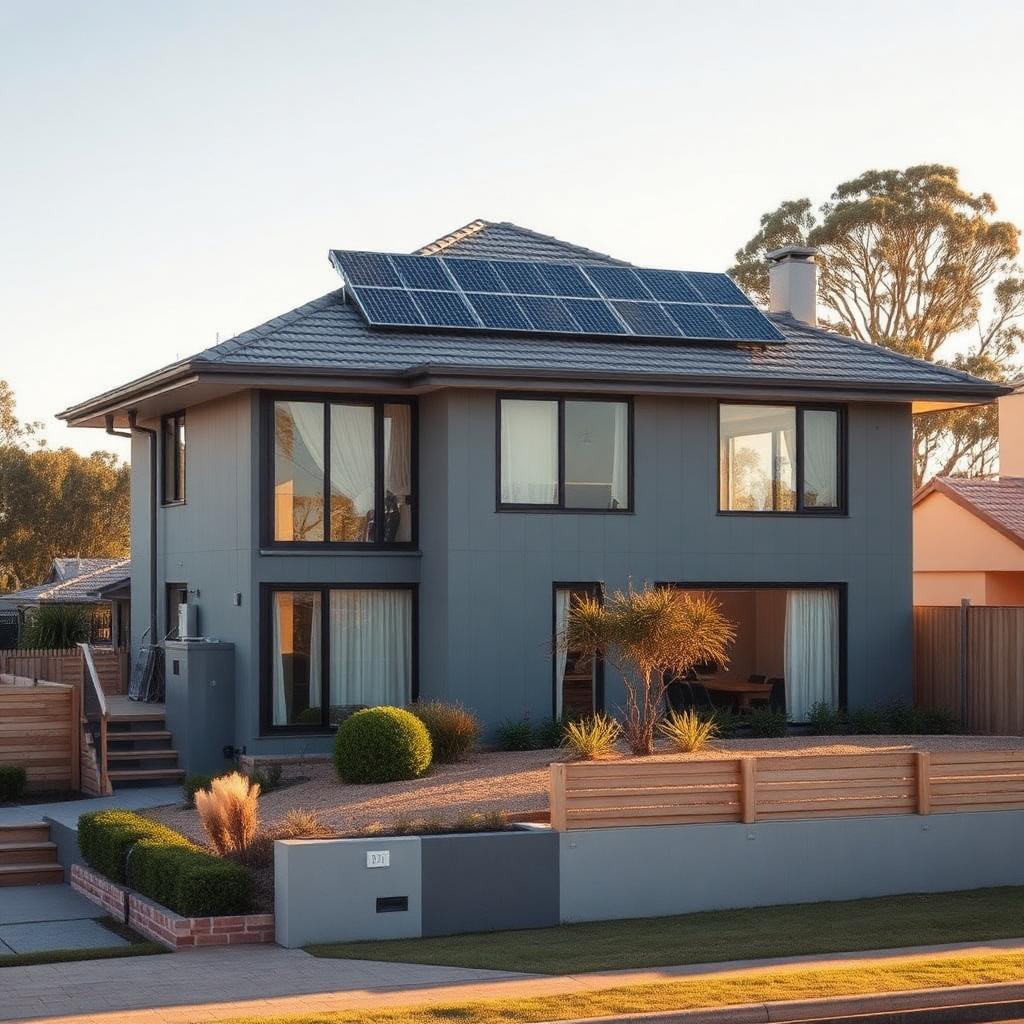
Most new houses and townhouses approved in jurisdictions that have adopted NCC 2022 must now meet a 7-star NatHERS-equivalent thermal standard, up from the 6-star minimum that applied for more than a decade. Apartment buildings generally need to average 7 stars across units, with no individual apartment below 6 stars, although NSW uses BASIX-aligned settings and state-specific concessions apply. The rule sits inside the National Construction Code (NCC) 2022, which has been adopted with variations in every state and territory except Tasmania and the Northern Territory by mid-2026.
Building ministers have paused further changes to the code for residential energy efficiency until at least mid-2029, so the 7-star standard, alongside a separate Whole of Home energy budget, is expected to remain the main residential energy-efficiency framework for the rest of the decade.
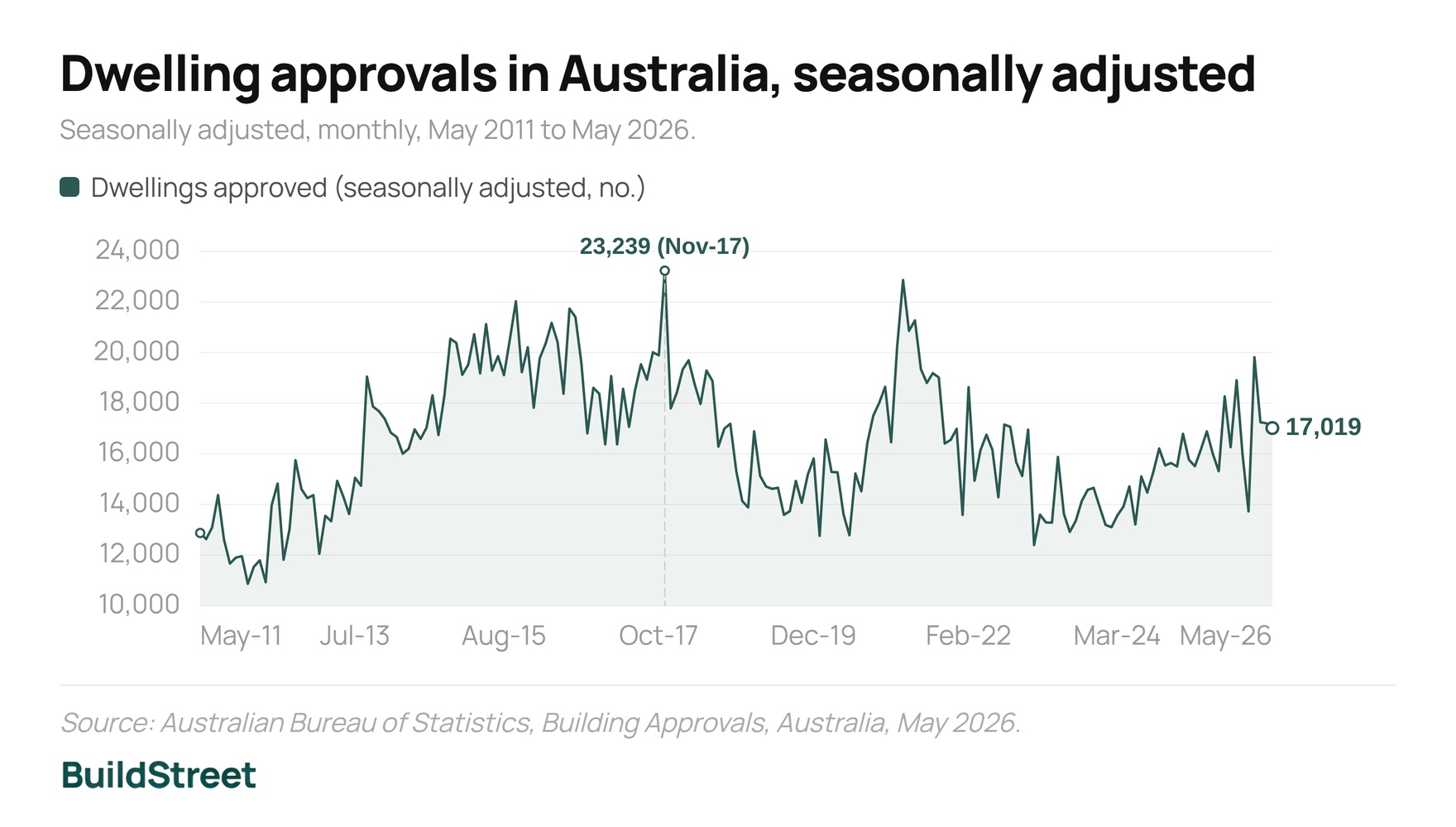
The ABS recorded 17,019 dwelling approvals in May 2026 on a seasonally adjusted basis, with new homes assessed against the code, BASIX or transition rules that applied in their jurisdiction at the approval stage.
NatHERS minimum
7 stars
Required for new houses and townhouses under NCC 2022, up from 6 stars
Official · NCC 2022Whole of Home score
60 / 50
NCC default for houses / apartments, NSW uses BASIX-aligned settings
Official · NCC 2022Code freeze
2029
Earliest year building ministers will consider further residential energy changes
Official · Oct 2025Jurisdictions yet to adopt
2
Tasmania and the Northern Territory still apply lower star minimums
Compiled · Jul 2026Why Australia's 7-star energy standard has divided the building industry
The cost debate around NCC 2022's minimum energy rating: HIA's $20,000 estimate for Victoria, government modelling showing a $822 lifetime net benefit, and state-by-state build cost data during the rollout.
Read full article →Solar panel and battery statistics for new Australian homes in 2026
Rooftop solar and battery storage feed into the Whole of Home score. Uptake rates, state incentives and available cost data for new-build solar and battery systems.
Read full article →SECTION 01 · Standard
What the National Construction Code requires from new homes
NatHERS thermal rating scale, 0 to 10 stars
New houses and townhouses in adopting jurisdictions must generally reach a minimum NatHERS-equivalent thermal rating of 7 stars, one full star above the 6-star minimum that applied under the previous code. Apartment buildings face a related but separate test: the building must average 7 stars across all units, with no individual apartment below 6 stars.
A second test, called Whole of Home, sets a minimum energy score of 60 out of 100 for houses and 50 out of 100 for apartments under the NCC 2022 default settings, with NSW using BASIX-aligned settings and jurisdictional variations applying. It works on a scale where 100 represents a net zero energy home, and scores above 100 are possible if a home generates more solar energy than it uses.
The score covers energy used by fixed equipment inside the home, including heating and cooling systems, hot water, lighting, and pool or spa pumps, after deducting eligible rooftop solar generation. It sits alongside the thermal rating, which measures how well a building's shell holds a comfortable temperature without mechanical heating or cooling.
Residential buildings account for around 24% of Australia's electricity use and more than 10% of its carbon emissions, according to DCCEEW. The combined requirements are estimated to save new homes an average of $183 a year on power bills, according to government modelling, though actual savings depend on climate, household size and how the home is used.
Why the standard exists
Lower energy bills
Estimated to save new homes an average of $183 a year on power bills.
One national baseline
A broadly common 7-star standard applies across most jurisdictions, with NSW using BASIX-aligned settings.
Less heating and cooling
A higher-performing shell can reduce how much energy a home needs to stay comfortable year-round.
Lower emissions
Government modelling expects the changes to reduce energy demand and emissions from the housing sector.
Source: DCCEEW, residential buildings and energy efficiency guidance.
What star rating do new homes need in Australia?
Most new homes need a minimum 7-star NatHERS rating plus a Whole of Home energy score of at least 60 out of 100 for houses, or 50 out of 100 for apartments under the NCC 2022 default settings. Tasmania and the Northern Territory are the exceptions, and still apply lower minimums.
SECTION 02 · History
How does the 7-star rule compare with the old 6-star standard?
The average Australian home rated about 1.8 stars in 2003, when no national minimum yet existed, though some states had already introduced their own early minimums from 2001, typically 3 to 4 stars.
A 6-star floor was mandated nationally from 2010, before NCC 2022 lifted it to 7 stars and added the Whole of Home budget as a separate layer of assessment — a bigger shift than the one-star headline suggests.
2001
First state minimums
Jurisdictions begin setting their own minimum star requirements, generally 3 to 4 stars.
2003
Baseline set
The average established Australian home rates about 1.8 stars, before mandatory ratings applied nationally.
2010
6-star minimum
A 6-star NatHERS minimum for new homes is mandated nationally.
2022 to 2025
7-star and Whole of Home
NCC 2022 lifts the minimum to 7 stars and adds the Whole of Home budget. States adopt on staggered dates.
2029
Earliest review
Building ministers have paused further residential energy changes until at least mid-2029.
Historical star ratings before 2016 were not collected in a national database and are drawn from CSIRO research and public commentary rather than certificate records.
Under the previous code, a Victorian home could reach 6 stars and separately install either a solar water heater or a rainwater tank connected to the toilets. That services requirement was removed when NCC 2022 became mandatory in Victoria on 1 May 2024, replaced by the wider Whole of Home energy budget, known in the code as H6P2.
From 1 October 2023, the thermal standard for applicable new homes in New South Wales rose from an average of 5.5 to 6 stars to 7 stars, alongside a 7% to 11% increase in greenhouse gas emission reduction targets depending on location and development type.
NSW's own BASIX system estimates an average home meeting the higher standard will save $1,070 a year in energy bills, higher than the national $183 estimate because the two figures use different scopes, methods and assumptions.
Bill savings estimates, national vs NSW
$183 vs $1,070
The national modelling estimate and NSW's own BASIX estimate are not directly comparable because they use different scope, methods and assumptions.
The comparison only holds in states that have actually adopted the new standard. Tasmania still requires 6 stars for new homes, and the Northern Territory requires 5 stars for houses and 3.5 stars for apartments, so the before-and-after story does not apply nationally.
SECTION 03 · Design
What does a 7-star home design need?
A 7-star NatHERS rating is performance based rather than tied to one fixed specification. The required mix of insulation, glazing, shading, orientation, ceiling fans and building sealing varies by climate zone, site layout and design. One home may reach 7 stars with stronger glazing and moderate insulation, while another may need smaller windows, better orientation or additional insulation to reach the same rating.
NatHERS guidance for designers points to a consistent set of levers:
- Orientation suited to the local climate
- Better glazing and shading
- More internal zoning, with doors between living areas
- Additional insulation across more of the building
- Ceiling fans
- Lighter roof and wall colours in warmer climates
- Fewer ceiling penetrations from downlights, roof windows and skylights, which let conditioned air escape
Reaching 7 stars is not the end of the compliance process. In Victoria, for example, certifiers still expect documentation covering window schedules, U-values, solar heat gain coefficients, insulation R-values, orientation, and lighting and services. The NCC separately requires attention to insulation installation methods, thermal breaks, building sealing, and water heating and pumping.
SECTION 04 · Climate zones
How climate zones affect 7-star home design in Australia
Australia is divided into eight NCC climate zones, from hot humid Zone 1 in the tropics to alpine Zone 8, and the design response needed to reach 7 stars changes depending on the home's climate zone.
NCC climate zones and design priority in Australia
| Zone | Climate description | Design priority |
|---|---|---|
| 1 | Hot humid summer, warm winter | Cooling |
| 2 | Warm humid summer, mild winter | Cooling |
| 3 | Hot dry summer, warm winter | Cooling |
| 4 | Hot dry summer, cool winter | Cooling and heating balance |
| 5 | Warm temperate | Cooling and heating balance |
| 6 | Mild temperate | Cooling and heating balance |
| 7 | Cool temperate | Heating |
| 8 | Alpine | Heating |
Source: Design priority reflects where heating and cooling demand is greatest in each climate zone, not a formal NCC classification. Australian Government, Your Home, climate zone guidance.
The practical difference shows up in design priorities: homes in the hot, humid north are built to shed heat, while homes in the cool south and inland are built to hold onto it. Most of Australia benefits from north-facing living areas that capture winter sun while eaves block summer heat, but homes above the Tropic of Capricorn benefit more from cooling breezes and shade than from northern sun.
NatHERS software applies standard climate data and weather files that are generally aligned to postcode boundaries, though an alternative zone can be assigned within a postcode where local conditions differ enough to matter.
SECTION 05 · Adoption
Which states and territories have adopted the standard, and when?
Two jurisdictions, Tasmania and the Northern Territory, have not adopted the 7-star minimum. Everywhere else, adoption has been staggered across six commencement dates between October 2023 and May 2025, even though NCC 2022's energy provisions sit in one national code.
7-star adoption by state and territory in Australia
| State or territory | Star minimum | Whole of Home | Commencement | NCC 2025 transition |
|---|---|---|---|---|
| New South Wales | 7 stars | BASIX-equivalent target | 1 October 2023 | Other provisions deferred to 1 May 2027 |
| Australian Capital Territory | 7 stars | NCC 2022 default, 60 / 50, subject to territory variation | 15 January 2024 | Dual-code window, 1 May 2026 to 1 May 2027 |
| Victoria | 7 stars | 60 / 50 | 1 May 2024 | Adopted from 1 May 2026 |
| Queensland | 7 stars | 60 / 50 | 1 May 2024 | Other provisions deferred to 1 May 2027 |
| South Australia | 7 stars | NCC 2022 default, 60 / 50, subject to state variation | 1 October 2024 | Plumbing code only (2026); building code deferred to 2027 |
| Western Australia | 7 stars | NCC 2022 default, 60 / 50, subject to state variation | 1 May 2025 | Optional from May 2026; Amendment 2 usable to April 2027 |
| Tasmania | 6 stars | Not applied | Not adopted | NCC 2022 reinstated, 5 June 2026 to 1 May 2027 |
| Northern Territory | 5 stars for houses; 3.5 stars for apartments | Not applied | Not adopted | Reversed an earlier move to NCC 2025; NCC 2022 continues |
Source: ABCB, NCC 2022 and NCC 2025; DCCEEW; NSW Planning; ACT Planning; Victoria DEECA; Queensland Housing; PlanSA; WA Government; Northern Territory Government; Tasmania CBOS.
Whole of Home and NCC 2025 transition dates
Queensland's target of 60 for houses and 50 for units matches the national NCC default, as does Victoria's. The ACT, South Australia and Western Australia have adopted NCC 2022's residential energy provisions, but public state or territory guidance confirming a specific Whole of Home score was not found during this review. For those jurisdictions, the table shows the NCC 2022 default score, subject to any local variation. Building ministers confirmed NCC 2025 adds no new residential energy-efficiency requirements, so none of these transition dates change the 7-star or Whole of Home figures shown here.
Adoption rollout, October 2023 to May 2025
19 months
Among adopting jurisdictions, rollout took 19 months, spread across six separate commencement dates. Tasmania and the Northern Territory remain outside the 7-star system altogether.
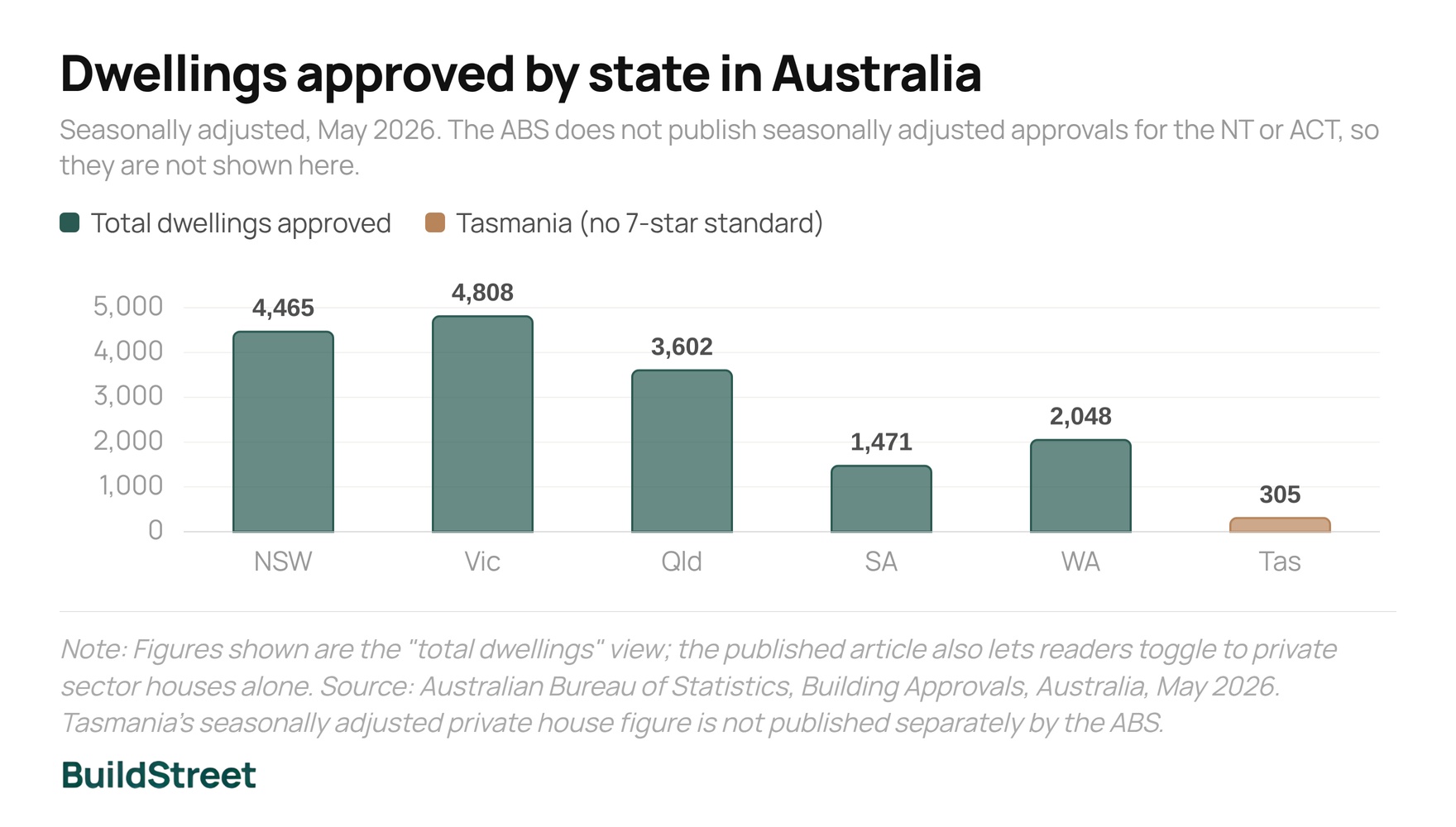
Building activity gives a sense of scale, though it says nothing about which star rating each approval will meet. In the seasonally adjusted estimate for May 2026, Victoria and New South Wales remained the largest markets by dwellings approved, while Tasmania — which has not adopted the 7-star standard — recorded the smallest number among the jurisdictions with published seasonally adjusted figures.
The month-to-month movements diverged sharply by state. South Australia's seasonally adjusted approvals rose 10.9% in May 2026, the strongest gain of any state, while Queensland fell 8.8%, the steepest decline. Single-month swings of that size are common in a series built from relatively small state-level counts, so they should be read as monthly volatility rather than evidence of a sustained shift.
Dwellings approved by state in Australia
Seasonally adjusted, May 2026. The ABS does not publish seasonally adjusted approvals for the NT or ACT, so they are not shown. Tasmania's private house figure is not published separately.
NSW
Source: ABS, Building Approvals, Australia, May 2026 (Table 07).
Dwelling approvals in Australia, seasonally adjusted
Seasonally adjusted, monthly, May 2011 to May 2026.
May-11
Source: ABS, Building Approvals, Australia, May 2026.
On a yearly-average basis, seasonally adjusted approvals peaked around 2015, rose again to a second high around 2021, fell to a recent low around 2023, and have recovered since, although the monthly series itself moves up and down considerably from month to month.
SECTION 06 · Exemptions
Exemptions and transition rules still apply in some jurisdictions
At least seven major exemption or transition categories remain active in 2026, and the list is not exhaustive. It does not include every state-specific rule, such as South Australia's delayed application of modern homes provisions to alterations and additions until 30 April 2030.
Selected arrangements
7+
Selected exemption or transition categories identified from official state and territory guidance
Jurisdictions affected
5
Jurisdictions listed in the selected arrangements table
Selected 7-star exemptions and transition arrangements in Australia
| Arrangement | Where it applies | What it allows |
|---|---|---|
| Tropical allowance | NCC climate zones 1 and 2 | 6 or 6.5 stars with a compliant outdoor living area |
| North coast carve-out | NSW climate zones 9, 10 and 11 | BASIX uplift did not apply; average 5.5 to 6 stars remains |
| Flats and alterations | NSW flat buildings and shop-top housing up to 5 storeys; alterations and additions | BASIX uplift did not apply |
| South Australian concessions | Small or irregular allotments, workers' and tourist accommodation, part of the Mount Barker zone, off-site manufactured homes of 70 m² or less | 6 stars allowed alongside NCC 2022 energy usage and condensation rules |
| Load limit exclusion | Western Australia | Regulation 15C excludes separate NatHERS heating and cooling load limits |
| Dual code period | ACT, 1 May 2026 to 1 May 2027 | Either NCC 2022 or NCC 2025 permitted, not mixed |
| Code reinstatement | Tasmania, 5 June 2026 to 1 May 2027 | NCC 2022 reinstated; certificate of likely compliance exemptions apply |
Data gap: concession usage
No national dataset shows how many new homes use each 7-star exemption or transition rule.
Source: NatHERS; NSW Planning; PlanSA; ACT Planning; Tasmania CBOS; Western Australia Building Regulations 2012.
SECTION 07 · Compliance
How 7-star home energy compliance is checked
NatHERS certificates are issued at the design stage and record the thermal rating, Whole of Home score, key design features and certificate details used to check the approved design. The certificate allows builders, certifiers and regulators to confirm that a home was designed to meet the NCC's minimum energy-efficiency standards and was built to match the rated design.
CSIRO says NatHERS certificate use has climbed steadily. In 2018, about 80 NatHERS certificates were generated for every 100 ABS building permits, rising to 96.5 certificates per 100 permits in 2025. This indicates that NatHERS software is the dominant assessment pathway, but certificates per permit are not the same as a direct compliance-outcome rate.
Compliance assessment, nationwide
96.5 per 100 permits
CSIRO reported 96.5 NatHERS certificates for every 100 ABS building permits in 2025, up from about 80 per 100 permits in 2018. This is a certificate-use proxy, not a direct measure of passed inspections or enforcement outcomes.
Data gap: compliance outcomes
No national dataset tracks 7-star permit refusals, failed inspections or enforcement actions.
Enforcement then follows each state's own building approval system. Victoria's building surveyors check energy-efficiency documentation before issuing permits and may inspect homes during construction. Queensland accepts a software assessment when it is completed by a suitably trained assessor using an approved NatHERS tool. New South Wales uses BASIX and NatHERS documentation for applicable residential development. In Tasmania, the building surveyor checks compliance at the Certificate of Likely Compliance stage, with a Form 55 certificate used where an independent assessor conducted the rating.
SECTION 08 · Outlook
Is Australia moving to an 8-star home energy standard?
Building ministers have paused further residential energy efficiency changes to the National Construction Code until at least mid-2029, except for essential safety and quality changes. The federal Minister for Housing announced the pause in August 2025, and state and territory building ministers formally agreed to it in October 2025. The 7-star and Whole of Home standards introduced in NCC 2022 are expected to remain the main residential energy-efficiency settings during the pause.
NCC 2025 was available for jurisdictions to consider from 1 May 2026 after preview publication earlier in 2026, but it does not add new residential energy-efficiency requirements. Its main changes are concentrated in other areas, including commercial buildings, water management, carpark fire safety and condensation control.
States and territories are rolling out NCC 2025's other provisions on different timelines through to May 2027, as the table in Section 05 shows. That staggered rollout does not change the 7-star or Whole of Home standard in jurisdictions that have already adopted NCC 2022 residential energy provisions.
Is Australia moving to an 8-star standard soon?
No. Building ministers agreed in October 2025 to pause further residential energy efficiency changes to the National Construction Code until at least mid-2029, except for essential safety and quality changes. The 7-star and Whole of Home requirements introduced in NCC 2022 remain the standard in adopting jurisdictions.
About the data
What the data does and does not show
This article uses official national, state and territory guidance on NCC 2022, NatHERS, BASIX and residential energy-efficiency rules. It also uses ABS Building Approvals data for housing-approval context.
Official data does not include:
- a national dataset on 7-star permit refusals, failed inspections or enforcement actions
- a national count of how many new homes use each exemption or transition rule
- a government-run estimate of total 7-star compliance costs
- a directly comparable bill-savings figure across all jurisdictions
ABS Building Approvals figures are revised in later releases, so future releases may revise or supersede the May 2026 figures used in this article.
General information only
This page is based on publicly available official sources, including DCCEEW, the Australian Building Codes Board, NatHERS, the ABS, and state and territory government guidance. It is general information only and is not building, engineering or legal advice.
References
- DCCEEW: residential buildings and energy efficiency guidance
- ABCB: NCC 2022, Volume Two, Part H6 Energy Efficiency
- Standards Australia: NCC 2025 preview and adoption
- Treasury: Building Ministers' Meeting communiqué, October 2025
- NatHERS: Top tips for building for 7 stars
- Home Energy Rating: understanding your new home certificate
- CSIRO: NatHERS certificate headline data
- ABS: Building Approvals, Australia, May 2026
- Australian Government Your Home: climate zones
- NSW Planning: BASIX sustainability standards
- ACT Planning: NCC 2025 transition guidance
- Victoria DEECA: 7-star energy efficiency standards
- Queensland Housing: modern homes residential energy standards
- PlanSA: NCC 2022 modern homes provisions
- WA Government: Energy efficiency matters
- NT Government: Energy efficiency of residential buildings
- Tasmania CBOS: NCC 2025 and 2026 guidance
Chart Snapshots