Home Energy Ratings · Build Street
What does a NatHERS energy rating measure?
The Nationwide House Energy Rating Scheme (NatHERS) measures the thermal performance of a home's design, not its total energy use.
The Star Rating runs from 0 to 10 and reflects how well a home's design and construction are expected to maintain a comfortable temperature in its local climate. Since 2022, the National Construction Code has set a minimum of 7 stars for new homes in most jurisdictions, up from 6. A separate Whole of Home rating, on a scale of 0 to 100+, covers the home's broader modelled energy use, including heating and cooling, appliances, hot water, lighting, solar and battery storage.
That split matters: residential buildings account for around 24% of Australia's electricity use and more than 10% of its carbon emissions. A single star number is often mistaken for a stand-in for a home's entire energy performance, but the Star Rating covers only the building shell.
Star Rating scale
0–10
Thermal performance of the building shell only
Whole of Home scale
0–100+
Broader modelled household energy use, higher is better
Minimum Star Rating, NCC 2022
7 / 10
Up from a 6-star minimum before the update
NatHERS climate zones
69
Each with its own star-band thresholds
What energy efficiency rules apply to new homes in Australia in 2026?
Current National Construction Code requirements for new homes across Australian states and territories, including how the Star Rating, Whole of Home and load-limit thresholds are measured for compliance.
Read full article →Why has Australia's 7-star energy standard divided the building industry?
Compares state-by-state construction cost data since the NCC 2022 rollout with the benefit-cost modelling and industry estimates behind the 7-star minimum.
Read full article →What does a NatHERS rating actually measure?
A NatHERS Star Rating measures the thermal performance of a home's design and construction, on a scale of 0 to 10, based on how well it is expected to maintain a comfortable temperature in its local climate. It does not measure the home's total energy use. That broader figure, covering heating and cooling, appliances, hot water, lighting, solar generation and battery storage, is captured separately by the Whole of Home rating, on a scale of 0 to 100+.
SECTION 01 · The core distinction
What is the NatHERS rating system?
NatHERS, the Nationwide House Energy Rating Scheme, has operated for more than three decades, rating the energy performance of Australian homes since 1993. It produces two distinct measures rather than one combined score: a Star Rating for thermal performance and a Whole of Home rating for broader modelled household energy use. For new homes, the certificate is assessed from design plans before construction. For existing homes, the certificate records the home's current, as-built energy efficiency.
The Star Rating, on a scale of 0 to 10, reflects the thermal performance of the design itself: how well the layout, materials, insulation, windows, orientation and shading are expected to keep the home comfortable in its local climate. The Whole of Home rating, on a scale of 0 to 100+, estimates the home's total modelled energy use, including heating and cooling, hot water, lighting, fixed appliances, and any onsite solar or battery storage. A home can score well on one measure and poorly on the other. The two ratings measure different parts of home energy performance and cannot be used interchangeably.
Star Rating
Whole of Home
Source: homeenergyrating.gov.au, understanding your new home's certificate.
How have NatHERS minimum ratings changed?
The minimum Star Rating for new homes has risen from 6 to 7 since 2022, the second increase in fifteen years. The 0 to 10 scale itself has not changed since it was expanded in 2006, but the average outcome has moved with each tightening of the minimum.
Scheme begins
NatHERS starts providing ratings for new homes.
National adoption
Energy-efficiency requirements adopted in all states and territories.
10-star scale introduced
Star bands expanded to the current 0–10 scale and to 69 climate zones.
6-star minimum
Minimum rating for new homes raised to 6 stars (or the BASIX equivalent in NSW).
Average rating: 6.2 stars
CSIRO records the average newly built home at 6.2 stars, more than triple the 1.8-star average estimated at the scheme's 2003 baseline.
7-star minimum in Victoria
Updated NCC 2022 energy-efficiency standards become mandatory in Victoria, moving applicable new homes from 6 to 7 stars.
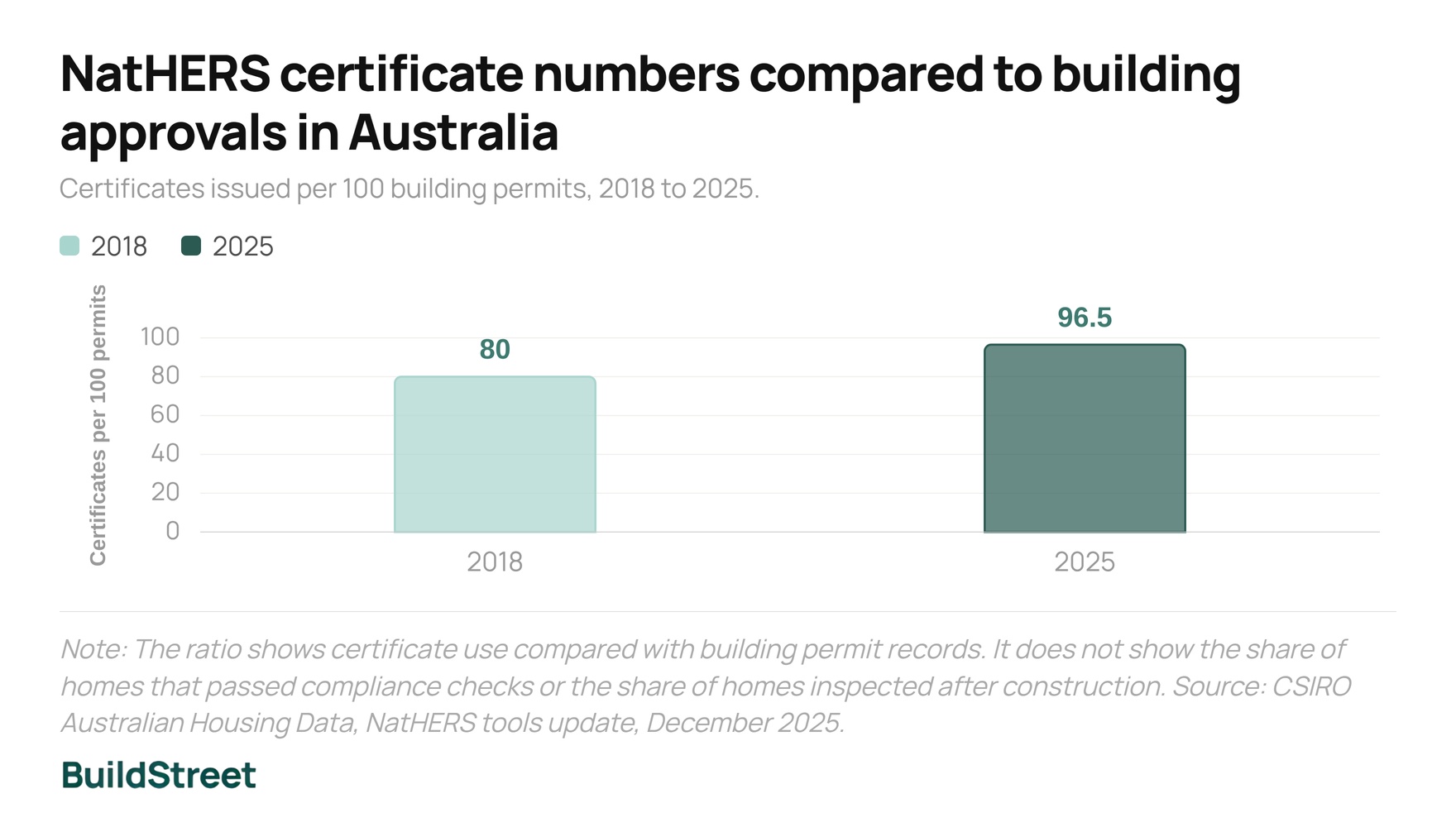
Certificate use hits 96.5 per 100 permits
CSIRO reports 96.5 NatHERS certificates for every 100 ABS building permit records in 2025, up from around 80 per 100 in 2018.
NatHERS certificate numbers compared to building approvals in Australia
Certificates issued per 100 building permits, 2018 to 2025.
The ratio shows certificate use compared with building permit records. It does not show the share of homes that passed compliance checks or the share of homes inspected after construction.
Source: CSIRO Australian Housing Data, NatHERS tools update, December 2025.
How do older homes compare with new NatHERS standards?
Homes built before 2003 average below 3 stars out of a possible 10, less than half the 6.2-star average recorded for new homes in 2019. Australia has about 11 million existing residential buildings, and most predate current energy-efficiency standards by a wide margin, leaving the 7-star minimum required today well out of reach for most of the existing stock.
Existing residential buildings
About 11 million
Most built before current standards applied
Average rating, pre-2003 homes
Below 3 stars
Out of a possible 10
Household Energy Upgrades Fund
$1.3 billion
Allocated in the 2023–24 Federal Budget
Homes targeted by the fund
110,000+
For energy-efficiency upgrades to existing homes
Source: energy.gov.au, update to the Trajectory for Low Energy Buildings (August 2025), and DCCEEW, residential buildings.
SECTION 02 · The method
How a NatHERS star rating is calculated
Every NatHERS assessment simulates a full year of hourly weather data, 8,760 hours in total, using the CSIRO-developed Chenath engine to calculate the energy needed to keep each part of a home within a fixed comfort range. Four accredited software tools currently perform this simulation, all built on the same underlying engine so results are comparable with each other.
Source: NatHERS-accredited software uses standard climate zones, Reference Meteorological Year weather files, internal heat-load assumptions and area correction factors. Software tools include AccuRate Home, BERS Pro, FirstRate5 and Hero. Source: homeenergyrating.gov.au, software rules and modelling inputs.
- 1
Building data entered
Room dimensions, materials, windows, construction type, orientation and location are entered from design plans, or measured for an existing home.
- 2
Climate file applied
The software applies the Reference Meteorological Year weather file for the home's specific climate zone, using a full year of hourly climate data.
- 3
Standard occupancy applied
Fixed occupancy hours and thermostat settings are applied so every home is modelled under the same assumptions, rather than the behaviour of its actual occupants.
- 4
Passive measures modelled first
The model applies natural ventilation, shading and mechanical air movement before mechanical heating or cooling is triggered.
- 5
Heating and cooling loads calculated
Hour-by-hour energy demand is calculated in megajoules per square metre of conditioned floor area, not raw annual energy use.
- 6
Area correction factor applied
Loads are adjusted for dwelling size, so homes of different footprints can be compared on a more consistent basis.
- 7
Star Rating assigned
The adjusted load is compared against that climate zone's own star-band thresholds and assigned in half-star increments.
- 8
Whole of Home rating calculated
A separate calculation adds heating and cooling, fixed appliances, hot water, lighting, solar generation and battery storage to produce the 0–100+ score.
- 9
Certificate issued
An accredited assessor issues the certificate with the scheme logo, colour formatting and a QR code linking to the secure online record.
Source: nathers.gov.au and homeenergyrating.gov.au, how NatHERS ratings are calculated.
What temperature settings are used in NatHERS assessments?
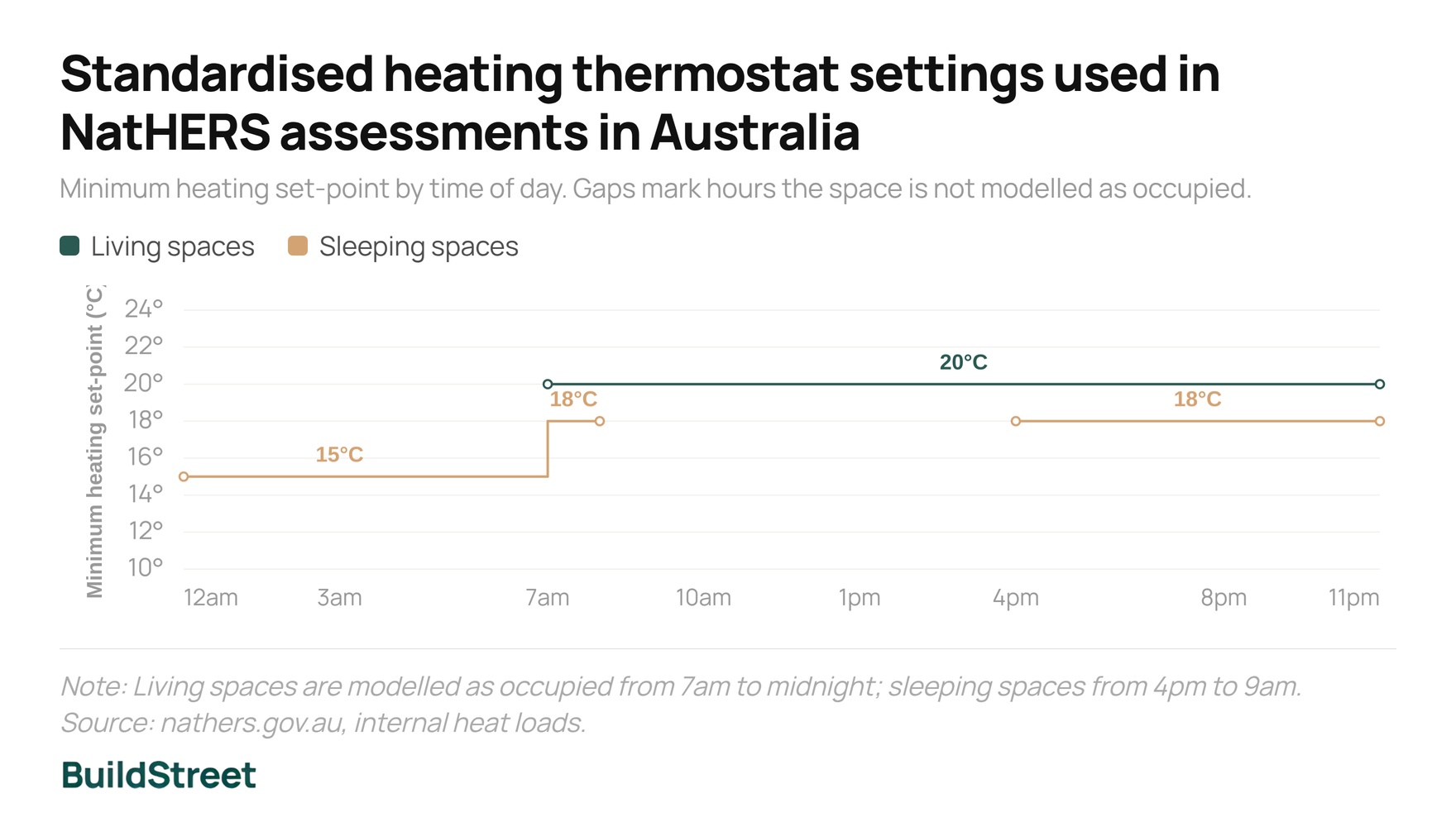
NatHERS assessments use standard thermostat and occupancy settings so homes can be compared on the same basis. Living spaces are modelled with a 20°C minimum heating setting during occupied hours. Sleeping spaces use a 18°C minimum heating setting from 7am to 9am and from 4pm to midnight, then 15°C from midnight to 7am.
Cooling settings are not a single national number. They vary by climate zone and room type to reflect local acclimatisation, air movement, air temperature and humidity.
Standardised heating thermostat settings used in NatHERS assessments in Australia
Minimum heating set-point by time of day.
- living
- sleeping
Living spaces are modelled as occupied from 7am to midnight; sleeping spaces from 4pm to 9am. Gaps in each line mark hours the space is not modelled as occupied, so no setting applies.
Source: nathers.gov.au, internal heat loads.
The standardisation behind these figures is deliberate: because every home is assessed against the same occupancy and comfort assumptions, two homes can be compared fairly regardless of how their actual occupants behave.
Source: Current NCC 2022 accredited software tools use Chenath versions 3.22, 3.23 or 3.24. homeenergyrating.gov.au, Software Accreditation Protocol for new homes ratings NCC 2025, Version 20241122.
SECTION 03 · The design inputs
What affects a home's NatHERS score?
A home's NatHERS Star Rating is affected by climate zone, orientation, insulation, shading, window type, building materials, air leakage, floor area and ceiling fans. Together, these inputs affect how much heating and cooling the home is modelled to need. Appliances, hot water systems, lighting, solar panels and batteries are assessed separately through the Whole of Home rating.
Orientation
The home's orientation affects how much sun reaches living areas, windows and shaded spaces at different times of year.
Insulation
Entered separately for roof, ceiling, walls and floor. Higher values reduce heat transfer through the shell.
Windows and glazing
Frame type, glass type, solar heat gain coefficient and U-value are entered for each opening. Window performance affects both heating and cooling loads.
Shading
Modelled as operable, closing when solar irradiance on the glazing exceeds 75 W/m². Shading can reduce cooling loads in hot conditions, but it can also affect winter heat gain.
Building materials
Construction type and thermal mass are entered per element. CSIRO data from 2019 put the average new home at a metal roof, brick veneer walls and a concrete floor.
Airtightness
Air leakage is measured or estimated in existing-home assessments and forms part of the thermal model. Australian housing has been identified as having relatively poor airtightness compared with many international benchmarks.
Floor area
Used to calculate energy loads per square metre, then adjusted by the area correction factor.
Ceiling fans
Ceiling fans can affect the thermal model because they influence comfort conditions before mechanical cooling is triggered. Other fixed appliances are assessed through the Whole of Home calculation.
Source: homeenergyrating.gov.au and nathers.gov.au, measuring the energy efficiency of new homes.
How does the NatHERS area correction factor work?
Because ratings are based on energy load per square metre, smaller dwellings can be disadvantaged by a higher ratio of exposed wall and ceiling area to floor area. NatHERS applies an area correction factor to offset this: in practice, smaller homes may receive a higher adjusted rating, and larger homes may receive a lower one, all else equal. Floor plan size can affect the final Star Rating, even when the construction quality is otherwise similar.
SECTION 04 · Climate calibration
How do NatHERS climate zones affect home energy ratings?
NatHERS divides Australia into 69 climate zones, each with its own Reference Meteorological Year weather file and star-band thresholds. The zones are generally aligned with postcode boundaries, but alternative zones can apply where local features, such as elevation or topography, create meaningfully different climate conditions within the same postcode.
This means a home in Darwin and a home in Hobart is not assessed against the same thermal-performance benchmark. A rating is calibrated to the local climate zone, not just the building design.
NatHERS climate zones are not the same as NCC climate zones
The National Construction Code uses a separate 8-zone climate system for building-code purposes. NatHERS uses 69 climate zones for thermal modelling and star-band calculation. The two systems are related to climate, but they are not interchangeable.
Darwin
Zone 1 · NT
Hot humid tropical
Cairns
Zone 32 · QLD
Hot humid tropical
Brisbane
Zone 10 · QLD
Warm humid subtropical
Perth
Zone 13 · WA
Hot dry Mediterranean
Sydney CBD
Zone 17 · NSW
Temperate coastal
Adelaide
Zone 16 · SA
Mediterranean
Canberra
Zone 24 · ACT
Cool temperate inland
Melbourne
Zone 21 · VIC
Cool temperate
Hobart
Zone 26 · TAS
Cool temperate
Source: Sample locations only. Climate-zone boundaries generally follow postcodes rather than city limits. homeenergyrating.gov.au, climate zone map and NatHERS Climate Zone Postcodes, September 2025.
SECTION 05 · Compliance
What is the difference between a NatHERS rating and NCC compliance?
A NatHERS Star Rating is one part of National Construction Code compliance, not the full compliance test on its own. Under the NatHERS pathway in NCC 2022, a new home may need to satisfy three separate energy-efficiency checks, depending on the building type, jurisdiction and compliance pathway.
The first check is the thermal Star Rating: New houses generally need a minimum 7-star NatHERS rating in jurisdictions that have adopted the NCC 2022 residential energy-efficiency provisions. For apartments, the building generally needs to average 7 stars across all sole-occupancy units, with no individual apartment below 6 stars.
The second check is the Whole of Home rating: Under the NCC 2022 default settings, new houses generally need a Whole of Home score of 60 out of 100, while new apartments generally need 50 out of 100. This rating covers broader modelled household energy use, including heating and cooling, hot water, lighting, fixed appliances, solar and batteries.
The third check is the heating and cooling load limit: These limits are set in megajoules per square metre per year and apply separately to heating and cooling loads. They sit alongside the Star Rating and are intended to prevent a design from passing on total thermal performance while performing poorly in either heating or cooling.
Thermal Star Rating
Minimum thermal-shell performance, assessed against local NatHERS climate-zone thresholds.
+
Whole of Home rating
Broader modelled household energy use across heating and cooling, hot water, lighting, fixed appliances, solar and batteries.
+
Heating and cooling load limits
Separate caps on modelled heating and cooling loads, measured in MJ/m² per year.
↓
NCC 2022 compliance pathway
Subject to building type, compliance pathway and state or territory variations. NSW uses BASIX-aligned residential sustainability standards, while NCC energy-efficiency requirements can still apply where relevant.
| Measure | Threshold or scale | What it covers | What it doesn't cover on its own |
|---|---|---|---|
| Star Rating | 0–10, half-star increments | Thermal performance of the building shell in its local climate zone | Total home energy use; appliances, solar, hot water and lighting are excluded |
| Whole of Home rating | 0–100+, higher is better | Overall modelled energy use: heating and cooling, hot water, lighting, appliances, solar and batteries | Not the same as the thermal Star Rating; a separate scale and purpose |
| NCC 2022 minimum, Star Rating | 7/10 (houses and apartments) | Minimum thermal performance threshold; no individual apartment below 6 stars | Not the only threshold; the Whole of Home minimum also applies |
| NCC 2022 minimum, Whole of Home (houses) | 60/100 | Minimum overall energy-use budget for new houses | Not a substitute for the thermal Star Rating; both must be met |
| NCC 2022 minimum, Whole of Home (apartments) | 50/100 | Minimum overall energy-use budget for new apartments | Lower minimum than houses, but the 7-star thermal minimum still applies |
| Heating and cooling load limits | Set per climate zone, MJ/m² a year | A cap on separate heating and cooling energy demands | Not a standalone requirement; applies on top of the Star Rating |
| New-home NatHERS certificate | Issued from design plans before construction | Demonstrates NCC compliance for the building permit | Cannot verify as-built performance after construction changes |
| Existing-home NatHERS certificate | Issued from an as-built assessment | Records the property's current energy efficiency | Cannot be used to demonstrate NCC compliance |
| NSW BASIX | Separate NSW residential sustainability system | Sets water, energy and thermal comfort standards for NSW residential development | NCC energy-efficiency requirements can still apply in NSW in addition to BASIX |
Source: homeenergyrating.gov.au, National Construction Code 2022, Whole of Home guidance and NSW Planning BASIX guidance.
SECTION 06 · NatHERS certificates
How NatHERS certificates show a home's energy rating
A NatHERS certificate records the rating type, assessor details and official certificate format. A new-home NatHERS certificate is issued from design plans before construction and can form part of the building approval documentation. An existing-home certificate records the energy performance of a home that has already been built.
The official accredited assessor directory lists more than 43 existing-home assessors across Australia. Past new-home ratings can also be searched through CSIRO's Energy Rating Finder, but that search tool does not currently include existing-home ratings.
Official certificate features include:
Scheme logo and colour formatting. NatHERS-accredited assessors issue certificates with the NatHERS logo and colour formatting.
QR code linked to an online record. The certificate includes a QR code that links to a secure online record of the assessment.
Certificate type. A new-home certificate records a design-stage assessment. An existing-home certificate records the energy performance of a home that has already been built.
Non-accredited certificate format. A certificate without the NatHERS logo and available only in black and white indicates it was produced by a non-accredited assessor. Non-accredited certificates do not carry the same NatHERS accreditation status.
Source: nathers.gov.au, understanding your certificate, and homeenergyrating.gov.au, find an accredited assessor.
SECTION 07 · Setting the record straight
What does a NatHERS rating not measure?
Several common misunderstandings about NatHERS come from treating the Star Rating as a complete measure of a home's energy performance. The Star Rating measures the thermal performance of the building shell. The separate Whole of Home rating measures broader modelled household energy use, including heating and cooling, hot water, lighting, fixed appliances, solar generation and battery storage.
| Myth | What the data actually shows |
|---|---|
| A NatHERS rating is a complete whole-home energy score. | The Star Rating covers only the thermal shell. Whole of Home, a separate 0–100+ scale, covers heating and cooling, hot water, lighting, appliances, solar and batteries. |
| Solar panels improve the Star Rating. | Solar and battery storage sit in the Whole of Home calculation only. Two identical designs, one with solar and one without, receive the same Star Rating. |
| NatHERS predicts an exact power bill. | The model uses standardised occupancy and thermostat assumptions, not household-specific behaviour or tariffs. Official sources do not publish bill outcomes by star level. |
| A 7-star rating means the same design everywhere. | Star bands are set separately for each of the 69 climate zones. The same design can rate differently depending on where it is assessed. |
| Any NatHERS certificate proves NCC compliance. | Only a new-home certificate can be used to demonstrate compliance. An existing-home certificate cannot, regardless of the star result it shows. |
| NatHERS rates how occupants use their home. | The assessment covers the building, its fixed appliances and any onsite renewables, not occupant behaviour. Standardised assumptions apply to every home alike. |
Source: nathers.gov.au and homeenergyrating.gov.au, official certificate and new-homes guidance.
FAQ
Frequently asked questions
Why can the same NatHERS rating mean different energy loads?+
A 7-star home does not have one national energy-load allowance. NatHERS star bands are calibrated separately for each climate zone, so the amount of modelled heating and cooling energy allowed at the same star level can differ by location. Each climate zone has its own weather file and star-band thresholds, so the same design can achieve a different Star Rating if it is assessed in a different climate zone.
Why do NatHERS load limits vary by climate zone?+
Under the NCC 2022 NatHERS pathway, heating and cooling load limits are set separately by climate zone, building class and floor type. The ABCB load-limit tables list separate heating and cooling values in MJ/m² per year, rather than one combined cap. City-to-city comparisons should be treated as examples of climate-zone calibration, not as a single national allowance.
How did the 2022 NatHERS climate-file update change ratings?+
The 2022 update replaced the climate data used in NatHERS modelling, moving from the earlier 1970 to 2005 observation period to climate files based on 1990 to 2015 data. Two assessments of the same design, one run under older settings and one run under NCC 2022 settings, can return different results because the underlying weather data has changed.
How were the 2022 star bands updated?+
Producing new star bands across all climate zones required NatHERS to test a sample of 18 dwelling designs across all 69 climate zones at multiple star levels. The analysis was used to recalibrate the star bands for the updated climate files. The updated star-band work is a technical calibration process and should not be described as a direct measure of real-world home performance after construction.
General information only
This article summarises publicly available NatHERS scheme rules and official statistics for general information and does not constitute building, engineering or compliance advice. Figures, thresholds and scheme details were accurate as at the publication date. Star bands, thresholds and software requirements may change between National Construction Code cycles.
References
- Measuring the energy efficiency of new homes, homeenergyrating.gov.au
- Understanding your new home's certificate, homeenergyrating.gov.au
- Understanding your certificate, existing homes, homeenergyrating.gov.au
- National Construction Code (NCC) 2022, homeenergyrating.gov.au
- Software rules and modelling inputs, homeenergyrating.gov.au
- Internal heat loads, NatHERS
- Software Accreditation Protocol for new homes ratings NCC 2025, Version 20241122
- Climate Zone Map, homeenergyrating.gov.au
- NatHERS Climate Zone Postcodes, September 2025
- NatHERS 2019 Update final report, NatHERS
- NatHERS 2022 Star bands, NCC 2022 star-band update
- TIC final report, impact of climate files on NatHERS 2022 star bands, May 2023
- Find an accredited assessor, homeenergyrating.gov.au
- Residential buildings, DCCEEW, updated February 2026
- Update to the Trajectory for Low Energy Buildings, energy.gov.au, August 2025
- NatHERS tools update, CSIRO Australian Housing Data, December 2025
- ABCB 2022 Heating and Cooling Load Limits, NCC 2022
Chart Snapshots