Energy Data · Australia · Updated 13 July 2026
All-electric homes vs gas connections in Australia
Victoria and the ACT are the only Australian jurisdictions that restrict new gas connections in most new homes. In New South Wales, South Australia, some Queensland gas distribution networks and the ACT (for the small number of connections still permitted), new retail gas customers will generally need to pay cost-reflective connection charges upfront from 1 October 2026.
Australian Government Treasury modelling estimates that switching cooking, space heating and water heating from gas to electricity saves the average household $1,040 a year, including upfront costs.
Across AER Schedule 2 jurisdictions, there were an implied 7.06 million residential electricity accounts and 2.36 million residential gas accounts at 31 March 2026 — electricity accounts outnumber reported residential gas accounts by about three to one in the jurisdictions covered.
States restricting gas in new builds
2
Victoria and the ACT
Avg. household saving, full electrification
$1,040
Per year, including upfront costs
Residential electricity customers
7,060,625
31 Mar 2026, up 1.3% YoY
Residential gas customers
2,359,988
31 Mar 2026, up 0.3% YoY
What energy efficiency rules apply to new homes in Australia in 2026?
How the NCC's 7-star standard works, the whole-of-home energy budget, and state-by-state adoption dates for new residential builds.
Read full article →Why Australia's 7-star energy standard has divided the building industry
The cost debate around NCC 2022's minimum energy rating, and what a higher energy standard actually adds to a typical build.
Read full article →SECTION 01 · Gas connection rules
Which states restrict gas connections in new builds in Australia?
Victoria and the ACT are the only Australian jurisdictions that restrict new gas connections in most new homes. Other states do not have statewide bans, although new gas connection costs are changing in parts of the east-coast gas network, and some councils have introduced local planning controls.
What a gas ‘restriction’ covers
Victoria's rule applies to new homes needing a planning permit from January 2024, with a broader restriction scheduled for most new homes and most new commercial buildings from January 2027. The ACT's rule started in December 2023. Neither rule forces existing gas users to disconnect.
Quick reference
Gas rules and numbers by state
Victoria
Restricted since 20241 Jan 2027
Broader restriction scheduled for most new homes and most new commercial buildings
$990–$1,920
Annual saving, all-electric home, no solar–with solar
37%
Homeowners likely to cancel gas within 10 yrs
Planning-permit homes went all-electric from 1 January 2024. The gas abolishment fee is capped at $220 for customers, though the real cost to the network is closer to $1,200.
Victoria's restriction applies in two stages. Homes needing a planning permit went all-electric from 1 January 2024. The rule extends to most new homes and most new commercial buildings from 1 January 2027.
The ACT prevented most new gas network connections from 8 December 2023. This covers residential, commercial and community-facility zones, with limited exemptions.
No other state has banned new gas connections outright. The cost of getting one is changing instead. From 1 October 2026, cost-reflective upfront connection charges apply to new retail gas customers connecting to main gas distribution networks in:
- New South Wales
- South Australia
- The ACT (for the few cases still permitted)
- Some Queensland gas distribution networks
Victoria introduced a similar upfront-payment rule on 1 January 2025. Western Australia has no equivalent upfront-cost rule. Its regulator's AA6 decision covers the Mid-West and South-West gas distribution systems for 2025 to 2029.
| Area | Rule | Applies to | Start | Source |
|---|---|---|---|---|
| Victoria | New homes requiring a planning permit must be all-electric | New residential builds; full ban 1 Jan 2027 | 1 Jan 2024 | Victorian Government |
| ACT | Most new gas network connections prevented | Residential, commercial, community-facility zones | 8 Dec 2023 | ACT Government |
| Waverley Council (NSW) | Gas cooktops, ovens and space heating not permitted | New residential development | 8 Dec 2022 | Council DCP |
| City of Parramatta (NSW) | All-electric building control | Parramatta city-centre area | 18 Sep 2023 | Council DCP |
| City of Sydney (NSW) | Indoor gas appliances restricted | New residential development | 1 Jan 2026 | Council policy |
| North Sydney Council (NSW) | Rules discourage gas connections and appliances | New residential developments | 1 Jul 2026 | Council policy |
| Western Australia | No restriction; regulator-approved growth forecast | 82,074 new connections, Mid-West and South-West gas network | 2025-2029 | Economic Regulation Authority (WA) |
Source: Victorian Government Gas Substitution Roadmap; ACT Government policy on preventing new gas network connections (2023); respective council DCPs; ERA WA Access Arrangement 2025–2029 (AA6).
SECTION 02 · Cost comparison
What does it cost to build all-electric vs with a gas connection?
Treasury modelling estimates that switching cooking, space heating and water heating from gas to electricity saves the average household $1,040 a year, including upfront capital costs. In Victoria, government modelling estimates that a new all-electric detached home saves around $990 a year compared with a new dual-fuel home, rising to $1,920 a year when paired with rooftop solar.
New home with a gas connection
New all-electric home
Source: Treasury, Australia's Net Zero Transformation, September 2025; Victorian Government all-electric home guidance; AER Victorian gas distribution access arrangements 2023–28; Essential Services Commission Victoria, Gas Distribution Code of Practice, October 2024.
Leaving the network later is a separate cost. Victoria caps the customer-facing abolishment fee at $220. The real cost to the network is closer to $1,200, historically recovered from remaining gas customers.
On 2 April 2026, the Australian Energy Market Commission finalised a national framework requiring customers who permanently abolish a gas connection to pay the cost-reflective charge for that service, rather than sharing the cost across remaining customers.
The framework is being phased in: information requirements for distributors start on 1 October 2026, retailer requirements follow from January 2027, and charging obligations take effect from the start of each network's next access arrangement period.
SECTION 03 · Why it's happening
What is driving the shift away from gas in new housing?
National gas demand is forecast to decline 23% by 2045, with the pace varying by region:
- East coast: more than 40% decline, with residential and commercial gas use forecast to fall sharply as more appliances shift to electricity.
- Western Australia: 4% decline.
For new housing, gas connection rules, running-cost comparisons and household energy technology are moving in different ways across Australia. Victoria and the ACT have restricted most new gas connections, while other states still allow gas in new homes.
Queensland is an exception to the broader policy pattern. The state repealed its renewable energy targets in 2025, although the gas customer growth shown below covers 2020-21 to 2024-25 and mostly predates that policy change.
Renewables share of electricity, 2025
About 43%
Up from 39% in 2024
Households with rooftop solar
4.3M+
Nationally, as of 2025
Home battery installs, 2025
268,000+
Up 260% year-on-year
Source: Clean Energy Council, Clean Energy Australia 2026, May 2026.
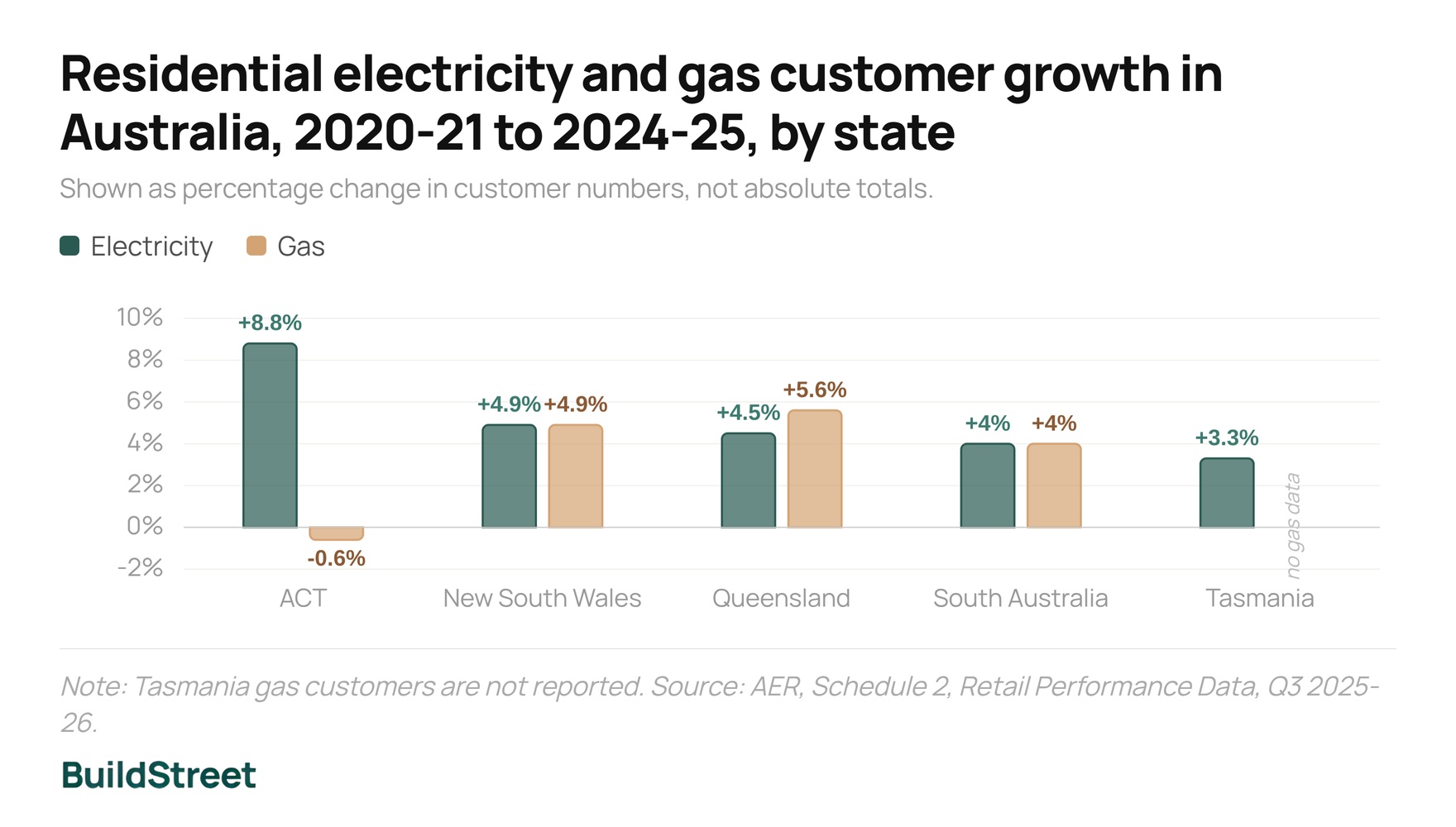
Solar and battery uptake sits alongside a slower-moving shift in gas and electricity customer numbers. The chart below shows how customer accounts changed across the five years to 2024-25, by state.
Residential electricity and gas customer growth in Australia, 2020-21 to 2024-25, by state
Percentage change in customer numbers, not absolute totals. Tasmania gas customers are not reported.
Source: AER, Schedule 2, Retail Performance Data, Q3 2025-26.
Gas customer growth, 2020-21 to 2024-25
−0.6% to +5.6%
Gas customer numbers fell only in the ACT (−0.6%), the one jurisdiction restricting new connections outright. Queensland grew fastest (+5.6%). That sits alongside the state's 2025 policy reset on gas, though the AER growth period itself covers 2020-21 to 2024-25 and mostly predates that change.
SECTION 04 · Customer numbers
How many electricity and gas customers does Australia have?
Electricity customers outnumber gas customers by roughly three to one in the AER Schedule 2 jurisdictions shown, with an implied 7.06 million electricity accounts and 2.36 million gas accounts at 31 March 2026.
Customer accounts is not a home count
Figures here describe residential electricity and gas accounts, not a count of homes. A dwelling can appear as an electricity customer with no data on whether it also has gas, or whether it uses bottled LPG instead of mains gas.
These figures cover accounts under the National Energy Customer Framework: NSW, Queensland, South Australia and the ACT, plus Tasmania for electricity only. Victoria and Western Australia report through separate state regulators and aren't included.
| Customer type | Q3 2025-26 implied count | Interpretation |
|---|---|---|
| Residential electricity customers | 7.06 million | Electricity is near-universal across connected households. |
| Residential gas customers | 2.36 million | Gas remains a residential fuel with a smaller customer base than electricity. |
Source: AER, Schedule 2, Retail Performance Data, Q3 2025-26, quarter ending 31 March 2026.
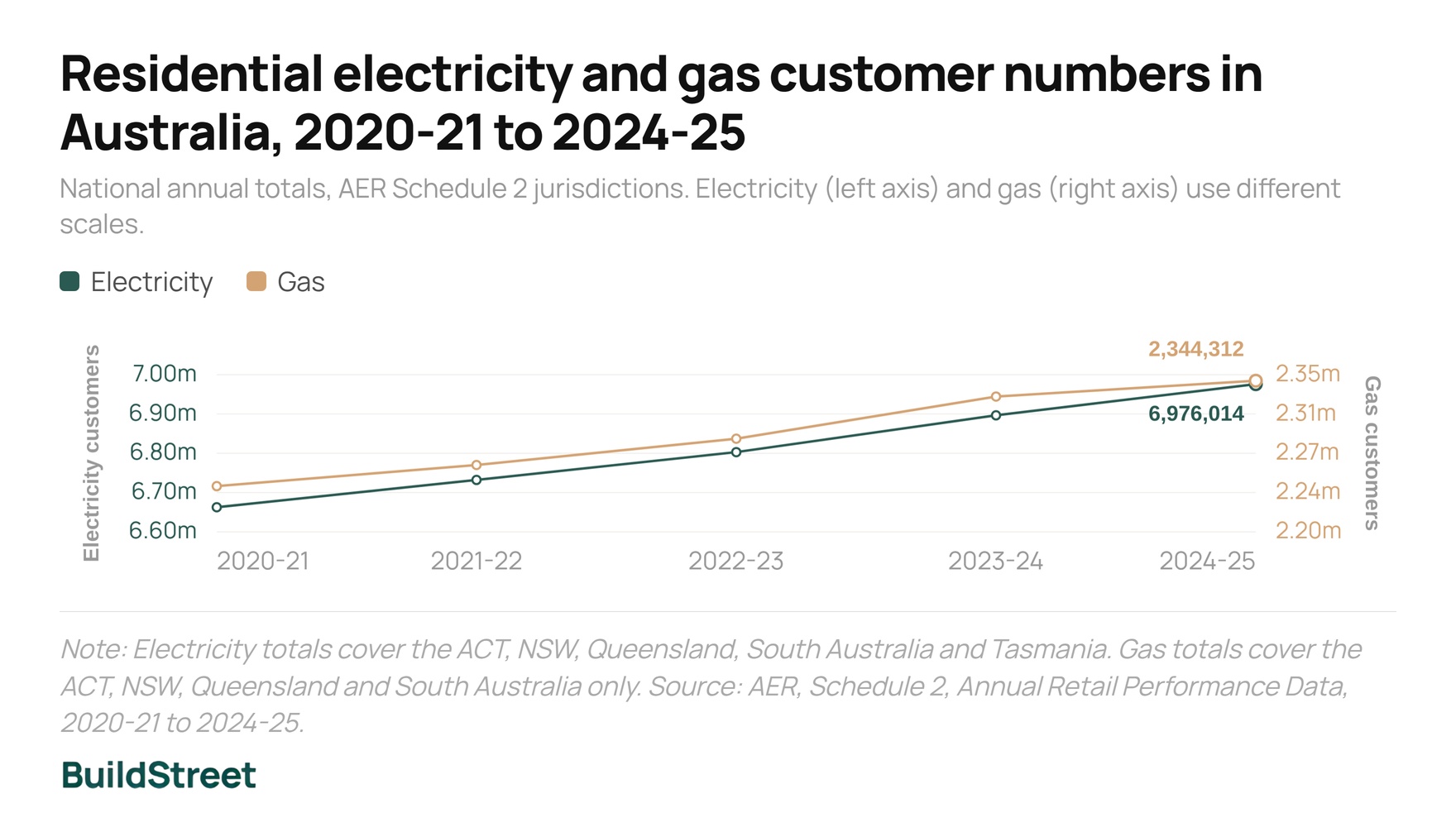
How have customer numbers changed since 2020-21?
Residential electricity and gas customer numbers in Australia, 2020-21 to 2024-25
National annual totals, AER Schedule 2 jurisdictions.
Electricity totals cover the ACT, NSW, Queensland, South Australia and Tasmania. Gas totals cover the ACT, NSW, Queensland and South Australia only. Source: AER, Schedule 2, Annual Retail Performance Data, 2020-21 to 2024-25.
Gas accounts grew almost as fast as electricity accounts
Between 2020-21 and 2024-25, electricity customers rose 4.7% and gas customers rose 4.5% across the AER Schedule 2 jurisdictions shown. This is a customer-count trend, not a demand trend or a direct measure of new-home fuel choice.
Across the AER Schedule 2 jurisdictions shown, about two-thirds of electricity customer accounts, 66.6%, have no matching residential gas account in the same dataset. That figure comes from subtracting reported gas customer accounts from electricity customer accounts, so it is an implied account-based estimate, not a home-by-home survey.
National datasets that count all-electric new homes directly
AEMO's gas-electricity meter-linking research, which tracks gas-connected homes by the year they connected, states that it excludes newly constructed fully electric homes. The closest official evidence is indirect: customer-account data and gas use among newer gas-connected homes.
The gap between electricity and gas customers varies by state
That 66.6% national figure hides a wide spread across states:
Implied share of electricity customers with no gas account in Australia, by state
Percentage of each state's electricity customers, stacked to 100%.
Stacked to 100% of each state's electricity customer base; an implied customer-count comparison, not a home count. Excludes Victoria, Western Australia and Tasmania. Source: AER, Schedule 2, Retail Performance Data, Q3 2025-26.
Gap between Queensland and the ACT
Queensland's implied share of electricity customers with no gas account (90.5%) sits 53 percentage points above the ACT's (37.8%), the widest spread of any two jurisdictions in this dataset.
Newer gas-connected homes use less gas for heating
In the ACT, only 10% of gas-connected homes that connected in 2022 were still using gas for heating, down from 52% among homes connected before 2005. Victoria shows a smaller shift, from 74% to 59% over a similar period.
Share of gas-connected homes in Australia still using gas for heating, older vs newer connections
"Older" cohorts differ by state: ACT and Victoria compare pre-2005 with 2022; NSW and SA compare 2017 stock with 2022 (NSW) or 2018-2022 (SA).
Source: AEMO gas-electricity meter-linking report, 2025.
Both the ACT and Victoria restrict new gas connections. The fall in gas heating use has not been even between them:
- ACT: 52% to 10%, a change of 42 percentage points.
- Victoria: 74% to 59%, a change of 15 percentage points.
The larger change in the ACT may reflect differences in the timing of gas connections, housing stock and local electrification settings, but this dataset does not isolate one cause.
SECTION 05 · Building standards
Do building energy rules require all-electric new homes?
Building energy-efficiency rules set standards for the building and its fixed services, but they do not require all-electric homes or ban gas connections.
The National Construction Code 2022 raised the minimum thermal performance standard for new houses from 6 stars to 7 stars and introduced Whole of Home energy-use requirements for fixed appliances such as heating, cooling, hot water and lighting. A new home can meet the 7-star standard and still have a gas connection in any state or territory where gas remains permitted.
The same National Construction Code update also introduced:
- Whole of Home annual energy-use requirements for new houses and apartments.
- Electric vehicle charging readiness requirements for new apartment buildings.
- Solar photovoltaic and battery readiness requirements for some new apartment and commercial buildings.
States and territories adopted the new energy-efficiency requirements on different dates, and New South Wales uses BASIX rather than the standard NCC Whole of Home pathway.
| State/territory | 7-star and whole-of-home applies from | Notes |
|---|---|---|
| Victoria | 1 May 2024 | Adopted alongside livable housing design standards |
| South Australia, ACT | 1 Oct 2023 | Conditions and transition periods vary by jurisdiction |
| Queensland | 1 May 2024 | Residential energy-efficiency standards under NCC 2022 commenced in Queensland on this date |
| Western Australia | 1 May 2025 | Adopted without the livable housing design standards |
| New South Wales | Uses BASIX instead | NSW applies its own Building Sustainability Index rather than adopting whole-of-home directly |
Source: Australian Building Codes Board, What's new about NCC 2022; state building authority transition guidance.
The differences between states are mostly about timing and compliance pathways, not whether the building standard itself bans gas. The gas-connection rules sit separately from the 7-star and Whole of Home energy-efficiency settings.
SECTION 06 · Existing homes
What happens to existing gas-connected homes?
Residential gas customers in the jurisdictions covered by the AER dataset total an implied 2.36 million accounts, so restrictions on new gas connections do not immediately remove gas from existing homes. Current new-build restrictions generally apply to future connections, not existing gas connections.
None of the current new-build policies require existing gas connections to be removed immediately. Some rules apply when gas appliances reach the end of their working life:
- Victoria: from 1 March 2027, a broken, irreparable gas hot-water system in an existing home must generally be replaced with an efficient electric alternative. Repair and maintenance of a working system can continue.
- Reverse-cycle air conditioners are already covered by national energy performance rules.
- Heat pumps are due to be added to those rules by 1 July 2027.
- Gas cooktops remain unregulated.
Some small gas networks are being closed where suppliers no longer consider them viable:
Customers affected by network decommissioning
400
Esperance, WA: decommissioned 2023
1,100
10 regional Victorian towns: closing by end of 2026
8,000
Albany, WA: closing from late 2026
Together, these closures affect fewer than 10,000 customers, compared with the 2.36 million residential gas accounts reported in the AER dataset. Network-level decommissioning is uncommon, and gas continues to serve most existing gas-connected homes.
SECTION 07 · Consumer attitudes
How do Australians feel about gas versus electric?
Households are more attached to gas for cooking than for heating. About 69% of current gas-cooking users say they would choose gas cooking again, while only 42% of current gas space-heating users say they would prefer electric next time.
Stated intent to disconnect from gas within the next ten years varies sharply by state, and is highest in the jurisdictions with the strictest new-build rules.
Share of homeowners likely to cancel their gas connection within 10 years
Survey question on stated intention over a 10-year horizon. Not a forecast of actual disconnections.
Source: Energy Consumers Australia, How households use gas and attitudes towards electrification, February 2025.
FAQ
Frequently asked questions
Is gas banned in new homes in Australia?+
Gas is not banned in new homes nationally. Victoria and the ACT restrict new gas connections in most new homes. New South Wales, South Australia and some Queensland gas distribution networks require cost-reflective upfront connection charges from 1 October 2026, but those rules are not statewide gas bans. Western Australia has no statewide gas restriction and no equivalent upfront-cost rule.
How much can households save by switching to all-electric?+
The average national saving is estimated at $1,040 a year, including upfront costs. In Victoria, a new all-electric home is estimated to save $990 a year without solar and up to $1,920 a year with solar. Actual savings vary by climate, household size and existing appliances.
How many residential electricity and gas customers are in Australia?+
At 31 March 2026, the AER dataset showed an implied 7.06 million residential electricity customers and 2.36 million residential gas customers across the jurisdictions it covers. The electricity count covers New South Wales, Queensland, South Australia, the ACT and Tasmania. The gas count covers New South Wales, Queensland, South Australia and the ACT. Victoria and Western Australia report separately, and Tasmania gas customers are not reported in this dataset.
How many new Australian homes are built all-electric?+
No official national dataset directly counts this. ABS records approvals and completions but not fuel type, and AEMO's gas-electricity meter-linking research specifically excludes fully electric new homes. Residential customer numbers show electricity accounts outnumber gas accounts roughly three to one nationally, but that reflects the existing housing stock, not new builds specifically.
Do existing homes have to disconnect from gas?+
No. Neither Victoria nor the ACT requires existing gas connections to be removed. Rules generally apply when an appliance reaches end of life; for example, a broken gas hot-water system in Victoria must be replaced with an electric alternative from 1 March 2027.
Does customer data show whether Australians prefer gas or electric?+
Not on its own. Customer numbers show how many accounts are connected, not why. Survey data shows households are more attached to gas for cooking (69% would choose it again) than for heating (where 42% of current gas space-heating users said they would prefer electric next time), and that preference varies by state.
General information only
This article is a statistical reference based on publicly available government and industry data. Figures for electricity and gas customer numbers are implied counts from the AER retail performance dataset, not a direct census of homes or new builds. Savings and cost estimates are indicative and vary by location, household and appliance. It is not financial, building or energy advice.
References
- ABS: Building Approvals, Australia, May 2026
- ABS: Building Activity, Australia, March Quarter 2026
- AEMO: Gas Statement of Opportunities, 2025 and 2026 editions
- AEMO: Gas-Electricity Meter Data Linking Project Report, January 2025
- AER: Quarterly retail performance update, Jan-Mar 2026
- AER: Schedule 2 retail performance data, Q3 2025-26
- Treasury: Australia's Net Zero Transformation, September 2025
- Energy Consumers Australia: How households use gas, February 2025
- Clean Energy Council: Clean Energy Australia 2026, May 2026
- Australian Building Codes Board: What's new about NCC 2022
- ERA WA: Mid-West and South-West Gas Access Arrangement, 2025-2029
- AEMC: Retail customer initiated gas abolishment rule, April 2026
- AEMC: Final determination on gas connection charges, December 2025
Chart Snapshots