


Published
- Mean net home value, households aged 65 and over, 2019-20
- $581,600
- Across all households with a reference person aged 65 and over, including non-owners, ABS Survey of Income and Housing
- Gap between median house and attached dwelling prices, Greater Sydney, June quarter 2026
- $647,600
- Established houses $1,487,600 compared with attached dwellings $840,000, preliminary ABS medians
- Maximum Age Pension outside Australia, couple, from 20 September 2026
- A$44,507
- A$44,506.80 a year, the basic rate without the Pension Supplement or Energy Supplement, Services Australia
 Australia's ageing population and housingHow the number of older Australians is growing, how many downsize, and how ageing in place affects the homes that get built.
 Are retirees leaving Australia because housing is too expensive?Departures at ages 65 and over, Age Pension recipients living overseas and rental stress among older renters, and what the data cannot show about motives.
Section 01 · Home equity
How much home equity do older Australian home owners have?
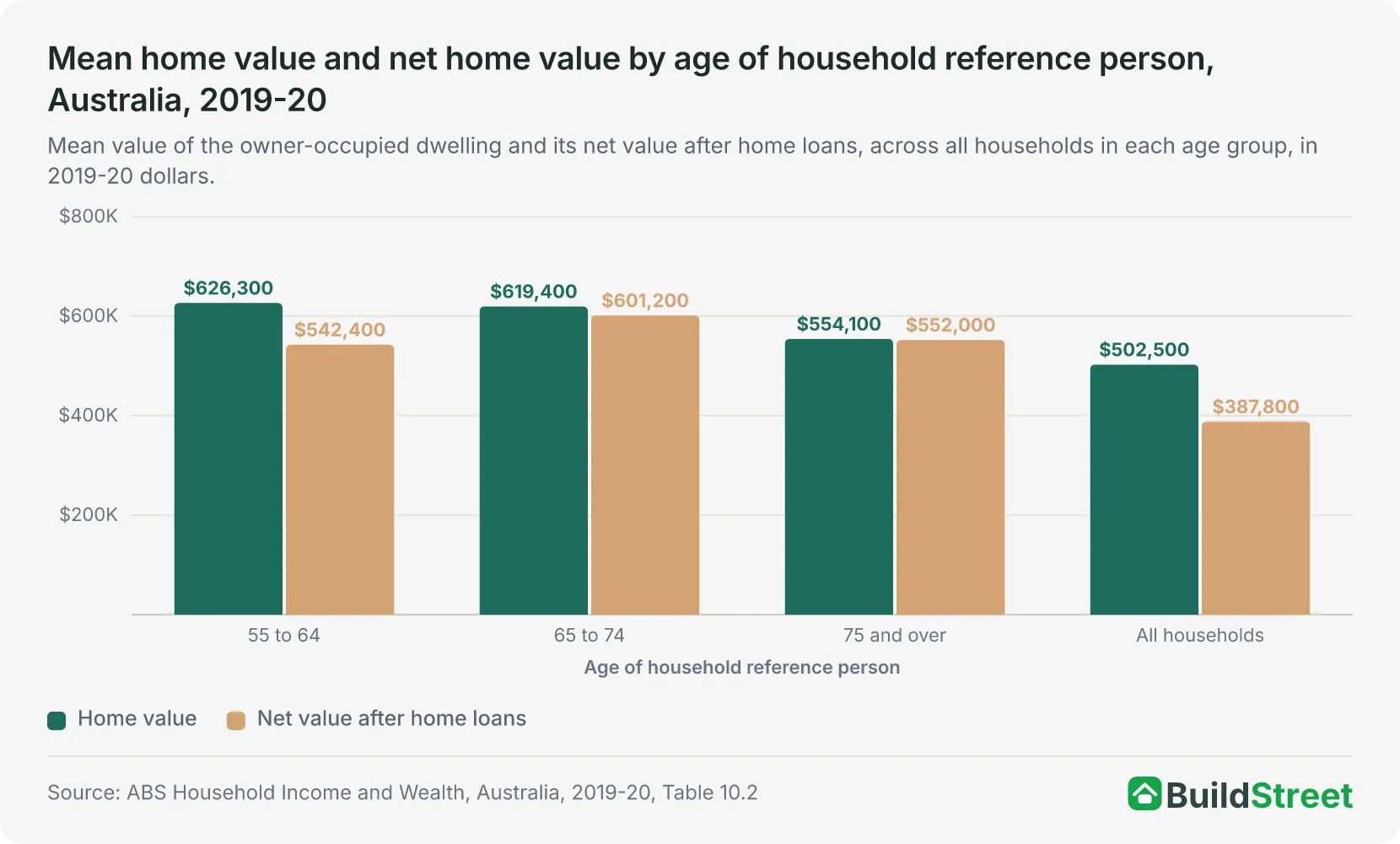
Households with a reference person aged 65 and over had a mean net home value of $581,600 in 2019-20, according to the Australian Bureau of Statistics (ABS) Survey of Income and Housing1. This average includes households that did not own a home, which were counted as having no home equity.
Households with a reference person aged 65 to 74 recorded the highest mean net home value among the three age groups aged 55 and over, at $601,200, compared with $542,400 for those aged 55 to 64 and $552,000 for those aged 75 and over1. The mean net home value for all households was $387,800.
The mean outstanding home loan balance, averaged across all households in each age group including those without a loan, was $84,800 for households aged 55 to 64, $17,300 for those aged 65 to 74 and $2,400 for those aged 75 and over1. The ABS advises using the estimate for ages 75 and over with caution because its relative standard error is 34.9 per cent.
Among households of all ages that owned their home without a mortgage, the mean value of the dwelling was $736,400 in 2019-201.
In 2019-20, 81.7 per cent of households with a reference person aged 65 to 74 owned their home, and 68.1 per cent owned it without a mortgage, according to ABS Housing Occupancy and Costs data2.
At ages 75 and over, 83.0 per cent of households owned their home and 79.4 per cent owned it without a mortgage2. However, the survey's margins of error overlap, meaning it does not establish a clear difference in overall home ownership rates between the two age groups.
The ABS did not release results from its 2023-24 Survey of Income and Housing because of data collection issues. Results from the 2025-26 survey are expected from mid-20273.
Among households with a reference person born from 1947 to 1951, home ownership increased from 54 per cent at ages 25 to 29 in 1976 to 82 per cent at ages 70 to 74 in 2021, according to Australian Institute of Health and Welfare (AIHW) analysis of Census data4.
| Housing tenure by age of household reference person, Australia, 2019-20 | ||||||
|---|---|---|---|---|---|---|
| Tenure | 65 to 74 (%) | ± (pts) | 75 and over (%) | ± (pts) | All households (%) | ± (pts) |
| Owner without a mortgage | 68.1 | 1.7 | 79.4 | 2.8 | 29.5 | 0.8 |
| Owner with a mortgage | 13.4 | 1.8 | 3.7 | 1.0 | 36.8 | 0.9 |
| All owners | 81.7 | 1.6 | 83.0 | 2.6 | 66.2 | 1.0 |
| All renters | 16.0 | 1.9 | 12.9 | 2.3 | 31.4 | 1.0 |
Source · ABS Housing Occupancy and Costs, 2019-20, Table 6.1.
Section 02 · Downsizing
How much equity does downsizing within Australia free up?
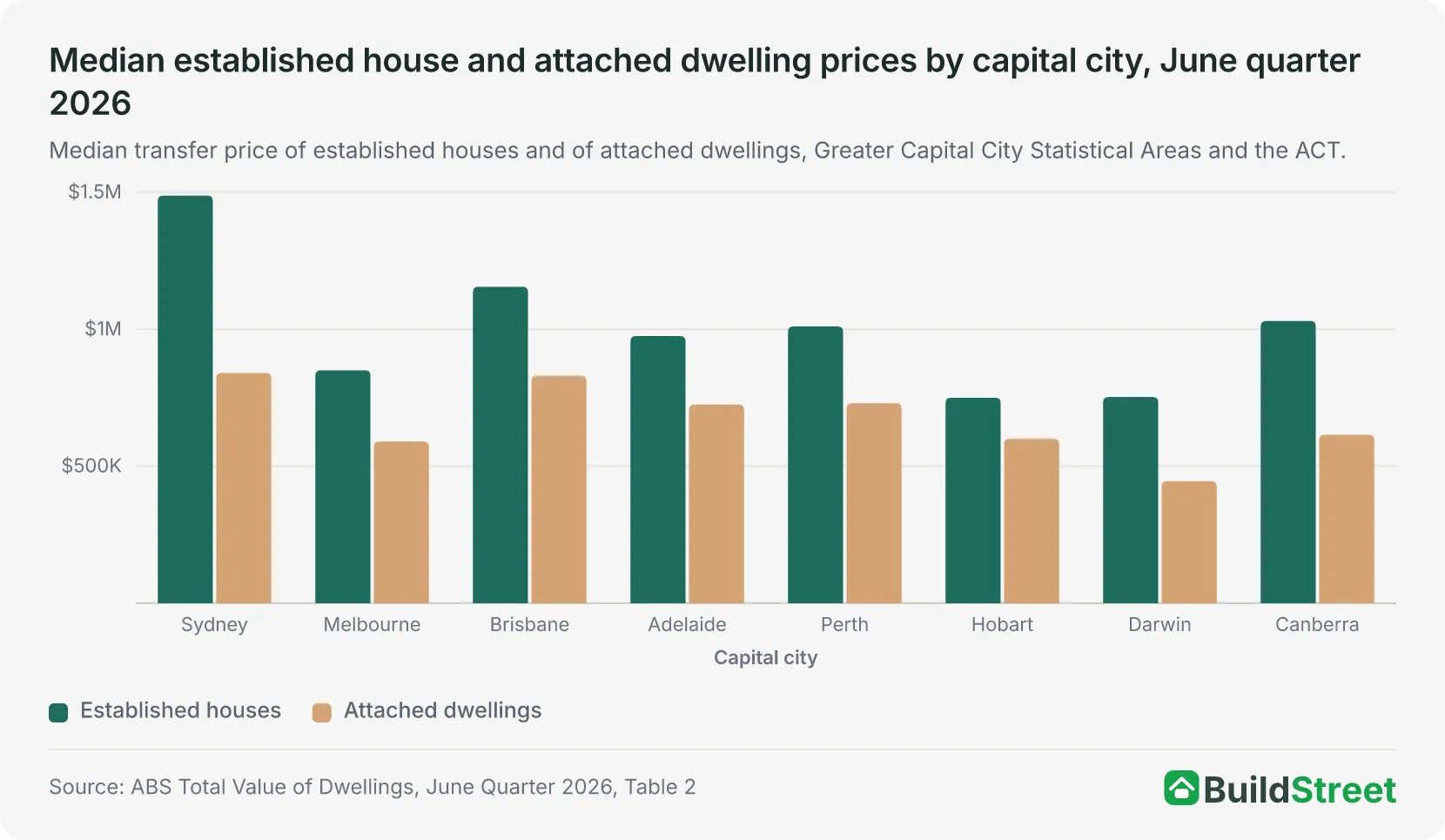
In Greater Sydney, the median price of established houses was $1,487,600 in the June quarter 2026, according to preliminary ABS Total Value of Dwellings data5. That was $647,600 higher than the median attached dwelling price of $840,000.
Greater Sydney recorded the largest gap between median house and attached dwelling prices among the eight capital cities, at $647,600, while Greater Hobart recorded the smallest, at $150,0005.
The gap was $415,000 in Canberra, $324,900 in Greater Brisbane and $260,000 in Greater Melbourne, where the median prices were $850,000 for established houses and $590,000 for attached dwellings5.
The June quarter 2026 medians are preliminary and can be revised for up to 10 quarters6. The next figures, covering the September quarter 2026, are due to be published on 1 December 20265.
Worked example · selling a median Greater Sydney house
This is an illustrative calculation based on the June quarter 2026 medians and the 2026-27 New South Wales transfer duty scale. A couple who sell a house at the Greater Sydney median of $1,487,600 and buy an attached dwelling at the median of $840,000 would pay transfer duty of $31,987 on the purchase7.
That leaves $615,613 from the sale, before agents' fees, legal costs and moving costs. Revenue NSW lists no transfer duty concession for pensioners or downsizers8. In Victoria, an eligible concession cardholder, including a pensioner, generally pays no land transfer duty on a home valued at $600,000 or less. The exemption is available once9. Using the Greater Melbourne median prices as an example, a couple who sell a house at the Greater Melbourne median of $850,000 and buy an attached dwelling at the median of $590,000 would release $260,000 if eligible for the pensioner and concession cardholder duty exemption. Without it, they would pay $30,470 in duty under the general scale, leaving $229,530109.
How does downsizing affect the Age Pension?
Services Australia excludes a person's principal home from the Age Pension assets test, and sale proceeds intended for a new principal home are exempt for up to 24 months for homes sold from 1 January 202311. Equity left over after the purchase generally counts as an assessable asset.
From 20 September 2026, a homeowner couple can receive the full Age Pension with combined assessable assets of up to $499,00012. The pension falls by $3 a fortnight for every $1,000 of assets above that limit13.
In an illustrative calculation, if the $615,613 from the Sydney example were the couple's only assessable asset, the assets test would reduce their combined Age Pension by $9,087 a year, from the maximum of $48,516 to $39,429. Their assessable assets would be $116,613 above the $499,000 limit, and each full $250 above it cuts the pension by $19.50 a year (466 × $19.50 = $9,087).
In the Melbourne example, $260,000 would be below the $499,000 assets limit. Its deemed income (the income assumed to be earned on financial assets) of about $290 a fortnight would be below the couple's income test free area of $396 a fortnight1415, so neither test would reduce the pension.
A downsizer contribution allows each eligible person aged 55 or over to put up to $300,000 of the proceeds from selling a home owned for 10 years or more into superannuation, provided the sale qualifies for the main residence capital gains tax exemption16. Services Australia includes superannuation in the financial assets assessed under the Age Pension income test17.
| Worked example · downsizing in Greater Sydney and Greater Melbourne, 2026 | ||
|---|---|---|
| Step | Greater Sydney | Greater Melbourne |
| Sale at the median established house price | $1,487,600 | $850,000 |
| Purchase at the median attached dwelling price | $840,000 | $590,000 |
| Purchase duty | $31,987 | $0 (pensioner and concession cardholder exemption) |
| Equity released | $615,613 | $260,000 |
| Couple's combined Age Pension a year after the means tests | $39,429 | $48,516 |
Source · ABS Total Value of Dwellings; Revenue NSW; State Revenue Office Victoria; Services Australia.
Section 03 · Buying overseas
What does a Greater Sydney house sale buy in Thailand, Malaysia and Poland?
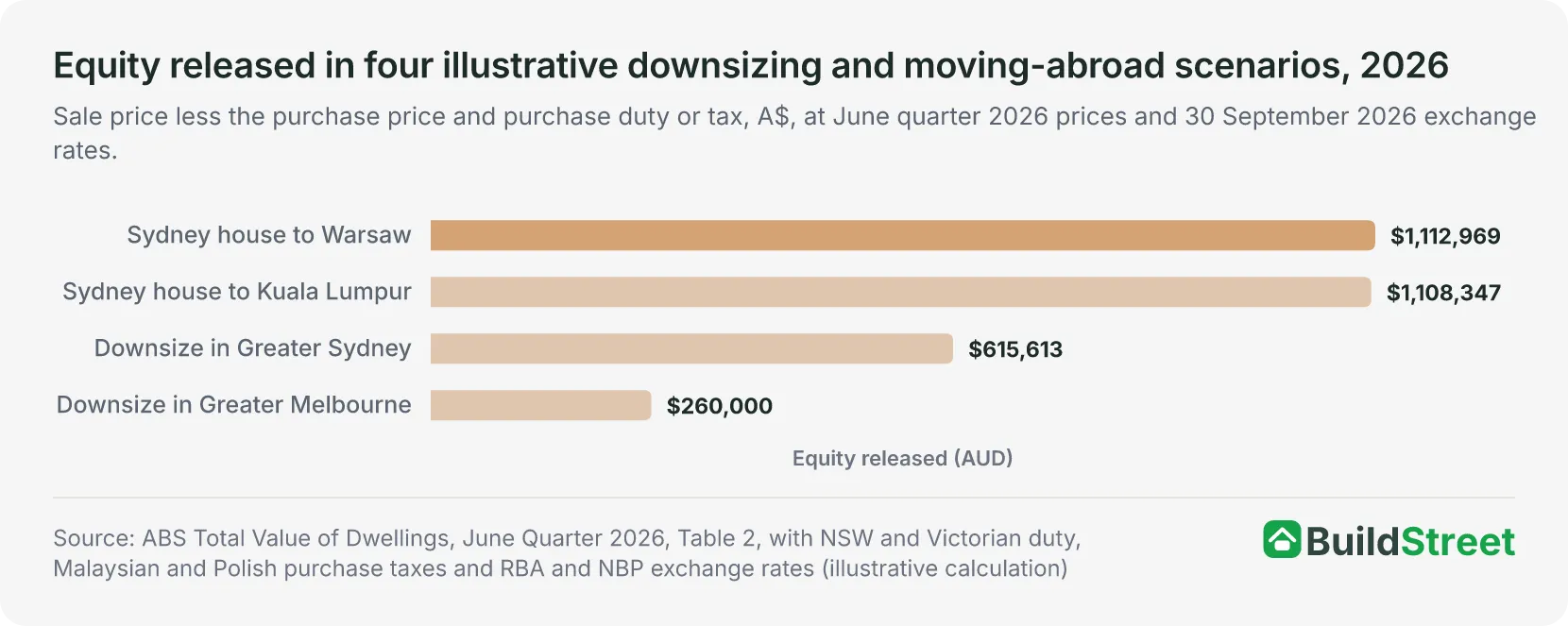
In an illustrative calculation, a couple selling a median Greater Sydney house would have $1,112,969 left after buying a 58.9 m² existing flat in Warsaw at the average price per square metre, or $1,108,347 after buying a home at Malaysia's RM1 million foreign-buyer minimum in Kuala Lumpur.
What are the foreign buyer rules and purchase taxes?
A foreign buyer in Malaysia generally cannot buy a home priced below RM1 million, or about A$351,000, under the Ministry of Economy's property acquisition guidelines, which have applied since 13 July 202218. In Kuala Lumpur, the average price of high-rise units was RM562,326, or about A$197,000, in the June quarter 2026, according to preliminary National Property Information Centre (NAPIC) data19.
Kuala Lumpur's average house price was RM825,282, or about A$290,000, and the average terraced house price was RM977,286, or about A$343,00019. All three average prices were below the RM1 million minimum for foreign buyers.
For a sale from 1 January 2026, a buyer who is not a Malaysian citizen or permanent resident pays stamp duty of 8 per cent on a residential property purchase20. On a RM1 million home, that is RM80,000, or about A$28,000.
Existing flats in Warsaw sold for an average of 16,723 złoty per square metre, or A$6,236, in the second quarter of 2026, according to the National Bank of Poland21. The average usable floor area of all dwellings in Warsaw's housing stock was 58.9 square metres in 2025, according to Statistics Poland22.
An Australian buying a self-contained flat in Poland outside the border zone does not need a permit under Polish law23. The buyer of an existing flat generally pays a 2 per cent property transaction tax24.
Worked example · a Greater Sydney house sale spent in Kuala Lumpur or Warsaw
This is an illustrative calculation based on the June quarter 2026 Greater Sydney median house price and exchange rates on 30 September 2026. At the Reserve Bank of Australia exchange rate of 2.8477 ringgit per Australian dollar, a home at the RM1 million minimum would cost A$351,161. With 8 per cent stamp duty, the total would be A$379,25325. A couple selling a house at the Greater Sydney median of $1,487,600 would have $1,108,347 left after that purchase.
At the National Bank of Poland exchange rate of 2.6818 złoty per Australian dollar, a 58.9-square-metre existing Warsaw flat at the average transaction price per square metre would cost 984,985 złoty, or A$367,28526. With the 2 per cent tax, the total would be A$374,631, leaving $1,112,969 from the same Sydney sale.
A foreign buyer who brings the purchase money into Thailand in foreign currency can own a Thai condominium unit outright, provided foreign owners together own no more than 49 per cent of the building's total condominium unit floor area27.
The Thai Department of Lands charges a transfer registration fee of 2 per cent of the appraised value28. The Bank of Thailand publishes condominium prices for Bangkok and its vicinities as an index, rather than an average purchase price, so an official average is not available to calculate the cost of buying a condominium in Bangkok29.
The foreign ownership rules in each country are covered in Can Australians buy property in Thailand, Malaysia or Poland?
| Home prices and purchase rules for a foreign buyer, Kuala Lumpur, Warsaw and Bangkok, 2026 | ||||
|---|---|---|---|---|
| Place and measure | Local currency | A$ equivalent | Foreign buyer rule | Purchase tax or fee |
| Kuala Lumpur, average high-rise unit, Q2 2026 | RM562,326 | $197,000 | Below the RM1 million minimum | 8% stamp duty |
| Kuala Lumpur, average house, Q2 2026 | RM825,282 | $290,000 | Below the RM1 million minimum | 8% stamp duty |
| Malaysia, foreign buyer minimum | RM1,000,000 | $351,000 | Minimum price per unit | 8% stamp duty |
| Warsaw, existing flats, per m², Q2 2026 | 16,723 zł | $6,236 | No permit for a flat outside the border zone | 2% tax on civil law transactions |
| Bangkok, condominium unit | No official average price | n/a | Foreign owners up to 49% of floor area | 2% transfer fee on appraised value |
Source · NAPIC; Ministry of Economy Malaysia; LHDN; National Bank of Poland; Department of Lands, Thailand; Bank of Thailand; RBA Table F11.1.
Section 04 · Ongoing costs
What do rates, insurance and upkeep cost home owners in Australia and overseas?
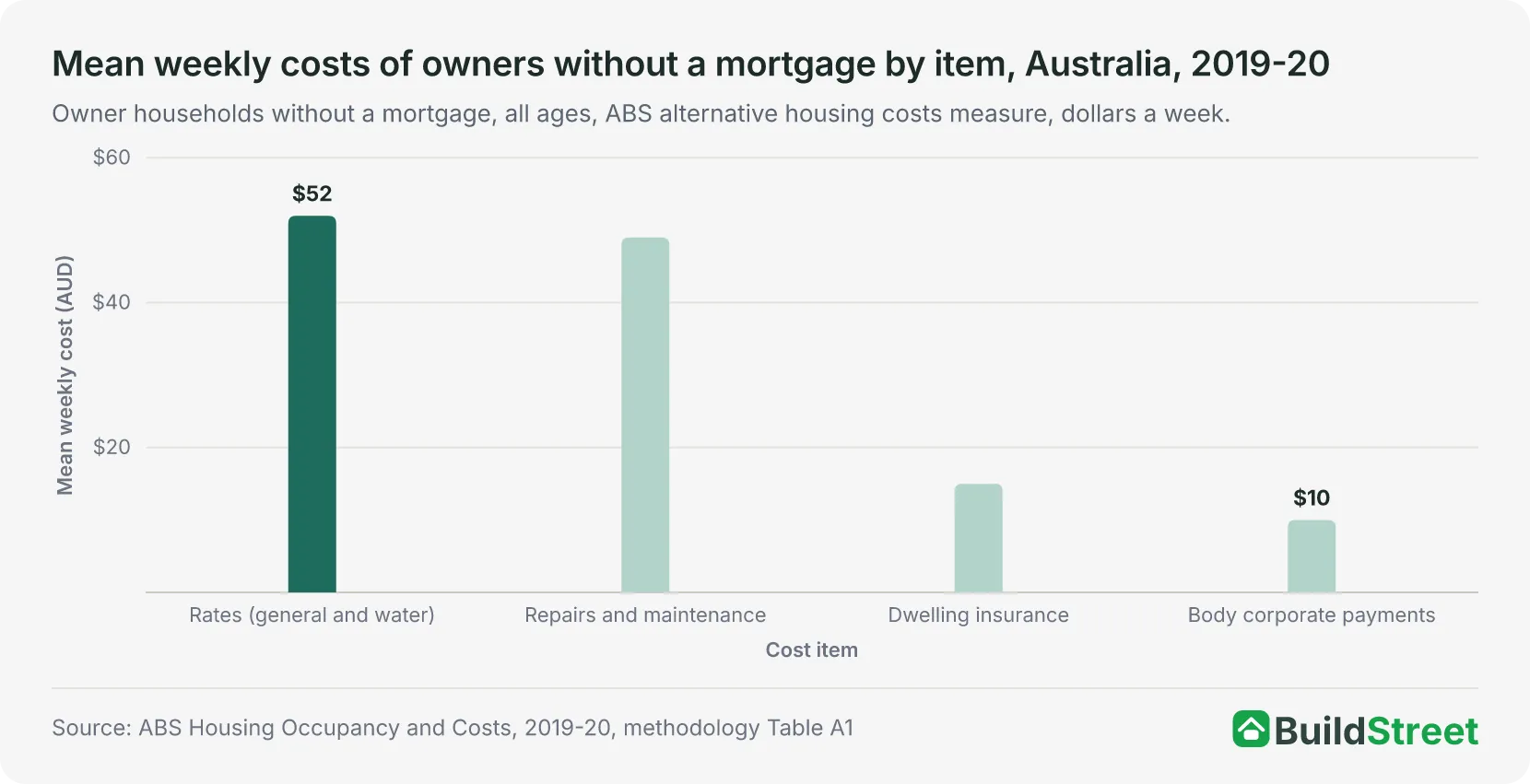
Households that owned their home without a mortgage had mean housing costs of $130 a week in 2019-20 under the ABS alternative measure, which includes rates, repairs and maintenance, dwelling insurance and body corporate payments2. Repairs and maintenance averaged $49 a week, home insurance $15 and body corporate payments $10.
The ABS standard measure for owners without a mortgage was $54 a week, of which $52 was council and water rates2. The average was $53 a week for owners without a mortgage aged 65 to 74 and $47 a week for those aged 75 and over.
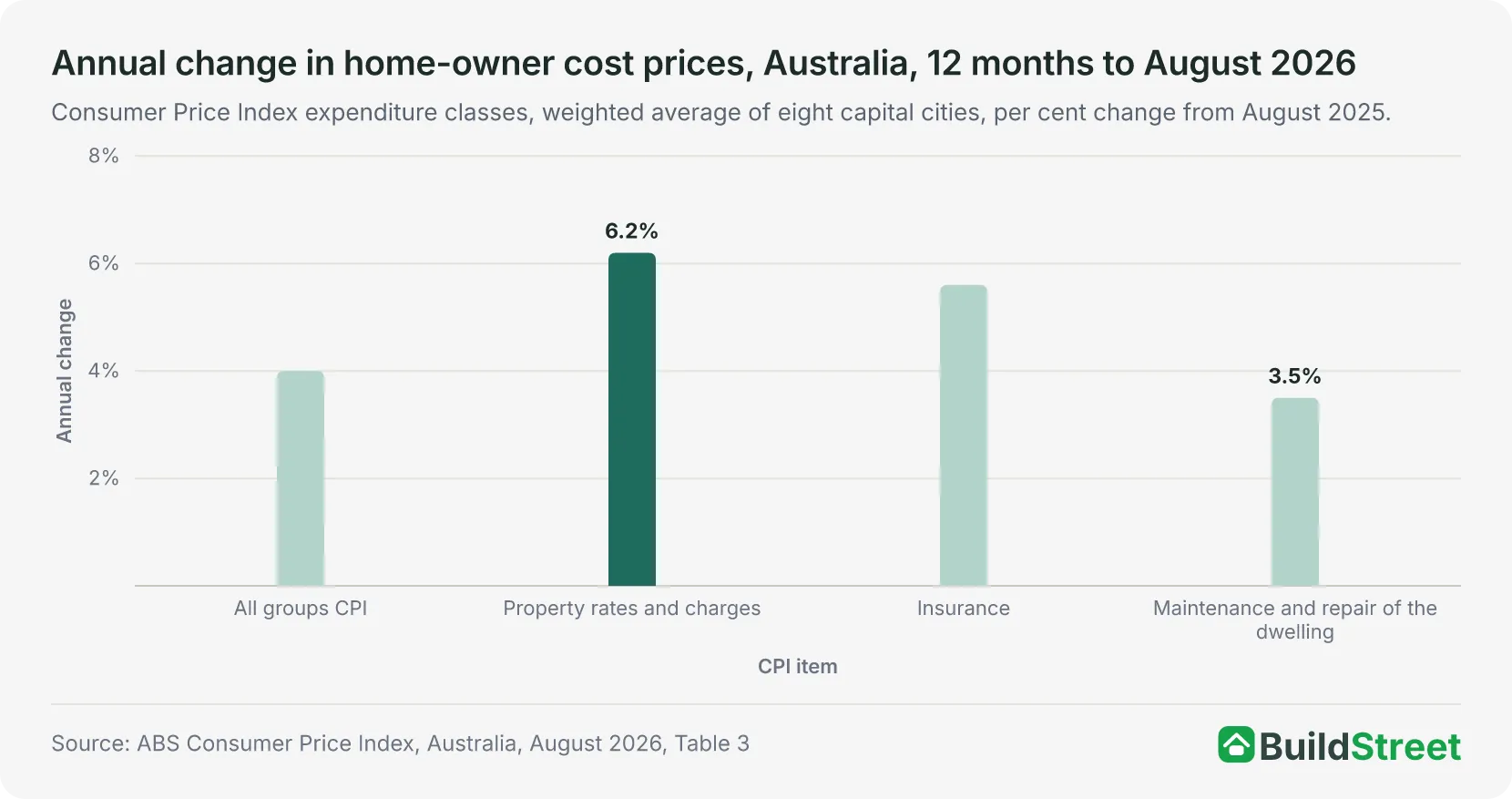
In Warsaw, the 2026 property tax on residential buildings is 1.25 złoty per square metre of usable floor area, the maximum rate set by Poland's Minister of Finance and Economy for 20263233. In an illustrative calculation, a 58.9-square-metre flat would incur annual building tax of 73.63 złoty, or about A$27, before the separate tax on its share of the land.
In Kuala Lumpur, the local council, City Hall, charges assessment tax on residential buildings at 4 per cent of their annual value34. No official source reviewed states a current annual property tax for a condominium in Bangkok, and no official source reviewed publishes average home insurance or maintenance costs for Thailand, Malaysia or Poland.
Wider household costs in the three countries are compared in Cost of living overseas vs Australia.
Section 05 · Pension and tax
How does moving abroad affect the Age Pension and tax?
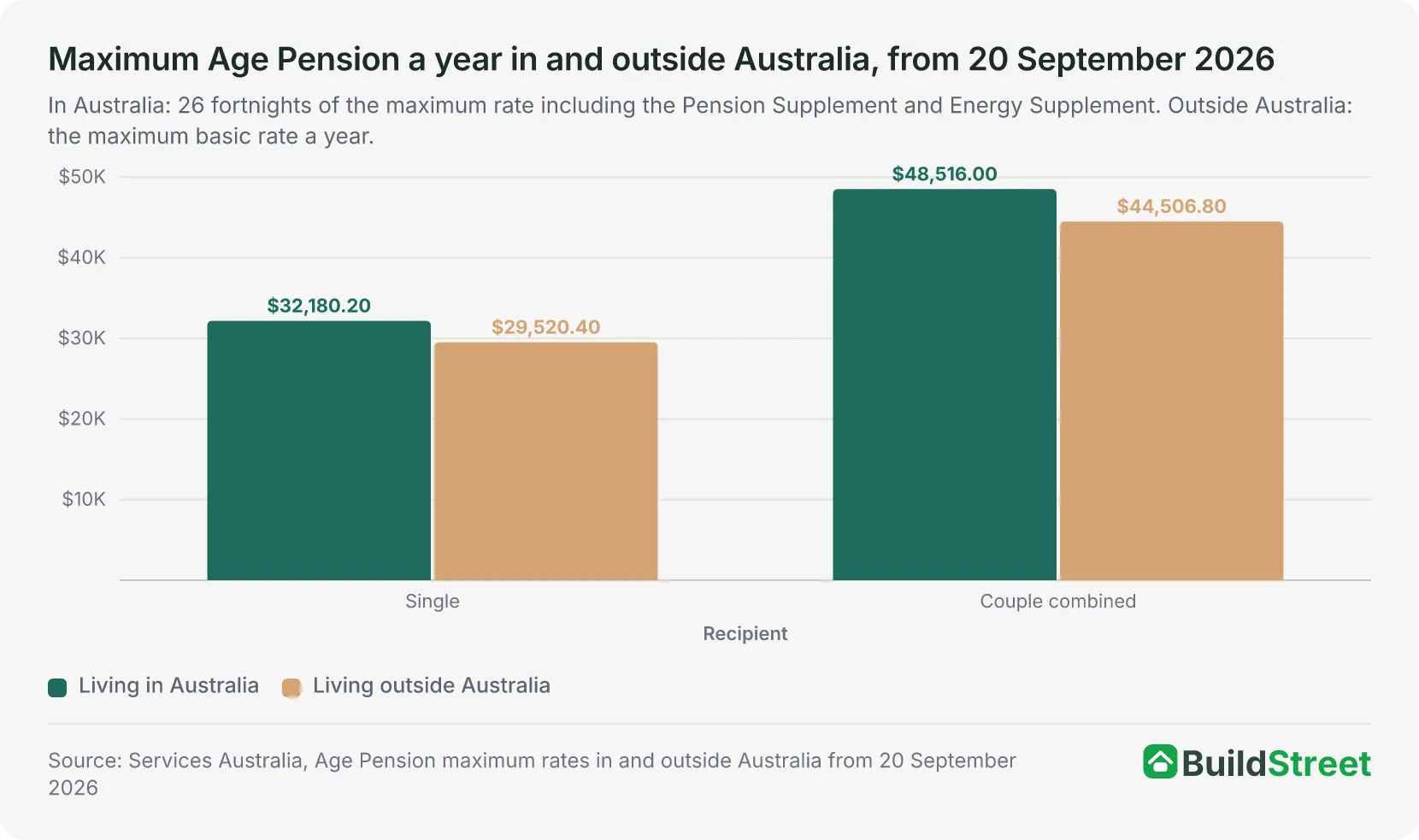
An Age Pension recipient who moves overseas can generally continue to receive payments, at a maximum of A$44,506.80 a year for a couple combined and A$29,520.40 for a single person from 20 September 2026, according to Services Australia35. The outside-Australia rate includes only the basic pension.
In Australia, the maximum rates including the Pension Supplement and Energy Supplement are $1,237.70 a fortnight for a single person and $1,866.00 for a couple combined, equal to $32,180.20 and $48,516.00 a year, respectively36. The maximum annual pension paid outside Australia is therefore $2,659.80 lower for a single person and $4,009.20 lower for a couple.
When a recipient leaves Australia to live in another country, the Energy Supplement and Pension Supplement stop and the Pensioner Concession Card is cancelled from the date of departure37. Rent Assistance also stops when they leave38.
After 26 weeks outside Australia, the pension rate generally depends on how long the person was an Australian resident between age 16 and Age Pension age. A person with 35 years or more of residence keeps the rate in most cases, while a person with 10 years receives 10/35 of that rate37.
Poland is one of 32 countries with which Australia has a social security agreement. Australia has no social security agreement with Thailand or Malaysia39.
Assets held outside Australia count in the Age Pension assets test12. For a homeowner couple living outside Australia, the assets limit for receiving a part Age Pension is A$1,070,000, compared with $1,121,000 for a homeowner couple in Australia35.
A home in Australia remains the principal home for up to 12 months of temporary absence. A home the recipient does not intend to return to is counted as an asset from the date of departure40. The Social Security Guide defines the principal home as generally the home a person lives in for the greatest amount of time each year41.
For the 2026-27 Budget change to the Pension Supplement, the Department of Social Services (DSS) estimated that around 88,000 recipients were already living permanently overseas, and that around 3,000 recipients a year move permanently overseas42. In June 2026, 73,985 Age Pension recipients had no state or territory recorded. This group includes people living overseas and those with invalid or incomplete addresses, so the figure does not represent the total number of recipients living abroad43.
In 2024-25, 17,840 people aged 65 and over left Australia as migrants, according to preliminary ABS Overseas Migration estimates44. This counts everyone aged 65 and over who spent at least 12 of the following 16 months outside Australia, not just retirees.
What tax applies to a foreign resident selling an Australian home?
A foreign resident for tax purposes cannot claim the main residence capital gains exemption for a property sold after 30 June 2020, unless the life events test is met45. The test applies when a person has been a foreign resident for six continuous years or less and has experienced certain life events, including a terminal medical condition, the death of a spouse or child under 18, or a relationship breakdown.
The date of disposal is the date the sale contract is signed, and an owner who is an Australian resident at that time is generally not affected by this exclusion45.
Foreign residents have no tax-free threshold. In 2025-26, the foreign resident income tax rate was 30 per cent on taxable income up to $135,000, and foreign residents do not pay the Medicare levy46. Australia has income tax treaties in force with Malaysia, Thailand and Poland, which took effect in 1981, 1989 and 1992, respectively47.
Section 06 · Scenarios compared
How does downsizing in Australia compare with buying in Kuala Lumpur or Warsaw?
Of the three scenarios based on selling a median Greater Sydney house, buying in Warsaw would release the most equity, at $1,112,969, compared with $1,108,347 for Kuala Lumpur and $615,613 for downsizing within Greater Sydney. Downsizing within Greater Melbourne, from a lower median house price, would release $260,000.
Each scenario is an illustrative calculation based on June quarter 2026 prices, 2026 purchase duties and taxes, and 30 September 2026 exchange rates, not a forecast. The scenarios compare a median Greater Sydney house price with Malaysia's legal minimum price for foreign buyers and an average Warsaw price per square metre, so they are not like-for-like purchases.
Under the assets test alone, the Greater Sydney downsizing scenario would reduce a homeowner couple's maximum Age Pension from $48,516 to $39,429 a year, while the Greater Melbourne scenario would leave it unchanged.
Assuming the overseas home is treated as the couple's principal home, both overseas scenarios would leave assessable assets above the $1,070,000 assets limit for receiving a part Age Pension for a homeowner couple living outside Australia. In neither scenario would the couple qualify for an Age Pension under the assets test while assessable assets remained above that limit35.
For a non-homeowner couple living outside Australia, the assets limit for receiving a part Age Pension is $1,337,00035. A couple who did not buy a home overseas would count as non-homeowners, and the full $1,487,600 from the Sydney sale would be assessable, which is also above that limit.
The calculations exclude agents' fees, legal costs, moving costs, currency conversion costs, any other assets the couple owns, and ongoing costs in each country. Prices, exchange rates and pension rates can change, and the Greater Sydney and Greater Melbourne medians are preliminary.
| Staying put compared with four illustrative scenarios for a homeowner couple, 2026 | ||||
|---|---|---|---|---|
| Scenario | Sale price | New home cost incl. duty or tax | Equity released | Maximum Age Pension a year after the assets test |
| Stay in a median Greater Sydney house | n/a | n/a | $0 | $48,516 |
| Downsize in Greater Sydney | $1,487,600 | $871,987 | $615,613 | $39,429 |
| Downsize in Greater Melbourne | $850,000 | $590,000 | $260,000 | $48,516 |
| Sydney house to a RM1 million home in Kuala Lumpur | $1,487,600 | $379,253 | $1,108,347 | Nil (assets above the A$1,070,000 limit) |
| Sydney house to a 58.9 m² existing flat in Warsaw | $1,487,600 | $374,631 | $1,112,969 | Nil (assets above the A$1,070,000 limit) |
Source · ABS Total Value of Dwellings; Revenue NSW; State Revenue Office Victoria; Services Australia; Ministry of Economy Malaysia; LHDN; National Bank of Poland; Statistics Poland; RBA Table F11.1.
Section 07 · Common questions
Frequently asked questions
How much equity do older Australians have in their homes?
Households with a reference person aged 65 and over had a mean net home value of $581,600 in 2019-20, according to the Australian Bureau of Statistics. This average includes households that do not own a home, whose home values are counted as zero.
How much money does downsizing free up in Sydney?
In an illustrative calculation using June quarter 2026 prices, downsizing from a median Greater Sydney house to a median attached dwelling would free up $615,613 after New South Wales transfer duty of $31,987. That is before agents' fees, legal costs and moving costs.
Does downsizing affect the Age Pension?
Equity released by downsizing generally counts as an assessable asset once the new home is bought, although sale proceeds intended for a new principal home are exempt for up to 24 months. From 20 September 2026, a homeowner couple can receive the full pension with combined assessable assets of up to $499,000, and the pension falls by $3 a fortnight for every $1,000 above that limit.
Can Australians keep the Age Pension if they move overseas?
An Age Pension recipient who moves overseas can generally continue to be paid, at the outside-Australia basic rate of up to A$44,506.80 a year for a couple combined from 20 September 2026, without the Pension Supplement or Energy Supplement. After 26 weeks, the rate generally depends on Australian residence between age 16 and Age Pension age, with 35 years or more needed for the full rate in most cases.
Can an Australian buy an apartment in Kuala Lumpur?
An Australian can generally buy an apartment in Kuala Lumpur priced at RM1 million or more, the minimum price for foreign buyers under Malaysia's Ministry of Economy guidelines. A buyer who is not a citizen or permanent resident pays 8 per cent stamp duty on a residential purchase on a sale from 1 January 2026.
Do foreign residents pay capital gains tax when they sell their Australian home?
A foreign resident for tax purposes cannot claim the main residence exemption from capital gains tax for a property sold after 30 June 2020 unless the life events test is met, according to the Australian Taxation Office. An owner who is an Australian resident at the date of the sale contract is generally not affected by this exclusion.
References
- ABS Household Income and Wealth, Australia, 2019-20 · Australian Bureau of Statistics ↑ b c d
- ABS Housing Occupancy and Costs, 2019-20 financial year · Australian Bureau of Statistics ↑ b c d
- ABS media statement, Survey of Income and Housing results will not be released · Australian Bureau of Statistics ↑
- AIHW: Home ownership and housing tenure · aihw.gov.au ↑
- ABS Total Value of Dwellings, June quarter 2026 (Cat. 6432.0) · Australian Bureau of Statistics ↑ b c d
- abs.gov.au · Australian Bureau of Statistics ↑
- Revenue NSW — Calculate Transfer Duty · revenue.nsw.gov.au ↑
- Revenue NSW, Transfer duty exemptions and concessions · revenue.nsw.gov.au ↑
- State Revenue Office Victoria, Pensioner and concession cardholder duty reduction, contracts from 1 July 2023 · sro.vic.gov.au ↑ b
- State Revenue Office Victoria — Land transfer duty current rates (non-principal place of residence) · sro.vic.gov.au ↑
- Services Australia, Real estate assets · servicesaustralia.gov.au ↑
- Services Australia, Assets test for Age Pension · servicesaustralia.gov.au ↑ b
- Department of Social Services, Social Security Guide 4.2.3 Pensions and benefits assets tests · guides.dss.gov.au ↑
- Services Australia, Income test for Age Pension · servicesaustralia.gov.au ↑
- Services Australia, Deeming (Age Pension) · servicesaustralia.gov.au ↑
- ATO, Downsizer super contributions · ato.gov.au ↑
- Services Australia, Superannuation (Age Pension) · servicesaustralia.gov.au ↑
- Ministry of Economy Malaysia, Garis Panduan Perolehan Hartanah (Guideline on the Acquisition of Properties) · ekonomi.gov.my ↑
- NAPIC — Malaysian House Price Index report, Q1 to Q2 2026p · napic.jpph.gov.my ↑ b
- Inland Revenue Board of Malaysia (LHDN), stamp duty guideline for First Schedule instruments, Stamp Act 1949 · hasil.gov.my ↑
- National Bank of Poland — Ceny mieszkań (housing prices database) · static.nbp.pl ↑
- Statistics Poland, Local Data Bank (BDL), average usable floor area of a dwelling, Warsaw · bdl.stat.gov.pl ↑
- Act of 24 March 1920 on the acquisition of real estate by foreigners, Poland · api.sejm.gov.pl ↑
- Act of 9 September 2000 on the tax on civil law transactions, Poland · api.sejm.gov.pl ↑
- Reserve Bank of Australia, Exchange Rates, Statistical Table F11.1 · Reserve Bank of Australia ↑
- National Bank of Poland, Table A of average exchange rates, AUD, 30 September 2026 · api.nbp.pl ↑
- Department of Lands, Condominium Act B.E. 2522 and related Ministerial Regulations · dol.go.th ↑
- Department of Lands, Thailand, Fees, taxes and duties · dol.go.th ↑
- Bank of Thailand, EC_EI_008_S4 Residential Property Price Index · app.bot.or.th ↑
- ABS, Consumer Price Index, Australia, August 2026 · Australian Bureau of Statistics ↑
- ABS, Consumer Price Index, Australia methodology, August 2026 · Australian Bureau of Statistics ↑
- Warsaw City Council resolution XXIX/1066/2025 on property tax rates for 2026 · edziennik.mazowieckie.pl ↑
- Poland, Minister of Finance announcement of the upper limits of local tax rates for 2026 · api.sejm.gov.pl ↑
- Kuala Lumpur City Hall (DBKL), Jabatan Penilaian dan Pengurusan Harta · dbkl.gov.my ↑
- Services Australia, Payment schedule and rates for people outside Australia: Age Pension · servicesaustralia.gov.au ↑ b c d
- Services Australia, How much Age Pension you can get (rates from 20 September 2026) · servicesaustralia.gov.au ↑
- Services Australia, When you leave Australia if you get Age Pension · servicesaustralia.gov.au ↑ b
- Services Australia: Travel outside Australia rules for Rent Assistance · servicesaustralia.gov.au ↑
- Department of Social Services, International social security agreements · dss.gov.au ↑
- Department of Social Services, Social Security Guide 4.6.3.60 Exempting the principal home - temporary vacation of property · guides.dss.gov.au ↑
- DSS, Social Security Guide 4.6.3.30 Defining the principal home · guides.dss.gov.au ↑
- Department of Social Services, Better targeting the Pension Supplement (2026-27 Budget) · dss.gov.au ↑ b
- DSS Benefit and Payment Recipient Demographics, June 2026 · data.gov.au ↑
- ABS Overseas Migration, 2024-25 · Australian Bureau of Statistics ↑
- ATO, Main residence exemption for foreign residents · ato.gov.au ↑ b
- ATO, Tax rates: foreign residents · ato.gov.au ↑
- Treasury, Income tax treaties · treasury.gov.au ↑
