

Published
- Foreign share of a Thai condominium
- 49%
- Maximum combined foreign ownership of the total unit floor area, Condominium Act B.E. 2522 section 19 bis.
- Federal minimum price for a foreign purchase, Malaysia
- RM1m
- Per unit, about A$345,000 at the September 2026 average exchange rate. State floors run from RM500,000 to RM3 million.
- Stamp duty on a Malaysian home for a foreign buyer
- 8%
- For agreements signed from 1 January 2026 by buyers who are neither Malaysian citizens nor permanent residents.
- Tax on civil law transactions, resale home, Poland
- 2%
- On the market value. A first-home exemption applies, but official sources do not clarify whether a home owned outside Poland counts.
 How does housing affordability in Australia compare internationally?How Australian home prices measure up against incomes and rents in other countries, on the OECD's comparable housing indicators.
 House prices since 2010: Australia, Thailand, Malaysia and PolandHow residential property prices have moved in the four countries since 2010, from each country's official house price index.
Section 01 · Thailand
Can foreigners buy property in Thailand?
A foreign individual can own a condominium unit in Thailand outright but generally cannot own land, which is restricted to Thai citizens except in certain circumstances1. Under the Condominium Act, a foreigner can own a unit if they have a Thai residence permit, entered Thailand under the investment promotion law, or use purchase money brought in from outside Thailand, provided the foreign-owned share of the building stays within the legal limit2.
Foreigners can buy land for a home only with the Interior Minister's permission. They must meet three conditions:
- Invest at least 40 million baht (about A$1.69 million)3 in Thai government or state-enterprise bonds, property funds or businesses eligible for Board of Investment promotion4.
- Keep the investment for at least five years4.
- Buy no more than 1 rai (1,600 square metres) of land, in Bangkok, Pattaya City, a municipality or a residential zone under town-planning law41.
The Department of Lands handles these applications on behalf of the Minister of Interior. Its service manual lists a 500 baht application fee, a permit fee of 100 baht per rai and a transfer fee of 2 per cent of the appraised value5. The stated processing time for land in Bangkok is 27 days.
A foreigner can lease land in Thailand for up to 30 years6. The Department of Lands will not register a longer lease, and leases of more than three years must be in writing and registered. A foreigner can own a building on leased land, because Thai law places no restriction on owning buildings1.
| What a foreign individual can hold in Thailand, by type of property, 2026 | |||
|---|---|---|---|
| Property | Can a foreign individual own it? | Main conditions | Law |
| Condominium unit | Yes, outright | Funds from outside Thailand, a Thai residence permit or entry under the investment promotion law. Foreign owners together hold no more than 49% of the building's unit floor area | Condominium Act B.E. 2522, ss 19 and 19 bis |
| Land for a home | Only with the Interior Minister's permission | At least 40 million baht invested for at least five years, for up to 1 rai (1,600 m²) in Bangkok, Pattaya City, a municipality or a residential zone | Land Code s 96 bis; Ministerial Regulation B.E. 2545 |
| Land under a lease | No, but can lease it for up to 30 years | Registered lease of no more than 30 years | Civil and Commercial Code, as applied by the Department of Lands |
| House on leased land | Yes | No restriction on owning a building | As described by the Board of Investment |
Source · Condominium Act B.E. 2522; Cabinet summary of 25 October 2022; Department of Lands lease registration guidance; Thailand Board of Investment.
Section 02 · Thai condominiums
What is the foreign ownership limit for condominiums in Thailand?
Foreign owners together can hold no more than 49 per cent of the total floor area of all units in a Thai condominium2. The floor area is measured when the condominium is registered.
When a unit is sold to a foreign buyer, the seller must declare the building's foreign-owned floor area to the land official. The official can register the sale only if the combined foreign-owned area remains within the 49 per cent limit2.
Thai law also sets out who can own a condominium unit. A foreigner who holds a residence permit under immigration law, or who entered Thailand under the investment promotion law, qualifies. So does a foreigner who brings foreign currency into Thailand, or pays from a non-resident baht account or a foreign-currency deposit account2.
A buyer using funds from overseas must provide the land office with evidence that the money meets these requirements and covers at least the unit's purchase price2.
In June 2024, Thailand's Cabinet asked the Ministry of Interior to review the rules and consider raising the foreign ownership limit from 49 per cent to up to 75 per cent, according to the Thai House of Representatives7. However, the limit remains 49 per cent, as the law has not been amended to introduce the proposed increase2.
Section 03 · Malaysia
Can foreigners buy property in Malaysia?
Foreigners can buy property in Malaysia, but they need approval from the relevant state government before the purchase8. The approval can include conditions and additional fees, and a purchase made without it is invalid. Sarawak has separate rules for foreign property purchases9.
The Ministry of Economy's property acquisition guideline, in force from 13 July 2022, sets a federal minimum purchase price of RM1 million per unit, about A$345,0003, for purchases by foreign buyers, including non-citizens and Malaysian permanent residents10. A residential purchase of RM1 million or more does not need the ministry's approval but remains subject to the relevant state government's rules.
The federal guideline restricts foreign buyers from purchasing four types of property:
- properties valued at less than RM1 million per unit
- low-cost and low-medium-cost homes, as defined by each state
- properties on Malay Reserve land
- homes allocated to Bumiputera buyers in a development10
Section 04 · Malaysian states
What is the minimum property price for foreigners in Malaysia by state?
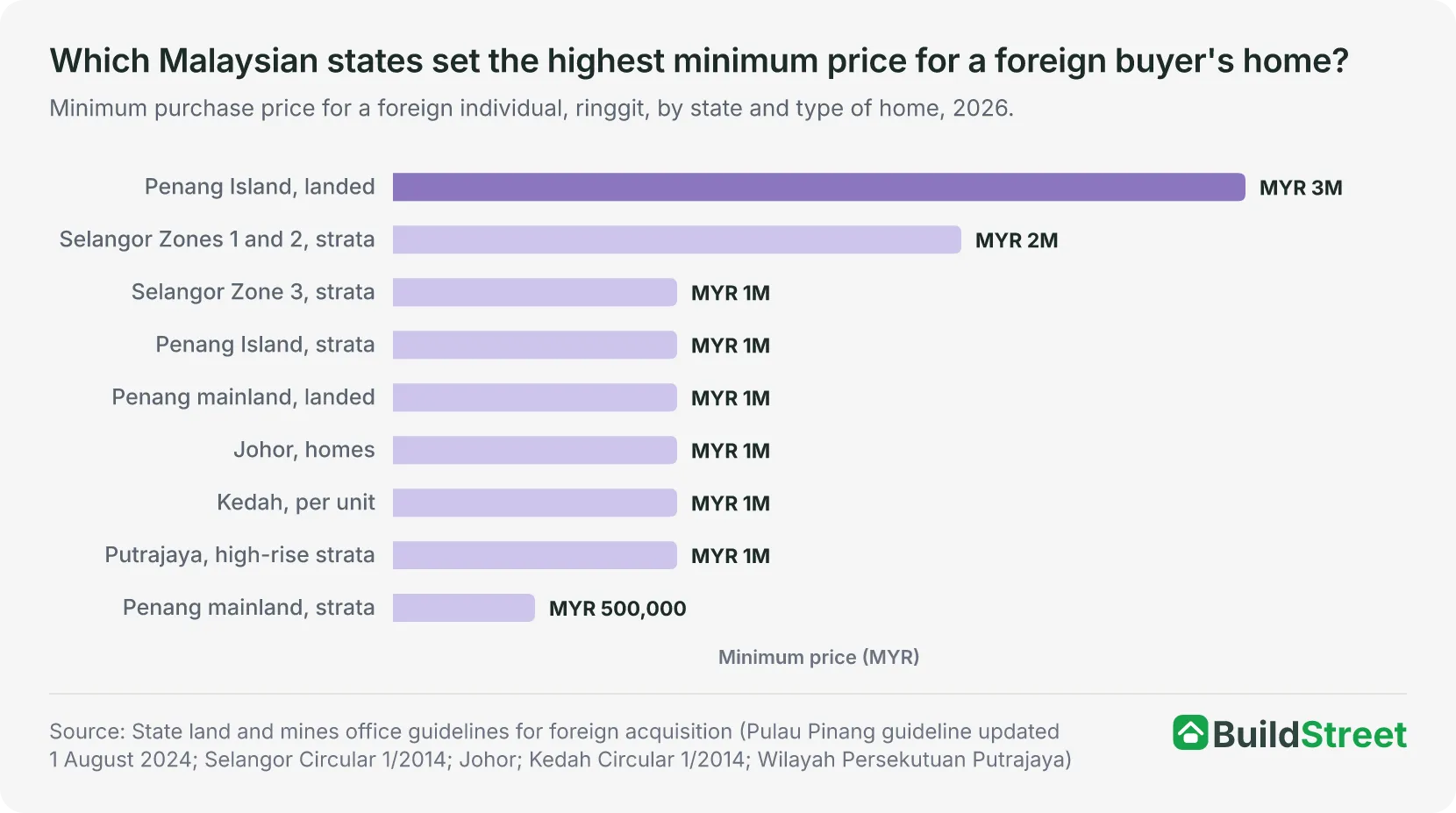
Penang has the highest minimum price for a foreign buyer among the six Malaysian states and federal territories with an official figure, at RM3 million for a landed home on Penang Island11. Minimum prices vary by state, location and property type.
Selangor's minimum is RM2 million in Zones 1 and 2 and RM1 million in Zone 3, under state rules introduced in September 201412. Zones 1 and 2 cover the Petaling, Gombak, Hulu Langat, Sepang, Klang, Kuala Selangor and Kuala Langat districts. In Selangor, foreign buyers can purchase only strata properties, including landed strata homes.
Penang sets separate minimum prices for the island and the mainland. On Penang Island, a foreign buyer must pay at least RM1 million for a strata home and RM3 million for a landed home11. In Seberang Perai, on the mainland, the minimum prices are RM500,000 for a strata home bought by an individual and RM1 million for a landed home. Penang also charges an approval fee of 3 per cent of the purchase value, reduced to 1.5 per cent for strata homes on Penang Island priced between RM1 million and RM1.5 million.
A foreign buyer in Penang can resell the property only three years after the sale and purchase agreement was signed11.
Johor's minimum is RM1 million for houses of two or more storeys, bungalow lots and apartments13. Foreign buyers cannot purchase single-storey or one-and-a-half-storey terraced homes. From 1 July 2025, Johor's approval fee for foreign purchases from developers increased to 3 per cent of the sale price or RM30,000, whichever is higher14.
Kedah raised its minimum purchase price from RM500,000 to RM1 million per unit in March 201415.
In Putrajaya, foreign buyers can purchase only high-rise strata homes priced at RM1 million or more16. Foreign ownership is also limited to 5 per cent of property titles.
Sarawak, which has its own property ownership rules, raised the two minimum property values for foreign purchases to RM500,000 and RM600,000 from 23 May 20199.
Official minimum prices were not found in the sources reviewed for Kuala Lumpur, Labuan, Melaka, Sabah, Negeri Sembilan, Perak, Pahang, Terengganu, Kelantan or Perlis. These locations are not shown in the comparison below. For them, the only published figure found is the federal minimum of RM1 million per unit10.
| Minimum prices, home types and state charges for a foreign individual buying a home, by Malaysian state, 2026 | ||||
|---|---|---|---|---|
| State or territory | Minimum price | Homes a foreign buyer may buy | State levy or fee | In force from |
| Selangor | RM2,000,000 (Zones 1 and 2); RM1,000,000 (Zone 3) | Strata homes, including landed strata, only | RM200 processing fee12 | 1 September 2014 |
| Penang | Island: RM1,000,000 strata, RM3,000,000 landed. Seberang Perai: RM500,000 strata, RM1,000,000 landed | Not low-cost, low-medium-cost or medium-cost homes11 | 3% levy (1.5% on island strata from RM1,000,000 to RM1,500,000); RM10,000 application fee11 | Prices from 2012 and 2017; levy from 1 March 2014 |
| Johor | RM1,000,000 | Landed homes of two storeys or more, bungalow lots and apartments13 | 3% of the sale price or RM30,000, whichever is higher; RM2,000 application fee | Levy from 1 July 2025 |
| Kedah | RM1,000,000 per unit | Not stated in the circular | Not stated in the circular | 1 March 2014 |
| Putrajaya | RM1,000,000 | High-rise strata homes only; foreign ownership capped at 5% of titles | Not stated in the guideline | Committee meeting 99/2022 |
| Sarawak | RM500,000 or RM600,000 | Set under Sarawak's own Land Code | Not stated in the direction | 23 May 2019 |
Source · state land and mines office guidelines for Selangor, Pulau Pinang, Johor, Kedah and Wilayah Persekutuan Putrajaya; Sarawak Government Gazette, Swk. L.N. 487 (2019).
Section 05 · Poland
Can foreigners buy property in Poland?
An Australian citizen can buy property in Poland, although a permit is generally required for a house or land. A self-contained flat outside the border zone can be purchased without a permit17.
Poland's property ownership rules apply to anyone without Polish citizenship. The permit exemption for citizens of the European Economic Area and Switzerland does not extend to Australians17. An Australian who also holds Polish citizenship is not considered a foreigner under these rules.
Foreign buyers can purchase certain properties without a permit, including:
- A self-contained flat, as defined under Polish law
- A separate garage unit, or a share in one, for the buyer's housing needs
- Any property, if the buyer has lived in Poland for at least five years after receiving permanent residence or EU long-term resident status
- Property bought jointly with a Polish spouse, if the foreign buyer has lived in Poland for at least two years after receiving permanent residence or EU long-term resident status17
These exemptions do not apply to property in Poland's border zone or agricultural land larger than 1 hectare17. The border zone includes municipalities along Poland's land borders and coastline, as well as neighbouring municipalities where the zone would otherwise be less than 15 km wide18.
A purchase made without a required permit is invalid. A notary cannot complete the sale, and the buyer's ownership cannot be registered17.
| Which property purchases in Poland need a permit for an Australian buyer, 2026 | ||
|---|---|---|
| Purchase | Permit needed? | 1920 Act provision |
| Self-contained flat outside the border zone | No | Art 8(1)(1) |
| Garage unit or share for the buyer's housing, outside the border zone | No | Art 8(1)(1a) |
| House, or a plot of land | Yes | Art 1(1) |
| Any property in the border zone, including a flat | Yes | Art 8(3) |
| Agricultural land of more than 1 hectare | Yes | Art 8(3) |
| Any property outside the border zone, after five years' residence on a permanent residence permit or an EU long-term resident permit | No | Art 8(1)(2) |
Source · Act of 24 March 1920 on the acquisition of real estate by foreigners, consolidated text Dz.U. 2017 poz. 2278.
Section 06 · Polish permits
When do Australians need a property permit in Poland?
Australians who need a permit to buy property in Poland must show that the purchase does not threaten national security or public order and that they have a connection to the country17. The permit is issued by Poland's Minister of the Interior and Administration.
Acceptable connections include Polish nationality or descent, marriage to a Polish citizen, residency in Poland, a management role in a Polish company controlled by foreigners, or business or farming activity in Poland17. Land bought for a foreigner's own residential use is limited to 0.5 hectares.
Before a permit is issued, Poland's Minister of National Defence can object within 14 days, with a possible extension to two months17. For agricultural property, the minister responsible for rural development can also object.
The ministry does not provide a standard application form. An application must include details of the property, seller, purpose of the purchase and source of funds, along with certified documents and sworn translations of foreign-language documents19.
Applications can be submitted in person or by post in Warsaw, or electronically through the government's ePUAP or e-Doręczenia services. Email applications are not accepted. The Ministry of the Interior and Administration does not state a processing time19.
The permit application fee is 1,570 zł, while a preliminary permit confirmation costs 98 zł20. The 1,570 zł fee is refunded if the permit is refused.
A permit is valid for two years from the date of issue17. A preliminary permit confirmation is valid for one year, during which a permit cannot be refused unless the circumstances behind the original decision change.
From 19 November 2026, notaries will be required to submit records of property purchases by foreigners electronically through a central system managed by Poland's National Council of Notaries21. A fee will apply, with the amount set by regulation. The change does not affect which buyers need a permit.
Section 07 · Taxes and fees
Property taxes and fees for foreign buyers in Thailand, Malaysia and Poland
The main government charges when buying a home include a transfer registration fee of 2 per cent of the appraised value in Thailand22, stamp duty of 8 per cent on a residential purchase by a foreign buyer in Malaysia23, and a 2 per cent tax on the market value of a resale home in Poland24.
What taxes and fees apply to a property purchase in Thailand?
In Thailand, the Department of Lands charges a transfer fee of 2 per cent based on the property's officially assessed value22. A seller who sells within five years of acquiring the property pays specific business tax of 3.3 per cent, including local tax, on whichever is higher: the assessed value or the sale price. Stamp duty of 0.5 per cent applies only when specific business tax is not payable.
From 1 July 2026 to 30 June 2027, transfer and mortgage registration fees are reduced to 0.01 per cent for homes priced at up to 7 million baht25. This reduction applies only to Thai nationals.
What taxes and fees do foreign buyers pay in Malaysia?
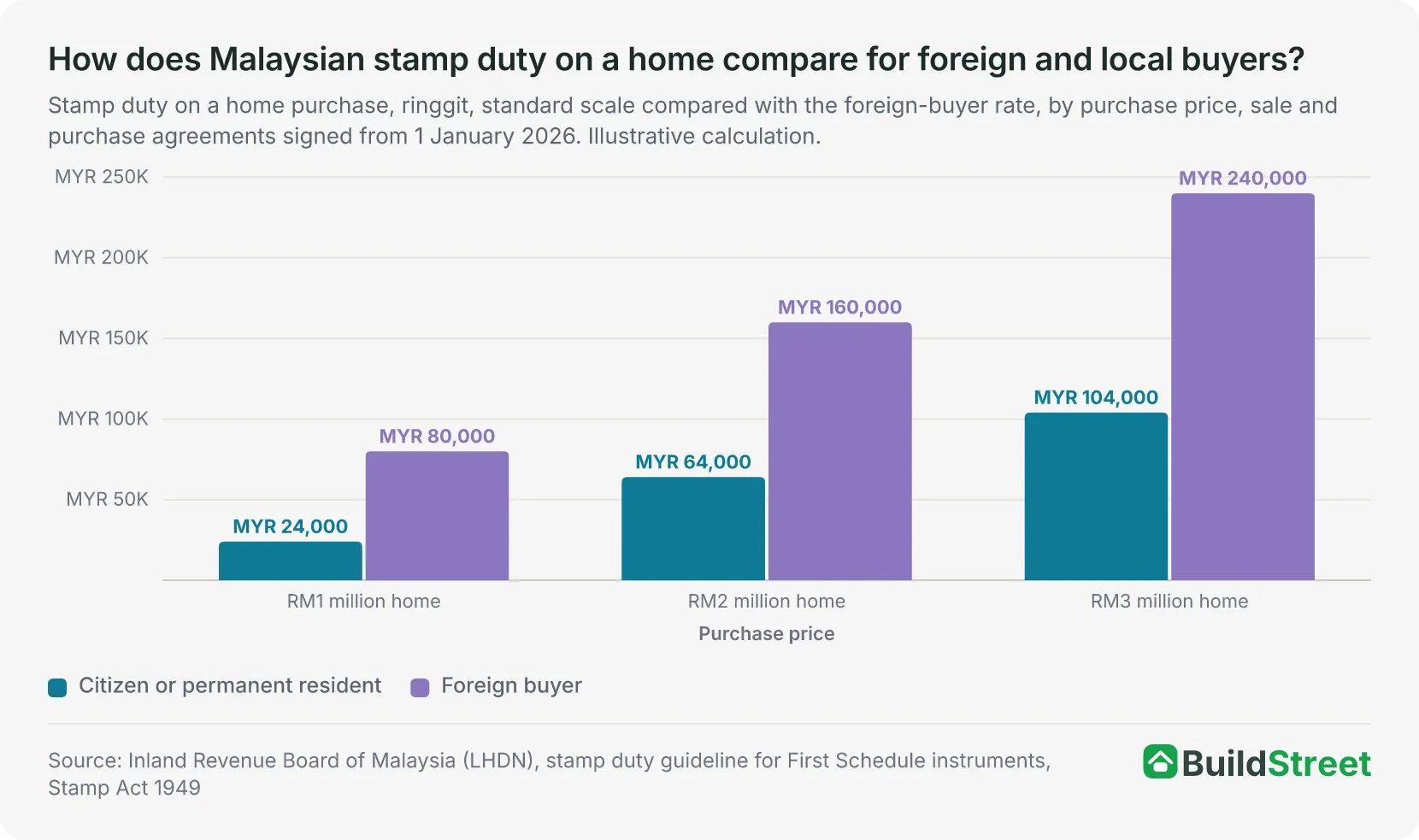
In Malaysia, a buyer who is neither a citizen nor a permanent resident pays stamp duty of 8 per cent on a residential purchase if the sale and purchase agreement was signed on or after 1 January 2026, according to the Inland Revenue Board of Malaysia (LHDN)23. From 1 January 2024, the flat rate for foreign buyers was 4 per cent, and that rate continues to apply to other types of property, including commercial premises26.
Malaysian citizens and permanent residents pay stamp duty on a sliding scale, starting at 1 per cent on the first RM100,000 and reaching 4 per cent on the amount above RM1 million23. Based on these rates, a foreign buyer of a RM1 million home would pay RM80,000 in stamp duty (8 per cent of the price), about A$27,6003. A citizen or permanent resident would pay RM24,000 under the standard scale: 1 per cent on the first RM100,000, 2 per cent on the next RM400,000 and 3 per cent on the remaining RM500,00023.
State charges apply in addition to stamp duty. These include Penang's approval levy of 3 per cent11 and Johor's levy on a purchase from a developer of 3 per cent of the sale price or RM30,000, whichever is higher14.
When the property is later sold, a non-citizen pays real property gains tax of 30 per cent on a sale within five years of buying the property, and 10 per cent from the sixth year27. A Malaysian citizen pays no real property gains tax on a sale from the sixth year.
What taxes and fees apply to a property purchase in Poland?
In Poland, a resale purchase is generally subject to a 2 per cent tax on civil law transactions based on the market value, which the notary collects when the sale is signed24. First-home buyers may be exempt if they have never owned a flat, house or share in either, apart from an inherited share of up to 50 per cent28. Poland's Ministry of Development and Technology states that the exemption applies to all taxpayers. However, official sources do not clarify whether a property previously owned outside Poland counts towards this restriction.
A new home bought from a developer is subject to value added tax (VAT) at 8 per cent for flats up to 150 square metres or houses up to 300 square metres29. Purchases subject to VAT are generally not also charged the tax on civil law transactions24.
The maximum notary fee on the sale of a flat is half the standard maximum fee, and the standard fee scale is capped at 10,000 zł30. The court fee for registering ownership of the property is 200 zł31.
Do Australians pay tax on overseas property?
An Australian resident for tax purposes must declare income from around the world, including rent from an overseas property, according to the Australian Taxation Office (ATO)32. Overseas rent is reported under "Other foreign income" in the tax return33. Tax paid in Thailand, Malaysia or Poland on that income may qualify for a foreign income tax offset, which can be claimed only after the foreign tax has been paid34.
When an overseas property is sold, an Australian resident may have to pay Australian capital gains tax on the profit from the sale32. Foreign amounts are converted to Australian dollars using Reserve Bank of Australia rates or, for a currency the Reserve Bank does not list such as the Polish zloty, another reasonable exchange rate3536.
The 2025-26 tax return asks whether the taxpayer owned or had an interest in assets outside Australia, including real estate, with a total value of A$50,000 or more37.
Australia has had double tax agreements in force with Malaysia since 1981, Thailand since 1989 and Poland since 199238.
| Main government charges on a home sale to a foreign individual in Thailand, Malaysia or Poland, by who pays, 2026 | |||
|---|---|---|---|
| Country and charge | Rate | Charged on | Paid by |
| Thailand: transfer registration fee | 2% | Appraised value | Not stated in the fee schedule |
| Thailand: specific business tax, sale within five years | 3.3% | Appraised value or sale price, whichever is higher | Seller |
| Thailand: stamp duty, where specific business tax is not payable | 0.5% | Appraised value or sale price, whichever is higher | Seller |
| Malaysia: stamp duty on a home, non-citizen without permanent residence | 8% | Purchase, agreements signed from 1 January 2026 | Buyer |
| Malaysia: state approval levy, Penang and Johor | 3% | Purchase value (Penang 1.5% on island strata from RM1 million to RM1.5 million; Johor: purchases from a developer, minimum RM30,000) | Applicant for state approval |
| Poland: tax on civil law transactions, resale home | 2% | Market value | Collected by the notary |
| Poland: value added tax, new flat up to 150 m² or house up to 300 m² | 8% | Developer's price | Included in the price |
| Poland: permit stamp duty, house or land | 1,570 zł | Each permit application | Applicant |
Source · Thai Department of Lands; Inland Revenue Board of Malaysia; PTG Pulau Pinang and PTG Johor; Polish Acts on the tax on civil law transactions, value added tax and stamp duty.
Section 08 · Common questions
Frequently asked questions
Can an Australian own a condo in Thailand?
An Australian can own a condominium unit in Thailand outright if they meet the country's eligibility requirements. These include using funds transferred from overseas through an approved account, holding a Thai residence permit or entering Thailand under the investment promotion law. The purchase can be registered only while foreign owners together hold no more than 49 per cent of the building's total unit floor area.
Can foreigners own land in Thailand?
Foreigners generally cannot own land in Thailand, outside government-approved industrial estates. The exception for a home requires the Interior Minister's permission and an investment of at least 40 million baht kept for at least five years, for up to 1 rai, or 1,600 square metres.
What is the minimum price a foreigner can pay for property in Malaysia?
The Malaysian federal guideline sets a minimum price of RM1 million per unit for foreign buyers, including non-citizens and Malaysian permanent residents. However, some states and federal territories have different minimum prices. Among the six covered by the comparison, these range from RM500,000 for certain properties in Sarawak and Penang's Seberang Perai to RM3 million for a landed home on Penang Island.
How much stamp duty does a foreigner pay on a home in Malaysia?
A buyer who is neither a Malaysian citizen nor a permanent resident pays stamp duty of 8 per cent on a residential purchase under a sale and purchase agreement signed from 1 January 2026. Malaysian citizens and permanent residents pay a scale that starts at 1 per cent and reaches 4 per cent above RM1 million.
Do Australians need a permit to buy an apartment in Poland?
An Australian without Polish or other European Economic Area citizenship does not need a permit to buy a self-contained flat in Poland, unless the flat is in the border zone along the land border or the coast. A house, a plot of land or any property in the border zone needs a permit from the Minister of the Interior and Administration.
Do Australian residents pay tax on rent from an overseas property?
An Australian resident for tax purposes declares rent from an overseas property in their Australian tax return, under "Other foreign income". Tax already paid overseas on that rent can give rise to a foreign income tax offset, which can be claimed only after the foreign tax has been paid.
References
- Thailand Board of Investment, One Start One Stop, Other legal issue · osos.boi.go.th ↑ b c
- Condominium Act B.E. 2522 (1979), Thailand · dol.go.th ↑ b c d e f g
- Australian Taxation Office, Monthly exchange rates for 1 July 2026 to 30 June 2027 · ato.gov.au ↑ b c
- Cabinet of Thailand, meeting summary of 25 October 2022, item 6 · infocenter.oic.go.th ↑ b c
- Department of Lands, Thailand, citizen manual: foreigner applying to acquire land for residence under section 96 bis (Bangkok) · dol.go.th ↑
- Department of Lands, land registration manual: lease registration · dol.go.th ↑
- Secretariat of the House of Representatives, Thailand, record of the meeting of 4 July 2024 · web.parliament.go.th ↑
- National Land Code (Revised 2020) [Act 828], Malaysia · lom.agc.gov.my ↑
- Sarawak Government Gazette, Swk. L.N. 487, The Land (Market Value of Property for Foreign Acquisition) (Amendment) Direction, 2019 · sag.sarawak.gov.my ↑ b
- Ministry of Economy Malaysia, Garis Panduan Perolehan Hartanah (Guideline on the Acquisition of Properties) · ekonomi.gov.my ↑ b c d e
- Penang Land and Mines Office, guideline on property acquisition and leasing by non-citizens and foreign companies · ptg.penang.gov.my ↑ b c d e f
- Selangor Land and Mines Office, Circular 1/2014 on property acquisition by foreign citizens · ptg.selangor.gov.my ↑ b
- Pejabat Tanah dan Galian Johor, Perolehan Hartanah Oleh Kepentingan Asing · ptj.johor.gov.my ↑ b
- Johor Land and Mines Office, Circular 3/2025 · ptj.johor.gov.my ↑ b
- Kedah Land and Mines Office, Circular 1/2014 · ptg.kedah.gov.my ↑
- Federal Territories Land and Mines Office, Putrajaya guideline · ptgwp.gov.my ↑
- Act of 24 March 1920 on the acquisition of real estate by foreigners, Poland · api.sejm.gov.pl ↑ b c d e f g h i j
- Act of 12 October 1990 on the protection of the state border, Poland · api.sejm.gov.pl ↑
- Ministry of the Interior and Administration, Poland, Obtain a permit to acquire real estate, shares or stock by foreigners · gov.pl ↑ b
- Act of 16 November 2006 on stamp duty, Poland · api.sejm.gov.pl ↑
- Act of 17 July 2026 amending the Act on the acquisition of real estate by foreigners and the Notaries Act, Poland · api.sejm.gov.pl ↑
- Department of Lands, Thailand, Fees, taxes and duties · dol.go.th ↑ b
- Inland Revenue Board of Malaysia (LHDN), stamp duty guideline for First Schedule instruments, Stamp Act 1949 · hasil.gov.my ↑ b c d
- Act of 9 September 2000 on the tax on civil law transactions, Poland · api.sejm.gov.pl ↑ b c
- Department of Lands, Thailand (Phichit Provincial Land Office), registration fee reduction for homes, 1 July 2026 to 30 June 2027 · dol.go.th ↑
- Finance (No. 2) Act 2023 [Act 851], Malaysia · lom.agc.gov.my ↑
- Inland Revenue Board of Malaysia (LHDN), Real Property Gains Tax (RPGT) Rates · hasil.gov.my ↑
- Ministry of Development and Technology, Poland, Buying a flat or house on the secondary market without PCC · gov.pl ↑
- Act of 11 March 2004 on value added tax, Poland · api.sejm.gov.pl ↑
- Regulation of the Minister of Justice on maximum notarial fees, Poland · api.sejm.gov.pl ↑
- Act of 28 July 2005 on court costs in civil cases, Poland · api.sejm.gov.pl ↑
- Australian Taxation Office, Australian resident for tax purposes foreign and worldwide income · ato.gov.au ↑ b
- ATO, Rental income you must declare · ato.gov.au ↑
- Australian Taxation Office, Claiming a foreign income tax offset · ato.gov.au ↑
- Reserve Bank of Australia, Exchange Rates, Statistical Table F11.1 · Reserve Bank of Australia ↑
- Australian Taxation Office, Foreign exchange rates · ato.gov.au ↑
- Australian Taxation Office, myTax 2026 Other foreign income · ato.gov.au ↑
- Treasury, Income tax treaties · treasury.gov.au ↑
- Condominium Act B.E. 2522 (1979), Thailand, English translation (Office of the Council of State) · web.krisdika.go.th
- Selangor Land and Mines Office, Circular 3/2021 · ptg.selangor.gov.my
- Inland Revenue Board of Malaysia (LHDN), reply to the Budget 2026 joint memorandum · hasil.gov.my
