Social housing overcrowding in Australia: households and underutilised dwellings
Public housing had an overcrowding rate of 4.3% at June 2025, while state-owned and managed Indigenous housing (SOMIH) had a rate of 22.9% and community housing had a rate of 3.5%. Indigenous community housing had an overcrowding rate of 16.2% at June 2025, the most recent year reported for that programme.
SOMIH had the highest overcrowding rate among the main social housing programmes, at more than five times the public housing rate. Detailed AIHW data for June 2024 also showed that 47.0% of SOMIH households in very remote areas were overcrowded.
The latest detailed AIHW suitability counts show about 22,600 social housing dwellings were overcrowded at June 2024, while about 60,900 were underutilised. Underutilised dwellings are homes with at least two more bedrooms than the household requires.
Overcrowded and underutilised dwellings sit within the same system, but they cannot be treated as a simple one-for-one match. The homes are not always in the same locations, they are often different sizes, and the households in each group may have different accessibility, community and family needs.
Overcrowded social housing households
About 22,600
Detailed AIHW count, June 2024; 5.6% of households with known suitability status
SOMIH overcrowding rate
22.9%
At June 2025; the highest rate among the main programmes
Public housing overcrowding rate
4.3%
At June 2025, down from 4.7% in June 2024
Households in underutilised dwellings
About 60,900
Detailed AIHW count, June 2024; 15% of social housing dwellings
Public housing statistics Australia
Stock, waitlist, occupancy, and state-by-state breakdown for Australia's largest social housing programme.
Read full article →Social housing in Australia: stock, waitlists, and the shortfall
The full picture across all four programmes: how many dwellings exist, how many households are waiting, and estimated unmet need.
Read full article →Section 01 · Definition
What is overcrowding in social housing?
Overcrowding in social housing means a household is living in a home that does not have enough bedrooms for its assessed needs. Under the Canadian National Occupancy Standard (CNOS), a dwelling is classified as overcrowded when the household needs at least one more bedroom.
The latest detailed AIHW suitability data shows that about 22,600 social housing dwellings were overcrowded at June 2024, equal to 5.6% of social housing households with known suitability status. Newer programme-level data for June 2025 shows overcrowding rates of 4.3% for public housing, 22.9% for SOMIH and 3.5% for community housing.
Each household with a known suitability status is classified as one of three categories:
Overcrowded
The home has fewer bedrooms than the household requires.
Suitable or adequate
The home has the right number of bedrooms, or one spare bedroom.
Underutilised
The home has at least two more bedrooms than the household requires.
These classifications apply only to households with a known suitability status. A small proportion of households each year have an "unknown or not stated" status and are excluded from percentage calculations.
Why overcrowding matters
- Overcrowding affects privacy, sleep quality, and children's ability to study.
- Crowded conditions make it easier for respiratory and other infectious diseases to spread.
- In remote communities, overcrowding places additional pressure on plumbing, bathrooms, kitchens, and other infrastructure that may already be under strain.
Section 02 · Measurement
How social housing overcrowding is measured
Social housing overcrowding is measured using the Canadian National Occupancy Standard (CNOS). AIHW reported that 5.6% of social housing households were overcrowded at June 2024, while newer Productivity Commission data shows programme-level overcrowding rates at June 2025.
| Household member type | Bedrooms allocated under CNOS |
|---|---|
| Married or de facto couple | One shared bedroom |
| Single adult (18+) or single adult child | One bedroom each |
| Two children under 5 (any sex combination) | May share one bedroom |
| Two children aged 5 to 17 of the same sex | May share one bedroom |
| Two children 5–17 of different sexes, if one is under 10 | May share one bedroom |
| Any other child aged 5–17 | One bedroom each |
Source: AIHW, Housing assistance in Australia, suitability methodology notes.
Because the same standard is used across Australian social housing data, comparisons between programmes and jurisdictions are more consistent.
The Canadian National Occupancy Standard uses a standard bedroom-allocation model, so it may not fully reflect extended-family living arrangements in remote Indigenous communities. Some homes may include multiple family groups or several generations, with household structures and room use that differ from the model. CNOS identifies when a recorded household needs more bedrooms, but it may not capture every form of housing pressure in remote communities.
Section 03 · By programme
Overcrowding by housing programme
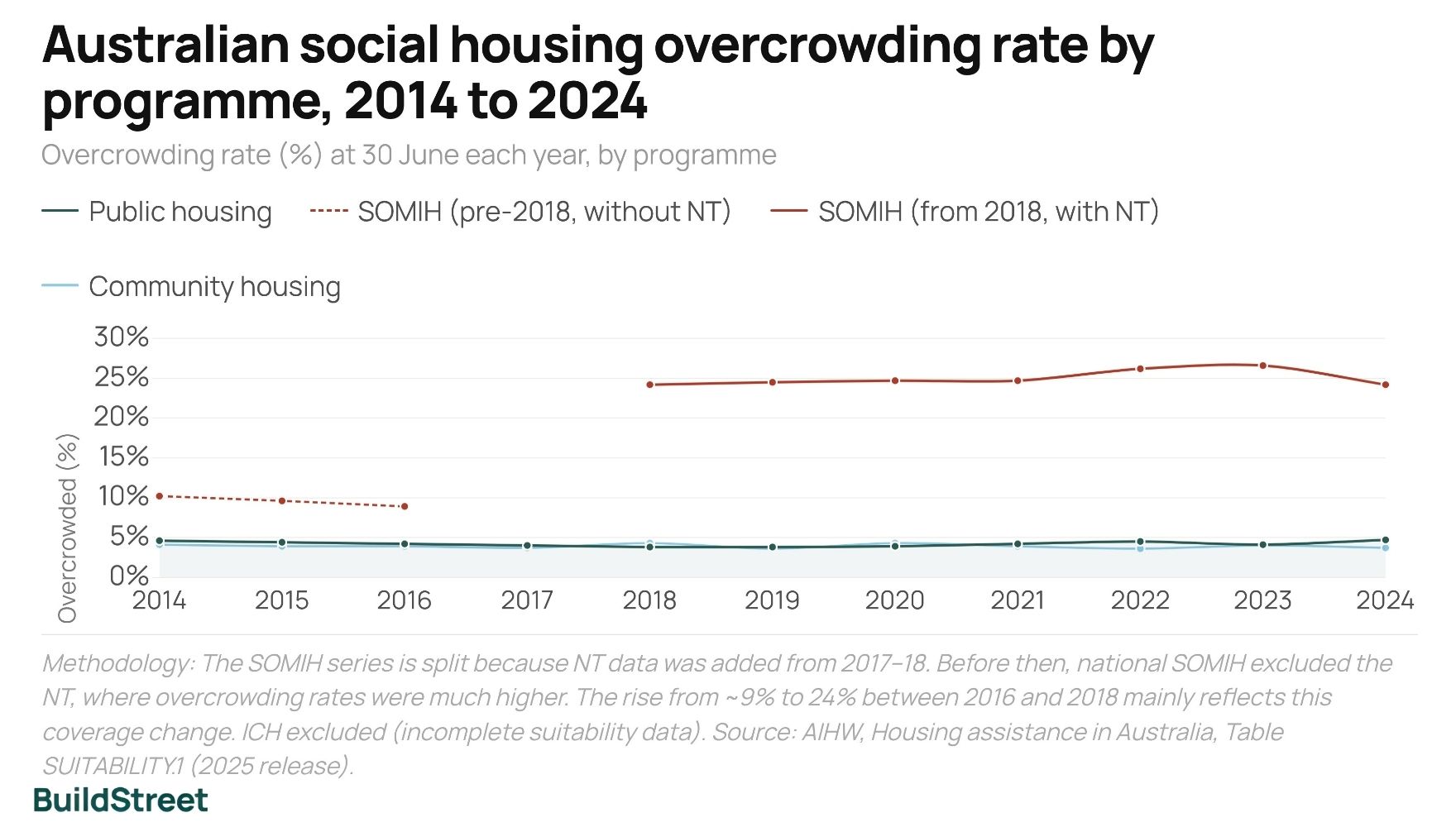
State-owned and managed Indigenous housing (SOMIH) has an overcrowding rate more than five times higher than public housing: 24.2% nationally at June 2024, compared with 4.7% for public housing and 3.7% for community housing.
Detailed counts and rates at 30 June 2024. Updated programme-level rates at 30 June 2025 are shown in the lede.
13,242
4.7% overcrowded
Public housing
3,551
24.2% overcrowded
SOMIH
3,810
3.7% overcrowded
Community housing
1,948
approx. 16% overcrowded*
Indigenous community housing
*ICH overcrowding rate is based on 12,154 households with known suitability status out of 17,579 total. Underutilised and suitable/adequate status are unavailable for ICH; the 12,154 denominator represents households with known overcrowding assessment. Because ICH suitability data is incomplete, the figure should be compared cautiously with the other programmes. Source: AIHW, Table SUITABILITY.1 (2025 release).
Australian social housing overcrowding rate by programme, 2014 to 2024
Overcrowding rate (%) at 30 June each year, by programme
Methodology: The SOMIH series is split because Northern Territory data was added to national reporting from 2017–18. Before then, national SOMIH figures excluded the NT, where overcrowding rates were much higher than in other jurisdictions. The rise from about 9% to 24% between 2016 and 2018 mainly reflects this coverage change, not only a change in overcrowding. ICH is excluded because suitability data is incomplete. Source: AIHW, Housing assistance in Australia, Table SUITABILITY.1 (2025 release).
Public housing overcrowding followed a U-shaped pattern over the decade to 2024. It fell from 4.6% (14,509 households) in 2014 to 3.8% (10,918 households) in 2018 and 2019, then rose to 4.7% (13,242 households) by 2024. The 2024 figure was the highest in the comparable series since 2015, despite there being around 18,000 fewer public housing households overall than in 2015.
Community housing remained relatively stable between 3.6% and 4.3% over the same period. Its lower overcrowding rate may reflect differences in household profile, dwelling type, and location compared with public housing.
Section 04 · State comparison
Public housing overcrowding by state and territory
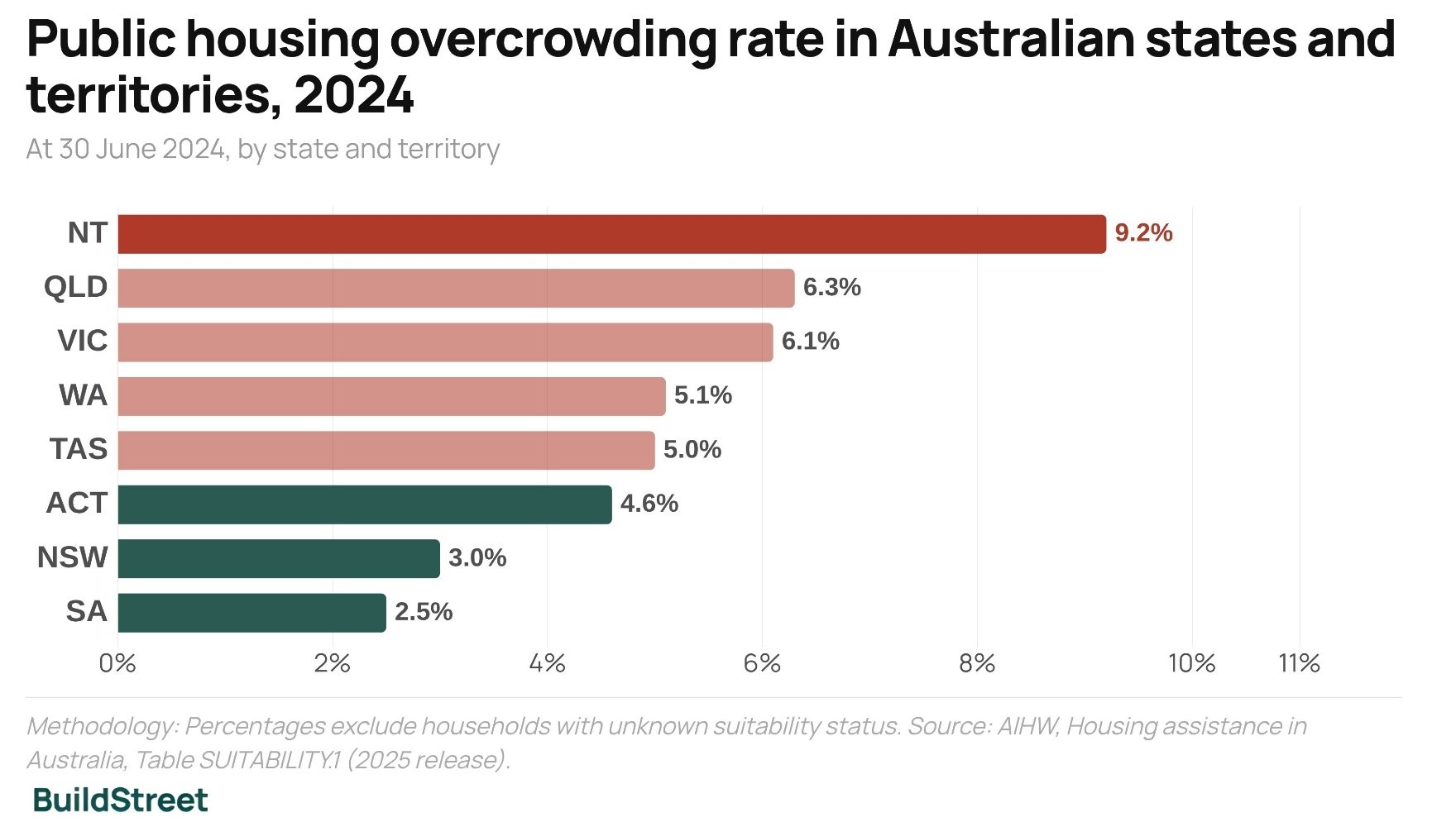
The Northern Territory has the highest public housing overcrowding rate at 9.2%, while South Australia has the lowest at 2.5%. Queensland and Victoria follow at 6.3% and 6.1% respectively. The national rate is 4.7%.
Public housing overcrowding rate in Australian states and territories, 2024
At 30 June 2024, by state and territory
Methodology: Percentages exclude households with unknown suitability status. Source: AIHW, Housing assistance in Australia, Table SUITABILITY.1 (2025 release).
| State/territory | Overcrowded households | Overcrowded (%) | Underutilised (%) | Suitable (%) |
|---|---|---|---|---|
| Northern Territory | 406 | 9.2% | 7.3% | 83.4% |
| Queensland | 3,312 | 6.3% | 14.6% | 79.1% |
| Victoria | 3,724 | 6.1% | 16.8% | 77.1% |
| Western Australia | 1,661 | 5.1% | 13.0% | 81.8% |
| Tasmania | 239 | 5.0% | 13.5% | 81.4% |
| ACT | 445 | 4.6% | 17.8% | 77.7% |
| New South Wales | 2,711 | 3.0% | 16.5% | 80.5% |
| South Australia | 744 | 2.5% | 25.0% | 72.5% |
| Australia | 13,242 | 4.7% | 16.6% | 78.8% |
Methodology: Percentages exclude households with unknown suitability status. Source: AIHW, Table SUITABILITY.1 (2025 release).
This was the largest single-year increase for any state or territory in the series. AIHW notes that jurisdiction-level data may not always be directly comparable over time because of changes in collection methods, reporting systems or reclassifications.
Section 05 · SOMIH
Indigenous housing overcrowding by state and territory
State-owned and managed Indigenous housing (SOMIH) overcrowding is highest in the Northern Territory. The NT's 51.3% overcrowding rate is more than twice the national SOMIH average of 24.2% and more than ten times the public housing national average of 4.7%. The NT also recorded 2,554 of Australia's 3,551 overcrowded SOMIH households at June 2024.
51.3%
NT SOMIH 2024
NT SOMIH overcrowding rate, 2024
Of 4,981 SOMIH households in the Northern Territory, 2,554 are in overcrowded dwellings. Without the NT, the national SOMIH overcrowding rate would be about 10%, still above the public housing national average of 4.7%.
Overcrowding rates range from 5.8% in Tasmania to 51.3% in the NT across the five SOMIH jurisdictions: New South Wales, Queensland, South Australia, Tasmania and the Northern Territory.
SOMIH overcrowding rate in Australian states and territories, 2024
At 30 June 2024. VIC, WA and ACT have no SOMIH programme.
Source: AIHW, Housing assistance in Australia, Table SUITABILITY.1 (2025 release).
| State/territory | Overcrowded households | Overcrowded (%) | Underutilised (%) | Suitable (%) |
|---|---|---|---|---|
| Northern Territory | 2,554 | 51.3% | n.p. | n.p. |
| Queensland | 489 | 15.3% | 19.1% | 65.6% |
| South Australia | 114 | 9.0% | 31.9% | 59.1% |
| New South Wales | 385 | 7.6% | 27.0% | 65.4% |
| Tasmania | 9 | 5.8% | 23.2% | 71.0% |
| Australia | 3,551 | 24.2% | 24.9% | 50.8% |
Methodology: Percentages exclude households with unknown suitability status. NT underutilised and suitable figures are not published (n.p.) to protect confidentiality; the NT total is known and unknown = 0, with 2,554 overcrowded confirmed. National underutilised and suitable percentages exclude NT from the denominator. VIC, WA, and ACT are not applicable (no SOMIH programme). Source: AIHW, Table SUITABILITY.1 (2025 release).
NSW transferred a substantial number of dwellings from public housing to SOMIH in both 2023–24 and 2024–25. NSW SOMIH households increased from 3,604 (June 2023) to 5,186 (June 2024), a rise of 44% in one year, while NSW public housing fell from 92,124 to 90,600. This means NSW SOMIH overcrowding counts and rates at June 2024 are not directly comparable with June 2023.
Indigenous housing overcrowding by remoteness area
SOMIH overcrowding climbs with remoteness, from 7.7% in major cities to 47.0% in very remote areas. Public housing shows the same gradient but at a much lower scale: 4.3% in major cities rising to 9.8% in very remote areas. In very remote areas, the SOMIH rate is nearly five times the public housing rate.
Remote housing stock may also be harder to modify or replace because of location, building age and construction costs.
SOMIH and public housing overcrowding by remoteness area in Australia, 2024
At 30 June 2024, by remoteness area
Methodology: Both SOMIH and public housing rates use known-suitability households as denominator. Source: AIHW, Table SUITABILITY.2 (2025 release). Remoteness based on the ABS Australian Statistical Geography Standard 2021.
| Remoteness area | SOMIH overcrowded (no.) | SOMIH total | SOMIH rate (%) | PH rate (%) |
|---|---|---|---|---|
| Major city | 357 | 4,605 | 7.7% | 4.3% |
| Inner regional | 160 | 1,651 | 9.7% | 4.9% |
| Outer regional | 457 | 2,410 | 18.9% | 6.2% |
| Remote | 597 | 1,780 | 33.5% | 8.8% |
| Very remote | 1,981 | 4,213 | 47.0% | 9.8% |
| National total | 3,551 | 14,659 | 24.2% | 4.7% |
Source: AIHW, Table SUITABILITY.2 (2025 release). SOMIH and PH rates are calculated using known-status households as denominator.
Indigenous housing overcrowding and underutilisation by remoteness area
In very remote areas, 47.0% of SOMIH households are overcrowded, while 18.8% are in dwellings with two or more bedrooms more than the household requires. This shows that overcrowding and underutilisation can appear in the same broad remoteness category, although the two measures use different denominators and cannot be directly added together.
SOMIH overcrowding and underutilisation by remoteness area in Australia, 2024
At 30 June 2024, by remoteness area
Methodology: Overcrowding rates sourced from Table SUITABILITY.2 (denominator: all known-status households, including NT). Underutilisation rates sourced from Table SUITABILITY.3; the denominator for SOMIH underutilisation rates excludes NT, as NT underutilised and suitable counts are not published. The two series use different denominators and cannot be directly summed. Source: AIHW, Tables SUITABILITY.2 and SUITABILITY.3 (2025 release).
NT SOMIH occupancy was 87.2% at 30 June 2025, compared with 87.3% at June 2024. With approximately 5,705 NT SOMIH dwellings at June 2024, roughly 730 dwellings were not occupied at that date. Of those, around 336 were untenantable due to maintenance or repair needs, and a further 23 were undergoing major redevelopment. The remaining dwellings were recorded as tenantable but vacant. These figures sit alongside location, dwelling condition and household-size requirements, which affect whether a vacant dwelling can address overcrowding.
Section 06 · Who is affected
Who lives in overcrowded social housing?
Low-income households make up most overcrowded public housing households. At June 2024, 83.9% of overcrowded public housing households were classified as low income, rising to 97.7% for SOMIH. The main tenant in overcrowded public housing was most commonly aged 35 to 44. Group and mixed composition households accounted for 55.0% of overcrowded public housing.
Household composition of overcrowded and underutilised public housing households, Australia, 2024
Public housing only, at 30 June 2024
Methodology: National (Total state) data for public housing only. "Group and mixed composition" includes multi-generational households, unrelated people sharing, and extended family groups. Household composition totals include a "not stated" category not shown in chart. Source: AIHW, Table SUITABILITY.4 (2025 release).
Overcrowded public housing households are predominantly multi-person and family groups:
- 55.0% are group and mixed composition (multi-generational households, extended family groups, and unrelated people sharing)
- 26.6% are sole-parent families with dependent children
- 8.6% are couples with dependent children
Among underutilised public housing households, single adults account for 73.5%, followed by couples without children at 17.4%. These households are more likely to have older main tenants than overcrowded households, which affects how underutilisation figures should be interpreted.
Low income share (overcrowded PH)
83.9%
Of overcrowded PH households classified as low income; 97.7% for SOMIH
Disability share (overcrowded PH)
28.3%
At least one household member with disability among overcrowded PH households
Peak age group (overcrowded PH)
35–44
31.4% of overcrowded PH main tenants; 25–34 is second at 16.7%
SOMIH overcrowded households show a more pronounced group-household pattern. Group and mixed composition households account for 77.8% of overcrowded SOMIH households. This aligns with the broader data limitations noted for Indigenous housing, where household structures may differ from standard occupancy assumptions. JobSeeker is the main income source for 18.8% of overcrowded SOMIH households, compared with 6.3% in public housing.
Among underutilised public housing households, 40.6% include at least one person with disability and 29.1% of main tenants are aged 55 to 64. This means underutilisation should be read as a statistical measure of bedroom mismatch, not as a complete measure of whether a dwelling is suitable for the household.
Source: AIHW, Table SUITABILITY.4 (2025 release). All percentages are national figures for the stated programme.
Section 07 · The matching argument
Why underutilised public housing does not automatically solve overcrowding
Public housing had 13,242 overcrowded households and 47,134 underutilised households at June 2024, a ratio of 3.6 to 1. However, these figures do not mean overcrowding can be resolved through simple reallocation. Location, dwelling size, accessibility needs and the profile of existing tenants all affect whether a household can be matched to a different home.
Overcrowded and underutilised Australian public housing households at 30 June 2024
Overcrowded (too small)
13,242
Public housing households in dwellings with fewer bedrooms than their assessed requirement.
Underutilised (too large)
47,134
Public housing households in dwellings with two or more bedrooms above their assessed requirement.
Why underutilised dwellings cannot be counted as available supply
The underutilised public housing pool is 3.6 times larger than the overcrowded pool. Across public housing, SOMIH and community housing, about 60,900 households were in underutilised dwellings at June 2024, compared with about 22,600 overcrowded households.
Why public housing bedroom mix matters
Only 7.2% of all public housing dwellings have four or more bedrooms, yet more than half of overcrowded public housing households fall into household types that typically require that size.
Public housing bedroom distribution in Australia, June 2024
297,684 public housing dwellings at 30 June 2024
Source: AIHW, Housing assistance in Australia, Table DWELLINGS.10 (2025 release).
Three-bedroom dwellings are the largest category at 34.8% of the stock (103,735 dwellings). Four-bedroom dwellings make up 6.3% (18,860) and five-or-more-bedroom dwellings account for 0.9% (2,613). Combined, homes with four or more bedrooms represent only 7.2% of all public housing, around 21,500 dwellings nationally.
Among overcrowded public housing households, 55.0% were in the "group and mixed composition" category. Sole-parent families with dependent children accounted for 26.6%, while couples with dependent children accounted for 8.6%. These household types can increase demand for larger dwellings, depending on household size and composition.
Overall public housing occupancy was 96.7% at June 2025, indicating that little public housing stock was vacant. High occupancy also means that a dwelling can be occupied while still being unsuitable for the household living in it.
Three barriers to matching overcrowded and underutilised households
Geographical mismatch. Overcrowding and underutilisation are not evenly distributed across states and territories. South Australia had the highest public housing underutilisation rate nationally at 25.0%, but one of the lowest overcrowding rates at 2.5%. The Northern Territory had the highest overcrowding rate at 9.2% and the lowest underutilisation rate at 7.3%. This means spare-bedroom capacity in one jurisdiction may not align with overcrowding pressure in another.
Public housing overcrowding and underutilisation in Australian states and territories, 2024
At 30 June 2024, by state and territory
Methodology: Percentages exclude households with unknown suitability status. Source: AIHW, Table SUITABILITY.1 (2025 release).
The profile of underutilised households. Of the 47,134 underutilised public housing households nationally, 44.0% had a main tenant aged 65 or over, and a further 29.1% had a main tenant aged 55 to 64. More than 40% included at least one person with disability. These figures show that underutilisation often occurs in households with older main tenants or disability needs, which may affect whether a smaller dwelling is suitable.
Availability of smaller dwellings. Relocation would also require smaller properties to be available in the same area. In many communities, the stock skews heavily toward larger family homes built decades ago. The one- and two-bedroom homes required by older single adults may not exist in sufficient numbers to enable meaningful matching without new construction. Around 57.9% of all public housing dwellings are one- or two-bedroom, but the available smaller homes may already be substantially occupied.
Section 08 · Data caveats
Data caveats for social housing overcrowding statistics
Several caveats apply to the suitability data. The most important are incomplete Indigenous community housing data, the SOMIH structural break from 2017–18, and stock transfers or reporting changes that affect year-on-year comparisons.
Unknown suitability is excluded from all rates. Overcrowding and underutilisation percentages are calculated using only households with a known suitability status as the base. Households where bedroom requirements were not recorded are excluded. Rates therefore reflect only the assessed population.
ICH suitability data is substantially incomplete. For Indigenous community housing, underutilised and suitable/adequate counts are unavailable in any state or territory. The 16% overcrowding rate for ICH is based on 12,154 households with assessed status out of 17,579 total, with NT data absent. Because of these gaps, ICH should be compared cautiously with the other social housing programmes.
The SOMIH series has a structural break from 2017–18. Northern Territory SOMIH data was first included in national reporting from 2017–18. The apparent jump in the national SOMIH overcrowding rate from approximately 9% to 24% reflects this change in data coverage, not a sudden increase in overcrowding. Pre-2018 and post-2018 SOMIH rates are not directly comparable.
State and year-on-year comparisons may be affected by transfers and reporting changes. Large stock transfers between programmes, changes in collection systems, and reclassifications can affect single-year comparisons. The 2023–24 NSW public housing to SOMIH transfer, and Victoria's 2024 public housing rate increase from 3.8% to 6.1%, are both cases where data quality caveats apply before drawing trend conclusions.
SOMIH underutilisation and overcrowding rates by remoteness use different base populations. Overcrowding rates by remoteness (Table SUITABILITY.2) include NT in the denominator. Underutilisation rates by remoteness (Table SUITABILITY.3) exclude NT, because NT underutilised and suitable counts are not published. The two series measure slightly different populations and cannot be directly added together.
Underutilisation does not necessarily mean a home is unsuitable for the household. A dwelling classified as underutilised under CNOS may still be entirely appropriate for the household living there. Many underutilised households include people with disability, older adults with mobility needs, or households with legitimate reasons for needing extra space. The classification identifies a statistical mismatch, not a failing of the individual household.
Section 09 · Frequently asked questions
Frequently asked questions about social housing overcrowding
The questions below explain how social housing overcrowding is measured, which programmes and places have the highest rates, and why underutilised dwellings cannot be treated as a simple solution to overcrowding.
What does overcrowding mean in social housing?+−
Which social housing programme has the highest overcrowding rate?+−
Why is SOMIH overcrowding so much higher in remote areas?+−
Why can't underutilised dwellings solve overcrowding?+−
Does overcrowding show up in social housing waitlist data?+−
General information only
This article draws on publicly available data from the Australian Institute of Health and Welfare and the Productivity Commission. It is intended as a statistical reference and does not constitute housing or financial advice. Suitability classifications are based on the Canadian National Occupancy Standard as applied in Australian housing assistance data. Indigenous community housing suitability data is incomplete, and some figures may not be comparable across jurisdictions or over time. Specific caveats are noted throughout the article.
Australian Institute of Health and Welfare (AIHW) – Housing assistance in Australia 2025, data tables: SUITABILITY.1, SUITABILITY.2, SUITABILITY.3, SUITABILITY.4 and DWELLINGS.10.
Productivity Commission – Report on Government Services 2026, Part G, Section 18 Housing: tables used for 30 June 2025 match of dwelling to household size, social housing stock and occupancy figures.
Chart Snapshots