Social housing waitlist statistics in Australia: how many households are waiting?
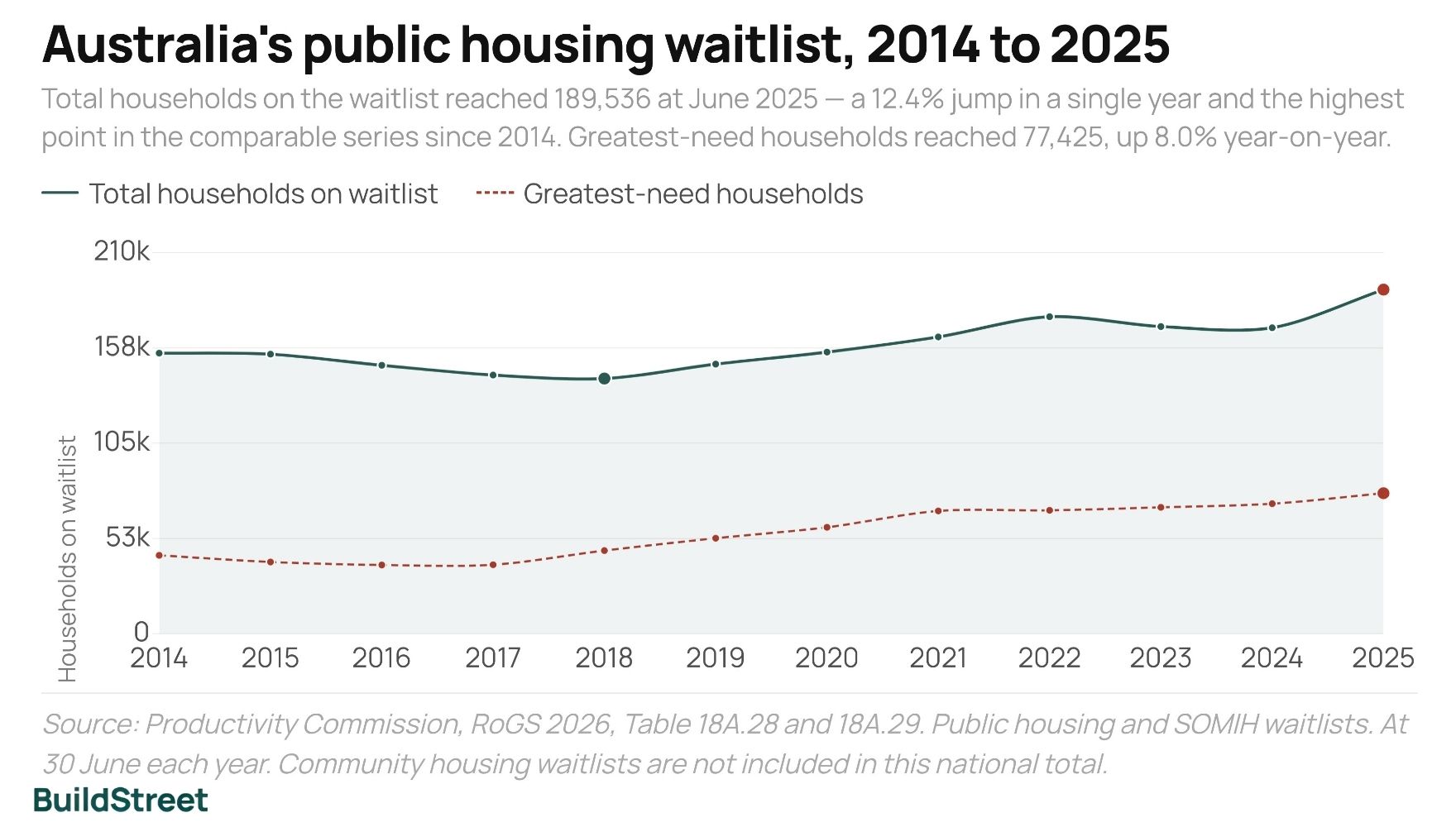
Australia's public housing waitlist reached 189,536 households at 30 June 2025, the highest level in the comparable series since 2014 and up 20,984 households, or 12.4%, from June 2024. Of those, 77,425 (40.8%) were classified as greatest need. In 2024-25, 16,016 households were newly allocated public housing nationally.
No single national figure covers all social housing waitlists. The public housing waitlist is the primary comparable national measure used throughout this article, with the SOMIH waitlist covered separately below.
Public housing waitlist (June 2025)
189,536
Up 20,984 from June 2024
Greatest need households
77,425
40.8% of total, June 2025
New public housing allocations
16,016
2024-25; waitlist is nearly 12 times larger
SOMIH waitlist (June 2025)
17,478
9,178 (52.5%) greatest need
Public housing dwellings (June 2025)
296,541
Down 8.4% from 323,803 in 2014
Social housing share of households
4.1%
Of all Australian households, June 2024
Why use the public housing waitlist as the main measure?
Community housing providers manage their own waitlists within integrated state systems, but this data is not aggregated nationally. The public housing waitlist is the only programme with consistent, published national data going back to 2014.
The gap between waitlist and annual allocations
With 189,536 households waiting and 16,016 newly allocated in 2024-25, the waitlist is nearly 12 times the annual allocation count. An illustrative ratio only — it does not account for new applications or exits.
Section 01 · Definition
What is a social housing waitlist in Australia?
A social housing waitlist is the register of applicants who have been assessed as eligible for housing assistance but have not yet been allocated a dwelling. At June 2025, the national public housing waitlist stood at 189,536 households. State and territory housing authorities manage these lists and assess applicants against local eligibility rules.
All jurisdictions use integrated waitlists, so a single application can cover both public and community housing. Because waitlist data are collected separately by programme, a household registered for more than one may appear in more than one count. Consistent national data for public housing are available back to 2014.
What does "greatest need" mean in social housing?
Within the waitlist, a household is classified as greatest need if it meets one or more priority criteria. Priority access is given to these households, so they are generally allocated ahead of other applicants.
Are community housing waitlists included in the national figure?
At June 2025, community housing served 110,326 households nationally, but this figure counts households already housed, not households waiting. Community housing waitlists exist, but they are not published as a single national total.
Section 02 · National total
How many households are on the public housing waitlist?
At 30 June 2025, 189,536 households were on the national public housing waitlist, a 12.4% increase from June 2024 and the highest total in the comparable series since 2014.
Public housing waitlist at a glance, 30 June 2025
189,536
Households on waitlist — highest since 2014
77,425
Greatest need households — 40.8% of total
+20,984
Increase from June 2024 — up 12.4% in 12 months
16,016
New allocations in 2024-25 — waitlist is nearly 12× larger
Australia's public housing waitlist: total households and greatest need, 2014 to 2025
The national waitlist rose from 154,566 in 2014 to 189,536 in 2025; greatest-need households grew from 43,224 to 77,425 over the same period.
Public housing waitlist at 30 June each year. Excludes households requesting a transfer within the same programme. The greatest-need definition changed from 2024-25 in NSW, Vic and WA. Source: Productivity Commission, ROGS 2026, Table 18A.29; AIHW, Housing assistance in Australia 2025, Table HOUSEHOLDS.26.
The 12.4% increase in 2024-25 is the largest single-year rise in the comparable series since 2014. The three largest state increases were New South Wales (+8,351), Queensland (+5,294), and Victoria (+4,850). Queensland's growth was almost entirely in the greatest-need category (+5,371); in NSW and Victoria, most of the total growth was among non-greatest-need applicants.
The greatest-need figures for NSW, Victoria, and WA are not directly comparable with earlier years. From 2024-25, those states began applying the very high rental housing costs criterion more consistently. Looking further back, the national waitlist rose from 140,578 in 2018 to 189,536 in 2025, an increase of 48,958 households over seven years.
Waitlist versus annual allocations
| Measure | Figure | What it means |
|---|---|---|
| Public housing waitlist | 189,536 | Households waiting at 30 June 2025 |
| Greatest-need waitlist | 77,425 | Priority households waiting at 30 June 2025 |
| New allocations (2024-25) | 16,016 | Households newly housed in public housing |
| Greatest-need allocations (2024-25) | 13,471 | Priority households newly housed |
| Waitlist-to-allocation ratio | ≈ 11.8× | Waitlist is nearly 12 times the annual allocation count |
The ratio is a simplified illustration. It assumes a static waitlist and a fixed annual allocation rate. Source: ROGS 2026, Table 18A.29.
State-owned and managed Indigenous housing (SOMIH) waitlist
At 30 June 2025, 17,478 households were on the SOMIH waitlist nationally, of which 9,178 (52.5%) were classified as greatest need. The SOMIH programme does not operate in Victoria, WA, or the ACT. Queensland accounts for 7,375 of the national total (42.2%), and NSW for 4,601 (26.3%). The SOMIH greatest-need count has grown from 3,827 in 2014 to 9,178 in 2025, an increase of 139.8%.
SOMIH waitlist (June 2025)
17,478
Excludes Vic, WA, ACT
SOMIH greatest need
9,178
52.5% of SOMIH waitlist
SOMIH: Queensland share
42.2%
7,375 of 17,478 total
SOMIH GN growth 2014-2025
+140%
3,827 in 2014 to 9,178 in 2025
Section 03 · Greatest need
How many public housing households are classified as greatest need?
A total of 77,425 households were classified as greatest need at June 2025, representing 40.8% of the 189,536 households on the public housing waitlist. The greatest-need proportion has fluctuated between 25 and 43% since 2014. It peaked at 42.5% in 2024 before falling to 40.8% in 2025.
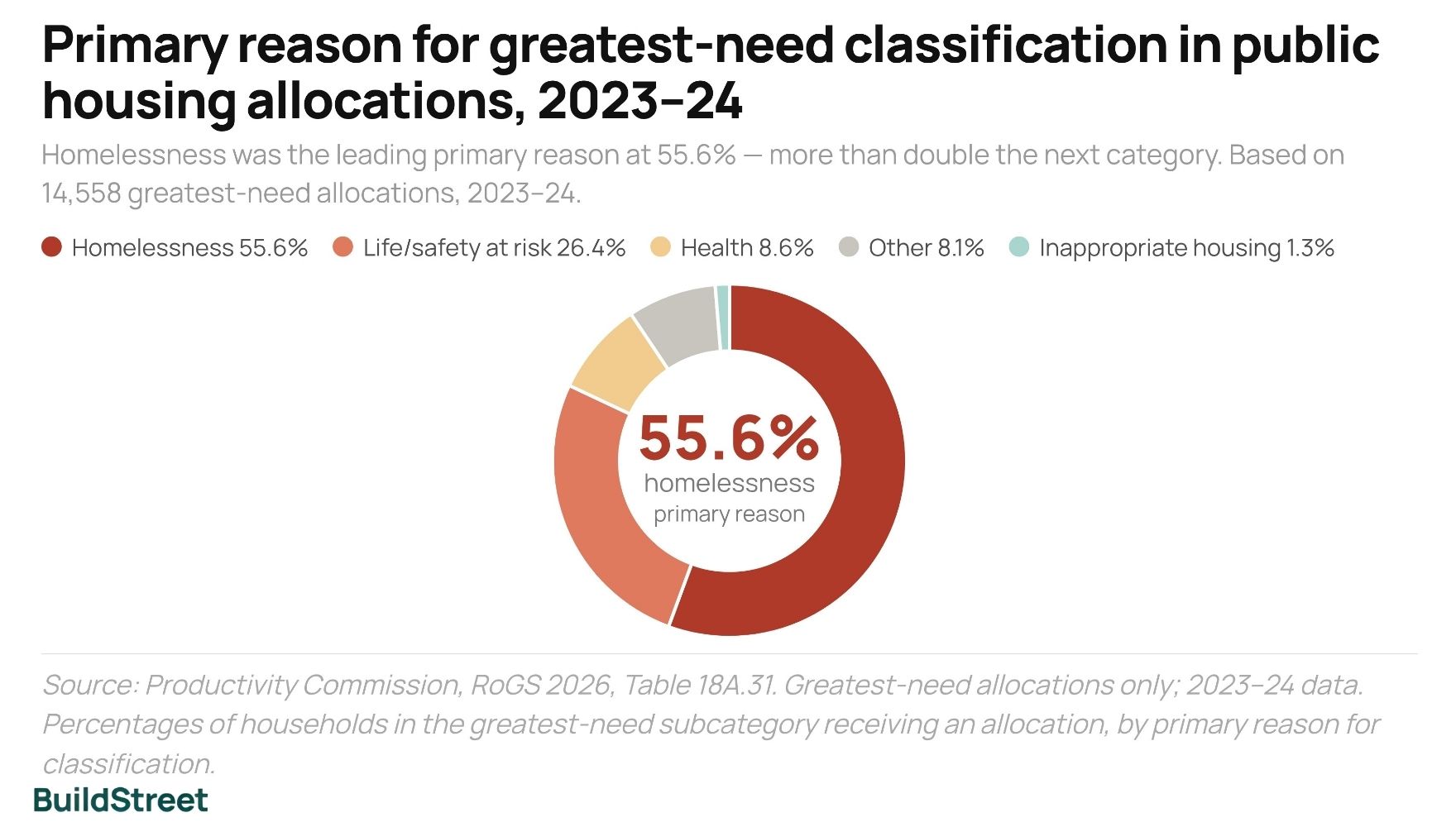
Greatest-need reason data covers newly allocated households only, not households still on the waitlist. Among the 14,496 public housing allocations classified as greatest need in 2023-24, homelessness was the primary reason in more than half of cases.
Primary reason for greatest need classification, newly allocated public housing households, 2023-24
Homelessness and life or safety at risk together account for more than four in five greatest-need allocations nationally.
- Homelessness · 55.6% (8,064)
- Life or safety at risk · 26.4% (3,820)
- Health condition aggravated · 8.6% (1,246)
- Other / not stated · 8.1% (1,165)
- Inappropriate housing · 1.3% (195)
Only the primary greatest-need reason is counted per household. Covers newly allocated households only, not the full current waitlist. Source: AIHW, Housing assistance in Australia, Table HOUSEHOLDS.16 (2025 release).
Homelessness accounted for 55.6% of greatest-need allocations in 2023-24 (8,064 households). Life or safety at risk, including domestic violence, accounted for a further 26.4% (3,820 households). Together, these two categories represent more than four in five greatest-need allocations.
Of all newly allocated public housing households in 2023-24, 87% were classified as greatest need. In 2024-25, 13,471 newly allocated households were classified as greatest need, representing 84.1% of all new public housing allocations.
Section 04 · State comparison
Public housing waitlist by state and territory
New South Wales has the largest public housing waitlist at 59,077 households (June 2025), followed by Victoria at 56,230 and Queensland at 24,112. The table below includes a waitlist rate per 10,000 households, based on June 2024 household estimates, to make comparisons across states clearer.
Public housing waitlist by state and territory in Australia, at 30 June 2025
NSW and Victoria hold the largest raw waitlists; the Northern Territory records the highest rate per 10,000 households.
Queensland's greatest-need share (99.6%) reflects a different classification methodology and is not comparable with other states. Source: Productivity Commission, ROGS 2026, Table 18A.29. Data at 30 June 2025.
| State / territory | Total waitlist | Greatest need | GN % | Per 10,000 | Δ from 2024 | Δ GN |
|---|---|---|---|---|---|---|
| New South Wales | 59,077 | 9,906 | 16.8% | 181 | +8,351 | +1,845 |
| Victoria | 56,230 | 24,803 | 44.1% | 210 | +4,850 | −2,944 |
| Queensland‡ | 24,112 | 24,024 | 99.6% | 113 | +5,294 | +5,371 |
| Western Australia | 22,409 | 7,382 | 32.9% | 203 | +2,115 | +1,700 |
| South Australia | 13,687 | 3,021 | 22.1% | 178 | −356 | −440 |
| Northern Territory | 5,467 | 2,240 | 41.0% | 655 | +44 | −42 |
| Tasmania | 5,152 | 4,124 | 80.0% | 213 | +443 | +387 |
| ACT | 3,402 | 1,925 | 56.6% | 187 | +243 | −104 |
| Australia | 189,536 | 77,425 | 40.8% | 181 | +20,984 | +5,773 |
‡ Queensland classifies virtually all waitlisted households as greatest need under a broader definition, which is not comparable with other states. Per-household rates use June 2024 total household counts as denominator. Victoria's greatest-need count fell despite total waitlist growth; the reason is not explained in official documentation. Source: ROGS 2026, Table 18A.29; AIHW Table HOUSEHOLDS.27.
Which state or territory has the highest waitlist rate?
Adjusted for population, the Northern Territory has the highest public housing waitlist rate at 655 per 10,000 households. The NT also has the highest share of households in social housing, at 14.4%, compared with 4.1% nationally. Among the states, Tasmania (213) and Victoria (210) have the highest waitlist rates per 10,000 households, followed by WA (203).
South Australia is the only jurisdiction where the total waitlist fell year-on-year, declining by 356 households to 13,687. Queensland recorded the largest greatest-need increase nationally (+5,371), exceeding the combined greatest-need growth of NSW (+1,845) and WA (+1,700).
Section 05 · Time waited
How long do households wait before being allocated public housing?
The national median wait for greatest-need households was 8 months in 2024-25, compared with 18 months for non-greatest-need applicants. These figures cover only households that received an allocation. Households still waiting are excluded.
There is an important caveat: greatest-need wait time is recorded from when they gained greatest need status, not from when they first applied. A household may have spent years on the general waitlist before that point, so the recorded wait can understate total time in the system.
Median wait for greatest-need public housing households, Australia, 2024-25
The national median for greatest-need households was 8 months; for non-greatest-need households it was 18 months. The Northern Territory had the longest greatest-need wait at 41 months; the ACT had the shortest at 2 months.
Time waited before public housing allocation, by greatest need status, 2023-24
57.9% of greatest-need allocations were within 12 months; 38.3% for non-greatest-need. Time for greatest-need is measured from the greatest-need application date, not original application date.
Covers newly allocated public housing households in 2023-24 only. Excludes households still waiting. Source: AIHW, Housing assistance in Australia, Table HOUSEHOLDS.19 (2025 release).
The distribution differs markedly between the two groups. Among greatest-need allocations in 2023-24:
- 29.5% waited less than 3 months, and 57.9% were housed within 12 months.
- Only 5.8% waited 5 or more years.
Among non-greatest-need households, recorded wait times were longer: 22.6% waited 5 years or more, and 38.3% were housed within 12 months.
Median wait times by state, 2024-25
Median months waited before public housing allocation, by state and territory, 2024-25
The NT's greatest-need median of 41 months is the longest nationally; the ACT's 2-month median is the shortest. QLD has no non-greatest-need value because 100% of new allocations were classified as greatest need.
Median wait times for newly allocated public housing households in 2024-25. Tasmania's non-greatest-need median of 0 months is based on 100 households and differs from earlier years. Source: Productivity Commission, ROGS 2026, Table 18A.28.
The Northern Territory's greatest-need median of 41 months (3.4 years) is more than 20 times longer than the ACT's 2-month median. The NT's non-greatest-need median of 51 months is the longest across both categories. These long waits may be associated with limited available properties relative to demand, particularly in remote communities.
Victoria shows a different pattern: its greatest-need median (10 months) is slightly longer than its non-greatest-need median (9 months). This may reflect the composition of greatest-need applicants in Victoria, where many are seeking accessible or modified dwellings that are in shorter supply.
Section 06 · Why it keeps growing
Why is the public housing waitlist growing?
The 12.4% increase in 2024-25 occurred alongside several overlapping pressures. The waitlist grows when new applications outpace the number of households housed or removed from the register, and this has been the case for most years since 2019.
01
Public housing stock has fallen
Public housing dwellings fell from 323,803 in 2014 to 296,541 in 2025, a reduction of 27,262 (8.4%). A smaller stock base means fewer dwellings turn over each year.
02
Most allocations come from turnover, not new supply
Most allocations occur when an existing tenant vacates. In 2024-25, 16,016 households were newly allocated. New construction adds relatively little compared with turnover in existing stock.
03
Private rental pressure
Private rental conditions may affect demand for social housing, although waitlist growth also reflects eligibility rules, application processing and allocation policies.
04
Social housing has not kept pace with household growth
Social housing's share of all Australian households has fallen over the long term. The number of households has increased while social housing has not grown at the same rate.
05
Stock transfers reduce the public housing count
When dwellings are transferred from public housing to community housing, they leave the public housing stock but remain social housing — reducing the allocation base.
06
Long-tenure households limit turnover
More than 44% of public housing households have lived in their current property for at least 10 years. Lower turnover means fewer properties become available each year.
Even if the waitlist stopped growing entirely, clearing 189,536 households at the 2024-25 allocation rate of 16,016 per year would take approximately 12 years, assuming current turnover patterns. This is a simplified illustration only.
Section 07 · Supply gap
Public housing supply and the waitlist gap
The waitlist has grown while the public housing dwelling stock has contracted. At June 2025, there were 296,541 public housing dwellings nationally, down from 323,803 in 2014, a decline of 27,262 dwellings (8.4%). Public housing's share of all households fell from approximately 3.6% to around 2.7% over the decade.
Australia's public housing dwelling stock and waitlist households, 2014 to 2025
Public housing dwelling stock fell from 323,803 in 2014 to 296,541 in 2025. The waitlist rose from 154,566 to 189,536 over the same period. The two series use separate axes.
Public housing dwelling stock at 30 June each year; may include vacant or under-repair dwellings. Transfers to community housing or SOMIH affect some years. Source: AIHW Tables DWELLINGS.1 and HOUSEHOLDS.26; ROGS 2026 Tables 18A.3 and 18A.29.
The decline in public housing stock includes several transfer events. South Australia transferred around 3,820 dwellings to community housing in 2017-18; New South Wales transferred stock to community housing in 2018-19 and to SOMIH in 2023-24; and Tasmania transferred approximately 2,000 dwellings to community housing in 2021-22.
Overcrowding and underused public housing dwellings
The supply shortfall is also affected by a mismatch between dwelling types and household needs. At June 2025, approximately 12,300 public housing households were classified as overcrowded (4.3%). At the same time, approximately 47,600 households (16.7%) were underutilised — they had more bedrooms than the household required.
Section 08 · Limitations
Why waitlists understate total housing need
The published waitlist figure of 189,536 captures only formally registered eligible households. Research estimates total unmet housing need at more than 640,000 Australian households, far higher than the registered count.
01 · Non-applicants
Eligible households who do not apply are not counted
Eligible households may not apply because the wait appears prohibitively long. Research suggests many low-income households in rental stress have not applied even though they may qualify. This unregistered demand is not captured.
02 · Transfers excluded
Public housing tenants seeking a different dwelling are not on the waitlist
All waitlist figures exclude households requesting a transfer to a different dwelling within the same programme — even though their circumstances represent a form of unmet need.
03 · Community housing not aggregated nationally
Community housing waitlists exist but are not published as a national total
Community housing providers manage their portion of integrated waitlists, but this data is not published as a national aggregate. Adding figures risks double-counting.
04 · Administrative changes move households on and off
Policy changes can alter counts without changing housing circumstances
Changes in eligibility criteria, priority systems, and application processing can move households on and off waitlists without any change in underlying circumstances.
05 · Exits are not tracked by reason
Some households leave the waitlist without being housed
Some households exit without receiving housing — for example, because they found private rental, relocated, or did not continue. The volume of exits is not publicly reported.
Research estimates of total unmet housing need consistently exceed the waitlist figures. One AHURI study estimated a social housing shortfall of around 435,000 dwellings for the lowest-income quintile. A separate UNSW City Futures / CHIA snapshot estimated more than 640,000 Australian households had unmet housing needs at the 2021 Census. By 2041, that figure is projected to exceed 940,000.
Section 09 · Who is housed
Who is being allocated public housing?
In 2024-25, 16,016 households were newly allocated public housing nationally. Of these, 84.1% were to greatest-need households, down from 87% in 2023-24.
Of the 2024-25 allocations:
- Queensland allocated 100% of its 3,161 new households as greatest need; the ACT allocated 94.2% as greatest need, the second highest share.
- Homelessness was the leading primary reason for greatest-need classification in 2023-24, accounting for 55.6% of allocations (8,064 households).
- In 2024-25, 64.1% of new public housing tenancies were allocated to households in selected equity groups (people with disability, younger or older main tenants, and Aboriginal and Torres Strait Islander households).
Households that include a person with disability waited an average of 652 days (around 21.5 months) in 2024-25, compared with 560 days (18.5 months) for households without a person with disability.
Section 10 · Frequently asked questions
FAQs about Australia's social housing waitlist
At 30 June 2025, 189,536 households were on the public housing waitlist nationally, the highest point in the comparable series since 2014 and up 12.4% from June 2024. The published figure counts households, not individual people. A further 17,478 households were on the separate SOMIH waitlist. No national aggregate figure exists for community housing waitlists.
General information only
This article is a statistical reference based on publicly available government data. All figures are sourced from official data releases. Numbers may be revised in subsequent releases. Cross-state comparisons of greatest-need figures carry methodological limitations due to differences in classification methodology, particularly Queensland's broad application of greatest-need criteria. This article does not constitute housing or financial advice.
Australian Institute of Health and Welfare (AIHW), Housing assistance in Australia 2025, Tables HOUSEHOLDS.16, HOUSEHOLDS.19, HOUSEHOLDS.26, HOUSEHOLDS.27, DWELLINGS.1 and SOCIALSHARE.1.
Productivity Commission, Report on Government Services 2026, Part G, Section 18 Housing, Tables 18A.3, 18A.28, 18A.29, 18A.31, 18A.32 and 18A.39.
Australian Housing and Urban Research Institute (AHURI), Final Report 452, 2026.
UNSW City Futures Research Centre / CHIA, Quantifying Australia's unmet housing need: a national snapshot, 2022.
Chart Snapshots