Insurance for building a new home in Australia: costs, cover and requirements
Building and owning a new home can involve several types of insurance, with different policies applying during construction and after completion.
In 2024–25, average home and contents premiums reached $4,966 in north Western Australia, more than double the $2,310 average across the rest of Australia. Statutory home warranty cover becomes compulsory above thresholds ranging from $3,300 in Queensland to $25,000 in the Northern Territory.
APRA's 2026 stress test estimates about one in seven existing Australian freestanding houses faces premiums high enough to be considered priced out of insurance, potentially widening to about one in four by 2050. This is a severe-but-plausible scenario, not a forecast.
No Australian government source publishes a single national average covering every insurance cost for a new build.
North WA average, 2024–25
$4,966
Rest of Australia: $2,310
Priced out, APRA stress test
About 1 in 7
Existing freestanding houses
Cyclone pool, higher risk
−14%
Cumulative two-year reduction
Warranty thresholds
$3,300–$25k
Seven operating schemes
A history of Australian housing policy
How grants, guarantees and supply programs shaped housing since 1990.
Read full article →Building approvals and completions
The gap between homes approved and homes completed.
Read full article →SECTION 01 · SCOPE
What insurance is required when building a new home?
During construction, contract works, public liability, workers' compensation and professional indemnity may apply. Most jurisdictions also require statutory home warranty or indemnity cover above a contract-value threshold. Home and contents insurance generally begins around completion, handover or occupation.
Insurance that may apply when building a new home in Australia
| Type | What it covers | When it applies |
|---|---|---|
| Contract works insurance | Loss or damage to materials, work in progress and the site from theft, vandalism, fire, storm and similar risks | Throughout construction, until handover |
| Public liability insurance | Injury to other people, or damage to their property, arising from the building work | Throughout construction |
| Workers' compensation | Injury to workers employed on the site | Throughout construction, where required for employers |
| Professional indemnity | Errors in design, certification or advice by building professionals | Where design or certification services are provided |
| Statutory home warranty or indemnity | Financial loss if the builder cannot complete work or fails to fix defects | Compulsory above a threshold in seven jurisdictions |
| Home and contents insurance | The completed dwelling, fixtures and household belongings | After construction |
Different policies protect different interests
SECTION 02 · CONSTRUCTION COVER
What is the difference between contract works and public liability insurance?
Contract works insurance protects the partially completed home, materials and work in progress against theft, vandalism, fire, storm and similar risks until handover. Public liability insurance covers claims where building work injures another person or damages someone else's property.
Queensland's regulator says most residential contracts require both forms of cover. NSW guidance warns that without them, the owner may be exposed because they own the site where work is being carried out.
Contract works insurance
Until handover
Protects the materials, works and site
Public liability insurance
During construction
Protects against third-party claims
Lenders may also require a current certificate of insurance before releasing construction funds.
SECTION 03 · WARRANTY VS HOME
What is the difference between home warranty insurance and home insurance?
Home warranty or indemnity insurance is a statutory scheme protecting eligible homeowners if a builder cannot complete work or fails to fix defects. Ordinary home and contents insurance covers the completed dwelling and belongings. Neither replaces the other.
Seven jurisdictions operate compulsory schemes. Most are last-resort arrangements triggered by a builder's death, disappearance or insolvency. Queensland defect cover and Victoria's First Resort Home Warranty Scheme can respond in other prescribed circumstances.
Statutory home warranty and indemnity insurance by jurisdiction, 2026
Filter by scheme design and sort the headline thresholds.
8 of 8 jurisdictions shown
NSWThreshold $20,000 · Max $340,000
Threshold
Work over $20,000 incl. GST
When cover may respond
Builder's death, disappearance, insolvency, or licence loss/suspension after a compensable order
Maximum cover
Up to $340,000, subject to limits and loss type
Cover period
6 years for major defects; 2 years for other loss
QueenslandThreshold $3,300 · Max $200,000
Threshold
Work over $3,300 incl. materials, labour and GST
When cover may respond
Non-completion requires a qualifying termination or builder failure. Defect claims can follow an unfulfilled direction to rectify, even if the builder is trading
Maximum cover
$200,000 standard; up to $300,000 with optional additional cover
Cover period
Structural defects: 6 years 6 months; shorter limits apply to non-structural and non-completion claims
VictoriaThreshold $20,000 · Max $400,000
Threshold
Work over $20,000; homes of 3 storeys or less
When cover may respond
Incomplete, defective or non-compliant work, including while the builder is still trading
Maximum cover
Maximum $400,000 total assistance per home
Cover period
Up to 6 years for major defects; up to 2 years for other defects or non-compliant work
Western AustraliaThreshold $20,000 · Max $200,000
Threshold
Residential building work over $20,000, subject to exemptions
When cover may respond
Builder's death, disappearance, insolvency or deregistration
Maximum cover
Deposit loss up to $40,000; incomplete or defective work up to $200,000
Cover period
Construction period plus 6 years from practical completion
South AustraliaThreshold $20,000 · Max $250,000
Threshold
Work valued at $20,000 or more requiring development approval
When cover may respond
Builder's death, disappearance or insolvency
Maximum cover
Up to $250,000 for policies issued from 1 October 2025
Cover period
5 years from practical completion
ACTThreshold $12,000 · Max $200,000
Threshold
Work over $12,000 requiring building approval
When cover may respond
Builder's death, disappearance or insolvency
Maximum cover
Minimum $200,000 from 1 January 2025
Cover period
5 years from occupancy certificate; 180-day discovery claim window
Northern TerritoryThreshold $25,000 · Max $200,000
Threshold
Work over $25,000 from 30 March 2026
When cover may respond
Builder's death, disappearance, bankruptcy or deregistration
Maximum cover
Non-completion up to 20% of contract price; combined cap $200,000
Cover period
1 year non-structural; 6 years structural; 90-day claim window
TasmaniaThreshold — · Max —
Threshold
No compulsory insurance threshold in force
When cover may respond
Statutory warranties apply rather than a trigger-based compulsory policy
Maximum cover
No equivalent compulsory scheme in force
Cover period
Statutory warranty periods apply
Several schemes changed in 2025–26
SECTION 04 · LOCATION RISK
How location and natural hazards affect home insurance costs
Home premiums vary substantially by location. Since 2022, the ACCC has tracked northern Australian insurance prices and the cyclone reinsurance pool. Its fifth and final monitoring report was released in June 2026.
December 2023 · Report 2
2022–23 premiums, pool still in transition
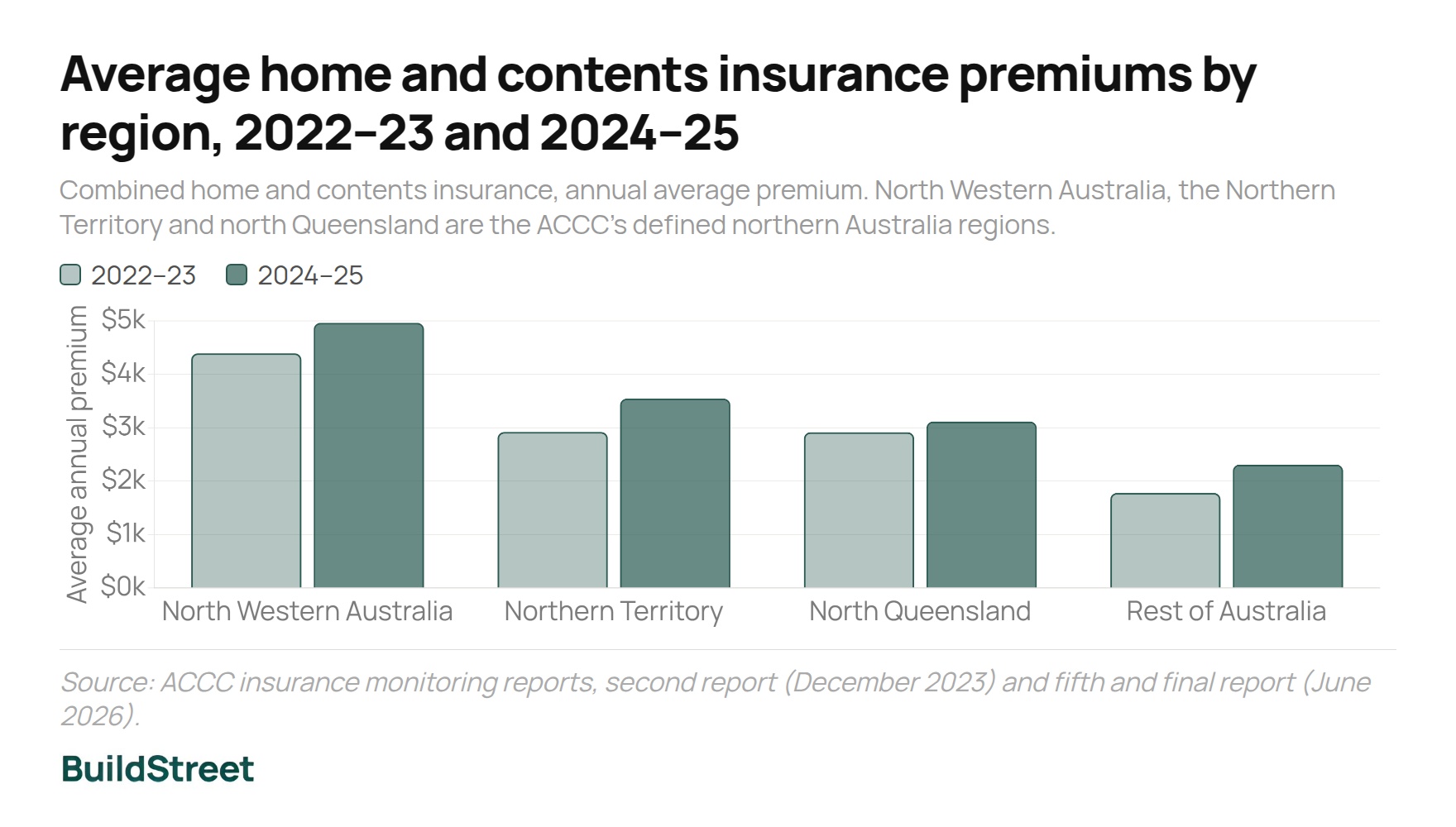
North WA averaged $4,395, NT $2,922, north Queensland $2,918 and the rest of Australia $1,779.
June 2026 · Final report
2024–25 premiums, monitoring concludes
North WA reached $4,966, NT $3,546, north Queensland $3,117 and the rest of Australia $2,310.
Average home and contents insurance premiums by region, 2022–23 and 2024–25
Annual average premium. Northern regions use the ACCC's definitions.
- 2022–23
- 2024–25
Source: ACCC insurance monitoring reports, December 2023 and June 2026.
Every northern region remained more expensive than the rest of Australia. North WA's average was about 2.2 times the rest-of-Australia figure in 2024–25. The narrowing gap largely reflected faster premium growth elsewhere, rather than falling northern premiums.
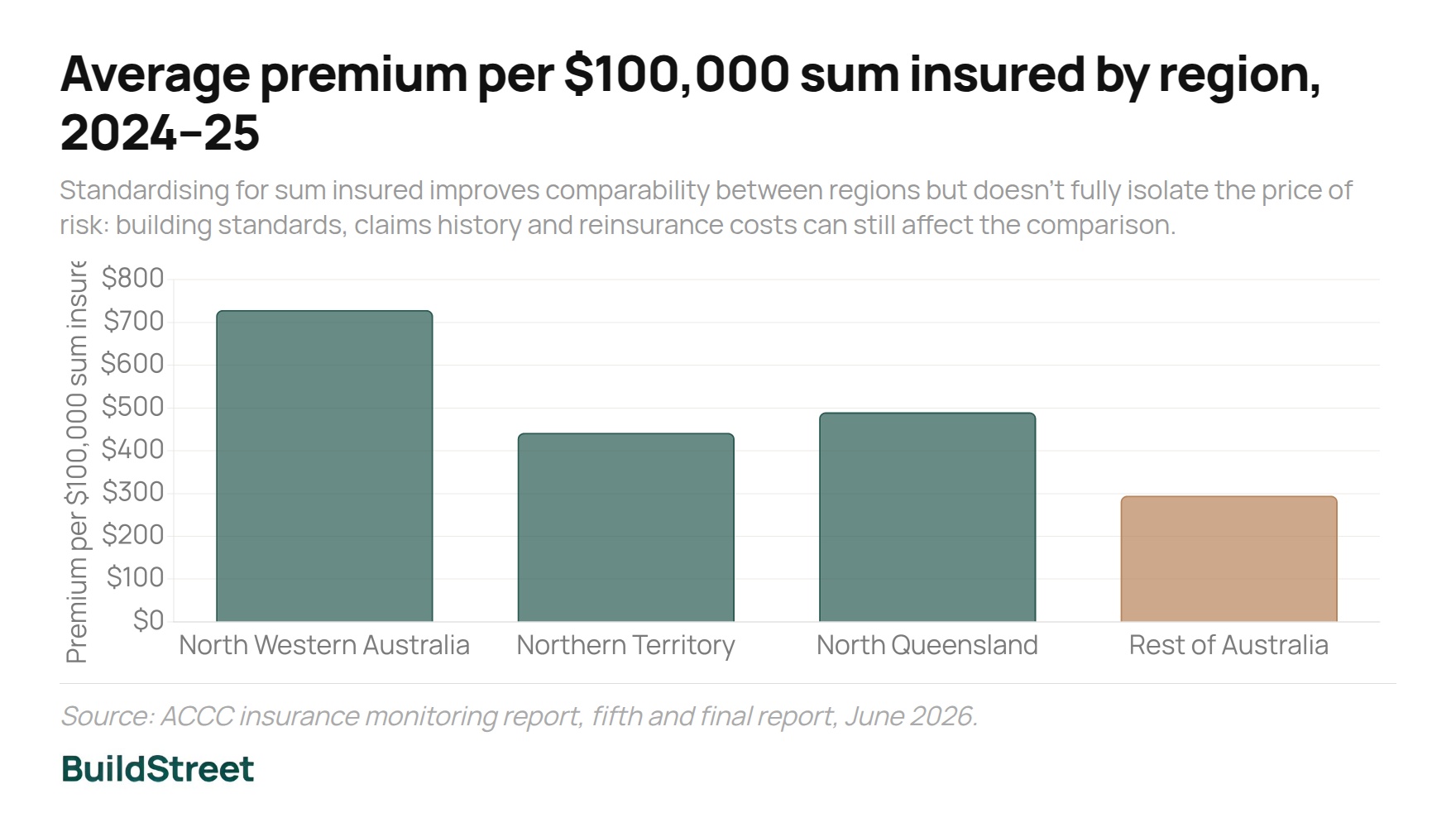
Average premium per $100,000 sum insured by region, 2024–25
Standardising the sum insured improves comparability but does not fully isolate the price of risk.
Source: ACCC insurance monitoring report, June 2026.
The ACCC linked part of the difference to higher rebuilding costs and more stringent northern building standards.
How the cyclone reinsurance pool affected premiums
Home insurance premium change by cyclone risk tier, first year after joining the pool
Per $100,000 sum insured. Positive values mean premiums rose relative to the pre-pool baseline.
Source: ACCC insurance monitoring report, June 2026.
Renewal premiums in medium-to-high risk areas fell 11% in year one and 14% cumulatively over two years. ARPC reported a larger 37% fall in highest-risk new-business quotes using a different methodology; the results are not directly comparable.
How affordability could change by 2050
APRA estimates about 1.4 million existing freestanding houses are already priced out on its measure—an annual premium equal to at least four weeks of household income. Under both stress-test scenarios, the share reaches around one in four by 2050, while the rural protection gap exceeds 40%.
2026 estimate
1 in 7
About 1.4 million houses
2050 scenario
1 in 4
About 1 million more homes
Rural areas, 2050
>40%
Protection gap in both scenarios
Stress test, not forecast
SECTION 05 · BUILDING STANDARDS
How flood, bushfire and cyclone standards can affect insurance costs
Hazard-prone sites may require additional construction standards. These can raise estimated rebuilding costs, increasing the sum insured and potentially the premium. No official source publishes a national dollar estimate for this effect.
Australian standards for flood, bushfire and cyclone-prone areas
| Hazard | Standard or rule | Where it applies |
|---|---|---|
| Flood | ABCB Standard for Construction of Buildings in Flood Hazard Areas, referenced by the NCC | Declared flood-hazard areas where the relevant provisions are adopted |
| Bushfire | AS 3959:2018, called up through the NCC with jurisdiction variations | Government-declared bushfire-prone areas across the states and ACT |
| Cyclone | AS/NZS 1170.2 wind regions C and D, plus AS 4055 for housing | Cyclonic northern coastal regions; exact classification is site-specific |
| Cyclone (NT) | NT regulations requiring cyclone-resistant construction since the 1970s | Cyclone-prone parts of the Northern Territory |
SECTION 06 · FINANCE
Construction loans and insurance requirements for new homes
Lenders may require proof of current cover before releasing construction funds because the property is security for the loan. After a claim, a cash settlement may be paid to the lender depending on its policy and financial interest.
>80%loan-to-value
Lenders mortgage insurance may apply. This usually one-off cost protects the lender, not the borrower, and is separate from insurance for the build itself.
Under APRA's higher physical-risk scenario, expected annual weather losses rise from under $7 billion in 2024 to more than $16 billion by 2050. Again, this is a stress-test scenario rather than a forecast.
SECTION 07 · RENOVATIONS
What insurance applies to renovations and owner-builder projects?
Knockdown rebuilds and major renovations may be subject to the same thresholds as new-home construction, depending on each scheme's definitions and contract structure. Demolition-only work, retained structures and work below the threshold may be treated differently.
Owner-builder projects also face separate cover and resale rules. In NSW, each directly engaged licensed contractor must provide cover where its contract exceeds $20,000, although the owner-builder's own work is not covered.
NSW contractor threshold
$20,000
Cover for directly engaged licensed contractors
NSW resale warning
7 years 6 months
From the owner-builder permit
WA resale cover rule
7 years
From the building licence
Data notes and limitations
References
- ACCC — Insurance monitoring report, June 2026
- APRA — Mind the Gap: Insurance Climate Vulnerability Assessment
- NSW Government — Insurance requirements for contractors
- SIRA — Home building compensation
- QBCC — What is home warranty insurance
- Building and Plumbing Commission Victoria — Home Warranty
- WA Government — Building or renovating your home
- SAFA — Building Indemnity Insurance
- ACT Planning — Residential building work insurance
- NT Government — Fidelity fund certificate
- Moneysmart — Choosing home insurance
- ABCB — Flood hazard construction standard
Chart Snapshots