Owner-builder insurance requirements in Australia: rules by state and territory
Across all eight Australian jurisdictions, no operating statutory home warranty scheme pays an owner-builder for defects in their own work. Four jurisdictions state an exclusion outright, three direct protection to a future owner, and Tasmania had no operating scheme at 30 July 2026.
Insurance obligations still arise around the project. Permit thresholds, public liability requirements, contractor packages and early-sale duties differ substantially by state and territory.
Own work covered
0 of 8
For the builder's benefit
Early-sale cover
2 of 8
Victoria and WA
Permit range
$10k–$25k
Five jurisdictions
Official sources
25
Public-sector sources
What home warranty insurance covers
Compare thresholds, cover limits and claim triggers.
Read full article →When a builder becomes insolvent
How projects, claims and scheme limits interact.
Read full article →SECTION 01 · OWNER-BUILDER STATUS
How owner-builder status affects insurance requirements
New South Wales, Queensland, South Australia and the ACT exclude owner-built work from statutory home warranty cover outright. Victoria, Western Australia and the Northern Territory can protect a purchaser or later owner instead. Tasmania's 2023 amendments had not commenced at the review date.
Outright exclusion
4 of 8
NSW, Qld, SA and ACT
Later-owner benefit
3 of 8
Vic, WA and NT
Not commenced
1 of 8
Tasmania
How the count was derived
A jurisdiction is included where official sources show an exclusion, cover directed to a future owner, or no operating scheme. The build-stage outcome is the same, although the legal basis differs.
Deferred cover in Victoria and Western Australia
Neither requires statutory cover before an owner-builder begins their own work. Cover becomes mandatory if the home is sold during the relevant period. In the Northern Territory, a certificate is required before the permit, but cover reaches a future owner only after transfer and one of four trigger events.
SECTION 02 · TYPES OF COVER
What insurance is available to owner-builders in Australia?
Six jurisdictions publish a headline statutory amount between $200,000 and $400,000, but none is claimable by the owner-builder for defects in their own work. Statutory schemes and site insurance serve different purposes.
Published statutory amounts and their basis
| Jurisdiction | Amount | Basis |
|---|---|---|
| Victoria | $400,000 | Scheme limit for eligible contracts from 1 July 2026 |
| New South Wales | $340,000 | Cover up to this amount, subject to limits |
| South Australia | $250,000 | Insurer liability cap |
| Queensland | $200,000 | Scheme maximum for each applicable condition |
| Western Australia | $200,000 | Payout limit or contract value if lower |
| ACT | $200,000 | Minimum insurance amount |
Project and liability insurance
Public liability, workers compensation, contract works and expanded home insurance may address injury, theft, fire, storm or damage to partly completed work. They do not replace statutory warranty protection, and statutory cover does not insure stolen materials or public liability.
SECTION 03 · STATUTORY SCHEMES
Home warranty insurance rules for owner-built homes
Seven separate scheme names operate across the jurisdictions. The comparison below separates treatment of the owner's own work from licensed contractor packages.
New South Wales
Home building compensation
Cover is not available
Victoria
Home Warranty
Not an insured contract during the build
Queensland
Queensland Home Warranty Scheme
Owner-builder work is not covered
Western Australia
Home indemnity insurance
Not required before building; mandatory on early sale
South Australia
Building indemnity insurance
Unavailable for self-performed work
Tasmania
No operating scheme confirmed
No operating cover identified
Australian Capital Territory
Residential building insurance
Excluded by Building Act 2004 s 87(b)
Northern Territory
Fidelity fund certificate
Certificate protects a future owner
The shared $20,000 boundary
NSW, Victoria and WA require cover above $20,000 for eligible contractor packages, while South Australia applies it at $20,000 or more. General triggers in Queensland and the ACT do not apply the same way inside permitted owner-builder projects.
SECTION 04 · SALE OBLIGATIONS
Owner-builder sale rules and statutory periods by state
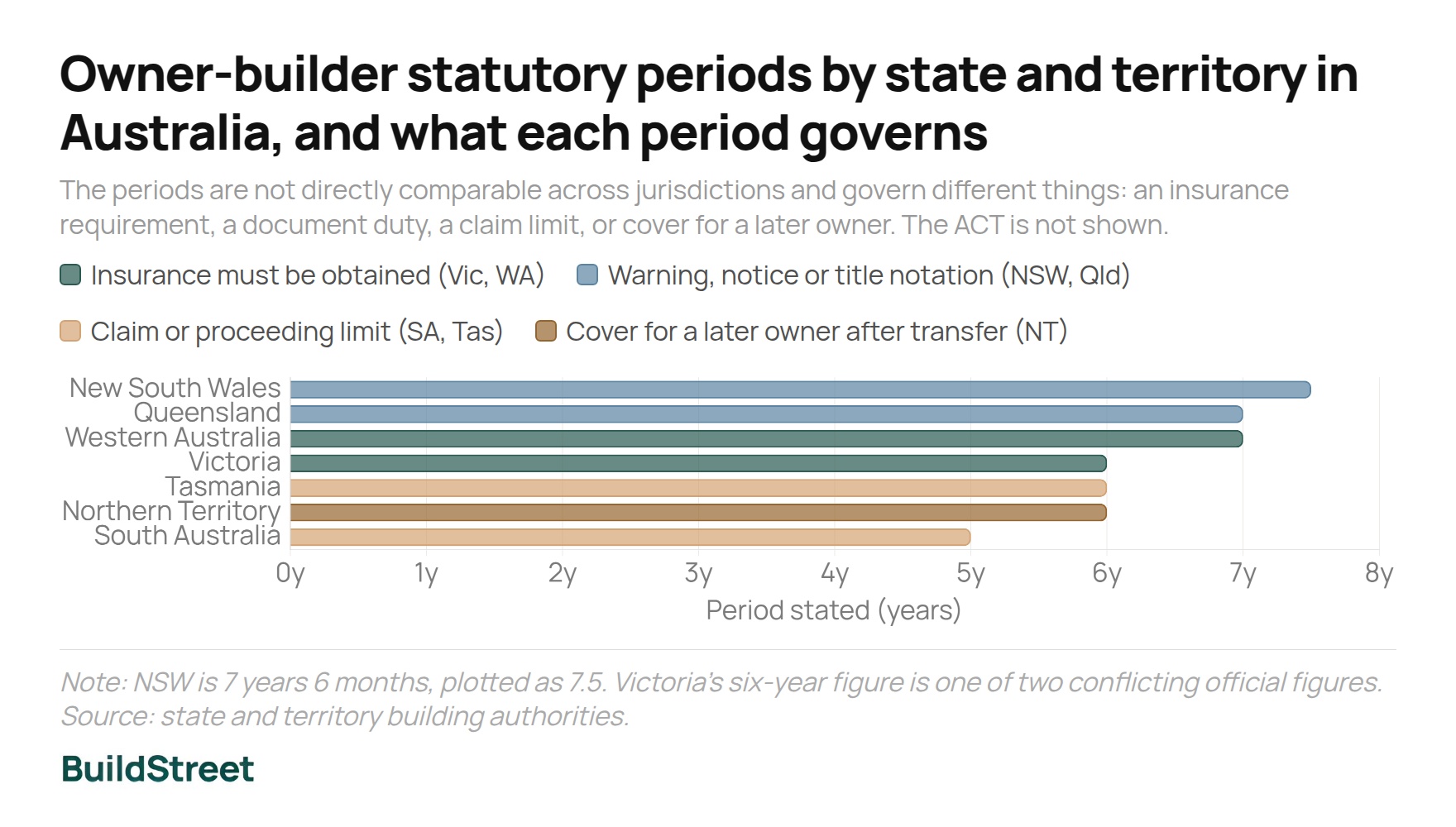
Seven jurisdictions state a relevant period from five to seven years and six months, but these periods govern different duties and begin from different events. Only Victoria and Western Australia require an insurance product on an early sale.
Owner-builder statutory periods by state and territory
Each period begins from a different event and governs a different obligation; lengths should not be treated as a ranking.
Source: State and territory regulators and legislation, current at 30 July 2026.
Early-sale requirements
| Jurisdiction | Requirement | Period |
|---|---|---|
| NSW | Prescribed consumer warning | 7 years 6 months from permit issue |
| Victoria | Cover, notice, defects report and statutory warranties | 6 years from completion; official sources conflict |
| Queensland | Two copies of prescribed notice | Title advice remains for 7 years |
| WA | Obtain HII and give purchaser the certificate | 7 years from building permit |
| SA | Disclose whether BII is in place | Claims usually up to 5 years from completion |
| Tasmania | No sale insurance step identified | Proceedings generally within 6 years |
| ACT | No resale insurance trigger identified | No period identified |
| NT | Cover begins for new owner after transfer and a trigger event | 6 years after completion |
Victoria's period requires qualification
Current official material states both six years and six and a half years. This article uses six years based on the regulator's Owner-Builder Information and Study Guide.
Victoria requires cover, a notice, a defects inspection report and statutory warranties. Western Australia requires a valid HII certificate. NSW and Queensland instead require prescribed warnings or notices, while South Australia requires disclosure.
SECTION 05 · PERMITS
What permits and insurance do owner-builders need?
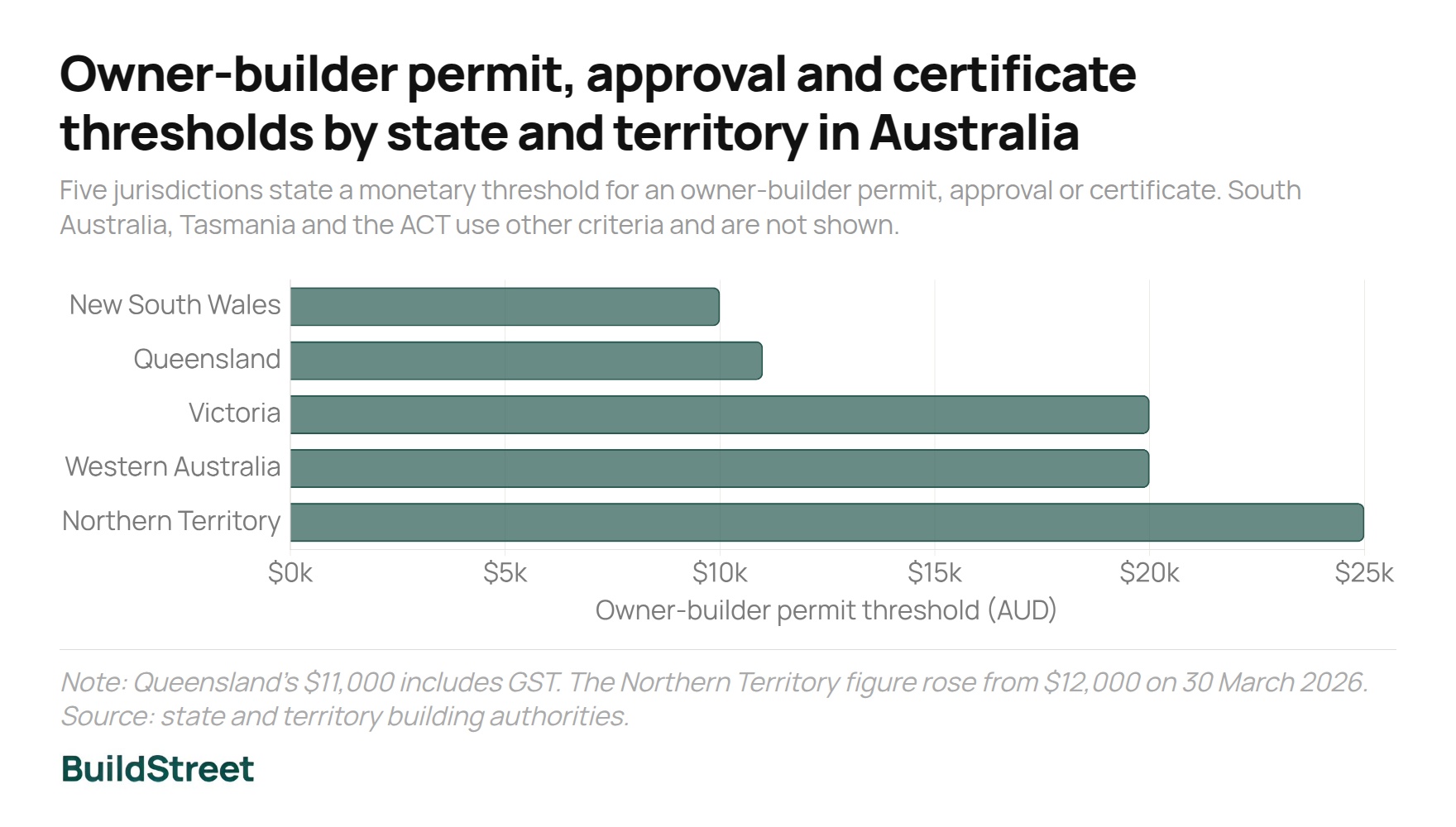
Tasmania and the Northern Territory require an insurance document at the owner-builder permit or approval stage. Tasmania requires a $5 million public liability certificate; the Northern Territory requires a fidelity fund certificate before the building permit is issued for eligible work.
Owner-builder permit, approval and certificate thresholds
Five jurisdictions state a monetary threshold. South Australia, Tasmania and the ACT use other criteria and are excluded.
Source: Building Commission NSW; BPC Victoria; QBCC; Building and Energy WA; Northern Territory Government.
The five value thresholds attach to different legal objects and are not directly comparable. South Australia, Tasmania and the ACT use criteria other than project value.
Three Victorian dollar tests
A Victorian owner-builder may encounter more than $10,000 for a major domestic building contract, over $20,000 for a certificate of consent, and over $20,000 for Home Warranty on an eligible contractor's work. The tests apply to different parts of the project.
SECTION 06 · RISKS AND LIABILITIES
What risks and liabilities do owner-builders carry?
Owner-builders can remain personally responsible for defective work, site safety, rectification and uninsured losses. Duties usually carried by a licensed builder move to the owner, and some survive a sale.
Tasmanian declaration
10 years
Potential defect liability
Victorian order breach
500 pu
Individual penalty
After-sale orders
2 of 8
Victoria and ACT
Work health and safety obligations also apply. Official guidance identifies site management, supervision, certification and rectification among the owner-builder's responsibilities. No comparable national data on owner-builder claims, disputes or defect rates was identified.
Insurance does not delegate responsibility
A policy may fund a covered loss, but it does not remove permit, safety, supervision, certification or statutory-warranty duties placed on the owner-builder.
SECTION 07 · COMPARISON
How owner-builder insurance rules differ across states
Permit triggers, scheme names, sale mechanisms and residual liabilities vary. One conclusion is consistent: no statutory scheme pays an owner-builder for defects in their own work.
Owner-builder rules at a glance
| Jurisdiction | Permit or approval | Own-work cover | Early sale |
|---|---|---|---|
| NSW | Over $10,000 | Not available | Consumer warning within 7.5 years |
| Victoria | Over $20,000 | Not insured during build | Cover, notice, report and warranties |
| Queensland | Over $11,000 incl. GST | Not covered | Prescribed notice |
| WA | Permit work over $20,000 | Not required before build | HII for remainder of 7 years |
| SA | Approved domestic work | Unavailable | Disclosure |
| Tasmania | Specified classes + $5m liability | No operating scheme confirmed | Warranties transfer |
| ACT | Work requiring approval | Part 6 excluded | No trigger identified |
| NT | Home work over $25,000 | Future-owner cover | Cover after transfer and trigger |
Recent changes
South Australia's BII threshold rose to $20,000 and its insurer liability limit to $250,000 in November 2025. The Northern Territory threshold rose to $25,000 in March 2026. Victoria replaced Domestic Building Insurance with Home Warranty for eligible contracts from 1 July 2026.
References
- Building Commission NSW — Working as an owner-builder
- Building and Plumbing Commission Victoria — Selling an owner-built home
- QBCC — Apply for an owner-builder permit
- Building and Energy WA — Owner-builder approval
- SA.GOV.AU — Building indemnity insurance
- CBOS Tasmania — Building surveyors and owner builders
- ACT Government — Building responsibilities
- Northern Territory Government — Owner-builder certificate
Chart Snapshots