Building costs & energy data · Australia · 2026
How much extra does a 7-star home cost in Australia?
Published estimates range from $710 for a Queensland Class 1 dwelling in Australian Building Codes Board modelling, expressed in 2021 dollars, to $3,310 for a single-storey, four-bedroom Victorian house in a government worked example. The Housing Industry Association produced a much higher adjusted estimate of $13,257 per dwelling under Option A, but the figures use different methods and are not directly comparable.
NCC 2022 lifted the model thermal-performance requirement for new homes from 6 stars to the equivalent of 7 stars and introduced a separate Whole of Home energy-use budget. States and territories adopted the changes at different times and with local variations.
There is no official national average cost premium. Industry and consumer groups disagree on whether the added cost is outweighed by lower energy bills and other benefits. NCC 2025 introduced no further residential energy-efficiency changes, and most additional residential code changes are paused until mid-2029.
Reported premium range
$710–$3,310
Official government estimates. The residential industry's own submission put a house far higher, at $13,257
Annual bill savings
$183–$300
Official range across jurisdictions; independent modelling of all-electric homes reports above $1,000
7-star minimum
NCC 2022
First adopted from October 2023; NCC 2025 made no further residential energy changes
States at 7 stars
6 of 8
Tasmania and the Northern Territory have not adopted the 7-star minimum for new houses
Why Australia's 7-star standard has divided the building industry
HIA puts the added cost near $20,000 for a typical Victorian house, while government modelling shows a net lifetime benefit of $822 per average dwelling.
Read full article →What a NatHERS energy rating actually measures
The star rating covers thermal shell only; a separate Whole of Home rating covers total energy use on a 0-100+ scale.
Read full article →SECTION 01 · Standard
What does the 7-star home energy standard require?
The NCC 2022 residential energy provisions generally require two separate performance outcomes: thermal performance equivalent to 7 NatHERS stars and compliance with a Whole of Home annual energy-use budget. The 7-star rating measures the building shell, while Whole of Home is a separate score.
Under the NCC 2022 NatHERS pathway, houses generally require a Whole of Home score of at least 60 out of 100, while apartments generally require at least 50. Alternative compliance pathways, state and territory variations and local concessions may apply.
Features commonly identified in government guidance include north-facing living areas, reduced east and west-facing glass, shading, low-e or tinted glazing, roof and wall insulation, lighter-coloured roofs and walls, and ceiling fans. Victorian guidance identifies better design and orientation, improved insulation and higher-performance glazing as common differences between 6-star and 7-star homes.
There is no single fixed package. The thermal performance outcome depends on climate, orientation, building design, insulation and glazing. The Whole of Home score is affected by heating and cooling, hot water, lighting, cooking, plug-in appliances, pool and spa equipment, rooftop solar and battery storage.
| Requirement | What it covers | Example features |
|---|---|---|
| Thermal performance rating | The predicted energy needed to heat and cool the home, based on its building shell, local climate and design. | Orientation, insulation, glazing, shading, roof colour |
| Whole of Home rating | Predicted annual energy use from major appliances and equipment, less energy generated on site. Houses generally require a score of at least 60, apartments at least 50. | Heating and cooling, hot water, lighting, cooking, plug-in appliances, and pool and spa equipment |
| On-site generation and storage | Solar generation and battery storage included in the Whole of Home assessment. | Rooftop solar and batteries |
Source: NatHERS, Introducing Whole of Home ratings, 23 March 2023; Queensland Government residential energy-efficiency standards; Victorian Government 7-star energy-efficiency building standards.
SECTION 02 · Cost
How much more does a 7-star home cost than a 6-star home?
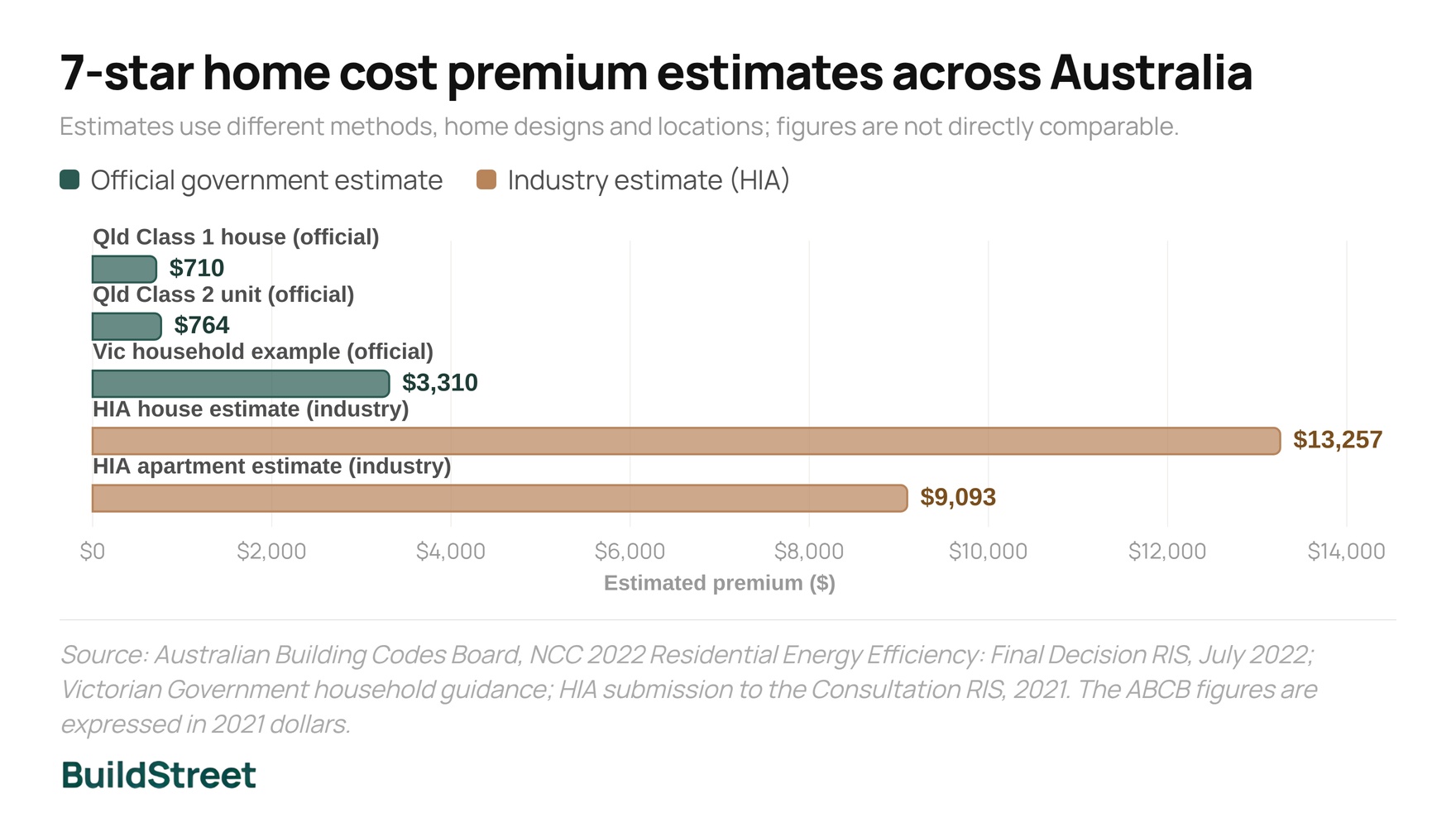
Reported premiums for the 7-star uplift range from $710 to $13,257 per dwelling, with the highest estimate almost 19 times the lowest. Three estimates exist, each using a different method, home design and location, and none of them represents a single national figure.
ABCB regulatory modelling · QLD
$710–$764
Class 1 houses $710, Class 2 units $764. Present-value cost-benefit analysis for the NCC 2019-to-2022 transition, not a builder quote.
Victoria · household example
$3,310
Estimated extra materials cost for a single-storey, four-bedroom house to meet the 7-star standard.
HIA · industry submission
$13,257
HIA estimated $13,257 per dwelling under Option A and $9,093 under Option B.
Source: ABCB, NCC 2022 Residential Energy Efficiency: Final Decision RIS, July 2022; Victorian Government household guidance; HIA submission to the Consultation RIS, 2021. ABCB figures are expressed in 2021 dollars.
7-star home cost premium estimates across Australia
Per-dwelling estimates use different methods, home designs and locations; figures are not directly comparable.
Source: ABCB, NCC 2022 Residential Energy Efficiency: Final Decision RIS, July 2022; Victorian Government household guidance; HIA submission to the Consultation RIS, 2021. ABCB figures are expressed in 2021 dollars.
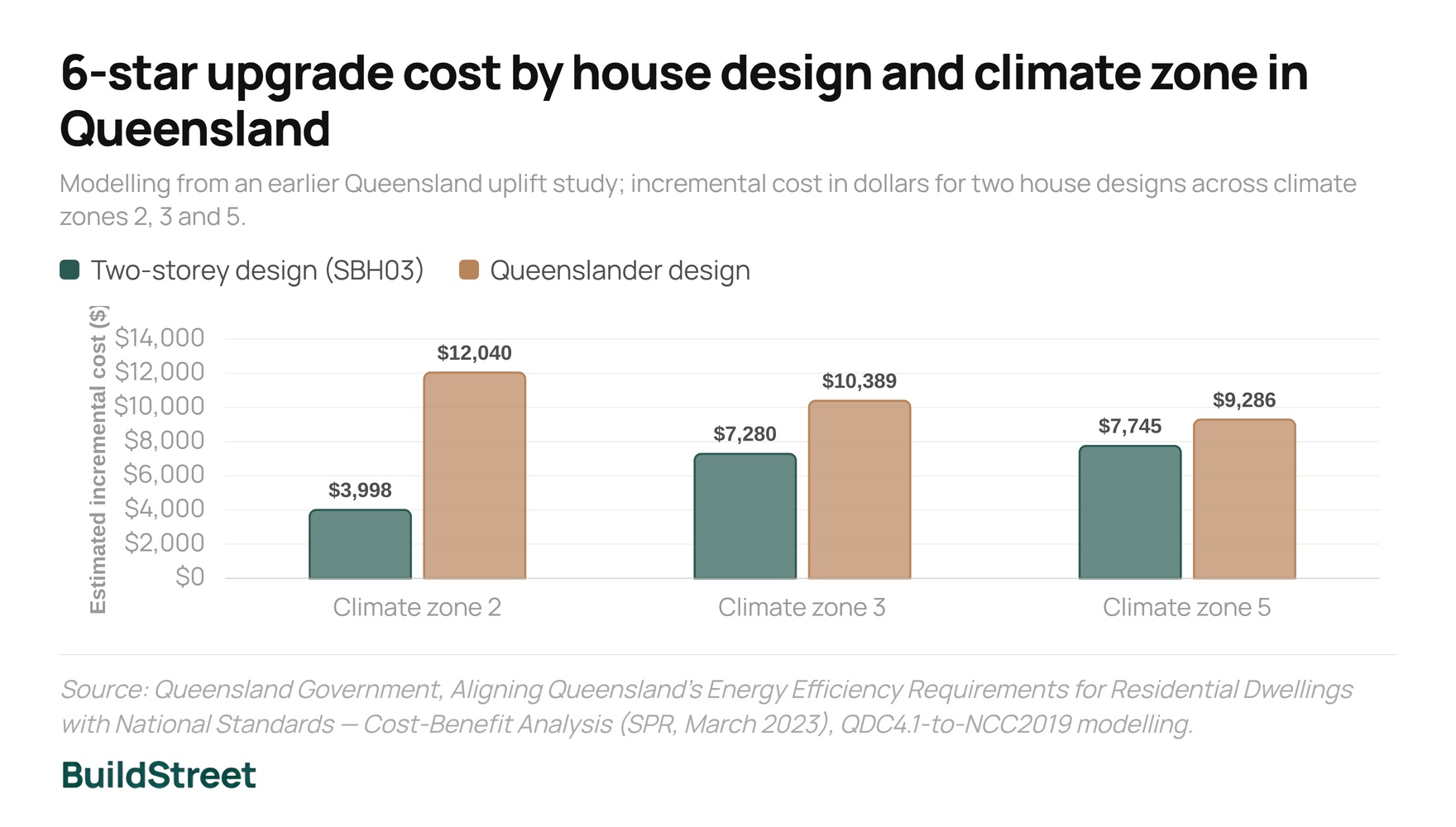
A separate, earlier Queensland Government study modelling the state's move from its own QDC 4.1 standard up to the national NCC 2019 6-star benchmark — not the 7-star standard discussed above — illustrates how much design, climate zone and orientation can affect upgrade costs:
- an earlier Queensland uplift study found a two-storey house design cost more to upgrade as the climate zone number increased, $3,998 in zone 2 rising to $7,745 in zone 5, while an older-style Queenslander design moved the opposite way, $12,040 in zone 2 falling to $9,286 in zone 5
- orientation alone moved the estimated cost by nearly $8,000 for the same design in the same climate zone, from $2,188 facing north to $10,135 facing west
- glazing was the largest single cost driver in three of the four Queensland house designs tested, well ahead of insulation
- more than 58% of affected dwellings in that earlier study showed an absolute reduction in construction cost, even with no change to the dwelling design, so cost is not automatically higher under a tighter standard
6-star upgrade cost by house design and climate zone in Queensland
Modelling from an earlier Queensland uplift study; incremental cost for two house designs across climate zones 2, 3 and 5.
- Two-storey design
- Queenslander design
Source: Queensland Government, Aligning Queensland's Energy Efficiency Requirements with National Standards – Cost-Benefit Analysis (SPR, March 2023), QDC4.1-to-NCC2019 modelling.
6-star upgrade cost by orientation in Queensland
Two-storey design in climate zone 3; incremental cost by orientation.
Source: Queensland Government, Aligning Queensland's Energy Efficiency Requirements with National Standards – Cost-Benefit Analysis (SPR, March 2023), QDC4.1-to-NCC2019 modelling.
About the data
No official Australian dataset publishes a measured national average cost for moving from a 6-star to a 7-star new home. The figures in this article come from regulatory modelling, one government worked example and an industry submission. They are not builder quotes, observed transaction prices or a national market average.
SECTION 03 · States
How 7-star home requirements differ by state and territory
Six of Australia's eight states and territories have adopted 7-star-based requirements, with implementation dates spanning 19 months from October 2023 to May 2025. Tasmania and the Northern Territory have not adopted the 7-star minimum, while several adopting jurisdictions apply local variations, exclusions or concessions.
ACT · First to fully implement
7-star adopted in full
- Adopted: 15 January 2024
- Full NCC 2022 energy and Whole of Home compliance
Victoria · Adopting
Mandatory from 1 May 2024
- Straight 6-to-7-star uplift plus Whole of Home budget
- Household cost example: $3,310
Queensland · Adopting
Commenced 1 May 2024
- Houses need 7 stars plus Whole of Home score of 60+
- Units need 50; apt buildings average 7, none below 6
New South Wales · Adopting
BASIX increases from 1 October 2023
- Thermal target lifted from avg 5.5–6 stars to 7
- Excludes climate zones 9, 10, 11 and apartments up to 5 storeys
South Australia · Adopting
7 stars from 1 October 2024
- Concessions allow some Class 1 homes at 6-star thermal
- Must still meet NCC 2022 energy usage and condensation rules
Western Australia · Adopting
Transition ended 30 April 2025
- From 1 May 2025, permits must nominate NCC 2022 or its first amendment
- Transitional provisions extended twice before this deadline
Tasmania · Not adopted
NCC 2022 restored, until 1 May 2027
- Building Amendment Act 2026 received Royal Assent 5 June 2026
- State variation keeps residential energy efficiency at 6 stars (BCA 2019 Amend 1), not the 7-star national standard
Northern Territory · Not adopted
Has not adopted NCC 2022 energy rules
- Minimum ratings remain 5 stars for houses
- 3.5 stars for apartments
Source: ACT, Victorian, Queensland, NSW, South Australian, Western Australian, Tasmanian and Northern Territory government guidance, 2023 to July 2026.
Notes on the state figures
Only Queensland and Victoria publish an official dollar premium for their own state. The Housing Industry Association's higher estimate is a national industry submission rather than a state government figure. South Australia's concessions and Western Australia's state variations modify how the national requirements apply.
State and national milestones, 2023 to 2029
Nine milestones trace the implementation of the 7-star-based requirements from October 2023 and the pause on most further residential changes until mid-2029.
NSW lifts its BASIX thermal target
The BASIX thermal performance target rises from an average of 5.5–6 stars to 7, with exclusions for some climate zones and smaller apartment buildings.
ACT fully implements the new standard
The ACT becomes the first jurisdiction to fully adopt NCC 2022's energy efficiency provisions.
Victoria and Queensland make the standard mandatory
Both states require 7 stars and a Whole of Home budget for new homes from this date.
South Australia moves to 7 stars, with concessions
Some Class 1 homes can still use 6-star thermal performance while meeting the energy usage and condensation rules.
WA's transition period ends
New permit applications must nominate NCC 2022 or its first amendment from this date.
Building ministers agree the pause
Ministers confirm no further residential changes will be made until mid-2029, except for essential quality and safety measures, and decide the content and timing of NCC 2025.
Treasury reports on the code; Tasmania moves to freeze
Treasury releases its interim report on the NCC Modernisation Project. Tasmania's government separately moves to legislate a freeze on adopting the national code.
NCC 2025 becomes available for adoption
States and territories can adopt NCC 2025 from this date. It makes no change to the 7-star and Whole of Home residential energy requirements introduced under NCC 2022.
Final report due, with most residential changes paused
The NCC Modernisation Project's final report is due late 2026. Most further residential changes are paused until mid-2029, except for essential safety and quality measures.
Sources: Australian Treasury, Building Ministers' Meeting communiqué, 22 October 2025; NCC Modernisation Project interim report, April 2026; Tasmanian Government, May 2026.
SECTION 04 · Payback
How long does it take for a 7-star home to repay the extra cost?
The simple payback period is about 11 years in the Victorian Government's worked example. There is no official national payback figure, and the result depends on the upfront cost, annual energy savings and financing assumptions.
Simple payback — Victoria's own worked example
$3,310 in extra upfront cost against at least $300 a year in savings works out to a simple payback of around 11 years, before financing costs or discounting. Under the Victorian Government's separate mortgage comparison, the additional materials cost adds about $150 a year to a 30-year mortgage. Predicted annual energy bill savings of at least $300 produce a modelled net saving of at least $150 a year.
Victoria's 7-star cost and savings example
The Victorian model compares a one-off additional materials cost with estimated annual mortgage repayments and predicted energy bill savings.
Source: Victorian Government household guidance, updated 2026, citing NCC analysis conducted in 2021.
Data limitation: no national 7-star payback figure
The 11-year figure is a simple calculation based on one Victorian example for a single-storey, four-bedroom house. It does not include financing costs or discounting. The separate mortgage comparison relies on the Victorian Government's modelling assumptions. Other dwelling designs, locations, construction costs and energy-use assumptions may produce different results.
SECTION 05 · Savings
How much can a 7-star home save on energy bills?
Published estimates of energy bill savings vary because they measure different combinations of thermal performance, appliances and rooftop solar. Selected government estimates for houses range from about $183 to at least $300 a year, while broader independent modelling reports savings above $1,000 a year.
Reported annual energy bill savings from 7-star homes
Government estimates for minimum-compliance homes vs Renew's modelling of all-electric homes with efficient appliances and rooftop solar.
The government figures describe selected minimum-compliance or regulatory examples. Renew's modelling includes a broader appliance and solar package and is not directly comparable.
Source: DCCEEW; Treasury; Queensland and Victorian government guidance; NSW Government; Renew, 2021.
The differences between the government and Renew estimates mainly reflect their scope. The government figures describe selected minimum-compliance or regulatory examples, while Renew's modelling includes efficient appliances and rooftop solar. Differences in energy prices, dwelling design and modelling assumptions may also affect the results.
These savings are being reported against real bill pressure. In the 12 months to May 2026, the Australian Bureau of Statistics recorded electricity prices up 21.1%, or 3.9% excluding Commonwealth and state rebates, while new dwelling prices rose 5.6%, driven mainly by project home builders passing through higher labour and materials costs.
SECTION 06 · Debate
Why builders and consumer groups disagree about 7-star home costs
The 2021 Consultation Regulation Impact Statement estimated national net costs of $2.366 billion under one scenario and $1.795 billion under another. HIA's adjusted modelling estimated higher net costs of $12.894 billion and $8.160 billion, while Renew modelled annual household savings above $1,000 for a broader package including efficient appliances and rooftop solar. These figures measure different outcomes and are not directly comparable.
Opposed the standard
Housing Industry Association
Argued the standard's costs would outweigh its benefits nationally, and put the per-dwelling cost well above the government's own figures.
HIA cited the Consultation RIS finding that costs would exceed benefits by three to one under one scenario and four to one under the other, producing estimated net losses of $2.366 billion and $1.795 billion. After applying its own adjustments, HIA estimated net costs of $12.894 billion under Option A and $8.160 billion under Option B. It argued that improving existing housing stock would deliver larger energy savings for less cost.
Source: HIA submission to the Consultation RIS, 2021.
Opposed the standard
Master Builders Queensland
Said the government's own modelling showed the change would cost more than it saved in Queensland, and called for a delay.
Master Builders Queensland cited government modelling showing a net cost of around $201.9 million a year in the state, and said some builders were reporting price increases of about $20,000 a house when applying the new requirements. It called for the change to be delayed to NCC 2025 rather than commencing under NCC 2022.
Source: Master Builders Queensland, 2022.
Supported the standard
Renew
Modelled savings well above the government's own figures and argued households would be better off from day one.
Renew's "Households better off" report modelled a 7-star home with efficient appliances and solar across four cities, finding savings high enough that the extra mortgage cost would be offset immediately rather than over a decade. It argued higher standards benefited households, comfort and emissions alike.
Source: Renew, "Households better off", 2021.
Supported the standard
ClimateWorks Australia and ASBEC
Warned that delaying the standard would cost households money and add to emissions.
Research by ClimateWorks Australia and the Australian Sustainable Built Environment Council estimated that delaying the changes by three years would add about $2 billion to household energy bills across the roughly 1.1 million homes expected to be built between 2022 and 2025, as well as adding to emissions over their lifetime.
Source: ClimateWorks Australia and ASBEC, cited via Renew, 2021.
Where the debate sits now
The broader NCC Modernisation Project received 213 submissions. The review found broad agreement on problems including complexity, cost and inconsistent compliance, but disagreement over the solutions. Its final report is due in late 2026, while most further residential NCC changes are paused until mid-2029, except for essential safety and quality measures.
What supporters argue
- in nearly all Renew scenarios, bill savings exceeded the increase in monthly mortgage repayments
- delaying the standard would have cost households collectively, on ClimateWorks and ASBEC's estimate
- supporters cite potential comfort and health benefits alongside bill savings
What opponents argue
- the government's own cost-benefit modelling shows marginal or negative net benefit for some dwelling types, such as Queensland's Class 2 units
- retrofitting existing housing stock could deliver larger energy savings for less cost than tightening standards for new homes alone
- compliance cost and complexity have grown across the NCC more broadly, not just in energy provisions
Source: Home Energy Rating (NatHERS) household guidance; Victorian Government household guidance.
Data notes
What the data does and does not show
There is no single national 7-star cost premium. Selected government estimates range from $710 in ABCB modelling for Queensland to $3,310 in a Victorian worked example, while HIA estimated $13,257 under its own assumptions. Selected government estimates for houses report annual bill savings of about $185 to at least $300. Broader NSW BASIX guidance and independent modelling that includes efficient appliances and rooftop solar report savings above $1,000 a year.
Official data does not include:
- a measured national average cost premium
- a national payback figure
- official cost estimates for every state and territory
- a like-for-like breakdown by climate zone, orientation or home size
- a multi-year cost-premium trend
FAQ
Frequently asked questions
How much extra does a 7-star home cost in Australia?+
There is no single national figure. Australian Building Codes Board regulatory modelling put the Queensland cost at $710 for a Class 1 house and $764 for a Class 2 unit, in 2021 dollars. Victoria's own worked example puts the extra materials cost at $3,310 for a single-storey four-bedroom house. HIA's industry submission estimated $13,257 per dwelling under Option A and $9,093 under Option B. The figures use different methods and are not directly comparable.
How much can a 7-star home save on energy bills each year?+
DCCEEW reports about $183 in national bill savings for new homes; Treasury and Queensland report around $185 for houses; Victoria reports at least $300 a year. Independent modelling by Renew of all-electric homes with efficient appliances and rooftop solar reports savings of $1,056 in Melbourne, $1,203 in Sydney, $1,231 in Hobart and $1,357 in Perth. NSW guidance says homes meeting the higher BASIX standards could save more than $1,000 a year.
How long does it take to pay back the 7-star cost premium?+
Victoria's worked example gives a simple payback of about 11 years, based on $3,310 extra upfront cost against at least $300 a year in savings, before financing or discounting. On the Victorian mortgage comparison, extra materials add about $150 a year to a 30-year mortgage, producing a modelled net saving of at least $150 a year. There is no official national payback figure.
Which states have adopted the 7-star standard?+
Six of eight jurisdictions have adopted 7-star-based requirements. NSW's BASIX changes took effect 1 October 2023, ACT on 15 January 2024, Victoria and Queensland on 1 May 2024, South Australia on 1 October 2024 (with concessions), and Western Australia from 1 May 2025 after a transition. Tasmania and the Northern Territory have not adopted the 7-star minimum for new houses.
General information only
This page is based on publicly available sources, including state and territory government guidance, Treasury and ABS material, and named industry and advocacy group reports. It is general information only and does not constitute financial or building advice. Where national data is unavailable, the article notes the gap rather than estimating a figure.
References
- Australian Building Codes Board – NCC 2022 Residential Energy Efficiency: Final Decision RIS, July 2022
- Queensland Government / SPR – Aligning Queensland's Energy Efficiency Requirements with National Standards: Cost-Benefit Analysis, March 2023
- Queensland Government – Residential energy efficiency standards, updated July 2025
- DCCEEW – Residential buildings, updated February 2026
- Australian Treasury – NCC Modernisation Project: Interim Report, April 2026
- Australian Treasury – Building Ministers' Meeting communiqué, October 2025
- Victorian Government – 7-star building standards: Common questions, updated 2026
- NSW Planning Portal – Increase to BASIX Standards, October 2023
- PlanSA – New building standards, from October 2024
- WA Government – Building Focus Issue 12: Implementing NCC 2022 in WA, July 2025
- Northern Territory Government – Energy efficiency of residential buildings
- Tasmanian Government – Energy efficiency for new homes
- Tasmanian Legislation – Building Amendment Act 2026, June 2026
- NatHERS – Introducing Whole of Home ratings, March 2023
- ABS – Consumer Price Index, Australia, May 2026
- Housing Industry Association – Residential building energy-efficiency proposal: Consultation RIS submission, November 2021
Chart Snapshots